











How Electric Toothbrushes Work:
Complete Technical Guide 2026
Explore the motors, batteries, electronics and sealing systems inside electric toothbrushes, with practical engineering choices for OEM product development.
Runtime examples assume two brushing sessions of two minutes each per day. Brush movement rates and battery performance depend on the model and operating mode.
Electric toothbrushes are deceptively complex machines. At their core, they combine precision motors, intelligent control systems, rechargeable power sources, and ergonomic design into a device that fits in the palm of your hand — yet performs tens of thousands of precise mechanical movements per brushing session. This guide breaks down exactly how electric toothbrushes work, from the physics of sonic vibration to the engineering decisions that shape OEM manufacturing.
Key Takeaways
- The three platforms covered here are sonic, oscillating-rotating and combination systems such as Relish Technology’s Rotasonic™. Each offers different drive mechanisms and product development options.
- Sonic toothbrushes clean through bristle contact and agitate the liquid around the brush head. Effective cleaning still depends on reaching tooth surfaces with the bristles.
- The motor, PCB and battery sit inside a sealed handle. IPX7 applies to the tested enclosure, rather than separately certifying every internal component.
- Battery technology (Li-ion vs NiMH) directly impacts weight, runtime, and charging time, all critical OEM decision points
- Pressure feedback can use force sensing, mechanical deflection or motor-load measurement to alert users when they exceed a model-specific brushing-pressure setting.
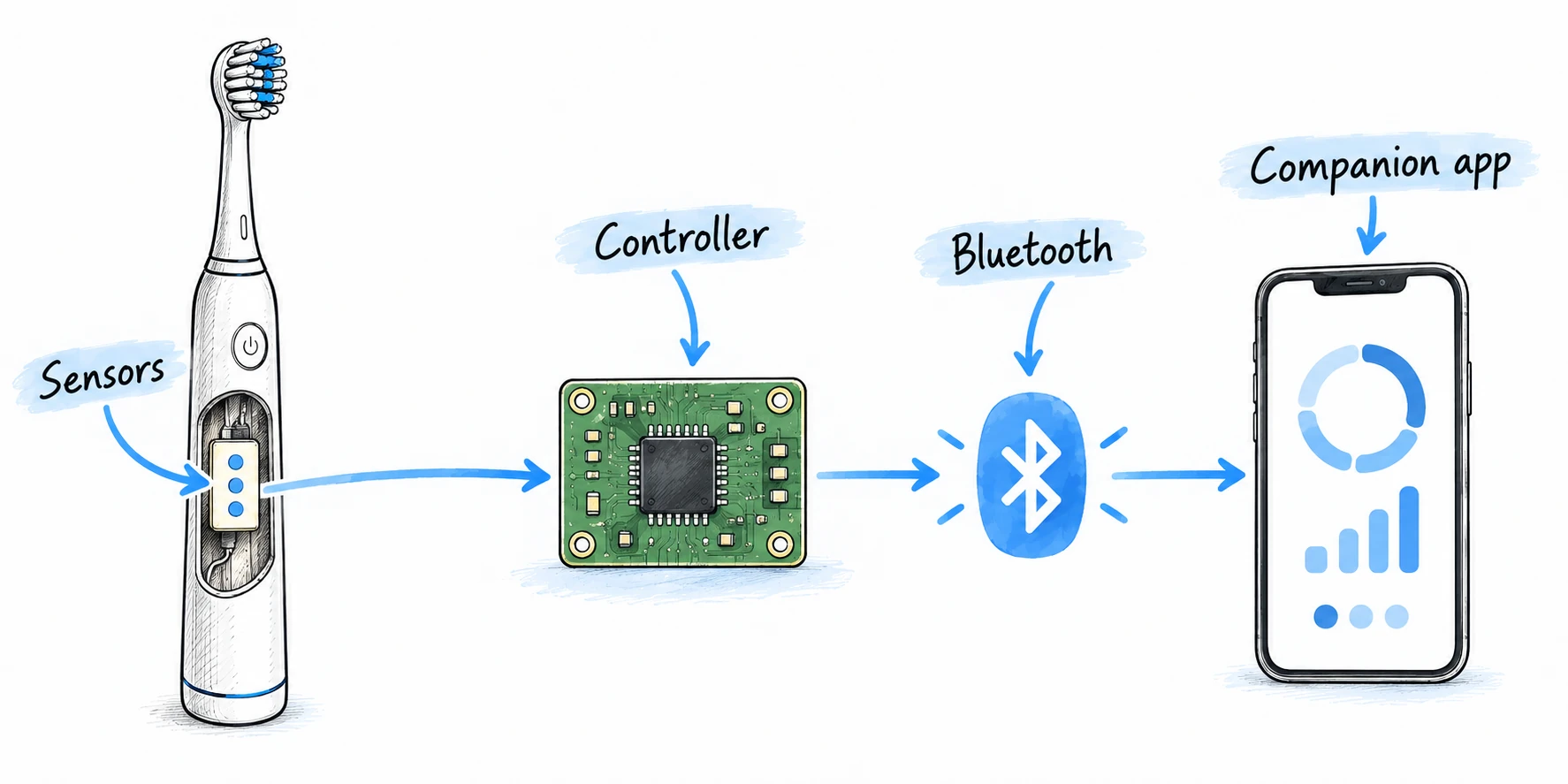
- Smart toothbrushes add Bluetooth connectivity, sensors and a companion app. The underlying cleaning platform may be shared with a non-connected model.
- For OEM buyers, the motor, battery, electronics, brush head, housing, finishing and packaging all affect the bill of materials (BOM) and the final quotation.
- Relish Technology’s Vibrosonic™ platform offers up to 48,000 strokes/min with a dual-harmonic drive approach. Select the operating profile to suit the product specification.
The Three Core Technologies of Electric Toothbrushes
This guide compares sonic, oscillating-rotating and combination platforms. Their drive mechanisms influence head movement, noise, power consumption and cost, while the complete product design determines the final performance.
1. Sonic Technology: Magnetic Coil Vibration
Many sonic toothbrushes use an electromagnetic drive system to create rapid movement at the brush head. The motor’s magnetic circuit, suspension and output shaft determine whether that movement is linear, angular or a combination. “Sonic” describes the operating approach; it does not mean every model uses the same voice-coil or linear resonant actuator.
In an electromagnetic drive, controlled current in the coil produces a changing magnetic force that moves the drive assembly. The shaft transfers that motion to the brush head. Keep frequency and movement counts separate: 120–240 Hz equals 7,200–14,400 complete cycles per minute. If each direction is counted as one stroke, that is 14,400–28,800 strokes/min. Compare models only after checking how the manufacturer counts strokes.
Rapid brush-head movement also agitates toothpaste and saliva near the bristles. This fluid movement is distinct from demonstrated clinical cleaning at a fixed distance. Guide the bristles over the tooth surfaces and gumline; a stated movement rate alone does not establish cleaning depth or a gingivitis-reduction result.
Relish Technology’s proprietary Vibrosonic™ platform uses a controlled secondary harmonic layer alongside the main drive profile. For an OEM project, our engineers can help specify the movement rate, amplitude and brushing modes to achieve the intended brushing feel and product positioning.
2. Rotating-Oscillating Technology: DC Gear Motor
Oscillating-rotating toothbrushes move the brush head back and forth through an angle. In a geared design, a small DC motor drives a transmission that converts shaft rotation into this alternating motion. Other architectures use different actuators or linkages, so the actual drive system should be checked in the product specification.
Head movement is described by its oscillation rate and angular travel. An advertised 5,000–10,000 movements per minute should not be labelled “rpm” unless it measures complete revolutions. Cleaning relies on bristle contact, with the alternating movement helping the user clean tooth surfaces.
A geared DC drive can be a cost-effective option for an OEM project. Compare the complete transmission, noise, durability, head compatibility and assembly requirements with the sonic alternatives; motor price alone does not determine the best platform.
3. Combination / Rotasonic Technology
Understanding how electric toothbrushes work with combination technology reveals the Rotasonic™ approach. The third category is the combination or hybrid approach — devices that use both sonic vibration and rotating-oscillating action simultaneously. This is where Rotasonic™ technology, developed at Relish Technology, sits.
Rotasonic™ brings sonic vibration and oscillating-rotating action into a dual-action cleaning platform. The actuator and transmission configuration depends on the model. OEM buyers can work with our engineers to compare head movement, brushing feel, noise and cost against the target specification.
The Anatomy of an Electric Toothbrush
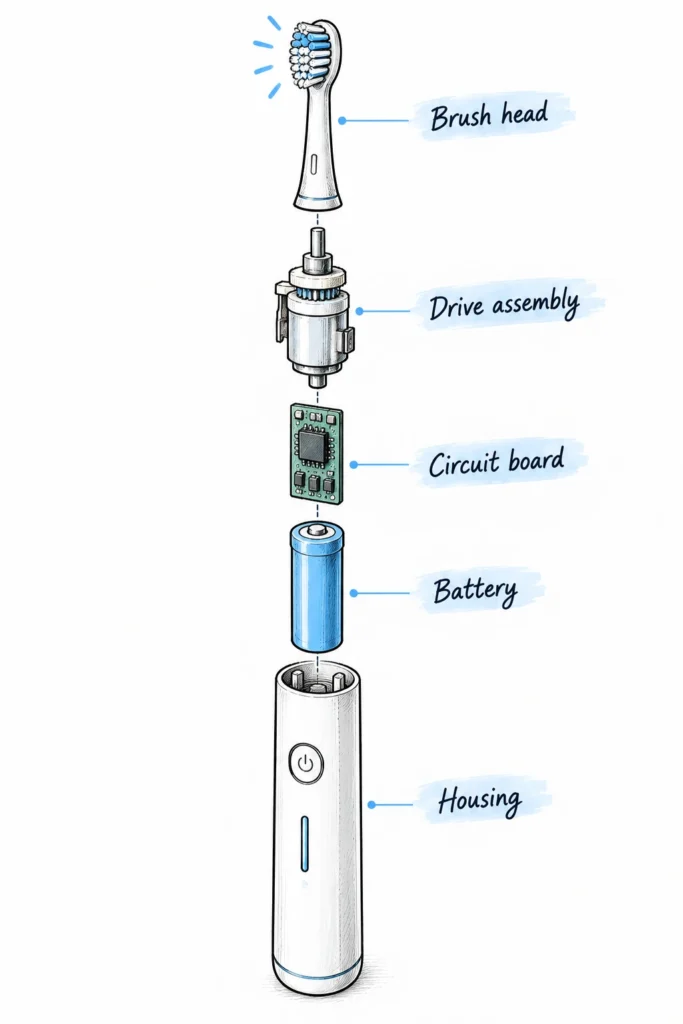
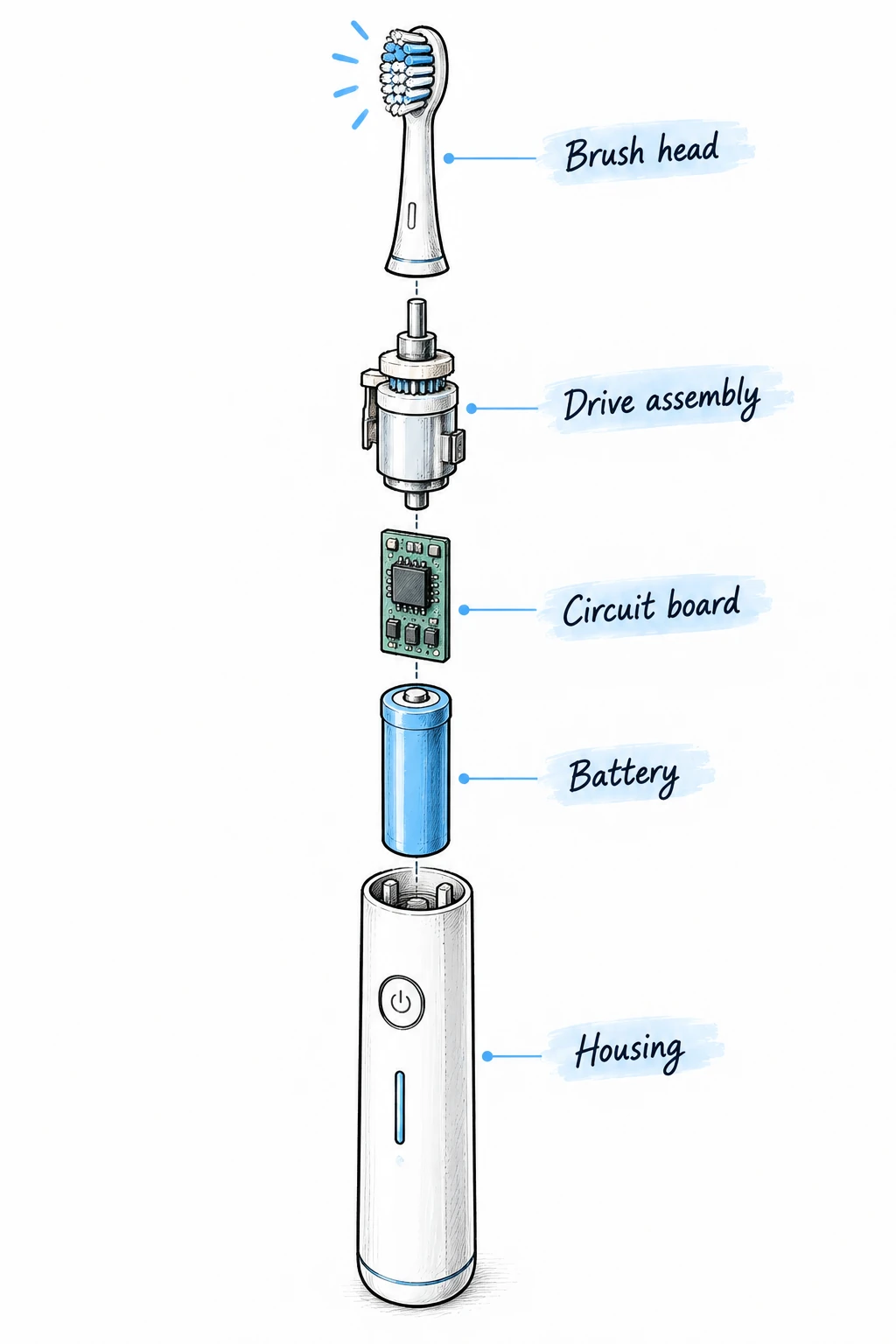
Beyond the core cleaning technology, every electric toothbrush contains a system of interconnected components that work together to deliver a reliable, safe, and user-friendly brushing experience. Understanding how electric toothbrushes work at the component level helps OEM buyers evaluate quality and cost trade-offs during product development. Here's a component-by-component breakdown.
Rechargeable Battery
Rechargeable models may use Li-ion or NiMH cells. The existing 600–2,000 mAh range is a product-planning example; compare cell voltage and energy in Wh as well as capacity. Runtime and cycle life depend on the cell, charging system, load and temperature.
Motor & Driver Circuit
The motor and driver circuit convert electrical power into brush-head movement. Electromagnetic and geared DC designs may require different power stages; an H-bridge is one possible arrangement.
PCB & Microcontroller
8–32 bit MCU manages brushing modes, timer, pressure sensor input, LED indicators, and BLE communication in smart models.
Pressure Sensor
Pressure detection may use a force sensor, a deflection mechanism or motor-load measurement. The controller compares the signal with a model-specific setting, then activates a warning or adjusts the motor.
Charging System
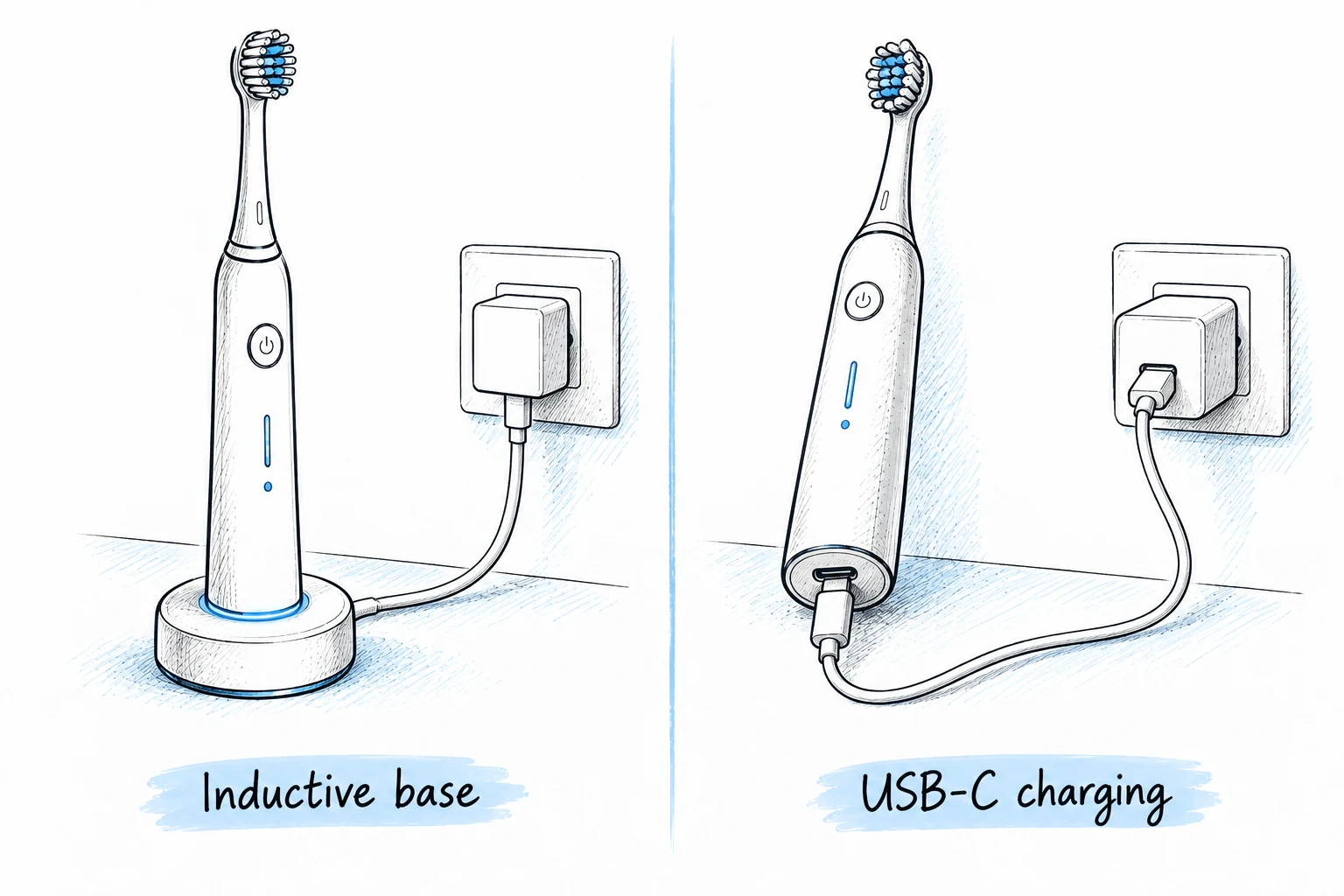
Charging may use a dedicated inductive base or a wired connection such as USB-C. The input rating, charging time and compatible charger depend on the design. An inductive base is not automatically Qi-compatible.
Brush Head & Drive Shaft
Replaceable head with nylon or PBT bristles. Connected to motor via stainless steel or nylon drive shaft. Click-fit or twist-lock attachment mechanism.
The PCB and Control System
The printed circuit board (PCB) carries the electronics that control modes, timing, indicators and optional sensors or connectivity. A 20–50 mm × 10–25 mm board is one layout example; dimensions depend on the handle and circuit design. Typical functions include:
- Microcontroller (MCU): An 8-bit or 32-bit controller runs the firmware. Select the device for processing, memory, power and interface requirements; a Bluetooth SoC may also perform this role.
- Motor driver: A power stage controlled by the MCU supplies the waveform and current required by the selected motor. The circuit may use an H-bridge, depending on the drive architecture.
- Clock source: An internal oscillator or external crystal provides the controller’s timing reference. Some designs use a 32.768 kHz crystal for low-power timekeeping; the required clocks depend on the chosen controller.
- Pressure Sensor Interface: An analog-to-digital converter (ADC) channel that reads the voltage change from the pressure sensor
- LED Driver: Current-limiting resistor + transistor circuit controlling the mode indicator LEDs
- BLE SoC (smart models only): A Bluetooth Low Energy system-on-chip (Nordic nRF52832 or similar) that handles wireless communication with the companion app
- Charging and battery protection: Charging control, voltage monitoring, temperature checks and protection functions are selected for the cell chemistry and product design. They may be integrated or implemented with separate circuits.
Brushing Modes and the Quadrant Timer
One of the most valuable features of modern electric toothbrushes — from both a consumer and OEM design perspective — is the brushing mode system. How electric toothbrushes work with multiple modes depends on firmware-controlled frequency and amplitude profiles managed by the microcontroller. Each mode has a different frequency, amplitude, and timing profile, giving users flexibility for different oral care needs.
Common Brushing Modes
| Mode | Frequency | Amplitude | Duration | Intended Use |
|---|---|---|---|---|
| Clean | Full frequency (e.g., 40,000 spm) | Standard | 2 min | Daily use, all-around cleaning |
| White / Polish | Full + intermittent pulse | Higher | 2 min | Surface stain removal, coffee/tea drinkers |
| Sensitive | 60–70% of max frequency | Reduced | 2 min | Users who prefer a gentler brushing feel |
| Gum Care / Soft | 40–50% of max, pulsing | Low | 3 min | Gentle gumline brushing |
| Tongue Clean | Low frequency, steady | Light | 30 sec | Breath freshening, tongue coating |
| Whitening | Alternating high/low | Variable | 3 min | Enhanced stain removal cycles |
A quadrant timer gives a brief pause or signal every 30 seconds to prompt a change of brushing area. Four intervals support a two-minute session. This is a pacing aid; users still need to guide the brush over the inner, outer and chewing surfaces.
Battery Technology and Charging Systems
Battery selection affects handle weight, runtime, charging and cost. For an OEM project, compare the cell together with the motor load, standby consumption and charging circuit to match the target use pattern and retail positioning.
Lithium-Ion (Li-ion) vs Nickel-Metal Hydride (NiMH)
Li-ion cells are widely used in rechargeable toothbrush designs. Check the supplier’s cell drawing and datasheet for voltage, dimensions and capacity. Cylindrical format names are approximate: a 14500 cell is nominally about 14 mm × 50 mm, while 14450 denotes about 14 mm × 45 mm. Dimensions, terminal details and capacity must be confirmed for the selected cell. Key selection factors include:
- Energy density: Compare the selected cells in Wh/kg and Wh/litre; a fixed threefold advantage does not apply to every Li-ion and NiMH design.
- Self-discharge: Cell chemistry, temperature and storage conditions affect charge retention. Low-self-discharge NiMH cells are available, so compare the selected cells’ storage specifications.
- Charging habits: Li-ion cells can normally be topped up within the approved charging limits. Follow the cell supplier’s voltage, current and temperature requirements.
- Cycle life: A full-equivalent cycle is cumulative discharge equal to the cell’s rated capacity, not one brushing session. A 500-cycle rating must state the test conditions and retained-capacity criterion. Brushing frequency alone cannot convert that rating into years of service.
- Charging time: A 1–3 hour charge is possible on a design built for that rate. The battery, charger, thermal limits and power-management circuit determine the result, rather than the connector type alone.
NiMH remains an option where cost, cell availability and the established charging design fit the project. It still requires appropriate charge control and protection against damaging operating conditions. Low-self-discharge variants can retain charge well, and memory-effect behaviour should not be generalised from NiCd batteries.
Charging Systems: Inductive vs USB-C
Inductive charging transfers energy between coils in the base and handle. The receiver rectifies and regulates that energy to charge the battery. Removing an exposed charging connector can simplify sealing, but charging efficiency, alignment, heat and full-charge time must be evaluated for the selected design. A dedicated toothbrush base does not necessarily support the Qi standard.
USB-C charging provides a convenient wired connection. Specify the input voltage and current, supported power protocol, charger compatibility and charging time. USB-C does not itself guarantee USB Power Delivery or a 1–3 hour charge. The port, surrounding housing and any cover must form a tested sealing system.
Water Resistance: IPX7 and the Engineering Challenge
Water resistance depends on the complete enclosure and its seals. IPX7 addresses temporary immersion under defined test conditions, commonly described for a small device as 1 metre for 30 minutes. It does not establish protection against water jets, all shower conditions or indefinite immersion, and it does not automatically apply to the charger. Follow the product’s stated cleaning and charging instructions.
Potting and Ultrasonic Welding
Potting or encapsulation can protect selected electronics with a compatible epoxy or silicone material. It is one part of the sealing strategy alongside housing joints, shaft seals and charging interfaces. The existing USD 0.80–2.50 per-unit allowance is a planning example; material volume, curing, labour and repairability affect the final cost.
Ultrasonic welding can join compatible plastic housing parts using high-frequency mechanical vibration. Equipment in the 20–40 kHz range is one example. Joint geometry, material and process settings determine weld strength and sealing quality; verify both on the finished assembly.
For the brush head attachment area — the most mechanically stressed seal point — silicone O-rings or liquid gasket sealant are used. The drive shaft passes through this seal via a close-tolerance bushing, maintaining waterproofing while allowing rotational or linear motion.
Need Help Specifying Your Electric Toothbrush?
Curious how an electric toothbrush works for your brand? Our engineers can walk you through motor selection, waterproofing strategy, and BOM cost optimization for your target market.
Talk to Our Engineering TeamSmart Toothbrushes: Sensors, BLE, and App Connectivity
Smart toothbrushes combine a brushing platform with Bluetooth connectivity, optional sensors and companion software. A connected and non-connected model may share a motor or brush head, while other designs use different components. Specify the physical cleaning performance and the data functions separately.
Key Smart Features and Their Sensors
| Smart Feature | Sensor Used | Technical Detail |
|---|---|---|
| Brushing Duration | Real-time clock (MCU timer) | Built into MCU — no additional sensor needed |
| Pressure Detection | Force sensor, deflection sensing or motor-load measurement | Position and calibration depend on the sensing design |
| Position Detection | 6-axis IMU (accelerometer + gyroscope) | Estimates movement and brushing zones through a validated algorithm |
| Brush Head Wear | Usage timer or session counter; additional sensing if fitted | Prompts replacement based on use; does not directly measure every bristle’s condition |
| Battery Health | Fuel gauge IC (coulomb counter) | Estimates remaining charge; cycle and health data depend on the implementation |
| Bluetooth Pairing | Bluetooth Low Energy SoC | For example, a Nordic nRF52-series device; select for the required features |
A six-axis inertial measurement unit (IMU) combines a three-axis accelerometer and three-axis gyroscope. Software can use these signals to estimate brushing movement and mouth zones. Accuracy depends on sensor placement, calibration, the algorithm and user behaviour. Zone feedback is an estimate of brushing activity, rather than a direct measurement of plaque removal or oral health.
The OEM Perspective on Smart Toothbrush Costs
Smart functions add connectivity, sensing and software to a product that already uses electronic control. The existing USD 8–25 per-unit estimate is a planning allowance for additional hardware, not an app-development quotation. Check which components are already included in the base platform to avoid double-counting. Example budget items include:
- BLE SoC and antenna: USD 2.50–5.00 as a planning allowance. Nordic nRF52840 and Realtek RTL8762 are examples; suitability depends on the selected part and software requirements.
- Six-axis IMU: USD 1.50–4.00 as a planning allowance. Examples include TDK InvenSense ICM-42670 and Bosch Sensortec BMI270.
- Pressure sensing: USD 0.30–1.00 as a planning allowance; the sensing method and required calibration determine the actual cost.
- App development: An illustrative one-time budget of USD 30,000–150,000 for iOS and Android. Scope separately for maintenance, cloud services, privacy controls and operating-system updates.
- Additional PCB layers and components: USD 1.00–3.00 as a planning allowance; confirm overlap with the selected connectivity and sensor modules.
A USD 25–60 retail premium is a positioning example for a connected model. Assess the selling price alongside channel costs, software maintenance, returns and the complete product cost before estimating profitability.
UV Sanitizing Technology
A UV sanitizing base uses a separate UV-C light system to reduce microorganisms on exposed brush-head surfaces. Wavelength, dose, exposure time, lamp placement, shadows and the tested organism determine the result. A 254 nm lamp and a 5–10 minute cycle describe particular designs; they do not establish a universal 99.9% reduction for all bacteria and viruses. Use product-specific test results for performance claims, and prevent eye or skin exposure with an enclosed design and suitable interlocks.
UV-C sources may include low-pressure mercury lamps or UV-C LEDs. Compare wavelength, delivered dose, thermal management, service life, material compatibility and disposal requirements for the selected source. Lamp type alone does not determine which complete sanitizer is more effective or durable.
The existing USD 3.50–8.00 BOM allowance illustrates a UV-base option. The light source, enclosure, control system and safety interlocks affect cost and packaging size. Position the feature using the selected product’s tested performance.
Brush Heads: Bristle Science and Engineering
While the handle contains all the electronic intelligence, the brush head is where the cleaning actually happens. Understanding how electric toothbrushes work to deliver effective oral care requires knowing brush head engineering — bristle material, diameter, tuft configuration, and flexural properties all influence cleaning performance and user experience.
Bristle Materials
Brush-head performance depends on filament material, diameter, length, taper and tuft arrangement. Nylon 612 and PBT are material options; PBT is not automatically softer than nylon. Define the required brushing feel and inspect filament ends, tuft retention and mechanical performance against the applicable specification. ISO 20127:2025 covers physical properties of powered toothbrushes; its end-rounding requirements have exceptions for specified filament types, so a universal tip-radius rule is inappropriate.
Indicator Bristles
Colour-fading indicator bristles provide a visual replacement reminder. Fading depends on the filament treatment, brushing habits and exposure; it is not a precise three-month clock. The existing USD 0.05–0.15 per-head allowance is a planning example. Colour-treated or mixed-colour filaments do not inherently require two-material injection moulding. Follow the brush-head replacement instructions and replace sooner when the bristles are worn.
OEM Manufacturing: From Component Selection to Mass Production
Understanding how electric toothbrushes work from a manufacturing perspective is the foundation for making intelligent OEM sourcing decisions. Every technical choice — motor type, battery capacity, waterproofing method, smart sensor integration — has a direct, quantifiable impact on manufacturing cost, product quality, and retail positioning. Read our electric toothbrush OEM guide for a deeper dive into the manufacturing pathway.
At Relish Technology, motor engineering, electronics, sealing and app connectivity inform the development process. The following 28-week schedule illustrates a new-product project; an existing platform or a more complex programme will follow a different timeline.
- Concept validation (weeks 1–4): Define product specification — technology type (sonic/rotary/Rotasonic), target markets, required certifications, price tier. This drives all subsequent decisions.
- Prototype development (weeks 5–12): Build functional prototypes of handle, electronics, and brush head. Test motor performance, battery runtime, waterproofing, and PCB firmware. Typical prototype quantity: 3–10 units.
- Pre-production validation (weeks 13–20): Engineering validation testing (EVT) and design validation testing (DVT) — IPX7 immersion testing, drop testing, EMC testing, battery cycle testing, and regulatory pre-compliance testing.
- Mass production preparation (weeks 21–28): Tooling completion, first article inspection, pilot run (100–300 units), and quality system setup including AQL sampling plans.
- Production and shipment: Full production combines in-process checks, functional testing and agreed sampling inspections. Define defect categories and acceptance criteria in the quality agreement. Safety-critical defects require a zero-acceptance approach; an AQL value must not be presented as permission to ship a known critical defect. Tour our manufacturing facilities to see our production capabilities firsthand.
How to Choose the Right Technology for Your Brand
With the technical foundation established, here is a decision framework for brand owners and procurement managers selecting an OEM partner for electric toothbrush development. Understanding how electric toothbrushes work across all three technology categories — sonic, rotating-oscillating, and Rotasonic™ — enables more informed conversations with manufacturers and more accurate product specifications.
| Criteria | Sonic | Rotating-Oscillating | Rotasonic™ (Combination) |
|---|---|---|---|
| BOM Cost Range | $12–$28 | $8–$20 | $18–$38 |
| Retail Price Positioning | Mid to Premium | Entry to Mid | Premium to Ultra-Premium |
| Noise Level | Depends on drive, mounting and operating mode | Depends on drive, gearing and operating mode | Depends on the combined drive design |
| Cleaning Action | Bristle movement and nearby liquid agitation | Alternating angular movement with bristle contact | Combined sonic and oscillating-rotating movement |
| Best Market Fit | Premium consumer brands | Value brands, Amazon FBA | Brands seeking a dual-action platform |
| Smart Feature Suitability | Excellent | Good | Excellent |
Ready to Start Your OEM Electric Toothbrush Project?
Whether you're launching a new brand, expanding an existing line, or sourcing for retail procurement — Relish Technology's engineering team can help you select the right technology platform and navigate the full journey from concept to mass production.
Talk to Our Engineering TeamISO 13485 · FDA/CE Compliance Support · 15+ Years OEM Experience · 20,000 m² Manufacturing Facility
Frequently Asked Questions
Answers to common questions about electric toothbrush mechanisms, components, charging, sensors and OEM product development.
References & Sources
- American Dental Association. Toothbrushes. Toothbrushes.
- International Electrotechnical Commission. IEC 60335-2-52:2021 — Particular requirements for oral hygiene appliances. IEC 60335-2-52:2021 — Particular requirements for oral hygiene appliances.
- International Organization for Standardization. ISO 20127:2025 — Dentistry — Physical properties of powered toothbrushes. ISO 20127:2025 — Dentistry — Physical properties of powered toothbrushes.
- U.S. Food and Drug Administration. Powered toothbrush classification: JEQ, 21 CFR 872.6865, Class I; 510(k)-exempt within applicable limits. Powered toothbrush classification: JEQ, 21 CFR 872.6865, Class I; 510(k)-exempt within applicable limits.
- Nordic Semiconductor. nRF52840 Product Specification. nRF52840 Product Specification.
- Bosch Sensortec. BMI270 inertial measurement unit. BMI270 inertial measurement unit.