











Come funzionano gli spazzolini elettrici:
Guida Tecnica Completa 2026
Explore the motors, batteries, electronics and sealing systems inside electric toothbrushes, with practical engineering choices for OEM product development.
Runtime examples assume two brushing sessions of two minutes each per day. Brush movement rates and battery performance depend on the model and operating mode.
Gli spazzolini elettrici sono macchine ingannevolmente complesse. Al loro interno, combinano motori di precisione, sistemi di controllo intelligenti, fonti di alimentazione ricaricabili e design ergonomico in un dispositivo che sta nel palmo della mano — eppure esegue decine di migliaia di movimenti meccanici precisi per ogni sessione di spazzolatura. Questa guida analizza esattamente come funzionano gli spazzolini elettrici, dalla fisica della vibrazione sonica alle decisioni ingegneristiche che modellano la produzione OEM.
Punti chiave
- The three platforms covered here are sonico, oscillating-rotating e combination systems such as Relish Technology’s Rotasonic™. Each offers different drive mechanisms and product development options.
- Sonic toothbrushes clean through il contatto delle setole and agitate the liquid around the brush head. Effective cleaning still depends on reaching tooth surfaces with the bristles.
- The motor, PCB and battery sit inside a sealed handle. IPX7 applies to the tested enclosure, rather than separately certifying every internal component.
- La tecnologia della batteria (Li-ion vs NiMH) influisce direttamente su peso, autonomia e tempo di ricarica, tutti punti decisionali critici per l'OEM
- Pressure feedback can use force sensing, mechanical deflection or motor-load measurement to alert users when they exceed a model-specific brushing-pressure setting.
- Gli spazzolini intelligenti aggiungono Bluetooth connectivity, sensors and a companion app. The underlying cleaning platform may be shared with a non-connected model.
- For OEM buyers, the motor, battery, electronics, brush head, housing, finishing and packaging all affect the bill of materials (BOM) and the final quotation.
- Relish Technology’s Vibrosonic™ di Relish Technology offers up to 000 colpi/min with a dual-harmonic drive approach. Select the operating profile to suit the product specification.
Le Tre Tecnologie Fondamentali degli Spazzolini Elettrici
This guide compares sonic, oscillating-rotating and combination platforms. Their drive mechanisms influence head movement, noise, power consumption and cost, while the complete product design determines the final performance.
Tecnologia Sonica: Vibrazione a Bobina Magnetica
Many sonic toothbrushes use an electromagnetic drive system to create rapid movement at the brush head. The motor’s magnetic circuit, suspension and output shaft determine whether that movement is linear, angular or a combination. “Sonic” describes the operating approach; it does not mean every model uses the same voice-coil or linear resonant actuator.
In an electromagnetic drive, controlled current in the coil produces a changing magnetic force that moves the drive assembly. The shaft transfers that motion to the brush head. Keep frequency and movement counts separate: 120–240 Hz equals 7,200–14,400 complete cycles per minute. If each direction is counted as one stroke, that is 14,400–28,800 strokes/min. Compare models only after checking how the manufacturer counts strokes.
Rapid brush-head movement also agitates toothpaste and saliva near the bristles. This fluid movement is distinct from demonstrated clinical cleaning at a fixed distance. Guide the bristles over the tooth surfaces and gumline; a stated movement rate alone does not establish cleaning depth or a gingivitis-reduction result.
Relish Technology’s proprietary Vibrosonic™ di Relish Technology uses a controlled secondary harmonic layer alongside the main drive profile. For an OEM project, our engineers can help specify the movement rate, amplitude and brushing modes to achieve the intended brushing feel and product positioning.
Tecnologia Rotante-Oscillante: Motore a Ingranaggi DC
Oscillating-rotating toothbrushes move the brush head back and forth through an angle. In a geared design, a small Motore a corrente continua drives a transmission that converts shaft rotation into this alternating motion. Other architectures use different actuators or linkages, so the actual drive system should be checked in the product specification.
Head movement is described by its oscillation rate and angular travel. An advertised 5,000–10,000 movements per minute should not be labelled “rpm” unless it measures complete revolutions. Cleaning relies on il contatto delle setole, with the alternating movement helping the user clean tooth surfaces.
A geared DC drive can be a cost-effective option for an OEM project. Compare the complete transmission, noise, durability, head compatibility and assembly requirements with the sonic alternatives; motor price alone does not determine the best platform.
Tecnologia Combinata / Rotasonic
Comprendere come funzionano gli spazzolini elettrici con tecnologia combinata rivela l'approccio Rotasonic™. La terza categoria è l'approccio combinato o ibrido — dispositivi che utilizzano simultaneamente vibrazione sonica e azione rotante-oscillante. È qui che si colloca la Rotasonic™ tecnologia, sviluppata da Relish Technology.
Rotasonic™ brings sonic vibration and oscillating-rotating action into a dual-action cleaning platform. The actuator and transmission configuration depends on the model. OEM buyers can work with our engineers to compare head movement, brushing feel, noise and cost against the target specification.
L'Anatomia di uno Spazzolino Elettrico
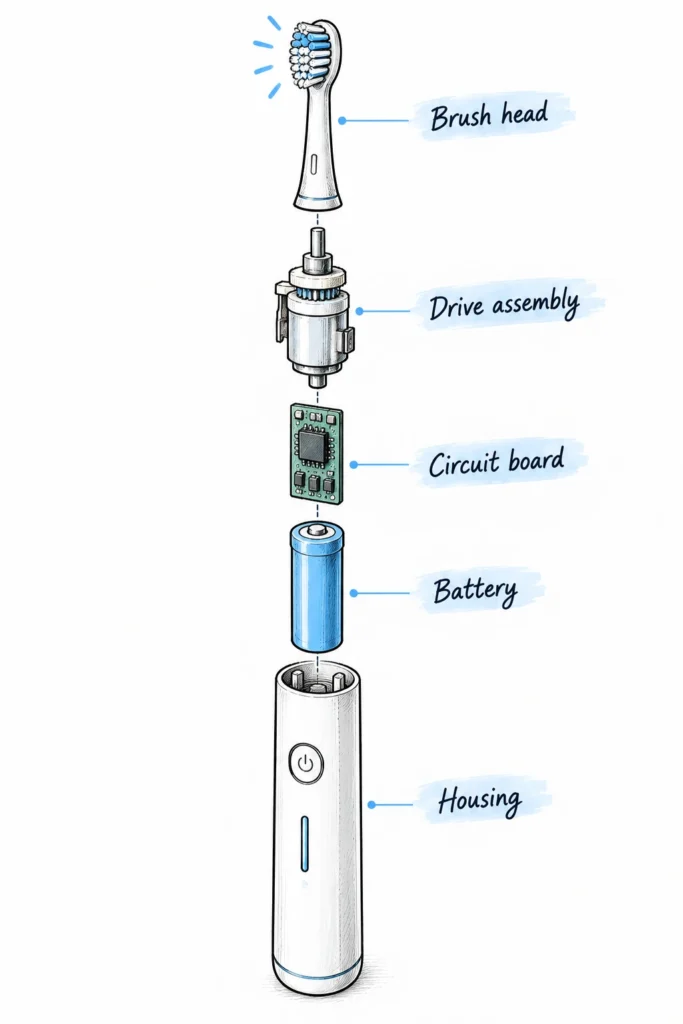
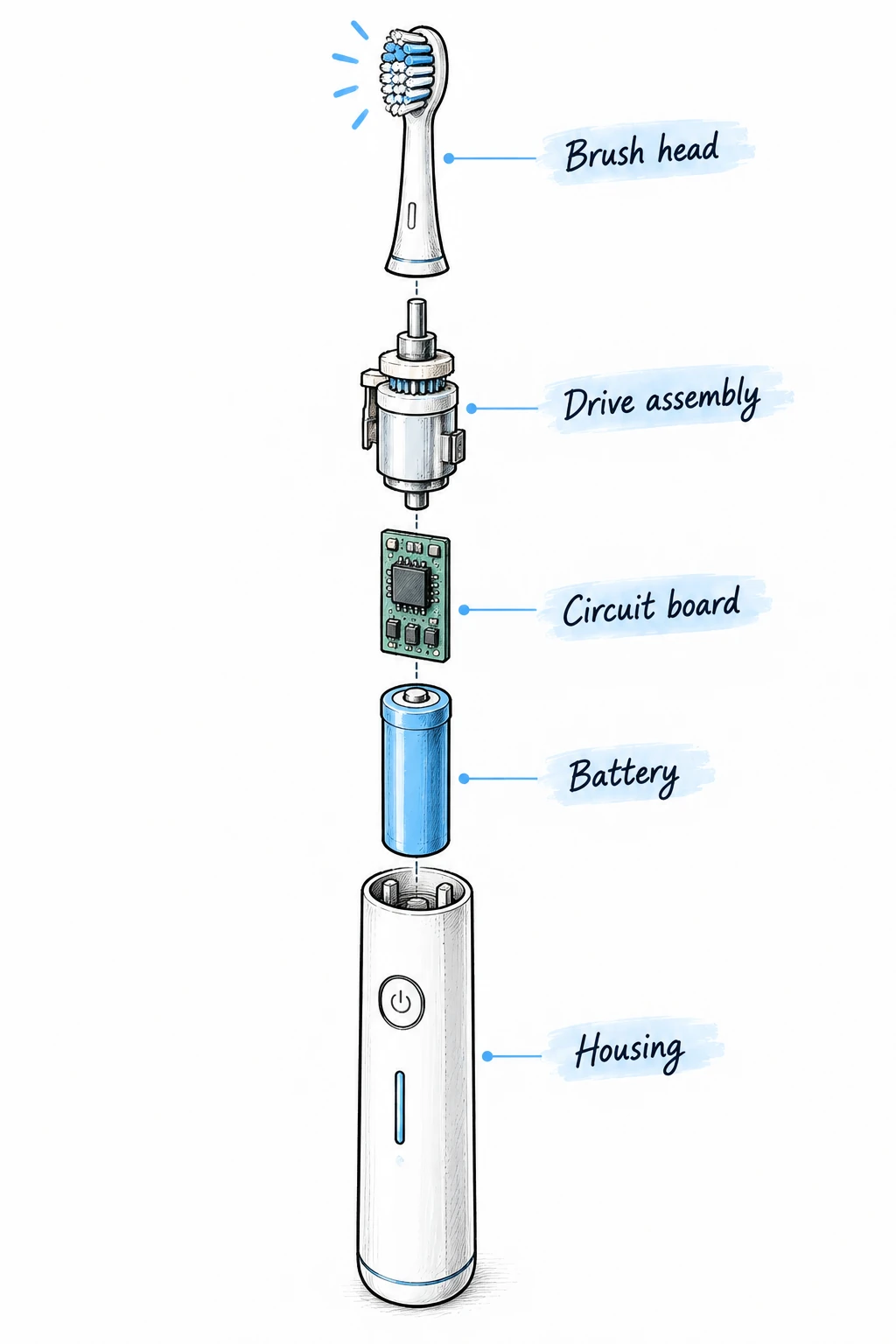
Oltre alla tecnologia di pulizia principale, ogni spazzolino elettrico contiene un sistema di componenti interconnessi che lavorano insieme per offrire un'esperienza di spazzolamento affidabile, sicura e facile da usare. Comprendere come funzionano gli spazzolini elettrici a livello di componenti aiuta gli acquirenti OEM a valutare qualità e compromessi di costo durante lo sviluppo del prodotto. Ecco una suddivisione componente per componente.
Batteria Ricaricabile
Rechargeable models may use Li-ion or NiMH cells. The existing 600–2,000 mAh range is a product-planning example; compare cell voltage and energy in Wh as well as capacity. Runtime and cycle life depend on the cell, charging system, load and temperature.
Motore e Circuito di Pilotaggio
The motor and driver circuit convert electrical power into brush-head movement. Electromagnetic and geared DC designs may require different power stages; an H-bridge is one possible arrangement.
PCB e Microcontrollore
MCU a 8–32 bit gestisce le modalità di spazzolamento, timer, input del sensore di pressione, indicatori LED e comunicazione BLE nei modelli smart.
Sensore di pressione
Pressure detection may use a force sensor, a deflection mechanism or motor-load measurement. The controller compares the signal with a model-specific setting, then activates a warning or adjusts the motor.
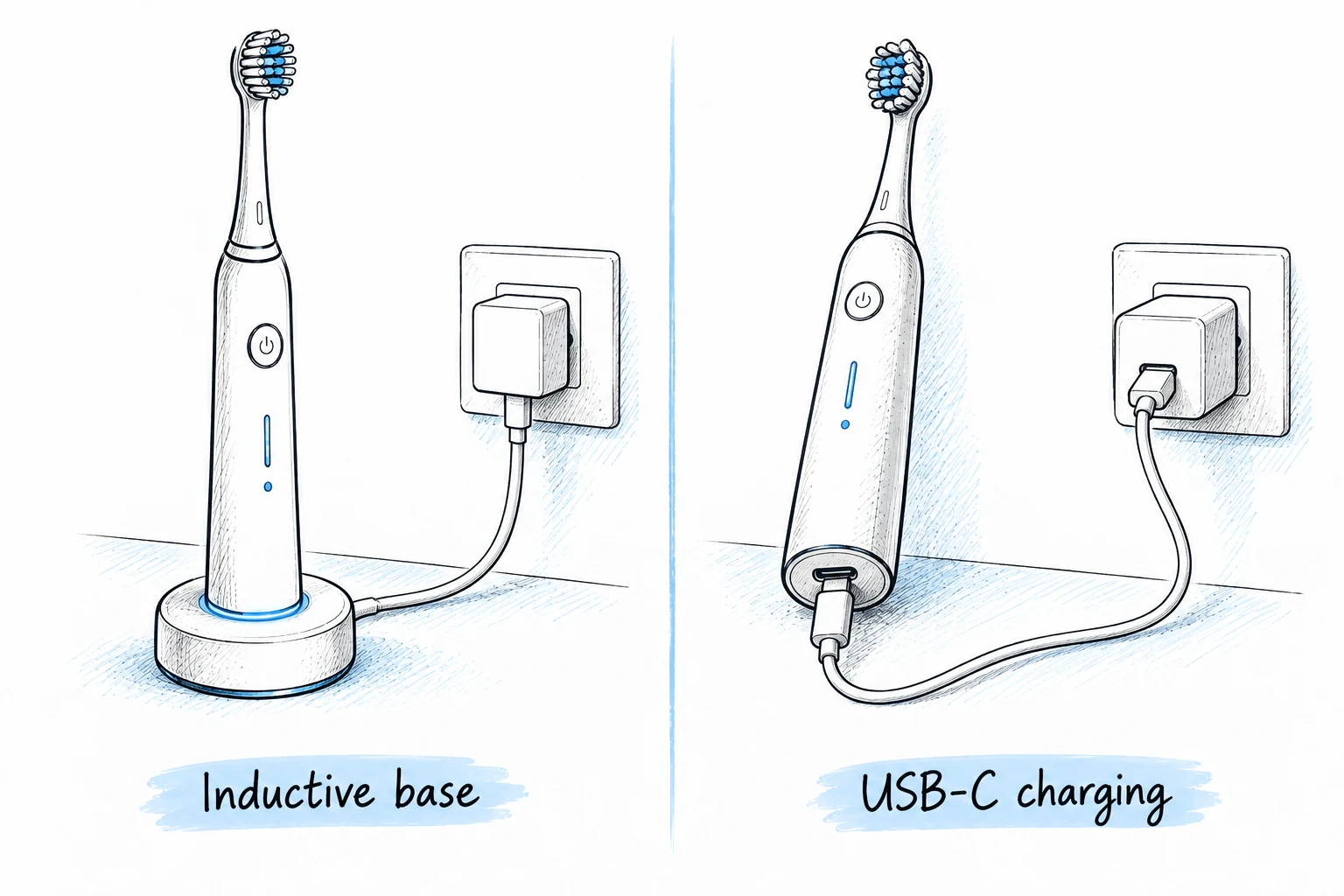
Sistema di ricarica
Charging may use a dedicated inductive base or a wired connection such as USB-C. The input rating, charging time and compatible charger depend on the design. An inductive base is not automatically Qi-compatible.
Testina e Albero di Trasmissione
Testina sostituibile con setole in nylon o PBT. Collegata al motore tramite albero di trasmissione in acciaio inossidabile o nylon. Meccanismo di attacco a scatto o a torsione.
Il PCB e il Sistema di Controllo
Il printed circuit board (PCB) carries the electronics that control modes, timing, indicators and optional sensors or connectivity. A 20–50 mm × 10–25 mm board is one layout example; dimensions depend on the handle and circuit design. Typical functions include:
- Microcontroller (MCU): An 8-bit or 32-bit controller runs the firmware. Select the device for processing, memory, power and interface requirements; a Bluetooth SoC may also perform this role.
- Driver motore: A power stage controlled by the MCU supplies the waveform and current required by the selected motor. The circuit may use an H-bridge, depending on the drive architecture.
- Clock source: An internal oscillator or external crystal provides the controller’s timing reference. Some designs use a 32.768 kHz crystal for low-power timekeeping; the required clocks depend on the chosen controller.
- Interfaccia del Sensore di Pressione: Un canale convertitore analogico-digitale (ADC) che legge la variazione di tensione dal sensore di pressione
- Driver LED: Resistore limitatore di corrente + circuito a transistor che controlla i LED indicatori di modalità
- SoC BLE (solo modelli smart): Un system-on-chip Bluetooth Low Energy (Nordic nRF52832 o simile) che gestisce la comunicazione wireless con l'app companion
- Charging and battery protection: Charging control, voltage monitoring, temperature checks and protection functions are selected for the cell chemistry and product design. They may be integrated or implemented with separate circuits.
Modalità di Spazzolamento e Timer a Quadranti
Una delle caratteristiche più preziose degli spazzolini elettrici moderni — sia dal punto di vista del consumatore che della progettazione OEM — è il sistema di modalità di spazzolamento. Il funzionamento degli spazzolini elettrici con più modalità dipende dai profili di frequenza e ampiezza controllati dal firmware e gestiti dal microcontrollore. Ogni modalità ha un diverso profilo di frequenza, ampiezza e temporizzazione, offrendo agli utenti flessibilità per diverse esigenze di cura orale.
Modalità di spazzolamento comuni
| Modalità | Frequenza | Ampiezza | Durata | Intended Use |
|---|---|---|---|---|
| Pulizia | Frequenza piena (es., 40.000 spm) | Standard | 2 min | Uso quotidiano, pulizia completa |
| Bianco / Lucidante | Piena + impulso intermittente | Più alto | 2 min | Rimozione macchie superficiali, consumatori di caffè/tè |
| Sensibile | 60–70% della frequenza massima | Ridotta | 2 min | Users who prefer a gentler brushing feel |
| Cura gengive / Delicata | 40–50% della massima, pulsante | Basso | 3 min | Gentle gumline brushing |
| Pulizia lingua | Bassa frequenza, costante | Leggera | 30 sec | Alito fresco, rivestimento linguale |
| Sbiancante | Alternanza alta/bassa | Variabile | 3 min | Cicli potenziati di rimozione macchie |
A timer a quadranti gives a brief pause or signal every 30 seconds to prompt a change of brushing area. Four intervals support a two-minute session. This is a pacing aid; users still need to guide the brush over the inner, outer and chewing surfaces.
Tecnologia della batteria e sistemi di ricarica
Battery selection affects handle weight, runtime, charging and cost. For an OEM project, compare the cell together with the motor load, standby consumption and charging circuit to match the target use pattern and retail positioning.
Ioni di Litio (Li-ion) vs Nichel-Metallo Idruro (NiMH)
Li-ion cells are widely used in rechargeable toothbrush designs. Check the supplier’s cell drawing and datasheet for voltage, dimensions and capacity. Cylindrical format names are approximate: a 14500 cell is nominally about 14 mm × 50 mm, while 14450 denotes about 14 mm × 45 mm. Dimensions, terminal details and capacity must be confirmed for the selected cell. Key selection factors include:
- Energy density: Compare the selected cells in Wh/kg and Wh/litre; a fixed threefold advantage does not apply to every Li-ion and NiMH design.
- Self-discharge: Cell chemistry, temperature and storage conditions affect charge retention. Low-self-discharge NiMH cells are available, so compare the selected cells’ storage specifications.
- Charging habits: Li-ion cells can normally be topped up within the approved charging limits. Follow the cell supplier’s voltage, current and temperature requirements.
- Cycle life: A full-equivalent cycle is cumulative discharge equal to the cell’s rated capacity, not one brushing session. A 500-cycle rating must state the test conditions and retained-capacity criterion. Brushing frequency alone cannot convert that rating into years of service.
- Charging time: A 1–3 hour charge is possible on a design built for that rate. The battery, charger, thermal limits and power-management circuit determine the result, rather than the connector type alone.
NiMH remains an option where cost, cell availability and the established charging design fit the project. It still requires appropriate charge control and protection against damaging operating conditions. Low-self-discharge variants can retain charge well, and memory-effect behaviour should not be generalised from NiCd batteries.
Sistemi di ricarica: Induttivo vs USB-C
Inductive charging transfers energy between coils in the base and handle. The receiver rectifies and regulates that energy to charge the battery. Removing an exposed charging connector can simplify sealing, but charging efficiency, alignment, heat and full-charge time must be evaluated for the selected design. A dedicated toothbrush base does not necessarily support the Qi standard.
USB-C charging provides a convenient wired connection. Specify the input voltage and current, supported power protocol, charger compatibility and charging time. USB-C does not itself guarantee USB Power Delivery or a 1–3 hour charge. The port, surrounding housing and any cover must form a tested sealing system.
Resistenza all'acqua: IPX7 e la sfida ingegneristica
Water resistance depends on the complete enclosure and its seals. IPX7 addresses temporary immersion under defined test conditions, commonly described for a small device as 1 metre for 30 minutes. It does not establish protection against water jets, all shower conditions or indefinite immersion, and it does not automatically apply to the charger. Follow the product’s stated cleaning and charging instructions.
Incapsulamento e saldatura a ultrasuoni
Potting or encapsulation can protect selected electronics with a compatible epoxy or silicone material. It is one part of the sealing strategy alongside housing joints, shaft seals and charging interfaces. The existing USD 0.80–2.50 per-unit allowance is a planning example; material volume, curing, labour and repairability affect the final cost.
Saldatura a ultrasuoni can join compatible plastic housing parts using high-frequency mechanical vibration. Equipment in the 20–40 kHz range is one example. Joint geometry, material and process settings determine weld strength and sealing quality; verify both on the finished assembly.
Per l'area di attacco della testina dello spazzolino — il punto di tenuta più sollecitato meccanicamente — vengono utilizzati O-ring in silicone o sigillante liquido per guarnizioni. L'albero di trasmissione passa attraverso questa tenuta tramite una boccola a tolleranza stretta, mantenendo l'impermeabilità consentendo al contempo il movimento rotatorio o lineare.
Hai bisogno di aiuto per specificare il tuo spazzolino elettrico?
Sei curioso di sapere come funziona uno spazzolino elettrico per il tuo marchio? I nostri ingegneri possono guidarti nella scelta del motore, nella strategia di impermeabilizzazione e nell'ottimizzazione dei costi del BOM per il tuo mercato di riferimento.
Parla con il Nostro Team di IngegneriaSpazzolini intelligenti: sensori, BLE e connettività dell'app
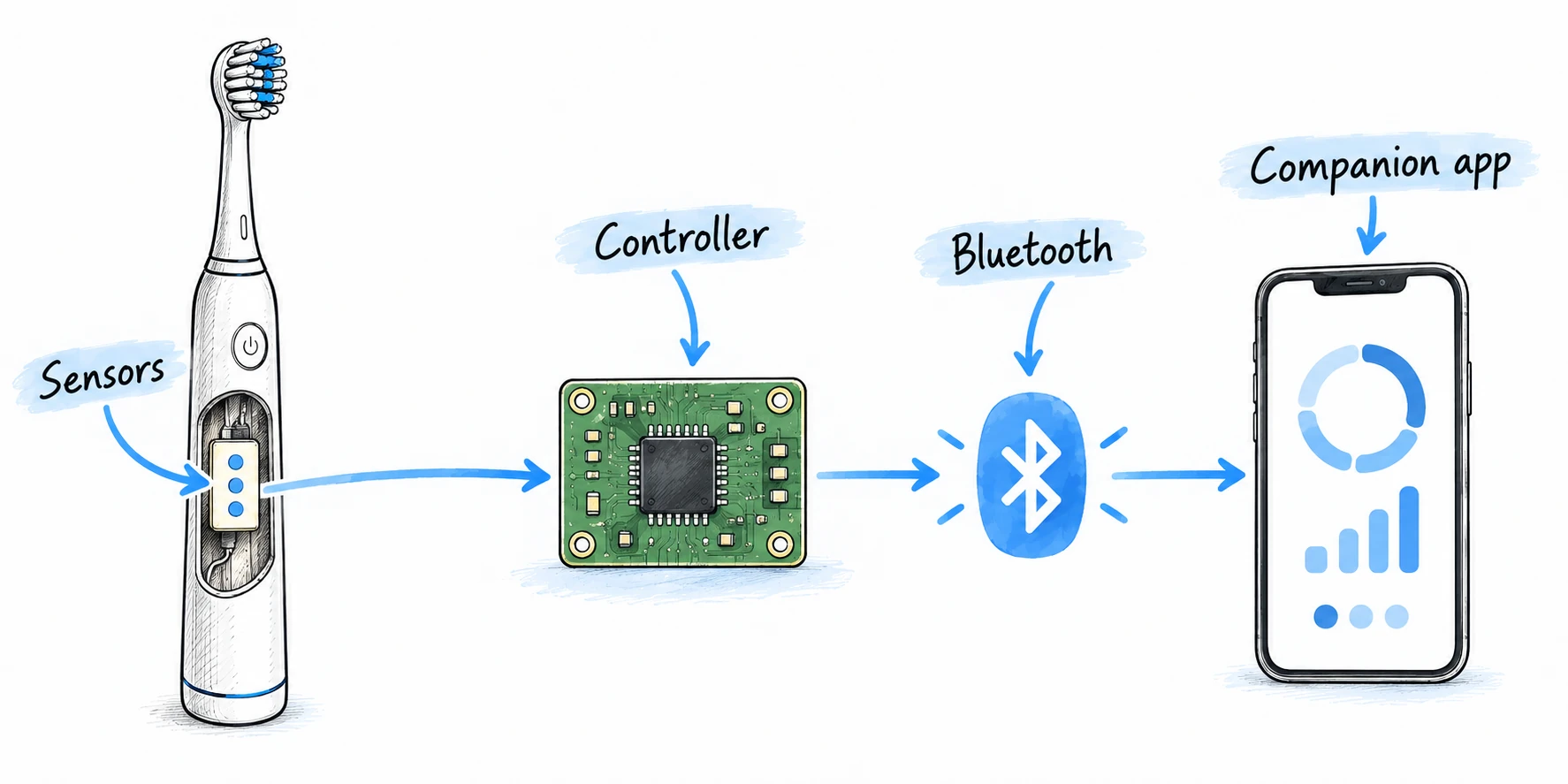
Smart toothbrushes combine a brushing platform with Connettività Bluetooth, optional sensors and companion software. A connected and non-connected model may share a motor or brush head, while other designs use different components. Specify the physical cleaning performance and the data functions separately.
Caratteristiche intelligenti chiave e relativi sensori
| Funzione intelligente | Sensore utilizzato | Dettaglio tecnico |
|---|---|---|
| Durata della spazzolatura | Orologio in tempo reale (timer MCU) | Integrato nell'MCU — nessun sensore aggiuntivo necessario |
| Rilevamento della pressione | Force sensor, deflection sensing or motor-load measurement | Position and calibration depend on the sensing design |
| Rilevamento della posizione | IMU a 6 assi (accelerometro + giroscopio) | Estimates movement and brushing zones through a validated algorithm |
| Usura della testina | Usage timer or session counter; additional sensing if fitted | Prompts replacement based on use; does not directly measure every bristle’s condition |
| Stato della batteria | IC del misuratore di carica (contatore di Coulomb) | Estimates remaining charge; cycle and health data depend on the implementation |
| Abbinamento Bluetooth | Bluetooth Low Energy SoC | For example, a Nordic nRF52-series device; select for the required features |
A six-axis inertial measurement unit (IMU) combines a three-axis accelerometer and three-axis gyroscope. Software can use these signals to estimate brushing movement and mouth zones. Accuracy depends on sensor placement, calibration, the algorithm and user behaviour. Zone feedback is an estimate of brushing activity, rather than a direct measurement of plaque removal or oral health.
La prospettiva OEM sui costi degli spazzolini intelligenti
Smart functions add connectivity, sensing and software to a product that already uses electronic control. The existing USD 8–25 per-unit estimate is a planning allowance for additional hardware, not an app-development quotation. Check which components are already included in the base platform to avoid double-counting. Example budget items include:
- BLE SoC and antenna: USD 2.50–5.00 as a planning allowance. Nordic nRF52840 and Realtek RTL8762 are examples; suitability depends on the selected part and software requirements.
- Six-axis IMU: USD 1.50–4.00 as a planning allowance. Examples include TDK InvenSense ICM-42670 and Bosch Sensortec BMI270.
- Pressure sensing: USD 0.30–1.00 as a planning allowance; the sensing method and required calibration determine the actual cost.
- App development: An illustrative one-time budget of USD 30,000–150,000 for iOS and Android. Scope separately for maintenance, cloud services, privacy controls and operating-system updates.
- Additional PCB layers and components: USD 1.00–3.00 as a planning allowance; confirm overlap with the selected connectivity and sensor modules.
A USD 25–60 retail premium is a positioning example for a connected model. Assess the selling price alongside channel costs, software maintenance, returns and the complete product cost before estimating profitability.
Tecnologia di Sanificazione UV
A UV sanitizing base uses a separate UV-C light system to reduce microorganisms on exposed brush-head surfaces. Wavelength, dose, exposure time, lamp placement, shadows and the tested organism determine the result. A 254 nm lamp and a 5–10 minute cycle describe particular designs; they do not establish a universal 99.9% reduction for all bacteria and viruses. Use product-specific test results for performance claims, and prevent eye or skin exposure with an enclosed design and suitable interlocks.
UV-C sources may include low-pressure mercury lamps or UV-C LEDs. Compare wavelength, delivered dose, thermal management, service life, material compatibility and disposal requirements for the selected source. Lamp type alone does not determine which complete sanitizer is more effective or durable.
The existing USD 3.50–8.00 BOM allowance illustrates a UV-base option. The light source, enclosure, control system and safety interlocks affect cost and packaging size. Position the feature using the selected product’s tested performance.
Testine: Scienza e Ingegneria delle Setole
Mentre il manico contiene tutta l'intelligenza elettronica, è la testina dove avviene effettivamente la pulizia. Comprendere come funzionano gli spazzolini elettrici per fornire un'efficace cura orale richiede la conoscenza dell'ingegneria delle testine — materiale delle setole, diametro, configurazione dei ciuffi e proprietà di flessione influenzano tutti le prestazioni di pulizia e l'esperienza utente.
Materiali delle Setole
Brush-head performance depends on filament material, diameter, length, taper and tuft arrangement. Nylon 612 and PBT are material options; PBT is not automatically softer than nylon. Define the required brushing feel and inspect filament ends, tuft retention and mechanical performance against the applicable specification. ISO 20127:2025 covers physical properties of powered toothbrushes; its end-rounding requirements have exceptions for specified filament types, so a universal tip-radius rule is inappropriate.
Setole Indicatrici
Colour-fading indicator bristles provide a visual replacement reminder. Fading depends on the filament treatment, brushing habits and exposure; it is not a precise three-month clock. The existing USD 0.05–0.15 per-head allowance is a planning example. Colour-treated or mixed-colour filaments do not inherently require two-material injection moulding. Follow the brush-head replacement instructions and replace sooner when the bristles are worn.
Produzione OEM: Dalla Selezione dei Componenti alla Produzione di Massa
Comprendere come funzionano gli spazzolini elettrici da una prospettiva produttiva è il fondamento per prendere decisioni intelligenti di approvvigionamento OEM. Ogni scelta tecnica — tipo di motore, capacità della batteria, metodo di impermeabilizzazione, integrazione di sensori smart — ha un impatto diretto e quantificabile sul costo di produzione, sulla qualità del prodotto e sul posizionamento al dettaglio. Consultate la nostra guida OEM agli spazzolini elettrici per un approfondimento sul percorso produttivo.
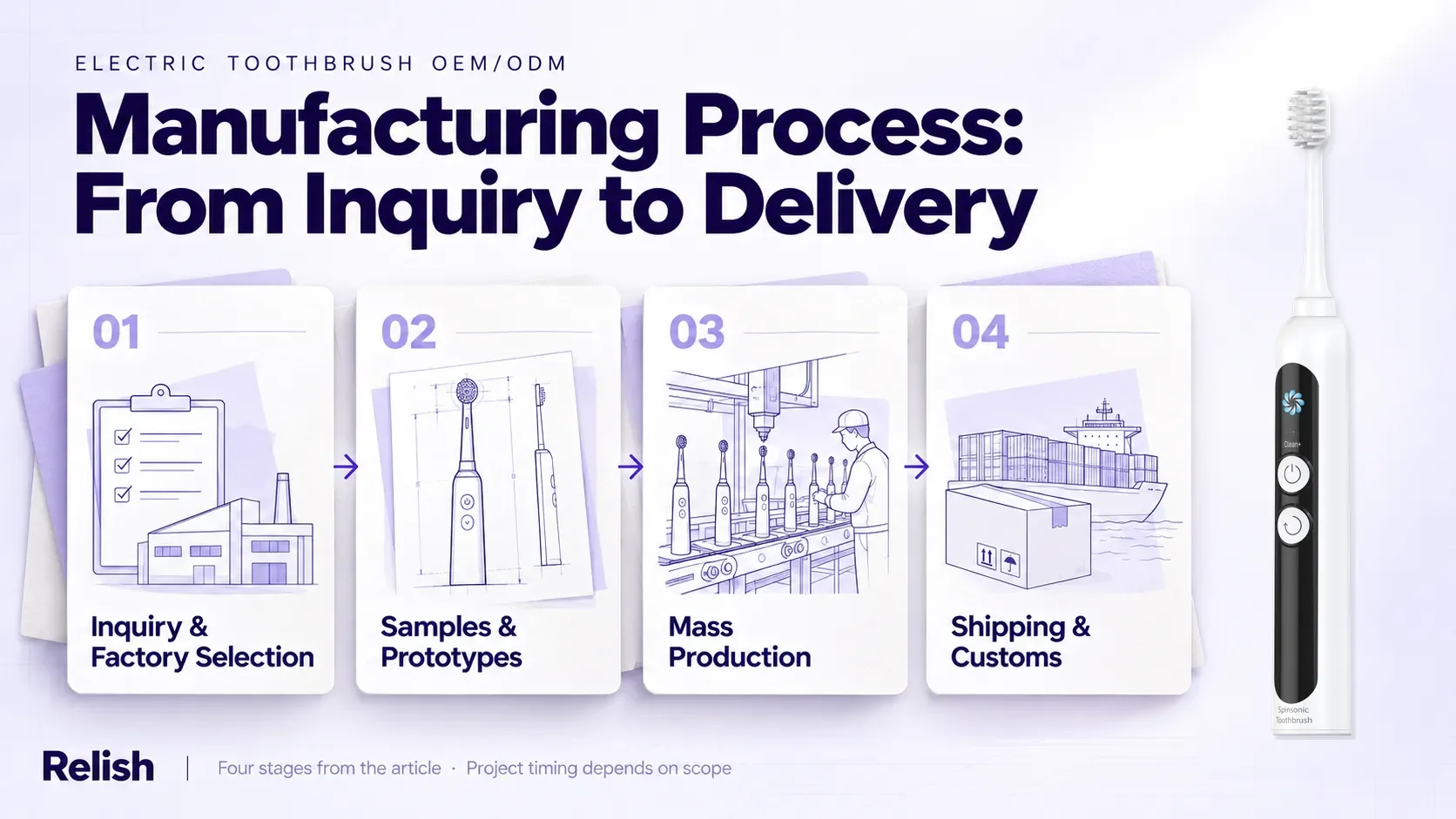
At Relish Technology, motor engineering, electronics, sealing and app connectivity inform the development process. The following 28-week schedule illustrates a new-product project; an existing platform or a more complex programme will follow a different timeline.
- Validazione del concept (settimane 1–4): Definire la specifica del prodotto — tipo di tecnologia (sonico/rotante/Rotasonic), mercati target, certificazioni richieste, fascia di prezzo. Questo guida tutte le decisioni successive.
- Sviluppo del prototipo (settimane 5–12): Costruire prototipi funzionali del manico, dell'elettronica e della testina. Testare le prestazioni del motore, l'autonomia della batteria, l'impermeabilità e il firmware del PCB. Quantità tipica del prototipo: 3–10 unità.
- Validazione pre-produzione (settimane 13–20): Test di validazione ingegneristica (EVT) e test di validazione del design (DVT) — test di immersione IPX7, test di caduta, test EMC, test del ciclo della batteria e test di pre-conformità normativa.
- Preparazione alla produzione di massa (settimane 21–28): Completamento della tooling, primo articolo di ispezione, run pilota (100–300 unità) e configurazione del sistema qualità inclusi piani di campionamento AQL.
- Production and shipment: Full production combines in-process checks, functional testing and agreed sampling inspections. Define defect categories and acceptance criteria in the quality agreement. Safety-critical defects require a zero-acceptance approach; an AQL value must not be presented as permission to ship a known critical defect. Visita ai nostri impianti di produzione per vedere le nostre capacità produttive di persona.
Come Scegliere la Tecnologia Giusta per il Tuo Marchio
Con le basi tecniche stabilite, ecco un quadro decisionale per proprietari di marchi e responsabili acquisti che selezionano un partner OEM per lo sviluppo di spazzolini elettrici. Comprendere come funzionano gli spazzolini elettrici in tutte e tre le categorie tecnologiche — sonico, rotante-oscillante e Rotasonic™ — consente conversazioni più informate con i produttori e specifiche di prodotto più accurate.
| Criteri | Sonico | Rotante-Oscillante | Rotasonic™ (Combinazione) |
|---|---|---|---|
| Intervallo di Costo BOM | $12-$28 | $8-$20 | $18–$38 |
| Posizionamento del Prezzo al Dettaglio | Medio a Premium | Entry to Mid | Premium to Ultra-Premium |
| Livello di Rumore | Depends on drive, mounting and operating mode | Depends on drive, gearing and operating mode | Depends on the combined drive design |
| Cleaning Action | Bristle movement and nearby liquid agitation | Alternating angular movement with bristle contact | Combined sonic and oscillating-rotating movement |
| Miglior Mercato di Riferimento | Marchi consumer premium | Marchi value, Amazon FBA | Brands seeking a dual-action platform |
| Idoneità alle Funzionalità Smart | Eccellente | Buono | Eccellente |
Pronto ad avviare il Suo progetto OEM per spazzolini elettrici?
Che tu stia lanciando un nuovo marchio, espandendo una linea esistente o approvvigionandoti per l'acquisto al dettaglio — il team di ingegneria di Relish Technology può aiutarti a selezionare la piattaforma tecnologica giusta e guidarti nell'intero percorso, dal concept alla produzione di massa.
Parla con il Nostro Team di IngegneriaISO 13485 · FDA/CE Compliance Support · 15+ Years OEM Experience · 20,000 m² Manufacturing Facility
Domande frequenti
Answers to common questions about electric toothbrush mechanisms, components, charging, sensors and OEM product development.
Riferimenti e fonti
- American Dental Association. Spazzolini. Spazzolini.
- Commissione Elettrotecnica Internazionale. IEC 60335-2-52:2021 — Particular requirements for oral hygiene appliances. IEC 60335-2-52:2021 — Particular requirements for oral hygiene appliances.
- International Organization for Standardization. ISO 20127:2025 — Dentistry — Physical properties of powered toothbrushes. ISO 20127:2025 — Dentistry — Physical properties of powered toothbrushes.
- U.S. Food and Drug Administration. Powered toothbrush classification: JEQ, 21 CFR 872.6865, Class I; 510(k)-exempt within applicable limits. Powered toothbrush classification: JEQ, 21 CFR 872.6865, Class I; 510(k)-exempt within applicable limits.
- Nordic Semiconductor. nRF52840 Product Specification. nRF52840 Product Specification.
- Bosch Sensortec. BMI270 inertial measurement unit. BMI270 inertial measurement unit.