











Cómo funcionan los cepillos de dientes eléctricos:
Guía Técnica Completa 2026
Explore the motors, batteries, electronics and sealing systems inside electric toothbrushes, with practical engineering choices for OEM product development.
Runtime examples assume two brushing sessions of two minutes each per day. Brush movement rates and battery performance depend on the model and operating mode.
Los cepillos de dientes eléctricos son máquinas engañosamente complejas. En su núcleo, combinan motores de precisión, sistemas de control inteligentes, fuentes de alimentación recargables y diseño ergonómico en un dispositivo que cabe en la palma de la mano, y que realiza decenas de miles de movimientos mecánicos precisos por sesión de cepillado. Esta guía desglosa exactamente cómo funcionan los cepillos de dientes eléctricos, desde la física de la vibración sónica hasta las decisiones de ingeniería que dan forma a la fabricación OEM.
Puntos clave
- The three platforms covered here are sónico, oscillating-rotating y combination systems such as Relish Technology’s Rotasonic™. Each offers different drive mechanisms and product development options.
- Sonic toothbrushes clean through contacto de las cerdas and agitate the liquid around the brush head. Effective cleaning still depends on reaching tooth surfaces with the bristles.
- The motor, PCB and battery sit inside a sealed handle. IPX7 applies to the tested enclosure, rather than separately certifying every internal component.
- La tecnología de batería (Li-ion vs NiMH) impacta directamente en el peso, la autonomía y el tiempo de carga, todos puntos críticos de decisión OEM
- Pressure feedback can use force sensing, mechanical deflection or motor-load measurement to alert users when they exceed a model-specific brushing-pressure setting.
- Los cepillos inteligentes añaden Bluetooth connectivity, sensors and a companion app. The underlying cleaning platform may be shared with a non-connected model.
- For OEM buyers, the motor, battery, electronics, brush head, housing, finishing and packaging all affect the bill of materials (BOM) and the final quotation.
- Relish Technology’s Vibrosonic™ de Relish Technology offers up to 48,000 golpes/min with a dual-harmonic drive approach. Select the operating profile to suit the product specification.
Las Tres Tecnologías Principales de los Cepillos de Dientes Eléctricos
This guide compares sonic, oscillating-rotating and combination platforms. Their drive mechanisms influence head movement, noise, power consumption and cost, while the complete product design determines the final performance.
Tecnología Sónica: Vibración de Bobina Magnética
Many sonic toothbrushes use an electromagnetic drive system to create rapid movement at the brush head. The motor’s magnetic circuit, suspension and output shaft determine whether that movement is linear, angular or a combination. “Sonic” describes the operating approach; it does not mean every model uses the same voice-coil or linear resonant actuator.
In an electromagnetic drive, controlled current in the coil produces a changing magnetic force that moves the drive assembly. The shaft transfers that motion to the brush head. Keep frequency and movement counts separate: 120–240 Hz equals 7,200–14,400 complete cycles per minute. If each direction is counted as one stroke, that is 14,400–28,800 strokes/min. Compare models only after checking how the manufacturer counts strokes.
Rapid brush-head movement also agitates toothpaste and saliva near the bristles. This fluid movement is distinct from demonstrated clinical cleaning at a fixed distance. Guide the bristles over the tooth surfaces and gumline; a stated movement rate alone does not establish cleaning depth or a gingivitis-reduction result.
Relish Technology’s proprietary Vibrosonic™ de Relish Technology uses a controlled secondary harmonic layer alongside the main drive profile. For an OEM project, our engineers can help specify the movement rate, amplitude and brushing modes to achieve the intended brushing feel and product positioning.
Tecnología Rotatoria-Oscilante: Motor de Engranajes de CC
Oscillating-rotating toothbrushes move the brush head back and forth through an angle. In a geared design, a small Motor de corriente continua drives a transmission that converts shaft rotation into this alternating motion. Other architectures use different actuators or linkages, so the actual drive system should be checked in the product specification.
Head movement is described by its oscillation rate and angular travel. An advertised 5,000–10,000 movements per minute should not be labelled “rpm” unless it measures complete revolutions. Cleaning relies on contacto de las cerdas, with the alternating movement helping the user clean tooth surfaces.
A geared DC drive can be a cost-effective option for an OEM project. Compare the complete transmission, noise, durability, head compatibility and assembly requirements with the sonic alternatives; motor price alone does not determine the best platform.
Tecnología Combinada / Rotasonic
Comprender cómo funcionan los cepillos de dientes eléctricos con tecnología combinada revela el enfoque Rotasonic™. La tercera categoría es el enfoque combinado o híbrido: dispositivos que utilizan tanto vibración sónica como acción rotatoria-oscilante simultáneamente. Aquí es donde se sitúa la Rotasonic™ tecnología, desarrollada en Relish Technology.
Rotasonic™ brings sonic vibration and oscillating-rotating action into a dual-action cleaning platform. The actuator and transmission configuration depends on the model. OEM buyers can work with our engineers to compare head movement, brushing feel, noise and cost against the target specification.
La Anatomía de un Cepillo de Dientes Eléctrico
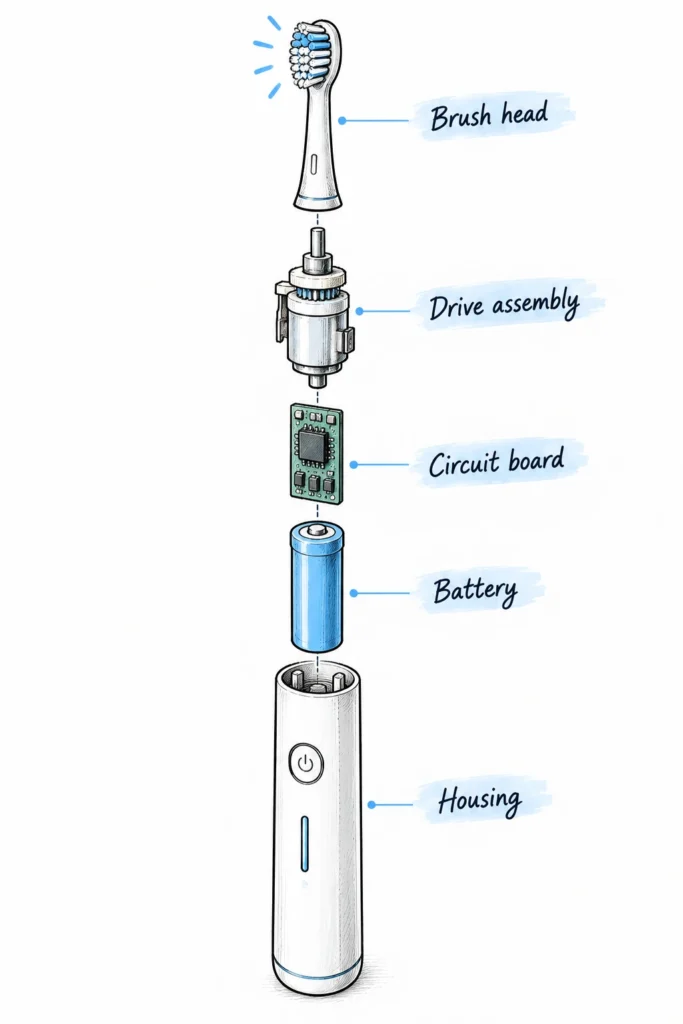
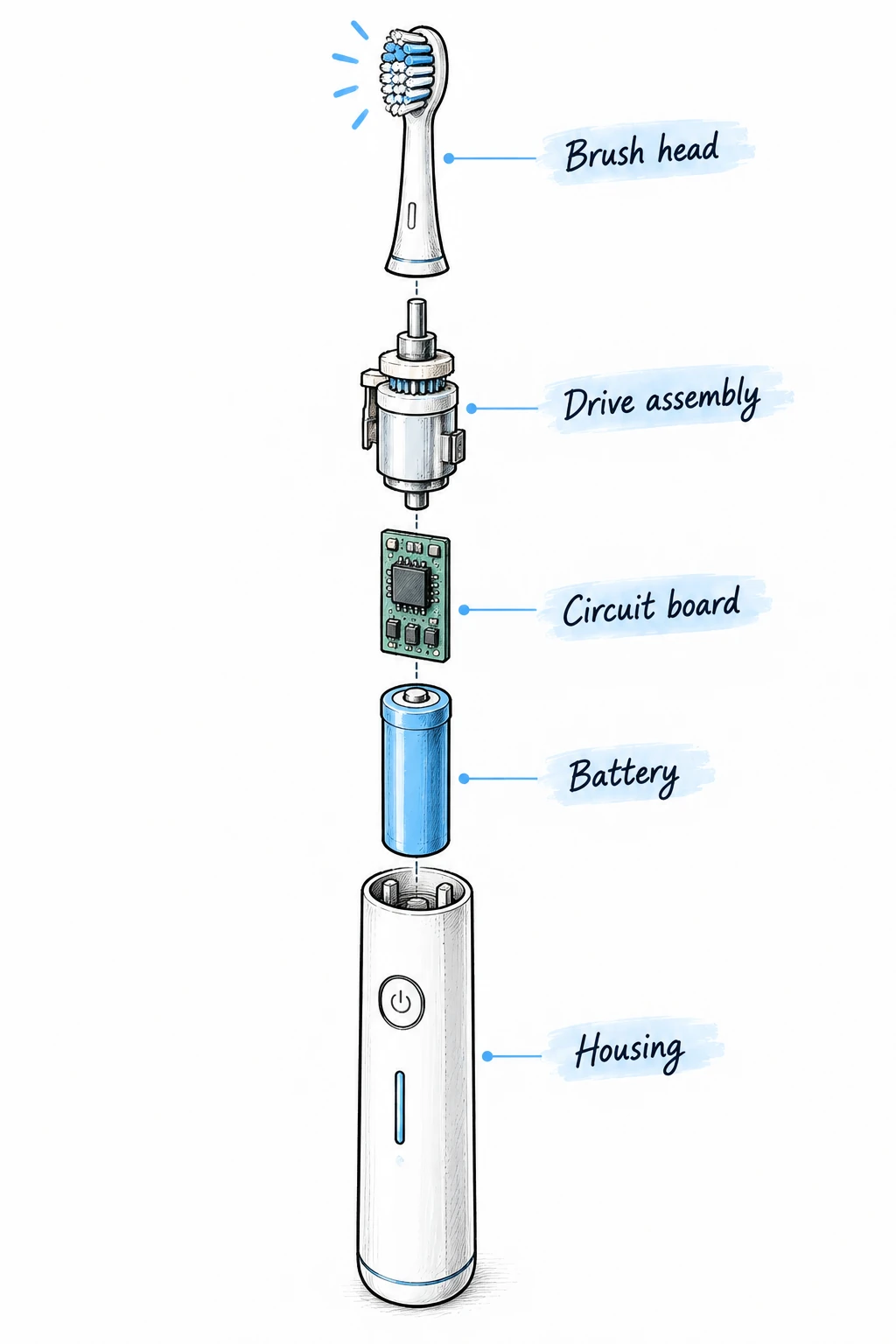
Más allá de la tecnología de limpieza central, cada cepillo de dientes eléctrico contiene un sistema de componentes interconectados que trabajan juntos para ofrecer una experiencia de cepillado confiable, segura y fácil de usar. Comprender cómo funcionan los cepillos de dientes eléctricos a nivel de componentes ayuda a los compradores OEM a evaluar las compensaciones entre calidad y costo durante el desarrollo del producto. Aquí hay un desglose componente por componente.
Batería Recargable
Rechargeable models may use Li-ion or NiMH cells. The existing 600–2,000 mAh range is a product-planning example; compare cell voltage and energy in Wh as well as capacity. Runtime and cycle life depend on the cell, charging system, load and temperature.
Motor y Circuito Controlador
The motor and driver circuit convert electrical power into brush-head movement. Electromagnetic and geared DC designs may require different power stages; an H-bridge is one possible arrangement.
PCB y Microcontrolador
MCU de 8–32 bits gestiona los modos de cepillado, temporizador, entrada del sensor de presión, indicadores LED y comunicación BLE en modelos inteligentes.
Sensor de Presión
Pressure detection may use a force sensor, a deflection mechanism or motor-load measurement. The controller compares the signal with a model-specific setting, then activates a warning or adjusts the motor.
Sistema de carga
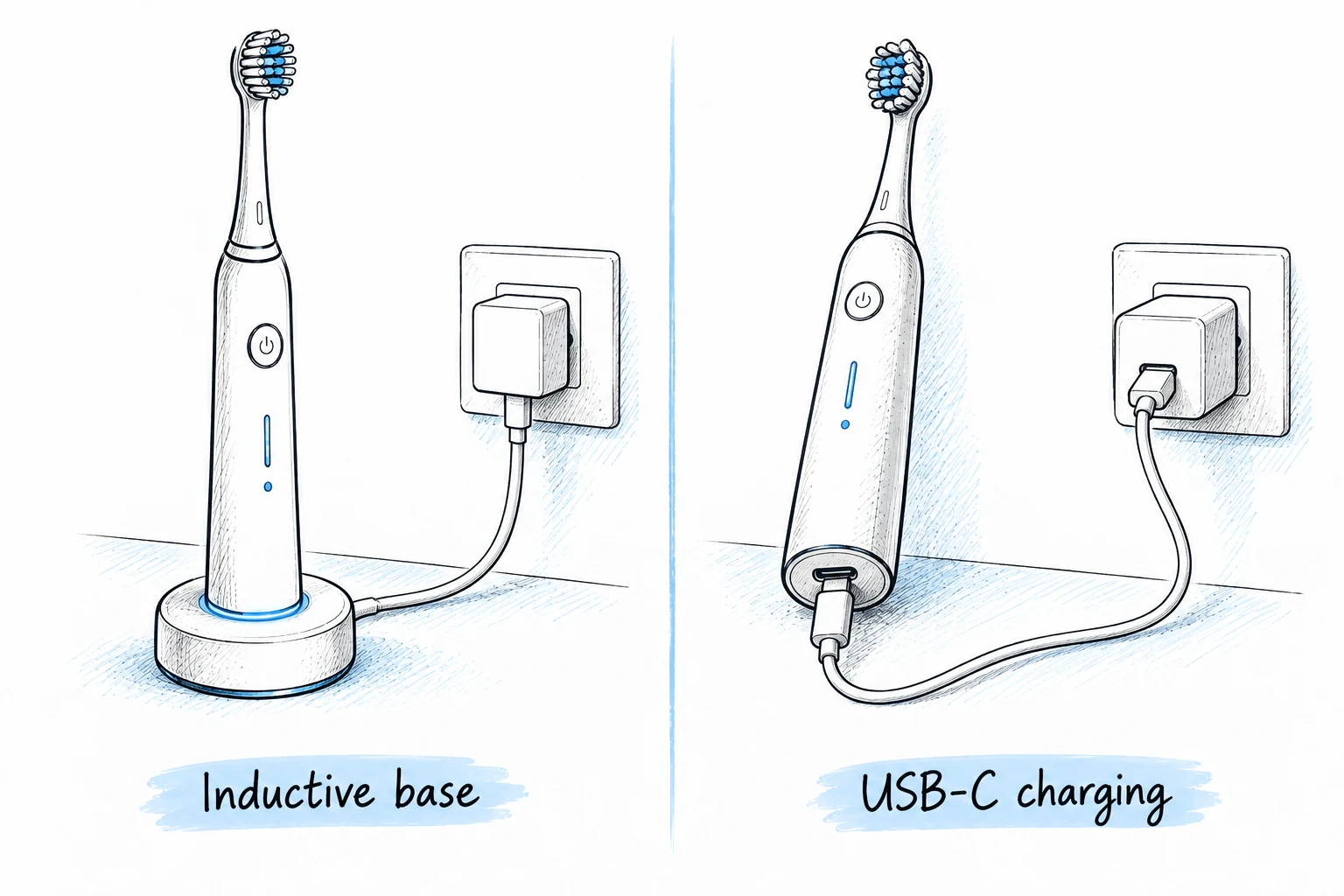
Charging may use a dedicated inductive base or a wired connection such as USB-C. The input rating, charging time and compatible charger depend on the design. An inductive base is not automatically Qi-compatible.
Cabezal del Cepillo y Eje de Transmisión
Cabezal reemplazable con cerdas de nailon o PBT. Conectado al motor mediante un eje de transmisión de acero inoxidable o nailon. Mecanismo de fijación por ajuste a presión o giro-bloqueo.
El PCB y el Sistema de Control
En printed circuit board (PCB) carries the electronics that control modes, timing, indicators and optional sensors or connectivity. A 20–50 mm × 10–25 mm board is one layout example; dimensions depend on the handle and circuit design. Typical functions include:
- Microcontroller (MCU): An 8-bit or 32-bit controller runs the firmware. Select the device for processing, memory, power and interface requirements; a Bluetooth SoC may also perform this role.
- Controlador de motor: A power stage controlled by the MCU supplies the waveform and current required by the selected motor. The circuit may use an H-bridge, depending on the drive architecture.
- Clock source: An internal oscillator or external crystal provides the controller’s timing reference. Some designs use a 32.768 kHz crystal for low-power timekeeping; the required clocks depend on the chosen controller.
- Interfaz del Sensor de Presión: Un canal de convertidor analógico-digital (ADC) que lee el cambio de voltaje del sensor de presión
- Controlador LED: Circuito de resistencia limitadora de corriente + transistor que controla los LED indicadores de modo
- SoC BLE (solo modelos inteligentes): Un sistema en chip Bluetooth Low Energy (Nordic nRF52832 o similar) que maneja la comunicación inalámbrica con la aplicación complementaria
- Charging and battery protection: Charging control, voltage monitoring, temperature checks and protection functions are selected for the cell chemistry and product design. They may be integrated or implemented with separate circuits.
Modos de Cepillado y el Temporizador por Cuadrantes
Una de las características más valiosas de los cepillos de dientes eléctricos modernos — tanto desde la perspectiva del consumidor como del diseño OEM — es el sistema de modos de cepillado. La forma en que los cepillos de dientes eléctricos funcionan con múltiples modos depende de perfiles de frecuencia y amplitud controlados por firmware gestionados por el microcontrolador. Cada modo tiene un perfil diferente de frecuencia, amplitud y tiempo, brindando a los usuarios flexibilidad para diferentes necesidades de cuidado bucal.
Modos de Cepillado Comunes
| Modo | Frecuencia | Amplitud | Duración | Intended Use |
|---|---|---|---|---|
| Limpieza | Frecuencia completa (ej., 40,000 spm) | Estándar | 2 min | Uso diario, limpieza general |
| Blanco / Pulido | Completa + pulso intermitente | Más alto | 2 min | Eliminación de manchas superficiales, consumidores de café/té |
| Sensible | 60–70% de la frecuencia máxima | Reducido | 2 min | Users who prefer a gentler brushing feel |
| Cuidado de Encías / Suave | 40–50% del máximo, pulsante | Bajo | 3 min | Gentle gumline brushing |
| Limpieza de Lengua | Baja frecuencia, constante | Ligero | 30 seg | Aliento fresco, recubrimiento de lengua |
| Blanqueamiento | Alto/bajo alternante | Variable | 3 min | Ciclos mejorados de eliminación de manchas |
A temporizador de cuadrante gives a brief pause or signal every 30 seconds to prompt a change of brushing area. Four intervals support a two-minute session. This is a pacing aid; users still need to guide the brush over the inner, outer and chewing surfaces.
Tecnología de Batería y Sistemas de Carga
Battery selection affects handle weight, runtime, charging and cost. For an OEM project, compare the cell together with the motor load, standby consumption and charging circuit to match the target use pattern and retail positioning.
Iones de Litio (Li-ion) vs Níquel-Metal Hidruro (NiMH)
Li-ion cells are widely used in rechargeable toothbrush designs. Check the supplier’s cell drawing and datasheet for voltage, dimensions and capacity. Cylindrical format names are approximate: a 14500 cell is nominally about 14 mm × 50 mm, while 14450 denotes about 14 mm × 45 mm. Dimensions, terminal details and capacity must be confirmed for the selected cell. Key selection factors include:
- Energy density: Compare the selected cells in Wh/kg and Wh/litre; a fixed threefold advantage does not apply to every Li-ion and NiMH design.
- Self-discharge: Cell chemistry, temperature and storage conditions affect charge retention. Low-self-discharge NiMH cells are available, so compare the selected cells’ storage specifications.
- Charging habits: Li-ion cells can normally be topped up within the approved charging limits. Follow the cell supplier’s voltage, current and temperature requirements.
- Cycle life: A full-equivalent cycle is cumulative discharge equal to the cell’s rated capacity, not one brushing session. A 500-cycle rating must state the test conditions and retained-capacity criterion. Brushing frequency alone cannot convert that rating into years of service.
- Charging time: A 1–3 hour charge is possible on a design built for that rate. The battery, charger, thermal limits and power-management circuit determine the result, rather than the connector type alone.
NiMH remains an option where cost, cell availability and the established charging design fit the project. It still requires appropriate charge control and protection against damaging operating conditions. Low-self-discharge variants can retain charge well, and memory-effect behaviour should not be generalised from NiCd batteries.
Sistemas de Carga: Inductivo vs USB-C
Inductive charging transfers energy between coils in the base and handle. The receiver rectifies and regulates that energy to charge the battery. Removing an exposed charging connector can simplify sealing, but charging efficiency, alignment, heat and full-charge time must be evaluated for the selected design. A dedicated toothbrush base does not necessarily support the Qi standard.
USB-C charging provides a convenient wired connection. Specify the input voltage and current, supported power protocol, charger compatibility and charging time. USB-C does not itself guarantee USB Power Delivery or a 1–3 hour charge. The port, surrounding housing and any cover must form a tested sealing system.
Resistencia al Agua: IPX7 y el Desafío de Ingeniería
Water resistance depends on the complete enclosure and its seals. IPX7 addresses temporary immersion under defined test conditions, commonly described for a small device as 1 metre for 30 minutes. It does not establish protection against water jets, all shower conditions or indefinite immersion, and it does not automatically apply to the charger. Follow the product’s stated cleaning and charging instructions.
Encapsulado y Soldadura Ultrasónica
Potting or encapsulation can protect selected electronics with a compatible epoxy or silicone material. It is one part of the sealing strategy alongside housing joints, shaft seals and charging interfaces. The existing USD 0.80–2.50 per-unit allowance is a planning example; material volume, curing, labour and repairability affect the final cost.
Soldadura ultrasónica can join compatible plastic housing parts using high-frequency mechanical vibration. Equipment in the 20–40 kHz range is one example. Joint geometry, material and process settings determine weld strength and sealing quality; verify both on the finished assembly.
Para el área de fijación del cabezal del cepillo — el punto de sellado con mayor estrés mecánico — se utilizan juntas tóricas de silicona o sellador de junta líquida. El eje de transmisión pasa a través de este sello mediante un buje de tolerancia ajustada, manteniendo la impermeabilización mientras permite el movimiento rotatorio o lineal.
¿Necesita ayuda para especificar su cepillo de dientes eléctrico?
¿Tiene curiosidad sobre cómo funciona un cepillo de dientes eléctrico para su marca? Nuestros ingenieros pueden guiarlo en la selección del motor, la estrategia de impermeabilización y la optimización del costo de la lista de materiales (BOM) para su mercado objetivo.
Hablar con nuestro equipo de ingenieríaCepillos de Dientes Inteligentes: Sensores, BLE y Conectividad de Aplicaciones
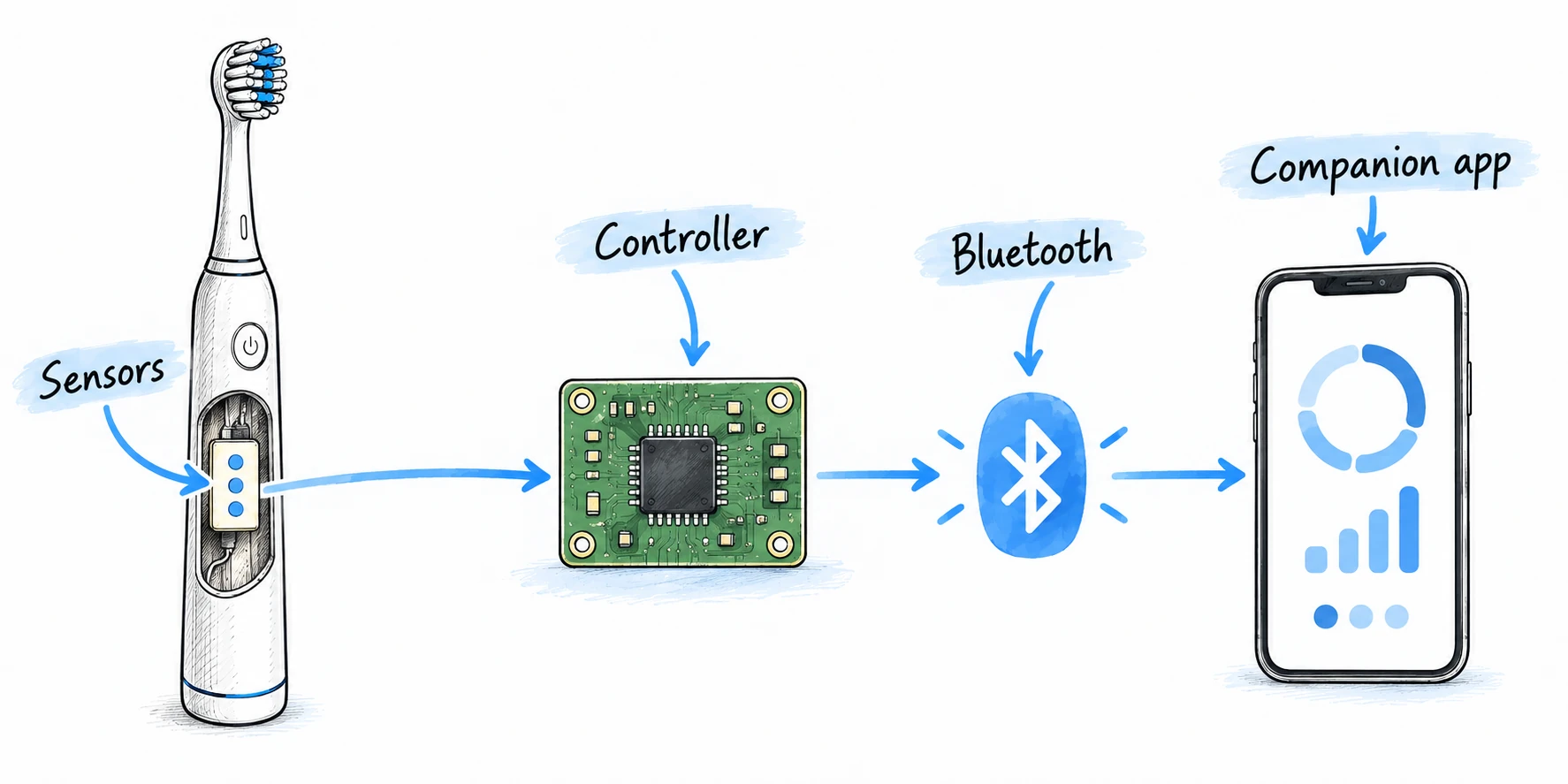
Smart toothbrushes combine a brushing platform with Conectividad Bluetooth, optional sensors and companion software. A connected and non-connected model may share a motor or brush head, while other designs use different components. Specify the physical cleaning performance and the data functions separately.
Funciones Inteligentes Clave y Sus Sensores
| Función inteligente | Sensor Utilizado | Detalle Técnico |
|---|---|---|
| Duración del cepillado | Reloj en tiempo real (temporizador MCU) | Integrado en MCU — no se necesita sensor adicional |
| Detección de Presión | Force sensor, deflection sensing or motor-load measurement | Position and calibration depend on the sensing design |
| Detección de Posición | IMU de 6 ejes (acelerómetro + giroscopio) | Estimates movement and brushing zones through a validated algorithm |
| Desgaste del Cabezal del Cepillo | Usage timer or session counter; additional sensing if fitted | Prompts replacement based on use; does not directly measure every bristle’s condition |
| Salud de la Batería | IC de indicador de combustible (contador de culombios) | Estimates remaining charge; cycle and health data depend on the implementation |
| Emparejamiento Bluetooth | Bluetooth Low Energy SoC | For example, a Nordic nRF52-series device; select for the required features |
A six-axis inertial measurement unit (IMU) combines a three-axis accelerometer and three-axis gyroscope. Software can use these signals to estimate brushing movement and mouth zones. Accuracy depends on sensor placement, calibration, the algorithm and user behaviour. Zone feedback is an estimate of brushing activity, rather than a direct measurement of plaque removal or oral health.
La Perspectiva OEM sobre los Costos de los Cepillos de Dientes Inteligentes
Smart functions add connectivity, sensing and software to a product that already uses electronic control. The existing USD 8–25 per-unit estimate is a planning allowance for additional hardware, not an app-development quotation. Check which components are already included in the base platform to avoid double-counting. Example budget items include:
- BLE SoC and antenna: USD 2.50–5.00 as a planning allowance. Nordic nRF52840 and Realtek RTL8762 are examples; suitability depends on the selected part and software requirements.
- Six-axis IMU: USD 1.50–4.00 as a planning allowance. Examples include TDK InvenSense ICM-42670 and Bosch Sensortec BMI270.
- Pressure sensing: USD 0.30–1.00 as a planning allowance; the sensing method and required calibration determine the actual cost.
- App development: An illustrative one-time budget of USD 30,000–150,000 for iOS and Android. Scope separately for maintenance, cloud services, privacy controls and operating-system updates.
- Additional PCB layers and components: USD 1.00–3.00 as a planning allowance; confirm overlap with the selected connectivity and sensor modules.
A USD 25–60 retail premium is a positioning example for a connected model. Assess the selling price alongside channel costs, software maintenance, returns and the complete product cost before estimating profitability.
Tecnología de desinfección UV
A UV sanitizing base uses a separate UV-C light system to reduce microorganisms on exposed brush-head surfaces. Wavelength, dose, exposure time, lamp placement, shadows and the tested organism determine the result. A 254 nm lamp and a 5–10 minute cycle describe particular designs; they do not establish a universal 99.9% reduction for all bacteria and viruses. Use product-specific test results for performance claims, and prevent eye or skin exposure with an enclosed design and suitable interlocks.
UV-C sources may include low-pressure mercury lamps or UV-C LEDs. Compare wavelength, delivered dose, thermal management, service life, material compatibility and disposal requirements for the selected source. Lamp type alone does not determine which complete sanitizer is more effective or durable.
The existing USD 3.50–8.00 BOM allowance illustrates a UV-base option. The light source, enclosure, control system and safety interlocks affect cost and packaging size. Position the feature using the selected product’s tested performance.
Cabezales de cepillo: ciencia e ingeniería de las cerdas
Mientras que el mango contiene toda la inteligencia electrónica, el cabezal del cepillo es donde ocurre la limpieza real. Comprender cómo funcionan los cepillos de dientes eléctricos para brindar un cuidado oral efectivo requiere conocer la ingeniería del cabezal del cepillo: el material de las cerdas, el diámetro, la configuración de los mechones y las propiedades de flexión influyen en el rendimiento de limpieza y la experiencia del usuario.
Materiales de las cerdas
Brush-head performance depends on filament material, diameter, length, taper and tuft arrangement. Nylon 612 and PBT are material options; PBT is not automatically softer than nylon. Define the required brushing feel and inspect filament ends, tuft retention and mechanical performance against the applicable specification. ISO 20127:2025 covers physical properties of powered toothbrushes; its end-rounding requirements have exceptions for specified filament types, so a universal tip-radius rule is inappropriate.
Cerdas indicadoras
Colour-fading indicator bristles provide a visual replacement reminder. Fading depends on the filament treatment, brushing habits and exposure; it is not a precise three-month clock. The existing USD 0.05–0.15 per-head allowance is a planning example. Colour-treated or mixed-colour filaments do not inherently require two-material injection moulding. Follow the brush-head replacement instructions and replace sooner when the bristles are worn.
Fabricación OEM: desde la selección de componentes hasta la producción en masa
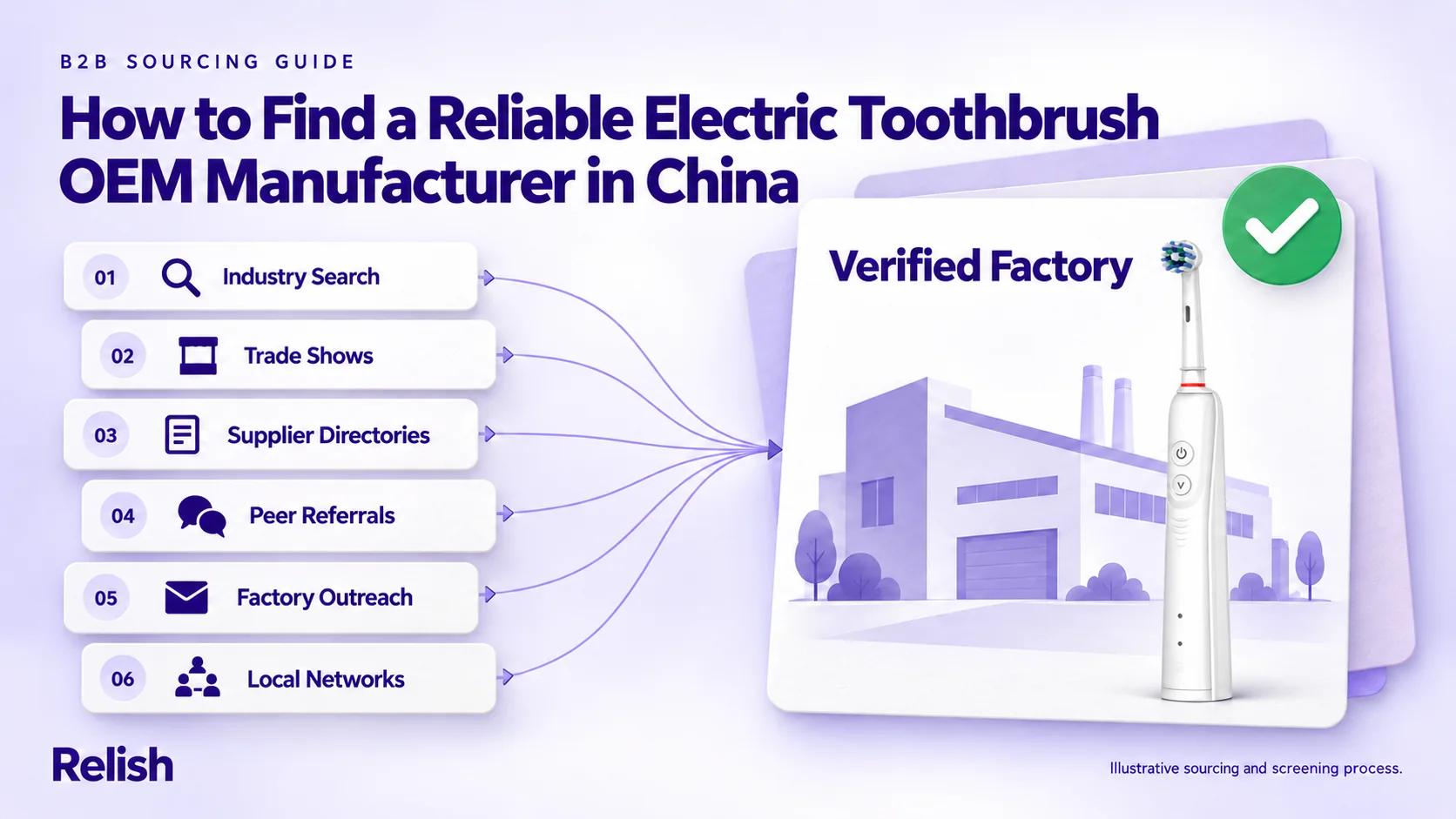
Comprender cómo funcionan los cepillos de dientes eléctricos desde una perspectiva de fabricación es la base para tomar decisiones inteligentes de abastecimiento OEM. Cada elección técnica — tipo de motor, capacidad de la batería, método de impermeabilización, integración de sensores inteligentes — tiene un impacto directo y cuantificable en el costo de fabricación, la calidad del producto y el posicionamiento minorista. Lea nuestra guía de OEM para cepillos de dientes eléctricos para una inmersión más profunda en la ruta de fabricación.
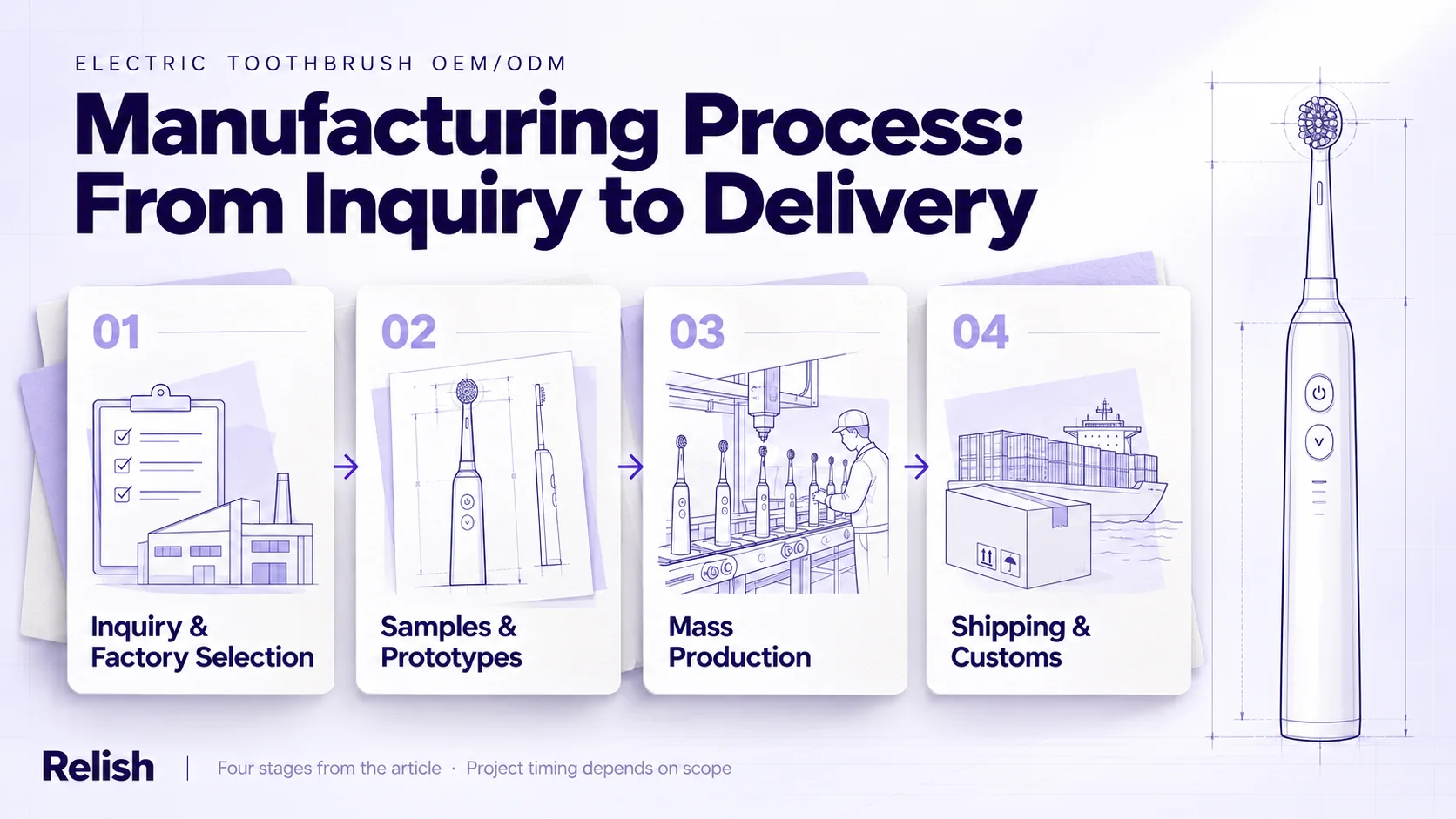
At Relish Technology, motor engineering, electronics, sealing and app connectivity inform the development process. The following 28-week schedule illustrates a new-product project; an existing platform or a more complex programme will follow a different timeline.
- Validación del concepto (semanas 1–4): Definir la especificación del producto — tipo de tecnología (sónica/rotatoria/Rotasonic), mercados objetivo, certificaciones requeridas, nivel de precio. Esto impulsa todas las decisiones posteriores.
- Desarrollo del prototipo (semanas 5–12): Construir prototipos funcionales del mango, la electrónica y el cabezal del cepillo. Probar el rendimiento del motor, la autonomía de la batería, la impermeabilización y el firmware de la PCB. Cantidad típica de prototipos: 3–10 unidades.
- Validación de preproducción (semanas 13–20): Pruebas de validación de ingeniería (EVT) y pruebas de validación de diseño (DVT) — pruebas de inmersión IPX7, pruebas de caída, pruebas de EMC, pruebas de ciclo de batería y pruebas de pre-cumplimiento normativo.
- Preparación para la producción en masa (semanas 21–28): Finalización del utillaje, inspección de la primera pieza, ejecución piloto (100–300 unidades) y configuración del sistema de calidad, incluidos los planes de muestreo AQL.
- Production and shipment: Full production combines in-process checks, functional testing and agreed sampling inspections. Define defect categories and acceptance criteria in the quality agreement. Safety-critical defects require a zero-acceptance approach; an AQL value must not be presented as permission to ship a known critical defect. Visite nuestras instalaciones de fabricación para ver nuestras capacidades de producción de primera mano.
Cómo elegir la tecnología adecuada para su marca
Con los fundamentos técnicos establecidos, aquí hay un marco de decisión para propietarios de marcas y gerentes de adquisiciones que seleccionan un socio OEM para el desarrollo de cepillos de dientes eléctricos. Comprender cómo funcionan los cepillos de dientes eléctricos en las tres categorías de tecnología — sónicos, oscilantes-rotatorios y Rotasonic™ — permite conversaciones más informadas con los fabricantes y especificaciones de producto más precisas.
| Criterios | Sónico | Rotatorio-oscilante | Rotasonic™ (Combinación) |
|---|---|---|---|
| Rango de Costo BOM | $12-$28 | $8-$20 | $18–$38 |
| Posicionamiento de Precio Minorista | Medio a Premium | Entrada a Medio | Premium a Ultra-Premium |
| Nivel de Ruido | Depends on drive, mounting and operating mode | Depends on drive, gearing and operating mode | Depends on the combined drive design |
| Cleaning Action | Bristle movement and nearby liquid agitation | Alternating angular movement with bristle contact | Combined sonic and oscillating-rotating movement |
| Mejor ajuste al mercado | Marcas premium de consumo | Marcas de valor, Amazon FBA | Brands seeking a dual-action platform |
| Idoneidad para funciones inteligentes | Excelente | Buena | Excelente |
¿Está listo para iniciar su proyecto de cepillo de dientes eléctrico OEM?
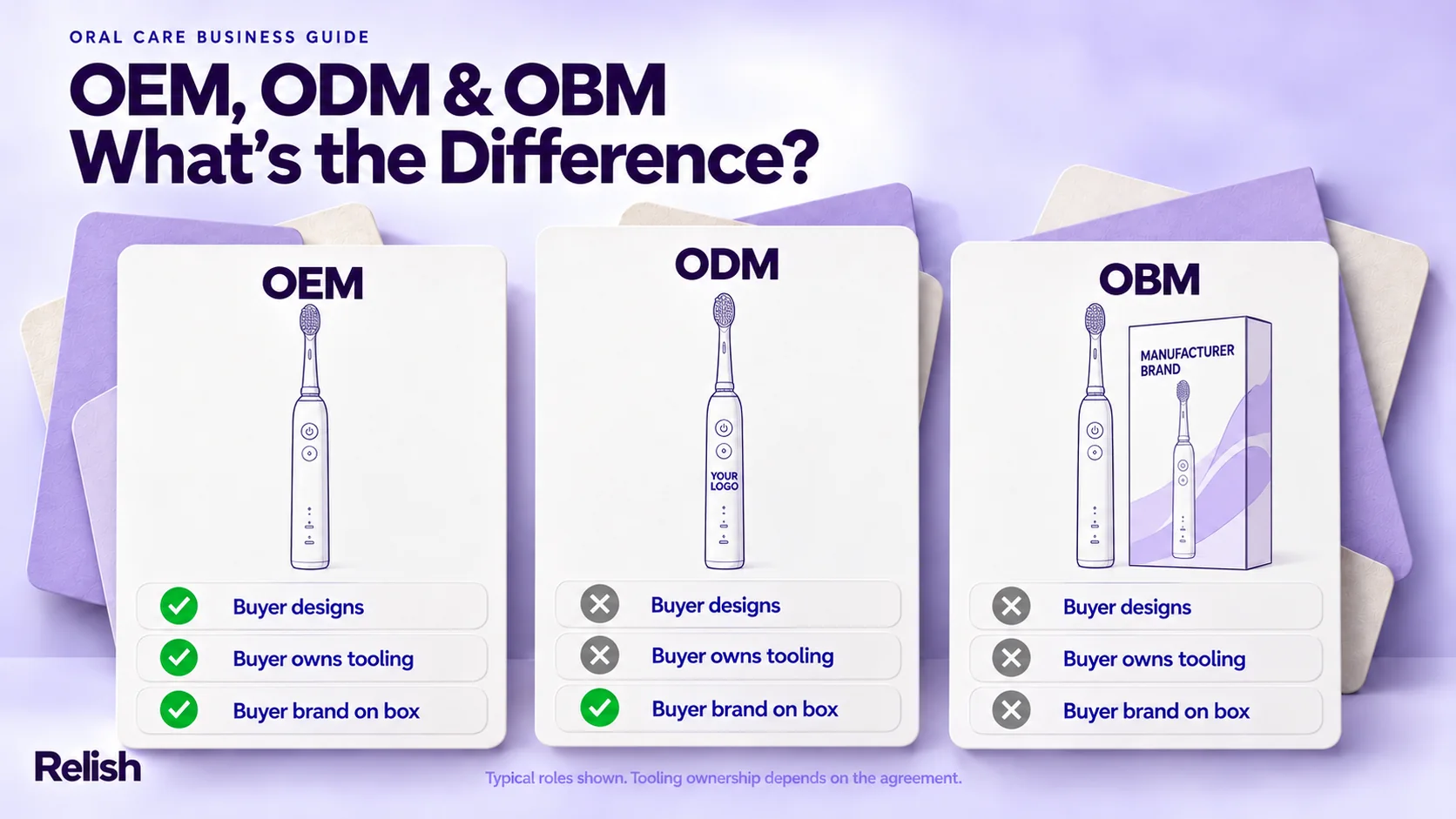
Ya sea que esté lanzando una nueva marca, ampliando una línea existente o abasteciéndose para compras minoristas — el equipo de ingeniería de Relish Technology puede ayudarle a seleccionar la plataforma tecnológica adecuada y guiarlo en todo el recorrido, desde el concepto hasta la producción en masa.
Hablar con nuestro equipo de ingenieríaISO 13485 · FDA/CE Compliance Support · 15+ Years OEM Experience · 20,000 m² Manufacturing Facility
Preguntas frecuentes
Answers to common questions about electric toothbrush mechanisms, components, charging, sensors and OEM product development.
Referencias y fuentes
- American Dental Association. Cepillos de Dientes. Cepillos de Dientes.
- Comisión Electrotécnica Internacional. IEC 60335-2-52:2021 — Particular requirements for oral hygiene appliances. IEC 60335-2-52:2021 — Particular requirements for oral hygiene appliances.
- International Organization for Standardization. ISO 20127:2025 — Dentistry — Physical properties of powered toothbrushes. ISO 20127:2025 — Dentistry — Physical properties of powered toothbrushes.
- U.S. Food and Drug Administration. Powered toothbrush classification: JEQ, 21 CFR 872.6865, Class I; 510(k)-exempt within applicable limits. Powered toothbrush classification: JEQ, 21 CFR 872.6865, Class I; 510(k)-exempt within applicable limits.
- Nordic Semiconductor. nRF52840 Product Specification. nRF52840 Product Specification.
- Bosch Sensortec. BMI270 inertial measurement unit. BMI270 inertial measurement unit.