











Comment fonctionnent les brosses à dents électriques :
Guide Technique Complet 2026
Explore the motors, batteries, electronics and sealing systems inside electric toothbrushes, with practical engineering choices for OEM product development.
Runtime examples assume two brushing sessions of two minutes each per day. Brush movement rates and battery performance depend on the model and operating mode.
Les brosses à dents électriques sont des machines d'une complexité trompeuse. À leur cœur, elles combinent des moteurs de précision, des systèmes de contrôle intelligents, des sources d'alimentation rechargeables et un design ergonomique dans un appareil qui tient dans la paume de votre main — tout en effectuant des dizaines de milliers de mouvements mécaniques précis par séance de brossage. Ce guide décompose exactement comment fonctionnent les brosses à dents électriques, de la physique de la vibration sonique aux décisions d'ingénierie qui façonnent la fabrication OEM.
Les points à retenir
- The three platforms covered here are sonique, oscillating-rotating et combination systems such as Relish Technology’s Rotasonic™. Each offers different drive mechanisms and product development options.
- Sonic toothbrushes clean through contact des poils and agitate the liquid around the brush head. Effective cleaning still depends on reaching tooth surfaces with the bristles.
- The motor, PCB and battery sit inside a sealed handle. IPX7 applies to the tested enclosure, rather than separately certifying every internal component.
- La technologie de batterie (Li-ion vs NiMH) impacte directement le poids, l'autonomie et le temps de charge, tous des points de décision OEM critiques
- Pressure feedback can use force sensing, mechanical deflection or motor-load measurement to alert users when they exceed a model-specific brushing-pressure setting.
- Les brosses à dents intelligentes ajoutent un Bluetooth connectivity, sensors and a companion app. The underlying cleaning platform may be shared with a non-connected model.
- For OEM buyers, the motor, battery, electronics, brush head, housing, finishing and packaging all affect the bill of materials (BOM) and the final quotation.
- Relish Technology’s Vibrosonic™ de Relish Technology offers up to 48 000 coups/min with a dual-harmonic drive approach. Select the operating profile to suit the product specification.
Les Trois Technologies de Base des Brosses à Dents Électriques
This guide compares sonic, oscillating-rotating and combination platforms. Their drive mechanisms influence head movement, noise, power consumption and cost, while the complete product design determines the final performance.
Technologie Sonique : Vibration à Bobine Magnétique
Many sonic toothbrushes use an electromagnetic drive system to create rapid movement at the brush head. The motor’s magnetic circuit, suspension and output shaft determine whether that movement is linear, angular or a combination. “Sonic” describes the operating approach; it does not mean every model uses the same voice-coil or linear resonant actuator.
In an electromagnetic drive, controlled current in the coil produces a changing magnetic force that moves the drive assembly. The shaft transfers that motion to the brush head. Keep frequency and movement counts separate: 120–240 Hz equals 7,200–14,400 complete cycles per minute. If each direction is counted as one stroke, that is 14,400–28,800 strokes/min. Compare models only after checking how the manufacturer counts strokes.
Rapid brush-head movement also agitates toothpaste and saliva near the bristles. This fluid movement is distinct from demonstrated clinical cleaning at a fixed distance. Guide the bristles over the tooth surfaces and gumline; a stated movement rate alone does not establish cleaning depth or a gingivitis-reduction result.
Relish Technology’s proprietary Vibrosonic™ de Relish Technology uses a controlled secondary harmonic layer alongside the main drive profile. For an OEM project, our engineers can help specify the movement rate, amplitude and brushing modes to achieve the intended brushing feel and product positioning.
Technologie Rotative-Oscillante : Moteur à Engrenages CC
Oscillating-rotating toothbrushes move the brush head back and forth through an angle. In a geared design, a small Moteur à courant continu drives a transmission that converts shaft rotation into this alternating motion. Other architectures use different actuators or linkages, so the actual drive system should be checked in the product specification.
Head movement is described by its oscillation rate and angular travel. An advertised 5,000–10,000 movements per minute should not be labelled “rpm” unless it measures complete revolutions. Cleaning relies on contact des poils, with the alternating movement helping the user clean tooth surfaces.
A geared DC drive can be a cost-effective option for an OEM project. Compare the complete transmission, noise, durability, head compatibility and assembly requirements with the sonic alternatives; motor price alone does not determine the best platform.
Technologie Combinée / Rotasonic
Comprendre le fonctionnement des brosses à dents électriques avec la technologie combinée révèle l'approche Rotasonic™. La troisième catégorie est l'approche combinée ou hybride — des appareils qui utilisent simultanément la vibration sonique et l'action rotative-oscillante. C'est là que se situe la Rotasonic™ technologie, développée chez Relish Technology.
Rotasonic™ brings sonic vibration and oscillating-rotating action into a dual-action cleaning platform. The actuator and transmission configuration depends on the model. OEM buyers can work with our engineers to compare head movement, brushing feel, noise and cost against the target specification.
L'Anatomie d'une Brosse à Dents Électrique
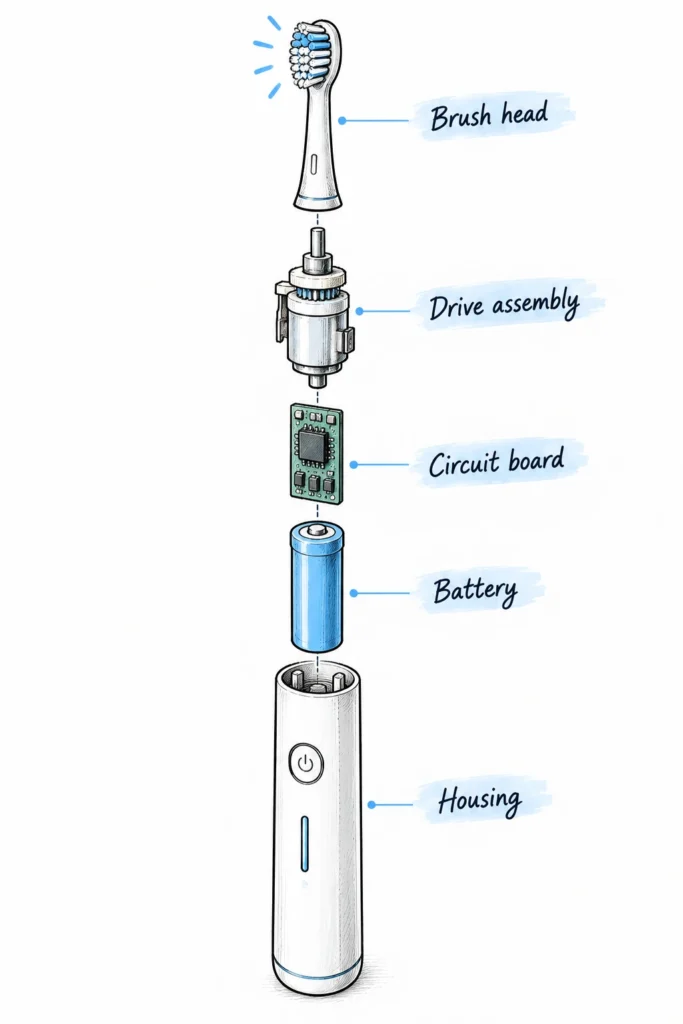
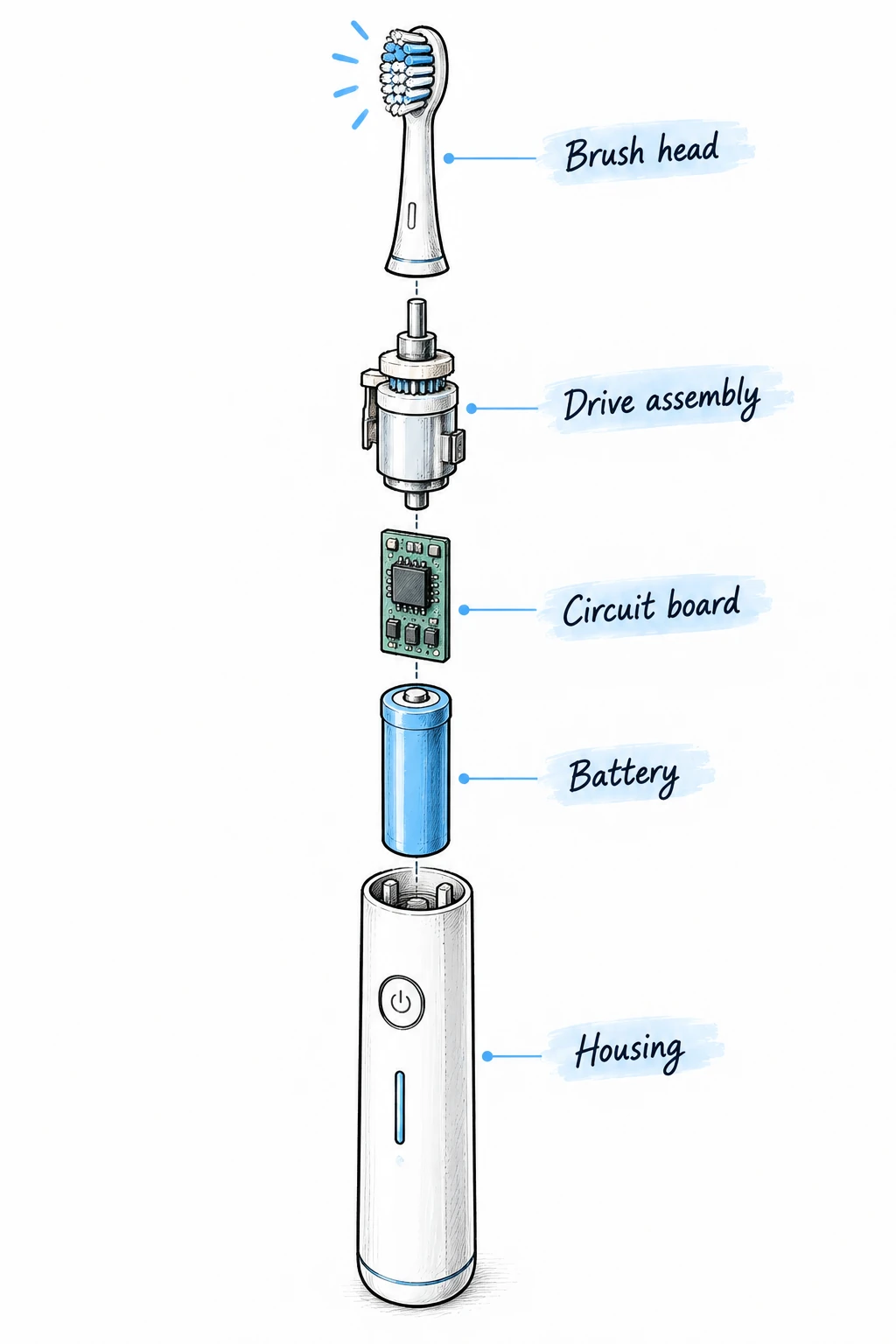
Au-delà de la technologie de nettoyage principale, chaque brosse à dents électrique contient un système de composants interconnectés qui travaillent ensemble pour offrir une expérience de brossage fiable, sûre et conviviale. Comprendre le fonctionnement des brosses à dents électriques au niveau des composants aide les acheteurs OEM à évaluer les compromis qualité-coût lors du développement de produits. Voici une analyse composant par composant.
Batterie Rechargeable
Rechargeable models may use Li-ion or NiMH cells. The existing 600–2,000 mAh range is a product-planning example; compare cell voltage and energy in Wh as well as capacity. Runtime and cycle life depend on the cell, charging system, load and temperature.
Moteur et Circuit d'Entraînement
The motor and driver circuit convert electrical power into brush-head movement. Electromagnetic and geared DC designs may require different power stages; an H-bridge is one possible arrangement.
PCB et Microcontrôleur
MCU 8–32 bits gère les modes de brossage, la minuterie, l'entrée du capteur de pression, les indicateurs LED et la communication BLE dans les modèles intelligents.
Capteur de pression
Pressure detection may use a force sensor, a deflection mechanism or motor-load measurement. The controller compares the signal with a model-specific setting, then activates a warning or adjusts the motor.
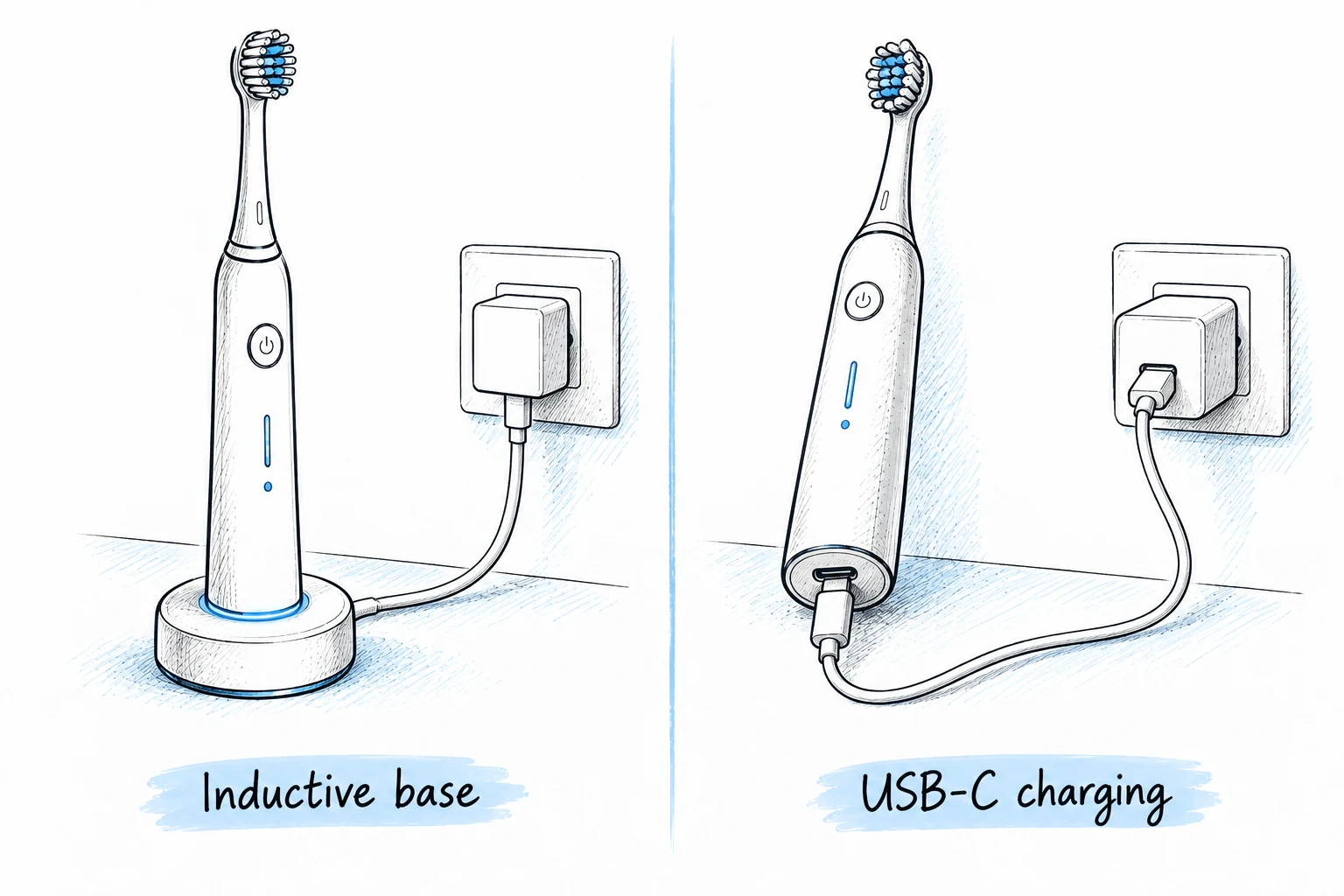
Système de recharge
Charging may use a dedicated inductive base or a wired connection such as USB-C. The input rating, charging time and compatible charger depend on the design. An inductive base is not automatically Qi-compatible.
Tête de Brosse et Arbre d'Entraînement
Tête remplaçable avec poils en nylon ou PBT. Connectée au moteur via un arbre d'entraînement en acier inoxydable ou nylon. Mécanisme de fixation par encliquetage ou verrouillage à torsion.
Le PCB et le Système de Contrôle
Le printed circuit board (PCB) carries the electronics that control modes, timing, indicators and optional sensors or connectivity. A 20–50 mm × 10–25 mm board is one layout example; dimensions depend on the handle and circuit design. Typical functions include:
- Microcontroller (MCU): An 8-bit or 32-bit controller runs the firmware. Select the device for processing, memory, power and interface requirements; a Bluetooth SoC may also perform this role.
- Pilote moteur : A power stage controlled by the MCU supplies the waveform and current required by the selected motor. The circuit may use an H-bridge, depending on the drive architecture.
- Clock source: An internal oscillator or external crystal provides the controller’s timing reference. Some designs use a 32.768 kHz crystal for low-power timekeeping; the required clocks depend on the chosen controller.
- Interface du Capteur de Pression: Un canal de convertisseur analogique-numérique (ADC) qui lit le changement de tension du capteur de pression
- Pilote LED: Circuit de résistance de limitation de courant + transistor contrôlant les LED indicatrices de mode
- SoC BLE (modèles intelligents uniquement) : Un système sur puce Bluetooth Low Energy (Nordic nRF52832 ou similaire) qui gère la communication sans fil avec l'application compagnon
- Charging and battery protection: Charging control, voltage monitoring, temperature checks and protection functions are selected for the cell chemistry and product design. They may be integrated or implemented with separate circuits.
Modes de Brossage et Minuteur par Quadrant
L'une des fonctionnalités les plus précieuses des brosses à dents électriques modernes — tant du point de vue du consommateur que de la conception OEM — est le système de modes de brossage. Le fonctionnement des brosses à dents électriques avec plusieurs modes dépend de profils de fréquence et d'amplitude contrôlés par firmware, gérés par le microcontrôleur. Chaque mode possède un profil de fréquence, d'amplitude et de timing différent, offrant aux utilisateurs une flexibilité pour différents besoins de soins bucco-dentaires.
Modes de brossage courants
| Mode | Fréquence | Amplitude | Durée | Intended Use |
|---|---|---|---|---|
| Nettoyage | Fréquence complète (ex. : 40 000 spm) | Standard | 2 min | Usage quotidien, nettoyage complet |
| Blanc / Polissage | Complète + impulsion intermittente | Plus élevé | 2 min | Élimination des taches de surface, buveurs de café/thé |
| Sensible | 60–70 % de la fréquence maximale | Réduit | 2 min | Users who prefer a gentler brushing feel |
| Soin des gencives / Doux | 40–50 % du max, avec pulsations | Faible | 3 min | Gentle gumline brushing |
| Nettoyage de la langue | Basse fréquence, régulier | Léger | 30 sec | Haleine fraîche, enduit lingual |
| Blanchiment | Alternance haute/basse fréquence | Variable | 3 min | Cycles améliorés d'élimination des taches |
A Minuteur par quadrant gives a brief pause or signal every 30 seconds to prompt a change of brushing area. Four intervals support a two-minute session. This is a pacing aid; users still need to guide the brush over the inner, outer and chewing surfaces.
Technologie de batterie et systèmes de charge
Battery selection affects handle weight, runtime, charging and cost. For an OEM project, compare the cell together with the motor load, standby consumption and charging circuit to match the target use pattern and retail positioning.
Lithium-Ion (Li-ion) vs Nickel-Métal Hydrure (NiMH)
Li-ion cells are widely used in rechargeable toothbrush designs. Check the supplier’s cell drawing and datasheet for voltage, dimensions and capacity. Cylindrical format names are approximate: a 14500 cell is nominally about 14 mm × 50 mm, while 14450 denotes about 14 mm × 45 mm. Dimensions, terminal details and capacity must be confirmed for the selected cell. Key selection factors include:
- Energy density: Compare the selected cells in Wh/kg and Wh/litre; a fixed threefold advantage does not apply to every Li-ion and NiMH design.
- Self-discharge: Cell chemistry, temperature and storage conditions affect charge retention. Low-self-discharge NiMH cells are available, so compare the selected cells’ storage specifications.
- Charging habits: Li-ion cells can normally be topped up within the approved charging limits. Follow the cell supplier’s voltage, current and temperature requirements.
- Cycle life: A full-equivalent cycle is cumulative discharge equal to the cell’s rated capacity, not one brushing session. A 500-cycle rating must state the test conditions and retained-capacity criterion. Brushing frequency alone cannot convert that rating into years of service.
- Charging time: A 1–3 hour charge is possible on a design built for that rate. The battery, charger, thermal limits and power-management circuit determine the result, rather than the connector type alone.
NiMH remains an option where cost, cell availability and the established charging design fit the project. It still requires appropriate charge control and protection against damaging operating conditions. Low-self-discharge variants can retain charge well, and memory-effect behaviour should not be generalised from NiCd batteries.
Systèmes de charge : Inductif vs USB-C
Inductive charging transfers energy between coils in the base and handle. The receiver rectifies and regulates that energy to charge the battery. Removing an exposed charging connector can simplify sealing, but charging efficiency, alignment, heat and full-charge time must be evaluated for the selected design. A dedicated toothbrush base does not necessarily support the Qi standard.
USB-C charging provides a convenient wired connection. Specify the input voltage and current, supported power protocol, charger compatibility and charging time. USB-C does not itself guarantee USB Power Delivery or a 1–3 hour charge. The port, surrounding housing and any cover must form a tested sealing system.
Résistance à l'eau : IPX7 et le défi technique
Water resistance depends on the complete enclosure and its seals. IPX7 addresses temporary immersion under defined test conditions, commonly described for a small device as 1 metre for 30 minutes. It does not establish protection against water jets, all shower conditions or indefinite immersion, and it does not automatically apply to the charger. Follow the product’s stated cleaning and charging instructions.
Enrobage et soudure ultrasonique
Potting or encapsulation can protect selected electronics with a compatible epoxy or silicone material. It is one part of the sealing strategy alongside housing joints, shaft seals and charging interfaces. The existing USD 0.80–2.50 per-unit allowance is a planning example; material volume, curing, labour and repairability affect the final cost.
Soudage par ultrasons can join compatible plastic housing parts using high-frequency mechanical vibration. Equipment in the 20–40 kHz range is one example. Joint geometry, material and process settings determine weld strength and sealing quality; verify both on the finished assembly.
Pour la zone de fixation de la tête de brosse — le point d’étanchéité le plus sollicité mécaniquement — des joints toriques en silicone ou un mastic liquide sont utilisés. L’arbre d’entraînement traverse ce joint via une bague à tolérance serrée, maintenant l’étanchéité tout en permettant un mouvement rotatif ou linéaire.
Besoin d’aide pour spécifier votre brosse à dents électrique ?
Vous vous demandez comment fonctionne une brosse à dents électrique pour votre marque ? Nos ingénieurs peuvent vous guider dans la sélection du moteur, la stratégie d’étanchéité et l’optimisation des coûts BOM pour votre marché cible.
Parlez à notre équipe d'ingénierieBrosses à dents intelligentes : capteurs, BLE et connectivité d’application
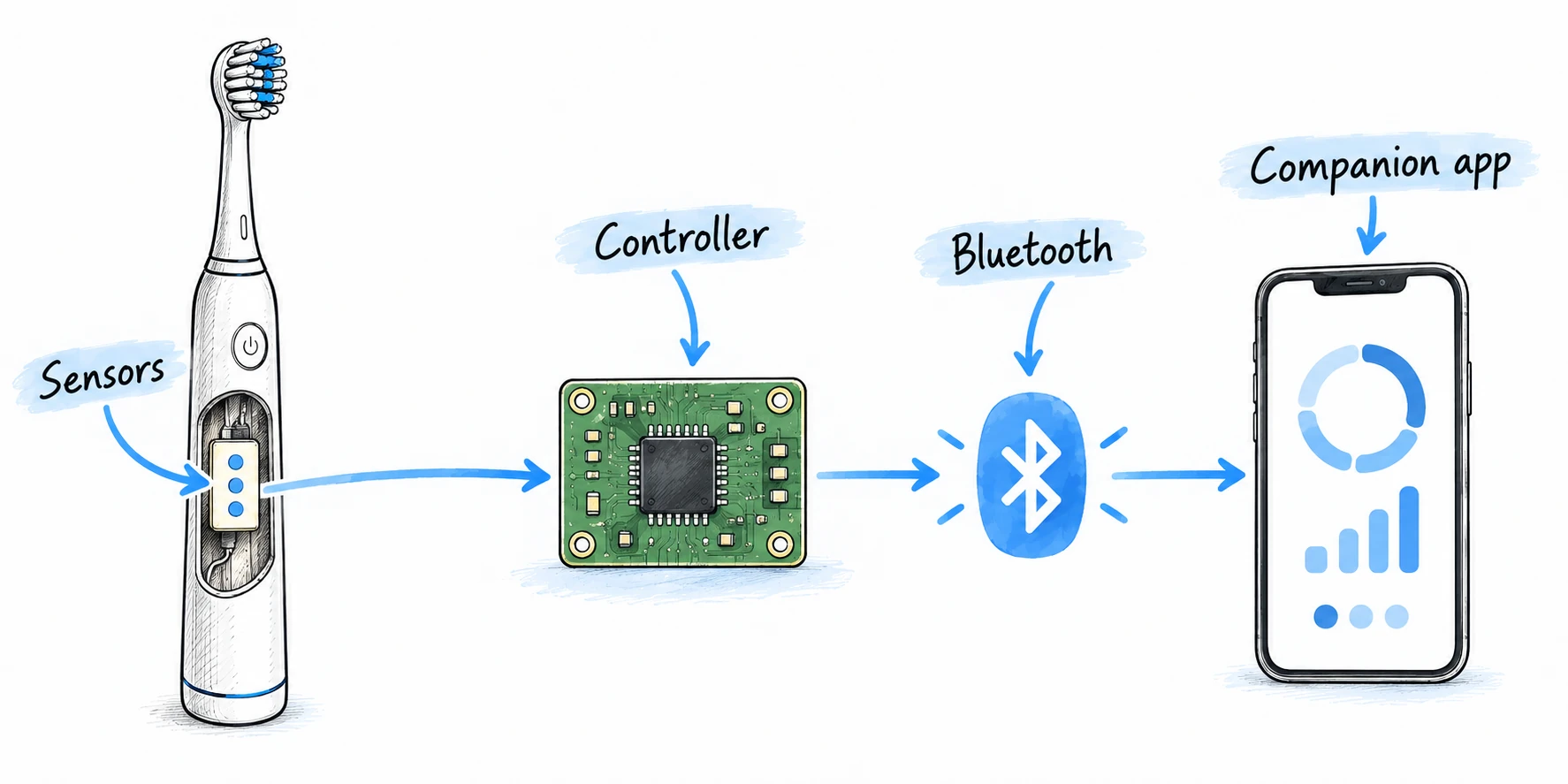
Smart toothbrushes combine a brushing platform with Connectivité Bluetooth, optional sensors and companion software. A connected and non-connected model may share a motor or brush head, while other designs use different components. Specify the physical cleaning performance and the data functions separately.
Principales fonctions intelligentes et leurs capteurs
| Fonctionnalité intelligente | Capteur utilisé | Détail technique |
|---|---|---|
| Durée du brossage | Horloge temps réel (minuterie MCU) | Intégrée au MCU — aucun capteur supplémentaire nécessaire |
| Détection de pression | Force sensor, deflection sensing or motor-load measurement | Position and calibration depend on the sensing design |
| Détection de position | IMU à 6 axes (accéléromètre + gyroscope) | Estimates movement and brushing zones through a validated algorithm |
| Usure de la tête de brosse | Usage timer or session counter; additional sensing if fitted | Prompts replacement based on use; does not directly measure every bristle’s condition |
| Santé de la batterie | Circuit intégré de jauge de carburant (compteur de coulombs) | Estimates remaining charge; cycle and health data depend on the implementation |
| Appairage Bluetooth | Bluetooth Low Energy SoC | For example, a Nordic nRF52-series device; select for the required features |
A six-axis inertial measurement unit (IMU) combines a three-axis accelerometer and three-axis gyroscope. Software can use these signals to estimate brushing movement and mouth zones. Accuracy depends on sensor placement, calibration, the algorithm and user behaviour. Zone feedback is an estimate of brushing activity, rather than a direct measurement of plaque removal or oral health.
La perspective OEM sur les coûts des brosses à dents intelligentes
Smart functions add connectivity, sensing and software to a product that already uses electronic control. The existing USD 8–25 per-unit estimate is a planning allowance for additional hardware, not an app-development quotation. Check which components are already included in the base platform to avoid double-counting. Example budget items include:
- BLE SoC and antenna: USD 2.50–5.00 as a planning allowance. Nordic nRF52840 and Realtek RTL8762 are examples; suitability depends on the selected part and software requirements.
- Six-axis IMU: USD 1.50–4.00 as a planning allowance. Examples include TDK InvenSense ICM-42670 and Bosch Sensortec BMI270.
- Pressure sensing: USD 0.30–1.00 as a planning allowance; the sensing method and required calibration determine the actual cost.
- App development: An illustrative one-time budget of USD 30,000–150,000 for iOS and Android. Scope separately for maintenance, cloud services, privacy controls and operating-system updates.
- Additional PCB layers and components: USD 1.00–3.00 as a planning allowance; confirm overlap with the selected connectivity and sensor modules.
A USD 25–60 retail premium is a positioning example for a connected model. Assess the selling price alongside channel costs, software maintenance, returns and the complete product cost before estimating profitability.
Technologie de désinfection UV
A UV sanitizing base uses a separate UV-C light system to reduce microorganisms on exposed brush-head surfaces. Wavelength, dose, exposure time, lamp placement, shadows and the tested organism determine the result. A 254 nm lamp and a 5–10 minute cycle describe particular designs; they do not establish a universal 99.9% reduction for all bacteria and viruses. Use product-specific test results for performance claims, and prevent eye or skin exposure with an enclosed design and suitable interlocks.
UV-C sources may include low-pressure mercury lamps or UV-C LEDs. Compare wavelength, delivered dose, thermal management, service life, material compatibility and disposal requirements for the selected source. Lamp type alone does not determine which complete sanitizer is more effective or durable.
The existing USD 3.50–8.00 BOM allowance illustrates a UV-base option. The light source, enclosure, control system and safety interlocks affect cost and packaging size. Position the feature using the selected product’s tested performance.
Têtes de brosse : science et ingénierie des brins
Alors que le manche contient toute l'intelligence électronique, la tête de brosse est là où le nettoyage se produit réellement. Comprendre comment fonctionnent les brosses à dents électriques pour offrir des soins bucco-dentaires efficaces nécessite de connaître l'ingénierie des têtes de brosse — le matériau des brins, le diamètre, la configuration des touffes et les propriétés de flexion influencent tous les performances de nettoyage et l'expérience utilisateur.
Matériaux des brins
Brush-head performance depends on filament material, diameter, length, taper and tuft arrangement. Nylon 612 and PBT are material options; PBT is not automatically softer than nylon. Define the required brushing feel and inspect filament ends, tuft retention and mechanical performance against the applicable specification. ISO 20127:2025 covers physical properties of powered toothbrushes; its end-rounding requirements have exceptions for specified filament types, so a universal tip-radius rule is inappropriate.
Brins indicateurs
Colour-fading indicator bristles provide a visual replacement reminder. Fading depends on the filament treatment, brushing habits and exposure; it is not a precise three-month clock. The existing USD 0.05–0.15 per-head allowance is a planning example. Colour-treated or mixed-colour filaments do not inherently require two-material injection moulding. Follow the brush-head replacement instructions and replace sooner when the bristles are worn.
Fabrication OEM : de la sélection des composants à la production de masse
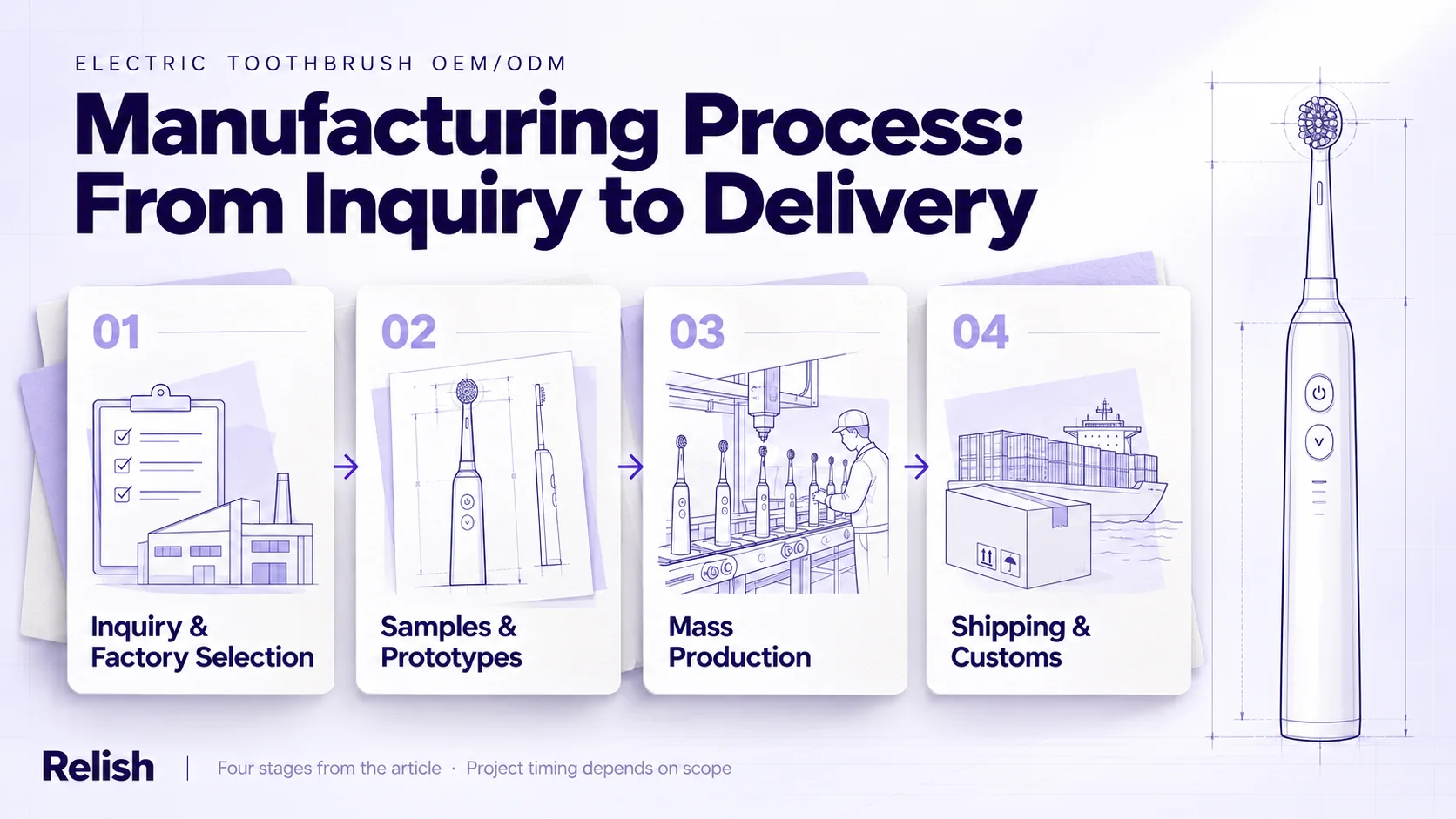
Comprendre comment fonctionnent les brosses à dents électriques d'un point de vue fabrication est la base pour prendre des décisions d'approvisionnement OEM intelligentes. Chaque choix technique — type de moteur, capacité de la batterie, méthode d'étanchéité, intégration de capteurs intelligents — a un impact direct et quantifiable sur le coût de fabrication, la qualité du produit et le positionnement au détail. Lisez notre guide OEM pour brosses à dents électriques pour une analyse plus approfondie du parcours de fabrication.
At Relish Technology, motor engineering, electronics, sealing and app connectivity inform the development process. The following 28-week schedule illustrates a new-product project; an existing platform or a more complex programme will follow a different timeline.
- Validation du concept (semaines 1 à 4) : Définir la spécification du produit — type de technologie (sonique/rotative/Rotasonic), marchés cibles, certifications requises, niveau de prix. Cela oriente toutes les décisions ultérieures.
- Développement du prototype (semaines 5 à 12) : Construire des prototypes fonctionnels du manche, de l'électronique et de la tête de brosse. Tester les performances du moteur, l'autonomie de la batterie, l'étanchéité et le firmware du PCB. Quantité typique de prototypes : 3 à 10 unités.
- Validation de pré-production (semaines 13 à 20) : Tests de validation d'ingénierie (EVT) et tests de validation de conception (DVT) — tests d'immersion IPX7, tests de chute, tests CEM, tests de cycle de batterie et tests de pré-conformité réglementaire.
- Préparation de la production de masse (semaines 21 à 28) : Achèvement de l'outillage, première inspection d'article, essai pilote (100 à 300 unités) et mise en place du système qualité incluant les plans d'échantillonnage AQL.
- Production and shipment: Full production combines in-process checks, functional testing and agreed sampling inspections. Define defect categories and acceptance criteria in the quality agreement. Safety-critical defects require a zero-acceptance approach; an AQL value must not be presented as permission to ship a known critical defect. Visite de nos installations de production pour voir nos capacités de production de première main.
Comment choisir la bonne technologie pour votre marque
Avec les fondations techniques établies, voici un cadre décisionnel pour les propriétaires de marques et les responsables des achats qui sélectionnent un partenaire OEM pour le développement de brosses à dents électriques. Comprendre le fonctionnement des brosses à dents électriques dans les trois catégories technologiques — sonique, rotation-oscillation et Rotasonic™ — permet des échanges plus éclairés avec les fabricants et des spécifications produit plus précises.
| Critères | Sonique | Rotation-Oscillation | Rotasonic™ (Combinaison) |
|---|---|---|---|
| Fourchette de coût BOM | $12-$28 | $8-$20 | $18–$38 |
| Positionnement du prix de détail | Milieu à Premium | Entrée à Milieu | Premium à Ultra-Premium |
| Niveau de bruit | Depends on drive, mounting and operating mode | Depends on drive, gearing and operating mode | Depends on the combined drive design |
| Cleaning Action | Bristle movement and nearby liquid agitation | Alternating angular movement with bristle contact | Combined sonic and oscillating-rotating movement |
| Meilleure adéquation au marché | Marques grand public premium | Marques de valeur, Amazon FBA | Brands seeking a dual-action platform |
| Adéquation aux fonctions intelligentes | Excellent | Bon | Excellent |
Prêt à lancer votre projet de brosse à dents électrique OEM ?
Que vous lanciez une nouvelle marque, élargissiez une gamme existante ou recherchiez des produits pour la vente au détail — Relish Technology's engineering team peut vous aider à sélectionner la bonne plateforme technologique et à naviguer tout au long du parcours, du concept à la production de masse.
Parlez à notre équipe d'ingénierieISO 13485 · FDA/CE Compliance Support · 15+ Years OEM Experience · 20,000 m² Manufacturing Facility
Questions fréquentes
Answers to common questions about electric toothbrush mechanisms, components, charging, sensors and OEM product development.
Références et sources
- American Dental Association. Brosses à dents. Brosses à dents.
- Commission électrotechnique internationale. IEC 60335-2-52:2021 — Particular requirements for oral hygiene appliances. IEC 60335-2-52:2021 — Particular requirements for oral hygiene appliances.
- International Organization for Standardization. ISO 20127:2025 — Dentistry — Physical properties of powered toothbrushes. ISO 20127:2025 — Dentistry — Physical properties of powered toothbrushes.
- U.S. Food and Drug Administration. Powered toothbrush classification: JEQ, 21 CFR 872.6865, Class I; 510(k)-exempt within applicable limits. Powered toothbrush classification: JEQ, 21 CFR 872.6865, Class I; 510(k)-exempt within applicable limits.
- Nordic Semiconductor. nRF52840 Product Specification. nRF52840 Product Specification.
- Bosch Sensortec. BMI270 inertial measurement unit. BMI270 inertial measurement unit.