

Hoe elektrische tandenborstels werken:
Complete Technische Gids 2026
Explore the motors, batteries, electronics and sealing systems inside electric toothbrushes, with practical engineering choices for OEM product development.
Runtime examples assume two brushing sessions of two minutes each per day. Brush movement rates and battery performance depend on the model and operating mode.
Elektrische tandenborstels zijn bedrieglijk complexe machines. In de kern combineren ze precisiemotoren, intelligente regelsystemen, oplaadbare stroombronnen en ergonomisch ontwerp in een apparaat dat in de palm van je hand past — en toch tienduizenden precieze mechanische bewegingen per poetsbeurt uitvoert. Deze gids legt precies uit hoe elektrische tandenborstels werken, van de fysica van sonische trillingen tot de technische beslissingen die OEM-productie vormgeven.
Belangrijkste punten
- The three platforms covered here are sonisch, oscillating-rotating en combination systems such as Relish Technology’s Rotasonic™. Each offers different drive mechanisms and product development options.
- Sonic toothbrushes clean through borstelcontact and agitate the liquid around the brush head. Effective cleaning still depends on reaching tooth surfaces with the bristles.
- The motor, PCB and battery sit inside a sealed handle. IPX7 applies to the tested enclosure, rather than separately certifying every internal component.
- Batterijtechnologie (Li-ion vs NiMH) heeft directe invloed op gewicht, gebruiksduur en oplaadtijd, alle kritieke OEM-beslispunten
- Pressure feedback can use force sensing, mechanical deflection or motor-load measurement to alert users when they exceed a model-specific brushing-pressure setting.
- Slimme tandenborstels voegen Bluetooth connectivity, sensors and a companion app. The underlying cleaning platform may be shared with a non-connected model.
- For OEM buyers, the motor, battery, electronics, brush head, housing, finishing and packaging all affect the bill of materials (BOM) and the final quotation.
- Relish Technology’s Vibrosonic™-platform offers up to 000 slagen/min with a dual-harmonic drive approach. Select the operating profile to suit the product specification.
De Drie Kerntechnologieën van Elektrische Tandenborstels
This guide compares sonic, oscillating-rotating and combination platforms. Their drive mechanisms influence head movement, noise, power consumption and cost, while the complete product design determines the final performance.
Sonische Technologie: Magnetische Spoeltrilling
Many sonic toothbrushes use an electromagnetic drive system to create rapid movement at the brush head. The motor’s magnetic circuit, suspension and output shaft determine whether that movement is linear, angular or a combination. “Sonic” describes the operating approach; it does not mean every model uses the same voice-coil or linear resonant actuator.
In an electromagnetic drive, controlled current in the coil produces a changing magnetic force that moves the drive assembly. The shaft transfers that motion to the brush head. Keep frequency and movement counts separate: 120–240 Hz equals 7,200–14,400 complete cycles per minute. If each direction is counted as one stroke, that is 14,400–28,800 strokes/min. Compare models only after checking how the manufacturer counts strokes.
Rapid brush-head movement also agitates toothpaste and saliva near the bristles. This fluid movement is distinct from demonstrated clinical cleaning at a fixed distance. Guide the bristles over the tooth surfaces and gumline; a stated movement rate alone does not establish cleaning depth or a gingivitis-reduction result.
Relish Technology’s proprietary Vibrosonic™-platform uses a controlled secondary harmonic layer alongside the main drive profile. For an OEM project, our engineers can help specify the movement rate, amplitude and brushing modes to achieve the intended brushing feel and product positioning.
Roterende-Oscillerende Technologie: DC-tandwielmotor
Oscillating-rotating toothbrushes move the brush head back and forth through an angle. In a geared design, a small Gelijkstroommotor drives a transmission that converts shaft rotation into this alternating motion. Other architectures use different actuators or linkages, so the actual drive system should be checked in the product specification.
Head movement is described by its oscillation rate and angular travel. An advertised 5,000–10,000 movements per minute should not be labelled “rpm” unless it measures complete revolutions. Cleaning relies on borstelcontact, with the alternating movement helping the user clean tooth surfaces.
A geared DC drive can be a cost-effective option for an OEM project. Compare the complete transmission, noise, durability, head compatibility and assembly requirements with the sonic alternatives; motor price alone does not determine the best platform.
Combinatie / Rotasonic-technologie
Om te begrijpen hoe elektrische tandenborstels werken met combinatietechnologie, wordt de Rotasonic™-benadering onthuld. De derde categorie is de combinatie- of hybride benadering — apparaten die zowel sonische trilling als roterende-oscillerende actie tegelijkertijd gebruiken. Dit is waar Rotasonic™ technologie, ontwikkeld bij Relish Technology, zich bevindt.
Rotasonic™ brings sonic vibration and oscillating-rotating action into a dual-action cleaning platform. The actuator and transmission configuration depends on the model. OEM buyers can work with our engineers to compare head movement, brushing feel, noise and cost against the target specification.
De Anatomie van een Elektrische Tandenborstel
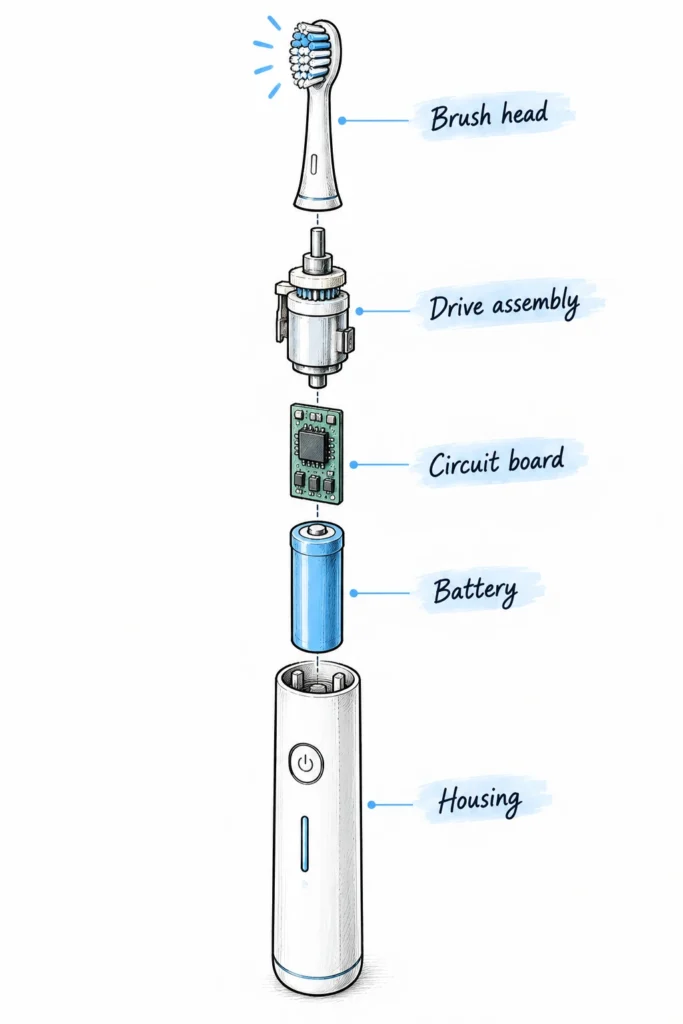
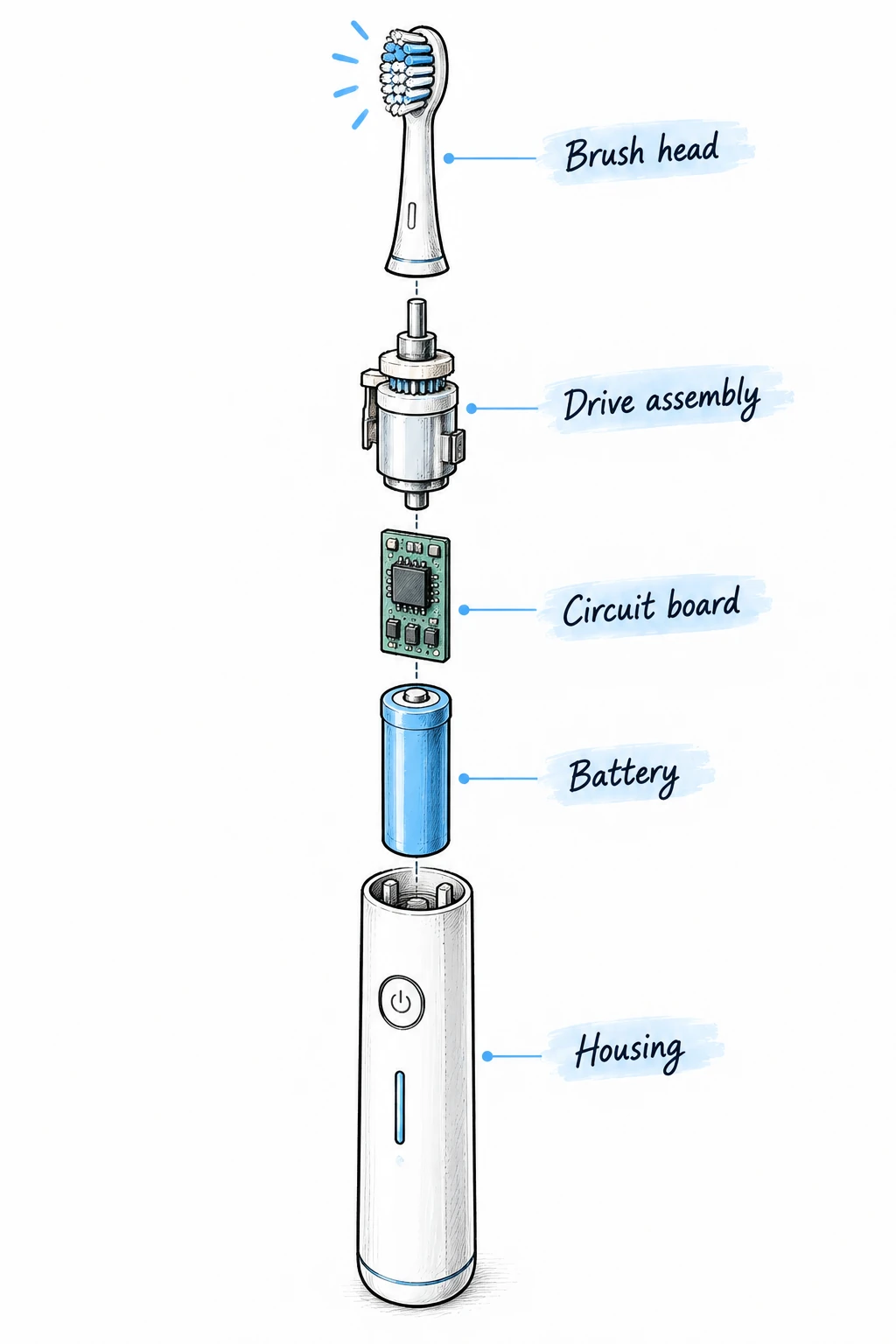
Naast de kernreinigingstechnologie bevat elke elektrische tandenborstel een systeem van onderling verbonden componenten die samenwerken om een betrouwbare, veilige en gebruiksvriendelijke poetservaring te bieden. Inzicht in hoe elektrische tandenborstels werken op componentniveau helpt OEM-kopers om kwaliteits- en kostenafwegingen te evalueren tijdens productontwikkeling. Hier is een component-voor-component uitsplitsing.
Oplaadbare Batterij
Rechargeable models may use Li-ion or NiMH cells. The existing 600–2,000 mAh range is a product-planning example; compare cell voltage and energy in Wh as well as capacity. Runtime and cycle life depend on the cell, charging system, load and temperature.
Motor & Aandrijfcircuit
The motor and driver circuit convert electrical power into brush-head movement. Electromagnetic and geared DC designs may require different power stages; an H-bridge is one possible arrangement.
PCB & Microcontroller
8–32 bit MCU beheert poetsmodi, timer, druksensorinvoer, LED-indicatoren en BLE-communicatie in slimme modellen.
Druksensor
Pressure detection may use a force sensor, a deflection mechanism or motor-load measurement. The controller compares the signal with a model-specific setting, then activates a warning or adjusts the motor.
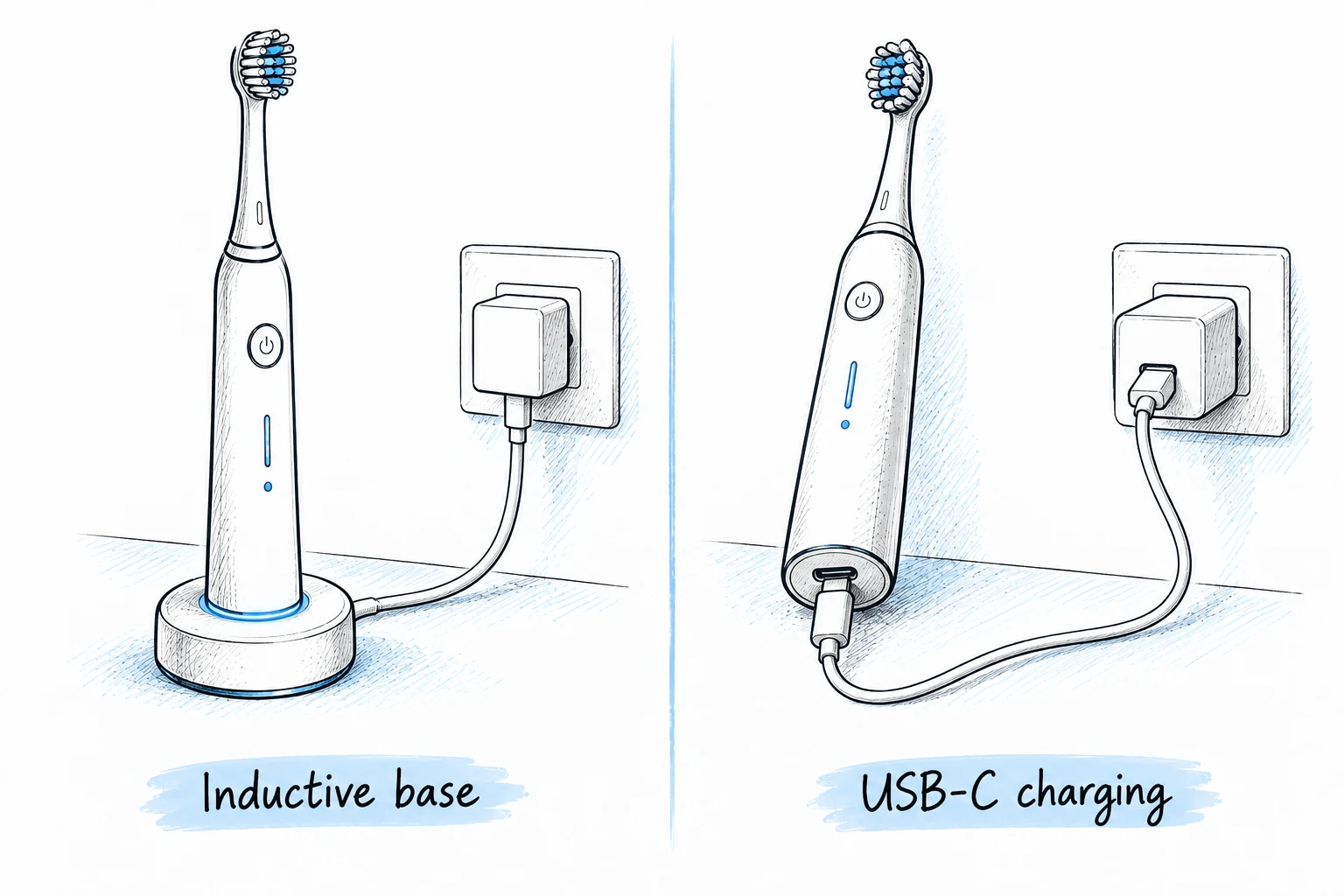
Oplaadsysteem
Charging may use a dedicated inductive base or a wired connection such as USB-C. The input rating, charging time and compatible charger depend on the design. An inductive base is not automatically Qi-compatible.
Borstelkop & Aandrijfas
Vervangbare kop met nylon of PBT-borstels. Verbonden met motor via roestvrijstalen of nylon aandrijfas. Klik- of draaibevestigingsmechanisme.
De PCB en het Besturingssysteem
De printed circuit board (PCB) carries the electronics that control modes, timing, indicators and optional sensors or connectivity. A 20–50 mm × 10–25 mm board is one layout example; dimensions depend on the handle and circuit design. Typical functions include:
- Microcontroller (MCU): An 8-bit or 32-bit controller runs the firmware. Select the device for processing, memory, power and interface requirements; a Bluetooth SoC may also perform this role.
- Motordriver: A power stage controlled by the MCU supplies the waveform and current required by the selected motor. The circuit may use an H-bridge, depending on the drive architecture.
- Clock source: An internal oscillator or external crystal provides the controller’s timing reference. Some designs use a 32.768 kHz crystal for low-power timekeeping; the required clocks depend on the chosen controller.
- Druksensor Interface: Een analoog-naar-digitaal converter (ADC) kanaal dat de spanningsverandering van de druksensor uitleest
- LED-aandrijving: Stroombegrenzende weerstand + transistorcircuit dat de modusindicator-LED's aanstuurt
- BLE SoC (alleen slimme modellen): Een Bluetooth Low Energy system-on-chip (Nordic nRF52832 of vergelijkbaar) die draadloze communicatie met de bijbehorende app afhandelt
- Charging and battery protection: Charging control, voltage monitoring, temperature checks and protection functions are selected for the cell chemistry and product design. They may be integrated or implemented with separate circuits.
Poetsmodi en de Kwadranttimer
Een van de meest waardevolle functies van moderne elektrische tandenborstels — zowel vanuit consumenten- als OEM-ontwerpperspectief — is het poetsmodussysteem. Hoe elektrische tandenborstels werken met meerdere modi hangt af van firmware-gestuurde frequentie- en amplitudeprofielen die worden beheerd door de microcontroller. Elke modus heeft een ander frequentie-, amplitude- en tijdsprofiel, waardoor gebruikers flexibiliteit krijgen voor verschillende mondverzorgingsbehoeften.
Veelvoorkomende poetsmodi
| Modus | Frequentie | Amplitude | Duur | Intended Use |
|---|---|---|---|---|
| Reinigen | Volledige frequentie (bijv. 40.000 spm) | Standaard | 2 min | Dagelijks gebruik, allesomvattende reiniging |
| Wit / Polijsten | Volledig + intermitterende puls | Hoger | 2 min | Verwijdering van oppervlaktevlekken, koffie-/theedrinkers |
| Gevoelig | 60–70% van maximale frequentie | Verminderd | 2 min | Users who prefer a gentler brushing feel |
| Tandvleesverzorging / Zacht | 40–50% van max, pulserend | Laag | 3 min | Gentle gumline brushing |
| Tongreiniging | Lage frequentie, stabiel | Licht | 30 sec | Ademverfrissing, tongcoating |
| Whitening | Afwisselend hoog/laag | Afhankelijk van de uitvoering | 3 min | Verbeterde vlekverwijderingscycli |
A kwadranttimer gives a brief pause or signal every 30 seconds to prompt a change of brushing area. Four intervals support a two-minute session. This is a pacing aid; users still need to guide the brush over the inner, outer and chewing surfaces.
Batterijtechnologie en oplaadsystemen
Battery selection affects handle weight, runtime, charging and cost. For an OEM project, compare the cell together with the motor load, standby consumption and charging circuit to match the target use pattern and retail positioning.
Lithium-ion (Li-ion) versus nikkel-metaalhydride (NiMH)
Li-ion cells are widely used in rechargeable toothbrush designs. Check the supplier’s cell drawing and datasheet for voltage, dimensions and capacity. Cylindrical format names are approximate: a 14500 cell is nominally about 14 mm × 50 mm, while 14450 denotes about 14 mm × 45 mm. Dimensions, terminal details and capacity must be confirmed for the selected cell. Key selection factors include:
- Energy density: Compare the selected cells in Wh/kg and Wh/litre; a fixed threefold advantage does not apply to every Li-ion and NiMH design.
- Self-discharge: Cell chemistry, temperature and storage conditions affect charge retention. Low-self-discharge NiMH cells are available, so compare the selected cells’ storage specifications.
- Charging habits: Li-ion cells can normally be topped up within the approved charging limits. Follow the cell supplier’s voltage, current and temperature requirements.
- Cycle life: A full-equivalent cycle is cumulative discharge equal to the cell’s rated capacity, not one brushing session. A 500-cycle rating must state the test conditions and retained-capacity criterion. Brushing frequency alone cannot convert that rating into years of service.
- Charging time: A 1–3 hour charge is possible on a design built for that rate. The battery, charger, thermal limits and power-management circuit determine the result, rather than the connector type alone.
NiMH remains an option where cost, cell availability and the established charging design fit the project. It still requires appropriate charge control and protection against damaging operating conditions. Low-self-discharge variants can retain charge well, and memory-effect behaviour should not be generalised from NiCd batteries.
Oplaadsystemen: Inductief versus USB-C
Inductive charging transfers energy between coils in the base and handle. The receiver rectifies and regulates that energy to charge the battery. Removing an exposed charging connector can simplify sealing, but charging efficiency, alignment, heat and full-charge time must be evaluated for the selected design. A dedicated toothbrush base does not necessarily support the Qi standard.
USB-C charging provides a convenient wired connection. Specify the input voltage and current, supported power protocol, charger compatibility and charging time. USB-C does not itself guarantee USB Power Delivery or a 1–3 hour charge. The port, surrounding housing and any cover must form a tested sealing system.
Waterbestendigheid: IPX7 en de technische uitdaging
Water resistance depends on the complete enclosure and its seals. IPX7 addresses temporary immersion under defined test conditions, commonly described for a small device as 1 metre for 30 minutes. It does not establish protection against water jets, all shower conditions or indefinite immersion, and it does not automatically apply to the charger. Follow the product’s stated cleaning and charging instructions.
Potting en ultrasoonlassen
Potting or encapsulation can protect selected electronics with a compatible epoxy or silicone material. It is one part of the sealing strategy alongside housing joints, shaft seals and charging interfaces. The existing USD 0.80–2.50 per-unit allowance is a planning example; material volume, curing, labour and repairability affect the final cost.
Ultrasoon lassen can join compatible plastic housing parts using high-frequency mechanical vibration. Equipment in the 20–40 kHz range is one example. Joint geometry, material and process settings determine weld strength and sealing quality; verify both on the finished assembly.
Voor het bevestigingsgebied van de borstelkop — het meest mechanisch belaste afdichtingspunt — worden siliconen O-ringen of vloeibare pakkingafdichting gebruikt. De aandrijfas gaat door deze afdichting via een bus met nauwe tolerantie, waardoor waterdichtheid behouden blijft terwijl rotatie- of lineaire beweging mogelijk is.
Hulp nodig bij het specificeren van uw elektrische tandenborstel?
Benieuwd hoe een elektrische tandenborstel werkt voor uw merk? Onze ingenieurs kunnen u begeleiden bij de motorkeuze, waterdichtheidsstrategie en BOM-kostenoptimalisatie voor uw doelmarkt.
Praat met ons technisch teamSlimme tandenborstels: sensoren, BLE en app-connectiviteit
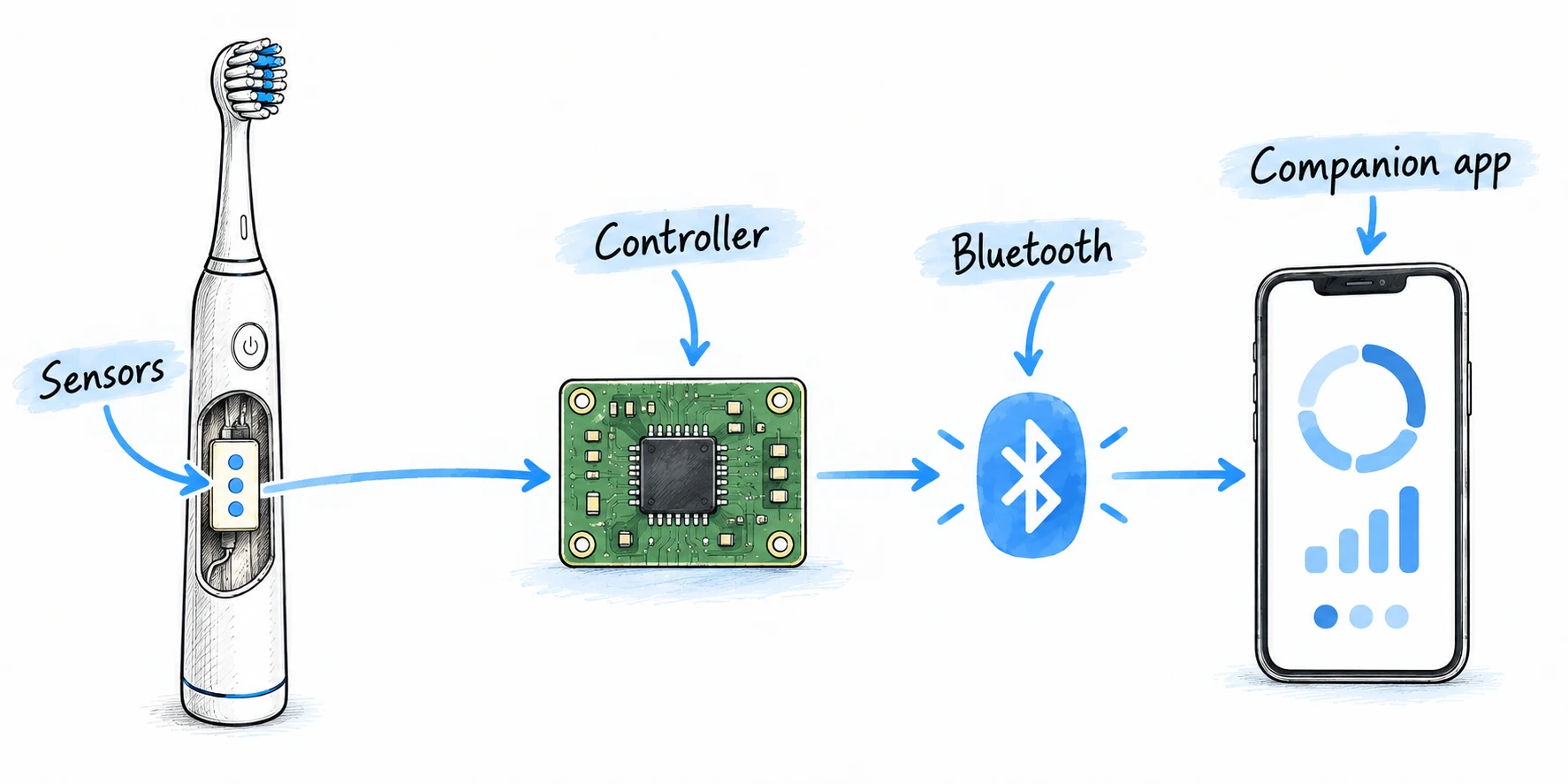
Smart toothbrushes combine a brushing platform with Bluetooth-verbinding, optional sensors and companion software. A connected and non-connected model may share a motor or brush head, while other designs use different components. Specify the physical cleaning performance and the data functions separately.
Belangrijke slimme functies en hun sensoren
| Slimme functie | Gebruikte sensor | Technisch detail |
|---|---|---|
| Poetsduur | Real-time klok (MCU-timer) | Ingebouwd in MCU — geen extra sensor nodig |
| Drukdetectie | Force sensor, deflection sensing or motor-load measurement | Position and calibration depend on the sensing design |
| Positiedetectie | 6-assige IMU (versnellingsmeter + gyroscoop) | Estimates movement and brushing zones through a validated algorithm |
| Borstelkopslijtage | Usage timer or session counter; additional sensing if fitted | Prompts replacement based on use; does not directly measure every bristle’s condition |
| Batterijgezondheid | Brandstofmeter-IC (coulombteller) | Estimates remaining charge; cycle and health data depend on the implementation |
| Bluetooth-koppeling | Bluetooth Low Energy SoC | For example, a Nordic nRF52-series device; select for the required features |
A six-axis inertial measurement unit (IMU) combines a three-axis accelerometer and three-axis gyroscope. Software can use these signals to estimate brushing movement and mouth zones. Accuracy depends on sensor placement, calibration, the algorithm and user behaviour. Zone feedback is an estimate of brushing activity, rather than a direct measurement of plaque removal or oral health.
Het OEM-perspectief op slimme tandenborstelkosten
Smart functions add connectivity, sensing and software to a product that already uses electronic control. The existing USD 8–25 per-unit estimate is a planning allowance for additional hardware, not an app-development quotation. Check which components are already included in the base platform to avoid double-counting. Example budget items include:
- BLE SoC and antenna: USD 2.50–5.00 as a planning allowance. Nordic nRF52840 and Realtek RTL8762 are examples; suitability depends on the selected part and software requirements.
- Six-axis IMU: USD 1.50–4.00 as a planning allowance. Examples include TDK InvenSense ICM-42670 and Bosch Sensortec BMI270.
- Pressure sensing: USD 0.30–1.00 as a planning allowance; the sensing method and required calibration determine the actual cost.
- App development: An illustrative one-time budget of USD 30,000–150,000 for iOS and Android. Scope separately for maintenance, cloud services, privacy controls and operating-system updates.
- Additional PCB layers and components: USD 1.00–3.00 as a planning allowance; confirm overlap with the selected connectivity and sensor modules.
A USD 25–60 retail premium is a positioning example for a connected model. Assess the selling price alongside channel costs, software maintenance, returns and the complete product cost before estimating profitability.
UV-ontsmettingstechnologie
A UV sanitizing base uses a separate UV-C light system to reduce microorganisms on exposed brush-head surfaces. Wavelength, dose, exposure time, lamp placement, shadows and the tested organism determine the result. A 254 nm lamp and a 5–10 minute cycle describe particular designs; they do not establish a universal 99.9% reduction for all bacteria and viruses. Use product-specific test results for performance claims, and prevent eye or skin exposure with an enclosed design and suitable interlocks.
UV-C sources may include low-pressure mercury lamps or UV-C LEDs. Compare wavelength, delivered dose, thermal management, service life, material compatibility and disposal requirements for the selected source. Lamp type alone does not determine which complete sanitizer is more effective or durable.
The existing USD 3.50–8.00 BOM allowance illustrates a UV-base option. The light source, enclosure, control system and safety interlocks affect cost and packaging size. Position the feature using the selected product’s tested performance.
Borstelkoppen: Borstelhaarwetenschap en -techniek
Terwijl het handvat alle elektronische intelligentie bevat, vindt de daadwerkelijke reiniging plaats op de borstelkop. Inzicht in hoe elektrische tandenborstels werken om effectieve mondverzorging te leveren, vereist kennis van borstelkoptechniek — borstelmateriaal, diameter, tuftconfiguratie en buigeigenschappen beïnvloeden allemaal de reinigingsprestaties en gebruikerservaring.
Materialen van de borstelharen
Brush-head performance depends on filament material, diameter, length, taper and tuft arrangement. Nylon 612 and PBT are material options; PBT is not automatically softer than nylon. Define the required brushing feel and inspect filament ends, tuft retention and mechanical performance against the applicable specification. ISO 20127:2025 covers physical properties of powered toothbrushes; its end-rounding requirements have exceptions for specified filament types, so a universal tip-radius rule is inappropriate.
Indicatorborstels
Colour-fading indicator bristles provide a visual replacement reminder. Fading depends on the filament treatment, brushing habits and exposure; it is not a precise three-month clock. The existing USD 0.05–0.15 per-head allowance is a planning example. Colour-treated or mixed-colour filaments do not inherently require two-material injection moulding. Follow the brush-head replacement instructions and replace sooner when the bristles are worn.
OEM-productie: Van componentselectie tot massaproductie
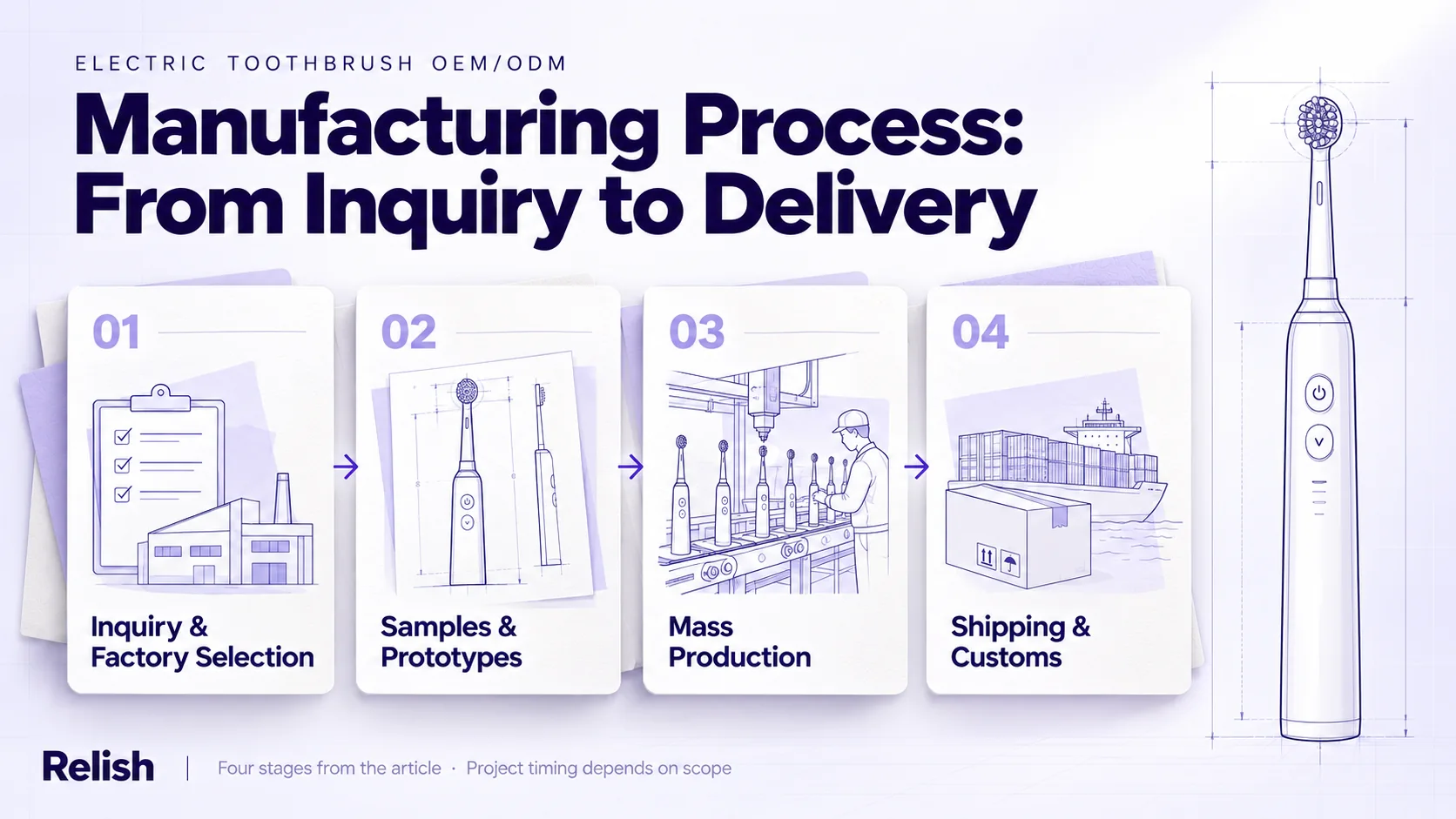
Inzicht in hoe elektrische tandenborstels werken vanuit een productieperspectief is de basis voor het nemen van intelligente OEM-inkoopbeslissingen. Elke technische keuze — motortype, batterijcapaciteit, waterdichtingsmethode, integratie van slimme sensoren — heeft een directe, kwantificeerbare impact op productiekosten, productkwaliteit en retailpositionering. Lees onze OEM-gids voor elektrische tandenborstels voor een diepere duik in het productietraject.
At Relish Technology, motor engineering, electronics, sealing and app connectivity inform the development process. The following 28-week schedule illustrates a new-product project; an existing platform or a more complex programme will follow a different timeline.
- Conceptvalidatie (weken 1–4): Definieer productspecificatie — technologie type (sonisch/roterend/Rotasonic), doelmarkten, vereiste certificeringen, prijsniveau. Dit stuurt alle volgende beslissingen.
- Prototypeontwikkeling (weken 5–12): Bouw functionele prototypes van handvat, elektronica en borstelkop. Test motorprestaties, batterijduur, waterdichtheid en PCB-firmware. Typische prototypenhoeveelheid: 3–10 stuks.
- Pre-productievalidatie (weken 13–20): Engineering validatietesten (EVT) en design validatietesten (DVT) — IPX7-onderdompelingstesten, valtesten, EMC-testen, batterijcyclustesten en regelgevende pre-compliance testen.
- Voorbereiding massaproductie (weken 21–28): Voltooiing van gereedschap, eerste artikel inspectie, proefrun (100–300 stuks) en kwaliteitssysteemopstelling inclusief AQL-steekproefplannen.
- Production and shipment: Full production combines in-process checks, functional testing and agreed sampling inspections. Define defect categories and acceptance criteria in the quality agreement. Safety-critical defects require a zero-acceptance approach; an AQL value must not be presented as permission to ship a known critical defect. Bezoek onze productiefaciliteiten om onze productiecapaciteiten uit eerste hand te zien.
Hoe de juiste technologie voor uw merk te kiezen
Nu de technische basis is gelegd, volgt hier een beslissingskader voor merk-eigenaren en inkoopmanagers die een OEM-partner selecteren voor de ontwikkeling van elektrische tandenborstels. Inzicht in hoe elektrische tandenborstels werken in alle drie de technologiecategorieën — sonisch, roterend-oscillerend en Rotasonic™ — maakt beter geïnformeerde gesprekken met fabrikanten en nauwkeurigere productspecificaties mogelijk.
| Criteria | Sonisch | Roterend-oscillerend | Rotasonic™ (Combinatie) |
|---|---|---|---|
| BOM-kostenbereik | $12-$28 | $8-$20 | $18–$38 |
| Retailprijspositionering | Midden tot Premium | Instap tot Midden | Premium tot Ultra-Premium |
| Geluidsniveau | Depends on drive, mounting and operating mode | Depends on drive, gearing and operating mode | Depends on the combined drive design |
| Cleaning Action | Bristle movement and nearby liquid agitation | Alternating angular movement with bristle contact | Combined sonic and oscillating-rotating movement |
| Beste Marktfit | Premium consumentenmerken | Waardemerken, Amazon FBA | Brands seeking a dual-action platform |
| Geschiktheid voor Slimme Functies | Uitstekend | Goed | Uitstekend |
Klaar om uw OEM elektrische tandenborstel project te starten?
Of u nu een nieuw merk lanceert, een bestaande lijn uitbreidt of inkoopt voor retailprocurement — het technische team van Relish Technology kan u helpen het juiste technologieplatform te kiezen en de volledige reis van concept tot massaproductie te begeleiden.
Praat met ons technisch teamISO 13485 · FDA/CE Compliance Support · 15+ Years OEM Experience · 20,000 m² Manufacturing Facility
Veelgestelde vragen
Answers to common questions about electric toothbrush mechanisms, components, charging, sensors and OEM product development.
Referenties en bronnen
- American Dental Association (ADA). Tandenborstels. Tandenborstels.
- Internationale Elektrotechnische Commissie. IEC 60335-2-52:2021 — Particular requirements for oral hygiene appliances. IEC 60335-2-52:2021 — Particular requirements for oral hygiene appliances.
- International Organization for Standardization. ISO 20127:2025 — Dentistry — Physical properties of powered toothbrushes. ISO 20127:2025 — Dentistry — Physical properties of powered toothbrushes.
- Amerikaanse Food and Drug Administration. Powered toothbrush classification: JEQ, 21 CFR 872.6865, Class I; 510(k)-exempt within applicable limits. Powered toothbrush classification: JEQ, 21 CFR 872.6865, Class I; 510(k)-exempt within applicable limits.
- Nordic Semiconductor. nRF52840 Product Specification. nRF52840 Product Specification.
- Bosch Sensortec. BMI270 inertial measurement unit. BMI270 inertial measurement unit.