

電動歯ブラシの仕組み:
完全技術ガイド 2026
Explore the motors, batteries, electronics and sealing systems inside electric toothbrushes, with practical engineering choices for OEM product development.
Runtime examples assume two brushing sessions of two minutes each per day. Brush movement rates and battery performance depend on the model and operating mode.
電動歯ブラシは一見単純そうに見えて、非常に複雑な機械です。その核心は、精密モーター、インテリジェント制御システム、充電式電源、人間工学に基づいたデザインを、手のひらに収まるデバイスに統合し、1回のブラッシングで数万回もの正確な機械的動作を実行します。このガイドでは、ソニック振動の物理学からOEM製造を形作るエンジニアリング上の決定まで、電動歯ブラシがどのように機能するかを詳しく解説します。
押さえておきたいポイント
- The three platforms covered here are ソニック, oscillating-rotating や combination systems such as Relish Technology’s Rotasonic™. Each offers different drive mechanisms and product development options.
- Sonic toothbrushes clean through 毛先の接触 and agitate the liquid around the brush head. Effective cleaning still depends on reaching tooth surfaces with the bristles.
- The motor, PCB and battery sit inside a sealed handle. IPX7 applies to the tested enclosure, rather than separately certifying every internal component.
- バッテリー技術(Li-ion vs NiMH)は直接的に 重量、稼働時間、充電時間, に影響を与え、これらはすべて重要なOEMの決定事項です
- Pressure feedback can use force sensing, mechanical deflection or motor-load measurement to alert users when they exceed a model-specific brushing-pressure setting.
- スマート歯ブラシは Bluetooth connectivity, sensors and a companion app. The underlying cleaning platform may be shared with a non-connected model.
- For OEM buyers, the motor, battery, electronics, brush head, housing, finishing and packaging all affect the bill of materials (BOM) and the final quotation.
- Relish Technology’s Vibrosonic™ プラットフォーム offers up to 48,000ストローク/分 with a dual-harmonic drive approach. Select the operating profile to suit the product specification.
電動歯ブラシの3つの中核技術
This guide compares sonic, oscillating-rotating and combination platforms. Their drive mechanisms influence head movement, noise, power consumption and cost, while the complete product design determines the final performance.
ソニック技術:磁気コイル振動
Many sonic toothbrushes use an electromagnetic drive system to create rapid movement at the brush head. The motor’s magnetic circuit, suspension and output shaft determine whether that movement is linear, angular or a combination. “Sonic” describes the operating approach; it does not mean every model uses the same voice-coil or linear resonant actuator.
In an electromagnetic drive, controlled current in the coil produces a changing magnetic force that moves the drive assembly. The shaft transfers that motion to the brush head. Keep frequency and movement counts separate: 120–240 Hz equals 7,200–14,400 complete cycles per minute. If each direction is counted as one stroke, that is 14,400–28,800 strokes/min. Compare models only after checking how the manufacturer counts strokes.
Rapid brush-head movement also agitates toothpaste and saliva near the bristles. This fluid movement is distinct from demonstrated clinical cleaning at a fixed distance. Guide the bristles over the tooth surfaces and gumline; a stated movement rate alone does not establish cleaning depth or a gingivitis-reduction result.
Relish Technology’s proprietary Vibrosonic™ プラットフォーム uses a controlled secondary harmonic layer alongside the main drive profile. For an OEM project, our engineers can help specify the movement rate, amplitude and brushing modes to achieve the intended brushing feel and product positioning.
回転振動技術:DCギヤモーター
Oscillating-rotating toothbrushes move the brush head back and forth through an angle. In a geared design, a small DCモーター drives a transmission that converts shaft rotation into this alternating motion. Other architectures use different actuators or linkages, so the actual drive system should be checked in the product specification.
Head movement is described by its oscillation rate and angular travel. An advertised 5,000–10,000 movements per minute should not be labelled “rpm” unless it measures complete revolutions. Cleaning relies on 毛先の接触, with the alternating movement helping the user clean tooth surfaces.
A geared DC drive can be a cost-effective option for an OEM project. Compare the complete transmission, noise, durability, head compatibility and assembly requirements with the sonic alternatives; motor price alone does not determine the best platform.
コンビネーション / ロータソニック技術
電動歯ブラシがコンビネーション技術でどのように機能するかを理解すると、Rotasonic™ アプローチが明らかになります。第3のカテゴリーはコンビネーションまたはハイブリッドアプローチであり、音波振動と回転振動動作を同時に使用するデバイスです。ここに Rotasonic™ 技術(Relish Technology が開発)が位置づけられます。
Rotasonic™ brings sonic vibration and oscillating-rotating action into a dual-action cleaning platform. The actuator and transmission configuration depends on the model. OEM buyers can work with our engineers to compare head movement, brushing feel, noise and cost against the target specification.
電動歯ブラシの構造
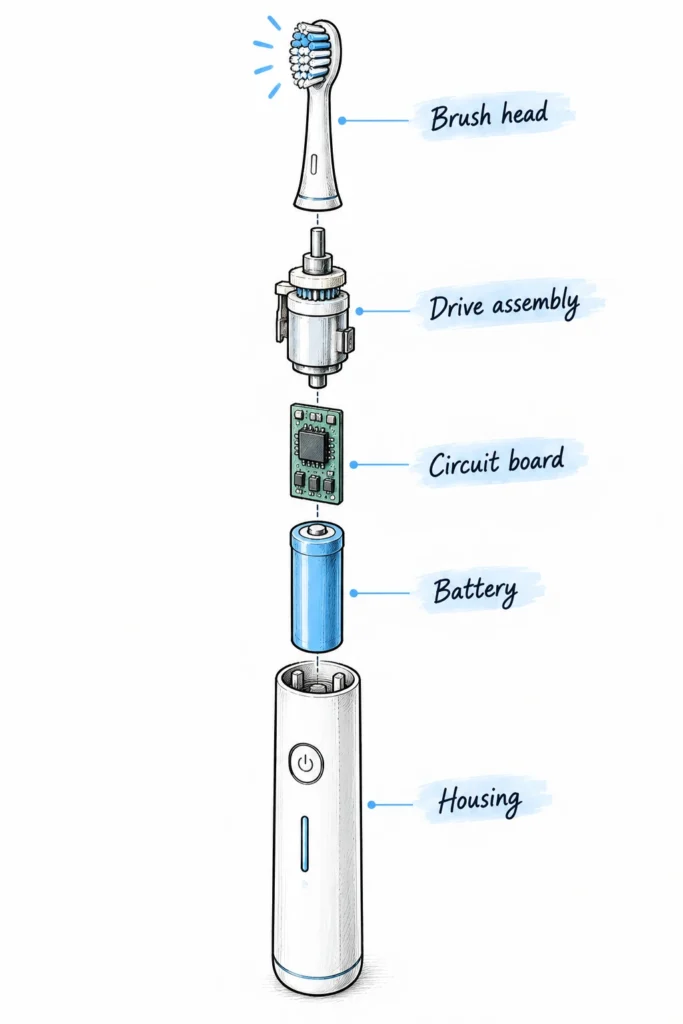
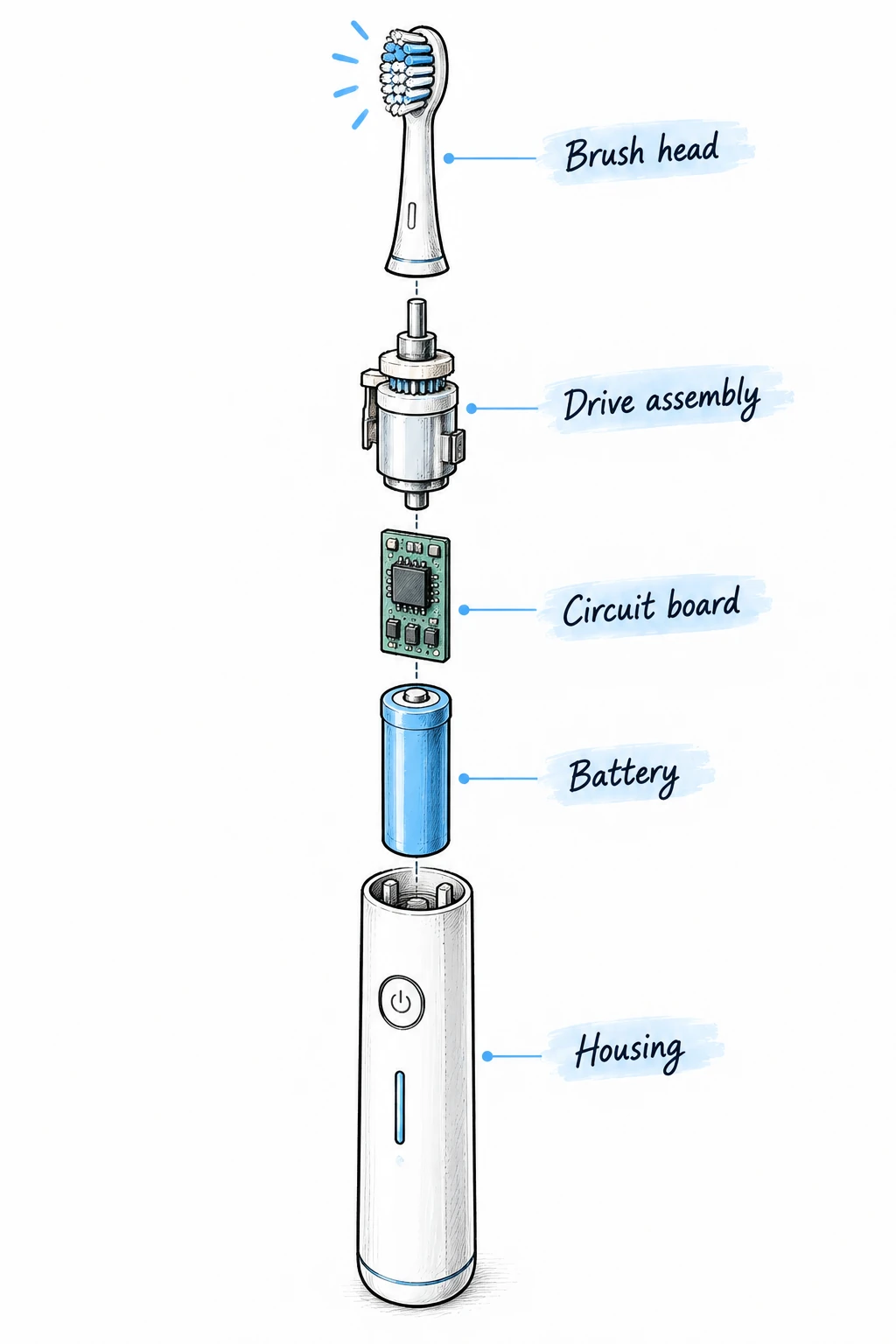
中核となる洗浄技術に加えて、すべての電動歯ブラシには、信頼性が高く安全でユーザーフレンドリーなブラッシング体験を提供するために連携する相互接続されたコンポーネントのシステムが含まれています。電動歯ブラシがコンポーネントレベルでどのように機能するかを理解することは、OEMバイヤーが製品開発中に品質とコストのトレードオフを評価するのに役立ちます。以下はコンポーネントごとの内訳です。
充電式バッテリー
Rechargeable models may use Li-ion or NiMH cells. The existing 600–2,000 mAh range is a product-planning example; compare cell voltage and energy in Wh as well as capacity. Runtime and cycle life depend on the cell, charging system, load and temperature.
モーター&ドライバー回路
The motor and driver circuit convert electrical power into brush-head movement. Electromagnetic and geared DC designs may require different power stages; an H-bridge is one possible arrangement.
PCB&マイクロコントローラー
8~32ビットMCUがブラッシングモード、タイマー、圧力センサー入力、LEDインジケーター、スマートモデルではBLE通信を管理します。
圧力センサー
Pressure detection may use a force sensor, a deflection mechanism or motor-load measurement. The controller compares the signal with a model-specific setting, then activates a warning or adjusts the motor.
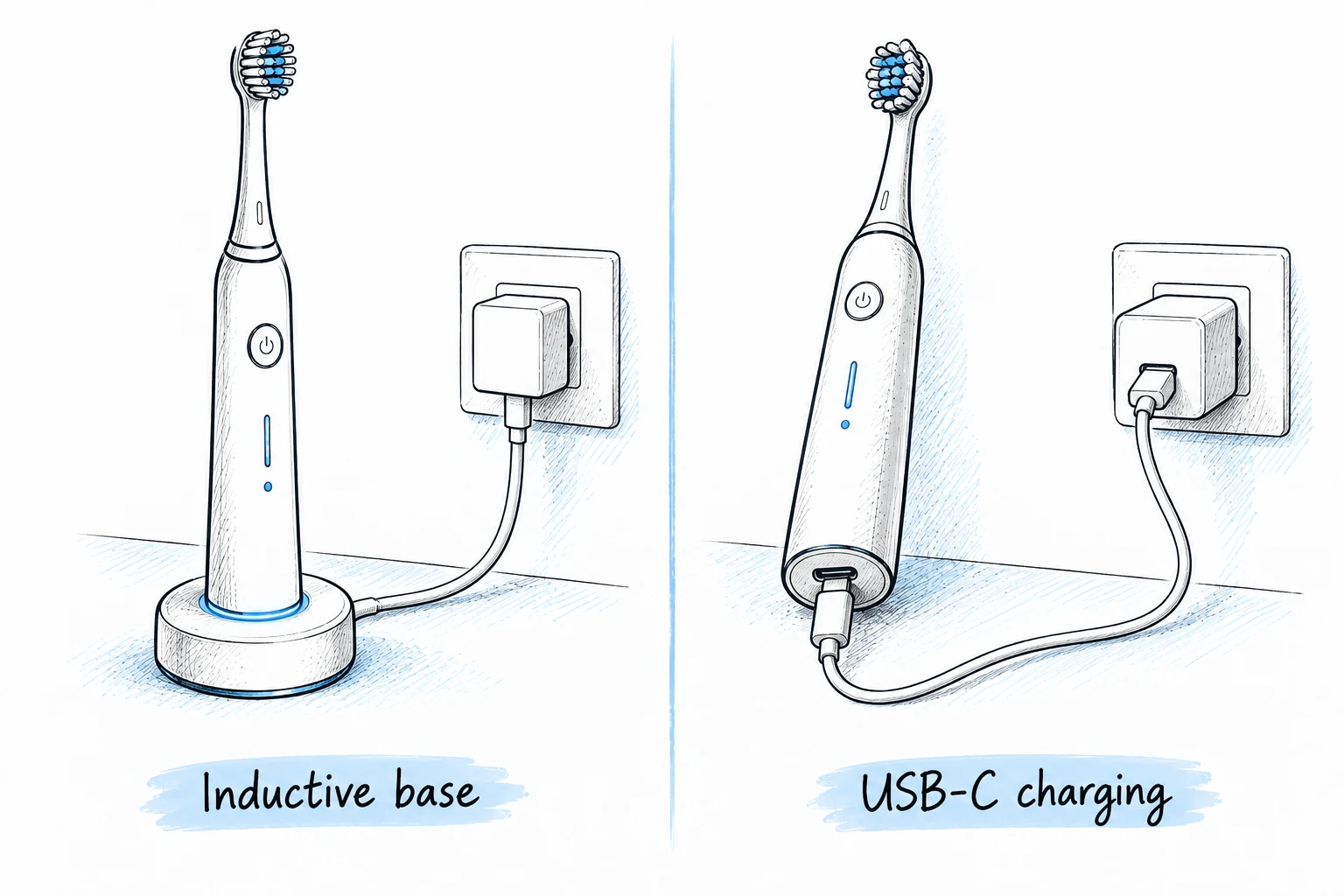
充電システム
Charging may use a dedicated inductive base or a wired connection such as USB-C. The input rating, charging time and compatible charger depend on the design. An inductive base is not automatically Qi-compatible.
ブラシヘッド&ドライブシャフト
ナイロンまたはPBTブラシ毛を使用した交換可能なヘッド。ステンレス鋼またはナイロンのドライブシャフトを介してモーターに接続。クリックフィットまたはツイストロック式の取り付け機構。
PCBと制御システム
について printed circuit board (PCB) carries the electronics that control modes, timing, indicators and optional sensors or connectivity. A 20–50 mm × 10–25 mm board is one layout example; dimensions depend on the handle and circuit design. Typical functions include:
- Microcontroller (MCU): An 8-bit or 32-bit controller runs the firmware. Select the device for processing, memory, power and interface requirements; a Bluetooth SoC may also perform this role.
- モータードライバー: A power stage controlled by the MCU supplies the waveform and current required by the selected motor. The circuit may use an H-bridge, depending on the drive architecture.
- Clock source: An internal oscillator or external crystal provides the controller’s timing reference. Some designs use a 32.768 kHz crystal for low-power timekeeping; the required clocks depend on the chosen controller.
- 圧力センサーインターフェース: 圧力センサーからの電圧変化を読み取るアナログ-デジタル変換器(ADC)チャンネル
- LEDドライバー: モードインジケーターLEDを制御する電流制限抵抗+トランジスタ回路
- BLE SoC (スマートモデルのみ):コンパニオンアプリとのワイヤレス通信を処理するBluetooth Low Energyシステムオンチップ(Nordic nRF52832または同等品)
- Charging and battery protection: Charging control, voltage monitoring, temperature checks and protection functions are selected for the cell chemistry and product design. They may be integrated or implemented with separate circuits.
ブラッシングモードとクアドラントタイマー
現代の電動歯ブラシの最も価値ある機能の一つは、消費者とOEM設計の両方の観点から、 ブラッシングモードシステム. です。電動歯ブラシが複数のモードで動作する仕組みは、マイクロコントローラによって制御されるファームウェアベースの周波数と振幅プロファイルに依存します。各モードは異なる周波数、振幅、タイミングプロファイルを持ち、ユーザーはさまざまなオーラルケアのニーズに合わせて柔軟に選択できます。
一般的なブラッシングモード
| 模式 | 周波数 | 振幅 | 期間 | Intended Use |
|---|---|---|---|---|
| 清潔 | フル周波数(例:40,000 spm) | 標準 | 2分 | 日常使用、全体的なクリーニング |
| ホワイト/ポリッシュ | フル+断続パルス | より高い | 2分 | 表面の着色除去、コーヒー/紅茶をよく飲む方 |
| 敏感 | 最大周波数の60~70% | 低減 | 2分 | Users who prefer a gentler brushing feel |
| ガムケア/ソフト | 最大の40~50%、パルス | 低い | 3分 | Gentle gumline brushing |
| タングクリーン | 低周波、安定 | 軽い | 30秒 | 口臭予防、舌苔除去 |
| ホワイトニング | 高/低を交互に | 製品により異なる | 3分 | 強化された着色除去サイクル |
A クアドラントタイマー gives a brief pause or signal every 30 seconds to prompt a change of brushing area. Four intervals support a two-minute session. This is a pacing aid; users still need to guide the brush over the inner, outer and chewing surfaces.
バッテリー技術と充電システム
Battery selection affects handle weight, runtime, charging and cost. For an OEM project, compare the cell together with the motor load, standby consumption and charging circuit to match the target use pattern and retail positioning.
リチウムイオン(Li-ion) vs ニッケル水素(NiMH)
Li-ion cells are widely used in rechargeable toothbrush designs. Check the supplier’s cell drawing and datasheet for voltage, dimensions and capacity. Cylindrical format names are approximate: a 14500 cell is nominally about 14 mm × 50 mm, while 14450 denotes about 14 mm × 45 mm. Dimensions, terminal details and capacity must be confirmed for the selected cell. Key selection factors include:
- Energy density: Compare the selected cells in Wh/kg and Wh/litre; a fixed threefold advantage does not apply to every Li-ion and NiMH design.
- Self-discharge: Cell chemistry, temperature and storage conditions affect charge retention. Low-self-discharge NiMH cells are available, so compare the selected cells’ storage specifications.
- Charging habits: Li-ion cells can normally be topped up within the approved charging limits. Follow the cell supplier’s voltage, current and temperature requirements.
- Cycle life: A full-equivalent cycle is cumulative discharge equal to the cell’s rated capacity, not one brushing session. A 500-cycle rating must state the test conditions and retained-capacity criterion. Brushing frequency alone cannot convert that rating into years of service.
- Charging time: A 1–3 hour charge is possible on a design built for that rate. The battery, charger, thermal limits and power-management circuit determine the result, rather than the connector type alone.
NiMH remains an option where cost, cell availability and the established charging design fit the project. It still requires appropriate charge control and protection against damaging operating conditions. Low-self-discharge variants can retain charge well, and memory-effect behaviour should not be generalised from NiCd batteries.
充電システム:誘導式 vs USB-C
Inductive charging transfers energy between coils in the base and handle. The receiver rectifies and regulates that energy to charge the battery. Removing an exposed charging connector can simplify sealing, but charging efficiency, alignment, heat and full-charge time must be evaluated for the selected design. A dedicated toothbrush base does not necessarily support the Qi standard.
USB-C charging provides a convenient wired connection. Specify the input voltage and current, supported power protocol, charger compatibility and charging time. USB-C does not itself guarantee USB Power Delivery or a 1–3 hour charge. The port, surrounding housing and any cover must form a tested sealing system.
耐水性:IPX7とエンジニアリング上の課題
Water resistance depends on the complete enclosure and its seals. IPX7 addresses temporary immersion under defined test conditions, commonly described for a small device as 1 metre for 30 minutes. It does not establish protection against water jets, all shower conditions or indefinite immersion, and it does not automatically apply to the charger. Follow the product’s stated cleaning and charging instructions.
ポッティングと超音波溶着
Potting or encapsulation can protect selected electronics with a compatible epoxy or silicone material. It is one part of the sealing strategy alongside housing joints, shaft seals and charging interfaces. The existing USD 0.80–2.50 per-unit allowance is a planning example; material volume, curing, labour and repairability affect the final cost.
超音波溶着 can join compatible plastic housing parts using high-frequency mechanical vibration. Equipment in the 20–40 kHz range is one example. Joint geometry, material and process settings determine weld strength and sealing quality; verify both on the finished assembly.
ブラシヘッド取り付け部(最も機械的ストレスがかかるシールポイント)には、シリコーンOリングまたは液体ガスケットシーラントが使用されます。ドライブシャフトは、このシールをクリアランスの小さいブッシングを介して通過し、防水性を維持しながら回転または直線運動を可能にします。
電動歯ブラシの仕様決定についてサポートが必要ですか?
電動歯ブラシがお客様のブランドにとってどのように機能するかご興味はありますか?当社のエンジニアが、対象市場向けのモーター選定、防水戦略、BOMコスト最適化についてご説明いたします。
エンジニアリング・チームと話すスマート歯ブラシ:センサー、BLE、アプリ接続
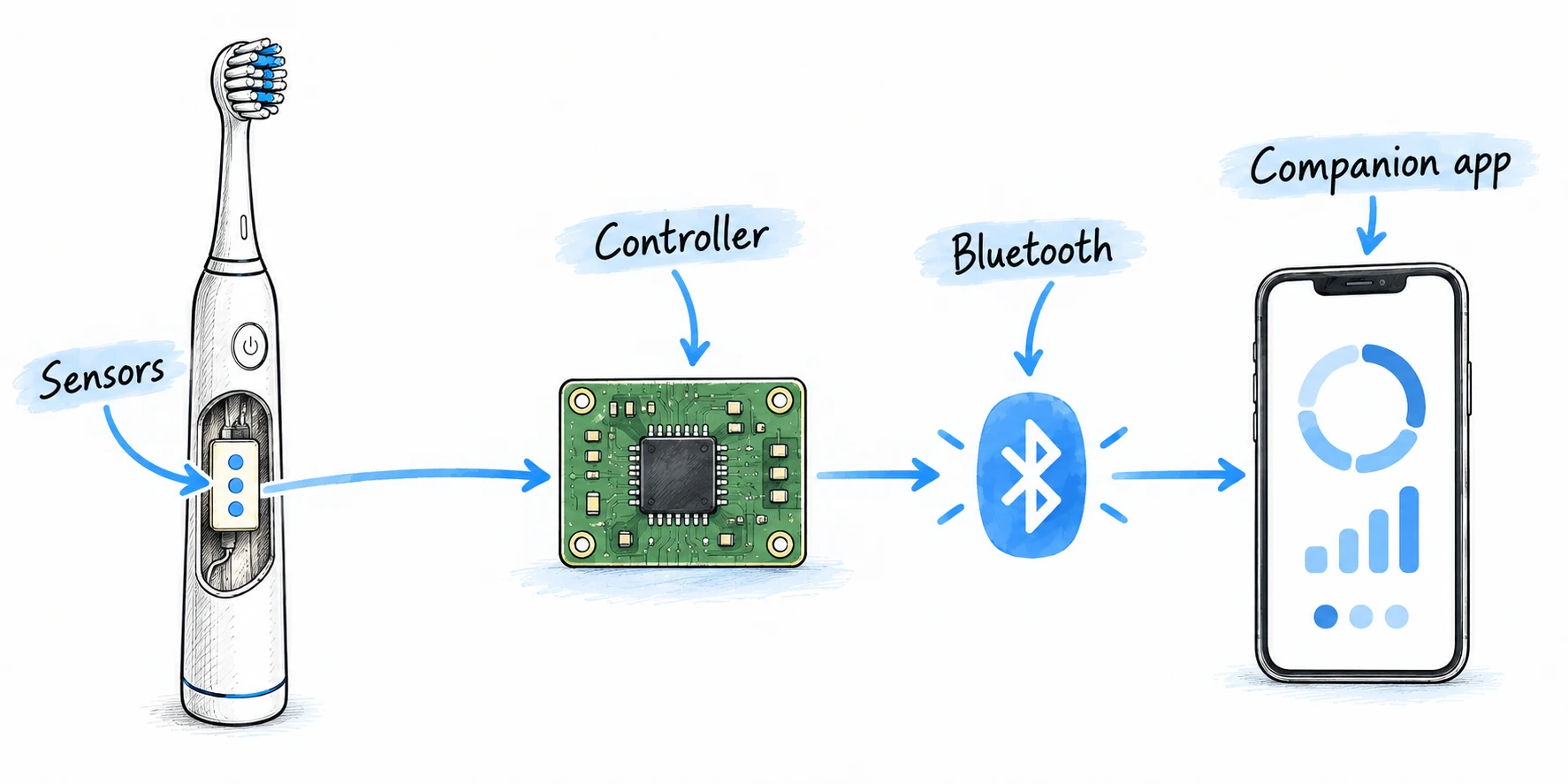
Smart toothbrushes combine a brushing platform with ブルートゥース接続, optional sensors and companion software. A connected and non-connected model may share a motor or brush head, while other designs use different components. Specify the physical cleaning performance and the data functions separately.
主要なスマート機能とそのセンサー
| スマート機能 | 使用センサー | 技術詳細 |
|---|---|---|
| ブラッシング時間 | リアルタイムクロック(MCUタイマー) | MCUに内蔵 – 追加センサー不要 |
| 圧力検出 | Force sensor, deflection sensing or motor-load measurement | Position and calibration depend on the sensing design |
| 位置検出 | 6軸IMU(加速度計+ジャイロスコープ) | Estimates movement and brushing zones through a validated algorithm |
| ブラシヘッドの摩耗 | Usage timer or session counter; additional sensing if fitted | Prompts replacement based on use; does not directly measure every bristle’s condition |
| バッテリーの健全性 | 燃料ゲージIC(クーロンカウンター) | Estimates remaining charge; cycle and health data depend on the implementation |
| Bluetoothペアリング | Bluetooth Low Energy SoC | For example, a Nordic nRF52-series device; select for the required features |
A six-axis inertial measurement unit (IMU) combines a three-axis accelerometer and three-axis gyroscope. Software can use these signals to estimate brushing movement and mouth zones. Accuracy depends on sensor placement, calibration, the algorithm and user behaviour. Zone feedback is an estimate of brushing activity, rather than a direct measurement of plaque removal or oral health.
スマート歯ブラシのコストに関するOEMの視点
Smart functions add connectivity, sensing and software to a product that already uses electronic control. The existing USD 8–25 per-unit estimate is a planning allowance for additional hardware, not an app-development quotation. Check which components are already included in the base platform to avoid double-counting. Example budget items include:
- BLE SoC and antenna: USD 2.50–5.00 as a planning allowance. Nordic nRF52840 and Realtek RTL8762 are examples; suitability depends on the selected part and software requirements.
- Six-axis IMU: USD 1.50–4.00 as a planning allowance. Examples include TDK InvenSense ICM-42670 and Bosch Sensortec BMI270.
- Pressure sensing: USD 0.30–1.00 as a planning allowance; the sensing method and required calibration determine the actual cost.
- App development: An illustrative one-time budget of USD 30,000–150,000 for iOS and Android. Scope separately for maintenance, cloud services, privacy controls and operating-system updates.
- Additional PCB layers and components: USD 1.00–3.00 as a planning allowance; confirm overlap with the selected connectivity and sensor modules.
A USD 25–60 retail premium is a positioning example for a connected model. Assess the selling price alongside channel costs, software maintenance, returns and the complete product cost before estimating profitability.
UV除菌技術
A UV sanitizing base uses a separate UV-C light system to reduce microorganisms on exposed brush-head surfaces. Wavelength, dose, exposure time, lamp placement, shadows and the tested organism determine the result. A 254 nm lamp and a 5–10 minute cycle describe particular designs; they do not establish a universal 99.9% reduction for all bacteria and viruses. Use product-specific test results for performance claims, and prevent eye or skin exposure with an enclosed design and suitable interlocks.
UV-C sources may include low-pressure mercury lamps or UV-C LEDs. Compare wavelength, delivered dose, thermal management, service life, material compatibility and disposal requirements for the selected source. Lamp type alone does not determine which complete sanitizer is more effective or durable.
The existing USD 3.50–8.00 BOM allowance illustrates a UV-base option. The light source, enclosure, control system and safety interlocks affect cost and packaging size. Position the feature using the selected product’s tested performance.
ブラシヘッド:毛先の科学とエンジニアリング
ハンドルにすべての電子インテリジェンスが含まれている一方、実際の清掃が行われるのはブラシヘッドである。電動歯ブラシが効果的なオーラルケアを提供する仕組みを理解するには、ブラシヘッドのエンジニアリング(毛材、直径、タフト構成、可撓性特性)を知る必要があり、これらすべてが清掃性能とユーザー体験に影響を与える。
毛材
Brush-head performance depends on filament material, diameter, length, taper and tuft arrangement. Nylon 612 and PBT are material options; PBT is not automatically softer than nylon. Define the required brushing feel and inspect filament ends, tuft retention and mechanical performance against the applicable specification. ISO 20127:2025 covers physical properties of powered toothbrushes; its end-rounding requirements have exceptions for specified filament types, so a universal tip-radius rule is inappropriate.
インジケーター毛
Colour-fading indicator bristles provide a visual replacement reminder. Fading depends on the filament treatment, brushing habits and exposure; it is not a precise three-month clock. The existing USD 0.05–0.15 per-head allowance is a planning example. Colour-treated or mixed-colour filaments do not inherently require two-material injection moulding. Follow the brush-head replacement instructions and replace sooner when the bristles are worn.
OEM製造:コンポーネント選定から量産まで
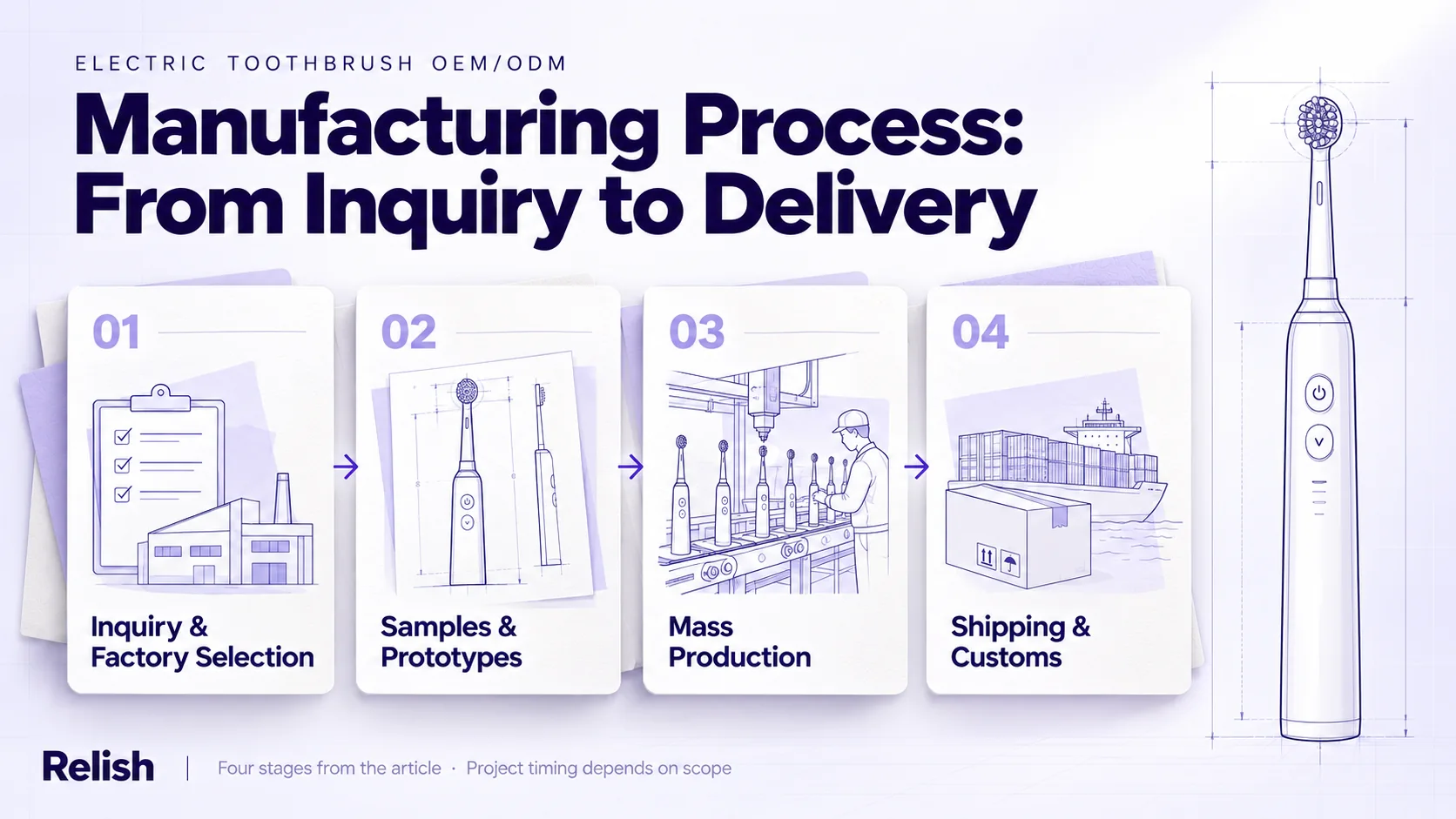
製造の観点から電動歯ブラシがどのように機能するかを理解することは、インテリジェントなOEM調達判断の基盤となる。モータータイプ、バッテリー容量、防水方法、スマートセンサー統合など、すべての技術的選択は、製造コスト、製品品質、小売ポジショニングに直接的で定量化可能な影響を与える。 電動歯ブラシOEMガイドをお読みください 製造プロセスの詳細についてはこちら。
At Relish Technology, motor engineering, electronics, sealing and app connectivity inform the development process. The following 28-week schedule illustrates a new-product project; an existing platform or a more complex programme will follow a different timeline.
- コンセプト検証 (1~4週目):製品仕様の定義 — 技術タイプ(音波式/回転式/Rotasonic)、ターゲット市場、必要な認証、価格帯。これが以降のすべての決定を左右する。
- プロトタイプ開発 (5~12週目):ハンドル、電子機器、ブラシヘッドの機能プロトタイプを構築。モーター性能、バッテリーランタイム、防水性、PCBファームウェアをテスト。標準的なプロトタイプ数量:3~10台。
- 量産前検証 (13~20週目):エンジニアリング検証テスト(EVT)および設計検証テスト(DVT) — IPX7浸漬テスト、落下テスト、EMCテスト、バッテリーサイクルテスト、規制事前コンプライアンステスト。
- 量産準備 (21~28週目):金型完成、初回品検査、パイロットラン(100~300台)、AQLサンプリング計画を含む品質システムのセットアップ。
- Production and shipment: Full production combines in-process checks, functional testing and agreed sampling inspections. Define defect categories and acceptance criteria in the quality agreement. Safety-critical defects require a zero-acceptance approach; an AQL value must not be presented as permission to ship a known critical defect. 製造施設の見学 当社の生産能力を直接ご覧ください。
ブランドに適した技術の選び方
技術基盤が確立されたところで、電動歯ブラシ開発のOEMパートナーを選定するブランドオーナーや調達マネージャー向けの意思決定フレームワークを以下に示します。電動歯ブラシがソニック、回転振動、Rotasonic™の3つの技術カテゴリーすべてでどのように機能するかを理解することで、メーカーとのより情報に基づいた対話と、より正確な製品仕様が可能になります。
| 基準 | ソニック | 回転・振動 | Rotasonic™(コンビネーション) |
|---|---|---|---|
| BOMコスト範囲 | $12-$28 | $8-$20 | $18–$38 |
| 零售价格定位 | 中高端 | 入门至中端 | 高端至超高端 |
| 噪音水平 | Depends on drive, mounting and operating mode | Depends on drive, gearing and operating mode | Depends on the combined drive design |
| Cleaning Action | Bristle movement and nearby liquid agitation | Alternating angular movement with bristle contact | Combined sonic and oscillating-rotating movement |
| 最佳市场契合度 | 高端消费品牌 | 价值品牌,亚马逊FBA | Brands seeking a dual-action platform |
| 智能功能适用性 | 素晴らしい | グッド | 素晴らしい |
OEM電動歯ブラシの製造を検討していますか?
无论您是推出新品牌、扩展现有产品线,还是为零售采购寻找货源——Relish Technology的工程团队都能帮助您选择合适的技术平台,并引导您完成从概念到量产的全过程。
エンジニアリング・チームと話すISO 13485 · FDA/CE Compliance Support · 15+ Years OEM Experience · 20,000 m² Manufacturing Facility
よくある質問
Answers to common questions about electric toothbrush mechanisms, components, charging, sensors and OEM product development.
参考文献・出典
- 米国歯科医師会。 歯ブラシ. 歯ブラシ.
- 国際電気標準会議(IEC)。 IEC 60335-2-52:2021 — Particular requirements for oral hygiene appliances. IEC 60335-2-52:2021 — Particular requirements for oral hygiene appliances.
- 国際標準化機構。 ISO 20127:2025 — Dentistry — Physical properties of powered toothbrushes. ISO 20127:2025 — Dentistry — Physical properties of powered toothbrushes.
- 米国食品医薬品局(FDA)。 Powered toothbrush classification: JEQ, 21 CFR 872.6865, Class I; 510(k)-exempt within applicable limits. Powered toothbrush classification: JEQ, 21 CFR 872.6865, Class I; 510(k)-exempt within applicable limits.
- Nordic Semiconductor. nRF52840 Product Specification. nRF52840 Product Specification.
- Bosch Sensortec. BMI270 inertial measurement unit. BMI270 inertial measurement unit.