









Amazon FBA オーラルケアブランド
U.S. Setup and Compliance Checklist
Plan an Amazon.com oral-care launch with a checklist for supplier scope, product classification, FBA preparation, listing assets, fees, and review-program rules.
Prepare an oral-care product for Amazon.com FBA by coordinating supplier selection, U.S. product requirements, packaging, shipment labels, listing content and launch costs. Use this checklist to assign the work, then confirm the current requirements for your ASIN and shipment in Seller Central.
押さえておきたいポイント
- Define the product, intended users, claims, accessories and U.S. sales plan before requesting supplier quotes or setting a launch budget.
- A standard powered toothbrush classification does not mean every product needs a 510(k). Verify the product code and exemption limits for the exact device and claims.
- FDA establishment registration and device listing are not FDA approval. ISO 13485, CE marking, test reports, and Amazon account documents each have different scope.
- Model costs using a current Amazon revenue calculator and project-specific quotes; include FBA, inbound placement, storage, returns, ads, and other applicable costs.
- For U.S. FBA shipments, plan unit preparation and labeling before shipment creation under current Seller Central instructions.
- Check eligibility and fees for Amazon Vine, and use neutral review requests permitted by Amazon’s current policies.
An FBA launch brings together product development, compliance, packaging, shipping and listing preparation. Give each task an owner and keep the approved specification at the center of the work. This guide covers Amazon’s U.S. store; check other stores and countries separately.
Why Plan an Oral-Care Launch for Amazon.com?
Evaluate FBA against your product’s dimensions, inventory plan, fulfillment costs and customer-support needs. Include shipment preparation, storage and returns when comparing it with other fulfillment options, and complete the product compliance review before sending inventory.
If your brand qualifies for Amazon Brand Registry, review the tools available to your account. Use A+ Content and comparison modules to explain your own products accurately, with specifications and evidence behind performance claims.
Step 1: Define the Product and Positioning
Give suppliers a product brief with the intended user, functions, target price, packaging, accessories and U.S. market requirements. Identify battery and wireless features early so the quote and compliance review cover the product you plan to sell. See our 電動歯ブラシコレクション for examples of product configurations.
Choose a development route based on scope
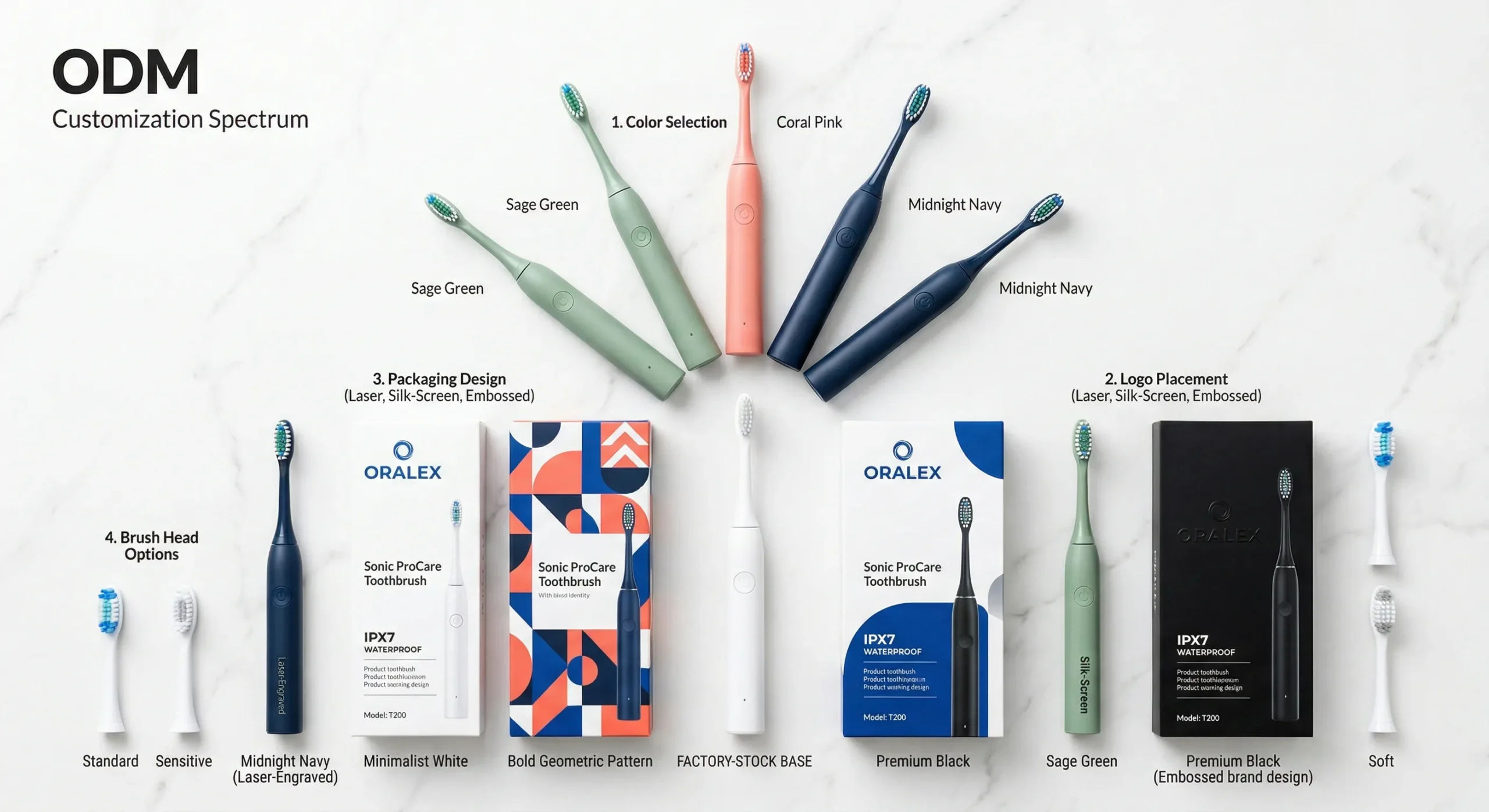
Describe the development work you need before choosing a private-label, ODM or OEM route. Agree which design changes, samples, test records and tooling are included, who owns them and when each stage will be approved.
| Development route | Typical scope to define | Main cost drivers | Evidence or deliverables | Useful when |
|---|---|---|---|---|
| Existing model with private label | Branding, selected options, and package artwork | Selected model, packaging, quantity, testing, and freight | Model specification, sample, artwork proof, and quote | You want to assess a defined existing product |
| ODM adaptation | Changes to an existing platform, features, or appearance | Design changes, tooling, components, validation, and order scope | Change list, approved drawings, sample, and project plan | You need product differentiation while using an existing base |
| OEM development | Product requirements and development for a proprietary configuration | Engineering, tooling, testing, materials, packaging, and launch scope | Requirements, design records, test plan, and acceptance criteria | You have a defined product plan and development resources |
Ask for quotes at the quantities you are considering, with tooling, packaging and sample costs listed separately. Confirm MOQ and timing for the selected model and customization work. Read our 自有品牌指南 for a broader comparison of development approaches.
Sonic, oscillating-rotating, and other configurations
Choose the brush-head movement and functions your product needs, then review the actual mechanism and test results. Sonic and ultrasonic describe different technologies; oscillating-rotating heads use a different movement again. Match technical and health-related claims to evidence for the finished model.
- Sonic configurations: Confirm the drive, brush-head motion, operating modes, and test method for the specific model.
- Oscillating-rotating configurations: Confirm the head mechanism, handle interface, replacement-head fit, and the motion of the tested model.
- Connected or combination products: List each included function, wireless feature, accessory, software responsibility, and product claim separately.
Test features with the intended users and buyers before selecting them for your range. Check their effect on usability, charging, water resistance and cost, and gather evidence for the claims you will use in the listing.
Step 2: Evaluate the OEM/ODM Supplier
Confirm the contracting company, production site and manufacturing responsibilities. Match the proposed model to its specifications, samples and test reports, and check the holder and scope of supplier certificates.
Supplier evidence checklist
- Entity and site: Confirm the contracting entity, actual production location, and which processes are performed there or by subcontractors.
- Product documents: Match test reports, declarations, and specifications to the model, revision, components, and intended market.
- Quality-system documents: Check the certificate holder, site, scope, validity, and issuing body. ISO 13485 applies to a quality-management system within its stated scope; it is not a product certificate or a universal requirement for every ordinary toothbrush.
- Regulatory responsibilities: Write down which party prepares, reviews, maintains, or submits each applicable document. Do not treat FDA registration or device listing as product approval.
- Samples and production: Identify the approved sample by model, revision, materials and firmware. Agree how production inspections and change approvals will keep later batches aligned with that sample and the written specification.
- Battery and transport: For lithium-battery products, review the UN 38.3 test-summary requirements and the carrier’s documents for the battery, product and shipping route. Confirm who supplies each record and when it must be available.
- Audit and references: Agree any audit or third-party inspection based on project risk and scope. Obtain customer references only where the supplier has permission to share them.
- Commercial terms: Confirm tooling ownership and use, change approval, MOQ, quote validity, project milestones, payment, packaging, and shipping responsibilities in writing.
当社の 認証概要 や 電動歯ブラシOEM製造ガイド for related context.
Step 3: Check Product and Market Requirements
Review the product’s intended use, claims, design and U.S. market requirements before finalizing the specification. Use the table to identify the documents and responsible parties for each applicable item.
| Topic | When to check | Evidence or source | Preparation impact | Planning note |
|---|---|---|---|---|
| FDA product classification | Before finalizing U.S. intended use and claims | FDA Product Classification database; applicable regulation and exemption limits | May affect labeling, registration/listing, quality controls, and market steps | Standard powered toothbrush product code JEQ is listed as Class I and generally 510(k)-exempt, subject to limitations. Confirm exact product and claims. |
| FDA establishment registration and device listing | If the product and responsible parties are subject to these requirements | Current FDA instructions and records for the applicable establishment/device | Identify the responsible parties and required records | Registration and listing are not FDA approval or clearance. |
| Wireless and EMC | If the configuration includes a radio or electronic functions | Applicable FCC rules, authorization path, and test evidence | May affect components, testing, labeling, and listing information | Review transmitter authorization as well as the requirements for other electronic functions. Part 15B alone does not cover a wireless transmitter. |
| Electrical safety and supplied adapters | For the product and any supplied charger or adapter | Applicable product standards, ratings, and test reports | Confirm which product components are included in the evaluation | Confirm the electrical-safety standards and evidence required by your product design, sales channel and intended use; UL or ETL listing is not a universal legal requirement for every powered toothbrush. |
| Chemical exposure and California sales | When substances, exposure, or California distribution may be relevant | Material declarations, exposure assessment, and applicable official information | May affect materials, warnings, and supporting records | Assess listed chemicals and potential exposure under California Proposition 65; it is not a single product certification. |
| EU/UK and other stores | Before listing in each non-U.S. store | Destination-specific rules and technical records for the exact configuration | May require different labels, declarations, testing, or responsible parties | Review each destination’s applicable legislation. CE marking indicates EU conformity, and medical-device classification depends on the intended purpose and claims. |
For the U.S. powered-toothbrush classification and exemptions, consult the FDA Product Classification database and the FDA page on Class I and Class II device exemptions. Check the exemption limitations and remaining controls for your device. Obtain a regulatory review if the product’s classification or claims are unclear.
For a broader overview of product records, see our Amazon electric-toothbrush compliance guide. Match supplier documents to your company, factory, model and proposed claims before using them in the launch file.
Step 4: Prepare Packaging and FBA Shipments
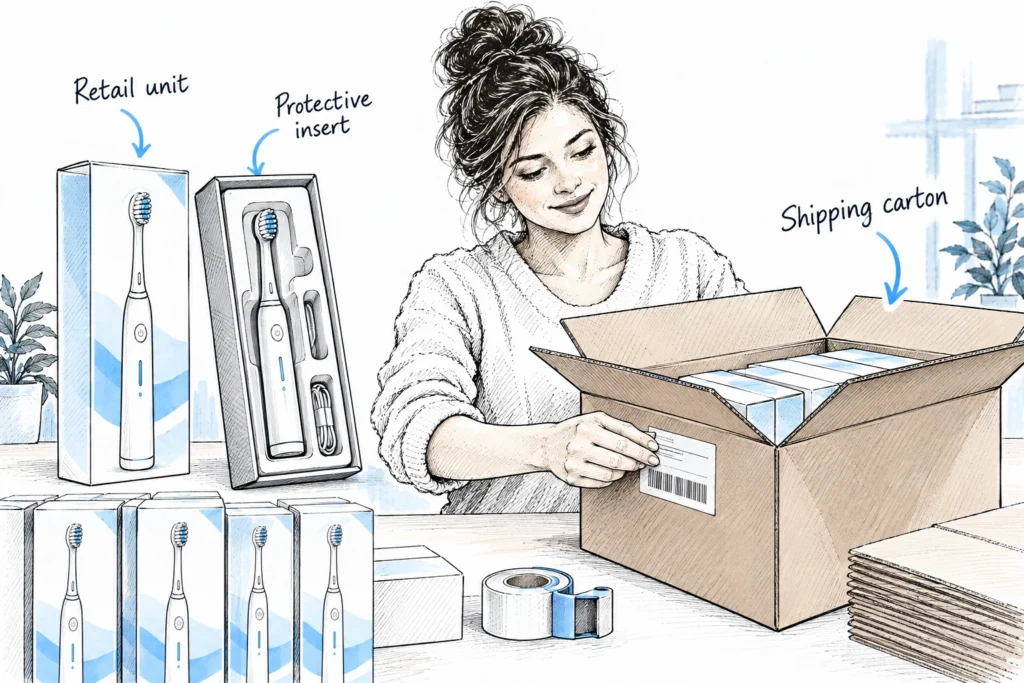
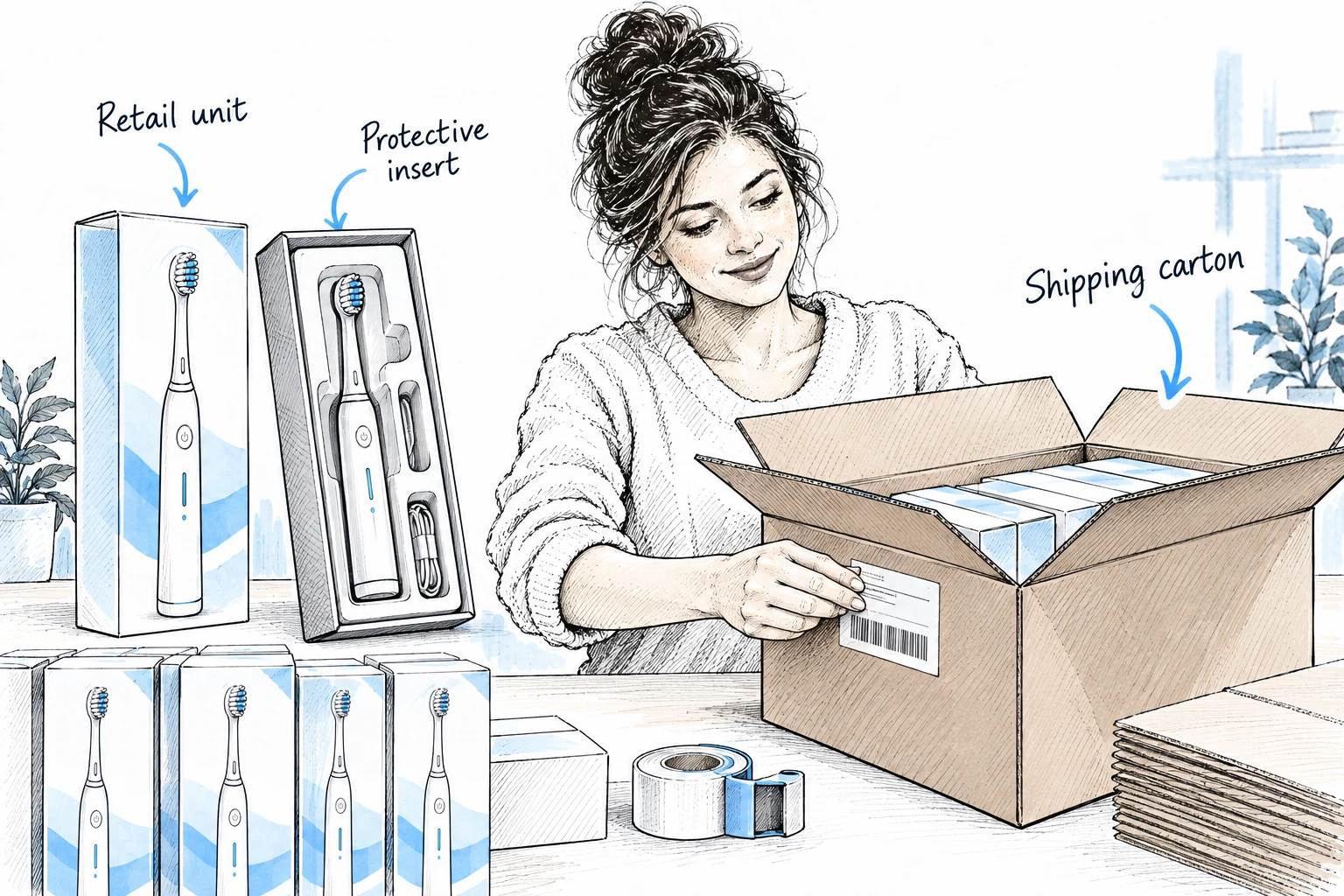
Plan the retail pack, protective inserts and shipment cartons together. Keep unit barcodes separate from box and pallet labels, and assign responsibility for country-of-origin marking and import documents.
U.S. FBA preparation checklist
- Unit packaging: Confirm the retail pack, protective components, accessories, and any required warnings against the product specification and applicable rules.
- Prep and labeling: Amazon no longer offers prep and item-labeling services for U.S. FBA shipments created on or after January 1, 2026. Arrange the required preparation and labeling with your supplier, your team or a service provider before dispatch.
- Barcode choice: Determine whether your ASIN and seller role qualify for a manufacturer barcode or require an Amazon barcode (FNSKU). Prepare separate shipment-box and pallet labels through the shipment workflow.
- Poly bags: If using a poly bag, check Amazon’s packaging specifications. A bag opening of 5 inches or more, measured flat, requires a suffocation warning. The threshold concerns the bag opening, not the size of the toothbrush.
- Cartons and shipment: Record carton contents, dimensions and weights accurately, and use the box IDs and pallet labels generated for the shipment. Confirm any case-pack limits in the current workflow.
- Batteries: Check the battery requirements for the product, shipment and carrier. Confirm which test summaries and transport documents are needed and make them available to the relevant parties.
- Packaging programs: Check whether your ASIN and packaging qualify for Ships in Product Packaging (SIPP). Review the program’s packaging criteria alongside the product’s required safety information.
Use the current Amazon U.S. FBA prep and item-labeling instructions and the relevant Seller Central shipment workflow before dispatch. Our OEMパッケージ設計ガイド covers packaging project inputs and artwork review.
Step 5: Build an Accurate Amazon Listing
Use the approved product specification to prepare the title, images, bullets, A+ Content and search terms. Show the included functions and accessories clearly, and review cleaning, whitening, water-resistance and compatibility claims against their supporting evidence. Check trademark use before referring to another brand.
Keyword and listing content
Research the terms buyers use for this product and place relevant phrases naturally in the listing. Use the search-term fields according to Amazon’s current rules, and include only features the model offers. Review any use of competitor names against Amazon’s policies and trademark rights.
Use A+ Content to explain features, package contents, operation and support. Compare your own models using current specifications so buyers can choose the product that suits them.
商品画像
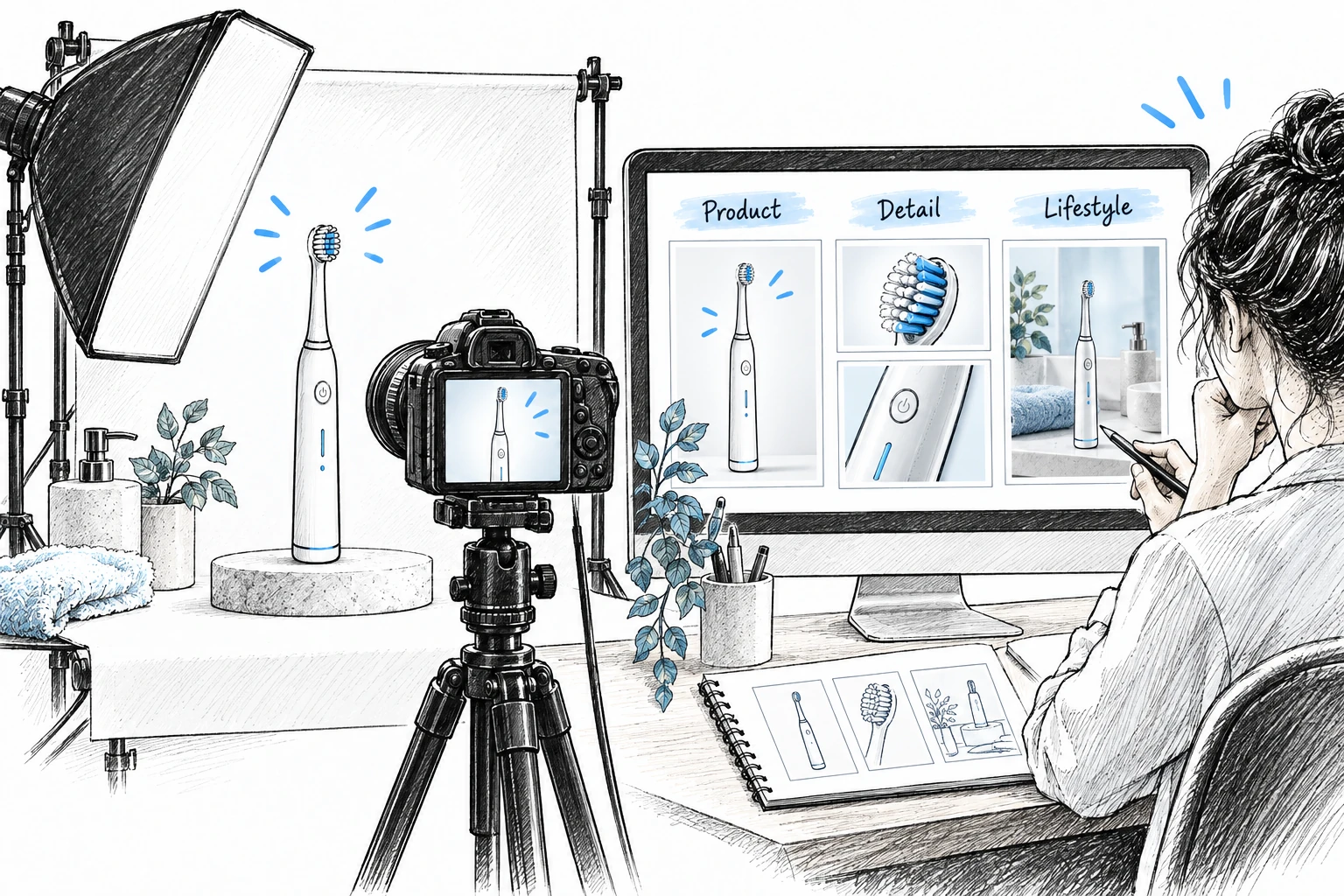
Plan a clear main image and supporting views of the product, accessories, dimensions and packaging. Check your category’s current rules for image size, backgrounds and permitted content before shooting and uploading the assets.
Step 6: Plan Launch, Reviews, and Advertising
Schedule the launch around available inventory, complete listing content, customer support and a reviewed cost model. Monitor sales, advertising and customer feedback after launch and adjust the plan using actual results.
Review programs and customer requests
Amazon Vine lets eligible sellers provide products for independent reviews. Participation does not guarantee a review, a positive rating or a publication date. Check eligibility, fees and store availability on Amazon’s Vine program page.
Amazon’s Early Reviewer Program has ended. Use only review-request methods permitted by current Amazon policy. Do not offer compensation, filter for positive reviews, or ask customers to change a rating. A compliant request should be neutral and sent through an Amazon-approved process.
Advertising and contribution margin
Set an advertising budget using the contribution margin available after the costs included in your model. ACOS is advertising spend divided by attributed sales; it does not measure net profit. Review campaign results alongside stock levels, returns and other selling costs.
Common FBA Planning Mistakes
Review these common gaps before approving inventory or shipment plans.
| Planning mistake | Why it matters | Better check |
|---|---|---|
| Assuming every toothbrush needs FDA 510(k) clearance | Classification, intended use, claims, and exemption limits determine the applicable path. | Check the FDA classification and exemption status for the specific product. |
| Treating registration or a certificate logo as product approval | Documents have different holders, scopes, and regulatory meanings. | Verify entity, site, model, scope, validity, and issuing body. |
| Budgeting from a generic fee or margin figure | Fees and costs depend on ASIN, size, price, shipment, storage, returns, and other inputs. | Use Amazon’s current calculator and a project-specific cost sheet. |
| Assuming Amazon will prep or label U.S. FBA inventory | Shipment instructions and available services have changed. | Confirm the current workflow and assign prep and labeling before shipment. |
| Assuming a Vine or advertising plan guarantees reviews or rank | Eligibility, customer behavior, and marketplace visibility are not guaranteed. | Follow current program rules and monitor actual results. |
| Approving a sample without recording its configuration | Later production can differ if parts, firmware, packaging, or revisions change. | Identify the sample version and agree change approval and inspection records. |
Planning an Amazon.com Oral-Care Project?
Discuss the product configuration, target market, documents, packaging, and project scope with our team.
Discuss Your FBA Projectよくある質問
Does every electric toothbrush sold on Amazon.com need FDA 510(k) clearance?
Standard powered toothbrushes under FDA product code JEQ are Class I and generally exempt from 510(k), subject to the applicable exemption limits and other controls. Check the device’s intended use, claims and design against the FDA classification record. A different configuration or claim may change the requirements; registration and device listing are not FDA approval.
Does Amazon FBA still prep and label U.S. shipments?
Amazon ended prep and item-labeling services for U.S. FBA shipments created on or after January 1, 2026. Arrange preparation and labeling with your supplier, your team or a service provider, and confirm the requirements in the current shipment workflow before dispatch.
Does every sellable unit need an FNSKU label?
No. Eligibility for a manufacturer barcode or an Amazon barcode (FNSKU) depends on the ASIN, brand role and current rules. Check the barcode requirements for your listing and seller account, then prepare the separate shipment-box or pallet labels through Seller Central.
How do I estimate Amazon referral and FBA fees?
Use Amazon’s current fee schedule and Revenue Calculator with the assigned category, selling price, dimensions, shipping weight and fulfillment method. For Beauty, Health, and Personal Care, the referral fee is currently 8% at a total sales price of $10 or less and 15% above $10, with a $0.30 minimum. Confirm your ASIN’s category and add inbound, storage, returns, advertising and other applicable costs to the model.
Can Amazon Vine guarantee 30 reviews?
No. Eligible sellers can enroll up to 30 units under current Vine terms, but a unit may not be claimed or reviewed. Vine Voices provide independent opinions that may be positive, neutral or negative. Check eligibility, fees and country availability before enrolling.
What should I ask a supplier before placing an FBA order?
Confirm the legal entity and production site, exact model and revision, material and component scope, applicable test and regulatory documents, sample approval, quote assumptions, MOQ, tooling ownership, packaging, prep and labeling responsibilities, inspection terms, and shipment schedule. Put agreed deliverables and changes in writing.
References and Further Reading
Primary sources checked on October 9, 2026. Recheck Amazon policies and product requirements before finalizing a listing or shipment.
- U.S. Food and Drug Administration. Product Classification Database: Powered Toothbrush (21 CFR 872.6865; product code JEQ). FDA database record.
- U.S. Food and Drug Administration. Class I and Class II Device Exemptions. FDA guidance.
- Amazon。 Standard Selling Fees. Amazon U.S. pricing and referral fees.
- Amazon Seller Central. FBA Prep and Item-Labeling Services. U.S. Seller Central help.
- Amazon。 Amazon Vine. Program details and eligibility.
- Amazon Seller Central. Commingling and manufacturer barcode eligibility update. U.S. seller announcement.