

Как работают электрические зубные щетки:
Полное техническое руководство 2026
Explore the motors, batteries, electronics and sealing systems inside electric toothbrushes, with practical engineering choices for OEM product development.
Runtime examples assume two brushing sessions of two minutes each per day. Brush movement rates and battery performance depend on the model and operating mode.
Электрические зубные щетки — обманчиво сложные устройства. По своей сути они объединяют прецизионные двигатели, интеллектуальные системы управления, перезаряжаемые источники питания и эргономичный дизайн в устройство, помещающееся на ладони, но выполняющее десятки тысяч точных механических движений за один сеанс чистки. Это руководство подробно объясняет, как работают электрические зубные щетки: от физики звуковой вибрации до инженерных решений, определяющих OEM-производство.
Ключевые выводы
- The three platforms covered here are звуковые, oscillating-rotating и combination systems such as Relish Technology’s Rotasonic™. Each offers different drive mechanisms and product development options.
- Sonic toothbrushes clean through контакта щетины, and agitate the liquid around the brush head. Effective cleaning still depends on reaching tooth surfaces with the bristles.
- The motor, PCB and battery sit inside a sealed handle. IPX7 applies to the tested enclosure, rather than separately certifying every internal component.
- Технология аккумулятора (Li-ion против NiMH) напрямую влияет на вес, время работы и время зарядки, что является критическими точками принятия решений для OEM
- Pressure feedback can use force sensing, mechanical deflection or motor-load measurement to alert users when they exceed a model-specific brushing-pressure setting.
- Умные зубные щетки добавляют Bluetooth connectivity, sensors and a companion app. The underlying cleaning platform may be shared with a non-connected model.
- For OEM buyers, the motor, battery, electronics, brush head, housing, finishing and packaging all affect the bill of materials (BOM) and the final quotation.
- Relish Technology’s Vibrosonic™ offers up to 48 000 движений/мин with a dual-harmonic drive approach. Select the operating profile to suit the product specification.
Три основные технологии электрических зубных щеток
This guide compares sonic, oscillating-rotating and combination platforms. Their drive mechanisms influence head movement, noise, power consumption and cost, while the complete product design determines the final performance.
Звуковая технология: вибрация магнитной катушки
Many sonic toothbrushes use an electromagnetic drive system to create rapid movement at the brush head. The motor’s magnetic circuit, suspension and output shaft determine whether that movement is linear, angular or a combination. “Sonic” describes the operating approach; it does not mean every model uses the same voice-coil or linear resonant actuator.
In an electromagnetic drive, controlled current in the coil produces a changing magnetic force that moves the drive assembly. The shaft transfers that motion to the brush head. Keep frequency and movement counts separate: 120–240 Hz equals 7,200–14,400 complete cycles per minute. If each direction is counted as one stroke, that is 14,400–28,800 strokes/min. Compare models only after checking how the manufacturer counts strokes.
Rapid brush-head movement also agitates toothpaste and saliva near the bristles. This fluid movement is distinct from demonstrated clinical cleaning at a fixed distance. Guide the bristles over the tooth surfaces and gumline; a stated movement rate alone does not establish cleaning depth or a gingivitis-reduction result.
Relish Technology’s proprietary Vibrosonic™ uses a controlled secondary harmonic layer alongside the main drive profile. For an OEM project, our engineers can help specify the movement rate, amplitude and brushing modes to achieve the intended brushing feel and product positioning.
Технология вращательно-колебательного движения: редукторный двигатель постоянного тока
Oscillating-rotating toothbrushes move the brush head back and forth through an angle. In a geared design, a small Двигатель постоянного тока drives a transmission that converts shaft rotation into this alternating motion. Other architectures use different actuators or linkages, so the actual drive system should be checked in the product specification.
Head movement is described by its oscillation rate and angular travel. An advertised 5,000–10,000 movements per minute should not be labelled “rpm” unless it measures complete revolutions. Cleaning relies on контакта щетины,, with the alternating movement helping the user clean tooth surfaces.
A geared DC drive can be a cost-effective option for an OEM project. Compare the complete transmission, noise, durability, head compatibility and assembly requirements with the sonic alternatives; motor price alone does not determine the best platform.
Комбинированная / Ротасоник технология
Чтобы понять, как работают электрические зубные щетки с комбинированной технологией, необходимо рассмотреть подход Rotasonic™. Третья категория — это комбинированный или гибридный подход: устройства, которые одновременно используют звуковую вибрацию и вращательно-колебательное действие. Именно здесь находится технология Rotasonic™ , разработанная компанией Relish Technology.
Rotasonic™ brings sonic vibration and oscillating-rotating action into a dual-action cleaning platform. The actuator and transmission configuration depends on the model. OEM buyers can work with our engineers to compare head movement, brushing feel, noise and cost against the target specification.
Анатомия электрической зубной щетки
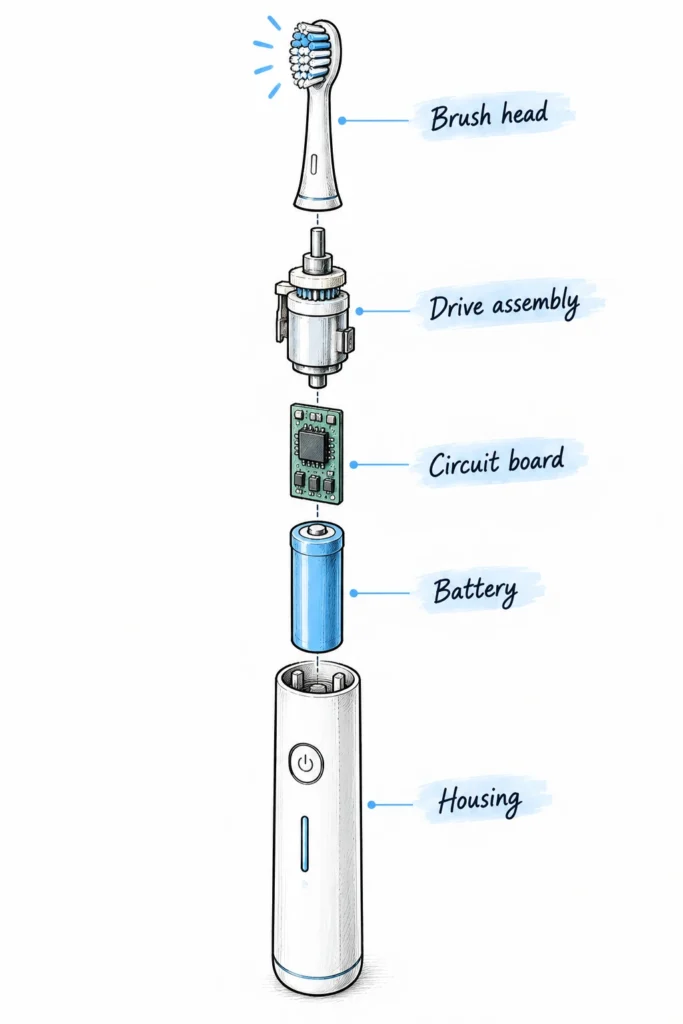
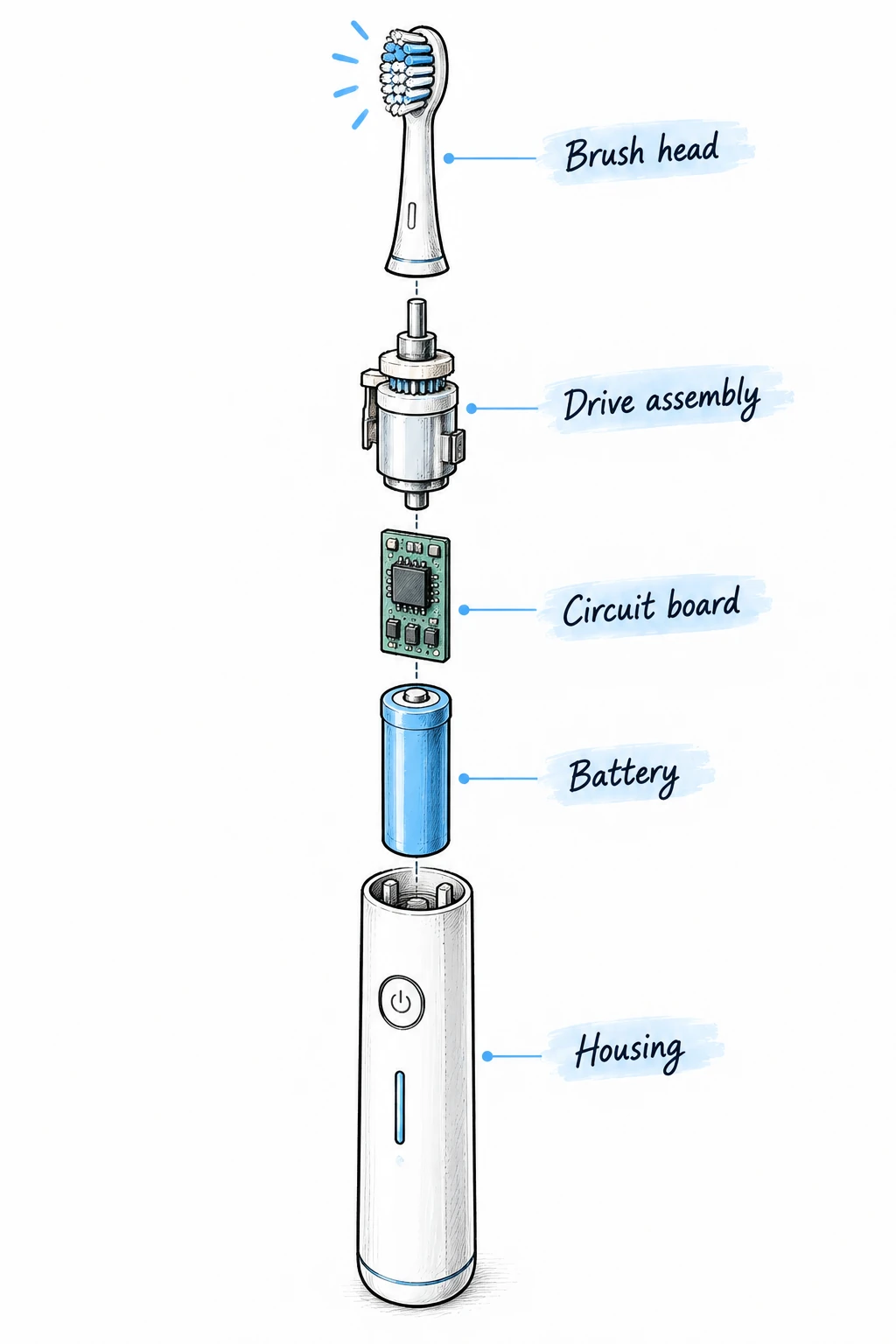
Помимо основной технологии очистки, каждая электрическая зубная щетка содержит систему взаимосвязанных компонентов, которые работают вместе, обеспечивая надежное, безопасное и удобное использование. Понимание того, как работают электрические зубные щетки на уровне компонентов, помогает OEM-покупателям оценивать качество и компромиссы по стоимости при разработке продукта. Вот разбор компонентов.
Аккумуляторная батарея
Rechargeable models may use Li-ion or NiMH cells. The existing 600–2,000 mAh range is a product-planning example; compare cell voltage and energy in Wh as well as capacity. Runtime and cycle life depend on the cell, charging system, load and temperature.
Двигатель и схема драйвера
The motor and driver circuit convert electrical power into brush-head movement. Electromagnetic and geared DC designs may require different power stages; an H-bridge is one possible arrangement.
Печатная плата (PCB) и микроконтроллер
8–32-битный MCU управляет режимами чистки, таймером, сигналом датчика давления, светодиодными индикаторами и связью BLE в умных моделях.
Датчик давления
Pressure detection may use a force sensor, a deflection mechanism or motor-load measurement. The controller compares the signal with a model-specific setting, then activates a warning or adjusts the motor.
Система зарядки
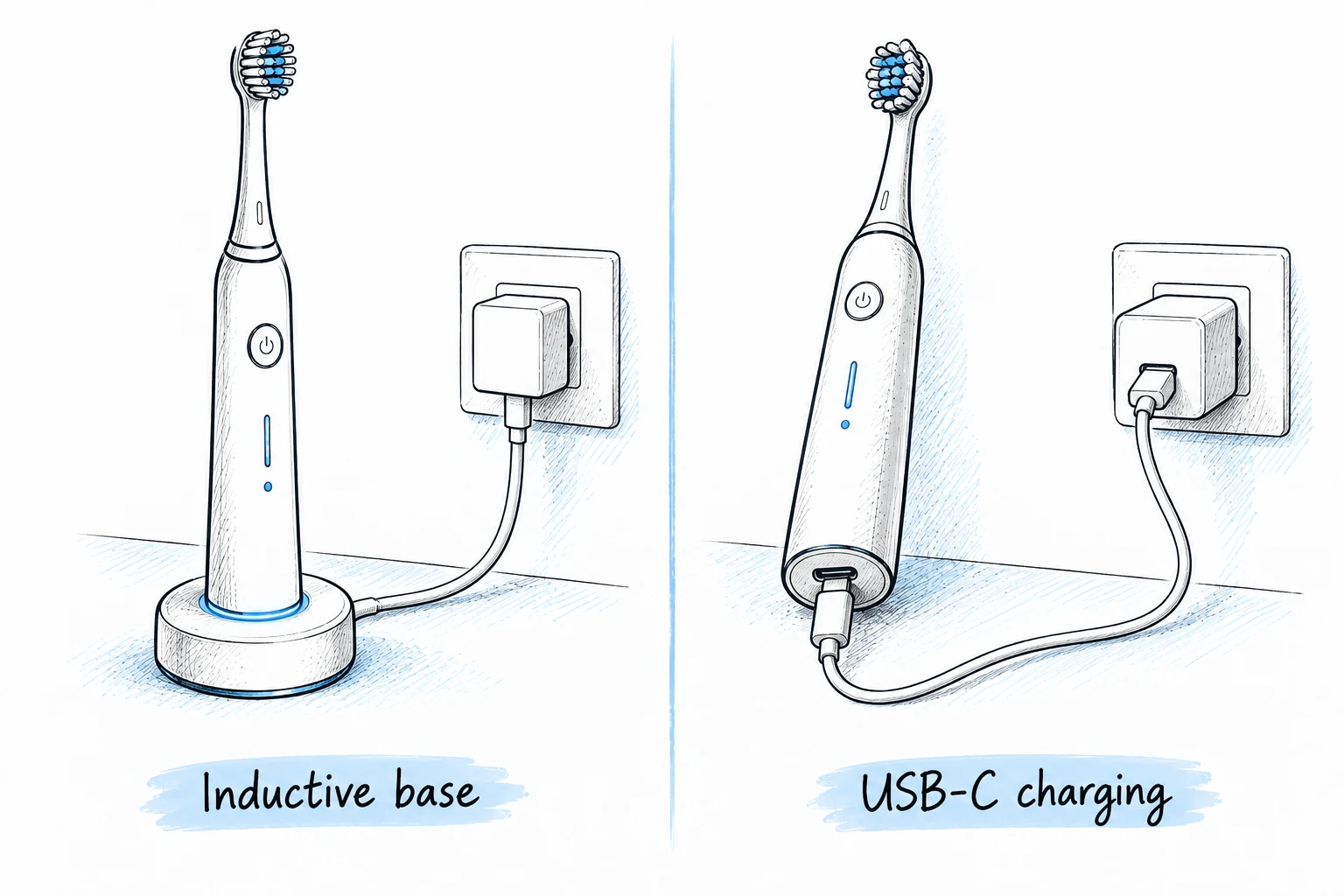
Charging may use a dedicated inductive base or a wired connection such as USB-C. The input rating, charging time and compatible charger depend on the design. An inductive base is not automatically Qi-compatible.
Насадка и приводной вал
Сменная насадка с нейлоновыми или PBT-щетинками. Соединена с двигателем через приводной вал из нержавеющей стали или нейлона. Механизм крепления: защелкивающийся или поворотно-фиксирующийся.
Печатная плата и система управления
Сайт printed circuit board (PCB) carries the electronics that control modes, timing, indicators and optional sensors or connectivity. A 20–50 mm × 10–25 mm board is one layout example; dimensions depend on the handle and circuit design. Typical functions include:
- Microcontroller (MCU): An 8-bit or 32-bit controller runs the firmware. Select the device for processing, memory, power and interface requirements; a Bluetooth SoC may also perform this role.
- Драйвер двигателя: A power stage controlled by the MCU supplies the waveform and current required by the selected motor. The circuit may use an H-bridge, depending on the drive architecture.
- Clock source: An internal oscillator or external crystal provides the controller’s timing reference. Some designs use a 32.768 kHz crystal for low-power timekeeping; the required clocks depend on the chosen controller.
- Интерфейс датчика давления: Канал аналого-цифрового преобразователя (ADC), считывающий изменение напряжения от датчика давления
- Драйвер светодиодов: Схема из токоограничивающего резистора и транзистора, управляющая светодиодами индикации режимов
- BLE SoC (только в умных моделях): Система на кристалле Bluetooth Low Energy (Nordic nRF52832 или аналогичная), обеспечивающая беспроводную связь с сопутствующим приложением
- Charging and battery protection: Charging control, voltage monitoring, temperature checks and protection functions are selected for the cell chemistry and product design. They may be integrated or implemented with separate circuits.
Режимы чистки и таймер квадрантов
Одна из самых ценных функций современных электрических зубных щеток — как с точки зрения потребителя, так и с точки зрения OEM-дизайна — это система режимов чистки. То, как электрические зубные щетки работают с несколькими режимами, зависит от управляемых микроконтроллером профилей частоты и амплитуды, заложенных в прошивке. Каждый режим имеет свой профиль частоты, амплитуды и времени, предоставляя пользователям гибкость для различных потребностей в уходе за полостью рта.
Распространенные режимы чистки
| Режим | Частота | Амплитуда | Продолжительность | Intended Use |
|---|---|---|---|---|
| Чистка | Полная частота (например, 40 000 движений/мин) | Стандартная | 2 мин | Ежедневное использование, комплексная очистка |
| Отбеливание / Полировка | Полная + прерывистый импульс | Выше | 2 мин | Удаление поверхностного налета, для любителей кофе/чая |
| Чувствительный | 60–70% от максимальной частоты | Пониженная | 2 мин | Users who prefer a gentler brushing feel |
| Уход за деснами / Мягкий | 40–50% от макс., пульсация | Низкий | 3 мин | Gentle gumline brushing |
| Чистка языка | Низкая частота, стабильно | Легкий | 30 сек | Освежение дыхания, удаление налета с языка |
| Отбеливание | Чередование высокого/низкого | Зависит от варианта | 3 мин | Усиленные циклы удаления налета |
A таймер квадрантов gives a brief pause or signal every 30 seconds to prompt a change of brushing area. Four intervals support a two-minute session. This is a pacing aid; users still need to guide the brush over the inner, outer and chewing surfaces.
Аккумуляторные технологии и системы зарядки
Battery selection affects handle weight, runtime, charging and cost. For an OEM project, compare the cell together with the motor load, standby consumption and charging circuit to match the target use pattern and retail positioning.
Литий-ионные (Li-ion) против никель-металлогидридных (NiMH)
Li-ion cells are widely used in rechargeable toothbrush designs. Check the supplier’s cell drawing and datasheet for voltage, dimensions and capacity. Cylindrical format names are approximate: a 14500 cell is nominally about 14 mm × 50 mm, while 14450 denotes about 14 mm × 45 mm. Dimensions, terminal details and capacity must be confirmed for the selected cell. Key selection factors include:
- Energy density: Compare the selected cells in Wh/kg and Wh/litre; a fixed threefold advantage does not apply to every Li-ion and NiMH design.
- Self-discharge: Cell chemistry, temperature and storage conditions affect charge retention. Low-self-discharge NiMH cells are available, so compare the selected cells’ storage specifications.
- Charging habits: Li-ion cells can normally be topped up within the approved charging limits. Follow the cell supplier’s voltage, current and temperature requirements.
- Cycle life: A full-equivalent cycle is cumulative discharge equal to the cell’s rated capacity, not one brushing session. A 500-cycle rating must state the test conditions and retained-capacity criterion. Brushing frequency alone cannot convert that rating into years of service.
- Charging time: A 1–3 hour charge is possible on a design built for that rate. The battery, charger, thermal limits and power-management circuit determine the result, rather than the connector type alone.
NiMH remains an option where cost, cell availability and the established charging design fit the project. It still requires appropriate charge control and protection against damaging operating conditions. Low-self-discharge variants can retain charge well, and memory-effect behaviour should not be generalised from NiCd batteries.
Системы зарядки: Индукционная против USB-C
Inductive charging transfers energy between coils in the base and handle. The receiver rectifies and regulates that energy to charge the battery. Removing an exposed charging connector can simplify sealing, but charging efficiency, alignment, heat and full-charge time must be evaluated for the selected design. A dedicated toothbrush base does not necessarily support the Qi standard.
USB-C charging provides a convenient wired connection. Specify the input voltage and current, supported power protocol, charger compatibility and charging time. USB-C does not itself guarantee USB Power Delivery or a 1–3 hour charge. The port, surrounding housing and any cover must form a tested sealing system.
Водонепроницаемость: IPX7 и инженерная задача
Water resistance depends on the complete enclosure and its seals. IPX7 addresses temporary immersion under defined test conditions, commonly described for a small device as 1 metre for 30 minutes. It does not establish protection against water jets, all shower conditions or indefinite immersion, and it does not automatically apply to the charger. Follow the product’s stated cleaning and charging instructions.
Заливка компаундом и ультразвуковая сварка
Potting or encapsulation can protect selected electronics with a compatible epoxy or silicone material. It is one part of the sealing strategy alongside housing joints, shaft seals and charging interfaces. The existing USD 0.80–2.50 per-unit allowance is a planning example; material volume, curing, labour and repairability affect the final cost.
Ультразвуковая сварка can join compatible plastic housing parts using high-frequency mechanical vibration. Equipment in the 20–40 kHz range is one example. Joint geometry, material and process settings determine weld strength and sealing quality; verify both on the finished assembly.
Для зоны крепления насадки — наиболее механически нагруженного места уплотнения — используются силиконовые O-кольца или жидкий герметик. Приводной вал проходит через это уплотнение через втулку с малым зазором, сохраняя гидроизоляцию при обеспечении вращательного или линейного движения.
Нужна помощь в спецификации вашей электрической зубной щетки?
Интересуетесь, как работает электрическая зубная щетка для вашего бренда? Наши инженеры могут провести вас по вопросам выбора двигателя, стратегии гидроизоляции и оптимизации стоимости спецификации материалов для вашего целевого рынка.
Поговорить с нашей инженерной командойУмные зубные щетки: датчики, BLE и подключение к приложению
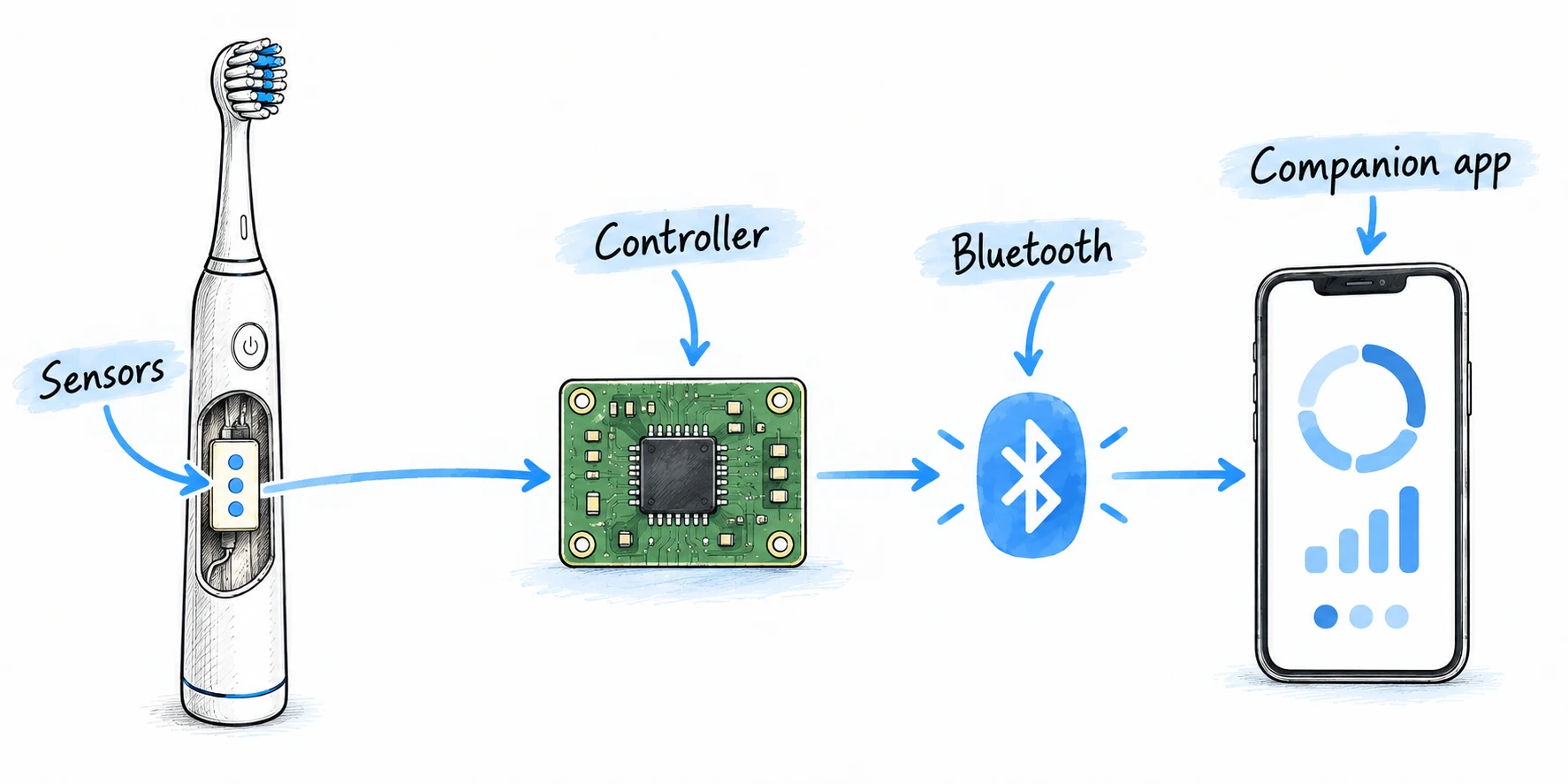
Smart toothbrushes combine a brushing platform with Возможность подключения Bluetooth, optional sensors and companion software. A connected and non-connected model may share a motor or brush head, while other designs use different components. Specify the physical cleaning performance and the data functions separately.
Ключевые «умные» функции и их датчики
| Умная функция | Используемый датчик | Техническая деталь |
|---|---|---|
| Продолжительность чистки зубов | Часы реального времени (таймер MCU) | Встроены в MCU — дополнительный датчик не требуется |
| Определение давления | Force sensor, deflection sensing or motor-load measurement | Position and calibration depend on the sensing design |
| Определение положения | 6-осевой IMU (акселерометр + гироскоп) | Estimates movement and brushing zones through a validated algorithm |
| Износ насадки | Usage timer or session counter; additional sensing if fitted | Prompts replacement based on use; does not directly measure every bristle’s condition |
| Состояние аккумулятора | Микросхема индикатора заряда (кулонометр) | Estimates remaining charge; cycle and health data depend on the implementation |
| Сопряжение по Bluetooth | Bluetooth Low Energy SoC | For example, a Nordic nRF52-series device; select for the required features |
A six-axis inertial measurement unit (IMU) combines a three-axis accelerometer and three-axis gyroscope. Software can use these signals to estimate brushing movement and mouth zones. Accuracy depends on sensor placement, calibration, the algorithm and user behaviour. Zone feedback is an estimate of brushing activity, rather than a direct measurement of plaque removal or oral health.
Перспектива OEM в отношении затрат на умные зубные щетки
Smart functions add connectivity, sensing and software to a product that already uses electronic control. The existing USD 8–25 per-unit estimate is a planning allowance for additional hardware, not an app-development quotation. Check which components are already included in the base platform to avoid double-counting. Example budget items include:
- BLE SoC and antenna: USD 2.50–5.00 as a planning allowance. Nordic nRF52840 and Realtek RTL8762 are examples; suitability depends on the selected part and software requirements.
- Six-axis IMU: USD 1.50–4.00 as a planning allowance. Examples include TDK InvenSense ICM-42670 and Bosch Sensortec BMI270.
- Pressure sensing: USD 0.30–1.00 as a planning allowance; the sensing method and required calibration determine the actual cost.
- App development: An illustrative one-time budget of USD 30,000–150,000 for iOS and Android. Scope separately for maintenance, cloud services, privacy controls and operating-system updates.
- Additional PCB layers and components: USD 1.00–3.00 as a planning allowance; confirm overlap with the selected connectivity and sensor modules.
A USD 25–60 retail premium is a positioning example for a connected model. Assess the selling price alongside channel costs, software maintenance, returns and the complete product cost before estimating profitability.
Технология УФ-санитарной обработки
A UV sanitizing base uses a separate UV-C light system to reduce microorganisms on exposed brush-head surfaces. Wavelength, dose, exposure time, lamp placement, shadows and the tested organism determine the result. A 254 nm lamp and a 5–10 minute cycle describe particular designs; they do not establish a universal 99.9% reduction for all bacteria and viruses. Use product-specific test results for performance claims, and prevent eye or skin exposure with an enclosed design and suitable interlocks.
UV-C sources may include low-pressure mercury lamps or UV-C LEDs. Compare wavelength, delivered dose, thermal management, service life, material compatibility and disposal requirements for the selected source. Lamp type alone does not determine which complete sanitizer is more effective or durable.
The existing USD 3.50–8.00 BOM allowance illustrates a UV-base option. The light source, enclosure, control system and safety interlocks affect cost and packaging size. Position the feature using the selected product’s tested performance.
Насадки: Наука и инженерия щетины
В то время как ручка содержит всю электронную интеллектуальную начинку, именно насадка отвечает за фактическую чистку. Понимание того, как работают электрические зубные щетки для обеспечения эффективного ухода за полостью рта, требует знания инженерии насадок — материал щетины, диаметр, конфигурация пучков и свойства гибкости — все это влияет на эффективность чистки и пользовательский опыт.
Материалы щетины
Brush-head performance depends on filament material, diameter, length, taper and tuft arrangement. Nylon 612 and PBT are material options; PBT is not automatically softer than nylon. Define the required brushing feel and inspect filament ends, tuft retention and mechanical performance against the applicable specification. ISO 20127:2025 covers physical properties of powered toothbrushes; its end-rounding requirements have exceptions for specified filament types, so a universal tip-radius rule is inappropriate.
Индикаторная щетина
Colour-fading indicator bristles provide a visual replacement reminder. Fading depends on the filament treatment, brushing habits and exposure; it is not a precise three-month clock. The existing USD 0.05–0.15 per-head allowance is a planning example. Colour-treated or mixed-colour filaments do not inherently require two-material injection moulding. Follow the brush-head replacement instructions and replace sooner when the bristles are worn.
OEM-производство: От выбора компонентов до массового производства
Понимание того, как работают электрические зубные щетки с производственной точки зрения, является основой для принятия разумных решений по OEM-закупкам. Каждый технический выбор — тип двигателя, емкость аккумулятора, метод гидроизоляции, интеграция интеллектуальных датчиков — оказывает прямое, поддающееся количественной оценке влияние на стоимость производства, качество продукта и розничное позиционирование. Ознакомьтесь с нашим руководством по OEM для электрических зубных щеток для более глубокого погружения в производственный процесс.
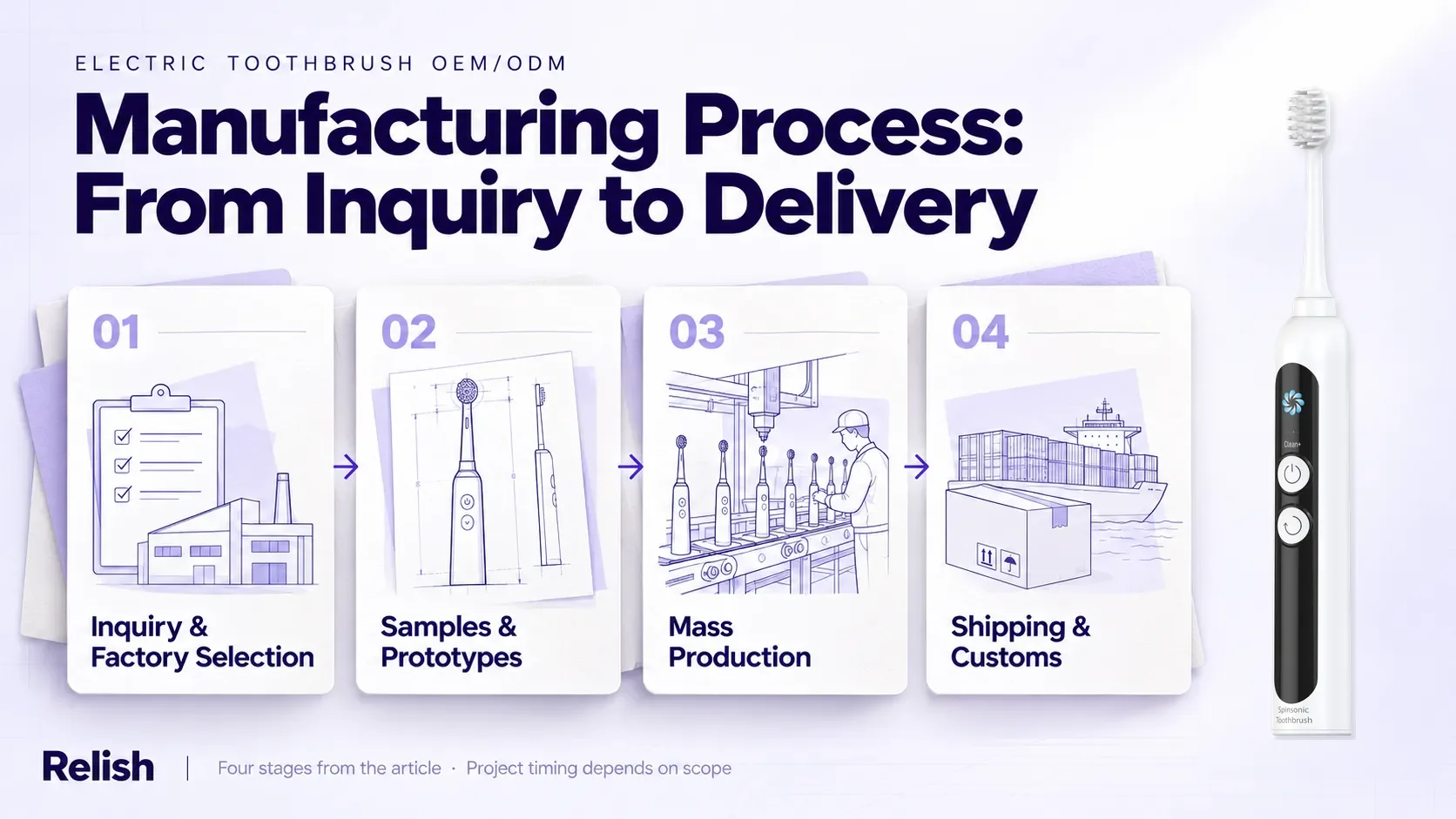
At Relish Technology, motor engineering, electronics, sealing and app connectivity inform the development process. The following 28-week schedule illustrates a new-product project; an existing platform or a more complex programme will follow a different timeline.
- Концептуальная валидация (недели 1–4): Определение спецификации продукта — тип технологии (звуковая/ротационная/Ротасоник), целевые рынки, требуемые сертификаты, ценовой сегмент. Это определяет все последующие решения.
- Разработка прототипа (недели 5–12): Создание функциональных прототипов ручки, электроники и насадки. Тестирование производительности двигателя, времени работы аккумулятора, гидроизоляции и прошивки печатной платы. Типичное количество прототипов: 3–10 единиц.
- Предпроизводственная валидация (недели 13–20): Инженерное валидационное тестирование (EVT) и дизайн-валидационное тестирование (DVT) — тестирование погружением IPX7, тестирование на падение, тестирование ЭМС, циклическое тестирование аккумулятора и предварительное тестирование на соответствие нормативным требованиям.
- Подготовка к массовому производству (недели 21–28): Завершение оснастки, контроль первой детали, пилотный запуск (100–300 единиц) и настройка системы качества, включая планы выборки AQL.
- Production and shipment: Full production combines in-process checks, functional testing and agreed sampling inspections. Define defect categories and acceptance criteria in the quality agreement. Safety-critical defects require a zero-acceptance approach; an AQL value must not be presented as permission to ship a known critical defect. Осмотрите наши производственные мощности чтобы лично ознакомиться с нашими производственными возможностями.
Как выбрать правильную технологию для вашего бренда
С учетом технической основы, ниже представлена структура принятия решений для владельцев брендов и менеджеров по закупкам, выбирающих OEM-партнера для разработки электрических зубных щеток. Понимание того, как работают электрические зубные щетки во всех трех категориях технологий — звуковые, вращательно-колебательные и Rotasonic™ — позволяет вести более осознанные переговоры с производителями и формировать более точные спецификации продукта.
| Критерии | Звуковая | Вращательно-осциллирующий | Rotasonic™ (Комбинированная) |
|---|---|---|---|
| Диапазон стоимости BOM | $12-$28 | $8-$20 | $18–$38 |
| Ценовое позиционирование в рознице | Средний и премиальный | Начальный и средний | Премиальный и ультра-премиальный |
| Уровень шума | Depends on drive, mounting and operating mode | Depends on drive, gearing and operating mode | Depends on the combined drive design |
| Cleaning Action | Bristle movement and nearby liquid agitation | Alternating angular movement with bristle contact | Combined sonic and oscillating-rotating movement |
| Наилучшее соответствие рынку | Премиальные потребительские бренды | Бренды среднего сегмента, Amazon FBA | Brands seeking a dual-action platform |
| Пригодность для интеллектуальных функций | Отличная | Хорошая | Отличная |
Готовы начать свой проект по производству электрических зубных щеток?
Запускаете ли вы новый бренд, расширяете существующую линейку или ищете источники для розничных закупок — инженерная команда Relish Technology поможет вам выбрать правильную технологическую платформу и пройти полный путь от концепции до массового производства.
Поговорить с нашей инженерной командойISO 13485 · FDA/CE Compliance Support · 15+ Years OEM Experience · 20,000 m² Manufacturing Facility
Часто задаваемые вопросы
Answers to common questions about electric toothbrush mechanisms, components, charging, sensors and OEM product development.
Литература и источники
- Американская стоматологическая ассоциация (ADA). Зубные щетки. Зубные щетки.
- Международная электротехническая комиссия. IEC 60335-2-52:2021 — Particular requirements for oral hygiene appliances. IEC 60335-2-52:2021 — Particular requirements for oral hygiene appliances.
- Международная организация по стандартизации (ISO). ISO 20127:2025 — Dentistry — Physical properties of powered toothbrushes. ISO 20127:2025 — Dentistry — Physical properties of powered toothbrushes.
- Управление по санитарному надзору за качеством пищевых продуктов и медикаментов США (FDA). Powered toothbrush classification: JEQ, 21 CFR 872.6865, Class I; 510(k)-exempt within applicable limits. Powered toothbrush classification: JEQ, 21 CFR 872.6865, Class I; 510(k)-exempt within applicable limits.
- Nordic Semiconductor. nRF52840 Product Specification. nRF52840 Product Specification.
- Bosch Sensortec. BMI270 inertial measurement unit. BMI270 inertial measurement unit.