











Brosse à dents électrique pour dents et gencives sensibles : Guide technique pour les propriétaires de marques
A comfortable brushing experience can give an oral care brand a clear point of difference. For a sensitive-teeth product, that promise starts with bristle design, controllable brushing intensity and useful user feedback.
This guide explains how to specify an brosse à dents électrique pour dents et gencives sensibles, from brush-head materials to pressure feedback, costs and product claims. Explorez notre collection de brosses à dents électriques for OEM platforms you can develop around these priorities.
Qu'est-ce qui cause la sensibilité dentaire ?
Understanding sensitivity helps a brand define a comfortable brushing product and distinguish its design features from treatment claims.
Several conditions can cause sensitive teeth. Exposed dentin is one common mechanism, while tooth decay or cracks may cause pain that needs a different approach.
Avant de sélectionner les composants, les propriétaires de marques doivent comprendre les mécanismes sous-jacents : involves exposed dentin. Relevant causes and circumstances include:
- Récession gingivale: Root surfaces become exposed as the gum line recedes.
- Tooth wear: Acid erosion and mechanical abrasion can contribute to loss of protective tooth structure.
- : Les aliments acides, les boissons ou un brossage agressif usent l'émail: Cracks can cause sensitivity or pain; this is distinct from a simple exposed-dentin problem.
- : Créant des voies vers la pulpe: Some people experience temporary sensitivity after treatment.
Dentinal tubules contain fluid. Changes in that fluid in response to stimuli can trigger brief pain in exposed dentin. A toothbrush specification should focus on comfortable, effective cleaning rather than diagnosing the cause.
La dentine contient des tubules microscopiques qui se connectent à la pulpe nerveuse. Lorsque des stimuli (froid, chaleur, pression) atteignent ces tubules, les patients ressentent une douleur aiguë et brève.
The following features help turn a gentle-brushing concept into a testable OEM specification. Assess their combined effect on brushing feel, cleaning performance and production cost.
Conception des brins souples
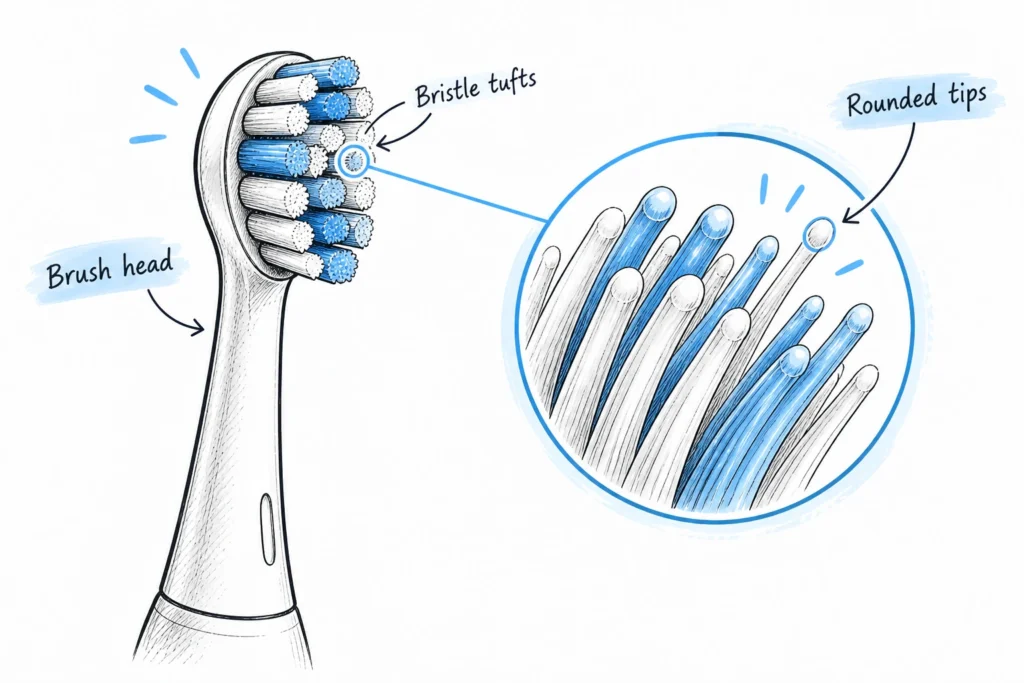
Start with the complete bristle design. Filament diameter, material, length, tuft density and tip finish all influence stiffness and contact feel. Compare finished brush-head samples rather than judging softness by diameter alone.
| Type de poils | Filament diameter | Prototype use |
|---|---|---|
| Extra-soft | 0.15–0.18 mm | Comfort-focused prototype; evaluate the finished tuft design |
| Sensibilité sévère, post-opératoire | 0.18–0.22 mm | Gentle daily-brushing prototype |
| Intermédiaire | 0.22–0.28 mm | Firmer prototype; assess suitability for the target user |
Usage général (peut irriter les gencives sensibles): Define the filament material, softness and tip-finish inspection method. An end-rounding ratio of ≥90% can be a project QC target for suitable end-roundable filaments; it is not a universal requirement for tapered or other special tip designs. Use the applicable powered-toothbrush standard and agree sample acceptance criteria.
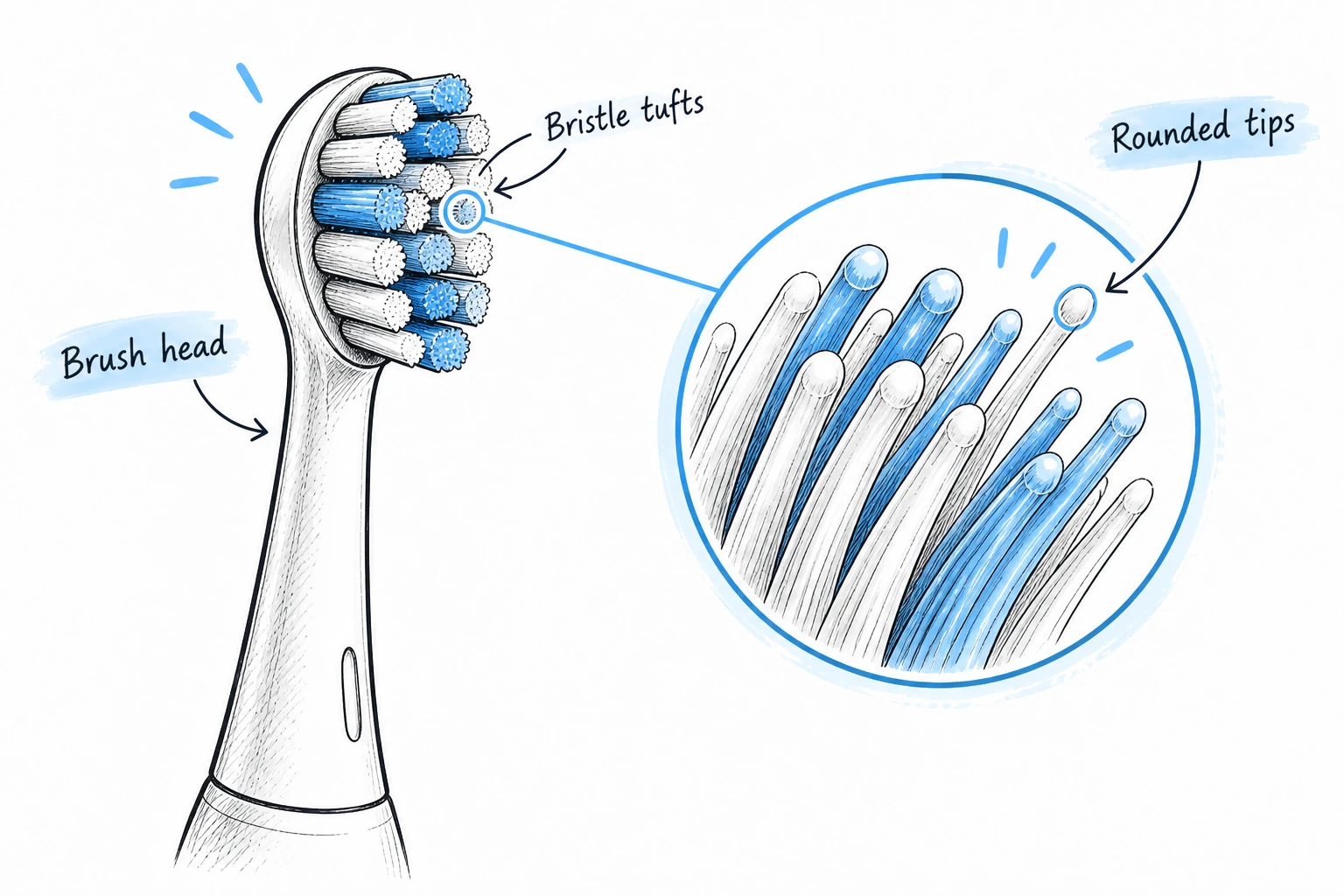
(taux d'arrondi des extrémités ≥90%). Les poils tranchants créent des micro-abrasions sur le tissu gingival.
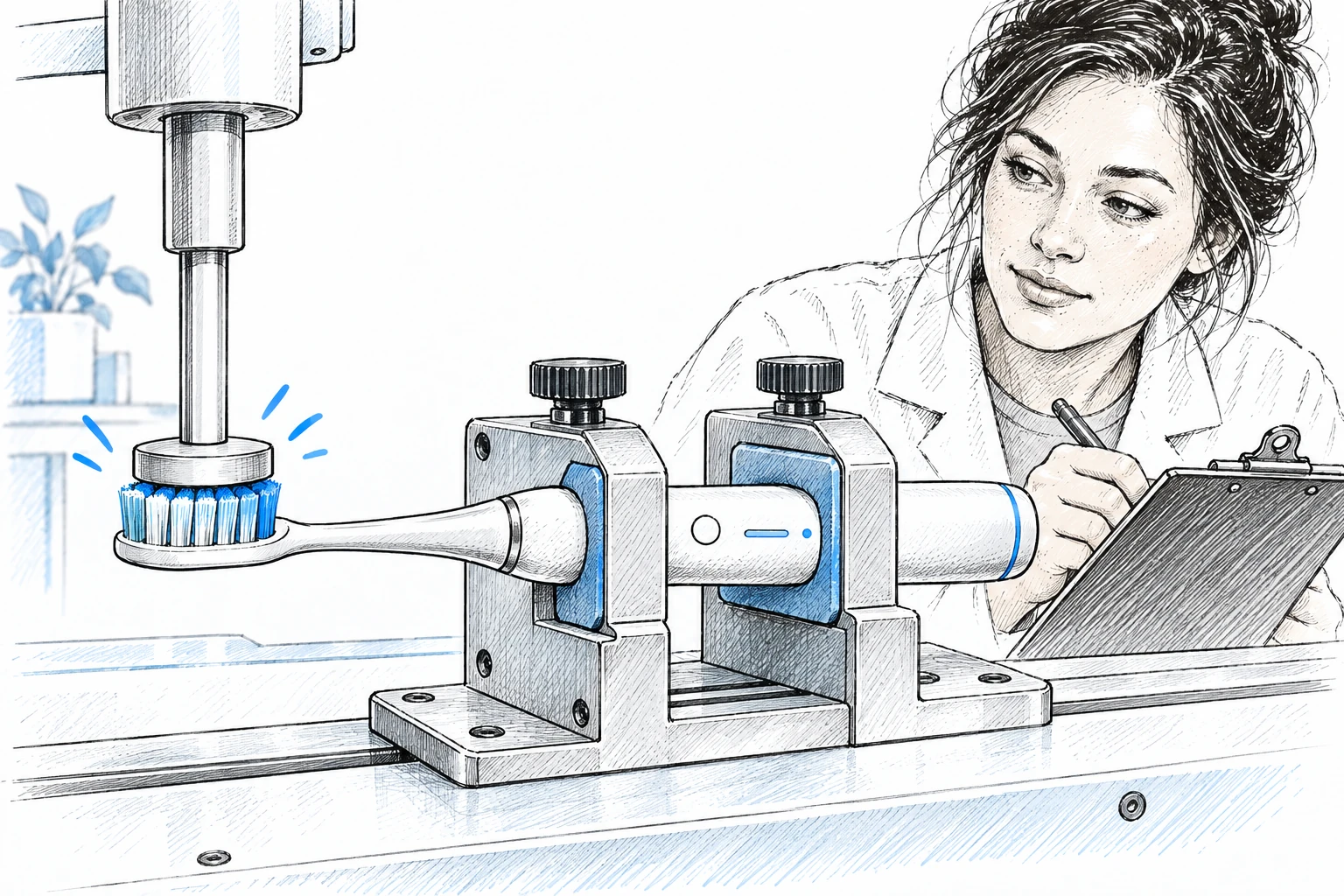
Pressure feedback can help users notice excessive brushing force. Choose the alert threshold and response for the intended brushing feel, then verify them on the finished assembly. For OEM brands, the sensor, mechanical design and calibration process all affect cost.
brosse à dents électrique pour dents sensibles
- conçue à cet effet doit inclure une détection de pression pour empêcher automatiquement le sur-brossage. Pour l'approvisionnement OEM, cette fonctionnalité est un facteur de coût clé dans la nomenclature et un différenciateur majeur dans le segment des dents sensibles.: Respond to changing mechanical loads; suitability depends on the force-measurement circuit and calibration.
- Capteurs à effet Hall: Detect magnetic-field changes associated with movement or deflection in the head or drive assembly.
- Interrupteurs mécaniques: Provide a threshold response with relatively simple hardware.
Solutions de brosses à dents intelligentes peuvent offrir :
- Retour visuel (indicateur LED)
- Retour haptique (changement de motif de vibration)
- Automatic motor-output adjustment when a pressure threshold is reached
Describe the actual response clearly: a pressure alert helps the user adjust force, while a motor-output reduction changes the brushing action. Neither physically removes the force the user applies.
Modes de brossage doux
A sensitive mode should provide a comfortable, repeatable brushing profile. Specify amplitude, frequency and drive settings using units that match the motor system; internal motor rpm is different from brush-head oscillations or strokes per minute.
| Mode | Internal-motor speed example | Cas d'utilisation |
|---|---|---|
| Sensible | 5,000–8,000 motor rpm | Gentle profile; confirm comfort on the selected platform |
| Nettoyage | 8,000–12,000 motor rpm | Entretien quotidien |
| Blanchiment/Polissage | 12,000–15,000 motor rpm | Polishing profile; verify the product claim |
| Soin des gencives | Pulsed drive profile | A different brushing feel |
Recommandation OEM: Include a well-tuned gentle mode. For a linear sonic drive, specify its actual frequency and amplitude rather than applying the rotary-motor rpm examples above.
Sonic and Oscillating-Rotating Platforms
The drive system influences brush-head motion, brushing feel and BOM cost. Compare complete products with equivalent head softness and pressure settings before choosing a platform.
Oscillant-rotatif: Alternating angular movement of the head. Comfort depends on the head, motion profile, applied force and technique.
Sonique: Rapid vibrating brush-head movement. Bristle contact remains important; liquid movement does not make every sonic design inherently gentler or replace brushing contact.
Technologie Vibrosonic™ in Relish Tech’s product line supports lower-frequency mode options and amplitude control for sensitive-brushing configurations. Confirm the selected model’s actual settings in the specification.
Conception de la tête de brosse
Brush-head geometry affects access and contact feel. Compare compact shapes, rounded edges and tuft layouts using the intended user group and brushing technique.
- Têtes compactes: A 28–32 mm head length is an illustrative design option; evaluate access and comfort on the finished head.
- Cols inclinés: Can improve access to harder-to-reach tooth surfaces.
- Soft cup edges: Can reduce hard-edge contact, depending on the material and geometry.
Pour un positionnement sensible, recommander :
- Têtes ovales ou en forme de diamant avec bords arrondis
- Tuft layouts that support cleaning along the gum line with light pressure
- Silicone or TPE (thermoplastic elastomer) details selected for a comfortable contact feel
Timer Functions
Timers and pacing cues help users follow a consistent brushing routine:
- 2-minute timer: Supports the ADA recommendation to brush for two minutes twice a day.
- Quad-pacer: A cue every 30 seconds prompts users to move to another mouth section.
- Minuterie intelligente avec intégration d'application: Suit les habitudes de brossage au fil du temps
Analyse coûts-avantages pour l'approvisionnement OEM
Compare the value of each feature against its effect on the complete product specification. The following percentages are illustrative BOM uplifts against a comparable baseline, not additive quotes; supplier configuration and order volume will change the result.
| Caractéristique | Illustrative BOM uplift | Planning assessment of value | Sourcing considerations |
|---|---|---|---|
| Poils extra-doux | +2-5% | Élevé | Confirm filament availability and order quantity |
| Capteur de pression | +8-15% | Très élevé | Peut affecter le prix unitaire |
| Modes multiples (4+) | +3-6% | Intermédiaire | Confirm firmware and validation scope |
| La technologie sonique | +10-20% | Élevé | Confirm platform and component MOQ |
| Connectivité d'application | +12-18% | Moyenne-élevée | Dépendant du volume |
Illustrative FOB budgets in USD per unit:
- Entrée de gamme (basic soft-bristle configuration): USD 8–15 per unit FOB
- Milieu de gamme (mode options and soft bristles): USD 18–28 per unit FOB
- Haut de gamme (sonic drive, pressure sensing and app): USD 35–55 per unit FOB
Essentiels d'approvisionnement OEM pour brosses à dents dents sensibles
- Quantité minimale de commande : Custom OEM orders typically start at 1,000 units, with flexibility based on the project. Wholesale orders for available stock start at 50 units.
- Délai de livraison : Illustrative production windows are 45–90 days for a standard configuration and 60–120 days for a custom pressure-sensing configuration, after specification and sample approval. Clinical studies and external program reviews require a separate schedule.
- Protocole QC : Pressure-threshold calibration and verification; IQ/OQ/PQ where applicable to the process; filament-tip inspection and tuft-retention testing using applicable ISO 20127:2025 methods.
- Certifications : Enregistrement FDA Classe I, marquage CE, ISO 13485 (qualité des dispositifs médicaux) — Le sceau ADA nécessite une validation clinique distincte
Pour une ventilation détaillée des coûts de fabrication de brosses à dents électriques incluant les structures de nomenclature pour les modèles dents sensibles, consultez notre guide d'analyse des coûts.
Besoin d'un devis OEM pour brosses à dents dents sensibles ?
Obtenez une évaluation détaillée de la faisabilité de production incluant les options de spécifications de poils, l'étalonnage du capteur de pression et les coûts de parcours réglementaire.
Demander un devis OEMConsidérations réglementaires et de certification
Plan the compliance route for the product’s intended use and sales markets. Product requirements, quality-system certification and voluntary third-party acceptance serve different purposes.
- Sceau d'acceptation ADA: A voluntary product assessment. The toothbrush category addresses safety, plaque removal and gingivitis reduction; it is not a general seal for treating tooth sensitivity.
- ISO 20127:2025: Physical properties and test methods for powered toothbrushes.
- Marquage CE (EU): Identify the applicable legislation and complete the relevant conformity assessment for the product.
- FDA requirements (US): An ordinary powered toothbrush is Class I under 21 CFR 872.6865, product code JEQ, with 510(k) exemption subject to its limitations. Establishment registration and device listing are separate obligations, not FDA product approval.
En savoir plus sur nos capacités de certification et de conformité et lisez notre guide des certifications pour brosses à dents électriques OEM pour une analyse complète du parcours réglementaire.
If pursuing ADA acceptance, budget separately for the required product evidence and program review. The earlier planning range of USD 15,000–30,000 and 3–6 months is an illustrative project allowance, not an ADA fee schedule or guaranteed completion time. Confirm the current submission requirements before commissioning studies.
Positionner votre marque de brosse à dents pour dents sensibles
Segments de consommateurs cibles
- Consumers aged 40+: Assess comfort needs and product preferences through audience research.
- People after dental procedures: Product use and timing should follow the treating professional’s advice.
- People with orthodontic appliances: Consider access around brackets and the ease of maintaining a brushing routine.
- Comfort-focused consumers: Test whether gentler brushing features support the proposed price point.
Angles de différenciation concurrentielle
- “Dentist-recommended gentleness”: Use when the stated recommendation is documented and matches the product.
- " Conçu pour la sensibilité ": Crédibilité technique/ingénierie
- “Gentle care for your daily routine”: A clear, comfort-led message.
Emballage et allégations marketing
Claim wording to assess against the finished product’s evidence:
- " Poils souples conçus pour les dents et les gencives sensibles "
- “A gentle mode for comfortable daily brushing”
- “Pressure feedback helps you notice when you press too hard”
Claims planning: Match the wording to the product evidence, intended use and target-market requirements. A claim to treat or cure sensitivity requires a different assessment from a claim about soft bristles or brushing comfort.
Points clés à retenir pour les propriétaires de marques
- Specify the complete bristle design: Agree material, filament dimensions, tuft layout and tip-finish criteria. A ≥90% end-rounding target applies only where the chosen filament design supports that inspection.
- Make pressure feedback useful: Verify the trigger threshold and response, then explain clearly how users should react.
- Compare complete platforms: Neither sonic nor oscillating-rotating motion guarantees a gentler experience by itself.
- Tune a gentle brushing profile: Measure frequency, amplitude and drive settings in the correct units rather than treating 5,000–8,000 internal motor rpm as a universal brush-head specification.
- Plan voluntary acceptance separately: Treat the USD 15,000–30,000 and 3–6 month study allowance as a budgeting example; confirm the actual scope and review process.
Téléchargez la Fiche technique de la brosse à dents pour dents sensibles — y compris les tolérances de diamètre des poils, les plages d'étalonnage du capteur de pression et les estimations du coût des matériaux pour la production OEM.
Frequently Asked Questions About Electric Toothbrushes for Sensitive Teeth
These questions cover brushing comfort, brush-head choices and practical OEM sourcing decisions.
Quel est le meilleur dentifrice pour les dents et gencives sensibles ?
Look for soft bristles, a comfortable head shape and a controllable brushing profile. Pressure feedback can be useful. Evaluate the finished product’s comfort rather than assuming one motor type or filament diameter is best for everyone.
Les brosses à dents électriques ou manuelles sont-elles meilleures pour les dents sensibles ?
Both manual and powered toothbrushes can provide effective cleaning. For sensitive teeth, soft bristles and light pressure matter; a powered model may add helpful pacing or pressure feedback.
À quelle fréquence devriez-vous remplacer une brosse à dents pour dents sensibles ?
Replace the brush or detachable head about every 3–4 months, or sooner if the bristles are worn or splayed. Follow any model-specific replacement instructions.
Quelle dureté de poils est la meilleure pour les gencives qui se rétractent ?
A soft-bristled head and light brushing pressure are sensible starting points. A dental professional can advise on gum recession; a specific filament diameter or pressure sensor does not guarantee that recession will stop.
Les brosses à dents soniques endommagent-elles les dents sensibles ?
Comfort depends on the finished head, mode settings, brushing force and technique. Sonic motion does not eliminate bristle contact or make every model gentler than an oscillating-rotating brush.
Quelles caractéristiques une brosse à dents pour dents sensibles devrait-elle avoir ?
Prioritize soft bristles, a comfortable head and a well-tuned gentle mode. Consider pressure feedback and a two-minute timer according to the intended user and product budget.
Comment choisir un fabricant OEM pour les brosses à dents pour dents sensibles ?
Review the proposed filament material and finished-head samples, agree relevant QC methods, and verify pressure-feedback calibration where fitted. Ask for evidence that supports the exact product claims and any advertised certifications or voluntary acceptance.
L'utilisation d'une brosse à dents à poils souples peut-elle inverser la sensibilité dentaire ?
A soft brush can make daily cleaning more comfortable, but it does not address every cause of sensitivity. Persistent or new sensitivity should be assessed by a dental professional.
Références
- American Dental Association. (2026). Brosses à dents. ADA.org.
- American Dental Association. Sensitive Teeth. MouthHealthy.
- International Organization for Standardization. (2025). ISO 20127:2025 — Dentistry — Physical properties of powered toothbrushes. ISO 20127:2025.
- American Dental Association. ADA Seal of Acceptance category requirements overview. ADA Seal requirements.
- U.S. Food and Drug Administration. Product classification: powered toothbrush, JEQ. classification FDA.
Articles connexes
Prêt à sourcer votre brosse à dents pour dents sensibles ?
Relish Tech develops OEM electric toothbrushes with soft-bristle options, pressure feedback, gentle modes and Vibrosonic™ technology. Build a clear specification with our team, from brush-head feel to sensor calibration and production cost.