











Electric Toothbrush for Sensitive Teeth & Gums: A Technical Guide for Brand Owners
A comfortable brushing experience can give an oral care brand a clear point of difference. For a sensitive-teeth product, that promise starts with bristle design, controllable brushing intensity and useful user feedback.
This guide explains how to specify an electric toothbrush for sensitive teeth and gums, from brush-head materials to pressure feedback, costs and product claims. Explore our electric toothbrush collection for OEM platforms you can develop around these priorities.
What Causes Tooth Sensitivity?
Understanding sensitivity helps a brand define a comfortable brushing product and distinguish its design features from treatment claims.
Several conditions can cause sensitive teeth. Exposed dentin is one common mechanism, while tooth decay or cracks may cause pain that needs a different approach.
Dentin hypersensitivity involves exposed dentin. Relevant causes and circumstances include:
- Gum recession: Root surfaces become exposed as the gum line recedes.
- Tooth wear: Acid erosion and mechanical abrasion can contribute to loss of protective tooth structure.
- Cracked teeth: Cracks can cause sensitivity or pain; this is distinct from a simple exposed-dentin problem.
- Periodontal treatment: Some people experience temporary sensitivity after treatment.
Dentinal tubules contain fluid. Changes in that fluid in response to stimuli can trigger brief pain in exposed dentin. A toothbrush specification should focus on comfortable, effective cleaning rather than diagnosing the cause.
Key Toothbrush Features for Sensitive Teeth
The following features help turn a gentle-brushing concept into a testable OEM specification. Assess their combined effect on brushing feel, cleaning performance and production cost.
Soft Bristle Design
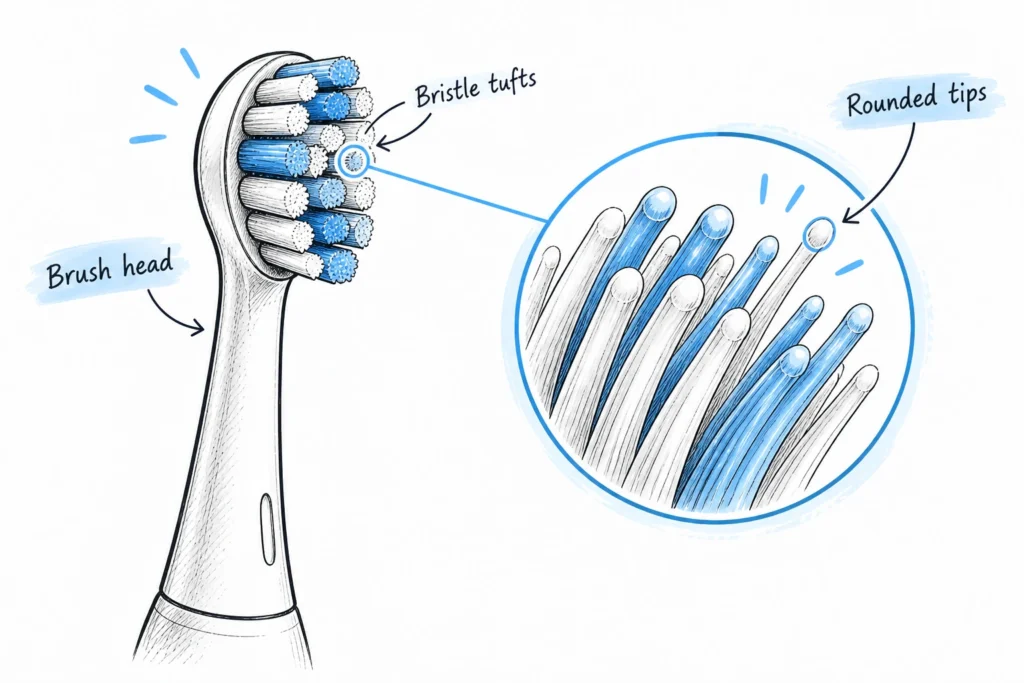
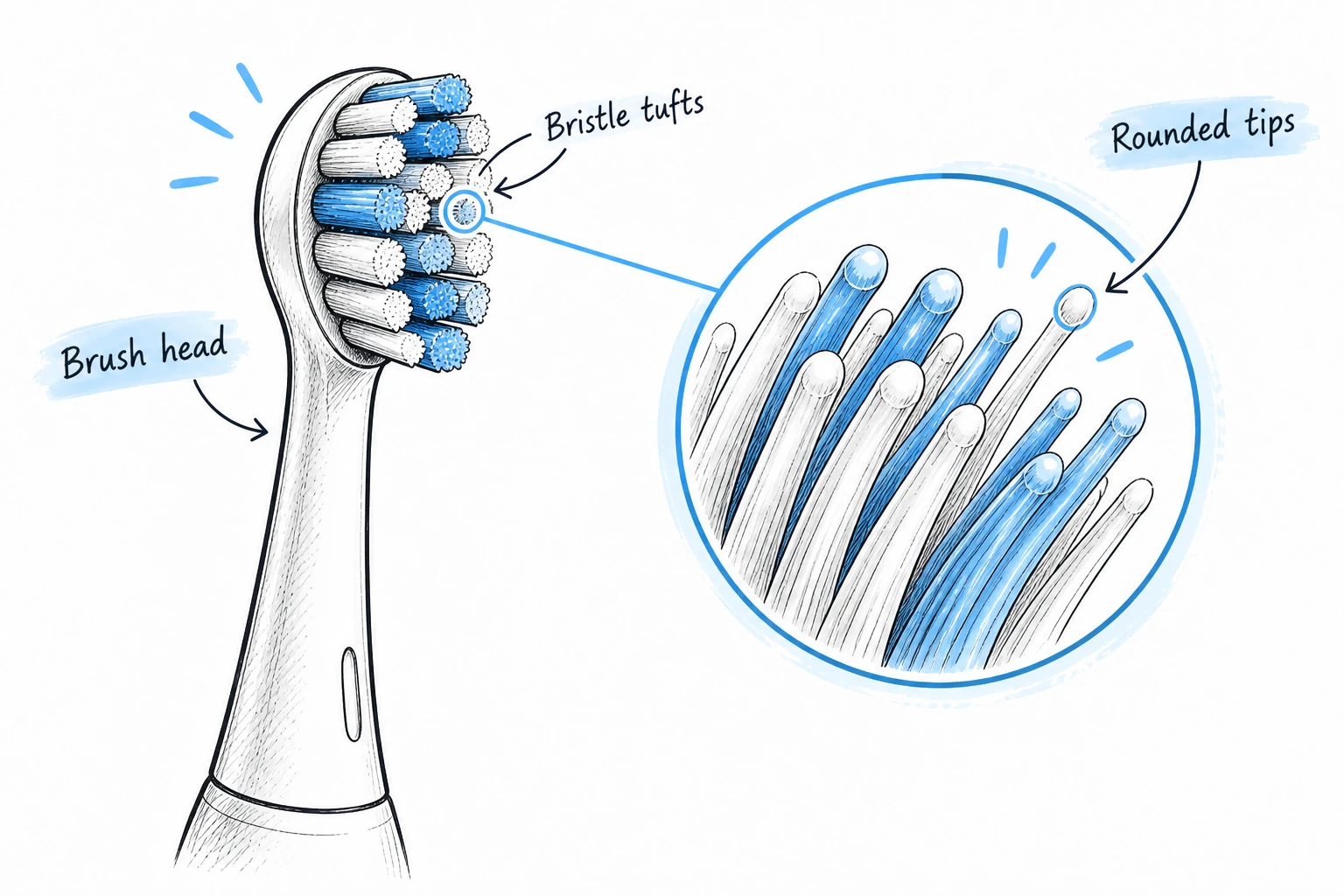
Start with the complete bristle design. Filament diameter, material, length, tuft density and tip finish all influence stiffness and contact feel. Compare finished brush-head samples rather than judging softness by diameter alone.
| Bristle Type | Filament diameter | Prototype use |
|---|---|---|
| Extra-soft | 0.15–0.18 mm | Comfort-focused prototype; evaluate the finished tuft design |
| Soft | 0.18–0.22 mm | Gentle daily-brushing prototype |
| Medium | 0.22–0.28 mm | Firmer prototype; assess suitability for the target user |
OEM specification guidance: Define the filament material, softness and tip-finish inspection method. An end-rounding ratio of ≥90% can be a project QC target for suitable end-roundable filaments; it is not a universal requirement for tapered or other special tip designs. Use the applicable powered-toothbrush standard and agree sample acceptance criteria.
Pressure Sensing Technology
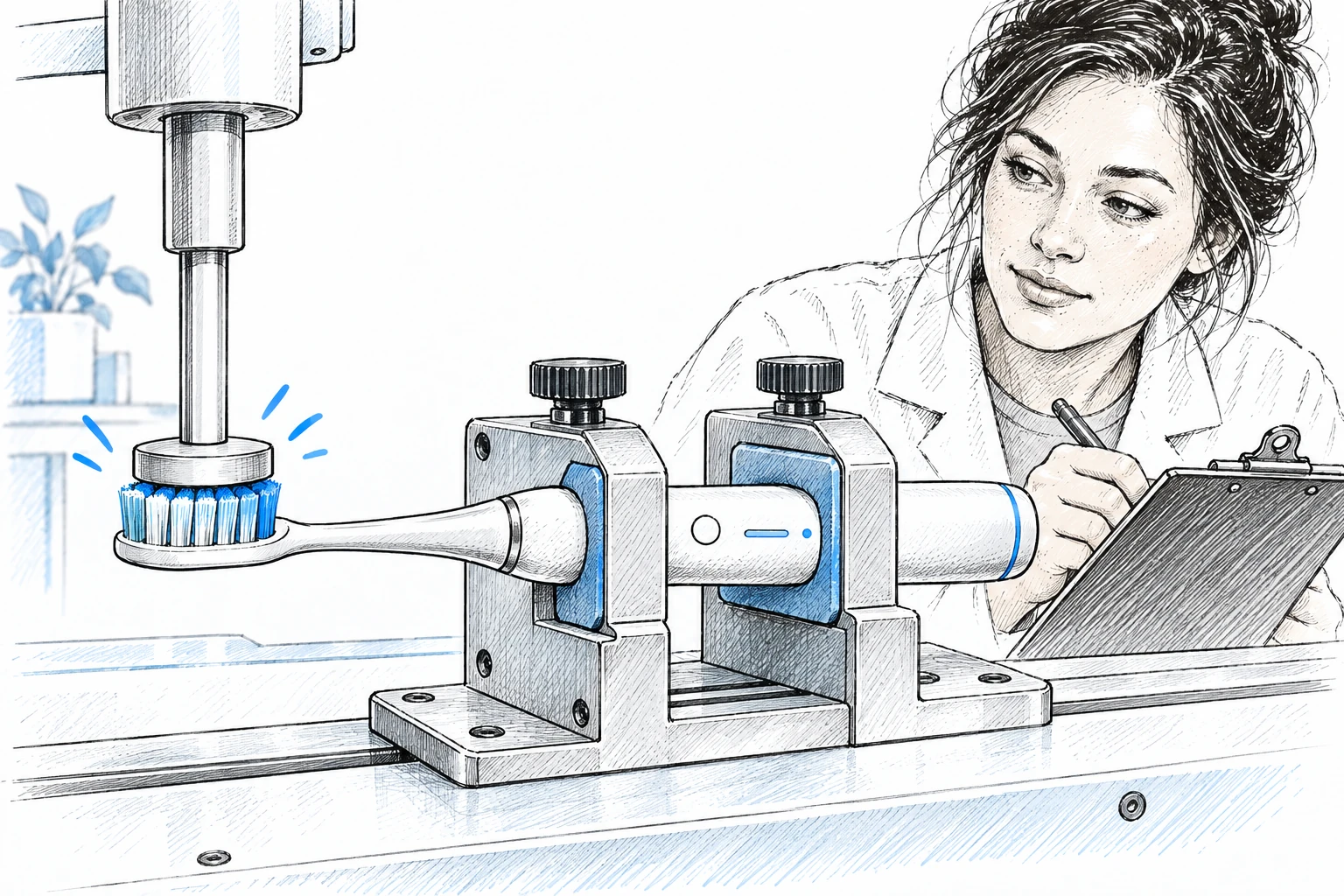
Pressure feedback can help users notice excessive brushing force. Choose the alert threshold and response for the intended brushing feel, then verify them on the finished assembly. For OEM brands, the sensor, mechanical design and calibration process all affect cost.
Technical implementations:
- Piezoelectric sensors: Respond to changing mechanical loads; suitability depends on the force-measurement circuit and calibration.
- Hall effect sensors: Detect magnetic-field changes associated with movement or deflection in the head or drive assembly.
- Mechanical switches: Provide a threshold response with relatively simple hardware.
Smart toothbrush solutions can provide:
- Visual feedback (LED indicator)
- Haptic feedback (vibration pattern change)
- Automatic motor-output adjustment when a pressure threshold is reached
Describe the actual response clearly: a pressure alert helps the user adjust force, while a motor-output reduction changes the brushing action. Neither physically removes the force the user applies.
Gentle Cleaning Modes
A sensitive mode should provide a comfortable, repeatable brushing profile. Specify amplitude, frequency and drive settings using units that match the motor system; internal motor rpm is different from brush-head oscillations or strokes per minute.
| Mode | Internal-motor speed example | Use Case |
|---|---|---|
| Sensitive | 5,000–8,000 motor rpm | Gentle profile; confirm comfort on the selected platform |
| Clean | 8,000–12,000 motor rpm | Daily maintenance |
| White/Polish | 12,000–15,000 motor rpm | Polishing profile; verify the product claim |
| Gum Care | Pulsed drive profile | A different brushing feel |
OEM recommendation: Include a well-tuned gentle mode. For a linear sonic drive, specify its actual frequency and amplitude rather than applying the rotary-motor rpm examples above.
Sonic and Oscillating-Rotating Platforms
The drive system influences brush-head motion, brushing feel and BOM cost. Compare complete products with equivalent head softness and pressure settings before choosing a platform.
Oscillating-rotating: Alternating angular movement of the head. Comfort depends on the head, motion profile, applied force and technique.
Sonic: Rapid vibrating brush-head movement. Bristle contact remains important; liquid movement does not make every sonic design inherently gentler or replace brushing contact.
Vibrosonic™ technology in Relish Tech’s product line supports lower-frequency mode options and amplitude control for sensitive-brushing configurations. Confirm the selected model’s actual settings in the specification.
Brush Head Design
Brush-head geometry affects access and contact feel. Compare compact shapes, rounded edges and tuft layouts using the intended user group and brushing technique.
- Compact heads: A 28–32 mm head length is an illustrative design option; evaluate access and comfort on the finished head.
- Angled necks: Can improve access to harder-to-reach tooth surfaces.
- Soft cup edges: Can reduce hard-edge contact, depending on the material and geometry.
For sensitive positioning, recommend:
- Oval or diamond-shaped heads with rounded edges
- Tuft layouts that support cleaning along the gum line with light pressure
- Silicone or TPE (thermoplastic elastomer) details selected for a comfortable contact feel
Timer Functions
Timers and pacing cues help users follow a consistent brushing routine:
- 2-minute timer: Supports the ADA recommendation to brush for two minutes twice a day.
- Quad-pacer: A cue every 30 seconds prompts users to move to another mouth section.
- Smart timer with app integration: Tracks brushing habits over time
Cost-Benefit Analysis for OEM Sourcing
Compare the value of each feature against its effect on the complete product specification. The following percentages are illustrative BOM uplifts against a comparable baseline, not additive quotes; supplier configuration and order volume will change the result.
| Feature | Illustrative BOM uplift | Planning assessment of value | Sourcing considerations |
|---|---|---|---|
| Extra-soft bristles | +2-5% | High | Confirm filament availability and order quantity |
| Pressure sensor | +8-15% | Very High | May affect unit price |
| Multiple modes (4+) | +3-6% | Medium | Confirm firmware and validation scope |
| Sonic technology | +10-20% | High | Confirm platform and component MOQ |
| App connectivity | +12-18% | Medium-High | Volume-dependent |
Illustrative FOB budgets in USD per unit:
- Entry-level (basic soft-bristle configuration): USD 8–15 per unit FOB
- Mid-range (mode options and soft bristles): USD 18–28 per unit FOB
- Premium (sonic drive, pressure sensing and app): USD 35–55 per unit FOB
OEM Sourcing Essentials for Sensitive Teeth Toothbrushes
- MOQ: Custom OEM orders typically start at 1,000 units, with flexibility based on the project. Wholesale orders for available stock start at 50 units.
- Lead Time: Illustrative production windows are 45–90 days for a standard configuration and 60–120 days for a custom pressure-sensing configuration, after specification and sample approval. Clinical studies and external program reviews require a separate schedule.
- QC Protocol: Pressure-threshold calibration and verification; IQ/OQ/PQ where applicable to the process; filament-tip inspection and tuft-retention testing using applicable ISO 20127:2025 methods.
- Certifications: FDA Class I registration, CE marking, ISO 13485 (medical device quality) — ADA Seal requires separate clinical validation
For a detailed electric toothbrush manufacturing cost breakdown including BOM structures for sensitive-teeth models, refer to our cost analysis guide.
Need an OEM Quote for Sensitive Teeth Toothbrushes?
Get a detailed production feasibility assessment including bristle specification options, pressure sensor calibration, and regulatory pathway costs.
Request OEM QuoteRegulatory and Certification Considerations
Plan the compliance route for the product’s intended use and sales markets. Product requirements, quality-system certification and voluntary third-party acceptance serve different purposes.
- ADA Seal of Acceptance: A voluntary product assessment. The toothbrush category addresses safety, plaque removal and gingivitis reduction; it is not a general seal for treating tooth sensitivity.
- ISO 20127:2025: Physical properties and test methods for powered toothbrushes.
- CE marking (EU): Identify the applicable legislation and complete the relevant conformity assessment for the product.
- FDA requirements (US): An ordinary powered toothbrush is Class I under 21 CFR 872.6865, product code JEQ, with 510(k) exemption subject to its limitations. Establishment registration and device listing are separate obligations, not FDA product approval.
Learn more about our certifications and compliance capabilities and read our OEM electric toothbrush certifications guide for a complete regulatory pathway breakdown.
If pursuing ADA acceptance, budget separately for the required product evidence and program review. The earlier planning range of USD 15,000–30,000 and 3–6 months is an illustrative project allowance, not an ADA fee schedule or guaranteed completion time. Confirm the current submission requirements before commissioning studies.
Positioning Your Sensitive Teeth Toothbrush Brand
Target Consumer Segments
- Consumers aged 40+: Assess comfort needs and product preferences through audience research.
- People after dental procedures: Product use and timing should follow the treating professional’s advice.
- People with orthodontic appliances: Consider access around brackets and the ease of maintaining a brushing routine.
- Comfort-focused consumers: Test whether gentler brushing features support the proposed price point.
Competitive Differentiation Angles
- “Dentist-recommended gentleness”: Use when the stated recommendation is documented and matches the product.
- "Engineered for sensitivity": Technical/engineering credibility
- “Gentle care for your daily routine”: A clear, comfort-led message.
Packaging and Marketing Claims
Claim wording to assess against the finished product’s evidence:
- "Soft bristles designed for sensitive teeth and gums"
- “A gentle mode for comfortable daily brushing”
- “Pressure feedback helps you notice when you press too hard”
Claims planning: Match the wording to the product evidence, intended use and target-market requirements. A claim to treat or cure sensitivity requires a different assessment from a claim about soft bristles or brushing comfort.
Key Takeaways for Brand Owners
- Specify the complete bristle design: Agree material, filament dimensions, tuft layout and tip-finish criteria. A ≥90% end-rounding target applies only where the chosen filament design supports that inspection.
- Make pressure feedback useful: Verify the trigger threshold and response, then explain clearly how users should react.
- Compare complete platforms: Neither sonic nor oscillating-rotating motion guarantees a gentler experience by itself.
- Tune a gentle brushing profile: Measure frequency, amplitude and drive settings in the correct units rather than treating 5,000–8,000 internal motor rpm as a universal brush-head specification.
- Plan voluntary acceptance separately: Treat the USD 15,000–30,000 and 3–6 month study allowance as a budgeting example; confirm the actual scope and review process.
Download the Sensitive Teeth Toothbrush Spec Sheet — including bristle diameter tolerances, pressure sensor calibration ranges, and BOM cost estimates for OEM production.
Frequently Asked Questions About Electric Toothbrushes for Sensitive Teeth
These questions cover brushing comfort, brush-head choices and practical OEM sourcing decisions.
What is the best toothbrush for sensitive teeth and gums?
Look for soft bristles, a comfortable head shape and a controllable brushing profile. Pressure feedback can be useful. Evaluate the finished product’s comfort rather than assuming one motor type or filament diameter is best for everyone.
Are electric or manual toothbrushes better for sensitive teeth?
Both manual and powered toothbrushes can provide effective cleaning. For sensitive teeth, soft bristles and light pressure matter; a powered model may add helpful pacing or pressure feedback.
How often should you replace a toothbrush for sensitive teeth?
Replace the brush or detachable head about every 3–4 months, or sooner if the bristles are worn or splayed. Follow any model-specific replacement instructions.
What bristle hardness is best for receding gums?
A soft-bristled head and light brushing pressure are sensible starting points. A dental professional can advise on gum recession; a specific filament diameter or pressure sensor does not guarantee that recession will stop.
Do sonic toothbrushes damage sensitive teeth?
Comfort depends on the finished head, mode settings, brushing force and technique. Sonic motion does not eliminate bristle contact or make every model gentler than an oscillating-rotating brush.
What features should a sensitive teeth toothbrush have?
Prioritize soft bristles, a comfortable head and a well-tuned gentle mode. Consider pressure feedback and a two-minute timer according to the intended user and product budget.
How do I choose an OEM manufacturer for sensitive teeth toothbrushes?
Review the proposed filament material and finished-head samples, agree relevant QC methods, and verify pressure-feedback calibration where fitted. Ask for evidence that supports the exact product claims and any advertised certifications or voluntary acceptance.
Can using a soft-bristled toothbrush reverse tooth sensitivity?
A soft brush can make daily cleaning more comfortable, but it does not address every cause of sensitivity. Persistent or new sensitivity should be assessed by a dental professional.
References
- American Dental Association. (2026). Toothbrushes. ADA.org.
- American Dental Association. Sensitive Teeth. MouthHealthy.
- International Organization for Standardization. (2025). ISO 20127:2025 — Dentistry — Physical properties of powered toothbrushes. ISO 20127:2025.
- American Dental Association. ADA Seal of Acceptance category requirements overview. ADA Seal requirements.
- U.S. Food and Drug Administration. Product classification: powered toothbrush, JEQ. FDA classification.
Related Articles
Ready to Source Your Sensitive Teeth Toothbrush?
Relish Tech develops OEM electric toothbrushes with soft-bristle options, pressure feedback, gentle modes and Vibrosonic™ technology. Build a clear specification with our team, from brush-head feel to sensor calibration and production cost.