











Sonic vs Oscillating-Rotating Toothbrush: 2026 Guide
Compare sonic and oscillating-rotating toothbrushes by drive mechanism, cleaning evidence, brushing feel, cost and OEM requirements to choose the right platform for your brand.
Choosing between sonic and oscillating-rotating electric toothbrush technology shapes your product design, target price and brand positioning. This guide compares the engineering and buying considerations that matter when developing an oral care range.
With 15+ years of electric toothbrush manufacturing experience for brands sold in 120+ countries, we have helped hundreds of entrepreneurs make this choice. Here is how to compare the platforms and select the right fit for your brand.
Important context: This article is part of our Electric Toothbrush Technology Guide—if you want the foundational understanding of how electric toothbrushes work, start there.
Key Takeaways
- Sonic toothbrushes combine rapid bristle motion with fluid agitation. The 24,000–48,000 movements-per-minute range shown here is an example specification; counting conventions vary by model.
- Oscillating-rotating (O-R) toothbrushes move the head back and forth through a limited angle. Example specifications of 7,500–10,500 oscillations per minute describe alternating motion, not continuous full revolutions.
- A 2025 randomized trial favored the tested O-R brush for plaque and gingivitis outcomes. Results apply to the specific brushes and study conditions, rather than a fixed advantage for every model.
- For gum care, compare model-specific evidence, soft bristles, brushing pressure and user comfort alongside the drive technology.
- Both technologies can support premium or value ranges. Drive design, brush heads, controls, accessories and user experience shape the final positioning.
- Hybrid platforms such as Relish Tech’s Rotasonic™ offer another route to product differentiation by combining motion characteristics.
The Two Technologies Explained: How They Actually Work
What Is a Sonic Toothbrush?
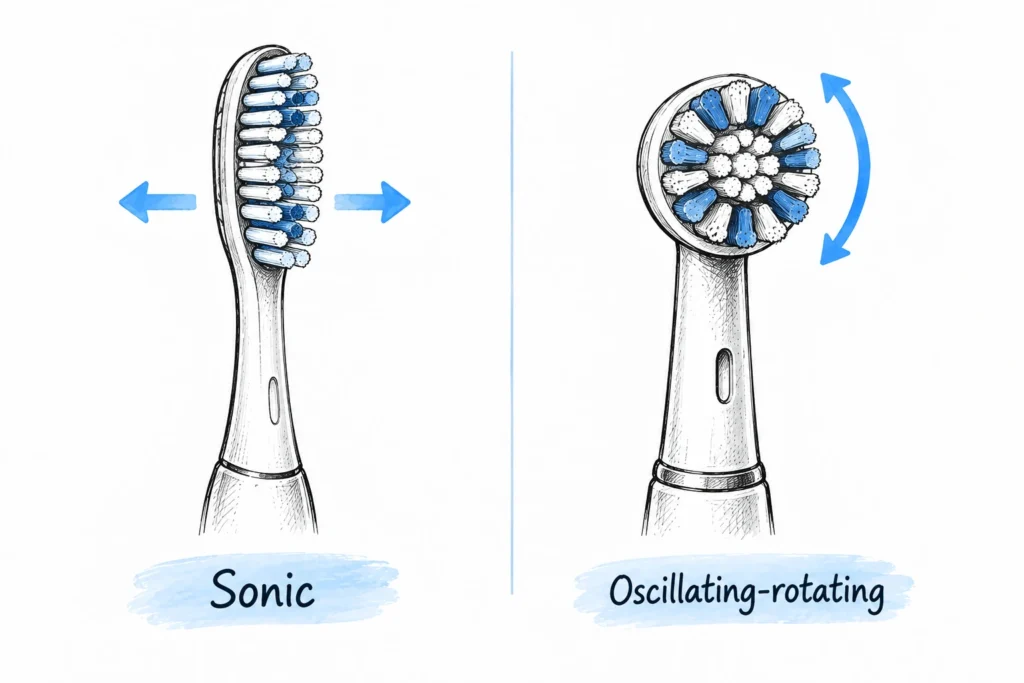
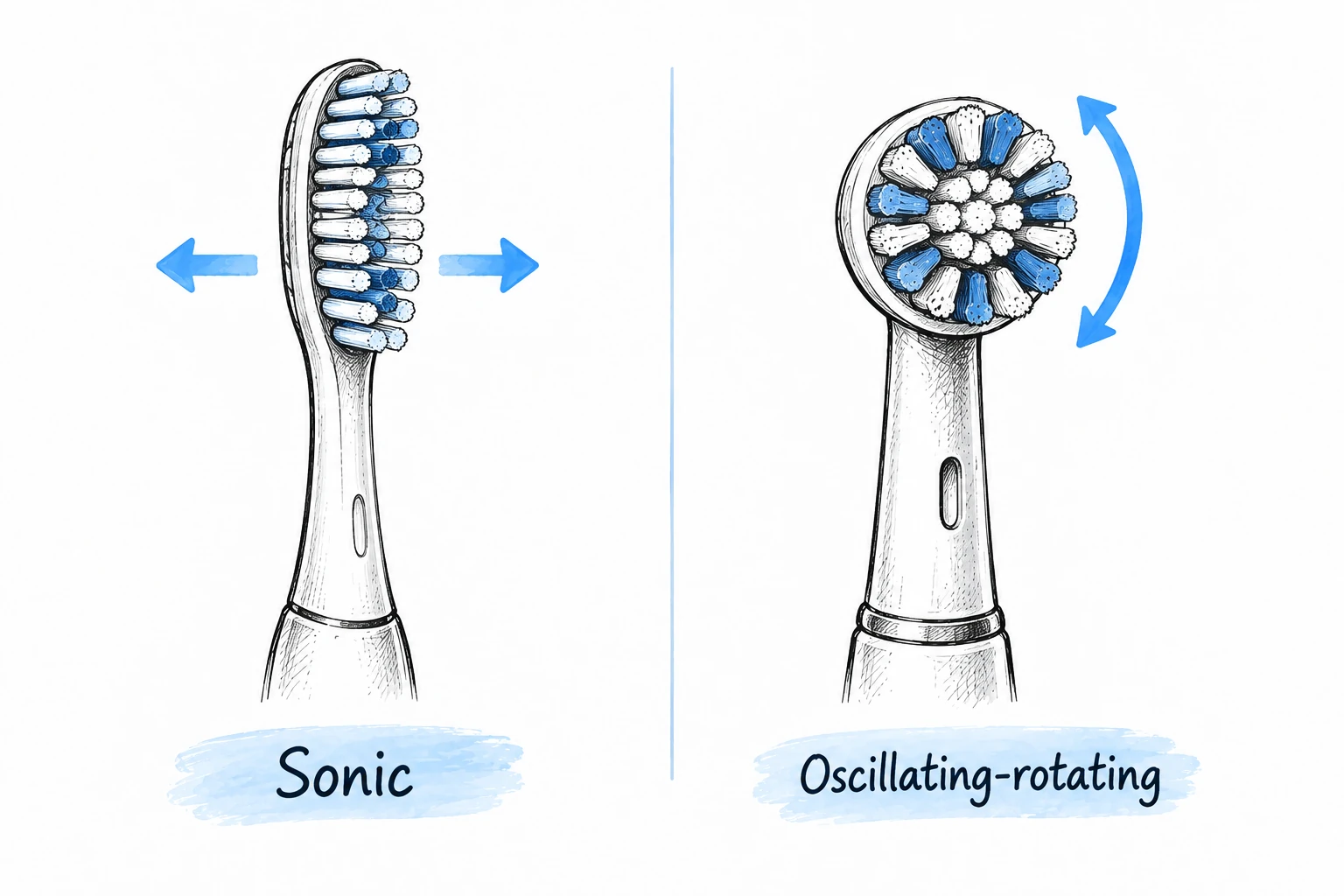
A sonic toothbrush uses an electromagnetic drive to create rapid brush-head movement. Example ratings of 24,000–48,000 movements per minute describe motion counts, not frequency in hertz; check how each manufacturer counts strokes.
The cleaning mechanism of a sonic toothbrush works through two primary pathways:
Bristle contact: Moving bristles disrupt plaque where they contact tooth surfaces. Head design, brushing pressure and technique all affect performance.
Fluid agitation: Rapid bristle movement also moves the toothpaste-and-saliva mixture around the head. This complements contact cleaning; it does not replace brushing all tooth surfaces or cleaning between teeth.
The physics: Hertz measures complete cycles per second. For example, 24,000–48,000 movements per minute equals 400–800 counted movements per second, but the frequency in hertz depends on whether each count means a full cycle or a one-way stroke. Sonic brushing should not be described as 20,000+ Hz ultrasound.
What Is an Oscillating-Rotating Toothbrush?
An oscillating-rotating toothbrush moves the brush head back and forth through a limited angular range. The example specifications below show 45–90 degrees per side and 7,500–10,500 oscillations per minute; the actual angle and counting method depend on the mechanism.
Oral-B is a well-established O-R brand with a substantial clinical research base. Assess individual study designs and tested products when using that evidence in a technology comparison.
The cleaning mechanism: Alternating head movement brings the bristles into contact with tooth surfaces. Some designs, including the Oral-B iO range, combine this movement with micro-vibrations. Guide the head over every surface using the model’s recommended technique.
Inside Sonic Technology: Engineering Meets Oral Care
How Vibrosonic™ Technology Works
At Relish Tech, our Vibrosonic™ platform represents our engineering approach to high-performance sonic brushing. Built on years of research and development, the technology centers on a precision-engineered magnetic levitation motor that delivers consistent, controlled vibrations without the wear and tear associated with traditional brush-type motors.
Example Vibrosonic™ specifications: Actual values depend on the selected model and test conditions.
| Parameter | Specification |
|---|---|
| Rated brush movements per minute | 31,000–40,000 vpm |
| Brush-head movement amplitude | 1.5–2.5mm |
| Motor type | Magnetic levitation (brushless) |
| Example motor efficiency | >85% |
| Example measured noise level | 55–65 dB |
A brushless electromagnetic drive avoids carbon-brush commutation wear, offering these design advantages:
- Motor durability: Eliminating carbon-brush wear can support motor life. Replaceable brush heads still wear with use.
- Reliability: Drive design and assembly quality help reduce failure risk and support a consistent brushing experience.
- Precise control: Digital circuits can modulate vibration patterns for different modes
What This Means for Your Brand
Sonic toothbrushes offer several positioning advantages:
Premium positioning: A well-controlled drive, comfortable brushing feel and useful features can support a premium offer. Explain the motion specification clearly rather than relying on a large number alone.
Comfort: Soft bristles, a suitable intensity setting and pressure feedback can help users brush gently. Comfort depends on the whole design, not the word “sonic” alone.
Novelty factor: The humming sound and gentle tickling sensation are memorable—consumers talk about their sonic toothbrushes, which drives organic word-of-mouth.
Slim head options: Some sonic head designs offer an elongated, slim profile that can suit your product’s appearance and handling.
Limitations to Consider
Sonic technology isn't without trade-offs:
User technique: Users need to guide the head along all tooth surfaces with gentle pressure, following the model’s instructions. Avoid prescribing one fixed dwell time per tooth for every sonic design.
Cost: A precision electromagnetic drive can cost more than a basic motor-and-gear assembly, but the complete product specification determines the price.
Inside Oscillating-Rotating Technology: The Engineering
The Mechanics
Many O-R designs use a motor and transmission to move a small, round head back and forth. Other drive architectures are also available. The head shape supports tooth-by-tooth guidance rather than matching every tooth’s shape exactly.
Illustrative O-R design parameters: Confirm the selected model’s motion definitions, operating load and electrical test conditions.
| Parameter | Specification |
|---|---|
| Oscillation arc | 45–90 degrees per side |
| Oscillations per minute | 7,500–10,500 |
| Internal motor speed, where applicable | Example: 2,800–4,000 rpm; not brush-head oscillation count |
| Power consumption | 3–8W |
A small O-R head can make tooth-by-tooth guidance intuitive. Users still need to cover every surface, allow enough brushing time and avoid excessive pressure.
The Clinical Advantage
O-R toothbrushes have an extensive clinical literature. The useful question for an OEM buyer is which results apply to the chosen model, brush head, mode and intended product claims.
Key findings from the clinical literature:
- A four-week randomized trial compared Oral-B iO2 with usmile Marble-Art and favored the tested O-R model for plaque and gingivitis outcomes.
- Study duration, plaque indices, brush heads and brushing instructions affect comparisons; short- and long-term results should be assessed separately.
- The ADA's official list of accepted powered toothbrushes includes multiple O-R models
For certification and compliance planning, distinguish ADA product acceptance, FDA requirements and ISO quality-management certification. Our R&D team has experience with both technologies.
For your brand: Use clinical research to guide development and claim planning. Evidence for another manufacturer’s brush does not automatically substantiate the same claim for your own product.
Strategic Implication
Clinical evidence: Review the tested model, outcomes, study design and funding when assessing the research base.
Clear user guidance: A small round head supports a straightforward tooth-by-tooth brushing routine.
Manufacturing efficiency: Established O-R supply chains can support competitive component sourcing. Plan the relevant FDA, CE and other compliance requirements around the actual product and target market.
Brand heritage: If you're positioning as "proven" or "trusted," O-R technology carries that implicit message.
Limitations to Consider
Brushing feel: The movement and sound differ from sonic designs. Test whether the chosen head and intensity settings suit your audience.
Brands to compete with: Oral-B dominates O-R perception. You'll need significant marketing spend to establish differentiation.
Brush head size: The round head design can feel awkward for users preferring slim profiles.
Cleaning Evidence: How Should You Compare the Technologies?
Plaque Removal Comparison
Let's get to the real question: which technology removes more plaque? The answer requires nuance.
Some direct trials favor particular O-R models for plaque removal:
- The 2025 four-week trial found better plaque outcomes with the tested O-R model after a single brushing and at follow-up. This is a comparison of specific products, not a universal percentage difference.
- The result depends on the complete brush system: drive, head, bristles, settings and how it is used.
For repeated use, assess sustained performance and everyday brushing habits:
- Both technologies can support effective plaque removal when used correctly.
- User comfort and ease of covering every tooth surface affect whether a routine is maintained.
- Do not assume that learning a single brushing technique makes every sonic and O-R model clinically equivalent.
For your brand: Compare suitable samples using consistent instructions, and choose the model whose handling, comfort and evidence fit your intended users.
Gum Care: Compare the Brush System and the Evidence
What direct comparisons can tell you:
- Some model-specific trials favor O-R brushes for gingivitis outcomes. Use the reported measure and study conditions when interpreting those findings.
- Plaque disruption matters for gum care with either technology. Bristle softness, applied pressure and coverage also affect the brushing experience.
What to assess in a sonic design:
- Look for effective plaque removal alongside a comfortable head, suitable intensity settings and clear instructions.
- A gentle mode can help users find a comfortable setting; evaluate the actual sample rather than assuming all sonic brushes feel the same.
- For sensitive gums, compare soft heads, pressure feedback and brushing feel across both technologies.
For your product line: A gum-care range needs comfortable heads, suitable controls and evidence for the final product’s claims. Age or drive type alone does not establish a clinical advantage.
What Real Users Actually Prefer
Use sample testing to explore the following aspects of brushing feel:
Sonic designs:
- How users respond to the initial vibrating or tickling sensation
- Whether the controls and brushing modes feel useful
- Perceived noise and vibration at the chosen settings
O-R designs:
- Comfort with alternating head movement
- Ease of guiding a small round head from tooth to tooth
- Perceived mechanical sound and handling
The takeaway for your product strategy: User experience often trumps clinical data in consumer preferences. Consider who your target customer is and what will make them recommend your brand to friends.
Match the Technology to Your Brand Strategy
When to Choose Sonic Technology
Sonic toothbrush technology makes strategic sense when:
Premium technology positioning: Sonic designs can suit a target retail range such as USD 80–150+, when the complete product offers the performance, finish and features your customers value.
Comfort-focused products: Combine a soft head, controlled intensity and clear pressure guidance for users who prefer a gentle brushing feel.
You want aesthetic differentiation: Sonic brush heads can be dramatically slimmer, enabling unique product designs that stand out on shelves.
Regional launch planning: Check current retail assortments, consumer expectations and distributor feedback in each target market rather than assuming a region-wide technology preference.
Case Study: European Startup Success with Vibrosonic™
A European startup we worked with launched a Vibrosonic™-powered brand targeting millennials seeking "smart bathroom aesthetics." They positioned the technology as "German-engineered precision" and achieved 340% of their first-year sales target by differentiating on both performance claims and visual design.
When to Choose Oscillating-Rotating Technology
O-R technology makes strategic sense when:
Value-focused ranges: An established O-R design may suit an example retail target of USD 30–80, depending on the complete specification and sales channel.
Dental association acceptance: Plan the evidence required for your own product. A technology’s research history does not grant endorsement or regulatory approval.
You're competing with Oral-B (or want to avoid them): Standing apart from Oral-B's dominance requires either complete technology differentiation or finding underserved O-R niches.
Simple handling: A small round head can support an easy-to-explain brushing routine. Test comfort with the intended age group; for children’s toothbrush OEM projects, also assess head size, age suitability and caregiver guidance.
The Third Path: Hybrid Innovation
What if you don't have to choose? Hybrid technologies combine multiple cleaning mechanisms in a single brush head, and Relish Tech's Rotasonic™ platform exemplifies this approach.
Rotasonic™ technology combines:
- Sonic motion, with a 32,000-movements-per-minute example profile, alongside the selected head movement
- Precise oscillating rotation for mechanical plaque removal
- Additional drive features according to the selected platform; a sonic movement count alone does not establish ultrasonic output or an antimicrobial effect.
Integrating motion characteristics requires the drive, head and control system to work together. Rotasonic™ offers a platform for:
- Combining bristle movement patterns in one brushing system
- Tuning brushing feel through controlled vibration
- A genuine differentiation story for premium positioning
For your brand: A hybrid platform can support a distinctive product concept. Build the positioning around the selected model’s features and validated performance.
Manufacturing Considerations for OEM Buyers
Cost Implications by Technology
Use the following ranges as early planning examples, with the final cost determined by the specification, quantity and packaging. For a component-level breakdown, see our electric toothbrush manufacturing cost guide.
Sonic toothbrushes:
- Precision electromagnetic drives can add cost; compare current supplier quotes rather than applying a fixed motor-price multiplier.
- Brush head design requires precision engineering for consistent vibration
- PCB complexity increases with vibration modes and smart features
- Factory cost range: $8–25 for complete units (depending on features)
Oscillating-rotating toothbrushes:
- Mature motor technology with competitive component pricing
- Mechanical assembly is well-understood with high automation potential
- Brush-head material use depends on geometry, tufting and the replacement-head mechanism.
- Factory cost range: $5–20 for complete units (depending on features)
Hybrid technologies (like Rotasonic™):
- Higher component costs reflect dual-mechanism complexity
- Engineering investment pays off in premium positioning capability
- Cost varies significantly based on specific feature integration
Minimum Order Quantities and Production Planning
| Technology | Custom-order MOQ | Production Lead Time |
|---|---|---|
| Sonic | 1,000 units; flexible by order | Example: 45–60 days after specification approval |
| Oscillating-Rotating | 1,000 units; flexible by order | Example: 35–50 days after specification approval |
| Hybrid (Rotasonic™) | 1,000 units; flexible by order | Example: 60–90 days; allow extra for new development |
Custom orders normally start at 1,000 units, with flexibility according to the order; wholesale orders for in-stock products start at 50 units. Timing depends on the model, customization, tooling, approvals and order size. Explore our electric toothbrush collection or review our OEM manufacturing timeline to plan your project.
Quality Metrics That Matter
Review the manufacturer’s quality system, relevant product tests and certification and compliance support:
- Defect rate: We maintain <0.3% defect rate across all product lines
- Consistency: Agree the permitted variation and test conditions for the selected model; a ±5% frequency target is an example specification, not a universal lifetime guarantee.
- Battery performance: Real-world cycle testing (not just spec sheet compliance)
- Motor durability: Define the load, duty cycle and acceptance criteria for life testing. A 500-hour loaded test is an example target that must be matched to the project.
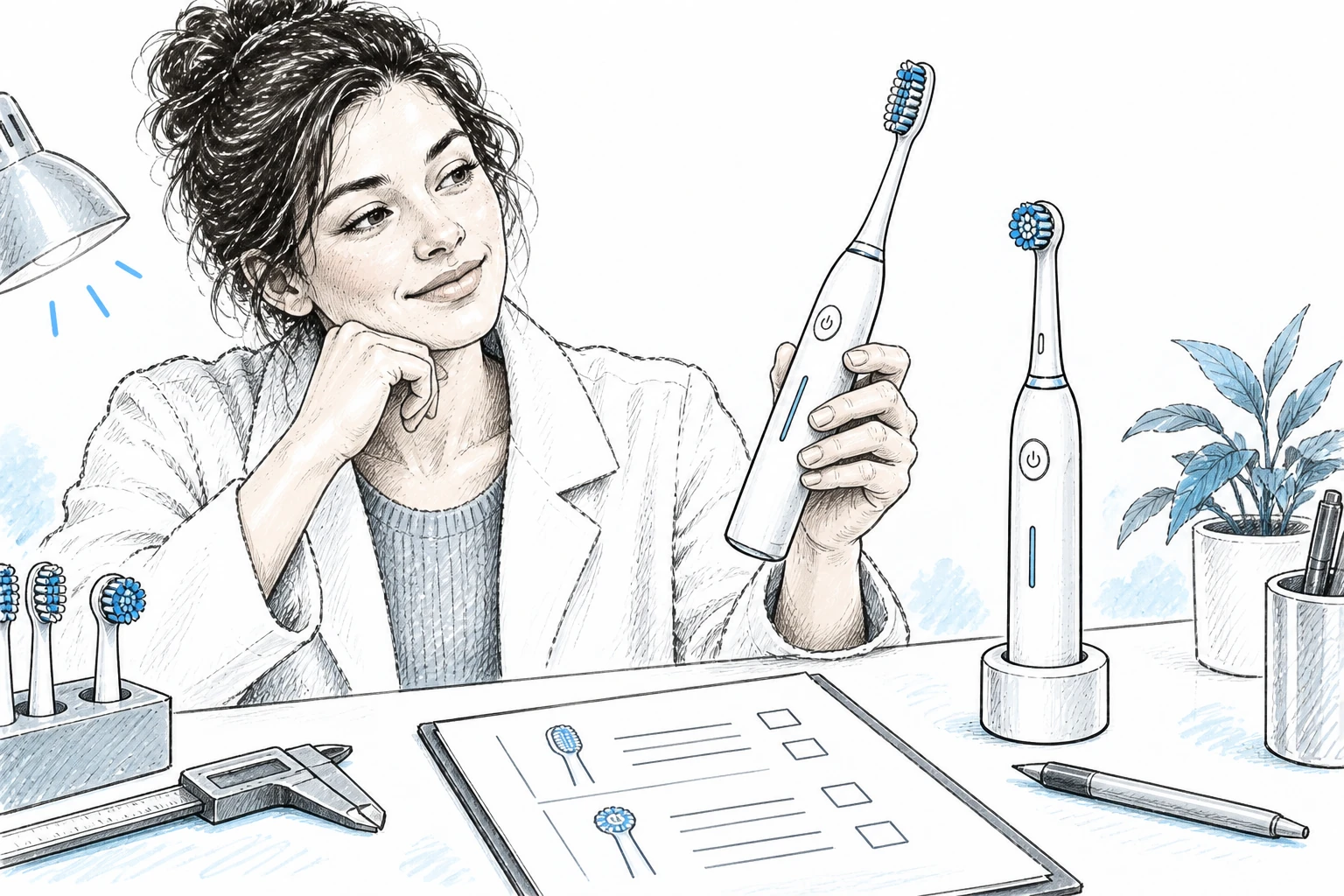
Your Technology Decision Checklist: 5 Questions to Ask
Use this framework to guide your decision:
- Define your primary value proposition
Plaque-removal positioning → Compare model-specific clinical evidence
Gentle brushing feel → Compare soft heads, intensity control and pressure feedback
Distinctive motion platform → Consider hybrid designs such as Rotasonic™
- Identify your target customer
Technology-focused customers → Assess sonic or hybrid designs
Value-focused families → Compare complete product cost and usability
Premium-seeking professionals → Sonic or hybrid
Gum-care customers → Compare comfort, pressure control and product evidence
- Set your price point
Example: USD 100+ premium positioning → Assess the complete sonic, O-R or hybrid offer
Example: USD 50–100 mid-market positioning → Compare models from both platforms
Example: under USD 50 → Prioritize the full product cost and required features
- Assess your marketing resources
Clinical claims → Build an evidence plan for the selected product
Innovation narrative possible → Sonic or hybrid
Limited differentiation options → Choose the path with less competition
- Evaluate production scale
Starting small → Discuss flexible custom quantities; in-stock wholesale products start at 50 units
Scaling rapidly → Both viable; ensure your manufacturer can scale
Complex hybrid features → Allow development and validation time beyond routine production
Beyond Technology: Other Factors
Technology choice is important, but remember:
- Brush head compatibility: Will replacement heads be available at reasonable prices?
- Battery runtime: Set a target using a stated mode and brushing schedule. Four weeks per charge can be a product goal, but is not a fixed expectation or capability of every model.
- Smart features: App connectivity, pressure sensors, and brushing timers add value
- Warranty support: Longer warranties signal quality confidence
Choose the Platform That Fits Your Product
Here's what 15 years of manufacturing has taught us: the "best" technology depends entirely on your brand strategy.
A sonic vs oscillating-rotating electric toothbrush isn't a binary right-or-wrong question. It's a strategic choice that should flow from understanding your target market, your positioning, and your manufacturing capabilities.
Sonic technology offers a range of slim-head designs, controlled vibration profiles and feature options.
Oscillating-rotating technology offers tooth-by-tooth guidance, established mechanisms and a substantial clinical research base.
Hybrid technology (like Rotasonic™) enables genuine differentiation for brands seeking to disrupt.
Whatever the mechanism, brush-head quality, drive control, reliability and user instructions determine whether the finished product delivers a consistent brushing experience.
Ready to Move Forward?
If you're evaluating electric toothbrush technology for your brand, we'd love to help you find the right fit. Our engineering team has experience with all major technology platforms. Download our product catalog for specifications.
Frequently Asked Questions
Which technology cleans better, sonic or oscillating-rotating?
Both technologies can clean effectively. Some direct trials favor particular O-R models for plaque and gingivitis outcomes; this does not establish one fixed percentage advantage for every brush. For an OEM project, compare evidence for the selected model and head.
Is sonic or oscillating-rotating better for sensitive gums?
Either technology can offer a comfortable brushing experience with a soft head, gentle pressure and suitable settings. Compare the actual head, pressure feedback and brushing feel rather than treating the drive type as a guarantee of gentleness.
What is the main advantage of hybrid technologies like Rotasonic™?
Hybrid designs combine motion characteristics to create a distinctive brushing system. Relish Tech’s Rotasonic™ platform supports this approach. The selected model’s specifications and tests should establish its performance; a sonic motion count alone does not demonstrate ultrasonic or antimicrobial effects.
Which technology is better for OEM manufacturing costs?
Compare complete specifications and current quotations. A basic O-R mechanism may offer competitive component costs, while a precision sonic drive or added smart features can increase cost. Either technology can support different price tiers.
Which markets prefer which technology?
Preferences vary by country, channel, brand familiarity and price segment. Check current local assortments and user feedback before choosing a technology for a regional launch.
What is the typical MOQ for OEM electric toothbrush production?
Custom electric toothbrush orders normally start at 1,000 units, with flexibility according to the actual order. Wholesale orders for in-stock products start at 50 units. Production timing depends on the model, customization, tooling, approvals and quantity; new development needs additional time.
Can a single brand offer both sonic and oscillating-rotating toothbrushes?
Yes. Offering both can help a brand serve different preferences and price segments. Plan replacement-head availability, spare parts, testing and after-sales support for each platform with a manufacturing partner experienced in both.
References
- Adam, R., Grender, J., Timm, H., Qaqish, J., & Goyal, C. R. (2025). A randomized controlled trial evaluating a novel oscillating-rotating electric toothbrush versus a sonic toothbrush for plaque and gingivitis. American Journal of Dentistry, 38(1), 3–8. PubMed study record
- Arockiam, A. S. et al. (2025). Should clinicians recommend oscillating-rotating toothbrushes over sonic models for superior plaque and gingivitis control? Evidence-Based Dentistry, 26, 99–100. Commentary on the four-week trial. Published commentary
- American Dental Association. Toothbrushes: brushing guidance and the Seal of Acceptance. ADA toothbrush guidance
- U.S. Food and Drug Administration. Powered toothbrush product classification: JEQ, Class I, 21 CFR 872.6865; 510(k)-exempt subject to applicable limitations. FDA classification record
- American Dental Association. Oral-B Oscillating-Rotating-Pulsating: product-specific Seal of Acceptance listing. ADA product listing
- International Organization for Standardization. ISO 13485:2016 — Medical devices — Quality management systems — Requirements for regulatory purposes. ISO standard overview
- American Dental Association. ADA Seal of Acceptance category requirements overview. ADA Seal requirements