







Electric Toothbrush Cost to Manufacture and Profit Analysis (2026 Complete Guide)
Component-level BOM breakdown from $6 to $55/unit, profit margins at every tier, and how B2B buyers can capture 75–88% gross margins by sourcing directly from Chinese OEM manufacturers.
Table of Contents
- Why Are Electric Toothbrushes So Expensive?
- Core Component Cost Breakdown
- Manufacturing Cost by Product Tier
- Profit Margin Analysis: Where Does the Money Go?
- 5 Key Pricing Factors Explained
- 2026 Market Trends Affecting Costs
- B2B Sourcing: Capturing the Margin
- Why Choose Relish Tech as Your OEM Partner
- Frequently Asked Questions
1. Why Are Electric Toothbrushes So Expensive?
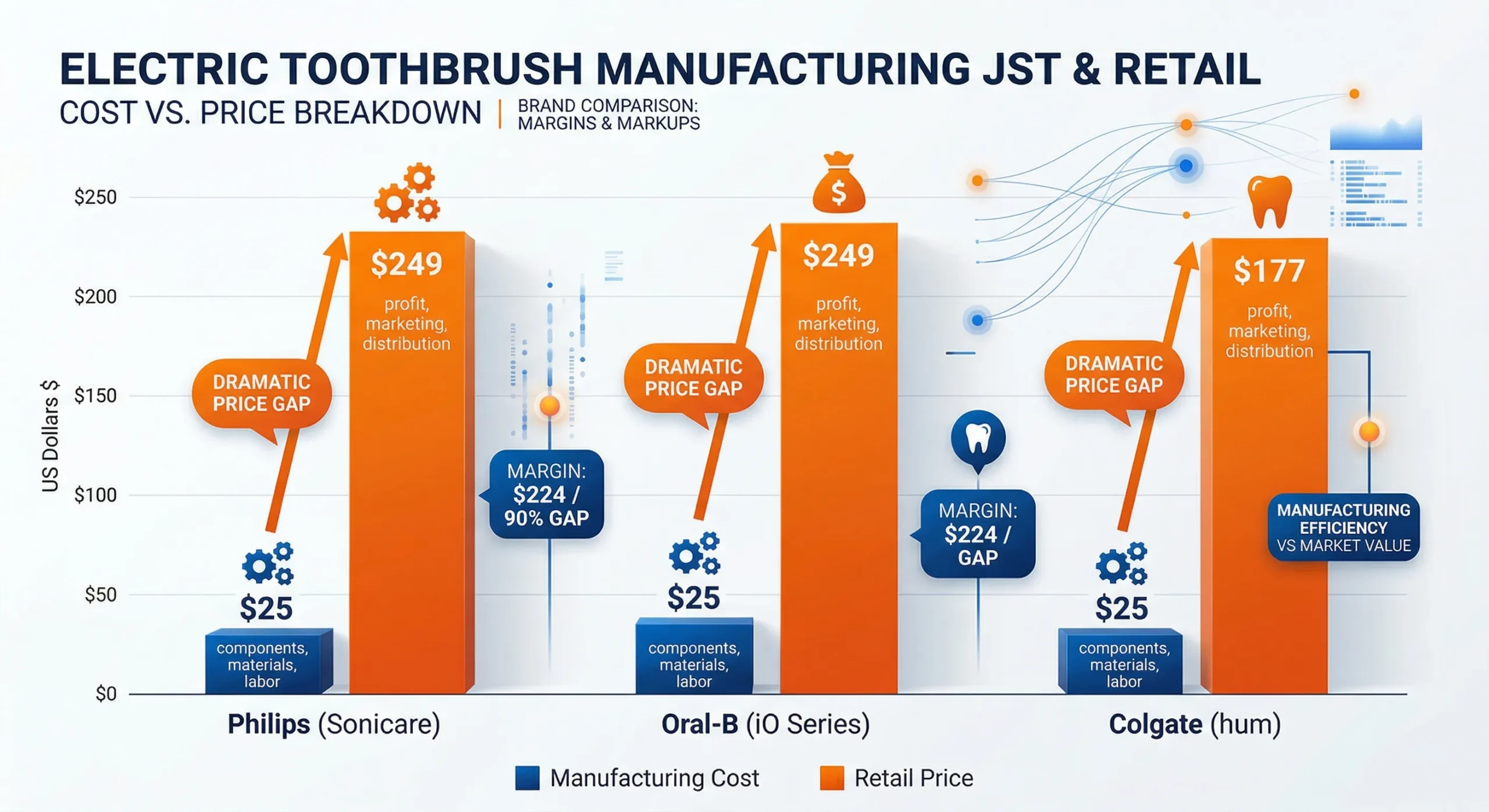
The retail price of a manual toothbrush in the US typically ranges from $2–8, while electric toothbrushes span from $25 to over $400. The gap between manufacturing cost and retail price is substantial — but understanding why reveals the real opportunity for B2B buyers.
Consider the major brand landscape:
| Brand | Entry Price | Premium Price | Est. Manufacturing Cost |
|---|---|---|---|
| Philips Sonicare | $25 | $330 | $8–$25 |
| Oral-B (P&G) | $30 | $400 | $10–$30 |
| Colgate | $20 | $150 | $8–$20 |
| Panasonic | $35 | $200 | $12–$28 |
| Private Label (OEM) | $15 | $80 | $8–$25 |
Source: Retail market data, 2026; Manufacturing cost estimates based on Relish factory operations.
The pattern is consistent across every brand tier: the difference between a $30 entry-level electric toothbrush and a $200 premium model is rarely the hardware. It's marketing spend, distribution channel markup, and brand equity. This is precisely why private label brands are growing rapidly — they deliver comparable quality at a fraction of the retail price while capturing a substantially larger margin for the brand owner.
B2B Opportunity
By sourcing through a Chinese OEM manufacturer, brands can access the same manufacturing infrastructure used by major international brands — at factory-direct pricing. A mid-range model costing $12–18 to manufacture can be retailed at $60–150, yielding gross margins of 75–88%.
2. Core Component Cost Breakdown
An electric toothbrush consists of six core component groups. Understanding where the cost goes is the first step to making informed sourcing decisions.
2.1 Sonic Electric Drive Motor
The motor is the heart of any electric toothbrush. Two types dominate the market:
| Motor Type | BOM Cost | Vibration Range | Lifespan | Best For |
|---|---|---|---|---|
| Brushed Motor | $0.50–$2.00 | 5,000–15,000 strokes/min | 200–400 hours | Entry-level models |
| Brushless Motor | $2.00–$8.00 | 20,000–62,000 strokes/min | 500–1,000 hours | Mid-to-premium models |
In a brushed motor, the rotor is a coil connected to the power shaft with a permanent magnet stator. In a brushless motor, the rotor is a permanent magnet linked directly to the shaft — eliminating friction, reducing heat, and enabling dramatically higher vibration frequencies. By 2026, brushless motors have become the standard for any toothbrush positioned above entry-level, primarily because the performance difference is immediately perceptible to consumers.
2.2 Battery
Battery quality directly determines user experience in two critical dimensions: usage time between charges, and overall battery lifespan.
| Battery Type | BOM Cost | Usage Time | Charge Time | Charge Cycles |
|---|---|---|---|---|
| NiMH (Nickel-Metal Hydride) | $0.80–$2.00 | 2–3 weeks | 12–24 hours | 300–500 |
| Li-ion (Lithium-Ion) | $1.50–$4.00 | 4–8 weeks | 2–4 hours | 500–800 |
| Li-ion + Wireless Charging | $3.00–$7.00 | 4–12 weeks | 1–3 hours | 800–1,200 |
Most 2026 models use lithium-ion batteries as the baseline. Adding wireless charging increases BOM by $3–7 per unit but significantly increases perceived value — and consumer willingness to pay a premium.
2.3 Printed Circuit Board (PCB)
The PCB controls vibration frequency, timing modes, pressure sensors, and — in premium models — smart connectivity features.
| PCB Type | BOM Cost | Features |
|---|---|---|
| Basic PCB | $0.50–$1.50 | On/off, single speed, basic timer |
| Standard PCB | $1.50–$4.00 | Multiple modes, 2-minute quadrant timer, pressure sensor |
| Smart PCB | $4.00–$12.00 | Bluetooth, app connectivity, real-time feedback, AI coaching |
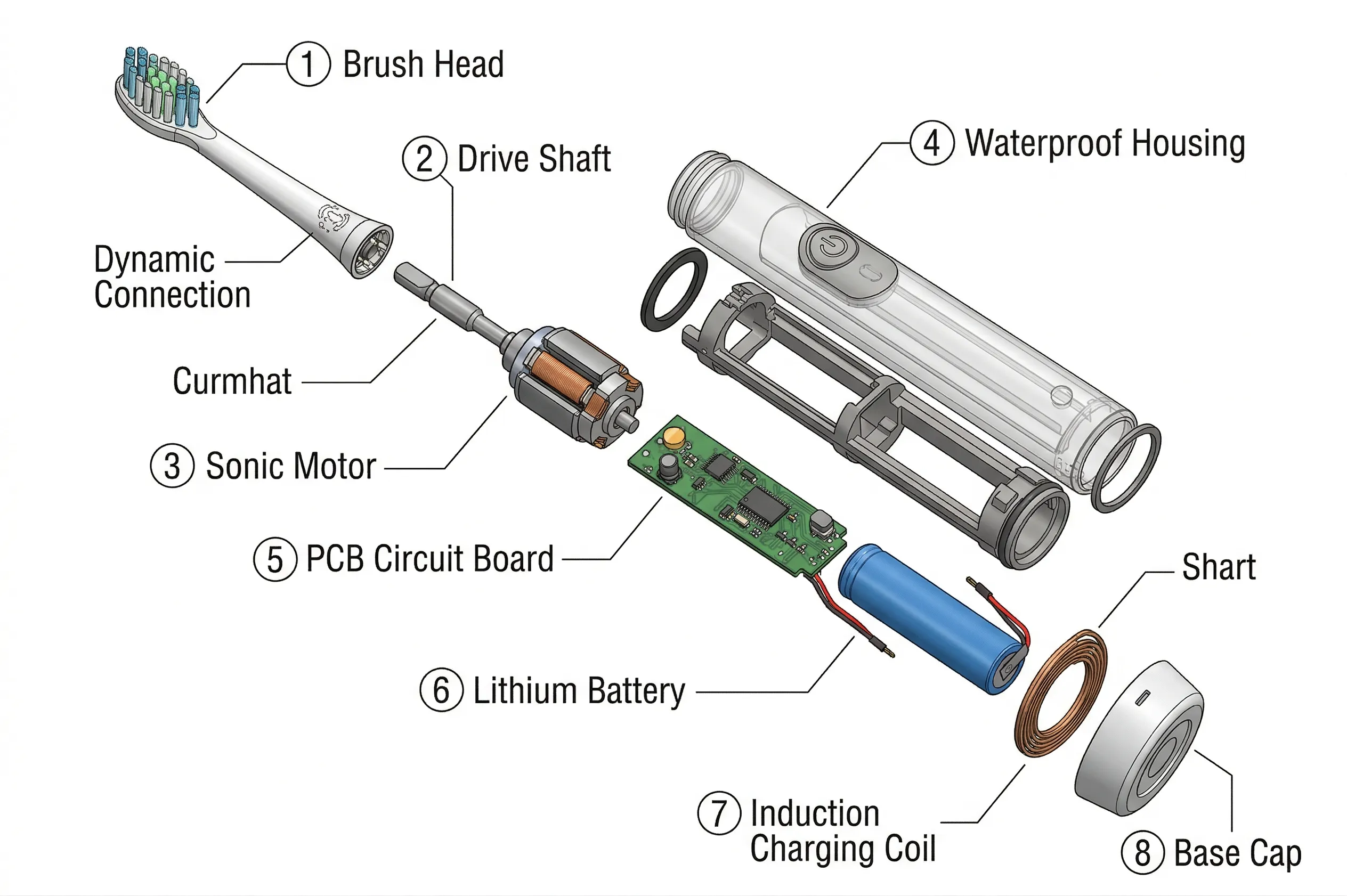
2.4 Drive Shaft & Mechanical Assembly
| Component | BOM Cost | Notes |
|---|---|---|
| Drive shaft | $0.30–$1.00 | Transfers motor rotation to brush head |
| Gear assembly | $0.50–$2.00 | Converts rotation to linear/pulsing motion |
| Waterproof sealing (IPX7) | $0.50–$1.50 | Ultrasonic welding required; critical for safety |
| Housing / body (ABS plastic) | $1.00–$3.00 | Soft-touch, matte, or metallic finish options |
2.5 Brush Head
| Bristle Type | BOM Cost | Characteristics |
|---|---|---|
| Standard nylon bristles | $0.30–$0.80 | Basic cleaning, average durability |
| DuPont Tynex bristles | $0.80–$2.00 | End-rounded tips, consistent quality, dentist-preferred |
| Charcoal / specialty bristles | $1.00–$3.00 | Bamboo charcoal, nano-silver, or textured specialty materials |
2.6 Packaging & Accessories
| Item | BOM Cost | Notes |
|---|---|---|
| Charging cable / dock | $0.50–$3.00 | USB-C standard in 2026; wireless docks add $2–5 |
| Travel case | $0.50–$2.00 | Rigid hard cases for premium positioning |
| Retail packaging (box, insert) | $0.80–$3.00 | Retail-ready packaging drives Amazon / pharmacy shelf appeal |
| User manual / compliance docs | $0.10–$0.30 | Multi-language manuals add to cost |
3. Manufacturing Cost by Product Tier
Combining all components, here is the total manufacturing cost (BOM + labor + overhead) by product tier in 2026. These figures represent factory-direct pricing at standard 1,000-unit MOQ.
| Product Tier | BOM Cost | Labor & Overhead | Total Mfg. Cost | Retail Price | Gross Margin |
|---|---|---|---|---|---|
| Entry-Level | $4–$7 | $2–$4 | $6–$11 | $20–$50 | 70–85% |
| Mid-Range | $8–$15 | $4–$6 | $12–$21 | $50–$120 | 75–85% |
| Premium | $15–$25 | $5–$8 | $20–$33 | $120–$250 | 85–90% |
| Ultra-Premium (Smart) | $25–$45 | $6–$10 | $31–$55 | $200–$400 | 85–90% |
Gross margin figures represent brand-level margins after manufacturing cost, before marketing, distribution, and retail fees. Costs are estimates at 1,000-unit MOQ. Scaling to 5,000+ units typically reduces per-unit cost by 15–30%.
Scale Effect
Increasing order volume from 1,000 to 5,000+ units typically reduces per-unit manufacturing cost by 15–30%, primarily through tooling amortization spread and volume-based component pricing. This is why the most successful private label brands start with a single SKU and scale deliberately.
4. Profit Margin Analysis: Where Does the Money Go?
For a $100 retail electric toothbrush, here is the typical cost breakdown at each stage of the value chain:
| Cost Category | Amount ($) | % of Retail Price |
|---|---|---|
| Manufacturing Cost | $12–$18 | 12–18% |
| Packaging & Logistics | $3–$6 | 3–6% |
| Marketing & Advertising | $15–$25 | 15–25% |
| Distributor Margin | $10–$15 | 10–15% |
| Retailer Margin | $20–$30 | 20–30% |
| Brand Net Profit | $10–$20 | 10–20% |
Based on mid-range retail pricing ($80–120) with conventional distribution channels. DTC brands eliminate distributor and reduce retailer margin significantly.
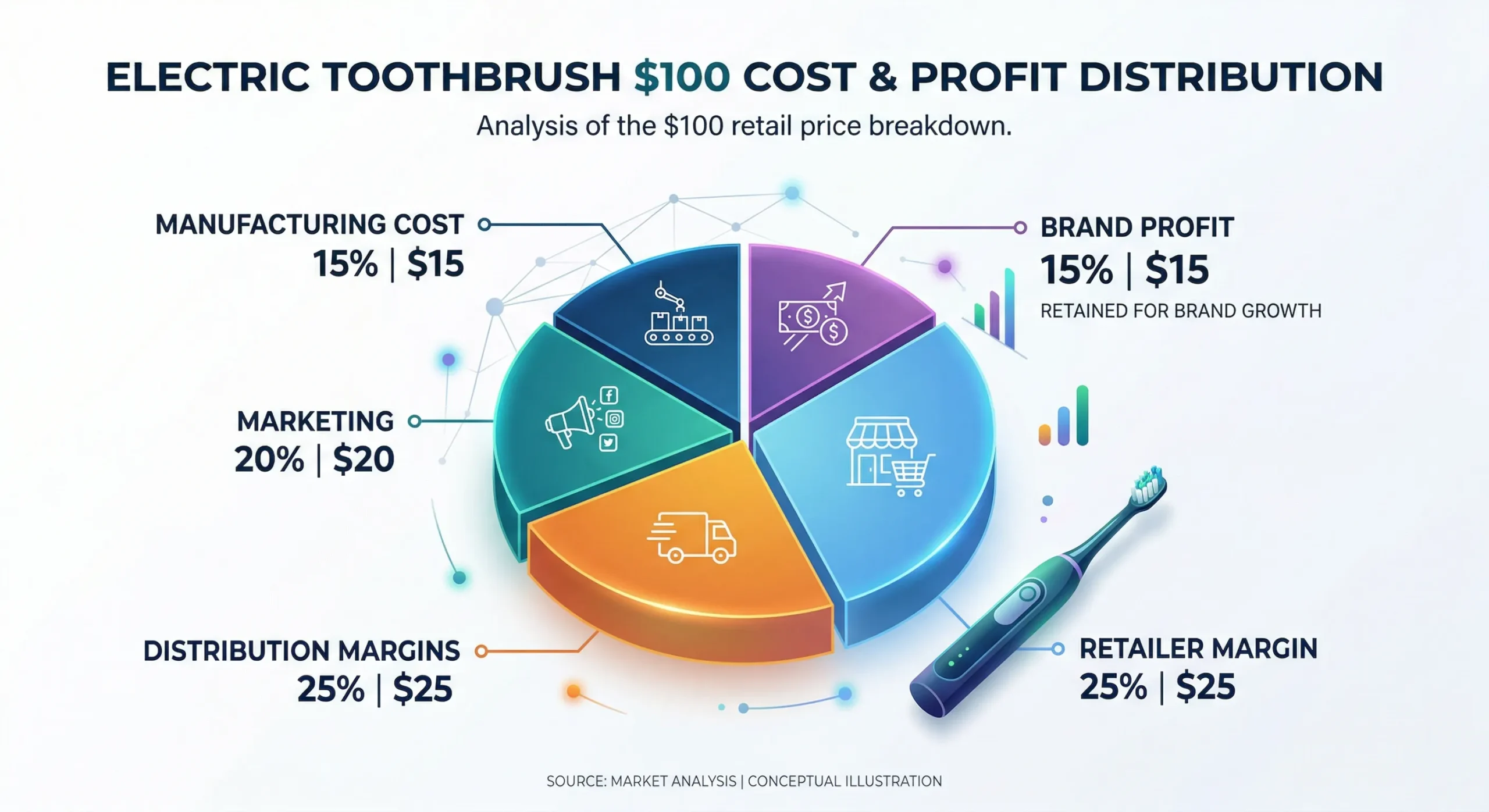
The manufacturer captures only 12–18% of the retail price. The dominant cost categories are marketing spend and distribution margins — which is why direct-to-consumer brands and private label brands consistently outperform established competitors on margin efficiency.
The Brand Premium Multiplier
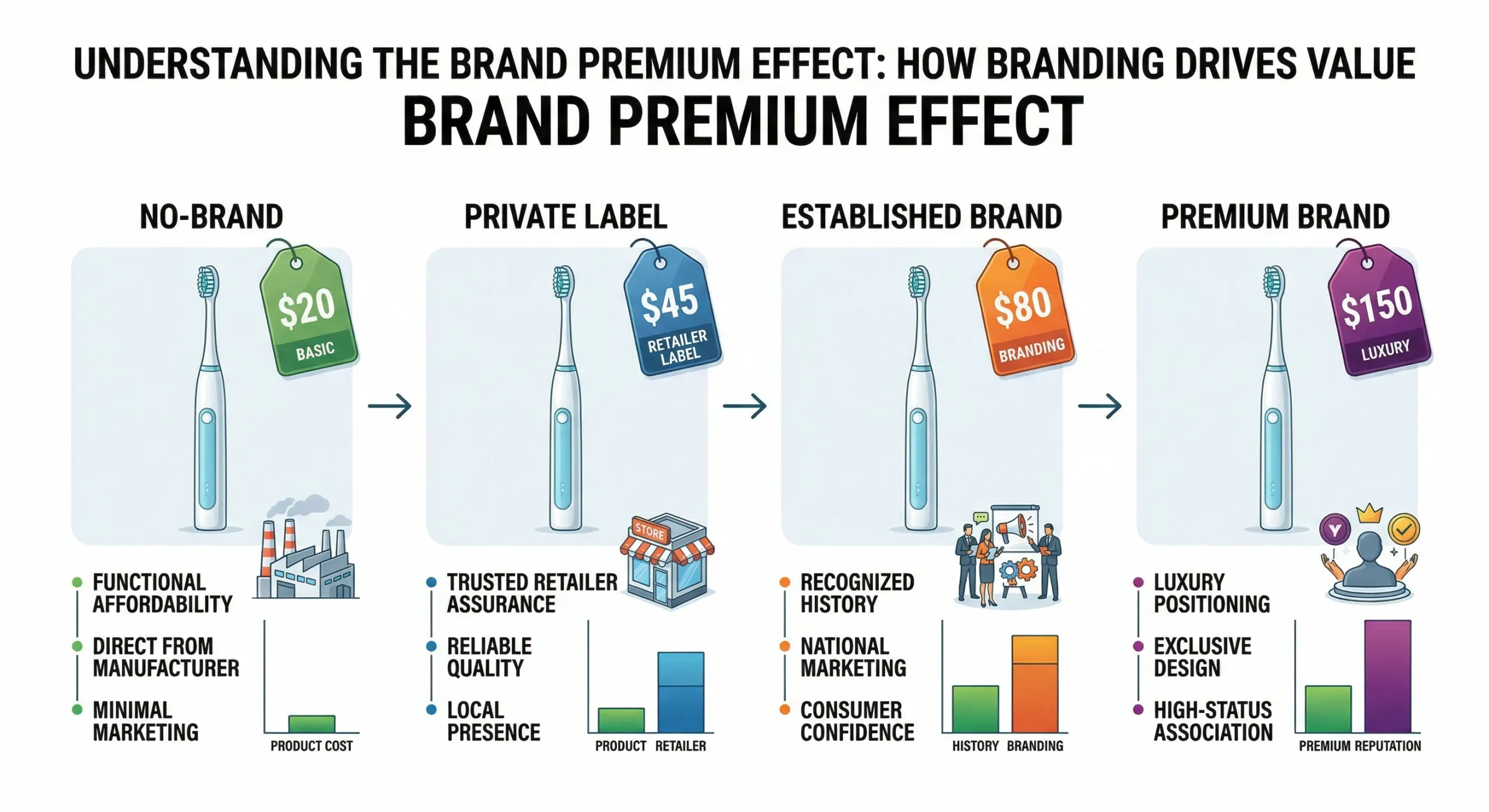
The brand premium is the single most powerful pricing lever. A product with identical manufacturing cost can carry dramatically different retail prices depending on positioning:
| Sourcing Model | Manufacturing Cost | Retail Price | Markup Ratio | Gross Margin |
|---|---|---|---|---|
| No-brand OEM | $12 | $20 | 1.7x | 40% |
| Private Label Brand | $12 | $45–$60 | 3.75–5x | 73–80% |
| Established Brand | $12 | $80 | 6.7x | 85% |
| Premium Brand (Philips / Oral-B) | $15 | $150 | 10x | 90% |
The key insight: the markup is almost entirely brand equity, not product difference. By launching your own private label electric toothbrush brand through an OEM partner, you capture the brand premium that currently flows to established players — without their decades of marketing investment.
About the Manufacturer: Relish Tech
Shenzhen Relish Technology Co., Ltd. is a professional OEM/ODM manufacturer with 15+ years in oral care manufacturing. Our Shenzhen facility houses a 20,000 m2 dust-free workshop with 12 automated production lines, producing 1.2 million+ units monthly across electric toothbrush and water flosser lines. We hold CE, FCC, FDA, ISO 13485, BSCI, RoHS, and REACH certifications for major export markets.
5. Key Pricing Factors Explained
Beyond component costs, five factors determine the final retail price of an electric toothbrush:
1. Motor & Battery Quality
The motor and battery are the two largest cost variables in the BOM. A brushless motor + lithium battery combination adds $5–12 to the BOM but enables premium retail positioning at $50–150+. The consumer-perceptible performance difference justifies this premium in most market tests.
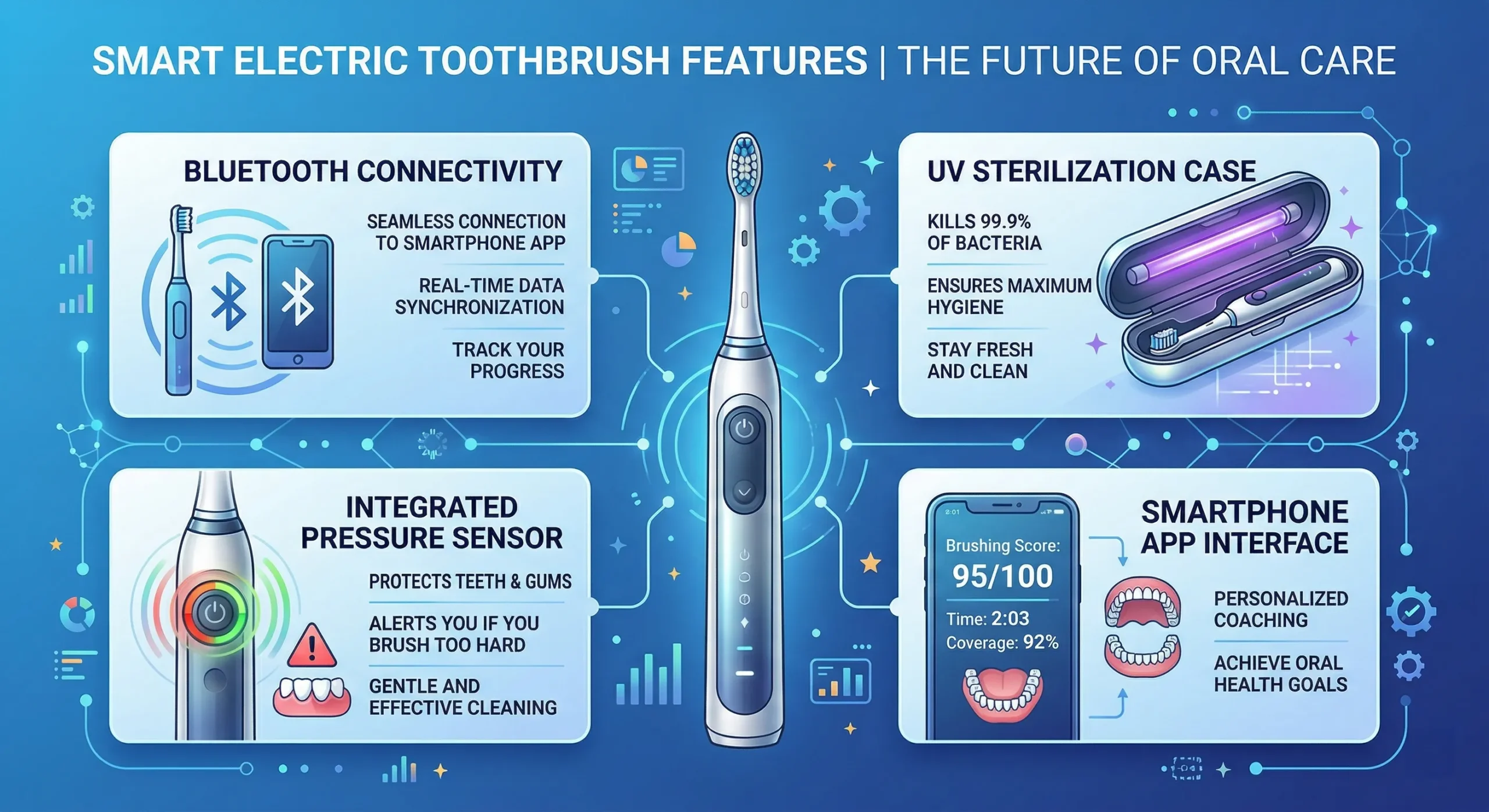
2. Smart Features
In 2026, smart features have become a major pricing driver, particularly in the premium segment:
| Smart Feature | Added BOM Cost | Added Retail Value | ROI Multiple |
|---|---|---|---|
| Bluetooth connectivity | +$4–$8 | +$30–$80 | 4–10x |
| Pressure sensor | +$1–$3 | +$15–$40 | 5–15x |
| UV sterilization | +$3–$6 | +$20–$50 | 3–8x |
| App integration / AI coaching | +$2–$5 | +$20–$60 | 4–12x |
Smart features consistently show 4–15x ROI on BOM investment — the highest leverage point in the entire product cost structure. However, they also add complexity to certification (FCC testing, cybersecurity requirements) and require ongoing app maintenance.
3. Brand Premium
Philips and Oral-B collectively spend $500M+ annually on oral care marketing. This investment justifies premium pricing — but also creates the market space for challenger brands. A Mintel consumer survey found that 75% of buyers cannot identify a meaningful performance difference between mid-range and premium electric toothbrushes in blind tests (Mintel, 2025).
4. Distribution Channel
| Channel | Typical Margin | Impact on Retail Price | Best For |
|---|---|---|---|
| Amazon / E-commerce | 15–25% | Lower | DTC brands, private label |
| Retail stores (Walmart, Target) | 30–50% | Higher | Established consumer brands |
| Direct-to-consumer (brand website) | 5–10% | Lowest | High-margin brand strategy |
| Dental clinics / pharmacies | 40–60% | Highest | Premium clinical positioning |
5. Certifications & Compliance
| Certification | Typical Cost | Timeline | Market Access |
|---|---|---|---|
| CE (EU) | $2,000–$5,000 | 3–6 weeks | All 27 EU member states |
| FCC (USA) | $1,500–$3,000 | 2–4 weeks | United States |
| FDA Registration (USA) | $1,000–$3,000 | 4–8 weeks | USA (if therapeutic claims) |
| IPX7 Waterproof | $300–$800 | 1–2 weeks | Required for all major retailers |
| ISO 13485 | $10,000–$30,000 | 3–6 months | Global quality credibility |
| BSCI (Ethical sourcing) | $2,000–$5,000 | 4–8 weeks | European retailers, Costco, Walmart |
Certifications represent a fixed upfront investment that amortizes across all units produced. This is why brands with longer product lines and higher volumes achieve lower effective certification cost per unit.
Read more: See our complete certifications overview covering FDA, CE, FCC, ISO 13485, and other essential compliance requirements for oral care exporters.
6. 2026 Market Trends Affecting Costs
1. Smart Feature Adoption Accelerating
Smart electric toothbrushes (Bluetooth + app connectivity) now account for 45% of premium segment sales, up from approximately 15% in 2020 (Grand View Research, 2026). This has increased average BOM costs by $8–15 per unit in the premium tier but enabled 30–50% higher retail pricing. For B2B buyers, this means the premium segment is becoming more accessible through ODM platforms — existing smart toothbrush designs that can be customized with your branding at a fraction of the development cost.
2. Sustainability Premium in Key Markets
Eco-friendly materials — recycled plastics, bamboo handles, biodegradable packaging — add $1–3 to manufacturing costs but command a 15–25% retail premium in European and North American markets. This is particularly relevant for brands targeting the UK, Germany, Scandinavia, and premium US retailers. Bamboo-handled electric toothbrushes and recycled packaging are increasingly available through established OEM manufacturers.
3. Supply Chain Normalization
Post-pandemic supply chain disruptions have largely resolved. Component costs in 2026 are approximately 8–12% lower than 2022 peaks, improving margins for manufacturers and brands alike. Lead times have stabilized at 30–45 days for ODM orders and 60–90 days for full OEM custom design projects.
4. China Manufacturing Dominance
China manufactures approximately 75% of the world's electric toothbrushes as of 2026, with Guangdong province leading in premium OEM manufacturing (Industry Market Research, 2026). This concentration creates significant advantages for B2B buyers: a complete supply chain ecosystem within a single geographic region, competitive pricing through supplier density, and experienced OEM manufacturers with established quality management systems. Water flossers and other oral care products follow the same supply chain, enabling bundled product line development.
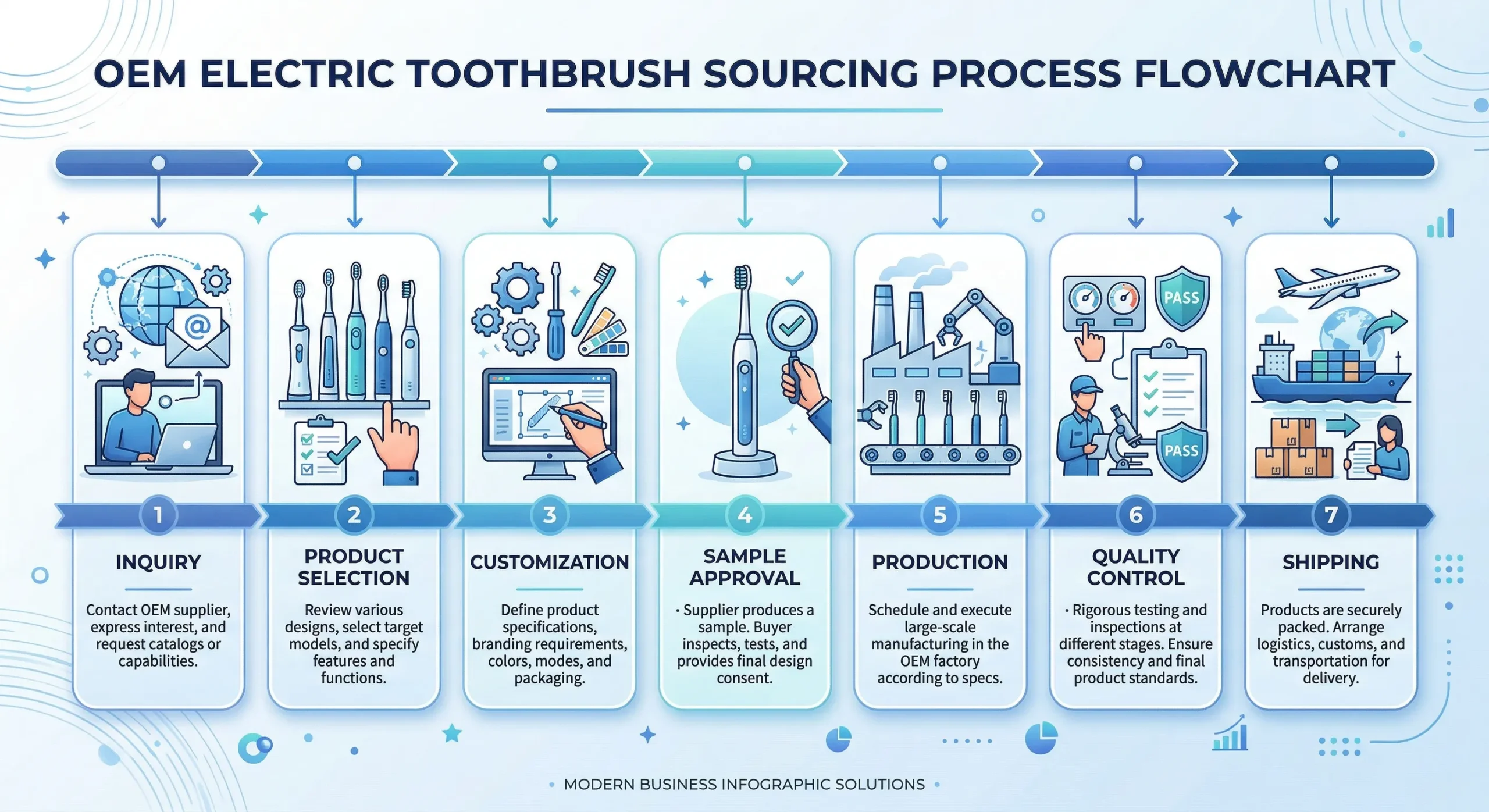
7. B2B Sourcing: Capturing the Margin
The economics of OEM sourcing versus conventional distribution are compelling:
| Sourcing Model | Unit Cost | Typical Retail | Gross Margin |
|---|---|---|---|
| Buy from distributor | $25–$40 | $60–$100 | 40–60% |
| OEM from China (standard) | $12–$18 | $60–$100 | 70–80% |
| OEM from China (private label) | $12–$18 | $80–$150 | 80–88% |
By sourcing directly from an OEM manufacturer, brands capture an additional 20–30 percentage points of gross margin compared to buying through distributors. At 10,000 units per year, this margin difference can represent $150,000–$400,000 in additional gross profit. For a step-by-step walkthrough, see our private label oral care products guide.
Factory Evaluation Checklist
- Certifications: Verify FDA, CE, ISO 13485, BSCI — these ensure market access across major export destinations
- R&D capability: Look for a dedicated R&D department with 10+ engineers capable of custom product development
- Production capacity: Confirm monthly output and current utilization rate; a factory at 80%+ capacity may have lead time constraints
- Quality control system: Verify IQC, IPQC, and OQC processes with documented inspection reports and defect rate tracking
- MOQ flexibility: Assess whether the manufacturer can accommodate your current volume while scaling as you grow
- Private label experience: Request examples of previous branding and packaging projects to assess design and production quality
- Sample policy: Always order pre-production samples; test vibration quality, battery life, waterproof integrity, and overall build
- Communication quality: Evaluate English proficiency, response time, and technical depth of responses
Red Flags
- Cannot provide verifiable business license or certification documents
- Prices more than 30% below market average — corners are being cut
- Reluctance to provide factory tour or video walkthrough
- No documented quality control processes or inspection reports
- Trading company claiming to be a manufacturer — ask to see production line ownership
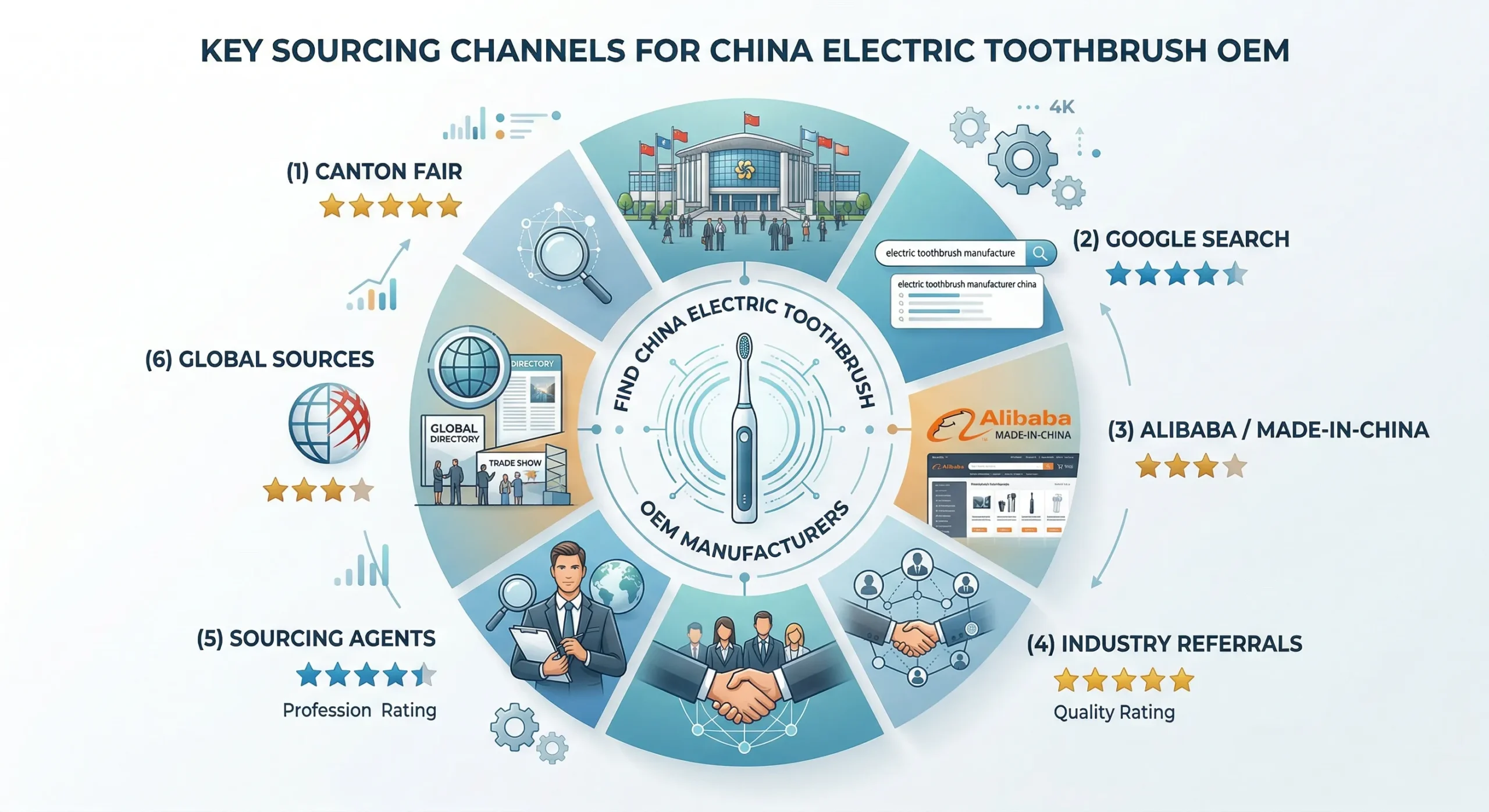
Read more: See our complete guide on How to Find a Reliable Electric Toothbrush OEM Manufacturer in China.
8. Why Choose Relish Tech as Your OEM Partner
As a professional manufacturer of electric toothbrushes and oral irrigators, Shenzhen Relish Technology offers the manufacturing depth, compliance experience, and scalability that B2B buyers need:
| Capability | Details |
|---|---|
| Experience | 15+ years in oral care manufacturing |
| Certifications | FDA, CE, ISO 13485, BSCI, FCC, RoHS, REACH |
| Production Capacity | 1.2 million+ units monthly across product lines |
| R&D Team | 30+ engineers for custom product development |
| Quality Control | Rigorous IQC/IPQC/OQC testing; defect rate below 1% |
| Product Range | Electric toothbrushes (rotary, sonic, U-shaped), water flossers (portable, countertop, combo) |
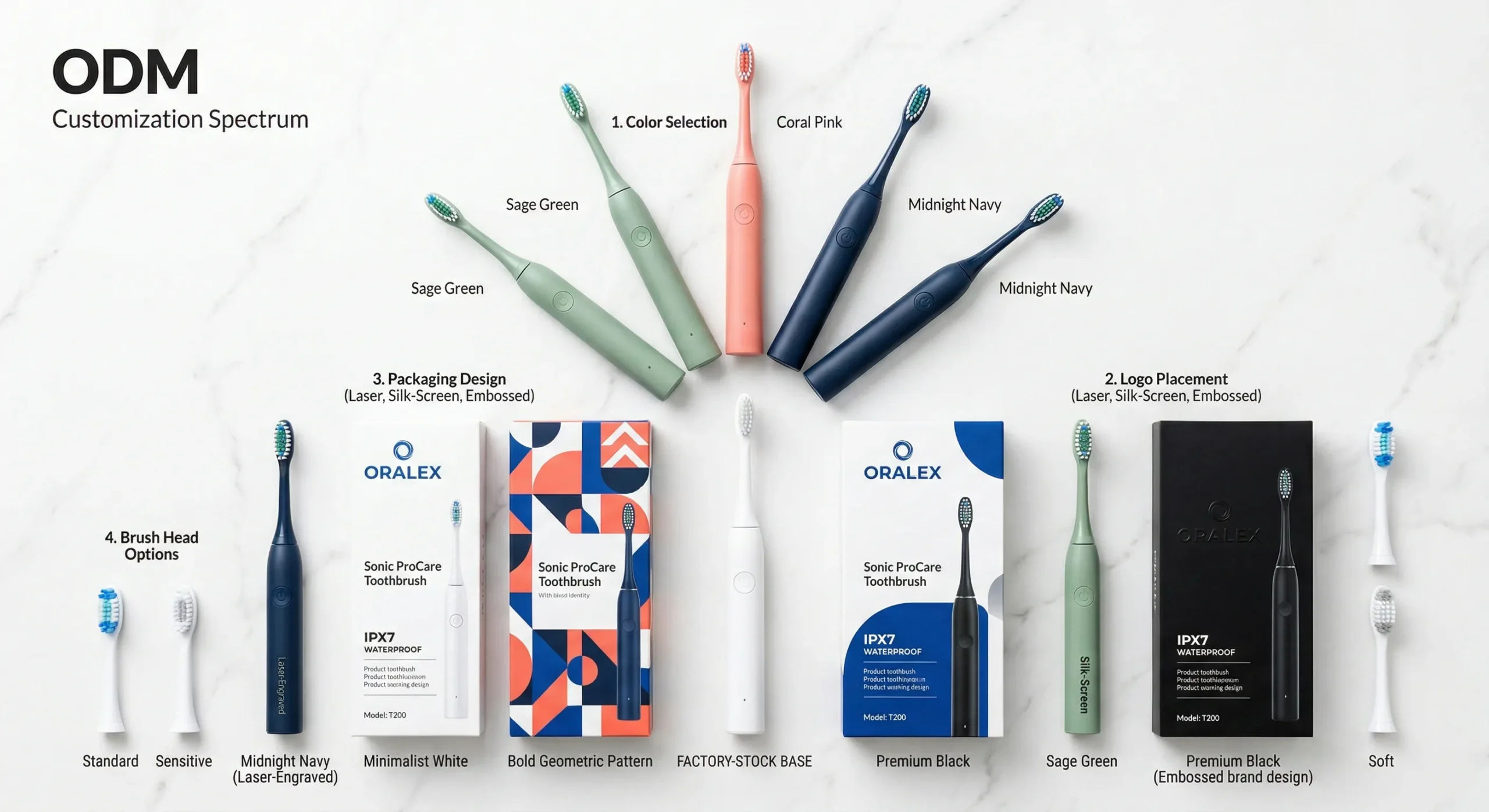
| Customization | Logo, color, packaging, smart features — full OEM/ODM services |
| MOQ | 500–1,000 units for standard models; flexible for growing brands |
| Lead Time | 30–45 days for ODM; 60–90 days for full OEM custom design |
| Global Reach | Trusted by brands across North America, Europe, Asia-Pacific, and the Middle East — see our client case studies and read what our clients say |
Our manufacturing facility in Shenzhen's Guangming District houses a 20,000 m2 dust-free workshop with 12 automated production lines. We serve oral care brands ranging from early-stage private label startups to established international distributors — and we understand that each growth stage requires a different manufacturing approach.
Get Your Manufacturing Cost Estimate Today
Receive a detailed BOM cost breakdown and customized quote within 24 hours. Or download our product catalog first.
Request a Free QuoteFrequently Asked Questions
About This FAQ
These answers are based on Relish Tech's 15+ years of manufacturing operations and verified market research data. Cost figures are estimates at standard 1,000-unit MOQ; actual costs vary by specification and volume.
| Question | Answer |
|---|---|
| What is the average manufacturing cost of an electric toothbrush in 2026? | Manufacturing costs range from $6–$11 for entry-level models to $31–$55 for ultra-premium smart models with Bluetooth connectivity and app integration. Mid-range electric toothbrushes — the most common tier for private label brands — typically cost $12–$21 per unit to manufacture at 1,000-unit MOQ, including BOM, labor, and overhead. |
| Why is there such a large gap between manufacturing cost and retail price? | The gap is primarily driven by brand premium, marketing spend, distribution margins, and retailer fees — not component costs. A $100 retail electric toothbrush typically costs $12–18 to manufacture. The remaining $82–88 covers marketing ($15–25), distributor margin ($10–15), retailer margin ($20–30), and brand profit ($10–20). By launching a private label brand through an OEM manufacturer, B2B buyers can capture the margin that currently goes to established brands. |
| What are the most expensive components in an electric toothbrush? | The motor and battery are the two largest cost variables. A brushless motor costs $2–8 compared to $0.50–2.00 for a brushed motor. Lithium-ion batteries with wireless charging add $3–7 to the BOM compared to $0.80–2.00 for NiMH. Smart PCBs with Bluetooth and pressure sensors cost $4–12 versus $0.50–1.50 for basic controllers. Together, these three component groups account for roughly 40–60% of total BOM cost. |
| What is the minimum order quantity for OEM electric toothbrushes? | MOQ varies by manufacturer and customization level. Standard ODM models (existing platform with branding customization) typically start at 300–1,000 units per SKU. Custom color, logo, or packaging requires 1,000–2,000 units. Fully custom designs with new tooling typically require 2,000–5,000 units. Relish offers flexible MOQs starting from 500 units for standard models. |
| What is the typical profit margin for a private label electric toothbrush brand? | Private label electric toothbrush brands sourcing from Chinese OEM manufacturers typically achieve gross margins of 75–88% at retail. A mid-range model costing $12–18 to manufacture can retail for $60–150, yielding $42–132 gross margin per unit. After marketing, logistics, and platform fees, net margins of 25–45% are achievable for brands running Amazon or direct-to-consumer operations. |
| What certifications are required to sell electric toothbrushes internationally? | Market-specific certifications are mandatory: CE marking (EU), FCC certification (USA), FDA registration (USA, if marketed with therapeutic claims), IPX7 waterproof rating (global retail standard), and PSE marking (Japan). ISO 13485 is recommended for quality management credibility. Relish holds CE, FCC, FDA, ISO 13485, BSCI, RoHS, and REACH certifications. |
| How have 2026 market trends affected electric toothbrush manufacturing costs? | Three key trends: (1) Post-pandemic normalization has reduced component costs 8–12% below 2022 peaks. (2) Smart feature adoption — Bluetooth and app connectivity now account for 45% of premium segment sales — has increased average BOM by $8–15/unit but enables 30–50% higher retail pricing. (3) China produces 75% of the world's electric toothbrushes (Industry Market Research, 2026), making direct OEM sourcing the most cost-effective path for new private label brands. |
References & Sources
- Grand View Research. (2026). Electric Toothbrush Market Size, Share & Trends Analysis Report. Retrieved from https://www.grandviewresearch.com/industry-analysis/electric-toothbrush-market
- Statista. (2026). Electric Toothbrush Market Revenue Worldwide. Retrieved from https://www.statista.com/statistics/478707/electric-toothbrush-market-revenue-worldwide
- Mintel. (2025). Oral Care — US — Consumer Attitudes and Brand Perception. Mintel Group Ltd.
- U.S. Food and Drug Administration. (2025). Dental Devices — Classification and Regulatory Guidance. Retrieved from https://www.fda.gov/medical-devices/dental-devices
- International Organization for Standardization. (2016). ISO 13485:2016 — Medical Devices — Quality Management Systems. Retrieved from https://www.iso.org/standard/71607.html
- Relish Technology Co., Ltd. (2026). Internal manufacturing cost data and factory operations. Retrieved from https://relish-tech.com/