

Private Label Oral Care Products: B2B Sourcing Guide
Planning a private label oral care range starts with matching product categories, customization scope, and sourcing steps to your program requirements. This guide helps B2B teams compare options and prepare for an OEM discussion.
Executive Summary: Building a Private Label Oral Care Program
- Market size: Mordor Intelligence forecasts about USD 80 billion by 2031, with 6.26% annual growth over 2026–2031. Category-level forecasts use different definitions and periods.
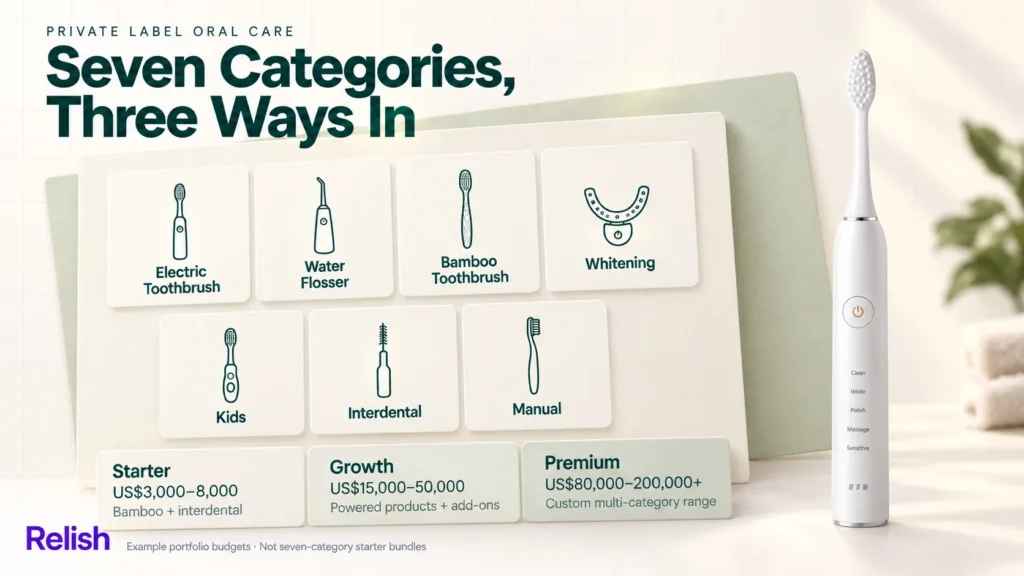
- Investment Tiers: Starter ($3K–$8K), Growth ($15K–$50K), Premium ($80K–$200K+).
- Relish custom orders typically start at 1,000 units, with flexibility for the specific order; wholesale orders for available stock start at 50 units. Existing-platform projects and full custom development have different schedules.
- Success Factors: Verify multi-category capability, test samples from 3+ categories.
Table of Contents
- The Private Label Oral Care Opportunity in 2026
- The Private Label Oral Care Product Matrix (7 Categories)
- Product Category Comparison: Investment, Markup & Complexity
- Building Your Portfolio: Three Investment Tiers
- OEM/ODM Customization Options by Category
- Certification Requirements by Product & Market
- Quality Control Standards for Private Label Oral Care
- How to Choose a Manufacturing Partner for Your Private Label Program
- Recommended Product Launch Sequence
- Frequently Asked Questions
About the Manufacturer: Relish Tech
This guide is authored by Shenzhen Relish Technology Co., Ltd., a full-line oral care OEM/ODM manufacturer with over 15 years in the industry. Our capabilities:
- Factory footprint: 20,000 m2 dust-free workshop, Shenzhen, China
- Monthly capacity: 1.2 million+ units across all oral care categories
- R&D team: 30+ engineers with full product development capabilities
- Certifications: CE, FCC, FDA, ISO 9001, ISO 13485 (medical grade line), RoHS, REACH
- Brands served: 200+ international private label clients in 120+ countries
1. The Private Label Oral Care Opportunity in 2026
Private label oral care offers several ways to stand out beyond price: bamboo-handled brushes for sustainability-focused ranges, smart sonic devices for technology-led brands, and whitening products tailored to the target market. Choose a segment whose product features, claims and pricing match your customers.
Mordor Intelligence forecasts a global oral care market of approximately USD 80 billion by 2031, with a CAGR of 6.26% over 2026–2031 [1]. For B2B buyers, the opportunity is to build a focused range with clear product positioning and workable unit economics. This guide compares product categories, illustrative purchasing budgets, compliance requirements and supplier evaluation criteria.
The addressable opportunity spans five distinct buyer archetypes:
- Amazon FBA Sellers: building defensible product portfolios in oral care
- Dental Clinics & Chains: white-labeling professional-grade tools for patient loyalty
- Health & Beauty Retailers: seeking exclusive SKUs to differentiate shelf presence
- Subscription Box Brands: sourcing premium oral care for curated wellness boxes
- Wellness & DTC Startups: building complete oral care brand lines for global DTC launch
Market Timing: Planning Your Entry in 2026
Focused brands can compete by serving a defined customer need rather than copying the largest oral care brands. Compare your intended channel, product positioning, supplier capacity and testing schedule before setting a launch date. CE marking, FCC authorization and FDA requirements follow different routes, so identify the rules that apply to each product and market.
2. The Private Label Oral Care Product Matrix (7 Categories)
Here is a complete overview of the seven core private label oral care product categories — with key specifications, market positioning, and manufacturer data for each.
Electric Toothbrushes
Sonic and oscillating electric toothbrushes offer scope for differentiation through brush-head design, pressure sensing, modes and packaging. Specify filament material and stiffness, and assess any performance claims for the finished product.
Water Flossers
Water flossers use a directed water stream for interdental cleaning. Countertop, portable and shower-connected designs suit different channels and use cases. Compare pressure control, reservoir size, tip options and product-specific evidence for dental claims.
Bamboo Toothbrushes
Manual toothbrushes with bamboo handles offer a clear material-led positioning and can avoid the electronics development required for powered products. Specify handle sourcing, filament material and packaging separately; a bamboo handle does not make the entire brush biodegradable.
Teeth Whitening Products
Whitening ranges can include strips, pens, LED devices, gels and powders. Formulated products and powered devices have different development and compliance requirements. Compare formulation, packaging, purchase price and permitted claims before choosing a format.
Kids Oral Care
Children’s ranges can include electric toothbrushes, manual brushes and toothpaste. Define the intended age group and assess small parts, materials, charging safety and instructions. Toy standards apply only when the product falls within their scope.
Interdental Products
Dental floss, floss picks and interdental brushes can complement a powered-product range or support replenishment programs. Compare usable length or pack count, filament strength, handle design and packaging when evaluating unit prices.
Manual Toothbrushes
Manual toothbrushes cover everyday, sensitive and ultra-soft options. They can serve dental clinics, retail or hospitality programs. Compare filament stiffness, tuft retention, handle design and packaging rather than choosing on unit price alone.
Category Opportunities to Evaluate
- Bamboo toothbrushes: a way to build material-led positioning. Verify sourcing and packaging claims for the finished product.
- Water flossers: portable and countertop designs serve different channels. Review demand, pressure settings and tip options for your target customer.
- Kids oral care: age-appropriate design, parent-friendly instructions and replacement-head availability can support a family range.
3. Product Category Comparison: Investment, Markup & Complexity
Use this comparison alongside your budget, launch timeline and sales channels. The figures are illustrative category examples, not a fixed ranking.
| Product Category | Illustrative startup budget | Illustrative retail markup | Lead Time (ODM) | Regulatory Complexity | Best Channel | Indicative consumer replacement cycle |
|---|---|---|---|---|---|---|
| Electric Toothbrush | $8K–$25K | 150–250% | 60–90 days | Medium | Amazon, DTC | 12–18 months |
| Water Flosser | $6K–$20K | 180–280% | 45–75 days | Medium | Amazon, Dental | 18–24 months |
| Bamboo Toothbrush | $800–$3K | 200–400% | 20–40 days | Low | Eco retail, Sub box | 3–4 months |
| Teeth Whitening | $1.5K–$8K | 300–500% | 30–50 days | Medium-High | DTC, Beauty retail | 1–3 months |
| Kids Oral Care | $5K–$18K | 150–220% | 60–90 days | High | Pharmacy, DTC | 6–12 months |
| Interdental Products | $500–$2K | 150–300% | 15–30 days | Low | Pharmacy, Dental | 1–2 months |
| Manual Toothbrush | $400–$1.5K | 80–150% | 15–25 days | Low | Retail, Hotel | 2–4 months |
How to Read This Table
The percentages in this table are markups on the FOB purchase price, not gross profit margins. Markup = (retail price − FOB price) ÷ FOB price; gross margin = (retail price − FOB price) ÷ retail price. For example, a 300% markup corresponds to a 75% product gross margin before freight, duties, fulfillment, marketing and other selling costs. Recalculate the figures using a current supplier quote and your channel costs. Replacement cycles are planning examples, not guaranteed repeat orders.
4. Building Your Portfolio: Three Investment Tiers

Based on our experience working with 200+ international brands, successful oral care portfolios tend to follow one of three investment models depending on capital availability and risk tolerance.
Starter Portfolio
Market testing with selected existing-platform products
- 1–2 bamboo toothbrush SKUs (custom label)
- 1 interdental product (floss picks or floss)
- Optional: 1 teeth whitening pen
- Focus: Amazon FBA, eco retail, subscription boxes
- Timeline: 30–60 days to first inventory
- Tooling: confirm whether an existing platform covers your design
Growth Portfolio
Multi-category brand with unique positioning
- 1 electric toothbrush line (2–3 SKUs)
- 1 water flosser (portable or countertop)
- Bamboo toothbrush as eco complement
- 1 teeth whitening product
- Focus: DTC website, Amazon, dental clinics
- Timeline: 60–120 days to launch
Premium Portfolio
A complete range with custom tooling and agreed IP rights
- Custom-design electric toothbrush (new mold)
- Smart water flosser with app connectivity
- Kids oral care line (brush + timer)
- Full teeth whitening system (device + gel)
- Custom branded packaging ecosystem
- Focus: Retail chains, global distribution, DTC
Pro Tip: The Hybrid Launch Strategy
Many successful brands start with a Starter Portfolio to validate their brand, packaging, and sales channels (typically 60–90 days), then expand into electronics once they have a working supply chain and real customer feedback. The first order is lower-risk and the manufacturer relationship is established before the bigger commitment.
5. OEM/ODM Customization Options by Category
Understanding what can and cannot be customized in each category helps you define your brand identity and negotiate more effectively with manufacturers. The depth of customization typically drives both MOQ and lead time.
Electric Toothbrushes — Customization Depth: HIGH
| Dimension | ODM Options | Full OEM Options |
|---|---|---|
| Housing | Choose an existing housing platform and available colors | Fully custom shape, texture, material |
| Motor | Choose from specified operating frequencies; confirm how vibrations or strokes are counted | Custom motion amplitude, operating frequency and control settings |
| Brush Heads | Bristle type, head count per pack | Custom head shape, proprietary attachment system |
| Modes | Select 1–4 from existing modes | Fully programmable timer/mode firmware |
| Charging | USB-C charging or a specified inductive system | Custom charging case or dock; define any wireless-charging protocol |
| Packaging | Custom print on standard box | Custom structure, materials, inserts, gift set |
Water Flossers — Customization Depth: HIGH
- Type: countertop (600 mL or larger reservoir), portable (150–300 mL) or shower-connected
- Pressure range: Adjustable from 30–110 PSI; number of pressure levels
- Tips included: Standard, orthodontic, periodontal, tongue cleaner — choose your bundle
- Technology: pulse rate of 1,200–1,800 pulses/min, defined burst modes and a UV feature where offered; validate its intended use and claims
- Housing: Color, button design, LED ring color, soft-touch coating
Bamboo Toothbrushes — Customization Depth: MEDIUM
- Handle: Bamboo species selection, ergonomic shape, logo laser engraving, natural color wash
- Bristles: specify nylon or supplier-verified bio-based filament, with defined stiffness and traceability
- Pack format: Single, 2-pack, 4-pack family set (color-coded handles)
- Packaging: kraft paper, verified FSC-certified board, or wrapping with substantiated compostability claims
- Add-ons: Bamboo travel case, bamboo holder, charcoal toothpaste bundle
Negotiating Customization Scope
Know what you actually need before the first factory meeting. Every customization beyond the ODM baseline adds cost and time. Come with a focused brief — custom color housing, your logo, custom box — rather than an open-ended "what can we customize" question. Focused requests get faster, cleaner quotes.
6. Certification Requirements by Product & Market
Missing an applicable compliance requirement can delay customs clearance, prevent a marketplace listing or create liability. Identify the requirements for each product and target market before launch, and include testing and documentation in your budget.
CE Marking
Identify applicable EU legislation for the product: EMC and RoHS for relevant electronics, RED for radio-enabled designs, and LVD where the voltage scope applies, including applicable power supplies. Prepare the technical documentation and EU Declaration of Conformity. Illustrative test budget: EUR 1,500–5,000; planning allowance: 4–8 weeks.
FDA Product Classification & Registration
The FDA route depends on the product and intended claims. Relevant device establishments may need registration and listing. For cosmetics, assess MoCRA facility registration and product listing, including exemptions; drug claims can trigger a different route. Registration or listing does not mean FDA approval.
FCC Equipment Authorization
Determine the FCC rules and authorization route for the electronics and any radio functions. Many unintentional radiators use Supplier’s Declaration of Conformity; intentional radio transmitters generally require certification. Illustrative testing allowance: USD 1,500–3,500 per model and 6–10 weeks; confirm the actual scope.
IP Water-Ingress Rating
Specify and test the water-ingress protection needed for the design. IPX5 addresses water jets; IPX7 addresses temporary immersion under defined conditions, commonly 1 m for 30 minutes. Neither automatically proves the other, and an IP rating is not a universal market-approval requirement. Illustrative test allowance: USD 300–800.
Children’s Product Safety
Assess age grading, small parts, materials, instructions and electrical safety. EN 71 in the EU and ASTM F963 in the USA are toy standards; they are not automatically required for every children’s toothbrush. Confirm the product’s classification and all applicable children’s product rules.
RoHS & REACH
RoHS restricts specified substances in in-scope electrical and electronic equipment. REACH has broader obligations for chemicals, materials and articles. Obtain material declarations and relevant evidence for the finished product and target market.
FSC Certification
FSC certification supports eligible claims about responsibly sourced forest materials and supply-chain traceability. It is voluntary; check the supplier’s certificate scope, chain of custody and permission to use FSC labels for the proposed bamboo or paper components.
PSE / KC Marks
For Japan, assess PSE scope for the product, power supply and relevant batteries. For South Korea, identify the applicable KC safety and electromagnetic compatibility requirements. Do not assume one mark covers every oral care device. An illustrative allowance of USD 1,500–3,000 per route should be confirmed against the actual test scope.
Certification Strategy: Plan All Markets Upfront
Define target markets before placing a production order. Existing platform reports can save time when they cover the proposed design, components and brand documentation. Confirm which reports remain applicable and what changes require assessment or retesting; adding a brand name does not automatically extend compliance to a modified product.
7. Quality Control Standards for Private Label Oral Care
Quality failures in oral care products carry significant brand risk and potential regulatory consequences. A three-stage quality control framework is the industry standard for reputable OEM manufacturers — and something you should verify before placing any order.
Incoming Quality Control (IQC)
Inspect incoming materials and components before production: filament stiffness, bamboo moisture content, specified plastic grade, PCB components and battery-cell identity and condition.
Ongoing — before each production runIn-Process Quality Control (IPQC)
Sample key production stages: assembly fastener torque, housing seals, measured brush-head operating frequency and pump output pressure.
During production — every 2–4 hoursOutgoing Quality Control (OQC)
Carry out the agreed final inspection before shipment. Define lot size, sampling level and AQL by defect class; values such as 1.0 for major defects and 2.5 for minor defects are inspection parameters, not guaranteed defect percentages. Specify functional, drop and packaging tests separately.
Before shipment — agreed 100% checks of safety-critical featuresThird-Party Audit
Optional but recommended for first orders. SGS or Bureau Veritas audits verify production capacity, quality systems, social compliance, and fire safety.
Before the first order — illustrative audit allowance of USD 400–800Key Test Standards by Product Category
- Electric toothbrushes: assess IEC 60335-1 together with IEC 60335-2-52 and the editions or national adoptions required for the market. IEC 62368-1 is not the general safety standard for a toothbrush.
- Water flossers: assess IEC 60335-1 together with IEC 60335-2-52 for in-scope electric oral hygiene appliances, including the applicable power supply and market adoption.
- Children’s electric toothbrushes: assess the applicable oral hygiene appliance standard and age-related product hazards. Add toy standards only where the product’s classification requires them.
- Whitening gels: assess ingredient restrictions, product classification, labeling and safety evidence for the target market. ISO 10993 applies to biological evaluation of medical devices; it is not a blanket cosmetic-gel certification.
- Floss products: assess filament strength, fraying, material safety and intended use. ISO 28158 covers integrated dental floss and handles within its scope; ISO 22254 concerns manual toothbrush filament stiffness, not floss. ADA acceptance is a voluntary program.
8. How to Choose a Manufacturing Partner for Your Private Label Program
Working with an oral care manufacturer for your entire product portfolio sounds efficient — and it can be, if the factory is genuinely equipped for every category you need. Unified quality systems, one logistics partner, consistent packaging, and better pricing as you grow across categories are real benefits. But not all factories claiming to be "full-line" actually are.
Five Verification Steps
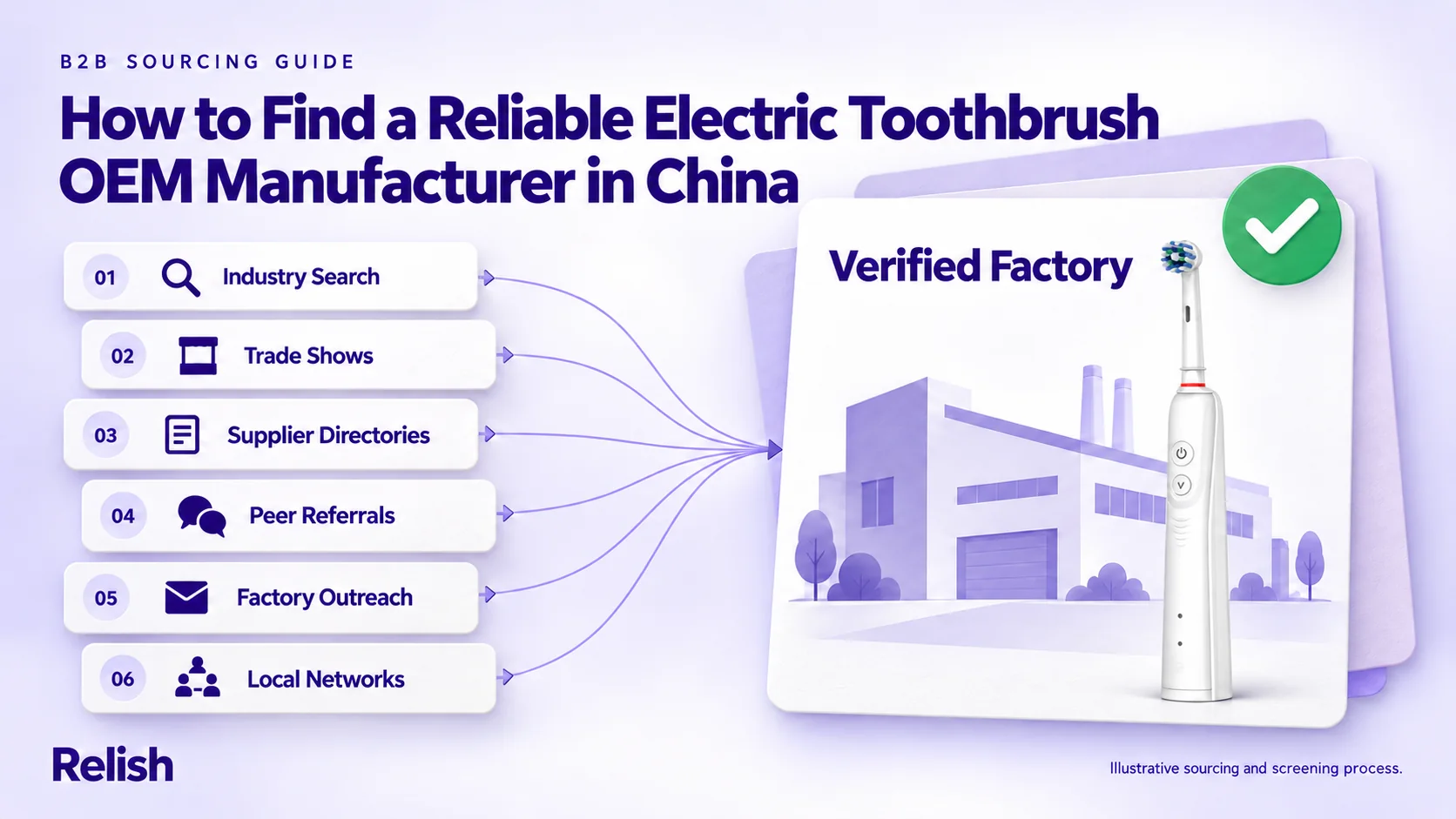
- Multi-category capability: request production photos or a factory tour for each category, including assembly, molding and packaging. Confirm which steps are performed in-house and which are subcontracted, and how the supplier controls both.
- Compliance documentation: obtain applicable test reports, declarations and authorization records. Check the model, components, brand, legal entities and market scope. For CE marking, a generic certificate alone does not replace the technical file and EU Declaration of Conformity.
- Order samples from several categories together. Differences in packaging, documentation or response times are reasons to clarify responsibility and sourcing arrangements; they do not by themselves prove that a supplier is brokering the products.
- Ask about scaling capacity: discuss forecast volumes, available production capacity, reorder lead times and how peak demand would be scheduled.
- Discuss a combined order across categories to explore pricing, packaging and logistics savings. Agree the terms and MOQ for each SKU; the total order value does not automatically create the same price reduction for every item.
Disqualifying Signals When Vetting Manufacturers
- Large unexplained differences in sample lead times across categories; ask whether tooling, materials or subcontracting accounts for them.
- Packaging quality that looks noticeably different across product categories in the same quote.
- Factory photos that do not clearly show the relevant processes, capacity and controls for the proposed product range.
- Engineers who can't answer basic technical questions about categories outside their core business.
- Unclear legal entity, manufacturing scope or responsibility for outsourced production.
9. Recommended Product Launch Sequence
A staged launch can help validate demand and build a supplier relationship before committing to a wider range. The sequence below is one planning example; adapt the first product and timing to your target customer, channel and budget.
Bamboo Toothbrush + Interdental Products
Start with straightforward existing-platform products if they fit your brand. Bamboo-handled brushes and floss picks avoid electronics development, but still need material, labeling and product-safety checks. A USD 2,000–5,000 order budget and delivery within about 45 days are planning examples to confirm against your specification and MOQ.
Electric Toothbrush or Water Flosser (choose one first)
Introduce the powered product that best matches your positioning. A water flosser may suit an interdental-care focus, while a sonic toothbrush may suit a daily-brushing range. Compare available platforms, required testing, tooling and channel economics; neither category automatically has a faster compliance route or the highest margin.
Teeth Whitening Product
Add a whitening product when it fits your customer and target-market rules. PAP-based and peroxide-based formulations both require classification, ingredient, safety and claims review. A bundle may raise average order value, but the effect depends on pricing and customer uptake.
Second Electronic Product + Kids Line
Add the second powered category when demand and operations support it. For a children’s version, review age-appropriate handle and brush-head design, filament stiffness, small parts, charging and instructions. Do not treat a smaller adult product as automatically suitable for children.
Bundle Strategy + Multi-Language Market Entry
Build bundles that fit your customer’s routine, such as a toothbrush, water flosser and suitable whitening product. Before entering another market, complete the required product, labeling, instructions and language work. Use annual forecasts to negotiate volume pricing, payment terms and production schedules.
Timeline Reality Check
The example timeline assumes straightforward existing-platform projects. Allow additional time for tooling, testing, packaging changes and factory holidays. Agree milestones with the supplier and allow for corrective work before fixing a public launch date.
10. Frequently Asked Questions
Ready to Build Your Private Label Oral Care Brand?
Planning a private label oral care program? Tell us the product categories, customization requirements, and target market you are evaluating, and our team can help you review the next steps.
References
- Mordor Intelligence (2026). Oral Care Market Size and Share. Forecast: approximately USD 80 billion by 2031; CAGR 6.26% over 2026–2031. Source: https://www.mordorintelligence.com/industry-reports/oral-care-market
- Grand View Research. Electric Toothbrush Market Size & Share Report, 2025–2030. Forecast CAGR: 7.8% over 2025–2030. Source: https://www.grandviewresearch.com/industry-analysis/electric-toothbrush-market
- American Dental Association. Toothbrushes: Oral Health Topics. Guidance on selecting and using toothbrushes. Source: https://www.ada.org/resources/ada-library/oral-health-topics/toothbrushes