











OEM Electric Toothbrush Timeline: Week-by-Week Process Guide (2026)
Project timelines depend on product scope, tooling, approvals, testing, supplier readiness, freight, customs, and destination. Use the calendar below as a planning example, then confirm milestones against the project and current availability.
Executive Summary: OEM Electric Toothbrush Production Timeline
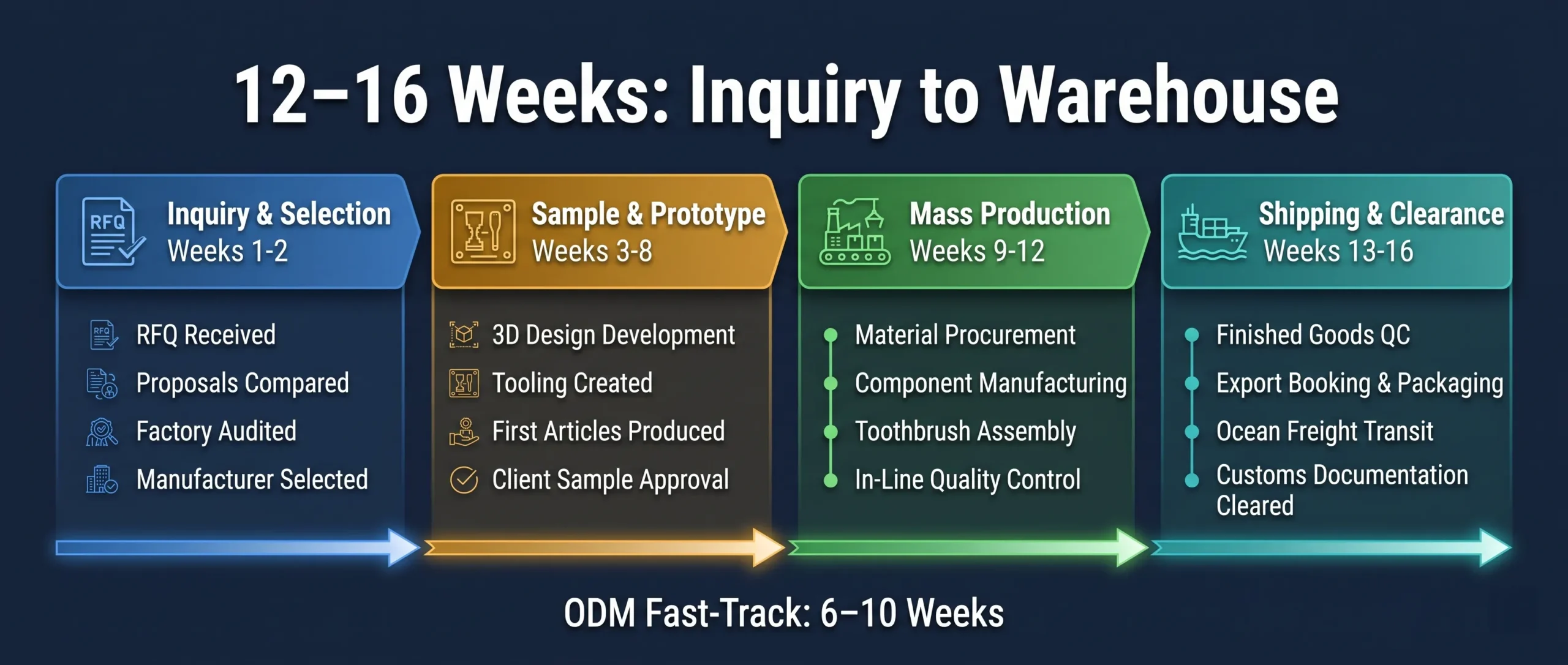
- Standard OEM Timeline: 12–16 weeks (84–112 days) is an illustrative inquiry-to-delivery planning range, not a guaranteed lead time. Confirm the project schedule.
- An existing-platform ODM project may avoid some structural tooling if the model and configuration fit. MOQ, customization, setup charges, testing, and timing depend on the product and written terms.
- Top Delay Risks: Schedule risks can include design changes, testing availability, supplier closures, component or packaging readiness, freight, and customs. Set project-specific buffers and confirm dates with the relevant providers.
- Payment and tooling milestones are negotiated contract terms. Specify deposits, balance triggers, tooling ownership, acceptance conditions, and nonconformity handling in the signed agreement.
In This Guide
- Full Timeline at a Glance
- Phase 1: Inquiry & Factory Selection (Weeks 1–2)
- Phase 2: Sample & Prototype Development (Weeks 3–8)
- Phase 3: Mass Production (Weeks 9–12)
- Phase 4: Shipping & Customs Clearance (Weeks 13–16)
- Existing-platform ODM options
- Top Delay Risks & How to Prevent Them
- Reverse Calendar Planning: Work Backwards from Your Launch Date
- Frequently Asked Questions
1. Full Timeline at a Glance
Before diving into individual weeks, here's the complete picture. Knowing the overall shape of the timeline helps you negotiate with factories, set realistic launch dates, and figure out where buffer time matters most.
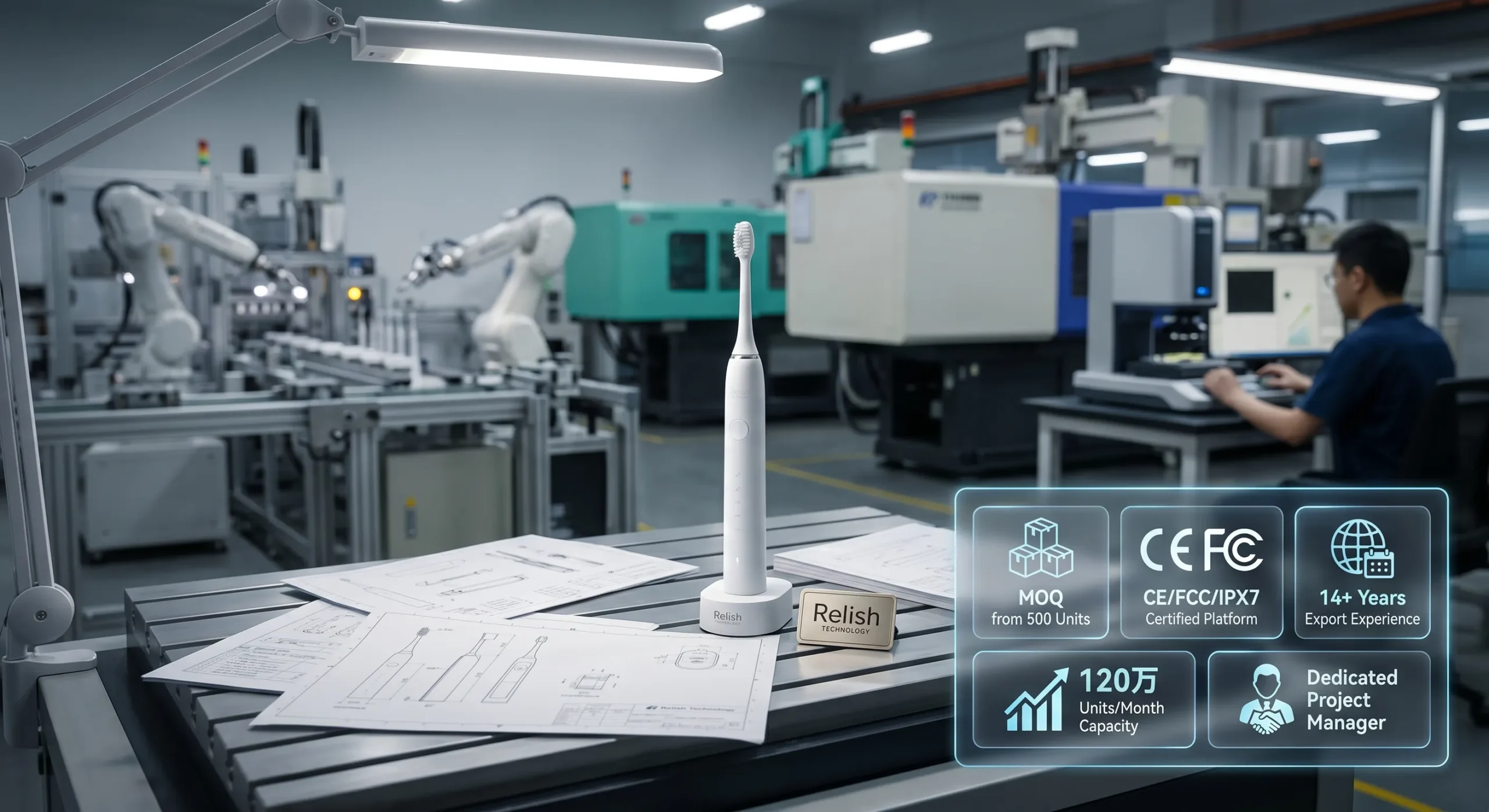
🏭 About the Manufacturer: Relish Technology
Relish Technology has manufactured oral-care products since 2012. Its operations in Shenzhen and Huizhou total 20,000 m². Share the product configuration, target market, order scope, and schedule to discuss relevant manufacturing options and product-specific documentation.
Learn more → · Client case studies → · View certifications →
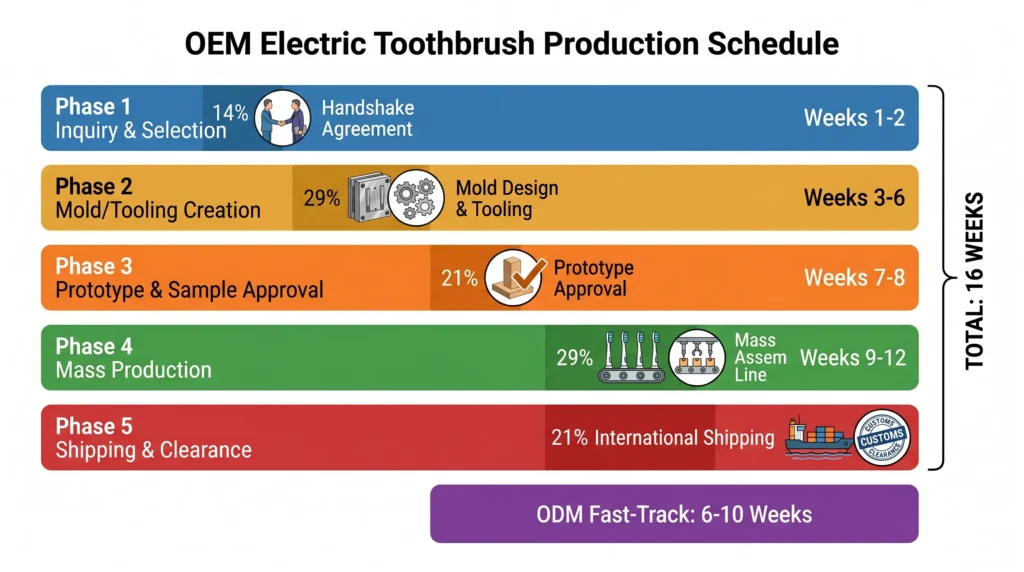
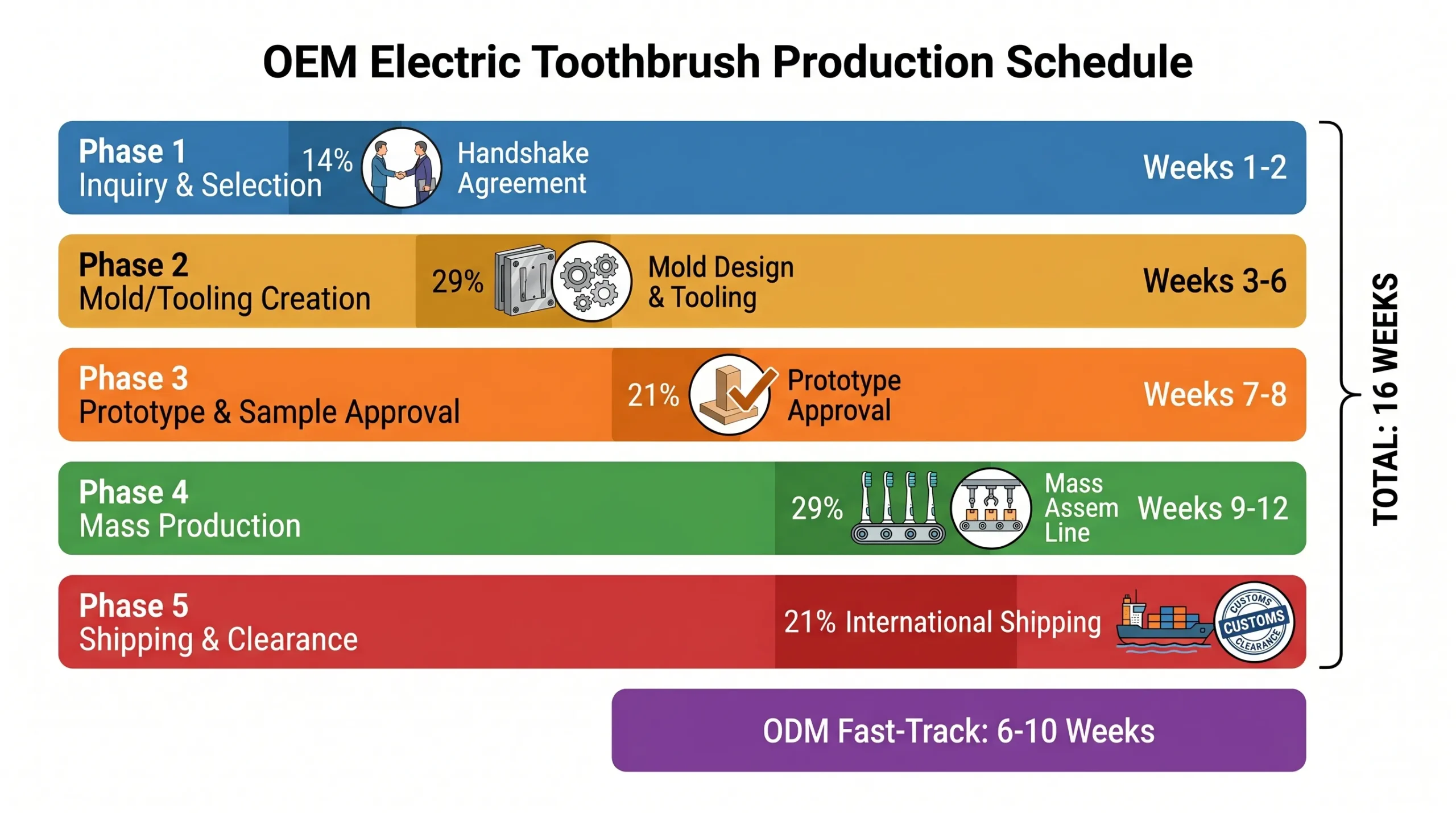
OEM Electric Toothbrush: Illustrative 16-Week Timeline (Visual Overview)
| Phase | Weeks | Key Activities | Your Decision Points |
|---|---|---|---|
| 1. Inquiry & Selection | 1–2 | RFQ, quote comparison, NDA signing, factory shortlisting | Choose factory, confirm specs |
| 2. Mold Creation | 3–6 | Engineering review, mold fabrication, first mold trial | Approve mold design, pay tooling deposit |
| 3. Prototype & Approval | 7–8 | First samples, testing, revisions, pre-production sign-off | Approve samples, sign purchase order |
| 4. Mass Production | 9–12 | Production deposit, inline checks, packaging, and pre-shipment inspection: schedule and payment terms are project-specific and contractual. | Review inspection results and follow the payment terms agreed in the contract. |
| 5. Shipping & Clearance | 13–16 | Sea/air freight, customs broker, last-mile delivery | Confirm receipt, log inventory |
One Number to Remember
Use the 16-week calendar as an example, then build a project-specific schedule. Add time for design changes, sample review, testing, transport, and clearance after confirming requirements with each supplier or service provider.
2. Phase 1 — Inquiry & Factory Selection (Weeks 1–2)
Early supplier evaluation helps clarify product scope, documentation, commercial terms, and schedule assumptions before tooling or production begins.
RFQ Preparation & Multi-Factory Outreach
InquiryStart Week 1 by writing a clear, detailed Request for Quotation (RFQ) and sending it to 4-6 factories simultaneously. The quality of your RFQ determines the quality of quotes you get back. Vague requests get vague responses—and inflated prices that aren't obvious until later.
- Define product specifications: Drive technology and specified motion metric, battery voltage and capacity/Wh, applicable ingress-protection target, handle dimensions, brush-head type, charging method, and operating modes.
- Set your target quantities: State your initial order quantity and projected annual volume. Factories price differently for 500 vs. 5,000 units
- List destination-market compliance requirements: identify applicable product rules and evidence for the model and configuration; confirm testing and documentation with the laboratory or qualified adviser.
- Specify packaging requirements: Retail box dimensions, insert card, master carton, Amazon-ready labeling requirements
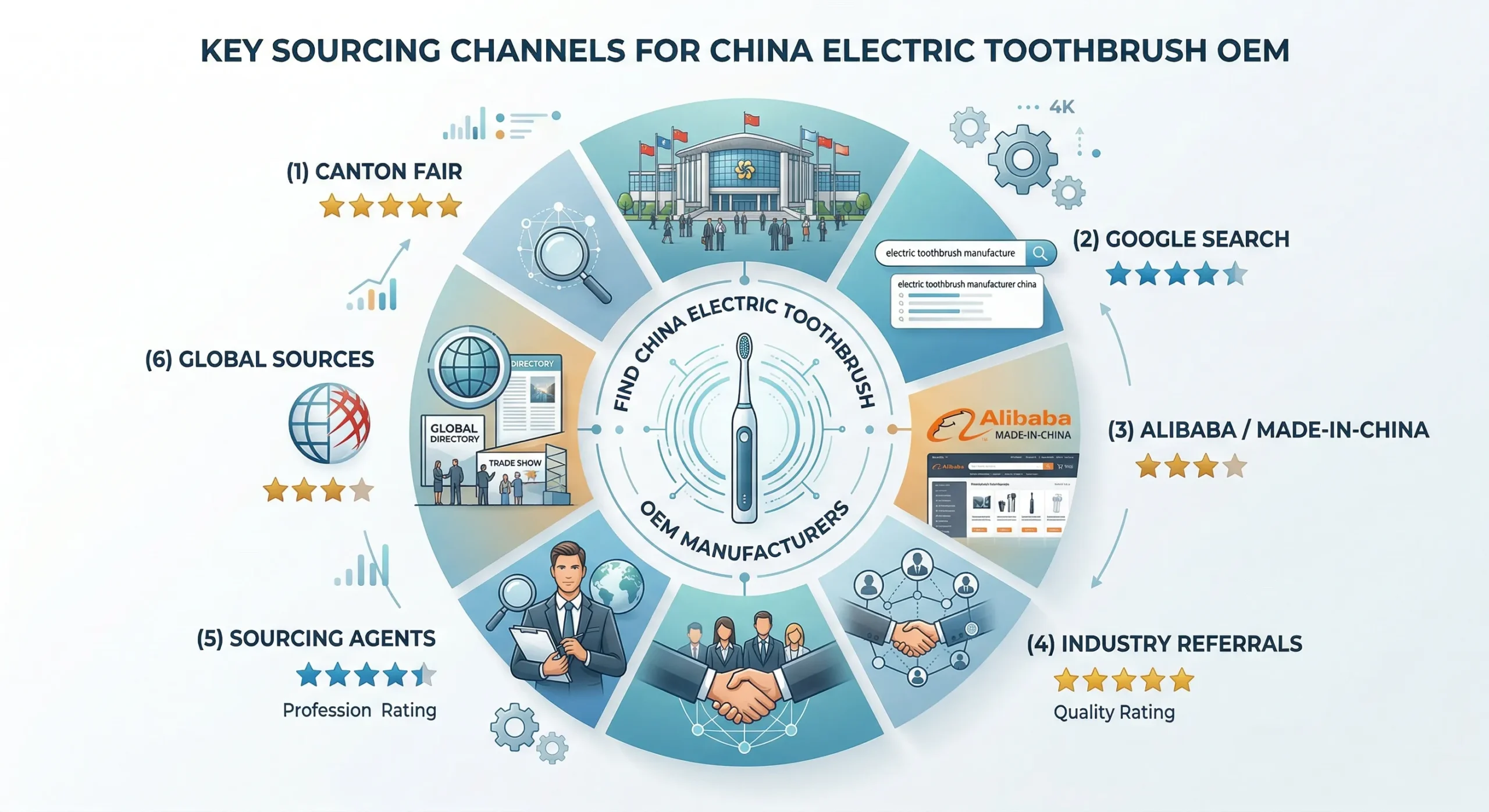
- Identify 4–6 candidate factories: Use Canton Fair directories, Alibaba Gold Supplier filter, Made-in-China.com, or direct referrals
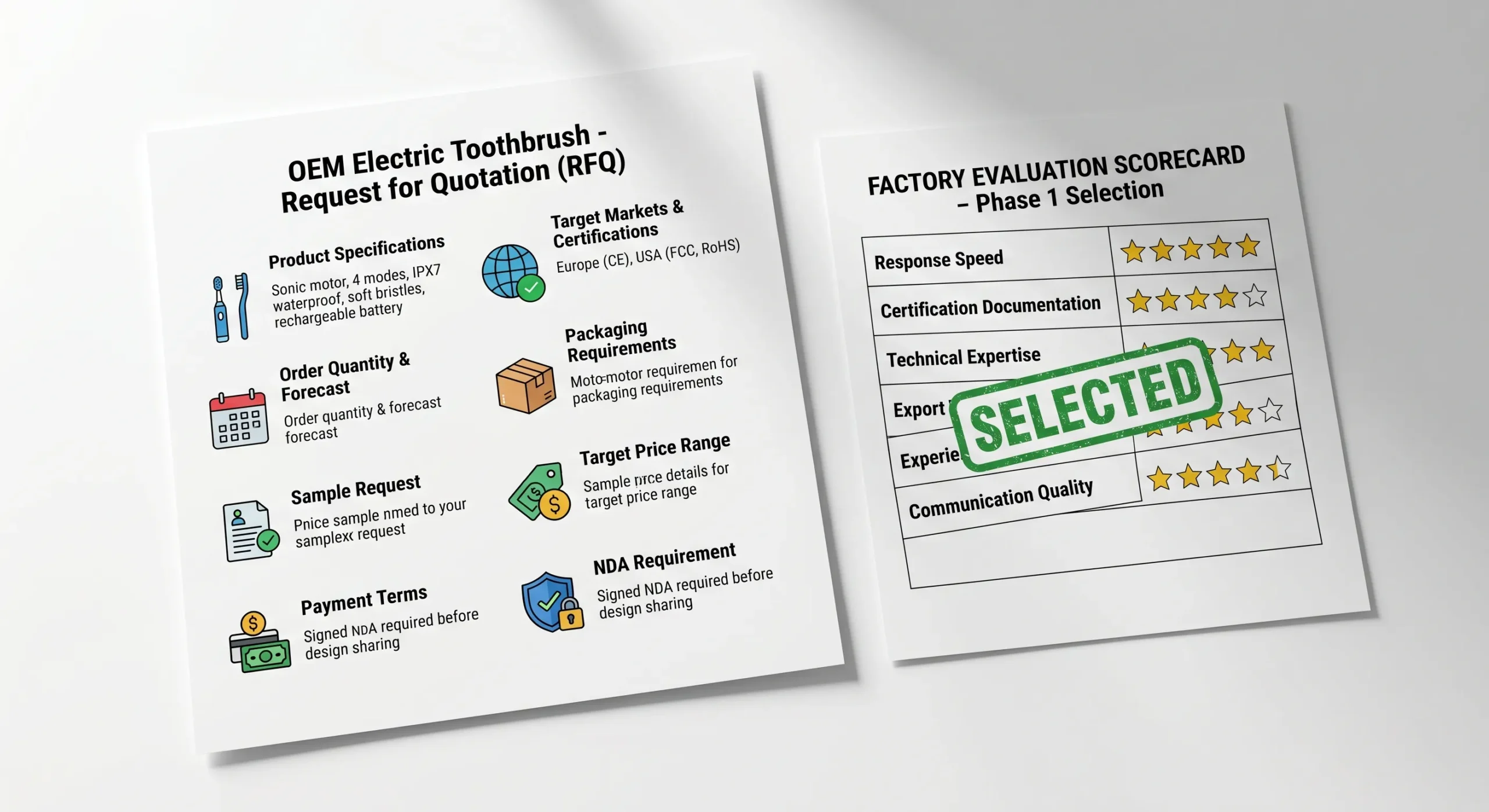
A complete RFQ covers these eight points
Product name and a 1-2 line description. A technical spec sheet with dimensions, materials, and performance targets. Your target market(s) and required certifications. Initial order quantity plus a 12-month volume forecast. Packaging specification for both retail and master carton. Sample quantity and lead time requirements. Target FOB price range—this is optional but helps filter out factories that aren't competitive in your range. And your expected payment terms.
Quote Evaluation & Factory Selection
SelectionCompare quotations on identical specifications, quantity, Incoterms, testing, packaging, and documentation. Assess total landed cost and assumptions; price alone does not establish supplier quality or future rework cost.
- Compare quotes on the same basis: Confirm all quotes use the same Incoterms (typically FOB Shenzhen), include the same certifications, and cover identical packaging specs
- Verify the supplier: Check its business registration and any claimed ISO 9001 certificate. For comparable products, request model-specific test reports and conformity documents relevant to your target market. CE is a conformity mark; FCC requirements depend on the product configuration.
- Evaluate communication speed: Track response times during evaluation and agree on communication expectations and escalation contacts before production.
- Request factory profile: How many production lines? Annual capacity? Current major clients (anonymized)? Have they exported to your target market before?
- Shortlist suppliers for further review. If needed, commission a scoped factory audit and obtain a current quotation from the provider.
What a reliable factory looks like
A supplier should explain its capabilities, identify open technical questions, provide current documentation for comparable products, and agree on a practical communication and review process. Verify claims against the project scope.
Walk away if you see this
Investigate inconsistent quotations, unclear documentation, or pressure to skip written terms. Compare like-for-like costs and seek clarification; no single signal proves fraud.
3. Phase 2 — Sample & Prototype Development (Weeks 3–8)
Sample development may take several weeks and require review rounds. Consolidate feedback, document approved changes, and evaluate new requirements against the schedule.
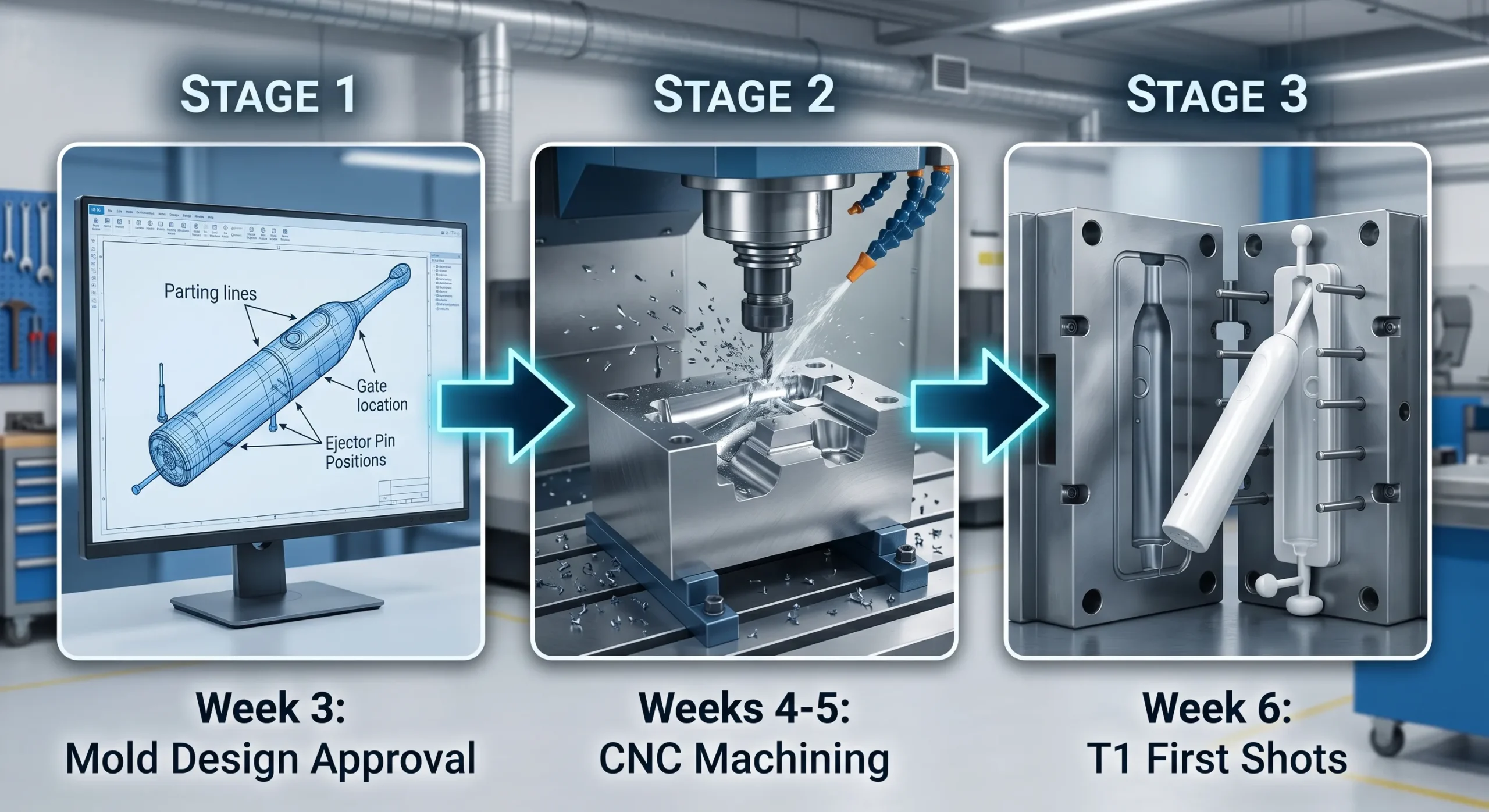
Engineering Review & Mold Design Confirmation
Tooling KickoffAfter scope and commercial terms are agreed, engineering reviews design, tooling, materials, assembly, and available processes. The number of questions and response time depend on the project.
- DFM review: Ask engineering to identify design, tooling, assembly, and process questions and document any proposed changes.
- Review proposed CAD and tooling designs before authorizing fabrication. Changes after work begins may affect engineering, time, and cost; define approval and tooling ownership in writing.
- Material confirmation: Confirm handle material (ABS / PC / ABS+PC blend), bristle material (nylon grade / DuPont Tynex), and TPE/rubber overmold specs
- Document the relevant vibration or brush-head movement metric and test method; distinguish VPM, Hz, and rotational speed. Do not call sonic operation ultrasonic without supporting frequency data.
- Tooling cost and payment timing depend on design and contract. Agree amount, ownership, acceptance milestone, and payment triggers in writing.
Mold Fabrication (CNC Machining)
ToolingDuring mold fabrication, request updates at agreed milestones. Toolmaking requires inspection and adjustment; the appropriate correction depends on the issue and engineering assessment.
- Tooling lead time and durability depend on design, material, process, workload, production conditions, and maintenance. Obtain a project-specific estimate.
- Request progress photos: Ask for CNC machining photos at 50% and 100% completion
- Parallel tasks during this wait:
- Finalize brand logo and color palette for mold texturing
- Draft retail packaging design for factory review
- Ask your testing lab to review the rules and test scope for the intended product and destination markets.
- Prepare importer-of-record arrangements if required for the destination and transaction.
- Tool life depends on grade, heat treatment, mold design, resin, production conditions, and maintenance; quoted shot counts are not universal guarantees.
Don't waste Weeks 4-5 waiting
Use the mold fabrication period to finalize packaging design and send it to the factory for a mockup. Register barcodes (EAN/UPC) for each SKU early enough to support listing and packaging preparation. Prepare listing copy, warehouse arrangements, and draft manuals while tooling is underway. Review regulatory requirements with the laboratory early; product testing and final approvals may need representative samples.
First Mold Trial & T1 Samples
First ShotsA first mold trial (often called T1) evaluates molded parts and fit. It may identify dimensional, surface, or assembly issues and is not necessarily a complete functional product.
- T1 dimensional inspection: Factory measures critical dimensions against your approved drawings using CMM (Coordinate Measuring Machine) or calipers
- Surface finish review: Check texture, gloss level, parting line visibility, and any sink marks or weld lines
- Assembly trial: Housing halves are assembled with the internal components (PCB, motor, battery) to check fit and tolerance stack-up
- T1 findings and corrective actions:
- Inspect flash, sink marks, weld lines, fit, and surface texture against the drawing and sample criteria.
- Ask engineering to identify root cause before approving a design, process, or tooling change.
- Record corrective actions and re-trial timing in the project schedule; no single repair or turnaround applies to every case.
- Review the updated sample before approving the next stage.
- Request T1 samples physically shipped: Even with photos, hands-on evaluation reveals things a camera misses. Tactile quality, weight distribution, button feel
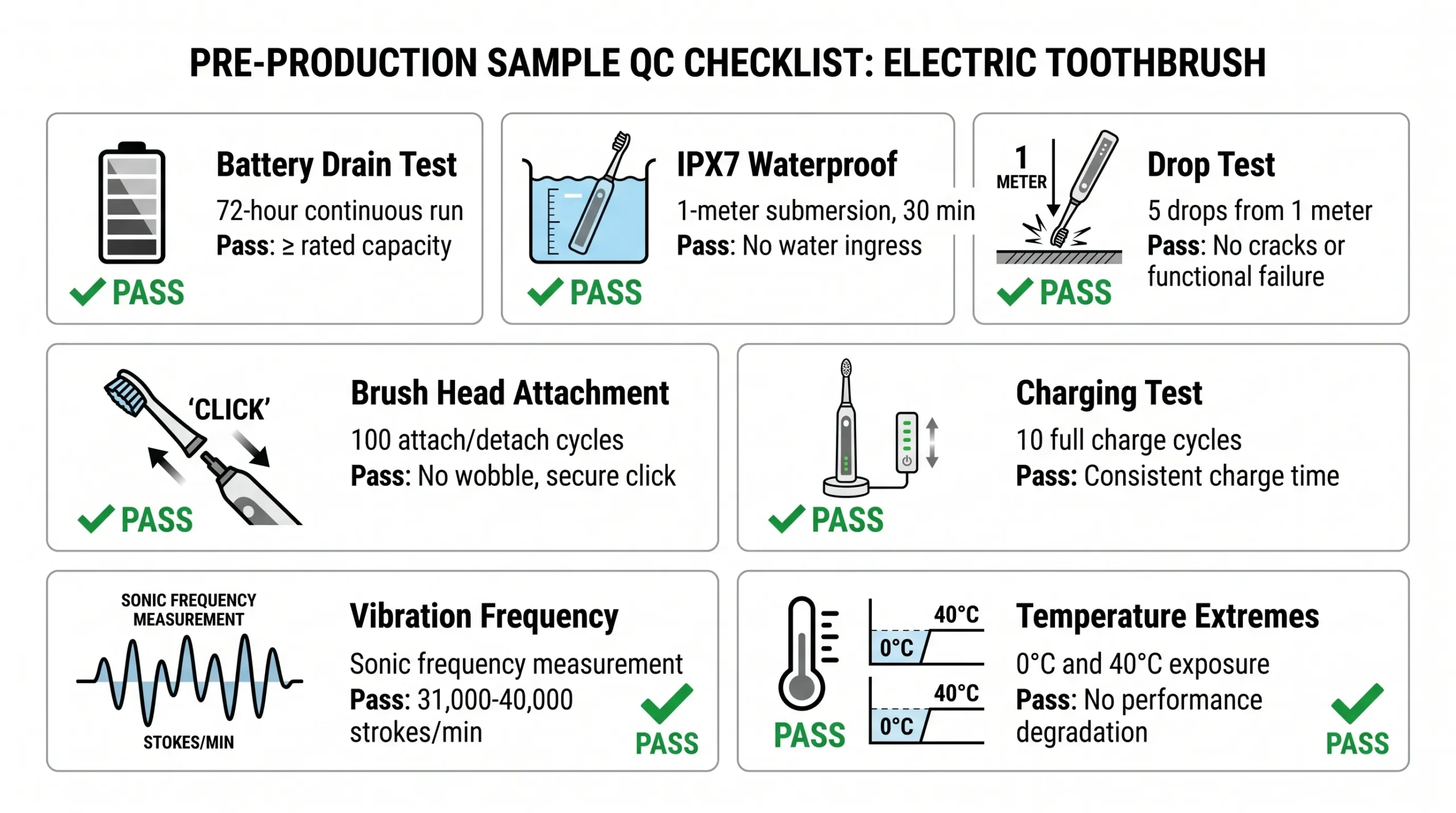
Pre-Production Sample (Functional Prototype) & Testing
Sample TestingThe pre-production sample should represent the agreed design closely enough for review. Define tests, sample size, conditions, acceptance criteria, and any changes requiring reassessment.
- Functional sample testing:
- Battery runtime: Define sample, charge state, operating mode, load, and stop criteria. One condition does not establish runtime for every mode or battery.
- IPX7 immersion: Use applicable IEC 60529 conditions, commonly 1 m for 30 minutes for the relevant enclosure. Longer duration is not an IPX7 requirement; an air-pressure screen is not the water test.
- Drop test: Agree sample, height, surface, orientations, repetitions, and pass criteria in the project protocol.
- Brush-head attachment: Define sample, cycle count, and evaluation criteria in the product specification.
- Charging/cycle test: Specify charger, battery, cycle count, measurements, and acceptance criteria.
- Vibration measurement: Document instrument, measurement point, method, and metric; distinguish sonic vibration from ultrasonic frequency and rotational speed.
- Temperature test: Define product state, exposure duration, operating condition, and criteria; limited testing does not prove all-environment performance.
- Packaging prototype review: Check retail box printed colors (request Pantone-accurate proof), barcode scanability, and insert card fit
- User manual review: Check labeling and instructions against the requirements applicable to each destination market and product configuration.
Before you sign off on the pre-production sample
Compare the production-representative sample and documented results against the agreed specifications and criteria. Determine whether changes require further testing or approval before production.
Purchase Order Confirmation & Production Scheduling
Mass Production KickoffAfter sample and commercial terms are approved, issue a purchase order and confirm the production slot. Define specifications, quantity, price, delivery terms, inspection criteria, and payment schedule in writing.
- Issue formal PO: Your signed Purchase Order should specify exact quantities per SKU, unit price, Incoterms, delivery deadline, packaging specifications, and payment terms
- Production schedule confirmation: Factory provides a Gantt chart or production schedule showing start date, estimated completion, and QC milestones
- Component procurement: Confirm availability and lead times for specified PCBs, batteries, motors, and materials with the supplier; update the project schedule if an item is not ready.
- Packaging production kickoff: Coordinate artwork approval, production quantity, and delivery timing with the packaging supplier and assembly schedule.
- Inspection planning: Agree the inspection scope, provider, sample plan, and timing with the supplier and inspector; availability varies.
4. Phase 3 — Mass Production (Weeks 9–12)
Agree on status updates and records to be shared. Use documented progress, inspection results, and issue tracking; follow the supplier agreement and site rules.
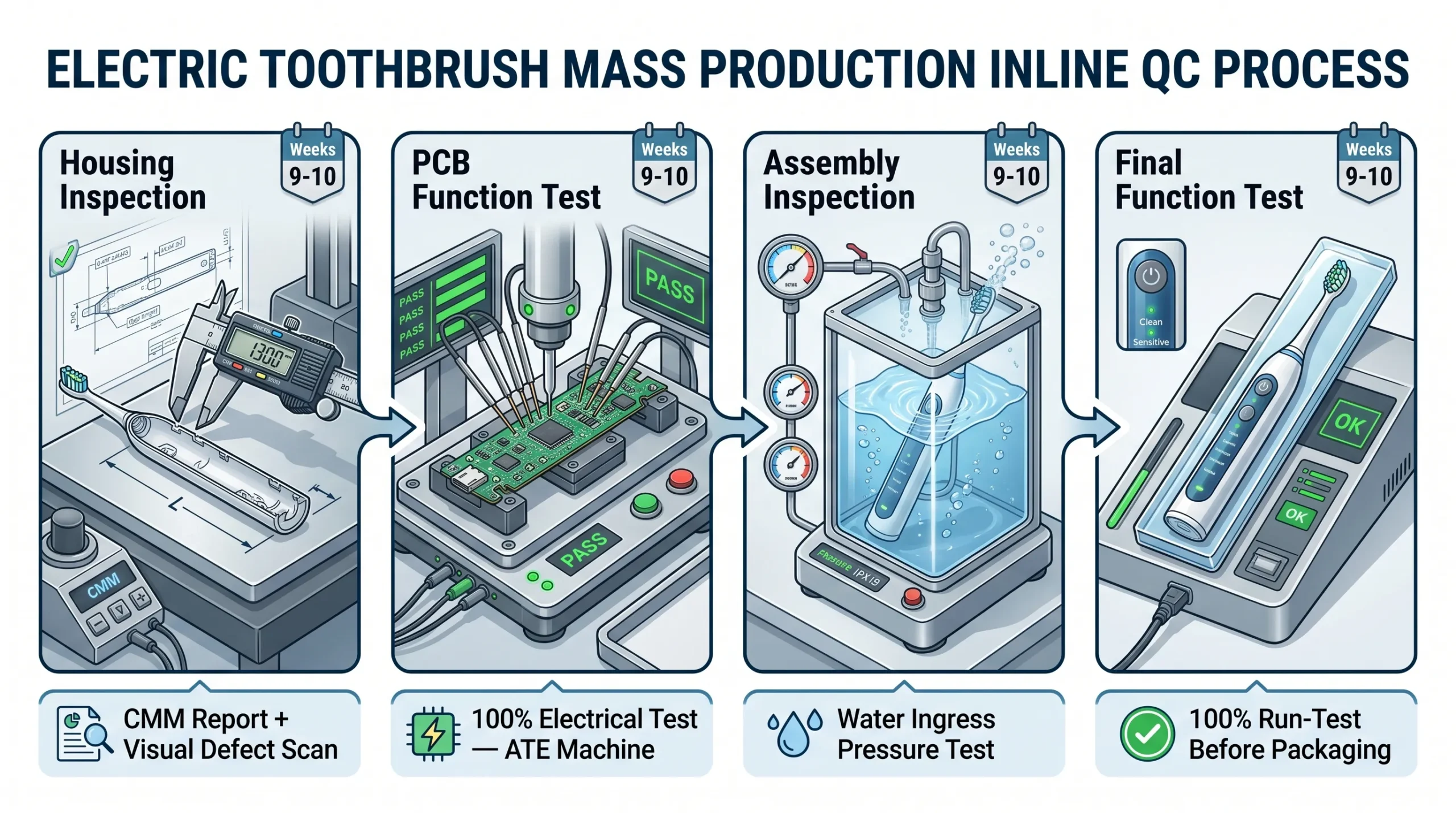
Active Production & Inline Quality Control
ProductionDocument production checkpoints, test coverage, sample plans, limits, and failure handling against the approved specification.
- Inline quality checkpoints (document the agreed plan):
- Housing: check dimensions and visible defects against the approved specification and sampling plan.
- PCB: document test coverage and limits; describe a check as 100% only if each unit receives the stated test.
- Assembly: verify alignment and seals against the specification. An air-pressure screen is not an IEC 60529 water-ingress test.
- Final function: identify the functions tested per unit and how failures are recorded and handled.
- Packaging: verify SKU, labels, accessories, and carton data against the approved specification.
- Request weekly production photos/videos: Completed units on the line, QC inspection records, and packaging line in operation
- Track production progress: For example, compare reported output with the production schedule and order quantity; investigate material variances early.
- If testing is required, confirm representative samples, scope, lab schedule, and production-change implications with the lab; timing is not guaranteed.
Mid-production red flags: act on these immediately
If the factory goes quiet without explanation, something is wrong. If they suddenly ask to substitute a component because of "stock issues," push back—get the original spec or a written explanation. If production pace falls significantly behind schedule with no clear reason, escalate. If a supplier requests payment ahead of an agreed milestone, compare the request with the contract and resolve any discrepancy in writing before payment.
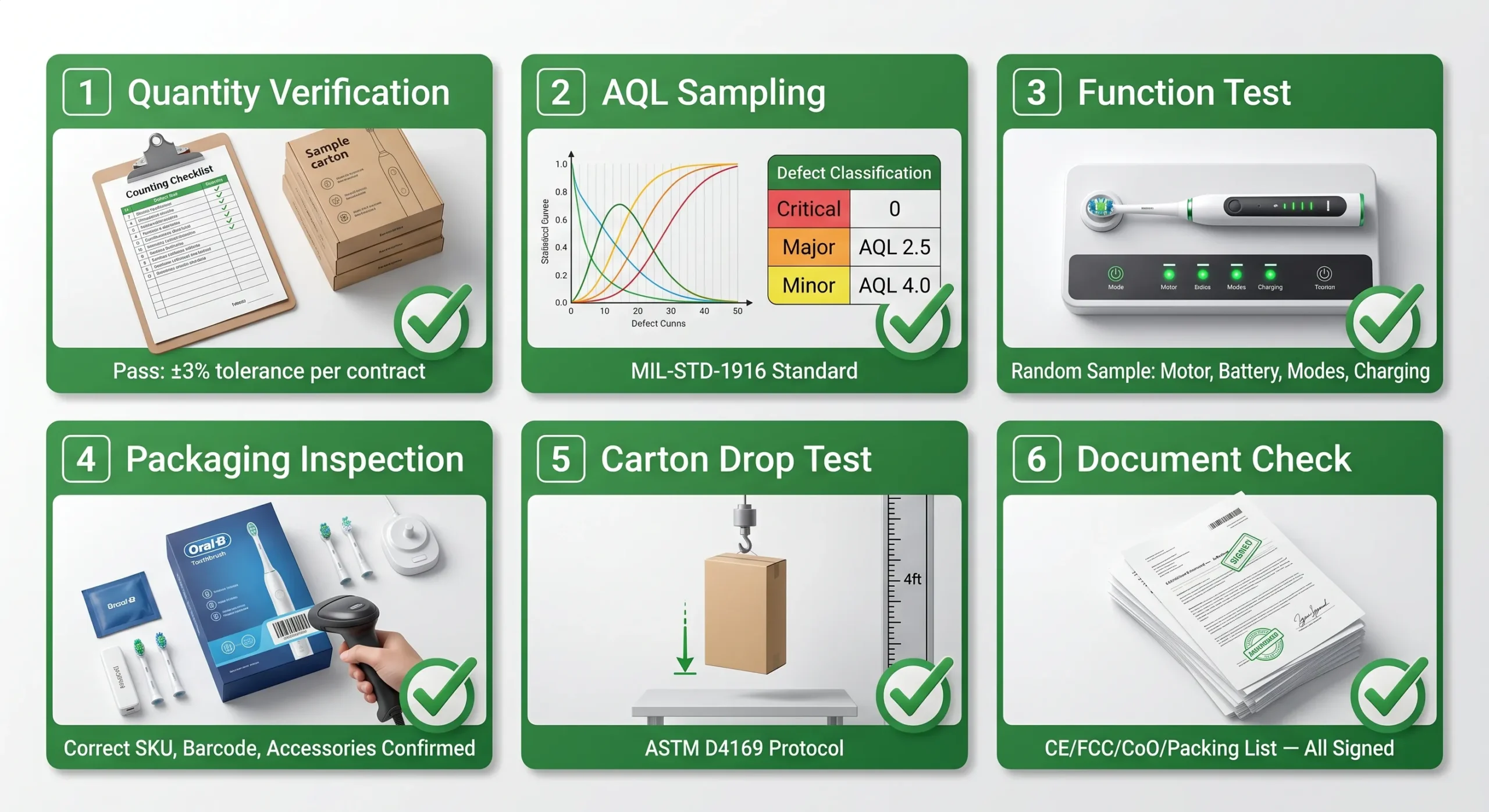
Production Completion & Pre-Shipment Inspection
QC & InspectionPre-shipment inspection can check goods against the agreed purchase order and acceptance plan. Define scope and process in advance; it does not guarantee every shipped unit.
- Pre-shipment inspection scope:
- Quantity: compare physical count with the PO and any tolerance expressly agreed in contract.
- Sampling: specify procedure, inspection level, sample size, defect classes, and acceptance/rejection numbers. AQL is a plan parameter, not measured defect rate; MIL-STD-1916 uses verification levels, not an AQL table.
- Workmanship: assess surface, color, assembly, and agreed criteria.
- Function: identify test functions, sample plan, and pass criteria.
- Packaging: verify carton markings, accessories, and barcodes against the approved specification.
- Carton drop testing: use the agreed protocol for height, orientations, surface, repetitions, and acceptance criteria.
- Choose an independent provider, buyer-appointed representative, or supplier records based on the agreed scope and evidence requirements. Fees and availability vary; confirm in writing.
- Document the nonconformity, corrective action, rework, and re-inspection criteria. Added time depends on the issue and agreed disposition.
- Prepare documents according to route, product, battery configuration, destination, and buyer requirements. Use a certificate of origin or conformity document only when applicable.
Pass criteria for pre-shipment inspection
Use the quantity, sampling plan, function checks, packaging, markings, and documents in the contract. If results miss criteria, document corrective action and verify closure before shipment.
5. Phase 4 — Shipping & Customs Clearance (Weeks 13–16)
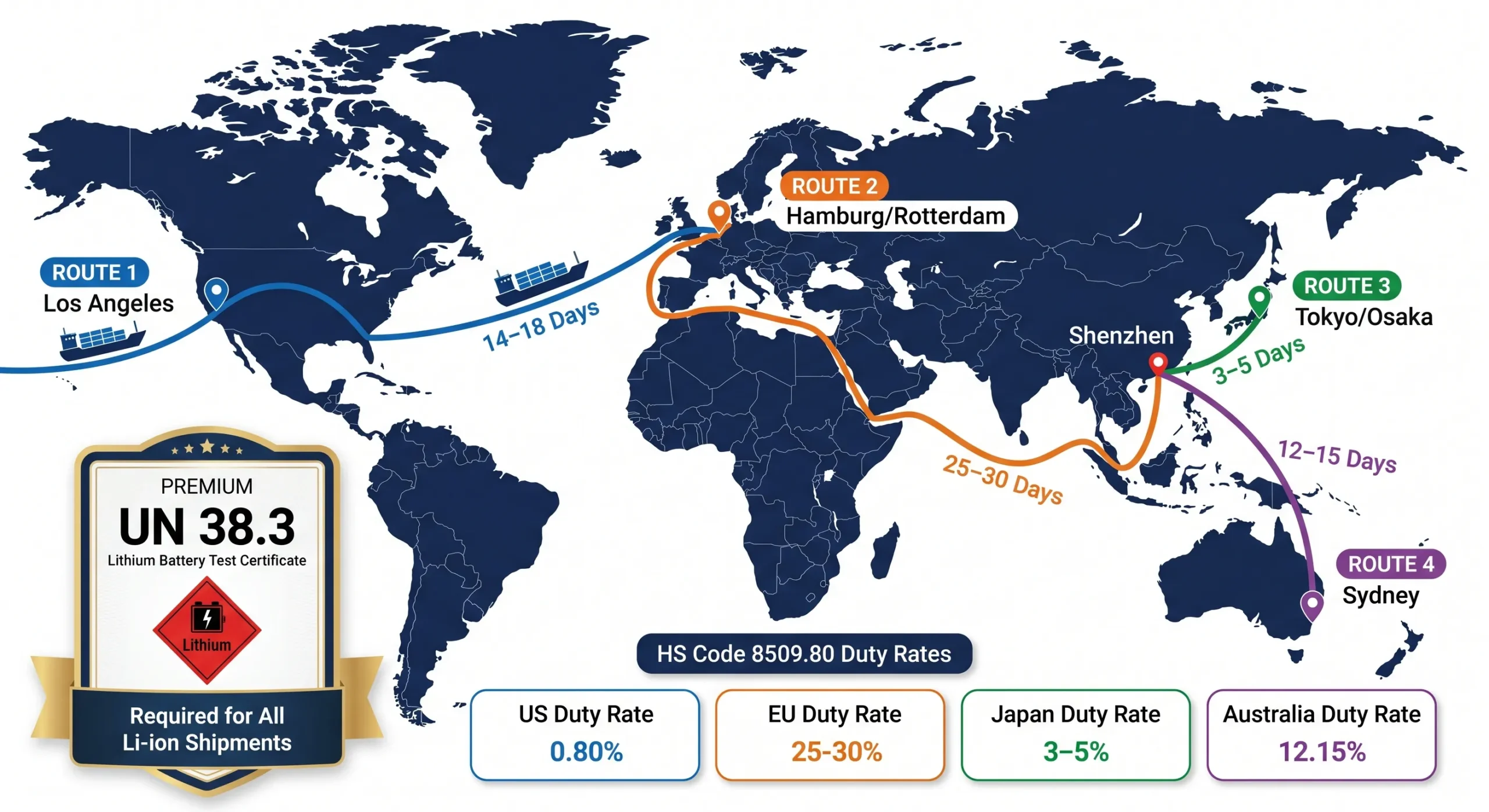
Shipping and customs timing depends on route, carrier, service, documents, battery configuration, port conditions, and clearance. Treat the week numbers as illustrative and confirm the current plan.
Cargo Pickup & Export Customs (China Side)
DepartureThe forwarder coordinates pickup and export formalities. Clearance timing depends on the shipment and its documents; confirm cutoffs and required records for the chosen service.
- Sea freight planning examples:
- Shenzhen to Los Angeles: request a current route and service estimate.
- Shenzhen to Hamburg or Rotterdam: request a current route and service estimate.
- Shenzhen to Tokyo or Osaka: request a current route and service estimate.
- Shenzhen to Sydney: request a current route and service estimate.
- Air freight may suit samples or urgent shipments. Transit and cost depend on route, service, chargeable weight, battery acceptance, and current capacity; compare current quotes.
- Classification depends on product configuration, jurisdiction, origin, and import date. Treat HS 8509.80 only as a possible heading to investigate, not a final national tariff code or duty.
- Shipment document checklist (confirm what applies):
- Commercial invoice with accurate transaction value and required shipment information.
- Packing list with package count, weights, dimensions, and contents as required.
- Bill of Lading or Air Waybill for the selected service.
- Certificate of origin only if required by destination, buyer, or applicable procedure; confirm correct form and origin rules.
- Applicable conformity documentation for the product and destination.
- FCC documentation only when applicable to the product and import.
- Battery test summary and shipping information required for the battery design and shipment mode.
Critical: Lithium Battery Shipping Compliance
For lithium-battery products, identify battery type, watt-hours, packing configuration, shipment mode, and applicable rules. Obtain the required UN 38.3 test summary and confirm declarations and labels for that shipment; air and sea rules differ.
In-Transit & Import Customs Preparation
TransitPrepare import paperwork before arrival. Confirm free time, storage or demurrage terms, and broker deadlines from current carrier and port information; charges vary.
- Share documents according to the broker’s agreed lead time. Pre-arrival review can identify gaps; no fixed number of days applies to every shipment.
- For applicable U.S. vessel shipments, determine whether ISF applies and submit required information within the regulatory timeframe before loading. ISF is not a general air-freight filing.
- For EU imports, confirm the economic operator and importer arrangements, applicable conformity documents, and customs registration requirements with the importer and broker. Keep these separate from the rules for Great Britain and Northern Ireland.
- Confirm the conformity route for Great Britain or Northern Ireland and the product. Great Britain recognizes CE alongside UKCA for many applicable products under current arrangements; Northern Ireland differs.
- Import duties to budget for:
- US: duty and additional tariffs depend on final classification, origin, product details, and import date. Check current official sources and obtain broker advice.
- EU: determine duty from the final classification, origin, and import date; do not rely on a generic percentage.
- UK: determine duty from the final commodity code, origin, and import date.
- Prepare fulfillment requirements before dispatch. For Amazon FBA, confirm current carton, labeling, prep, and shipment-plan requirements in Seller Central; these differ from standard third-party logistics.
Delivery, Receiving & Inventory Go-Live
ArrivalCargo clears customs and is delivered to your warehouse or fulfillment center. The OEM project is complete. But the work isn't over. Receiving is a quality checkpoint that many brands skip to their detriment.
- Reconcile carton count and visible condition, then inspect units under the receiving plan agreed for the order. Any percentage sample is project-specific, not universal.
- Inventory system update: Log lot numbers, production dates, and batch codes. This matters for warranty claims and potential recalls
- Amazon FBA receiving (if applicable): Reconcile delivered cartons and monitor receiving status against the shipment plan created before dispatch. Inventory availability depends on Amazon's processing.
- Photography and listing update: If you don't have product photography already, arrange an in-house or studio shoot immediately. You want listings live within days of inventory being available
- Debrief the project: Document what went well, what caused delays, and what you'd do differently. This becomes your manufacturing SOP for the next production run
Ready to Start Your OEM Electric Toothbrush Project?
Share your project brief to discuss a quotation and schedule. Scope, MOQ, tooling, testing, sample terms, and current capacity depend on the product and written agreement.
What's your target launch date? Include it in the form—we'll tell you if the timeline is realistic.
6. Existing-Platform ODM Options
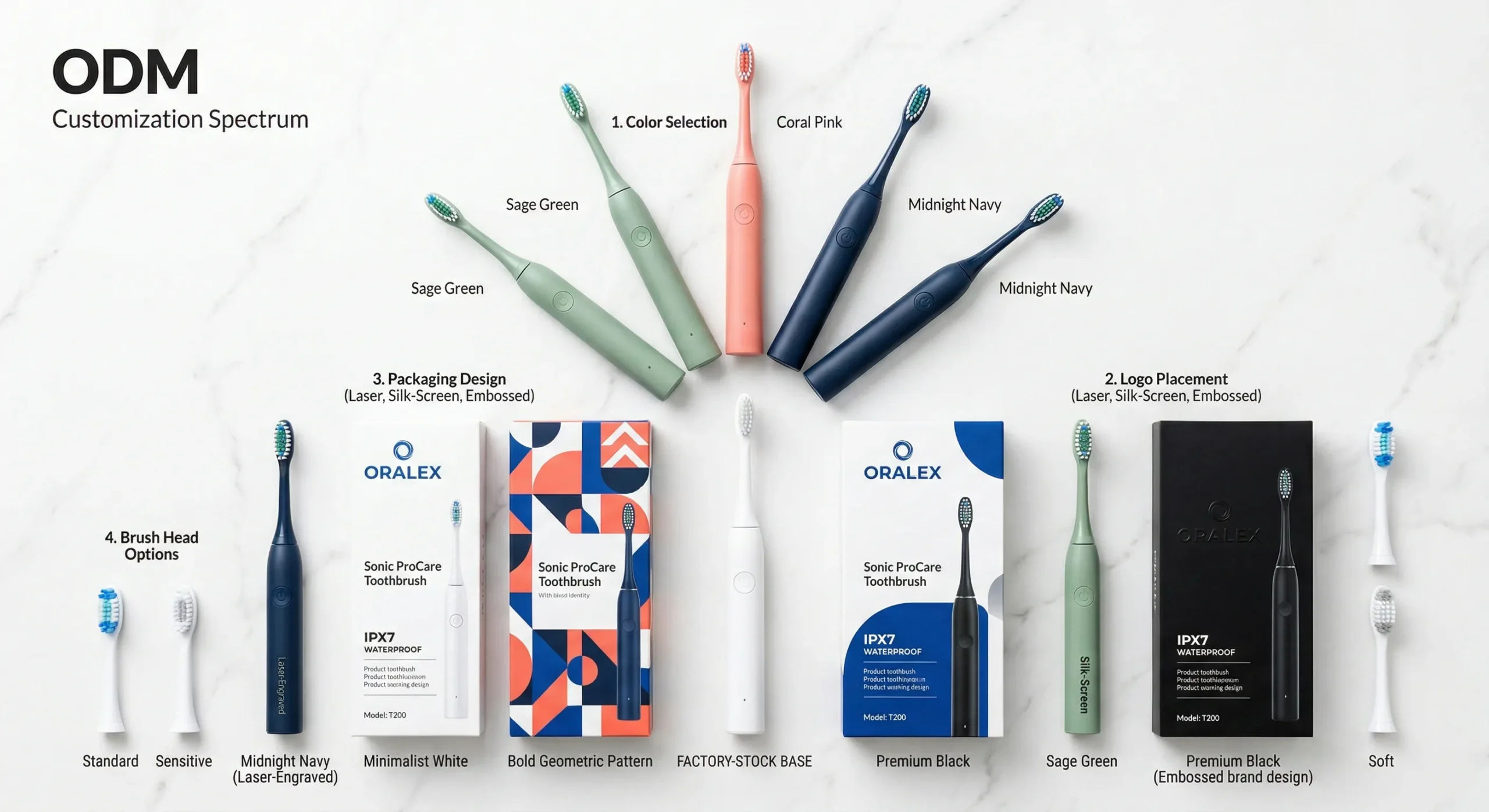
ODM may suit a project that fits an existing platform and available configuration. New tooling may still be needed for structural changes; branding, accessories, packaging, testing, and schedule depend on the agreed scope. Compare total cost, MOQ, rights, and timing with an OEM proposal.
Custom OEM: A project-specific design may involve engineering and structural tooling. Confirm timeline, tooling charges, MOQ, design scope, and intellectual-property rights in the written agreement.
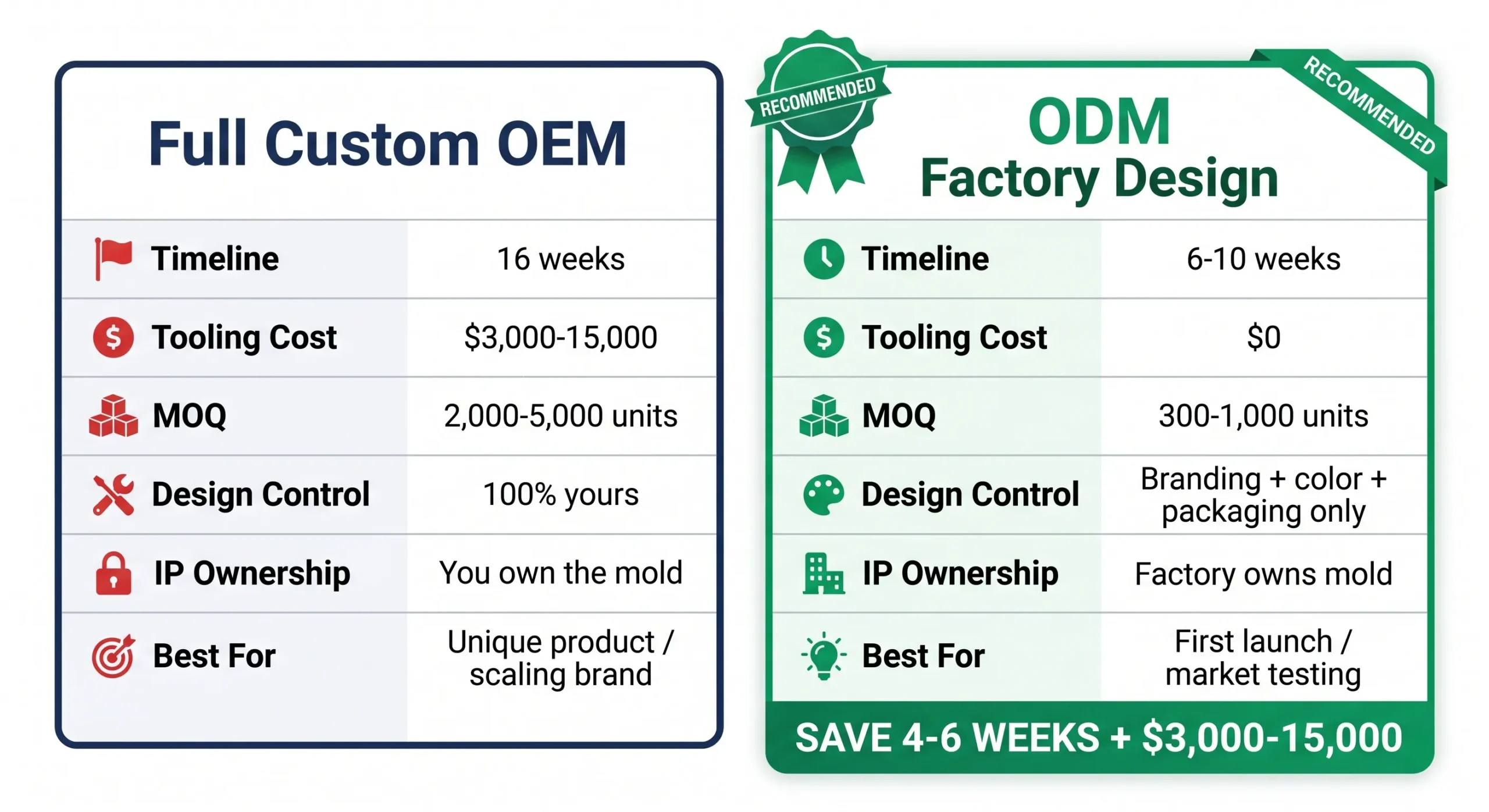
Existing-platform ODM: An existing platform may reduce some development or tooling work if it fits the brief. Confirm customization limits, setup charges, MOQ, testing, schedule, and intellectual-property rights in the written agreement.
Illustrative ODM Milestones
The sequence below shows how work may progress on an existing platform; confirm sample, production, freight, and receiving dates for the actual project.
| Week | Activity | Key Action for You |
|---|---|---|
| Week 1 | Browse existing-platform options, if available, and request project-specific samples. | Review product fit, configuration, sample terms, MOQ, and schedule. |
| Week 2 | Receive sample units; test functionality; confirm selection | Approve product model |
| Week 3 | Submit branding: logo, colors, packaging design | Provide complete brand assets |
| Week 4 | Factory prepares customized pre-production sample | Review and approve sample |
| Week 5 | Issue the purchase order and follow the written payment terms. | Issue PO |
| Weeks 6–8 | Mass production, inline QC, packaging | Monitor progress, book PSI |
| Week 9 | Review inspection results and follow the agreed payment and shipping terms. | Approve inspection, arrange freight |
| Week 10 | Customs clearance, delivery | Receive inventory, activate listings |
When ODM beats OEM
ODM may suit a project that fits an existing platform. Compare MOQ, customization, tooling or setup charges, testing, schedule, IP terms, and total cost with an OEM proposal; confirm any trial quantity in writing.
7. Where OEM Timelines Actually Break Down
The following factors can affect a project schedule; assess them against the supplier plan and current service estimates.
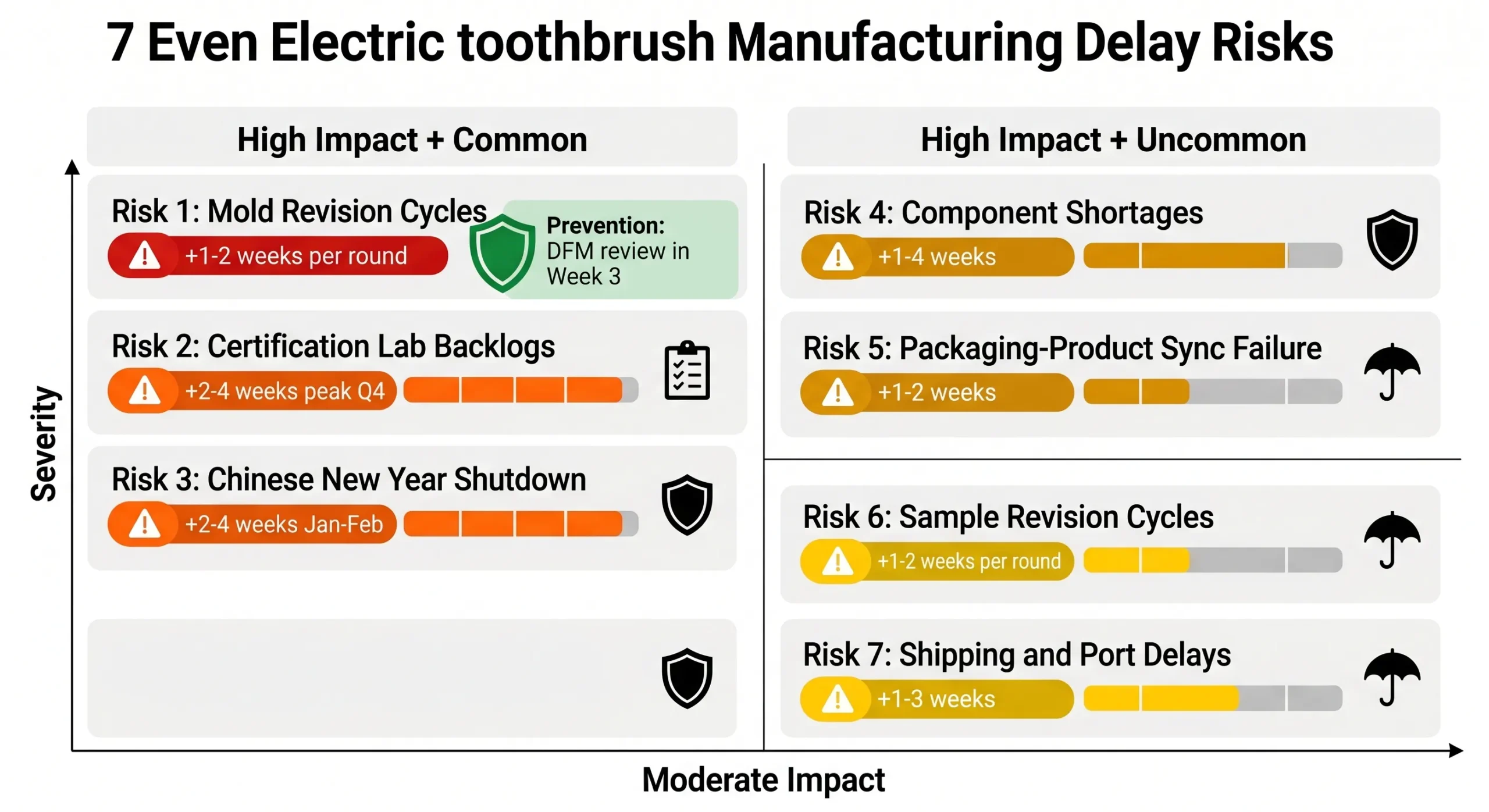
Mold revisions and design changes
Review design and tooling changes before fabrication. Record approval, cost, and schedule impact in the project plan.
Certification lab backlogs — invisible until you're stuck
Laboratory availability varies by product, test scope, market, season, and provider. Confirm current availability and whether representative samples can be evaluated.
Chinese New Year — the disruption you can see coming 12 months out
Chinese New Year dates and supplier closures vary by year and factory. Check the official calendar and obtain planned closure and restart dates from each supplier; use a project-specific buffer.
Packaging and product arriving at different times
Packaging may come from a separate supplier. Coordinate artwork, quantity, production, and delivery dates with the packaging supplier.
Sample revision loops — feedback that keeps coming
Revision rounds can extend sample approval. Consolidate feedback in one document, rank issues, and confirm the schedule impact of each approved change.
Component shortages — the supply chain problem that surfaces mid-production
Components such as PCBs and batteries can affect timing if supply is not confirmed. Ask the supplier to document availability and proposed alternatives; assess any substitution through change control. A second source may help where technically and contractually feasible.
Shipping and port delays — the last mile that adds weeks
Freight schedules vary with routing, capacity, port conditions, documents, and customs. Use current estimates and allow a project-specific buffer.
Keep milestones and decisions visible
Agree on a regular update cadence and document milestones, open issues, and decisions. Follow up on unexplained communication gaps and assess their effect on the project schedule.
8. Reverse Calendar Planning: Work Backwards from Your Launch Date
Reverse-calendar planning can clarify dependencies. Work backward from a target availability date using supplier, testing, production, freight, customs, and warehouse estimates confirmed for the project.
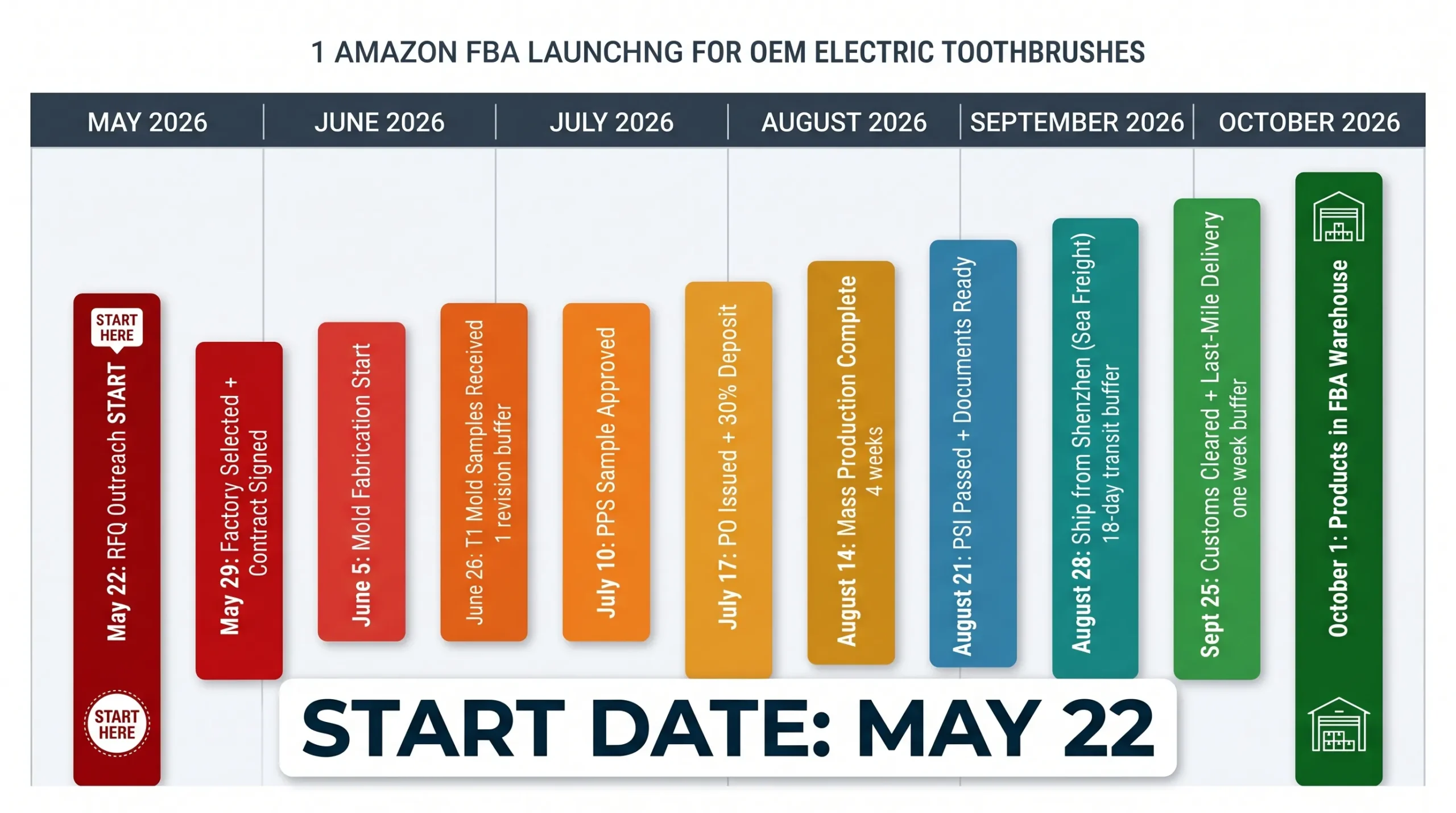
Example: Planning for an Amazon Q4 Holiday Season Launch
Illustrative target only: confirm current event eligibility, FBA appointments, receiving requirements, and the actual transit plan; this is not an official deadline.
| Milestone | Target Date | Notes |
|---|---|---|
| Products received in FBA warehouse | October 1 | Allow for current FBA appointment, receiving, and processing times; these vary and are not a fixed 1–2-week guarantee. |
| Customs clearance + last-mile delivery | September 25 | Illustrative only; confirm port, clearance, and last-mile timing for the route. |
| Ship from Shenzhen (sea freight) | August 28 | Illustrative port-to-port estimate only; confirm current route, service, and door-to-door timing with the forwarder. |
| Pre-shipment inspection passed | August 21 | Allow time for inspection and documents according to the agreed scope and route. |
| Mass production complete | August 14 | Illustrative production window; confirm current capacity and schedule. |
| Purchase Order issued / payment milestone per contract | July 17 | Start of mass production |
| Pre-production sample approved | July 10 | Allow for sample review and applicable testing; confirm scope and laboratory schedule. |
| T1 mold samples received | June 26 | Review time depends on findings, corrective work, and approval. |
| Mold fabrication start | June 5 | Illustrative tooling window; request a project-specific estimate. |
| Factory selected, contract signed | May 29 | NDA, mold design approved |
| Start RFQ outreach | May 22 | Begin factory search here |
For an October 1 Amazon FBA launch: Start your factory search by May 22
May 22 to October 1 is 132 days, about 18 weeks and 6 days in this example. This is a planning window, not a promise; update dates as milestones are confirmed.
If you missed the May window: compare a suitable existing-platform ODM option or revise the launch target. Actual timing and seasonal demand depend on the project and market.
Peak Season Timing Guide
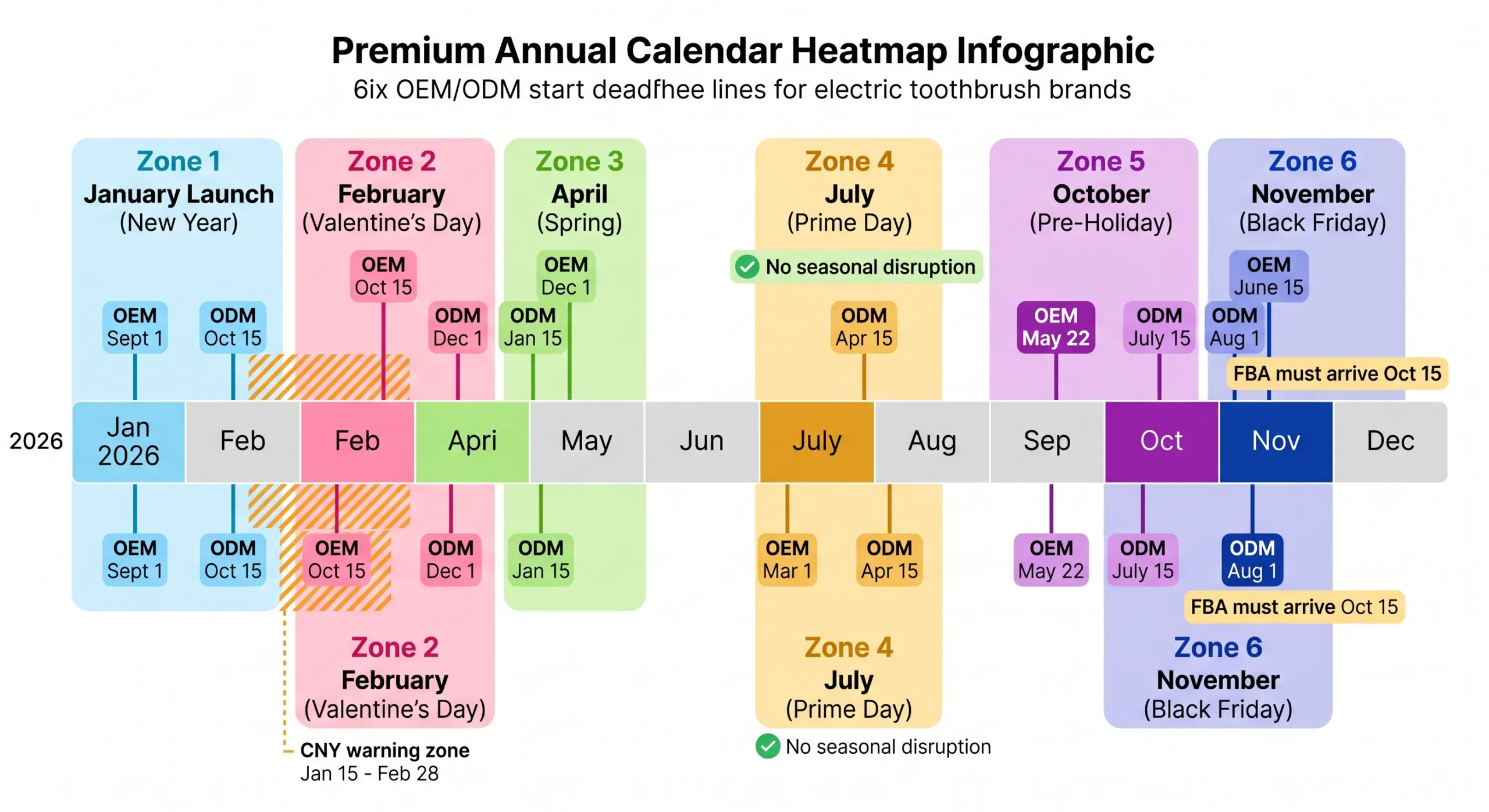
| Target Launch Window | Illustrative OEM Start Date | Illustrative ODM Start Date | Notes |
|---|---|---|---|
| January (New Year) | September 1 | October 15 | Check the official calendar and obtain supplier closure and restart dates for the relevant year. |
| February (Valentine's Day) | October 15 | December 1 | Illustrative note only; confirm the official holiday calendar and each supplier’s closure and restart dates. |
| April (Spring) | December 1 | January 15 | Confirm supplier availability and restart dates for the relevant year. |
| July (Prime Day) | March 1 | April 15 | Illustrative example only; verify current supplier and logistics availability. |
| October (Pre-Holiday) | May 22 | July 15 | Illustrative channel note; verify current market conditions. |
| November (Black Friday) | June 15 | August 1 | Confirm current event-specific eligibility and submission dates; no universal October 15 cutoff is asserted. |
📚 References
9. Frequently Asked Questions
Get a Personalized OEM Timeline for Your Project
Tell us your target launch date and product requirements. Our project team can discuss a project-specific schedule and applicable commercial terms.
Tip: Include your target launch date, destination market, and product requirements so the schedule discussion can account for project constraints.