

Sonic vs Oscillating-Rotating Zahnbürste: Leitfaden 2026
Compare sonic and oscillating-rotating toothbrushes by drive mechanism, cleaning evidence, brushing feel, cost and OEM requirements to choose the right platform for your brand.
Choosing between sonic and oscillating-rotating electric toothbrush technology shapes your product design, target price and brand positioning. This guide compares the engineering and buying considerations that matter when developing an oral care range.
With 15+ years of electric toothbrush manufacturing experience for brands sold in 120+ countries, we have helped hundreds of entrepreneurs make this choice. Here is how to compare the platforms and select the right fit for your brand.
Wichtiger Kontext: Dieser Artikel ist Teil unseres Leitfadens zur Technologie elektrischer Zahnbürsten— wenn Sie ein grundlegendes Verständnis dafür benötigen, wie elektrische Zahnbürsten funktionieren, beginnen Sie dort.
Auf einen Blick
- Schallzahnbürsten combine rapid bristle motion with fluid agitation. The 24,000–48,000 movements-per-minute range shown here is an example specification; counting conventions vary by model.
- Oszillierend-rotierende (O-R) Zahnbürsten move the head back and forth through a limited angle. Example specifications of 7,500–10,500 oscillations per minute describe alternating motion, not continuous full revolutions.
- A 2025 randomized trial favored the tested O-R brush for plaque and gingivitis outcomes. Results apply to the specific brushes and study conditions, rather than a fixed advantage for every model.
- For gum care, compare model-specific evidence, soft bristles, brushing pressure and user comfort alongside the drive technology.
- Both technologies can support premium or value ranges. Drive design, brush heads, controls, accessories and user experience shape the final positioning.
- Hybrid platforms such as Relish Tech’s Rotasonic™ offer another route to product differentiation by combining motion characteristics.
Die zwei Technologien erklärt: Wie sie tatsächlich funktionieren
Was ist eine Schallzahnbürste?
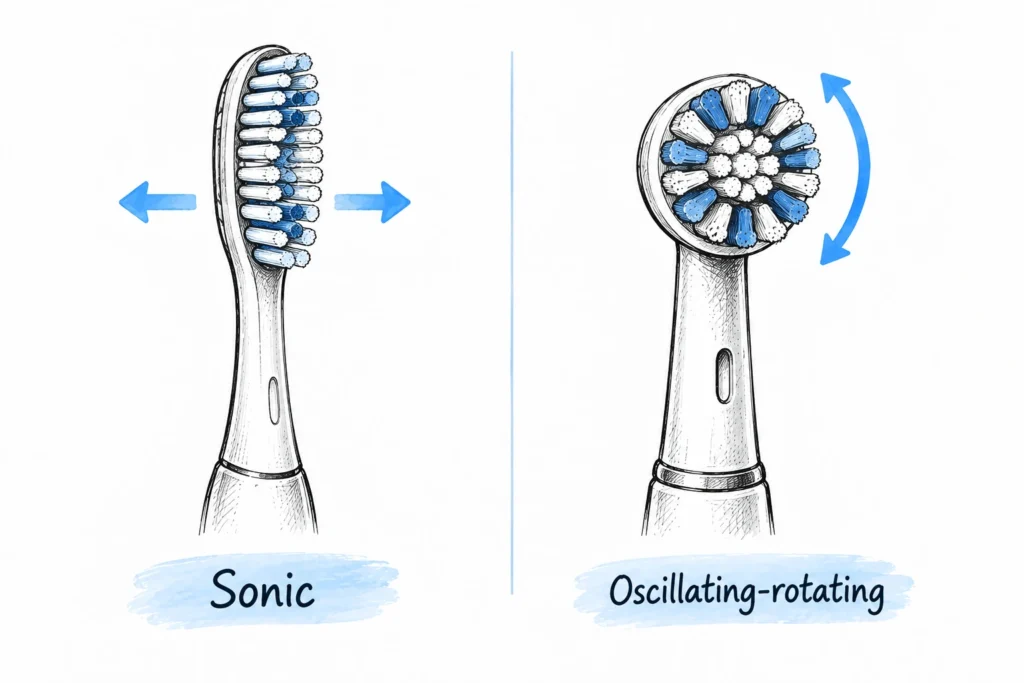
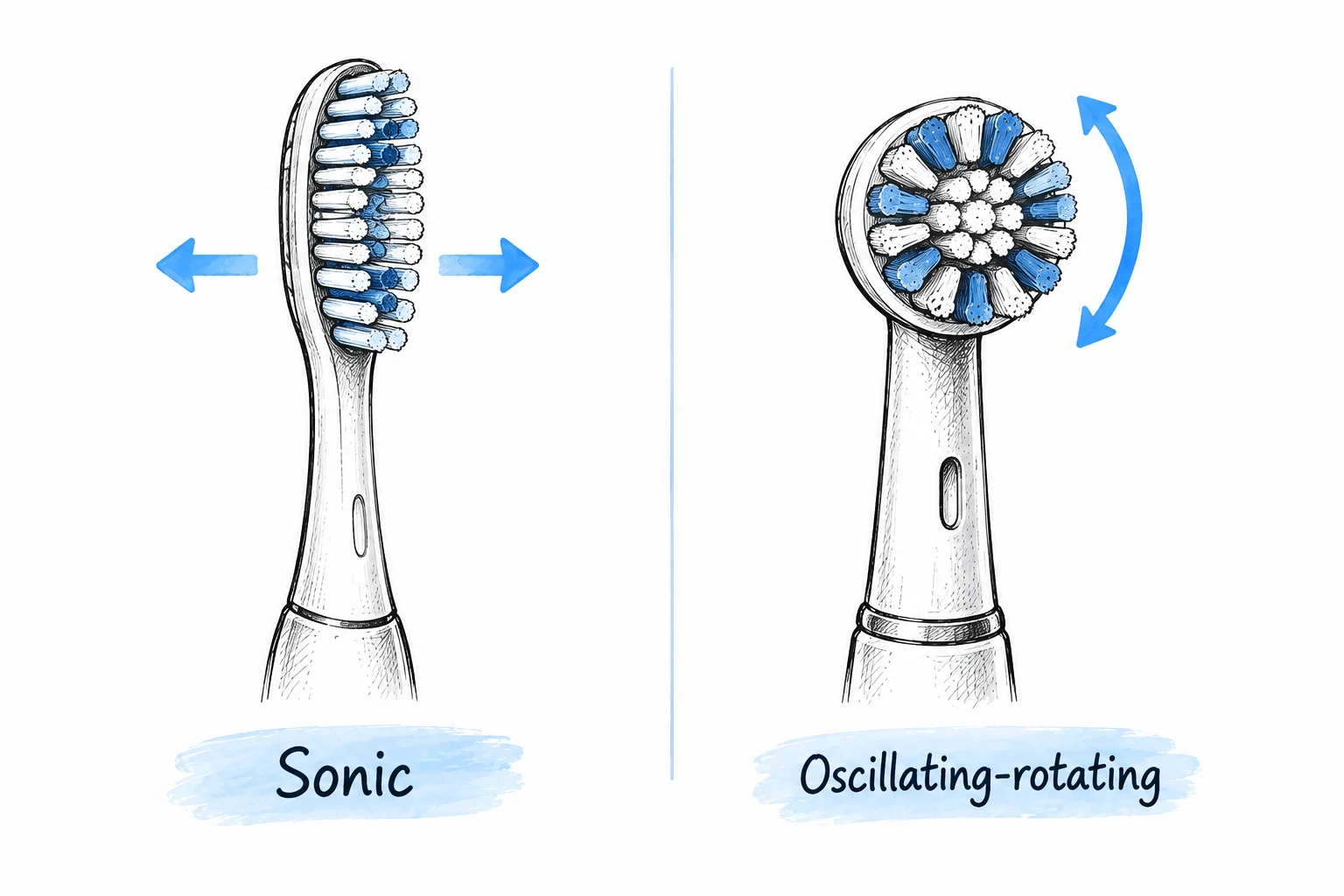
A sonic toothbrush uses an electromagnetic drive to create rapid brush-head movement. Example ratings of 24,000–48,000 movements per minute describe motion counts, not frequency in hertz; check how each manufacturer counts strokes.
Der Reinigungsmechanismus einer Schallzahnbürste funktioniert über zwei primäre Wege:
Bristle contact: Moving bristles disrupt plaque where they contact tooth surfaces. Head design, brushing pressure and technique all affect performance.
Fluid agitation: Rapid bristle movement also moves the toothpaste-and-saliva mixture around the head. This complements contact cleaning; it does not replace brushing all tooth surfaces or cleaning between teeth.
Die Physik: Hertz measures complete cycles per second. For example, 24,000–48,000 movements per minute equals 400–800 counted movements per second, but the frequency in hertz depends on whether each count means a full cycle or a one-way stroke. Sonic brushing should not be described as 20,000+ Hz ultrasound.
Was ist eine oszillierend-rotierende Zahnbürste?
An oscillating-rotating toothbrush moves the brush head back and forth through a limited angular range. The example specifications below show 45–90 Grad pro Seite and 7,500–10,500 oscillations per minute; the actual angle and counting method depend on the mechanism.
Oral-B is a well-established O-R brand with a substantial clinical research base. Assess individual study designs and tested products when using that evidence in a technology comparison.
Der Reinigungsmechanismus: Alternating head movement brings the bristles into contact with tooth surfaces. Some designs, including the Oral-B iO range, combine this movement with micro-vibrations. Guide the head over every surface using the model’s recommended technique.
Innenleben der Sonic-Technologie: Technik trifft Mundpflege
Wie die Vibrosonic™-Technologie funktioniert
Bei Relish Tech stellt unsere Vibrosonic™ -Plattform unseren technischen Ansatz für leistungsstarkes Sonic-Bürsten dar. Basierend auf jahrelanger Forschung und Entwicklung, konzentriert sich die Technologie auf einen präzisionsgefertigten Magnetlevitationsmotor, der konstante, kontrollierte Vibrationen ohne den mit herkömmlichen Bürstenmotoren verbundenen Verschleiß liefert.
Example Vibrosonic™ specifications: Actual values depend on the selected model and test conditions.
| Parameter | Vorgabe |
|---|---|
| Rated brush movements per minute | 000–40.000 vpm |
| Brush-head movement amplitude | 1,5–2,5 mm |
| Motortyp | Magnetlevitation (bürstenlos) |
| Example motor efficiency | >85% |
| Example measured noise level | 55–65 dB |
A brushless electromagnetic drive avoids carbon-brush commutation wear, offering these design advantages:
- Motor durability: Eliminating carbon-brush wear can support motor life. Replaceable brush heads still wear with use.
- Reliability: Drive design and assembly quality help reduce failure risk and support a consistent brushing experience.
- Präzise Steuerung: Digitale Schaltungen können Vibrationsmuster für verschiedene Modi modulieren
Was das für Ihre Marke bedeutet
Sonic-Zahnbürsten bieten mehrere Positionierungsvorteile:
Premium positioning: A well-controlled drive, comfortable brushing feel and useful features can support a premium offer. Explain the motion specification clearly rather than relying on a large number alone.
Comfort: Soft bristles, a suitable intensity setting and pressure feedback can help users brush gently. Comfort depends on the whole design, not the word “sonic” alone.
Neuheitsfaktor: Das summende Geräusch und das sanfte Kribbeln sind einprägsam – Verbraucher sprechen über ihre Sonic-Zahnbürsten, was organische Mundpropaganda fördert.
Slim head options: Some sonic head designs offer an elongated, slim profile that can suit your product’s appearance and handling.
Zu berücksichtigende Einschränkungen
Sonic-Technologie ist nicht ohne Nachteile:
User technique: Users need to guide the head along all tooth surfaces with gentle pressure, following the model’s instructions. Avoid prescribing one fixed dwell time per tooth for every sonic design.
Kosten: A precision electromagnetic drive can cost more than a basic motor-and-gear assembly, but the complete product specification determines the price.
Innenleben der Oszillations-Rotations-Technologie: Die Technik
Die Mechanik
Many O-R designs use a motor and transmission to move a small, round head back and forth. Other drive architectures are also available. The head shape supports tooth-by-tooth guidance rather than matching every tooth’s shape exactly.
Illustrative O-R design parameters: Confirm the selected model’s motion definitions, operating load and electrical test conditions.
| Parameter | Vorgabe |
|---|---|
| Oszillationsbogen | 45–90 Grad pro Seite |
| Oszillationen pro Minute | 7,500–10,500 |
| Internal motor speed, where applicable | Example: 2,800–4,000 rpm; not brush-head oscillation count |
| Stromverbrauch | 3–8 W |
A small O-R head can make tooth-by-tooth guidance intuitive. Users still need to cover every surface, allow enough brushing time and avoid excessive pressure.
Der klinische Vorteil
O-R toothbrushes have an extensive clinical literature. The useful question for an OEM buyer is which results apply to the chosen model, brush head, mode and intended product claims.
Wichtige Erkenntnisse aus der klinischen Literatur:
- A four-week randomized trial compared Oral-B iO2 with usmile Marble-Art and favored the tested O-R model for plaque and gingivitis outcomes.
- Study duration, plaque indices, brush heads and brushing instructions affect comparisons; short- and long-term results should be assessed separately.
- Die Die offizielle Liste der ADA für akzeptierte elektrische Zahnbürsten umfasst mehrere O-R-Modelle
Für certification and compliance planning, distinguish ADA product acceptance, FDA requirements and ISO quality-management certification. Our Forschungs- und Entwicklungsteam has experience with both technologies.
Für Ihre Marke: Use clinical research to guide development and claim planning. Evidence for another manufacturer’s brush does not automatically substantiate the same claim for your own product.
Strategische Implikation
Clinical evidence: Review the tested model, outcomes, study design and funding when assessing the research base.
Clear user guidance: A small round head supports a straightforward tooth-by-tooth brushing routine.
Fertigungseffizienz: Established O-R supply chains can support competitive component sourcing. Plan the relevant FDA, CE and other compliance requirements around the actual product and target market.
Markenerbe: Wenn Sie sich als "bewährt" oder "vertrauenswürdig" positionieren, trägt die O-R-Technologie diese implizite Botschaft.
Zu berücksichtigende Einschränkungen
Brushing feel: The movement and sound differ from sonic designs. Test whether the chosen head and intensity settings suit your audience.
Marken, mit denen Sie konkurrieren: Oral-B dominiert die Wahrnehmung von O-R. Sie benötigen erhebliche Marketingausgaben, um eine Differenzierung zu etablieren.
Bürstenkopfgröße: Das runde Kopfdesign kann sich für Benutzer, die schlanke Profile bevorzugen, unangenehm anfühlen.
Cleaning Evidence: How Should You Compare the Technologies?
Plaque-Entfernungsvergleich
Kommen wir zur eigentlichen Frage: Welche Technologie entfernt mehr Plaque? Die Antwort erfordert Nuancen.
Some direct trials favor particular O-R models for plaque removal:
- Die 2025 four-week trial found better plaque outcomes with the tested O-R model after a single brushing and at follow-up. This is a comparison of specific products, not a universal percentage difference.
- The result depends on the complete brush system: drive, head, bristles, settings and how it is used.
For repeated use, assess sustained performance and everyday brushing habits:
- Both technologies can support effective plaque removal when used correctly.
- User comfort and ease of covering every tooth surface affect whether a routine is maintained.
- Do not assume that learning a single brushing technique makes every sonic and O-R model clinically equivalent.
Für Ihre Marke: Compare suitable samples using consistent instructions, and choose the model whose handling, comfort and evidence fit your intended users.
Gum Care: Compare the Brush System and the Evidence
What direct comparisons can tell you:
- Some model-specific trials favor O-R brushes for gingivitis outcomes. Use the reported measure and study conditions when interpreting those findings.
- Plaque disruption matters for gum care with either technology. Bristle softness, applied pressure and coverage also affect the brushing experience.
What to assess in a sonic design:
- Look for effective plaque removal alongside a comfortable head, suitable intensity settings and clear instructions.
- A gentle mode can help users find a comfortable setting; evaluate the actual sample rather than assuming all sonic brushes feel the same.
- For sensitive gums, compare soft heads, pressure feedback and brushing feel across both technologies.
Für Ihre Produktlinie: A gum-care range needs comfortable heads, suitable controls and evidence for the final product’s claims. Age or drive type alone does not establish a clinical advantage.
Was echte Nutzer tatsächlich bevorzugen
Use sample testing to explore the following aspects of brushing feel:
Sonic designs:
- How users respond to the initial vibrating or tickling sensation
- Whether the controls and brushing modes feel useful
- Perceived noise and vibration at the chosen settings
O-R designs:
- Comfort with alternating head movement
- Ease of guiding a small round head from tooth to tooth
- Perceived mechanical sound and handling
Die Erkenntnis für Ihre Produktstrategie: Das Nutzererlebnis übertrifft bei Verbraucherpräferenzen oft klinische Daten. Überlegen Sie, wer Ihr Zielkunde ist und was ihn dazu bewegen würde, Ihre Marke weiterzuempfehlen.
Match the Technology to Your Brand Strategy
Wann Sie sich für Schalltechnologie entscheiden sollten
Schallzahnbürstentechnologie ist strategisch sinnvoll, wenn:
Premium technology positioning: Sonic designs can suit a target retail range such as USD 80–150+, when the complete product offers the performance, finish and features your customers value.
Comfort-focused products: Combine a soft head, controlled intensity and clear pressure guidance for users who prefer a gentle brushing feel.
Sie wünschen sich ästhetische Differenzierung: Schallbürstenköpfe können deutlich schlanker sein und ermöglichen einzigartige Produktdesigns, die im Regal hervorstechen.
Regional launch planning: Check current retail assortments, consumer expectations and distributor feedback in each target market rather than assuming a region-wide technology preference.
Fallstudie: Europäischer Startup-Erfolg mit Vibrosonic™
Ein europäisches Startup, mit dem wir zusammenarbeiteten, brachte eine auf Vibrosonic™ basierende Marke auf den Markt, die auf Millennials abzielte, die "smarte Badezimmerästhetik" suchten. Sie positionierten die Technologie als "deutsche Ingenieurspräzision" und erreichten 340% ihres Erstjahres-Umsatzziels durch Differenzierung sowohl bei Leistungsversprechen als auch bei der visuellen Gestaltung.
Wann Sie sich für oszillierend-rotierende Technologie entscheiden sollten
O-R-Technologie ist strategisch sinnvoll, wenn:
Value-focused ranges: An established O-R design may suit an example retail target of USD 30–80, depending on the complete specification and sales channel.
Dental association acceptance: Plan the evidence required for your own product. A technology’s research history does not grant endorsement or regulatory approval.
Sie konkurrieren mit Oral-B (oder möchten ihnen ausweichen): Um sich von der Dominanz von Oral-B abzuheben, ist entweder eine vollständige technologische Differenzierung oder die Erschließung unterversorgter O-R-Nischen erforderlich.
Simple handling: A small round head can support an easy-to-explain brushing routine. Test comfort with the intended age group; for children’s toothbrush OEM projects, also assess head size, age suitability and caregiver guidance.
Der dritte Weg: Hybride Innovation
Was, wenn Sie sich nicht entscheiden müssten? Hybridtechnologien Kombinieren Sie mehrere Reinigungsmechanismen in einem einzigen Bürstenkopf, und die Plattform von Relish Tech Rotasonic™ veranschaulicht diesen Ansatz.
Die Rotasonic™-Technologie kombiniert:
- Sonic motion, with a 32,000-movements-per-minute example profile, alongside the selected head movement
- Präzise oszillierende Rotation zur mechanischen Plaqueentfernung
- Additional drive features according to the selected platform; a sonic movement count alone does not establish ultrasonic output or an antimicrobial effect.
Integrating motion characteristics requires the drive, head and control system to work together. Rotasonic™ offers a platform for:
- Combining bristle movement patterns in one brushing system
- Tuning brushing feel through controlled vibration
- Eine echte Differenzierungsgeschichte für eine Premium-Positionierung
Für Ihre Marke: A hybrid platform can support a distinctive product concept. Build the positioning around the selected model’s features and validated performance.
Fertigungsaspekte für OEM-Käufer
Kostenauswirkungen nach Technologie
Use the following ranges as early planning examples, with the final cost determined by the specification, quantity and packaging. For a component-level breakdown, see our Leitfaden zu Herstellungskosten von Elektrozahnbürsten.
Schallzahnbürsten:
- Precision electromagnetic drives can add cost; compare current supplier quotes rather than applying a fixed motor-price multiplier.
- Das Bürstenkopfdesign erfordert Präzisionstechnik für konsistente Vibration
- Die PCB-Komplexität steigt mit Vibrationsmodi und intelligenten Funktionen
- Kostenbereich ab Werk: $8–25 pro kompletter Einheit (abhängig von den Funktionen)
Oszillierend-rotierende Zahnbürsten:
- Ausgereifte Motortechnologie mit wettbewerbsfähigen Komponentenpreisen
- Die mechanische Montage ist gut verstanden und bietet hohes Automatisierungspotenzial
- Brush-head material use depends on geometry, tufting and the replacement-head mechanism.
- Kostenbereich ab Werk: $5–20 pro kompletter Einheit (abhängig von den Funktionen)
Hybridtechnologien (wie Rotasonic™):
- Höhere Komponentenkosten spiegeln die Komplexität des dualen Mechanismus wider
- Die Investition in die Technik zahlt sich durch die Fähigkeit zur Premium-Positionierung aus
- Die Kosten variieren erheblich basierend auf der Integration spezifischer Funktionen
Mindestbestellmengen und Produktionsplanung
| Technologie | Custom-order MOQ | Produktionsvorlaufzeit |
|---|---|---|
| Sonic | 1,000 units; flexible by order | Example: 45–60 days after specification approval |
| Oszillierend-Rotierend | 1,000 units; flexible by order | Example: 35–50 days after specification approval |
| Hybrid (Rotasonic™) | 1,000 units; flexible by order | Example: 60–90 days; allow extra for new development |
Custom orders normally start at 1.000 Stück, with flexibility according to the order; wholesale orders for in-stock products start at 50 units. Timing depends on the model, customization, tooling, approvals and order size. Entdecken Sie unsere Kollektion elektrischer Zahnbürsten or review our OEM-Fertigungszeitpläne to plan your project.
Entscheidende Qualitätskriterien
Review the manufacturer’s quality system, relevant product tests and certification and compliance support:
- Defect rate:
We maintain <0.3% defect rate across all product lines - Consistency:
Agree the permitted variation and test conditions for the selected model; a ±5% frequency target is an example specification, not a universal lifetime guarantee. - Battery performance:
Real-world cycle testing (not just spec sheet compliance) - Motor durability: Define the load, duty cycle and acceptance criteria for life testing. A 500-hour loaded test is an example target that must be matched to the project.
Your Technology Decision Checklist: 5 Questions to Ask
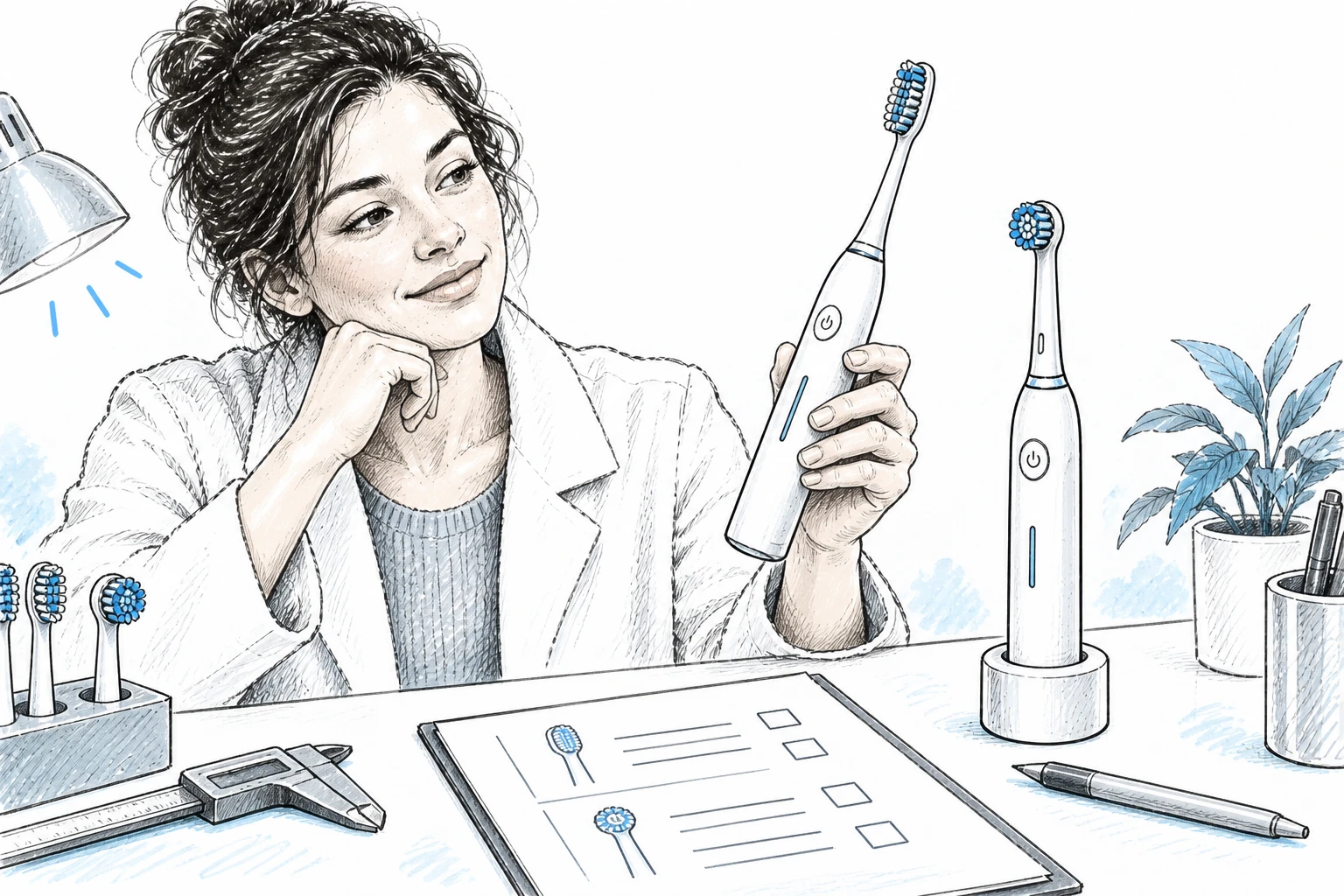
Use this framework to guide your decision:
- Define your primary value proposition
Plaque-removal positioning → Compare model-specific clinical evidence
Gentle brushing feel → Compare soft heads, intensity control and pressure feedback
Distinctive motion platform → Consider hybrid designs such as Rotasonic™
- Identify your target customer
Technology-focused customers → Assess sonic or hybrid designs
Value-focused families → Compare complete product cost and usability
Premium-seeking professionals → Sonic or hybrid
Gum-care customers → Compare comfort, pressure control and product evidence
- Set your price point
Example: USD 100+ premium positioning → Assess the complete sonic, O-R or hybrid offer
Example: USD 50–100 mid-market positioning → Compare models from both platforms
Example: under USD 50 → Prioritize the full product cost and required features
- Assess your marketing resources
Clinical claims → Build an evidence plan for the selected product
Innovation narrative possible → Sonic or hybrid
Limited differentiation options → Choose the path with less competition
- Evaluate production scale
Starting small → Discuss flexible custom quantities; in-stock wholesale products start at 50 units
Scaling rapidly → Both viable; ensure your manufacturer can scale
Complex hybrid features → Allow development and validation time beyond routine production
Beyond Technology: Other Factors
Technology choice is important, but remember:
- Bürstenkopf-Kompatibilität: Will replacement heads be available at reasonable prices?
- Batterielaufzeit: Set a target using a stated mode and brushing schedule. Four weeks per charge can be a product goal, but is not a fixed expectation or capability of every model.
- Smart-Funktionen: App connectivity, pressure sensors, and brushing timers add value
- Warranty support:
Longer warranties signal quality confidence
Choose the Platform That Fits Your Product
Here's what 15 years of manufacturing has taught us: the "best" technology depends entirely on your brand strategy.
Eine Schall- vs. oszillierend-rotierende elektrische Zahnbürste ist keine binäre Richtig-oder-Falsch-Frage. Es ist eine strategische Entscheidung, die aus dem Verständnis Ihres Zielmarktes, Ihrer Positionierung und Ihrer Fertigungskapazitäten resultieren sollte.
Schalltechnische Technologie offers a range of slim-head designs, controlled vibration profiles and feature options.
Oszillierend-rotierende Technologie offers tooth-by-tooth guidance, established mechanisms and a substantial clinical research base.
Hybrid-Technologie (wie Rotasonic™) ermöglicht echte Differenzierung für Marken, die den Markt aufmischen wollen.
Whatever the mechanism, brush-head quality, drive control, reliability and user instructions determine whether the finished product delivers a consistent brushing experience.
Bereit für den nächsten Schritt?
Wenn Sie die Technologie von elektrischen Zahnbürsten für Ihre Marke evaluieren, helfen wir Ihnen gerne, die passende Lösung zu finden. Unser Ingenieursteam verfügt über Erfahrung mit allen gängigen Technologieplattformen. Laden Sie zuerst unseren Produktkatalog für Spezifikationen.
Häufig gestellte Fragen
Welche Technologie reinigt besser, Schall oder oszillierend-rotierend?
Both technologies can clean effectively. Some direct trials favor particular O-R models for plaque and gingivitis outcomes; this does not establish one fixed percentage advantage for every brush. For an OEM project, compare evidence for the selected model and head.
Ist Schall oder oszillierend-rotierend besser für empfindliches Zahnfleisch?
Either technology can offer a comfortable brushing experience with a soft head, gentle pressure and suitable settings. Compare the actual head, pressure feedback and brushing feel rather than treating the drive type as a guarantee of gentleness.
Was ist der Hauptvorteil von Hybridtechnologien wie Rotasonic™?
Hybrid designs combine motion characteristics to create a distinctive brushing system. Relish Tech’s Rotasonic™ platform supports this approach. The selected model’s specifications and tests should establish its performance; a sonic motion count alone does not demonstrate ultrasonic or antimicrobial effects.
Welche Technologie ist besser für die OEM-Herstellungskosten?
Compare complete specifications and current quotations. A basic O-R mechanism may offer competitive component costs, while a precision sonic drive or added smart features can increase cost. Either technology can support different price tiers.
Welche Märkte bevorzugen welche Technologie?
Preferences vary by country, channel, brand familiarity and price segment. Check current local assortments and user feedback before choosing a technology for a regional launch.
Was ist die typische MOQ für die OEM-Produktion von elektrischen Zahnbürsten?
Custom electric toothbrush orders normally start at 1,000 units, with flexibility according to the actual order. Wholesale orders for in-stock products start at 50 units. Production timing depends on the model, customization, tooling, approvals and quantity; new development needs additional time.
Kann eine einzelne Marke sowohl Schall- als auch oszillierend-rotierende Zahnbürsten anbieten?
Yes. Offering both can help a brand serve different preferences and price segments. Plan replacement-head availability, spare parts, testing and after-sales support for each platform with a manufacturing partner experienced in both.
Quellen
- Adam, R., Grender, J., Timm, H., Qaqish, J., & Goyal, C. R. (2025). A randomized controlled trial evaluating a novel oscillating-rotating electric toothbrush versus a sonic toothbrush for plaque and gingivitis. American Journal of Dentistry, 38(1), 3–8. PubMed study record
- Arockiam, A. S. et al. (2025). Should clinicians recommend oscillating-rotating toothbrushes over sonic models for superior plaque and gingivitis control? Evidence-Based Dentistry, 26, 99–100. Commentary on the four-week trial. Published commentary
- American Dental Association. Zahnbürsten: brushing guidance and the Seal of Acceptance. ADA toothbrush guidance
- U.S. Food and Drug Administration. Powered toothbrush product classification: JEQ, Class I, 21 CFR 872.6865; 510(k)-exempt subject to applicable limitations. FDA classification record
- American Dental Association. Oral-B Oscillating-Rotating-Pulsating: product-specific Seal of Acceptance listing. ADA product listing
- International Organization for Standardization. ISO 13485:2016 — Medical devices — Quality management systems — Requirements for regulatory purposes. ISO standard overview
- American Dental Association. ADA Seal of Acceptance category requirements overview. ADA Seal requirements