

Private Label Electric Toothbrush: Complete Branding Guide (2026)
Plan your private label electric toothbrush launch around the product, brand and sales channel. The illustrative budget in this guide totals USD 8,600–36,600. Relish custom orders start at 1,000 units, with flexibility for individual projects; stocked products are available wholesale from 50 units. An existing ODM platform can shorten development, while final timing and profitability depend on the model, compliance work, order size and selling costs.
Executive Summary: Private Label Electric Toothbrush Launch
- Startup investment: The example budget totals USD 8,600–36,600 for samples, initial production, packaging, brand identity, photography, a website, launch marketing, compliance work and freight. Existing platform documentation can reduce duplicated work when it covers your exact product configuration.
- Margins by channel: Calculate product gross margin separately from platform, fulfillment, advertising and return costs. Replacement brush heads can support repeat purchases, but subscription profitability depends on customer retention and the cost of serving each order.
- Example launch sequence: Start with one channel, such as Amazon FBA, and prepare Brand Registry and A+ Content if eligible. Add a direct-to-consumer website and an optional replacement-head subscription as demand develops, then approach retail buyers with sales and customer-feedback data.
- Launch priorities: (1) Check trademark availability in your target markets before committing to branding. (2) Develop packaging that communicates product quality and the customer benefit clearly. (3) Plan replacement-head availability and after-sales support from the start.
Table of Contents
- What Is Private Label in Oral Care?
- Brand Positioning: 5 Practical Approaches
- Core Brand Identity Elements
- Packaging Design: Make the First Impression Count
- Startup Cost Breakdown
- MOQ, Unit Cost & Pricing Strategy
- Margins and Costs by Sales Channel
- Go-to-Market Strategy
- Multi-Market Localization
- Launch Timeline: From Brief to Shelves
- Pre-Launch Checklist
- FAQ
1. What Is Private Label in Oral Care?
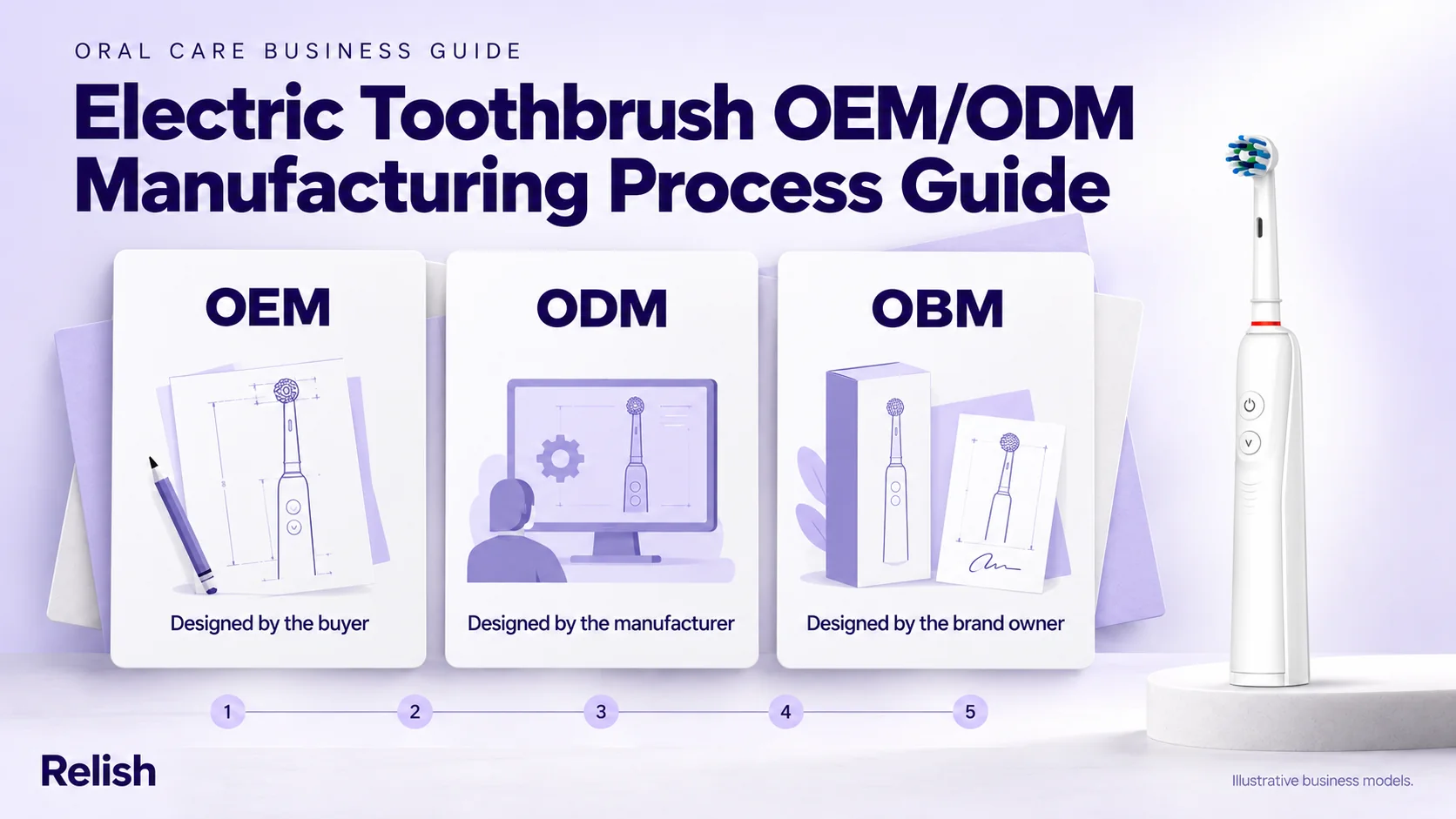
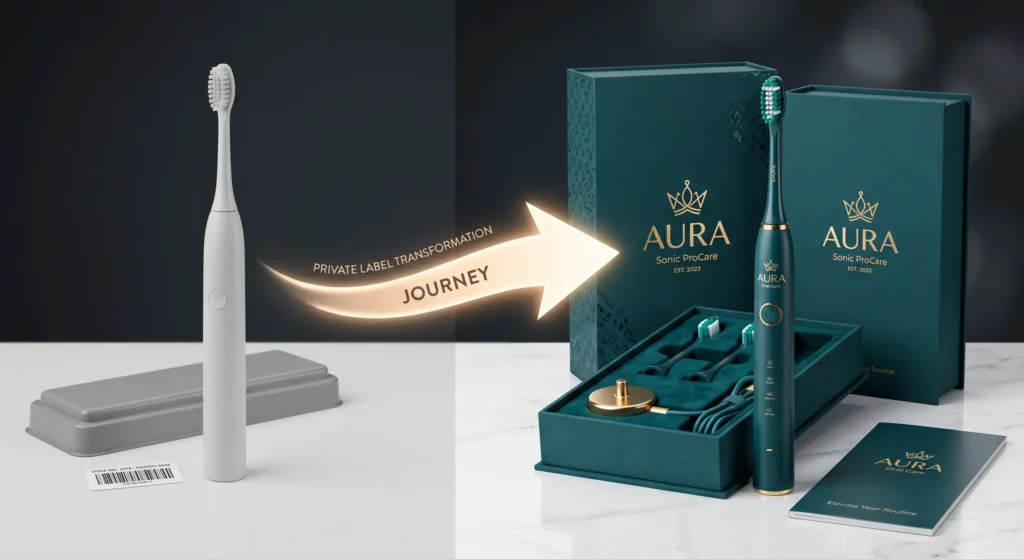
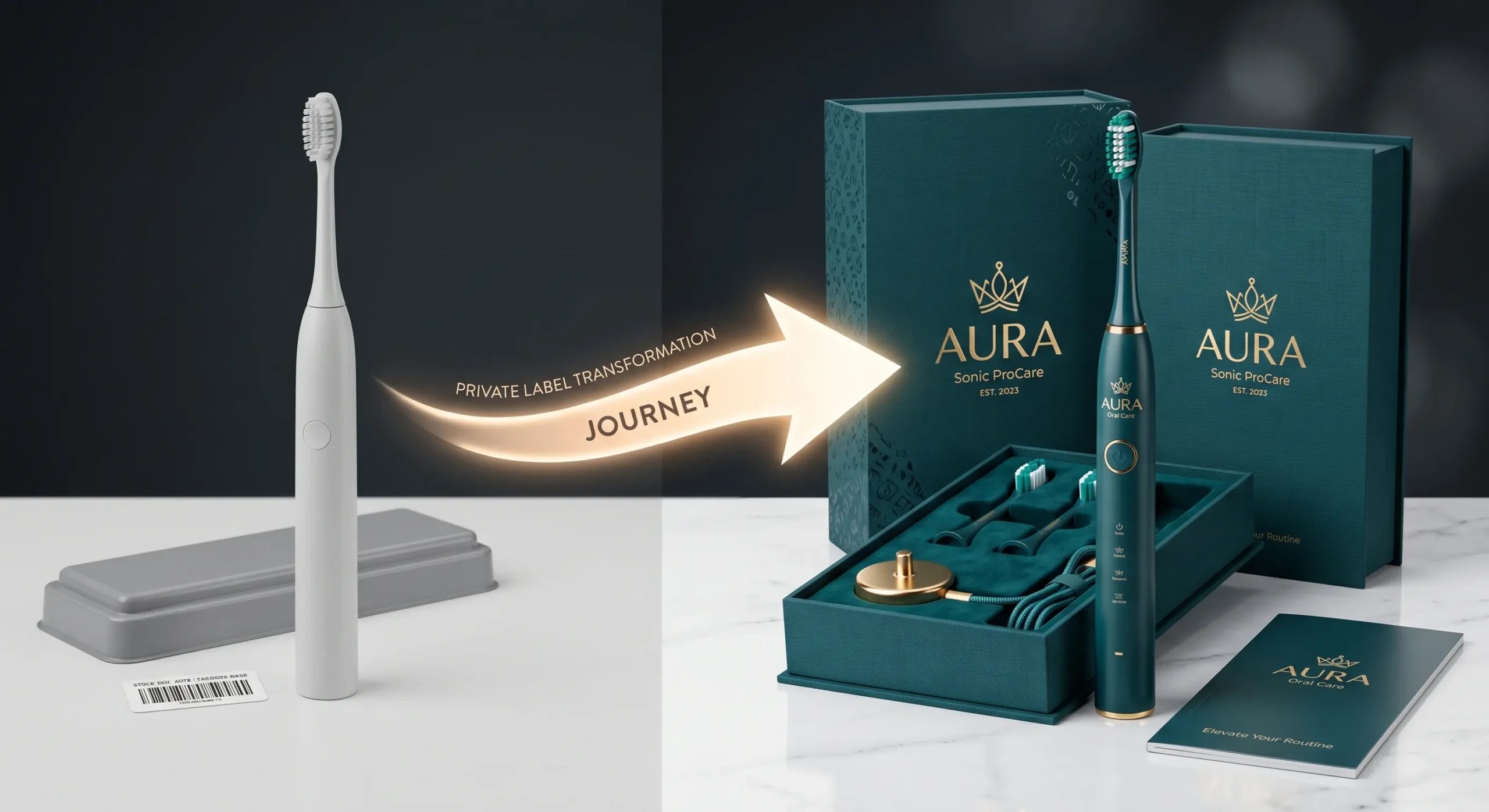
Private labeling means taking an existing manufacturer's product and selling it under your own brand name. In the oral care industry, this typically involves:
- Choosing a factory platform: Select from the manufacturer's existing sonic toothbrush models (motor, battery, charging, functions)
- Customizing appearance: Custom exterior color, finish (matte/glossy/soft-touch), logo placement (silk print, laser engraving, embossed)
- Designing packaging: Full custom packaging — box design, insert layout, instruction manual, warranty card
- Building a brand: Brand name, positioning, website, marketing content, Amazon listing, social presence
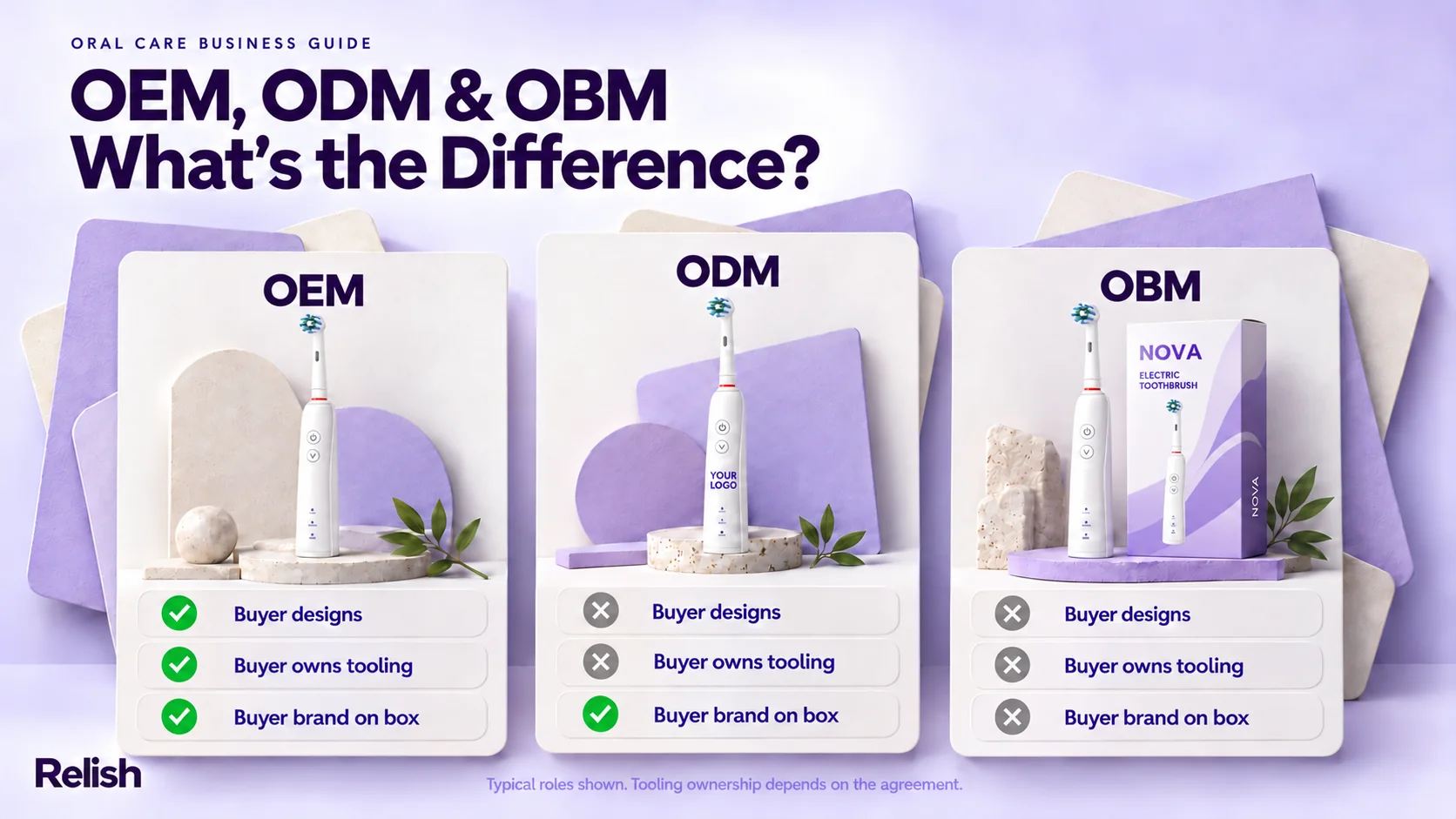
Private label vs. White label
Suppliers may use these terms differently. A useful working distinction is:
- White label: An existing product with limited changes, often your logo and packaging. It can simplify launch preparation, though product differentiation is limited.
- Private label: An existing product sold under your brand, with selected colors, packaging and marketing. Agree ownership of designs, tooling and intellectual property in the contract; brand ownership alone does not establish those rights.
💡 The private label opportunity in oral care
Straits Research estimates the global electric toothbrush market at USD 5.02 billion in 2026 and forecasts USD 8.50 billion by 2034, with a 6.8% CAGR for 2026–2034 [1]. For a new brand, the practical opportunity is to serve a clearly defined customer need with dependable product quality, distinctive presentation and reliable replacement-head supply.
📋 About the Manufacturer: Relish Technology
Relish Technology is a Shenzhen-based oral care OEM/ODM manufacturer with 14+ years of export experience in private label electric toothbrush manufacturing. Custom orders start at 1,000 units, with flexibility for individual projects; stocked products are available wholesale from 50 units. Our capabilities include a 20,000 m² facility, monthly capacity of 1.2M+ units, 300+ workers, 30+ R&D engineers and exports to 120+ countries. Existing platforms have CE, FCC, RoHS, IPX7 and PSE documentation as applicable. We help you check the documentation against your chosen model, materials and target market. View client case studies → | Request a private label consultation →
2. Brand Positioning: 5 Practical Approaches
Your positioning shapes the target price, packaging, sales channels and product selection. Choose one primary direction before starting design. The prices and features below are planning examples, rather than quotations or fixed specifications.
🎯 Premium Professional
- Professional positioning, with dentist endorsements only where genuine and authorized
- Sleek packaging, premium unboxing experience
- App-connected, 5+ modes, travel case included
- Marketing: product demonstrations, relevant creator reviews and documented professional partnerships
⚖️ Smart Value
- Everyday performance at an accessible price
- Clean, modern branding, strong photography
- 3–4 modes, USB charging, IPX7
- Marketing: Amazon PPC, comparison content
💰 Budget Champion
- Value-focused pricing and volume-based offers
- Simple packaging, multi-packs (2-pack, family pack)
- Basic functions, 2 modes
- Marketing: price-focused, bulk discounts
🌿 Eco-Conscious
- Material choices supported by specific recycling or environmental evidence
- Natural colors and verified environmental claims
- Replacement-head supply with clear material and disposal information
- Marketing: practical material, packaging and waste-reduction information
🧒 Kids / Family
- Fun characters, bright colors, kid-friendly design
- Parent-facing packaging with safety messaging
- Age-appropriate design, soft bristles, a timer and a gentle mode, with relevant safety checks
- Marketing: parenting influencers, educational content
3. Core Brand Identity Elements
Before a factory can produce anything with your brand, you need these identity assets ready:
Brand Name
A suitable domain and a name checked for trademark conflicts
Logo
Vector files (AI/EPS) for print
Color Palette
Primary + secondary + accent (Pantone)
Typography
Primary + secondary fonts for packaging
Packaging Design
Box dieline with print-ready artwork
Product Photography
Lifestyle + white background shots
For box styles, print finishes and order-specific packaging requirements, see Relish Technology’s custom packaging services →
Brand naming checklist
⚠️ Plan trademark protection before committing to production
Search for conflicting marks and discuss applications in your manufacturing and sales markets with a qualified trademark adviser. File before committing to branded production where appropriate; an application is not an approved registration. Amazon Brand Registry accepts eligible pending or registered trademarks from designated offices. Filing and professional fees vary by market and class; check current official fees and obtain a project-specific estimate.
4. Packaging Design: Make the First Impression Count
Packaging helps shoppers understand your product before they open it. Make the main benefit, contents and brand identity clear in both a small online image and a retail display. The unboxing experience should support the quality of the product inside.
📦 Rigid Box (Premium)
Illustrative cost: USD 0.80–2.00 per box; quantity and specification to be quoted
- Magnetic closure or lift-off lid
- EVA foam or molded pulp insert
- Spot UV, foil stamping, embossing available
- Best for: premium positioning ($40+ retail)
📦 Slide Box (Mid-range)
Illustrative cost: USD 0.40–1.00 per box; quantity and specification to be quoted
- Outer sleeve + inner tray
- Clean, modern presentation
- Full-color printing, matte or gloss lamination
- Best for: smart value positioning ($20–$40)
📦 Window Box (Value)
Illustrative cost: USD 0.20–0.50 per box; quantity and specification to be quoted
- Simple corrugated box with window cutout
- Product visible without opening
- Cost-effective for high-volume orders
- Best for: budget positioning ($10–$20)
📦 Hang Tag / Clamshell (Accessory)
Illustrative cost: USD 0.10–0.30 per pack; quantity and specification to be quoted
- Product with a hang tag, blister pack or transparent clamshell, as appropriate
- For replacement brush heads, travel cases
- Minimal material, maximum space efficiency
- Best for: accessories and add-on products
Packaging design requirements
Use the following as a layout checklist, then confirm the information legally required for your product and destination:
- Front panel: Brand logo, product name, key benefits, color identification where useful and required marks in their prescribed form
- Back panel: Specifications, package contents, channel-compatible barcodes, applicable regulatory information, manufacturer details and required importer or responsible-person contact details
- Side panels: Appropriate language information, instructions or a tutorial QR code, and warranty details; a QR code does not replace required printed information
- Inside: Quick start guide, USB cable (if applicable), brush head extras, registration card
Multi-market packaging strategy
A common box with market-specific sleeves or inserts can simplify production. Confirm required languages, warnings, labels and responsible-party details for each destination before approving artwork. Agree variant quantities and printing costs with the packaging supplier.
5. Startup Cost Breakdown
The following is an illustrative planning budget. Recalculate it for your selected model, quantity, market and sales channel before placing an order.
| Item | Budget Range | Notes |
|---|---|---|
| Product samples (3 rounds) | $300–$600 | Existing-model sample → branded sample → approved reference sample. Confirm sample and express-delivery charges with the supplier. |
| Initial production run (model and quantity to be quoted) | $4,000–$12,000 | Illustrative product budget. Confirm model, order size, finish and any tooling separately; a new color does not necessarily require a new mold. |
| Custom packaging (1,000–2,000 boxes) | $500–$2,000 | Design fee: $500–$1,500 (freelancer or agency). Print cost: $0.30–$1.00/box. |
| Brand identity (logo, colors, naming) | $500–$3,000 | Obtain a scope-based quote for naming, visual identity and trademark services. Official filing fees and professional fees are separate. |
| Product photography | $300–$1,500 | White background Amazon shots: $150–$300. Lifestyle shots: $500–$1,000. Video: $300–$1,000. |
| Website (Shopify or landing page) | $200–$2,000 | Budget for your chosen plan, domain, theme or design work and payment processing. Check current provider prices and avoid counting the same service twice. |
| Amazon launch budget (advertising and compliant review programs) | $2,000–$5,000 | |
| Compliance review and testing, where needed | $0–$8,000 | Review existing platform documentation first. Additional testing, technical-file work or market-specific assessment may be needed for your configuration and brand responsibilities; obtain a scoped laboratory quote. |
| Freight and delivery for the initial order | $800–$2,500 | Obtain a current quote for the destination, shipment volume and delivery terms. Include customs, inland delivery and any warehouse receiving charges. |
| TOTAL RANGE | USD 8,600–36,600 | The row minima total USD 8,600 and maxima USD 36,600. These are example allocations, not a complete quotation; ongoing operating costs and working capital need a separate allowance. |
6. MOQ, Unit Cost & Pricing Strategy
Unit cost by volume tier
| Volume | Unit Cost (basic model) | Unit Cost (mid-range) | Unit Cost (premium) |
|---|---|---|---|
| 500 units (subject to project review) | $6.50–$8.00 | $9.00–$12.00 | $14.00–$18.00 |
| 1,000 units | $5.50–$7.00 | $8.00–$10.50 | $12.00–$16.00 |
| 3,000 units | $4.50–$6.00 | $7.00–$9.00 | $10.00–$14.00 |
| 5,000 units | $3.50–$5.00 | $6.00–$8.00 | $9.00–$12.00 |
| 10,000+ units | $3.00–$4.50 | $5.00–$7.00 | $8.00–$11.00 |
Illustrative FOB Shenzhen unit costs, not a current quotation. Relish custom orders start at 1,000 units with project-specific flexibility; stocked-product wholesale starts at 50 units. Confirm packaging, freight, duties and other landed costs separately.
Pricing formula
Use price multiples as scenarios, then check the resulting margin against all channel costs. A selling price of three times cost means a 200% markup and a 66.7% gross margin before other selling costs.
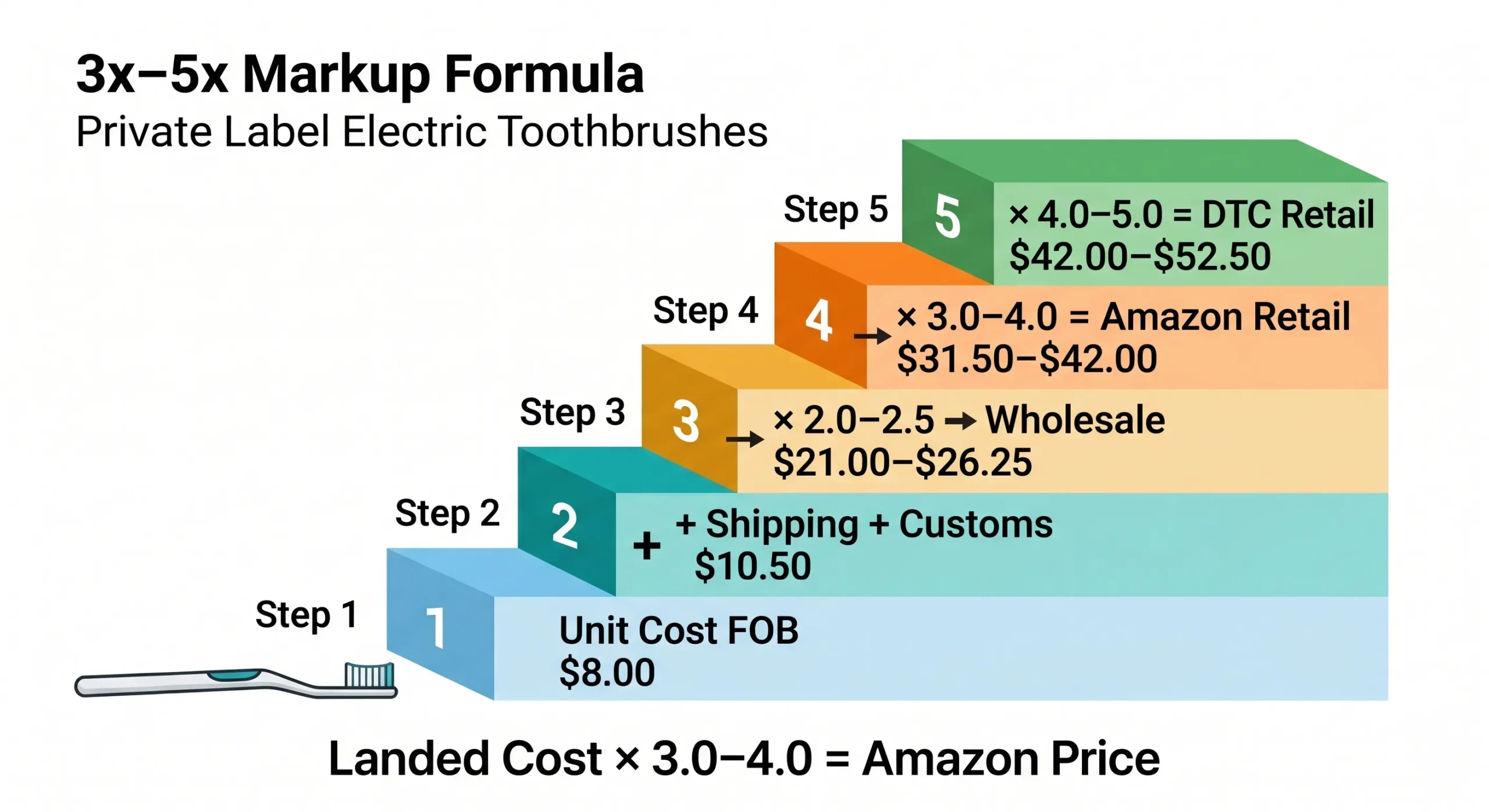
- Landed cost: Unit cost + shipping + customs duties + insurance
- Wholesale scenario: Landed cost × 2.0–2.5; check distributor economics and your own margin
- Amazon retail scenario: Landed cost × 3.0–4.0; model referral, fulfillment, advertising and return costs separately
- Direct-to-consumer retail scenario: Landed cost × 4.0–5.0; test customer acquisition, fulfillment and repeat-purchase economics
💡 Build repeat purchases around replacement brush heads
Replacement brush heads give customers a reason to return after the initial toothbrush purchase. Plan compatible head availability, clear reorder instructions and an optional subscription. Recommend replacement according to wear and product guidance; the ADA advises replacing toothbrushes about every three to four months, or sooner when bristles fray. Measure repeat purchases and retention before projecting customer lifetime value.
7. Margins and Costs by Sales Channel
Amazon FBA
Deduct the actual referral and fulfillment fees, advertising, returns and other channel costs; FBA fees are not a fixed 15% of selling price.
DTC (Shopify)
Model platform charges, payment processing, fulfillment, shipping and marketing. Check which payment charges apply to your setup to avoid double-counting.
Retail / Distributor
Start from your actual wholesale selling price and landed cost, then account for discounts, returns and support. Distributor and retailer margins are separate from your profit.
Subscription (Brush Heads)
Include head cost, pick-and-pack, shipping, payment fees, discounts, cancellations and customer support when assessing subscription profitability.
One possible channel sequence for a new brand:
- Months 1–3: Prepare an Amazon launch if it suits your market, with compliant listings, eligible brand tools and a controlled advertising test.
- Months 3–6: Develop a direct-to-consumer website and collect marketing consent; test a replacement-head subscription if customers want it.
- Months 6–12: Approach retail buyers when sales, product quality and customer feedback provide a useful basis for discussion.
8. Go-to-Market Strategy
Amazon-specific playbook
- Listing content: Write a clear title with your brand and relevant product terms, then explain verified features through accurate images, benefit-led bullet points and A+ Content where eligible. Follow the current marketplace and category rules.
- Advertising test: Use automatic and manual campaigns to learn which searches convert. Set an initial budget you can sustain, then adjust bids and keywords using actual sales and acquisition costs.
- Reviews: Use eligible programs such as Amazon Vine and approved review-request tools. Vine enrollment does not guarantee a set number of reviews. Do not offer incentives for positive reviews or send repeated requests.
- Product presentation: Use accurate photography, feature diagrams and demonstrations. Any comparison with named competitors should use current, verifiable specifications.
DTC content strategy
- Brand story page: "Why we started [Brand]" — consumers connect with founder narratives. Authenticity > polish.
- Educational content: "How to brush properly," "Sonic vs. rotary vs. manual," "When to replace your brush head" — content that positions your brand as the expert.
- Subscription offer: Make replacement-head ordering convenient, with an optional discount where the economics support it. State the price, delivery frequency, renewal and cancellation terms clearly.
- Email marketing: With the customer’s consent, send helpful setup information, care tips and timely replacement reminders, with a clear unsubscribe option.
9. Multi-Market Localization
For international sales, localization includes the product configuration, required information and sales content as well as translation:
| Element | What to Localize | Common Mistakes |
|---|---|---|
| Product | Compatible charging equipment, voltage and frequency where relevant, plus required model, rating, identification and warning labels | Assuming an EU plug fits UK sockets, or treating a plug change as sufficient for all local requirements |
| Packaging | Required languages, applicable regulatory marks, channel-compatible barcodes and responsible-party contact details | Single-language box shipped to all markets |
| Manual | Complete, professionally checked instructions, warnings and units of measurement appropriate to the market | Literal machine translation, missing sentences or instructions that do not match the supplied product |
| Amazon listing | Title, bullets, description, backend keywords in each marketplace's language | Using the same English listing across .de, .fr, .es marketplaces |
| Marketing | Color associations, cultural preferences, local influencer partnerships | Using US-centric marketing in Japan/EU |
💡 Cost-effective localization approach
Use a common product design where practical, then plan destination-specific labels, instructions, packaging and charging equipment. Keep all required model, rating and safety information on the product or packaging as applicable. Agree language variants and costs before production; one shared housing does not by itself establish compliance in every market.
10. Example Launch Timeline: From Brief to First Sale
Brand Foundation
Choose the brand name, complete initial trademark searches and plan applications. Secure a suitable domain and social accounts, then define the visual identity, positioning and target price.
Factory Selection & Sample Order
Send a clear RFQ to three to five shortlisted factories. Compare responses and order existing-model samples, with sample and delivery costs agreed in advance. Check quality, function and packaging.
Branded Sample & Packaging Design
Select factory. Commission packaging design (concurrent with branded sample production). Approve color, finish, logo placement on branded sample.
Pre-Production Sample & Amazon Setup
Approve the reference sample. Prepare compliant listing content and apply for Amazon Brand Registry if eligible; designated offices may support pending as well as registered trademarks.
Production & Photography
Produce the agreed order after sample approval and compliance planning. Prepare product photography and demonstrations in parallel; confirm the production schedule for the actual model and quantity.
QC & Shipping
Complete agreed pre-shipment checks and resolve issues before releasing the contractually due balance. Plan freight, customs clearance and warehouse receiving with the forwarder; confirm current transit estimates.
Launch!
Once inventory is received and the listing is ready, begin the launch campaign and monitor feedback, returns and advertising costs. The week ranges are an example plan; development, testing and logistics can change the schedule.
11. Pre-Launch Checklist
Before you place your production order, confirm every item on this list:
Product & Quality
Branding & Packaging
Legal & Compliance
Amazon & Marketing
12. Frequently Asked Questions
Ready to Build Your Private Label Brand?
Relish Technology supports private label electric toothbrush launches with existing product platforms, custom colors, packaging design and compliance-document review. Custom MOQ starts at 1,000 units with project-specific flexibility; stocked-product wholesale starts at 50 units. See how other brands launched with us →
References
- [1] Straits Research. Electric Toothbrush Market Size & Growth Analysis. The current summary estimates USD 5.02 billion for 2026 and forecasts USD 8.50 billion by 2034, with a 6.8% CAGR for 2026–2034. Retrieved from https://straitsresearch.com/report/electric-toothbrush-market.
- [2] American Dental Association. Toothbrushes: Oral Health Topics. Advice covers brushing twice daily for two minutes and replacing toothbrushes about every three to four months, or sooner when bristles are frayed. Retrieved from https://www.ada.org/resources/ada-library/oral-health-topics/toothbrushes.
- [3] Amazon. Brand Registry and Amazon Vine: official eligibility and program information. Retrieved from https://sell.amazon.com/brand-registry and https://sell.amazon.com/programs/vine.