








Sourcing Oral Care Products from China:
A Practical B2B Guide
A practical guide to evaluating oral-care suppliers in China. Compare product and process scope, request evidence that matches your order, clarify intellectual-property and quality responsibilities, and plan regulatory and shipping work for your target market. Relish Technology has manufactured oral-care products since 2012, with 20,000 m² of combined operations in Shenzhen and Huizhou.
Puntos clave
- Start with the product scope and supplier evidence: identify the factory, relevant processes, component sources and responsibilities for your order.
- Check each document’s issuer, holder, scope, product or model, market and validity; a quality-system certificate or market registration does not establish product conformity.
- Relish’s standard customized order quantity is 1,000 units; smaller quantities may be discussed case by case.
- Use an appropriately drafted NNN agreement to address confidentiality, use and circumvention; ask qualified counsel to review the terms for the transaction.
- Set a project schedule around agreed samples, tooling, testing, production and shipping milestones; timing depends on scope and readiness.
- Agree on product-specific inspection criteria, sampling methods, acceptance limits and corrective-action steps before production.
Choosing an oral care supplier in China means evaluating the manufacturer and the partners it uses. Component availability, production scope, development timing and logistics vary by product and supplier. Ask each candidate which work it performs in-house, which components it sources, and how it controls subcontracted processes. Compare the proposed plan with your requirements.
Supplier evidence matters at the company, site and product level. Confirm what the supplier makes, which processes are subcontracted, what documentation applies to the model and market, and how quality responsibilities are recorded. Use the steps below to organize that review and identify questions that need specialist advice.
How to Evaluate Oral-Care Supplier Locations
Compare the proposed location with your product, supplier options and delivery plan. Check each candidate’s documented capabilities and actual factory and component-supplier addresses before deciding where to place an order. A location alone does not verify a supplier’s scope.
Assessing Supplier Options in Shenzhen
Regional production shares should not be inferred from general oral-care market data. For broader market context, see this oral-care market overview; assess supplier and manufacturing scope using evidence for your project.
Si la tabla no se ve completa, desplácese horizontalmente para ver todas las columnas.
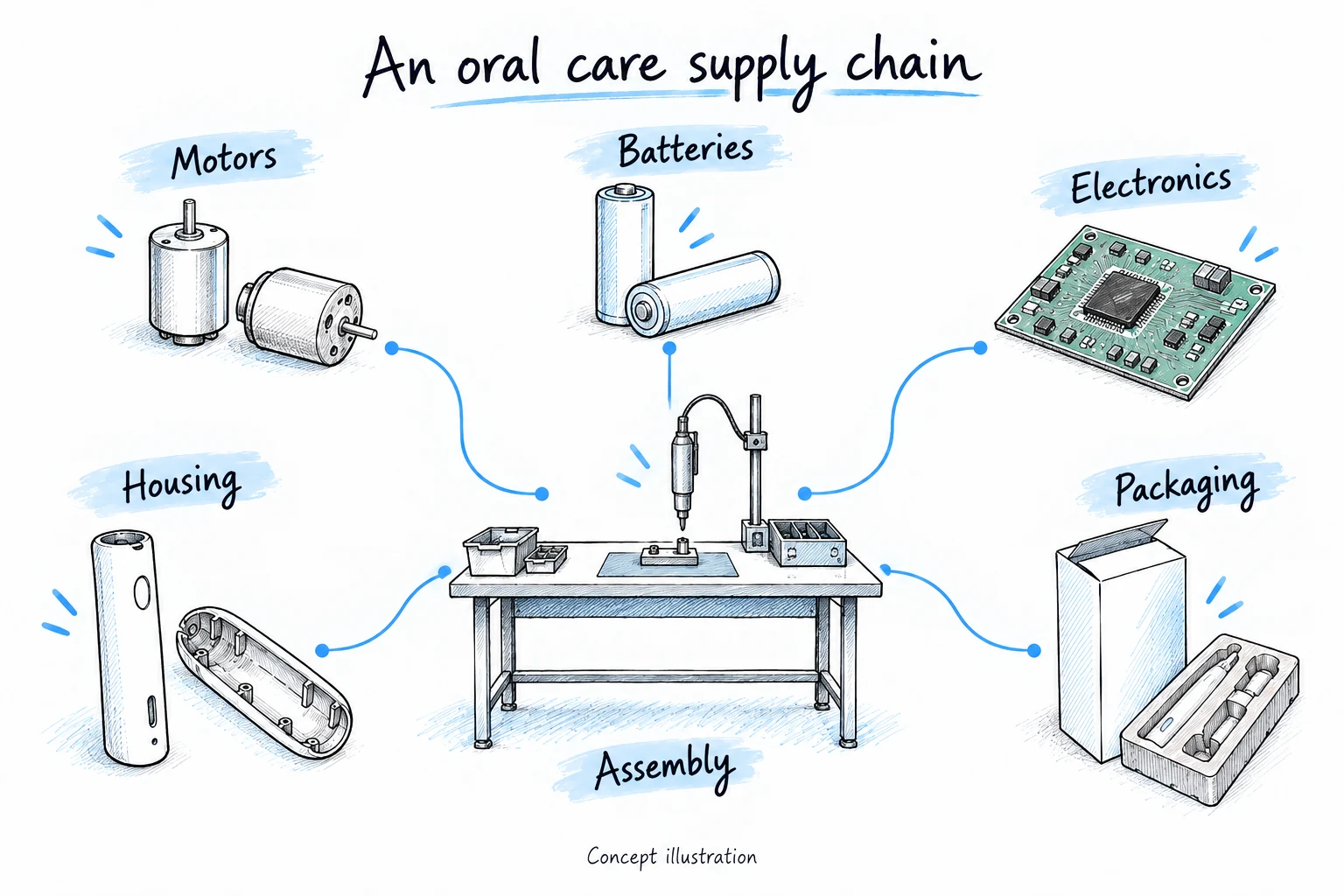
| Componente | Evidence to Request | Availability and Lead Time | Quote Basis |
|---|---|---|---|
| Motores de CC (sónicos/oscilantes) | Identify the proposed supplier | Confirm availability for the project | Request a comparable quote |
| Baterías de iones de litio | Check cell and supplier documentation | Confirm current lead time | Compare the same specification |
| PCB / Control electrónico | Clarify design and assembly scope | Confirm sample and build schedule | Separate engineering and unit costs |
| Moldeo por inyección de ABS/PC | Confirm material and molding partner | Check tooling and sample milestones | Separate tooling from part cost |
| Cerdas de nailon | Specify filament and tufting requirements | Confirm sample availability | Compare like-for-like materials |
| Embalaje (cajas de venta al por menor) | Confirm artwork and pack-out scope | Check approval and print schedule | Include packaging and freight |
A regional supplier network may offer options for components, assembly, testing and logistics, but available capabilities depend on the product and the companies involved. For your project, identify each supplier and process, confirm the factory address, and agree how specifications, changes and quality records will be managed. This review is more useful than assuming a city-wide capability or ranking.
Set project-specific milestones for sample, tooling, testing and production. Timing depends on scope, product complexity and supplier readiness; confirm the schedule in writing. Do not assume a fixed lead time for any city or supplier.
Reviewing Product Cost Components
Request a quotation for the exact model, order quantity and quality requirements. Ask the supplier to separate unit price and tooling, packaging, testing, freight, duties and other charges. Confirm whether the quoted term is FOB or includes delivery to your destination.
Cómo abastecerse de productos de cuidado bucal desde China: proceso de 7 pasos
Use this guide as a checklist for supplier discussions. Read our factory audit checklist, NNN agreement guide, quality control guide, supply-chain risk guide and manufacturing hub guide for related questions.
A structured sourcing process helps organize supplier review, product evidence, commercial terms and quality planning. Adapt the sequence to the product and project rather than treating it as a guaranteed result.
Defina las especificaciones del producto y el mercado objetivo
Document the product type, intended use, model options, materials, electrical configuration, accessories, target market and sales plan. Identify product-specific requirements for each destination using the applicable rules and current specialist guidance; do not assume that one certificate or route applies to every model.
Shortlist Potential Manufacturers
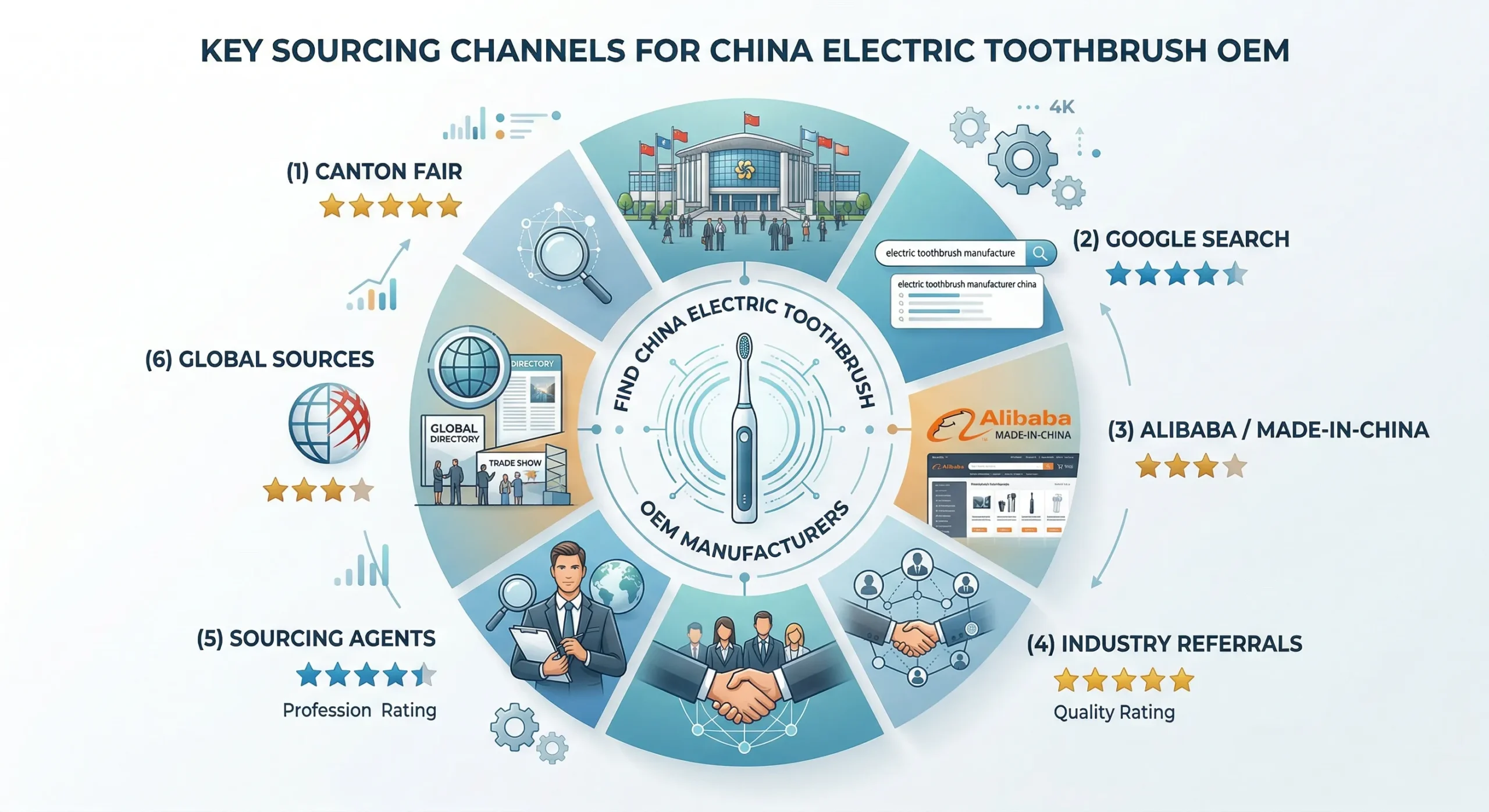
Use trade platforms, exhibitions, referrals and other channels to identify candidates. Verify the contracting entity, site, actual production scope, product experience and relevant documents with their issuers. Treat platform memberships as lead sources rather than proof of factory identity or capability. Compare more than one suitable candidate when practical. For review questions, see our oral care manufacturers guide.
Review Samples & Technical Documentation
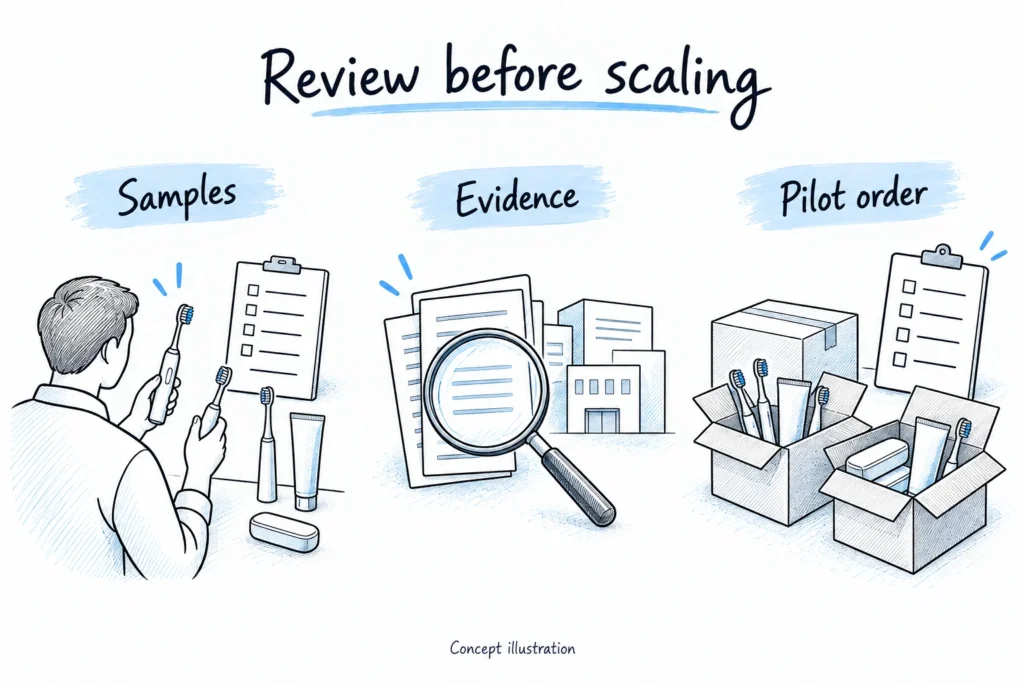
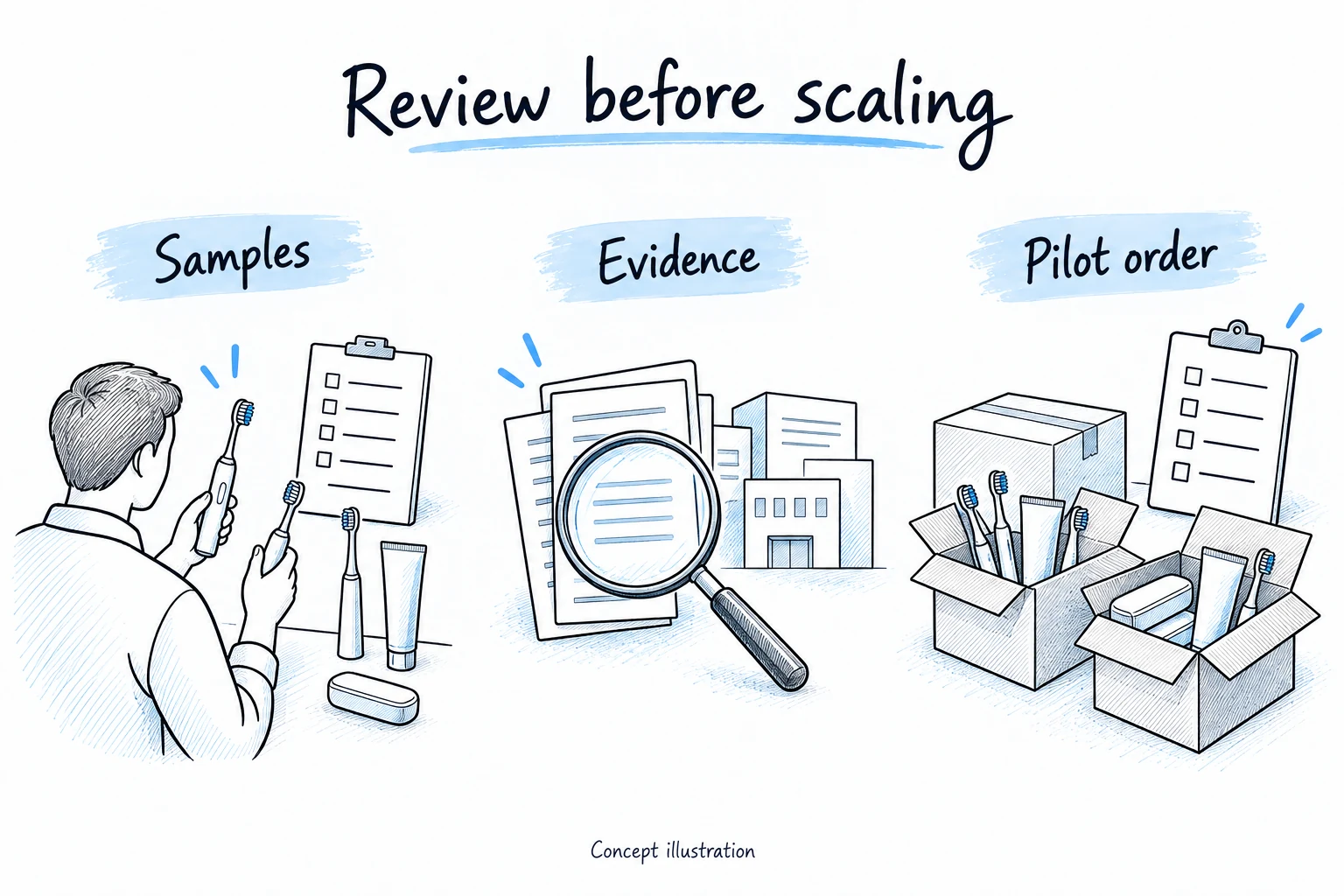
Agree which samples and documents are relevant to the model and destination market. Check the certificate holder, scope, issuing body and validity; confirm that test reports identify the tested product and applicable conditions. Review sample results alongside specifications, traceability and the supplier’s proposed quality-control plan. A sample alone does not establish production consistency.
Set Appropriate IP and Confidentiality Terms
An NNN agreement can address non-disclosure, non-use and non-circumvention obligations. Its effect depends on the parties, wording, governing law and evidence. Have qualified counsel review the agreement for the transaction. Consider sharing confidential technical details only after appropriate protections are in place. See our NNN agreement guide.
Realice una auditoría de fábrica
A factory audit or assessment can review the legal entity, premises, production scope, equipment, quality processes and records relevant to your order. Choose the audit scope and provider according to project risks and requirements. See our factory audit checklist for questions to consider; match the review to the order.
Agree Commercial Terms in Writing
Define the quoted model, specification, quantity tiers, tooling and development charges, packaging, testing, delivery term, payment schedule, warranty, acceptance criteria and remedies. Treat any quote as specific to its stated scope and validity period. Record responsibilities and changes in the manufacturing agreement.
Agree a Pilot Run and Scale-Up Criteria
Where appropriate, agree a pilot quantity and acceptance plan that fit the product and project economics. Compare pilot output with the approved specification and sample, review traceability and packaging, and document corrective actions before scaling. Set any third-party inspection scope and cost in advance.
Regulatory and Documentation Planning
Requirements for the model depend on product design, intended use and destination market. Confirm the classification, applicable conformity work, documentation and responsible parties for the exact model. A supplier may provide technical information, but regulatory responsibilities should be agreed for the transaction. See our certifications guide.
Si la tabla no se ve completa, desplácese horizontalmente para ver todas las columnas.
| Mercado | Requirements to Assess | Productos aplicables | Plazo | Responsible Parties |
|---|---|---|---|---|
| Estados Unidos | Confirm FDA classification, establishment registration/listing and any applicable premarket requirements | Class depends on device type, intended use and scope | Product- and task-specific | Confirm establishment and importer roles; foreign establishments may need a U.S. agent |
| Unión Europea | Assess applicable electrical safety, EMC/radio and substance requirements; MDR applies only where the product qualifies | Determine requirements from the exact design and intended use | Project-specific | Manufacturer and applicable EU economic operators, as defined for the product |
| Quality system | Review the supplier’s ISO 13485 certificate and quality-system scope where relevant | Supplier and activities named in the certificate | Check current scope and validity | Certificate holder; it is not product approval |
| Reino Unido | Check current Great Britain product rules and accepted conformity marking; Northern Ireland has separate arrangements | Requirements depend on product and applicable rules | Project-specific | Confirm the responsible economic operators for the market |
| Japón | Check whether the product or included power supply falls within applicable PSE requirements | Assess exact design, electrical components and scope | Project-specific | Confirm duties with the responsible importer and conformity parties |
| Australia | Determine whether electrical or radio requirements and RCM obligations apply | Depends on product configuration and market role | Project-specific | Confirm the responsible supplier and applicable obligations |
Discuss Your Oral-Care Sourcing Requirements
Relish Technology has manufactured oral-care products since 2012, with 20,000 m² of combined operations in Shenzhen and Huizhou. Share your product scope and target market to discuss a project-specific review.
Solicitar presupuesto de fábrica →Protección de la propiedad intelectual al comprar en China
IP planning depends on the rights involved, contract terms, who can access designs and how evidence is retained. Identify the information that needs protection, set access and use rules, and have qualified counsel review agreements for the relevant jurisdictions. Official government resources, including the MOFCOM website, can provide general background but do not establish a case outcome or guarantee enforcement.
Questions for Planning IP Protection
Use the following framework to organize intellectual-property questions throughout supplier evaluation and production:
- Agree confidentiality and permitted use: An NNN or other contract may address disclosure, use and circumvention. Choose terms, governing law and remedies with qualified counsel; the agreement does not eliminate risk or guarantee enforceability.
- Review trademark protection: Check whether registration in China or other markets is appropriate for your brand and goods. Discuss timing, ownership and filing strategy with qualified trademark counsel; fees and outcomes depend on the application and service provider.
- Assess patent options: A Chinese utility-model patent is distinct from a U.S. utility patent. Where appropriate, discuss patentability, filing before public disclosure, ownership and maintenance with a qualified patent professional. Protection depends on the right granted and applicable term rules.
- Set access and production controls: Share the information each partner needs for its agreed work, while documenting interfaces, confidentiality, traceability, quality duties and change approvals. Any supplier arrangement should preserve the information needed for safe and consistent assembly.
Planning Quality Controls with a Supplier
Quality review should focus on controls that match the product and agreed specification. Ask how the supplier qualifies materials, controls production changes, and keeps inspection and traceability records for each lot. Agree how it handles nonconforming product and corrective actions. An ISO 13485 certificate describes a quality-management-system scope; it does not guarantee a product result or defect rate.
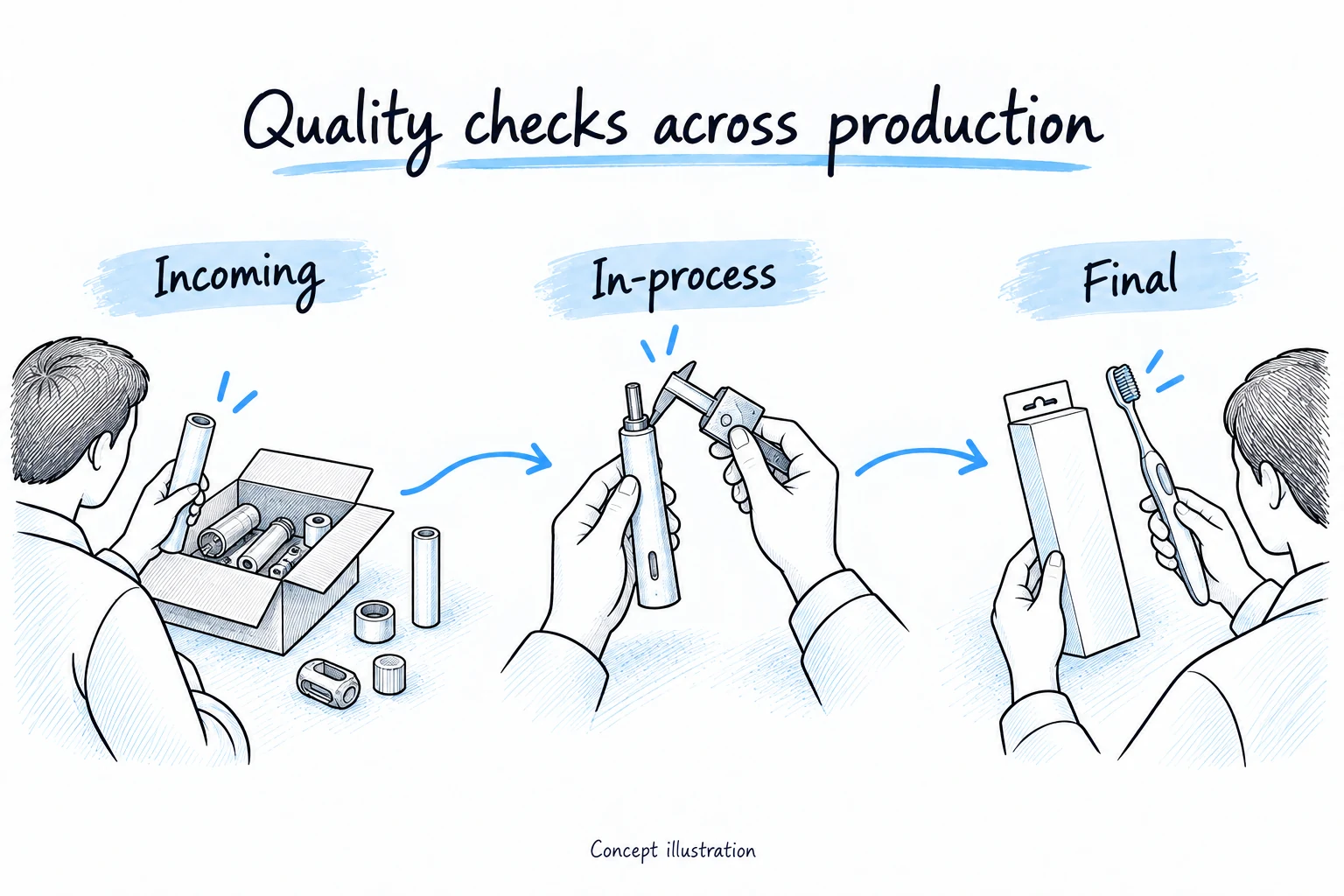
Inspección de materiales entrantes (IQC)
Agree incoming-inspection criteria for components that matter to the product, including records, sampling or test methods, acceptance limits and escalation steps. Responsibility for supplier approval and corrective action should be explicit. For related review topics, see our OEM Quality Control Guide.
Control de calidad durante el proceso (IPQC)
Ask which in-process checks are used for the selected product and how results are recorded. If acceptance sampling is part of the plan, agree the lot definition, inspection level, sample size, defect categories and acceptance limits. AQL is a sampling-plan parameter, not a delivered defect-rate guarantee.
Inspección final (OQC)
Define final checks according to product risks and the production-control plan. Routine functional checks, sampled performance tests and destructive or wet tests may require different methods and sample sizes. IPX5 water-jet testing is not an immersion test; any ingress-protection claim should match the tested model and conditions. Agree any independent pre-shipment inspection scope in advance.
Project Milestones and Logistics Planning
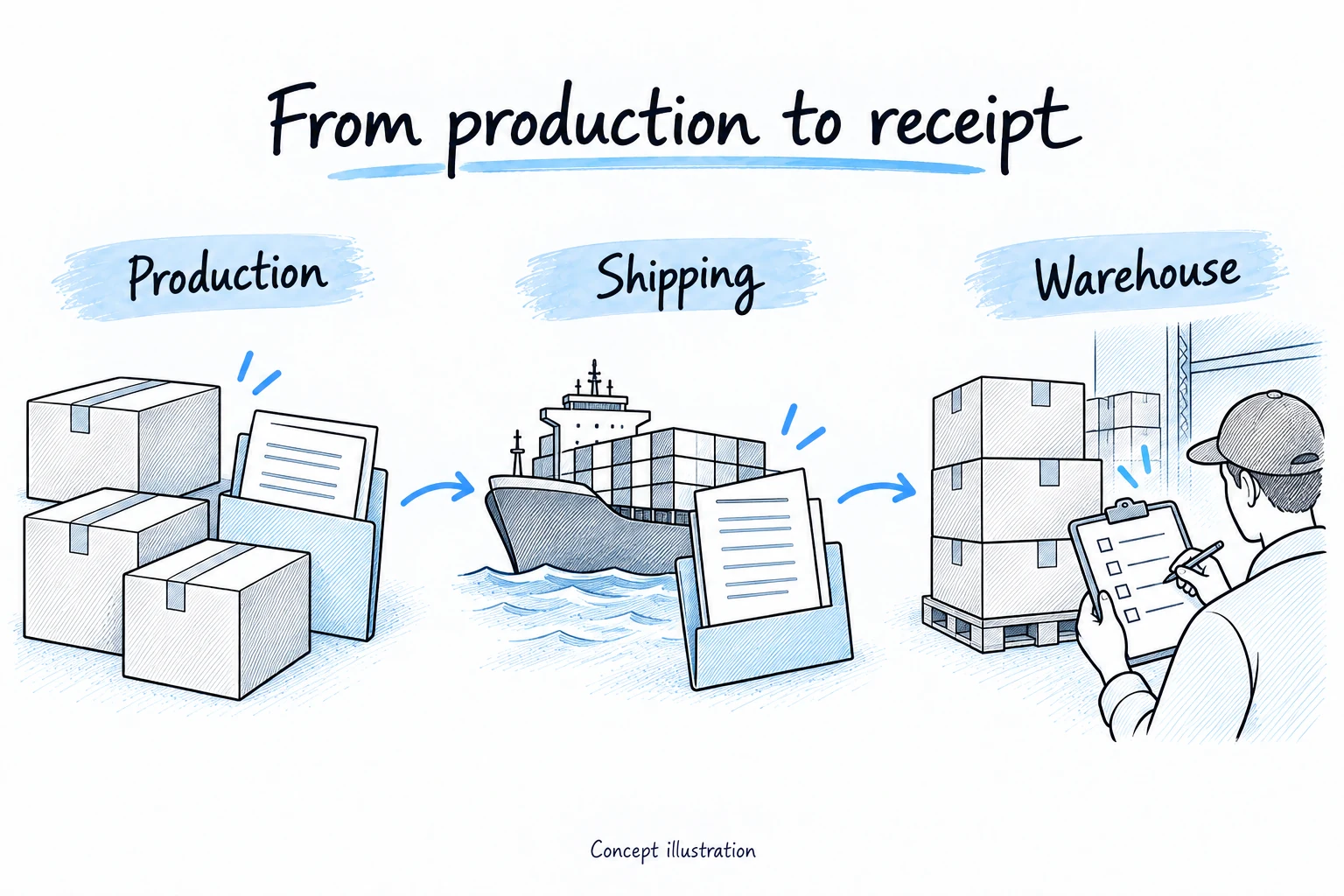
Use the timeline below as a planning framework, not a promised duration. Set a project-specific schedule around product scope, sample approval, tooling, testing, production readiness, shipment route and destination requirements; confirm dependencies with the supplier.
Si la tabla no se ve completa, desplácese horizontalmente para ver todas las columnas.
| Fase | Actividad | Duración | Notas |
|---|---|---|---|
| Milestone 1 | Supplier shortlist, initial discussions and appropriate sample request | Set by project | Protect confidential information before sharing it |
| Milestone 2 | Sample review, site assessment and commercial scope | Set by project | Agree the review scope and supplier responsibilities |
| Milestone 3 | Contract, design and tooling decisions | Depends on scope | Record approvals, rights and change control |
| Milestone 4 | Agreed pilot or validation build | Depends on scope | Use acceptance criteria agreed for the product |
| Milestone 5 | Production after required approvals | Supplier-confirmed schedule | Track readiness and any open corrective actions |
| Envío | Selected freight route and transport mode | Confirm with current carrier schedule | Compare destination, service and quoted terms |
| Delivery | Import clearance and warehouse receipt | Confirm for destination and shipment | Plan for documentation and route-specific delays |
Elegir el fabricante adecuado: OEM frente a ODM
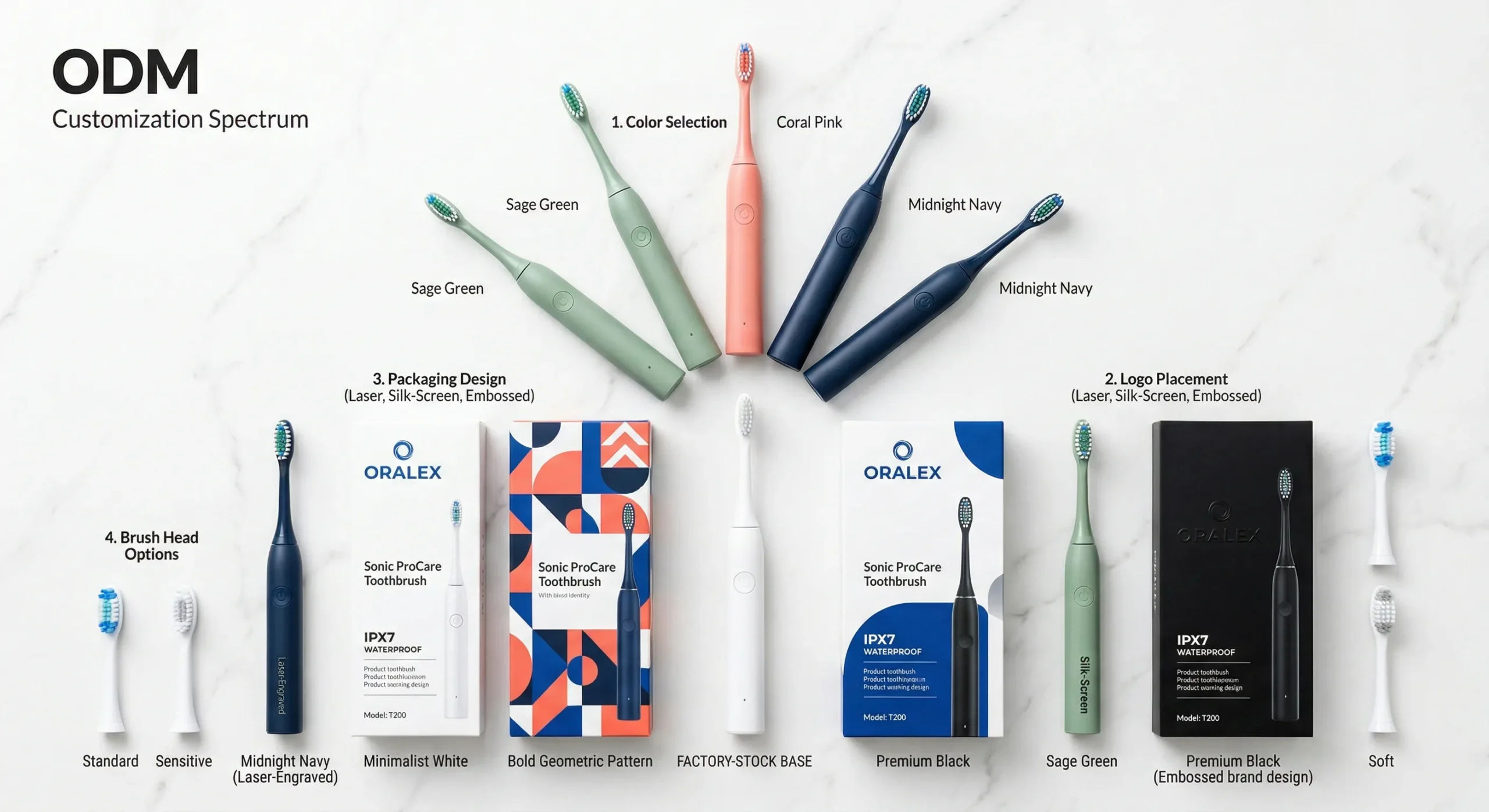
OEM, ODM and private-label arrangements can differ in design input, customization, tooling and project responsibilities. Define those terms in the agreement and record who owns or may reuse existing designs, new work, tooling and related intellectual property.
Si la tabla no se ve completa, desplácese horizontalmente para ver todas las columnas.
| Modelo de colaboración | Quién posee el diseño | Nivel de personalización | Cantidad mínima de pedido | Coste | Plazo |
|---|---|---|---|---|---|
| OEM | Brand provides or co-develops the brief; contract defines design rights | Set by agreed scope | Quote for the specified project | Tooling and development quoted separately | Project-specific |
| ODM | Supplier offers a base design; contract defines changes and rights | Agree available customization | Quote for the specified project | Confirm any tooling or development charges | Project-specific |
| Marca propia | Existing product with agreed branding scope | Confirm product and packaging options | Quote for the specified project | Confirm setup and recurring costs | Project-specific |
A brand may compare ODM and private-label options with OEM according to its product brief, budget, timeline and desired design input. The contract should define rights to existing and newly developed work, tooling access and any permitted reuse. Relish’s Vibrosonic™ and Rotasonic™ platforms are examples of available product platforms; project scope and rights should be confirmed for each engagement.
Supplier Review Questions and Warning Signs
Review these warning signs with follow-up questions and supporting evidence before deciding whether a supplier fits your requirements:
- Does not accept the proposed confidentiality terms: Ask what provisions the supplier can agree to and have counsel assess suitable protections for the transaction.
- Documents cannot be independently verified: Check the issuer, named entity, scope, validity and product connection using the issuer’s verification process where available.
- Unclear production scope or order quantity: Ask which site and partners will perform the work and how the proposed quantity affects setup, pricing and quality controls.
- Site information is incomplete: Confirm the legal entity and production address through suitable records and an appropriately scoped site assessment; online imagery alone is not proof.
- Samples differ from the agreed specification: Clarify the reason, update the approved specification and sample records, and confirm how production will be controlled.
- A quote is materially different from comparable offers: Check scope, materials, testing, tooling, delivery terms and exclusions before drawing conclusions about quality or value.
Preguntas frecuentes
These answers cover supplier assessment, compliance documents, intellectual property, quality planning and project timing.
Discuss an Oral-Care Product Project
Relish Technology has manufactured oral-care products since 2012, with 20,000 m² of combined operations in Shenzhen and Huizhou. Share your product requirements, target market and expected order quantity to discuss the next steps.
Comenta tu proyecto →Referencias y fuentes
- Grand View Research. Oral Care Market information. Grand View Research Inc. Retrieved from https://www.grandviewresearch.com/industry-analysis/oral-care-market
- International Organization for Standardization. (2016). ISO 13485:2016 — Medical Devices — Quality Management Systems — Requirements for Regulatory Purposes. ISO. Retrieved from https://www.iso.org/standard/59752.html
- U.S. Food & Drug Administration. Product Classification: Powered Toothbrush (JEQ). FDA.gov. Retrieved from https://www.accessdata.fda.gov/scripts/cdrh/cfdocs/cfPCD/classification.cfm?id=JEQ
- Ministry of Commerce of the People's Republic of China. MOFCOM website and public information. Retrieved from https://english.mofcom.gov.cn/
- Shenzhen Government Online. Public government and policy information. Retrieved from https://www.sz.gov.cn/cn/xxgk/zfxxgj/zcfg/
- Statista. Shenzhen statistics and facts. Statista. Retrieved from https://www.statista.com/topics/4834/shenzhen/
- American Dental Association. Powered toothbrushes. ADA. Retrieved from https://www.ada.org/resources/research/science-and-research-institute/oral-health-topics/powered-toothbrushes