

Spazzolino elettrico o manuale: la scienza alla base di una pulizia efficace dei denti
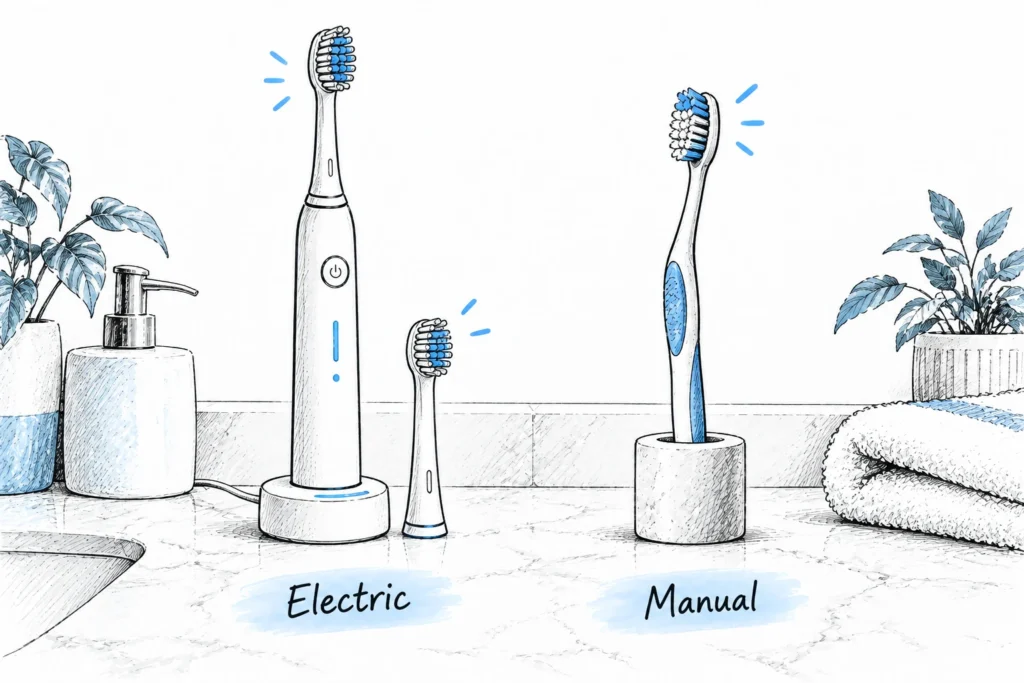
Per decenni, il dibattito sull'efficacia dello spazzolino elettrico vs manuale è persistito. Dentisti, ricercatori e consumatori si sono chiesti: la tecnologia degli spazzolini elettrici si traduce effettivamente in una migliore salute orale, o una tecnica adeguata con uno spazzolino manuale è sufficiente?
This guide compares the research, brushing features and ownership costs that matter to consumers and brands choosing between electric and manual toothbrushes.
Le Evidenze: Cosa Ci Dicono le Ricerche
Le evidenze più autorevoli provengono da revisioni sistematiche e meta-analisi condotte da ricercatori indipendenti:
Risultati della Revisione Sistematica Cochrane
Il 2014 Cochrane review compared powered and manual toothbrushes in everyday use. Its findings help explain the average benefits seen in the studies:
- 56 randomized controlled trials were included; 51 trials with 4,624 participants contributed data to the meta-analysis.
- Plaque index was 21% lower with powered brushing than manual brushing in studies lasting more than 3 months.
- Gingivitis index was 11% lower with powered brushing in studies lasting more than 3 months.
- Oscillating-rotating brushes had the largest evidence base. The pooled results do not establish the same benefit for every powered brush or motion type.
Clinical Findings by Study Duration
The Cochrane review reported the following average differences in plaque and gingivitis indices:
| Durata dello Studio | Metrica | Lower index with powered brushing |
|---|---|---|
| 1–3 mesi | Plaque index | 11% |
| 1–3 mesi | Gingivitis index | 6% |
| More than 3 months | Plaque index | 21% |
| More than 3 months | Gingivitis index | 11% |
Fonte: Yaacob et al., Cochrane (2014). These percentages describe relative differences in clinical indices, rather than guaranteed improvements for an individual or product. The review rated the evidence as moderate quality and noted that the clinical importance remained unclear.
Come Funzionano gli Spazzolini Elettrici
For brands, brush motion is an important design choice. An electric toothbrush drives the cleaning movement with a motor, reducing the need to produce every stroke by hand. Brush placement, coverage and pressure still matter.
Tecnologia Oscillante-Rotante
Oscillating-rotating brushes move a small, usually round head back and forth to clean tooth surfaces. Some designs operate at around 7,500–10,000 oscillations per minute. This is a back-and-forth movement rate, not a count of full revolutions, and the specification depends on the model.
Evidence strength: Oscillating-rotating designs had the largest evidence base in the Cochrane review. Relish manufactures these models within its ISO 13485-certified quality management system and supports applicable FDA registration requirements. FDA registration does not mean FDA certification or approval.
Tecnologia Sonica
Sonic brushes use rapid bristle movement to clean tooth surfaces and move fluid around the teeth. Advertised rates of 24,000–40,000 movements per minute depend on the model and whether the manufacturer counts strokes or complete cycles. Fluid movement can support cleaning around the bristles, but it does not establish deep subgingival cleaning or replace interdental cleaning.
Evidence strength: Assess clinical evidence for the specific brush design and measured outcome.
Tecnologia Ultrasonica
Ultrasonic toothbrushes use acoustic energy above the audible frequency range. For example, 1.6 MHz means 1.6 million acoustic cycles per second, or 96 million per minute; it does not mean 96 million bristle strokes. Whether ultrasound is combined with mechanical bristle movement depends on the design. Frequency alone does not establish cleaning performance or justify claims about heat or cavitation.
Forza dell'evidenza: Dati clinici a lungo termine limitati
Perché gli Spazzolini Manuali Possono Risultare Inadeguati
Quando si valutano le opzioni tra spazzolino elettrico e manuale, è importante comprendere i limiti intrinseci della spazzolatura manuale. Gli spazzolini manuali richiedono tecnica e durata adeguate per essere efficaci, aree in cui molti utenti hanno difficoltà:
Durata della spazzolatura
The challenge: The ADA recommends brushing for 2 minutes, twice daily. Stopping early can leave tooth surfaces inadequately cleaned, whether the brush is manual or powered.
Gli spazzolini elettrici con timer integrati (tipicamente 2 minuti con quadranti da 30 secondi) aiutano gli utenti a rispettare la durata raccomandata.
Costanza nella Tecnica
Il Bass technique is one approach to manual brushing. The essential points include:
- Angolo di 45 gradi verso il margine gengivale
- Colpi brevi e delicati
- Testina vibrante contro la superficie del dente
- Copertura di tutte le superfici (vestibolare, linguale, occlusale)
Powered movement reduces the need for repetitive hand strokes. Users still need to guide the brush across every tooth surface and follow the instructions for the selected head and motion type.
Controllo della Pressione
Excessive pressure and abrasive brushing can contribute to:
- Recessione gengivale: Esposizione delle superfici radicolari sensibili
- Tooth-surface wear: Abrasion of enamel or exposed dentin can contribute to sensitivity.
- Cervical abrasion: Wear near the gumline, which can have several contributing factors.
Models with pressure sensors can alert users when they press too hard. This feedback supports gentler brushing, alongside a soft brush head and appropriate technique.
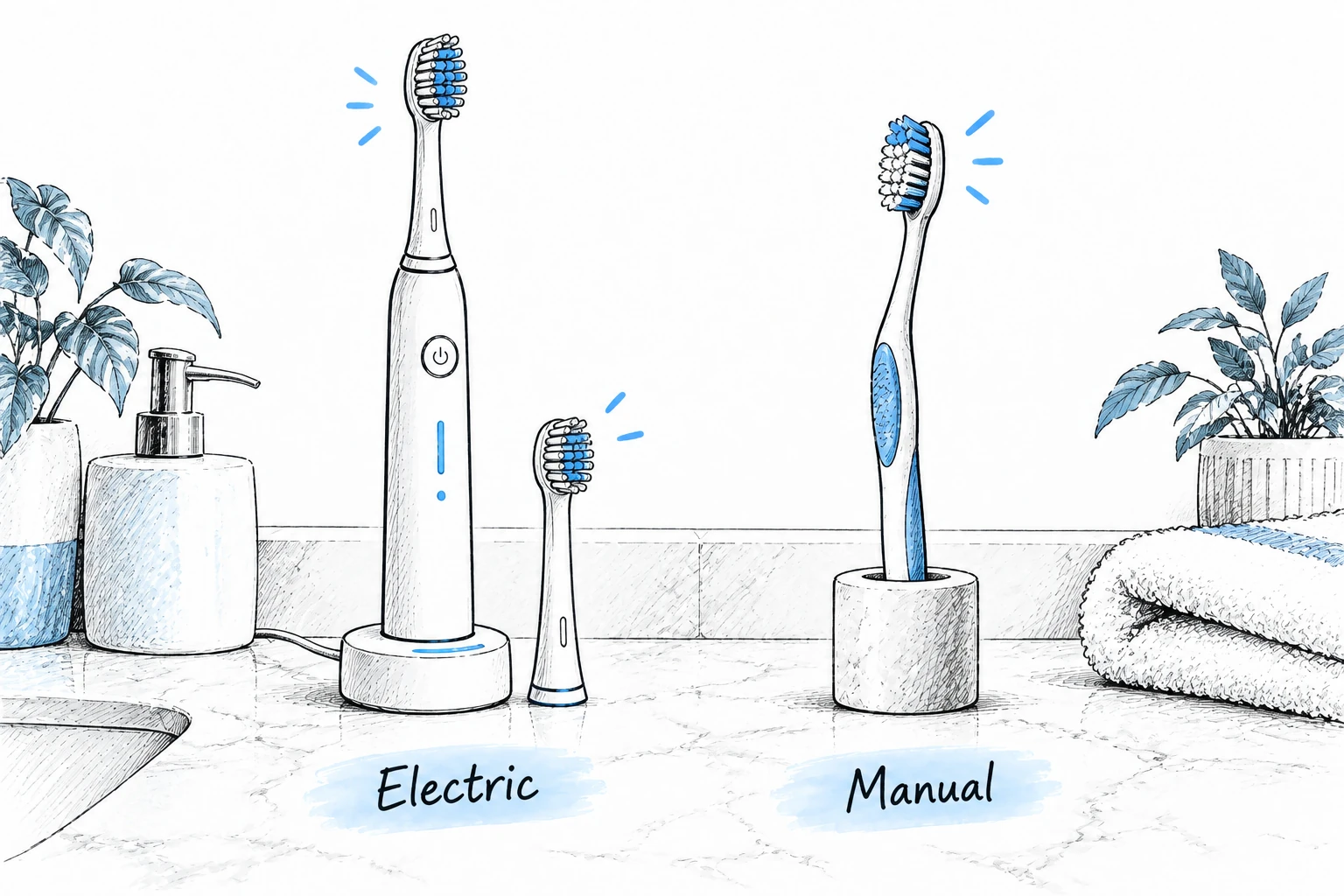
Confronto: Spazzolino Elettrico vs Manuale — Caratteristica per Caratteristica
✓ Spazzolini Elettrici
Quando si sceglie tra spazzolino elettrico e manuale per la propria gamma di prodotti, considerare questi vantaggi:
- Lower average plaque index in the Cochrane review
- Timer integrato da 2 minuti
- Motor-driven movement reduces repetitive hand strokes
- Pressure feedback on models equipped with a sensor
- Modalità multiple per diverse esigenze
- Più facili per persone con mobilità ridotta
- Age-appropriate features can help engage children
- Small heads can help users clean around orthodontic appliances
- Esplora la nostra collezione di spazzolini elettrici →
✓ Spazzolini Manuali
Confrontando spazzolino elettrico e manuale per linee attente al budget, gli spazzolini manuali mantengono ancora il loro valore:
- Costo iniziale inferiore ($1-10)
- Nessuna necessità di ricarica
- Nessuna batteria da sostituire
- Portatili e adatti ai viaggi
- No proprietary replacement-head system
- Direct manual control of brush movement and pressure
- Efficaci con la tecnica corretta
- No battery or electronic components to dispose of
- Visualizza la nostra gamma di spazzolini manuali →
Pronto a lanciare il tuo marchio di spazzolini elettrici? Richiedi un preventivo OEM a Relish in 24 ore — dai modelli base agli spazzolini smart premium con connettività app.
Richiedi Preventivo OEM →Popolazioni Speciali
Ease of use can matter as much as brush motion. Consider the needs of each user group:
Bambini
Age-appropriate powered brushes can offer:
- Powered cleaning with a small, soft brush head
- Timers or playful features that encourage a brushing routine
- An opportunity to practise coverage with an adult’s guidance
Choose a brush with an age rating, head size and bristle softness appropriate for the child. Adults should assist or supervise as needed and follow the product instructions and dental advice.
Persone con Mobilità Ridotta
A powered brush can make daily cleaning easier for people who find repetitive hand movements difficult, including some users with arthritis, carpal tunnel syndrome or Parkinson’s disease. Handle shape, grip and ease of switching modes should be assessed for the individual.
- Artrite
- Sindrome del tunnel carpale
- Morbo di Parkinson
- Controllo motorio limitato
Motor-driven movement can reduce repetitive hand effort, while the user or caregiver guides the brush across all tooth surfaces.
Pazienti Ortodontici
For people with braces, a suitable small head can help with access around brackets and wires. Cleaning technique and appropriate interdental tools remain important. Choose the brush and head with advice from the orthodontic team.
- Small heads for access around brackets and wires
- Gentle pressure and guidance from the orthodontic team
- Brushing combined with suitable interdental cleaning
Analisi dei costi
Per i proprietari di marchi che confrontano spazzolino elettrico vs manuale per linee retail o promozionali, è essenziale comprendere le dinamiche dei costi dall'approvvigionamento all'uso da parte del consumatore. Quando si valuta il costo dello spazzolino, considerare il costo totale di proprietà nel tempo:
| Fattore di Costo | Manuale | Elettrico |
|---|---|---|
| Acquisto iniziale | $1-10 | $30-300+ |
| Annual brush or replacement-head cost | $6-60 | $30-120 |
| Brushes or heads per year | 4 (trimestrali) | 4 (trimestrali) |
| Costo su 5 anni | $35-300 | $180-900 |
| Risultati per la salute orale | Can be effective with appropriate daily use | Average plaque and gingivitis benefit in the Cochrane review |
Buying insight: Compare the initial price, replacement availability and features the user will actually use. The figures above are illustrative USD ranges, not current retail quotations. The two five-year examples use different purchasing assumptions and should not be treated as the minimum and maximum of every price combination.
Elementi Essenziali per l'Approvvigionamento OEM di Spazzolini Elettrici
- MOQ (Quantità minima d'ordine): Relish Tech’s standard custom MOQ is 1.000 unità, with flexibility according to the order. Stock products are available for wholesale from 50 units. Confirm the quantity for the selected configuration in the quotation.
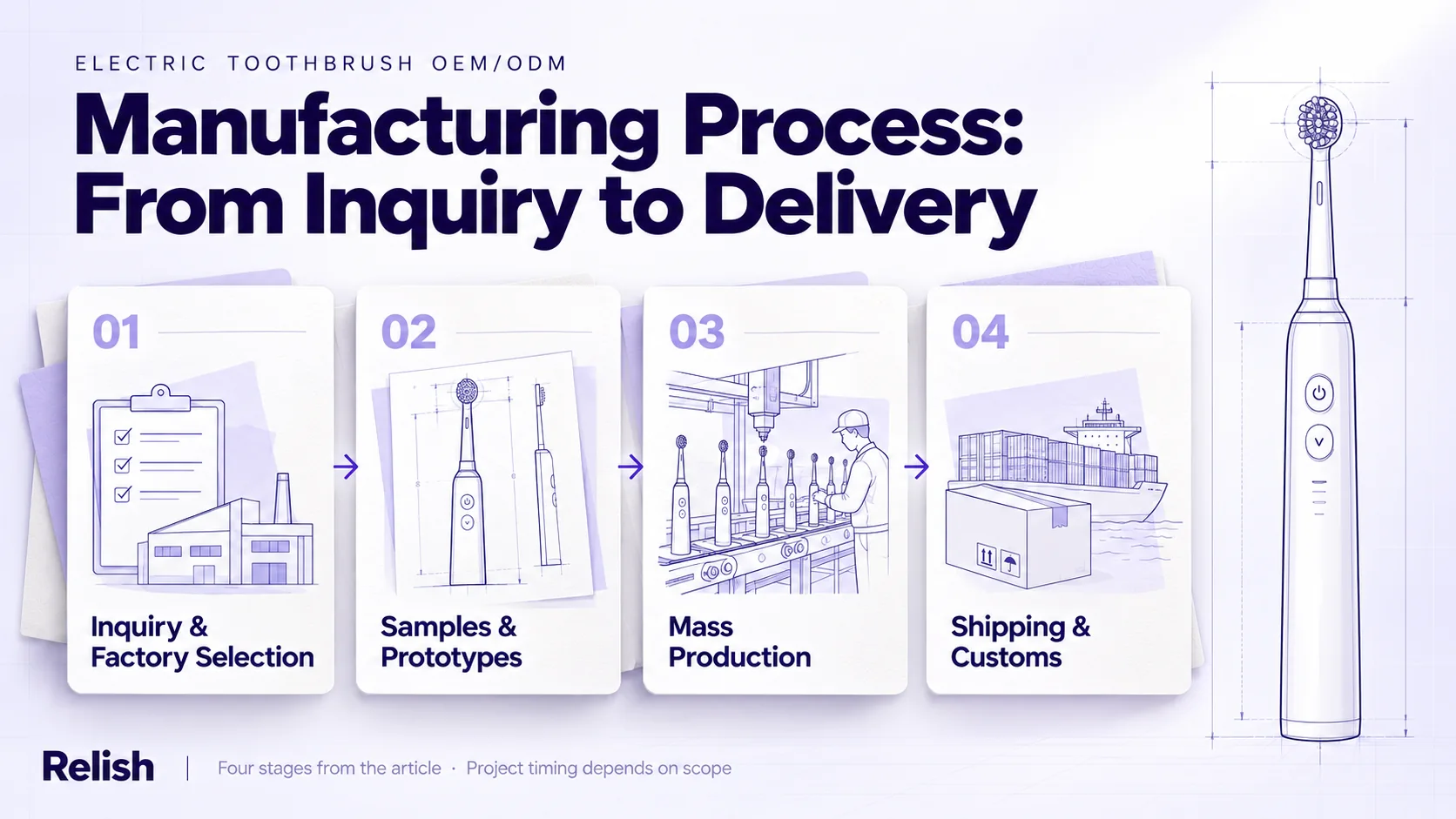
- Tempi di consegna: Plan for 45–90 giorni of OEM production after deposit confirmation, plus an indicative 7–14 days for shipping on the selected route. A 30-day rush order and a 15–25% premium depend on capacity and project scope; confirm the schedule and charges in the quotation.
- Controllo qualità: Agree on relevant Convalida IQ/OQ/PQ and pre-shipment inspections. Specify defect classes and sampling criteria; AQL 2.5 may be agreed for relevant cosmetic defects, alongside 100% functional testing for electronics. It is not an acceptance limit for safety-critical defects.
- Market Compliance: For the US, check the product’s FDA classification and applicable establishment registration and device listing requirements. Powered toothbrushes under JEQ/21 CFR 872.6865 are Class I and 510(k)-exempt within the exemption limits. For the EU, confirm CE obligations for the actual design and intended purpose, including applicable EMC, RoHS or radio-equipment rules. MDR 2017/745 and IEC 60601-1 are not universal requirements for every consumer electric toothbrush.
Punti chiave
- Research supports powered brushing: The 2014 Cochrane review found plaque and gingivitis indices 21% and 11% lower, respectively, after more than 3 months. These are pooled study results, not a promise for every model.
- Technique still matters: The motor supplies brush movement; the user supplies placement, coverage and appropriate pressure.
- Budget for ongoing use: The table illustrates five-year costs of USD 35–300 for manual brushes and USD 180–900 for powered models. The Cochrane review does not establish savings in dental expenses.
- Match the brush to the user: Children, people with limited dexterity and orthodontic patients may find suitable powered features helpful.
- Il miglior spazzolino = quello che userai: Lo spazzolino più efficace è quello che userai correttamente ogni giorno
Cerchi un partner OEM per spazzolini elettrici? Scarica il nostro catalogo prodotti 2026 che include modelli di spazzolini sonici, oscillanti-rotanti e intelligenti.
Scarica il Catalogo Prodotti →Domande Frequenti su Spazzolino Elettrico vs Manuale
Per i titolari di marchi che valutano se proporre spazzolini elettrici o manuali — o entrambi — queste risposte basate su evidenze affrontano le domande più comuni relative all'approvvigionamento e al posizionamento.
Gli spazzolini elettrici sono migliori di quelli manuali?
Powered brushes showed an average advantage in the 2014 Cochrane review: plaque and gingivitis indices were 21% and 11% lower, respectively, in studies lasting more than 3 months. Both manual and powered brushes can clean effectively with appropriate use. Choose a brush that supports thorough, gentle brushing every day.
Cosa dice la ricerca sugli spazzolini elettrici vs manuali?
The 2014 Cochrane review included 56 trials, with 51 providing data for meta-analysis. At 1–3 months, plaque and gingivitis indices were 11% and 6% lower with powered brushing; after more than 3 months, the differences were 21% and 11%. Evidence was rated moderate quality, and the review did not establish identical performance for every technology or model.
Quanto sono più efficaci gli spazzolini elettrici?
The frequently quoted 21% plaque and 11% gingivitis figures come from clinical index comparisons in studies lasting more than 3 months in the 2014 Cochrane review. They do not mean that every powered brush removes 21% more plaque in a single session. Brush design, correct use and daily consistency all affect results.
Uno spazzolino manuale è sufficiente per denti sani?
Yes. The ADA states that both manual and powered brushes can remove plaque effectively. Brush gently with a soft-bristled brush and fluoride toothpaste for 2 minutes, twice daily, covering all tooth surfaces. A powered brush may help if repetitive hand movement or maintaining a routine is difficult.
Quali sono i vantaggi degli spazzolini elettrici?
Useful features can include motor-driven movement, a 2-minute timer, interval reminders, pressure feedback and an easy-to-grip handle. Age-appropriate features may help engage children. Availability depends on the model, and these features support correct use rather than guarantee it.
Perché i dentisti raccomandano gli spazzolini elettrici?
A dentist may recommend a powered brush when its movement, timer, pressure feedback or handle makes daily cleaning easier for a particular patient. Manual brushes can also be effective. The recommendation should fit the person’s oral health, dexterity and brushing habits.
I costosi spazzolini da denti valgono l'investimento?
A mid-range model in the illustrative USD 50–150 range may provide useful features such as a timer, pressure feedback or multiple modes. Premium models can add position detection, app connectivity and AI coaching. Higher price alone does not establish better clinical results, and an affordable brush may be sufficient when used correctly.
Per quanto tempo dovresti lavarti i denti?
The ADA recommends brushing for 2 minutes, twice daily, with fluoride toothpaste. A 2-minute timer and 30-second interval reminders can help users spread brushing across the mouth and stay with the routine. They are useful aids, alongside gentle pressure and coverage of every tooth surface.
Riferimenti
- Yaacob, M., et al. (2014). Powered versus manual toothbrushing for oral health. Cochrane Database of Systematic Reviews, CD002281. Cochrane review.
- American Dental Association. Spazzolini. Oral Health Topics. linee guida ADA.
- US Food and Drug Administration. Powered toothbrush: Product Code JEQ, 21 CFR 872.6865. classificazione FDA.
- US Food and Drug Administration. Are There FDA Registered or FDA Certified Medical Devices? FDA registration and approval guidance.
- Sanz, M., et al. (2020). Treatment of stage I–III periodontitis: The EFP S3 level clinical practice guideline. Journal of Clinical Periodontology, 47(Suppl. 22), 4–60. EFP guideline.
Articoli correlati
Spazzolini Elettrici di Qualità per il Tuo Marchio
Relish Tech brings 15 years of oral care technology to electric toothbrush manufacturing, with models ranging from entry-level designs to premium smart brushes with app connectivity.