








Smart Toothbrush with App: IoT & Bluetooth Guide 2026
A smart toothbrush with app connectivity gives oral care brands a practical way to differentiate through useful feedback, connected services and a better daily brushing experience. For OEM projects, the key is to choose features that users will keep using and hardware that can deliver them reliably.
This guide explains connected toothbrush hardware, Bluetooth communication, companion-app development, data privacy and project budgets. Use it to compare technical options and plan an OEM product line around your brand, target users and launch schedule.
Smart Toothbrush Features for OEM Brands
What Makes a Toothbrush "Smart"?
A “smart” toothbrush may simply sync brushing records, or it may offer live pressure alerts and guided brushing. Compare what the product measures, how accurately it interprets those measurements and how clearly the app helps the user act on them.
Motion Sensors
A 6-axis IMU combines an accelerometer and gyroscope to measure motion and help estimate brushing zones.
Pressure Sensors
Measures brushing force so the device can alert users when they press too hard.
Bluetooth Module
Bluetooth Low Energy for communication with a compatible phone.
Microcontroller
Onboard MCU processes sensor data and manages power
The data collected by these sensors is processed locally and/or synced to a mobile app, where algorithms analyze brushing patterns and provide feedback.
Smart Toothbrush Sensor Technology
Motion and pressure sensors supply different kinds of feedback. Choose the sensor combination around the intended user experience, then assess its effect on hardware cost, calibration, firmware and power consumption.
Motion Tracking: Accelerometer & Gyroscope
Motion sensors are the heart of smart toothbrush tracking:
| Sensor Type | Function | Data Generated |
|---|---|---|
| 3-axis Accelerometer | Measures acceleration along three axes | Movement signals used to estimate brushing activity |
| 3-axis Gyroscope | Measures angular velocity | Rotation signals used to estimate orientation |
| Force-Sensitive Resistor | Changes resistance in response to applied force | Calibrated force readings and pressure alerts |
Brushing-zone estimation combines motion signals with algorithms to infer which area of the mouth is being brushed. Accuracy depends on sensor placement, calibration and brushing technique; an IMU does not directly measure plaque or guarantee complete coverage. Our R&D team can help develop and evaluate a suitable system.
Pressure Sensing
Pressure sensors in smart toothbrushes serve dual purposes:
- Pressure feedback: Alert the user or adjust motor output when the configured threshold is exceeded.
- Data collection: Record pressure patterns for app feedback
Technical implementations include:
- Piezoelectric film sensors: Respond to changing mechanical loads; signal conditioning and the sensing arrangement determine their usefulness.
- Strain gauge sensors: Measure deformation in a calibrated structure to estimate brushing force.
- Hall effect sensors: Measure magnetic-field changes caused by mechanical deflection.
Bluetooth Low Energy (BLE) Connectivity
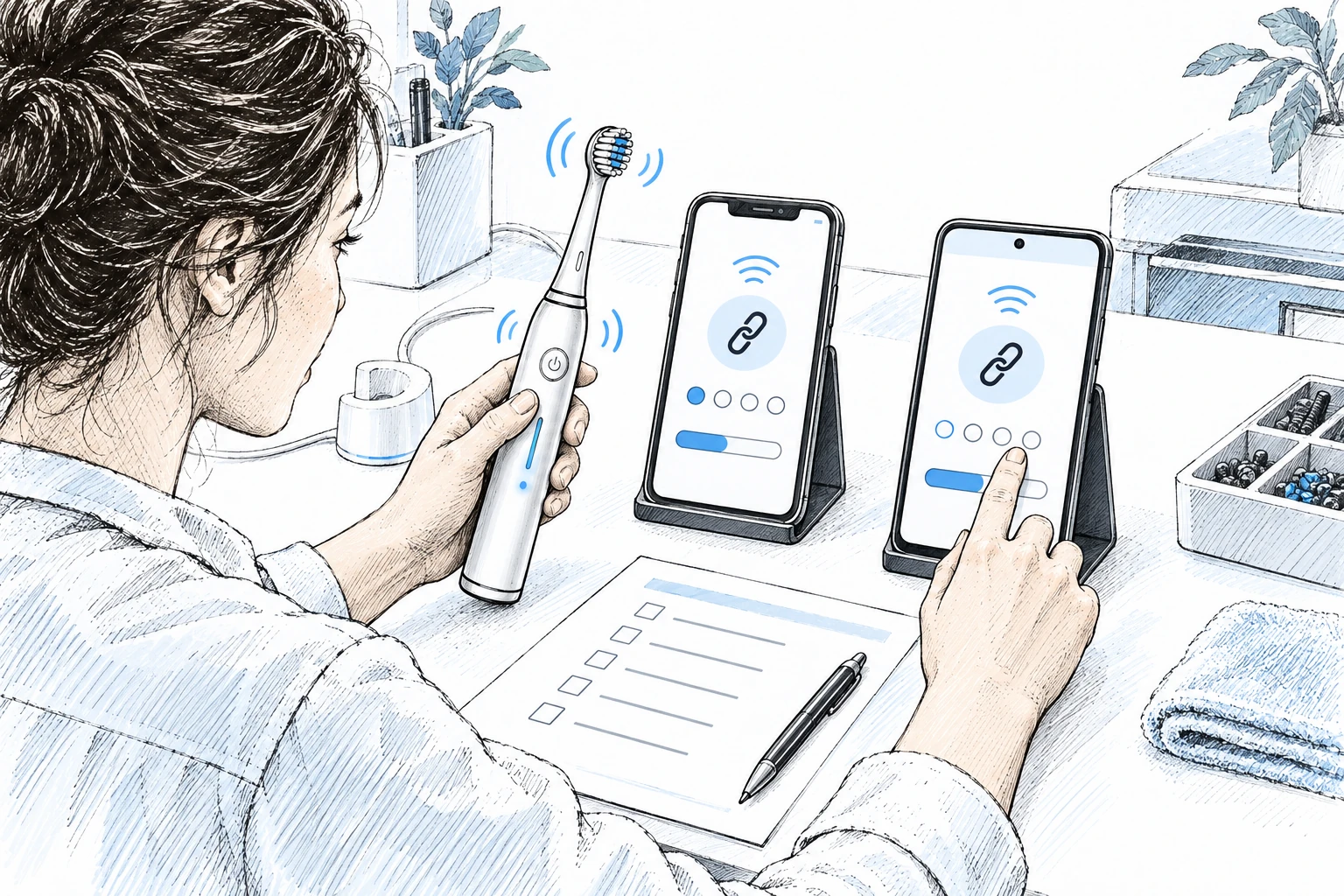
Bluetooth Low Energy (BLE) is a common link between a connected toothbrush and its companion app. Select the chipset, supported features and connection settings together, then test performance with the phones your customers use.
BLE Versions and Specifications
| Version | Range considerations | PHY data rate | Design considerations |
|---|---|---|---|
| BLE 4.0 | Depends on radio design and environment | 1 Mbps | Tune sleep and connection intervals |
| BLE 4.1 | Depends on radio design and environment | 1 Mbps | Check chipset and phone compatibility |
| BLE 4.2 | Depends on radio design and environment | 1 Mbps | Supports LE Secure Connections and privacy features |
| BLE 5.0+ | Longer range with optional LE Coded PHY | 1 Mbps; optional 2 Mbps or Coded PHY | 2M favors speed; Coded favors range |
Recommendation: Specify the BLE features you need rather than choosing by version number alone. Check secure pairing, reconnection, background sync, firmware updates and compatibility with your target phones.
Connection Protocols
Smart toothbrushes typically use these BLE protocols:
- GATT (Generic Attribute Profile): Organizes data into services and characteristics. A typical toothbrush exposes a GATT server that the app accesses as a client.
- Custom Characteristics: Manufacturer-defined data formats for brushing data, settings, firmware updates
Session summaries can be compact, while live sensor streams and firmware updates require more data. Define the payload, negotiated MTU, transfer behavior and recovery from interrupted connections.
Mobile App Architecture
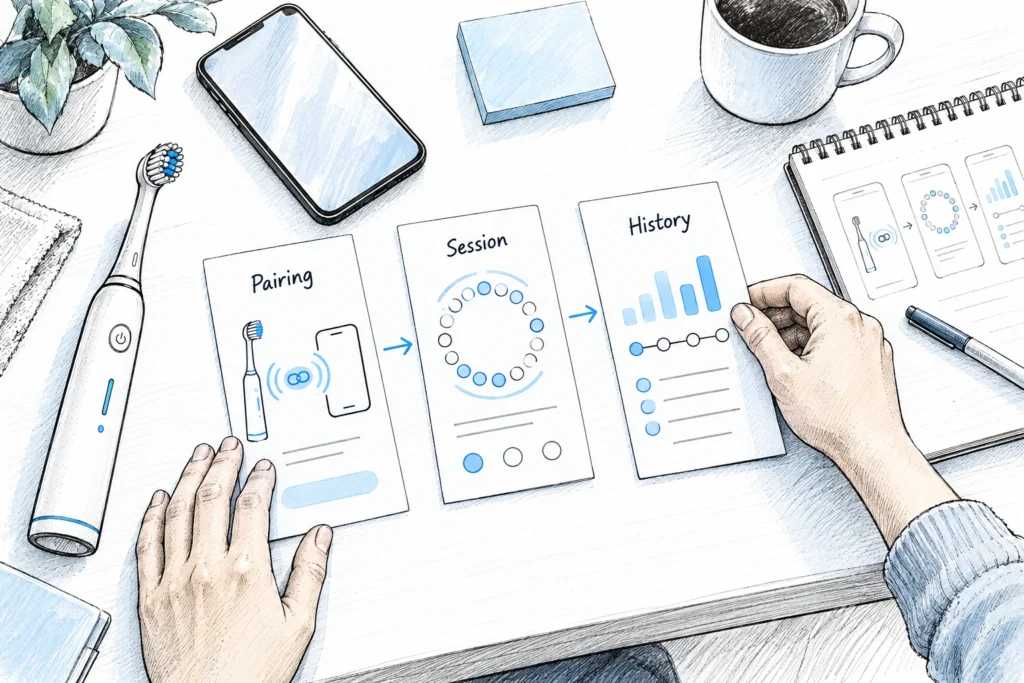
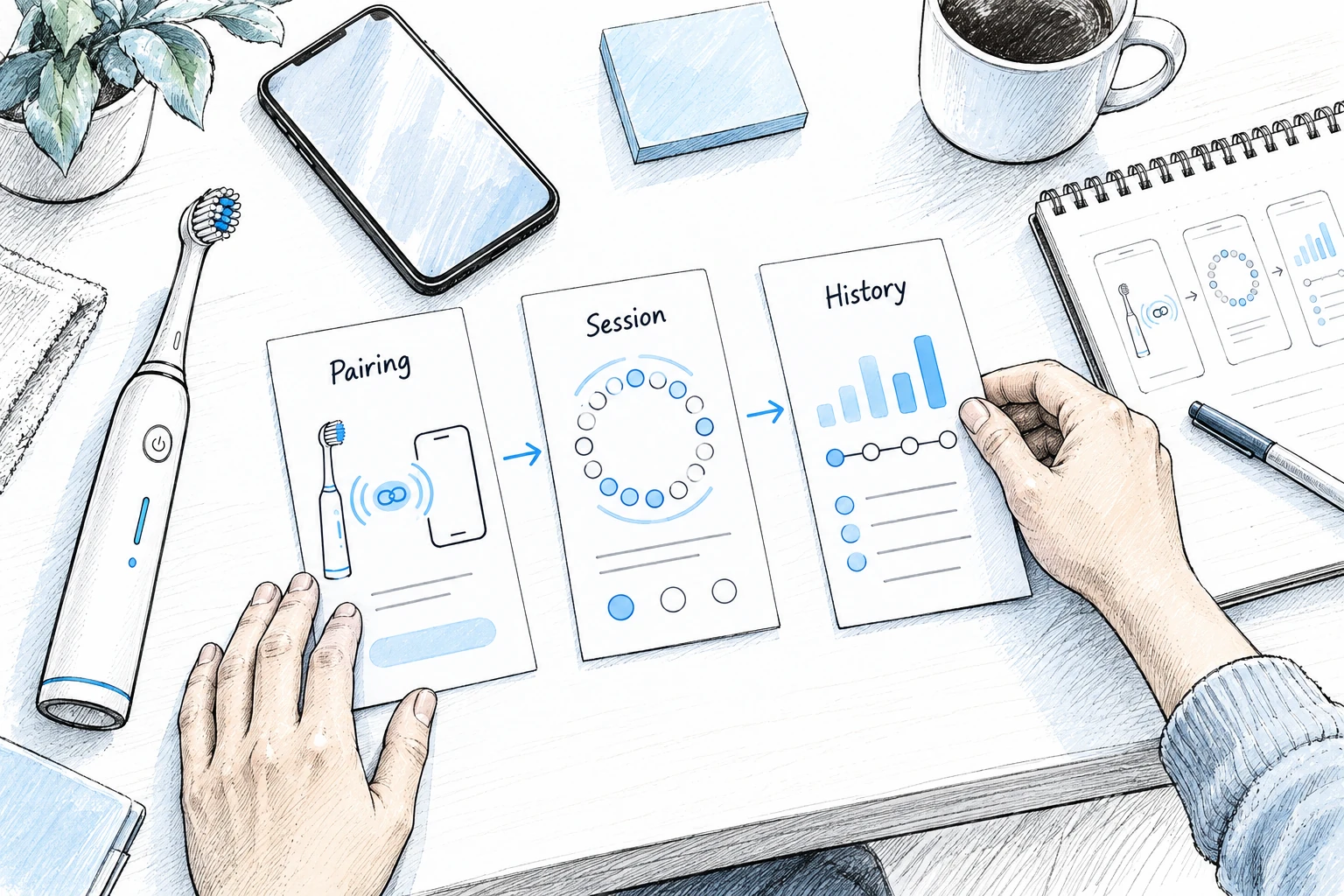
The companion app turns sensor readings into clear feedback and usable brushing records. Its development approach affects the launch schedule, support workload and ongoing cost. Explore our electric toothbrush collection when comparing hardware options for app integration.
App Types and Development Approaches
| Approach | Development Cost | Timeline | Customization |
|---|---|---|---|
| Existing app platform / white-label SDK | $5,000-15,000 | 2-3 months | Depends on SDK access and license |
| Custom development | $25,000-80,000 | 6-12 months | Full control |
| Custom cross-platform app (React Native/Flutter) | $15,000-50,000 | 4-8 months | Good flexibility |
Core App Features
Core features to consider: Choose a useful first-release set that the selected hardware can support.
- Real-time brushing visualization
- Session history and statistics
- Brushing-zone estimates, where supported
- Pressure feedback alerts
- Brushing duration tracking
- Brush head replacement reminders
Premium features (differentiators):
- AI-powered brushing analysis
- Personalized coaching and goals
- Gamification (points, streaks, achievements)
- Family accounts (multiple users)
- Supported health-platform integration
- Cloud data backup and sync
- User-authorized sharing with dental professionals
- Download our 2026 product catalog to explore premium smart toothbrush hardware options with built-in BLE and sensor platforms.
Platform Considerations
iOS vs Android vs Cross-platform:
- iOS: Focuses development on Apple devices; budget separately for an Android release.
- Android: Plan testing across the target phone models, OS versions and Bluetooth implementations.
- Cross-platform (React Native/Flutter): Shares much of the code across iOS and Android; Bluetooth and platform-specific features may still need native work.
Cross-platform development can reduce duplicated work when the SDKs and required device features support it. Compare that saving with the integration and testing effort for your product.
Health Data Integration
Health-platform integration can make brushing records easier to use alongside other wellness information. Confirm which data types each API accepts before promising compatibility; not every platform supports detailed oral care data.
| Platform | Type | Data Shared |
|---|---|---|
| Apple HealthKit | iOS Health App | Toothbrushing events and their duration |
| Android health APIs | Health Connect / Google Health API | Check supported record types; plan migration from Google Fit |
| Samsung Health | Samsung ecosystem APIs | Check SDK access and supported data types |
| Dental Platforms | B2B Integration | Agreed brushing records via a compatible interface |
Plan health-platform integration around:
- Developer accounts and app distribution fees, where required. Check current fees and account requirements before budgeting.
- Supported data types, API terms and any access review
- Platform permissions, a lawful processing basis and applicable user rights
- Data format standardization
Data Privacy and Security
Brushing records linked to an identifiable user are personal data and may reveal health information. Design the app around clear purposes, minimal collection, secure access and practical user controls, with requirements assessed for the markets you serve.
Regulatory Requirements
- GDPR (EU): Establish a lawful basis, limit collection and support applicable rights. Health data may require an additional condition for processing. See the European Commission guidance.
- CCPA (California): For businesses within its scope, provide the required notices and controls, including applicable access, deletion, correction and sale/sharing opt-out rights.
- HIPAA (US): Applicability depends on whether the app handles protected health information for a covered entity or business associate; sharing with a clinician alone does not automatically make every consumer app subject to HIPAA.
- Canada: Assess PIPEDA and applicable provincial or health-sector privacy laws for the activity and data flows.
- Certifications: Relish holds FDA, CE, ISO 13485, and IEC 60601-1 compliance for smart connected toothbrushes.
Security Best Practices
- Encryption: Protect Bluetooth links, app-to-server traffic and stored records with appropriate encryption and key management. Encryption in transit and at rest alone is not end-to-end encryption.
- Secure pairing: Use supported LE Secure Connections features and an appropriate authentication method; test the pairing flow and access controls.
- Firmware signing: Prevent unauthorized firmware updates
- Regular audits: Penetration testing and security reviews
⚠️ Data sharing: Explain what is shared, with whom and why. Obtain the permissions and legal basis required for the purpose, and provide applicable consent withdrawal and opt-out controls.
Cost Analysis for OEM Development
Budget for the complete connected product: hardware, tooling, firmware, app development, testing, certification and ongoing service. Quantities, feature scope and support commitments change the total. For hardware cost drivers, read our manufacturing cost guide.
| Cost item | Entry-Level | Mid-Range | Premium |
|---|---|---|---|
| Hardware (toothbrush) | $20-30 FOB | $30-45 FOB | $45-70 FOB |
| App development | $10,000-20,000 | $25,000-50,000 | $50,000-100,000 |
| Cloud infrastructure | $500-1,500/mo | $1,500-3,000/mo | $3,000-6,000/mo |
| Certifications | $5,000-10,000 | $10,000-20,000 | $20,000-40,000 |
| Illustrative launch budget | $50,000-80,000 | $100,000-180,000 | $200,000-400,000 |
For a full breakdown of certification requirements for smart electric toothbrushes, read our OEM certifications guide.
ROI planning: A 30–50% retail premium can be used as a pricing scenario, then tested against competing offers and customer demand. Measure app retention and repeat purchases after launch rather than assuming connectivity will improve them.
Building a smart toothbrush brand? Get your IoT toothbrush OEM feasibility report from Relish in 48 hours — hardware specs, app architecture options, and production cost estimates.
Request IoT OEM Feasibility Report →OEM Sourcing Essentials for Smart Toothbrushes
- MOQ (Minimum Order Quantity): Relish custom orders start at 1,000 units, with flexibility based on the project. Wholesale orders for available stock start at 50 units. Confirm the configuration, packaging and app scope when requesting a quote.
- Lead Time: Allow an illustrative 60–120 days for OEM production, depending on design approval, tooling and components. App work may run in parallel: the examples above range from 2–3 months for an existing platform to 6–12 months for a custom build. Confirm production and shipping schedules separately.
- Quality Control: Agree the validation and inspection plan for the product and manufacturing process, including IQ/OQ/PQ where applicable. Include 100% checks of the specified electronic functions, BLE connection and pressure feedback before shipment.
- Market requirements: US powered toothbrushes are generally FDA Class I devices under 21 CFR 872.6865, with 510(k) exemption subject to limits; registration, listing and applicable radio requirements still need attention. For the EU, assess CE requirements for radio equipment and the product’s intended purpose; MDR and IEC 60601-1 are not blanket requirements for every consumer toothbrush. See our OEM certifications guide.
Battery and Power Management
Sensors, wireless communication, displays and standby behavior all affect runtime. Balance the user experience with connection intervals, sleep states, motor demand and battery capacity, then verify the complete product under a defined usage routine.
| Usage Mode | Battery Life | Notes |
|---|---|---|
| BLE sync after each session | 2-4 weeks | Example target with periodic sync |
| Frequent BLE connection | 7-10 days | Example target with live feedback |
| Offline mode only | 4-6 weeks | Local records; later manual app sync |
| With display (OLED) | 5-10 days | Depends on display brightness and duty cycle |
Battery options: Lithium-ion and lithium-polymer designs are available. A 500–1,500 mAh capacity is an illustrative design range, not a requirement. Select the cell and charging arrangement together, and validate protection, sealing and runtime.
Key Takeaways for Brand Owners
- Choose a focused first release: Start with useful history, duration and supported pressure or zone feedback. Add AI analysis, gamification and health integrations when they address a clear user need.
- Compare app approaches: React Native or Flutter may reduce duplicated work across iOS and Android. Check BLE integration, SDK access and maintenance before selecting the framework.
- Specify BLE capabilities: Evaluate secure pairing, supported PHYs, phone compatibility and update support. A version number alone does not determine range, runtime or connection quality.
- Build privacy into the product: Set clear data purposes, controls and retention rules, and assess the laws applicable to your target markets.
- Validate health integration: HealthKit supports toothbrushing events. For Android projects, check supported record types and Google Fit migration options rather than promising universal compatibility.
Download our 2026 smart toothbrush OEM spec sheet — includes BLE module options, 6-axis IMU sensor specs, and app development cost breakdown.
Download Spec Sheet →Frequently Asked Questions About Smart Toothbrush With App
These answers cover the main hardware, app, cost and sourcing decisions for brands developing an app-connected toothbrush.
What is a smart toothbrush and how does it work?
A smart toothbrush combines an electric cleaning platform with connected functions such as session tracking, pressure alerts or guided brushing. The sensor set varies by model. BLE can send records to a companion app, which turns them into feedback and history.
Do smart toothbrushes actually improve oral health?
Timers, pressure alerts and guided feedback can help users follow a brushing routine. Benefits depend on the product, the feedback it provides and continued use. Assess any plaque, gum-health or behavior-improvement claim against evidence for that specific system.
How much does it cost to develop a smart toothbrush with app?
Use the budget table as an initial planning guide: hardware is USD 20–70 per unit FOB across the example tiers, while app development is USD 10,000–100,000. Illustrative launch budgets range from USD 50,000–80,000 for the entry tier to USD 200,000–400,000 for premium projects. These are separate scopes, not a sum without an order quantity; request a quote covering tooling, testing, production volume and ongoing services.
What Bluetooth version do smart toothbrushes use?
Connected toothbrushes commonly use BLE. Choose the chipset and supported features around secure pairing, phone compatibility, synchronization and firmware updates. The 2M and Coded PHY options introduced with Bluetooth 5 serve different speed and range goals; both are optional and require support at both ends. Test the intended phones and operating conditions.
Can smart toothbrush data integrate with health platforms?
Integration depends on the platform and supported data types. Apple HealthKit supports toothbrushing events. Google’s current guidance supports Fit APIs through the end of 2026 and describes migration to Health Connect or the Google Health API; check whether the chosen API accepts the records your product generates. Samsung and dental-system integrations also need their own access and interface assessment.
What are the privacy concerns with connected toothbrushes?
Brushing records can reveal a user’s habits and health information. Explain collection and sharing clearly, restrict access, protect transfers and stored records, and provide applicable deletion, permission and opt-out controls. Assess privacy obligations for the actual markets and data flows.
How long does battery last on a smart toothbrush?
Runtime depends on the cell, motor, display, standby settings and connection schedule. The table illustrates targets of 2–4 weeks with periodic sync, 4–6 weeks with offline logging, 7–10 days with frequent connections and 5–10 days with a display. These are example design profiles; verify the chosen model under a stated brushing routine.
What features should a premium smart toothbrush have?
Choose features around a clear premium experience: reliable zone estimates, helpful pressure feedback, personalized guidance and a well-designed app. Displays, AI analysis, cloud services and health integrations are options to evaluate against their cost, usability and support needs. Premium pricing depends on the value users perceive.
References
- Bluetooth SIG. The Bluetooth Low Energy primer. Radio features, GATT and BLE design concepts.
- Apple Developer Documentation. HealthKit toothbrushingEvent. Toothbrushing event data type.
- Android Developers. Fit migration guide. Google Fit API support and migration options.
- European Commission. Legal grounds for processing data. GDPR lawful processing and health-data conditions.
- US Department of Health and Human Services. Resources for Mobile Health Apps Developers. HIPAA applicability and health-app scenarios.
Related Articles
Develop Your Smart Toothbrush Product Line
Relish Tech offers end-to-end smart toothbrush OEM development: hardware design, BLE integration, app development support, and mass production.