








NNN Agreement & IP Protection Guide:
Sourcing from China Safely
Your intellectual property is your brand's most valuable asset. Learn how to protect it when manufacturing in China — with NNN agreements, trademark registration, patent strategy, and supply chain segmentation.
Key Takeaways
- A China-focused NNN agreement sets out confidentiality, permitted use and non-circumvention obligations for your manufacturing project. Enforceability depends on the contract and circumstances, not its title.
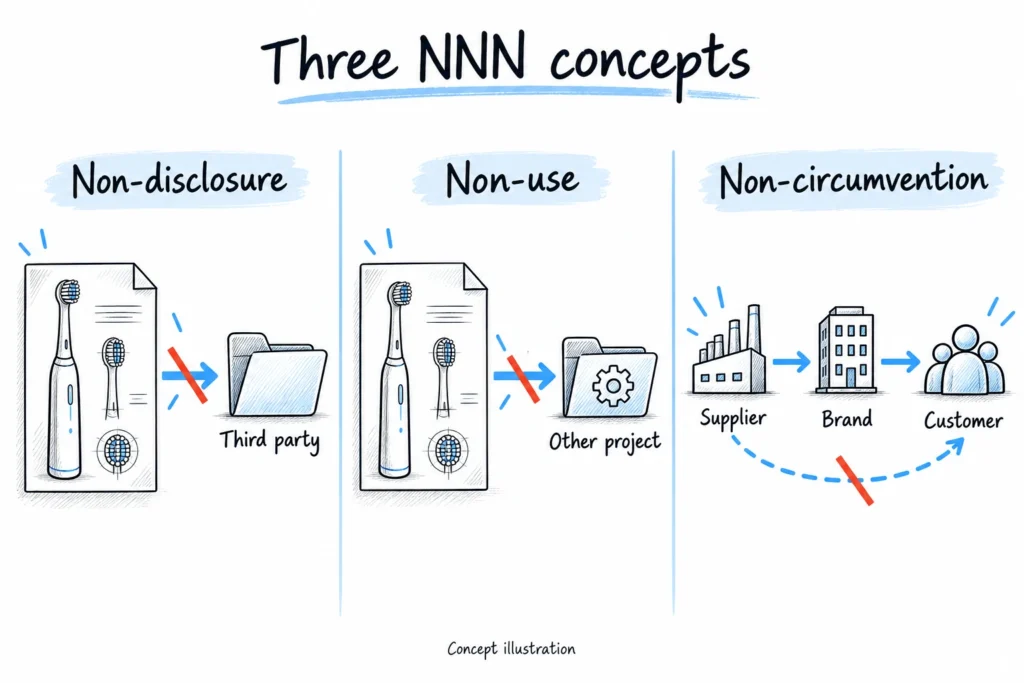
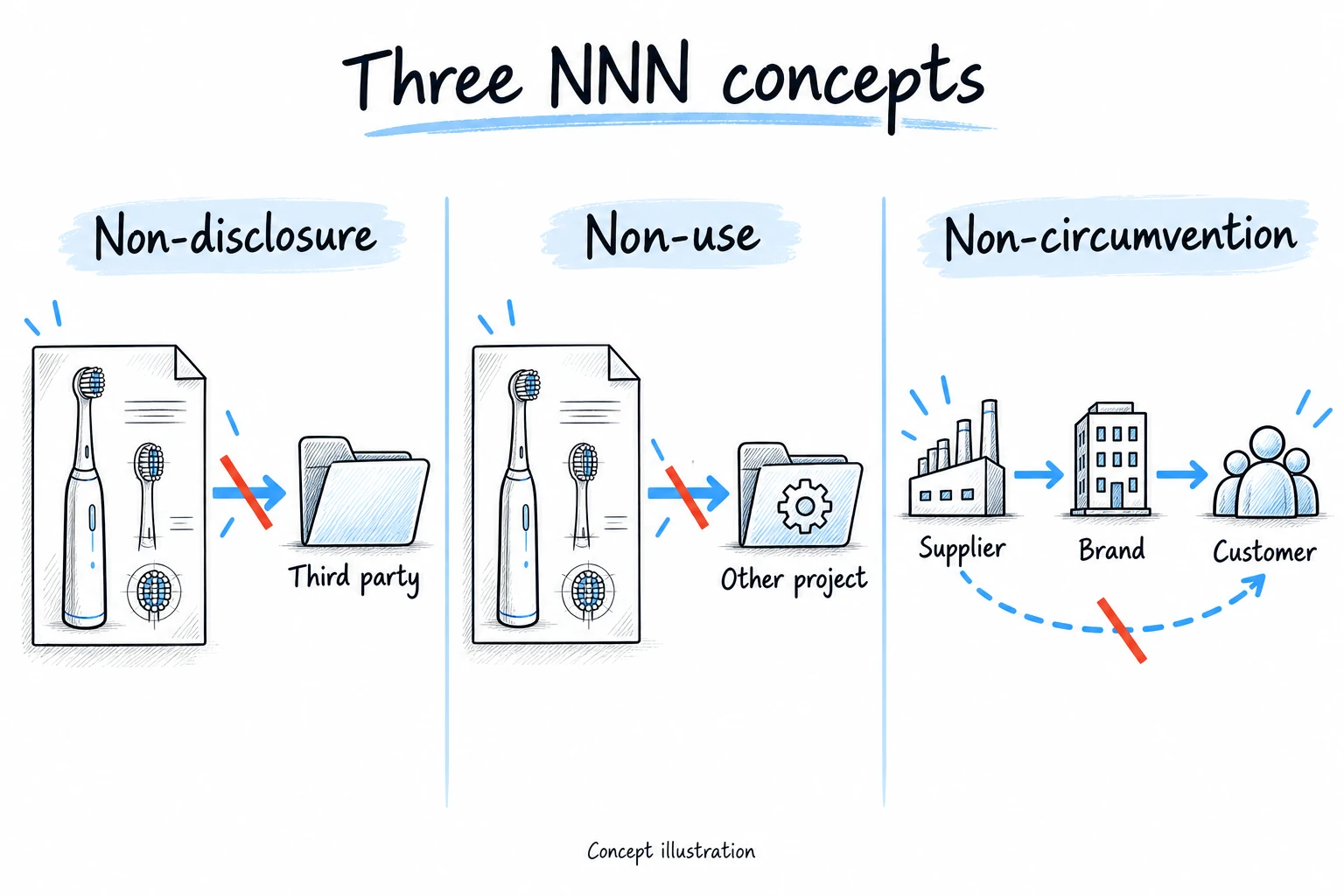
- It covers three critical protections: Non-Disclosure, Non-Use, and Non-Circumvention
- Agree on confidentiality and permitted use before sharing proprietary designs, sketches or prototype details.
- Plan China trademark protection early. First-to-file rules make timing important, alongside prior rights and safeguards against bad-faith applications.
- Build an evidence trail: keep signed agreements, dated design files, disclosure records and proof of ownership.
- Combine a suitable NNN agreement, trademark protection and eligible patent filings with practical access controls.
Protecting IP starts before you send design files to a manufacturer. Define what information may be used, who may access it and what happens when the relationship ends. A familiar NDA can still be useful, but its actual clauses, governing law and dispute arrangements need to fit your China sourcing project.
NNN Agreement vs NDA: Why the Distinction Matters
An NDA usually focuses on confidentiality; an NNN agreement explicitly addresses non-disclosure, non-use and non-circumvention. The labels alone do not determine protection: an NDA can also contain use restrictions. For OEM projects involving designs, formulations and customer information, compare the actual obligations.
| Attribute | Standard NDA (scope varies) | China-focused NNN agreement |
|---|---|---|
| Governing Law | As agreed by the parties | Often PRC law; specify the applicable law |
| Jurisdiction | As agreed in the contract | A specified court or arbitration forum, such as CIETAC |
| Non-Disclosure | Yes | Yes |
| Non-use of protected information | Depends on the wording | Expressly defined |
| Non-Circumvention (no cutting you out) | Depends on the wording | Expressly defined |
| Contract language and translations | Specify the controlling version and translation arrangements | A consistent Chinese or bilingual version can support local use |
| Agreed damages | May be included | May be included; amount and terms require review |
| Staff and subcontractor obligations | Depends on the wording | Address everyone permitted to access the information |
| Enforcement planning | Depends on forum, evidence and assets | Plan for the chosen forum, evidence and available remedies |
A non-use clause defines how the manufacturer may use protected information, including development of competing products. Check this explicitly even if the document is called an NDA. Contract restrictions complement IP and trade-secret rights; the absence of a particular clause does not automatically make copying lawful.
The 3 Core Clauses of an NNN Agreement
Confidentiality Protection
Define the confidential information covered, including product specifications, designs, formulations, pricing and customer data. Limit disclosure to authorized people who need it for the project, and address exclusions, permitted disclosure and the duration of confidentiality obligations.
No unauthorized use of protected information
Define permitted project use and prohibit unauthorized use of protected information to develop, manufacture or market competing products. Specify which obligations continue after the relationship ends. This addresses use of your information without assuming that every independently developed competing product is prohibited.
No bypassing agreed business relationships
Specify the customers, contacts and transactions covered by the non-circumvention clause. Set a suitable duration and address pre-existing relationships and permitted contact. This can help protect the commercial relationships disclosed during an OEM project.
What to Address in a China-Focused NNN Agreement
Use a contract tailored to the project and the manufacturer’s legal entity. Review these points before disclosing proprietary information:
- Language and controlling version: Prepare consistent Chinese or bilingual terms and specify which version controls. Agree on translation requirements for the chosen dispute forum.
- Governing law: Specify the applicable law. PRC law is often chosen for China manufacturing contracts; a foreign-law clause is not automatically unenforceable solely because it is foreign.
- Dispute resolution: Specify the competent court or a valid arbitration arrangement. If choosing CIETAC, address the seat, language and applicable rules rather than leaving alternatives unresolved.
- Agreed damages: Set a reasoned amount or calculation method for breach. Under Civil Code Article 585, a court or arbitral institution may adjust agreed damages at a party’s request in the circumstances set out by law.
- Staff and subcontractor obligations: Require appropriate confidentiality and use restrictions for everyone authorized to receive the information, including relevant employees and subcontractors.
- Scope of confidential information: Define explicitly what is covered — CAD files, mold designs, product specifications, customer lists, pricing, manufacturing processes.
- Survival clause: Set durations appropriate to the information and obligations. Trade secrets may need protection for as long as they remain secret; a fixed three-to-five-year period is not a universal minimum.
Budget for contract drafting alongside trademark and patent work. This guide uses USD 800–2,500 as an illustrative allowance for a tailored bilingual NNN agreement and USD 300–800 per trademark class for filing assistance. These are separate costs; obtain an itemized quote covering scope, official fees and professional fees.
Registering Your Trademark in China: First-to-File Rules
China generally gives priority to earlier trademark applications, but prior rights, earlier use in relevant circumstances and bad-faith rules also matter. Plan your filings before launch and review the Chinese name you intend to use. Overseas registration does not automatically provide China registration.
Step-by-Step: China Trademark Registration
Search for conflicts
Search the CNIPA trademark database for identical or similar marks and review the relevant goods and services. Class 21 includes toothbrushes and related tools; other classes depend on the products you plan to sell.
Appoint an appropriate China trademark agency
For applicants without a habitual residence or business office in China, use a lawfully established trademark agency for local filing. Check the agency and obtain a quote. The USD 300–800 per-class allowance in this guide is illustrative; examination, objections and other issues affect the timetable.
File in Latin Script AND Chinese Characters
Assess protection for the Latin-script brand name and the Chinese name or transliteration you intend to use. Search both before filing; protection for one version should not be assumed to cover every other version.
Register in All Relevant Classes
Choose goods and services that match your business: Class 21 may cover toothbrushes and oral care tools, Class 10 dental apparatus, and Class 3 toothpaste and preparations. You do not automatically need all three classes. China permits multi-class applications; confirm coverage, subclasses and fees with your agent.
Use and Renew
China trademark registrations last ten years from registration and can be renewed. A mark unused for three consecutive years without justification can face cancellation proceedings. Keep suitable records of genuine use and manage renewal deadlines.
Patent Strategy for Oral Care OEM Brands
An eligible China patent can help you stop unauthorized exploitation within its protected scope. It does not by itself establish freedom to operate against other parties’ rights. China offers invention, utility model and design patents:
Supply Chain Segmentation: The 4th Layer of Protection
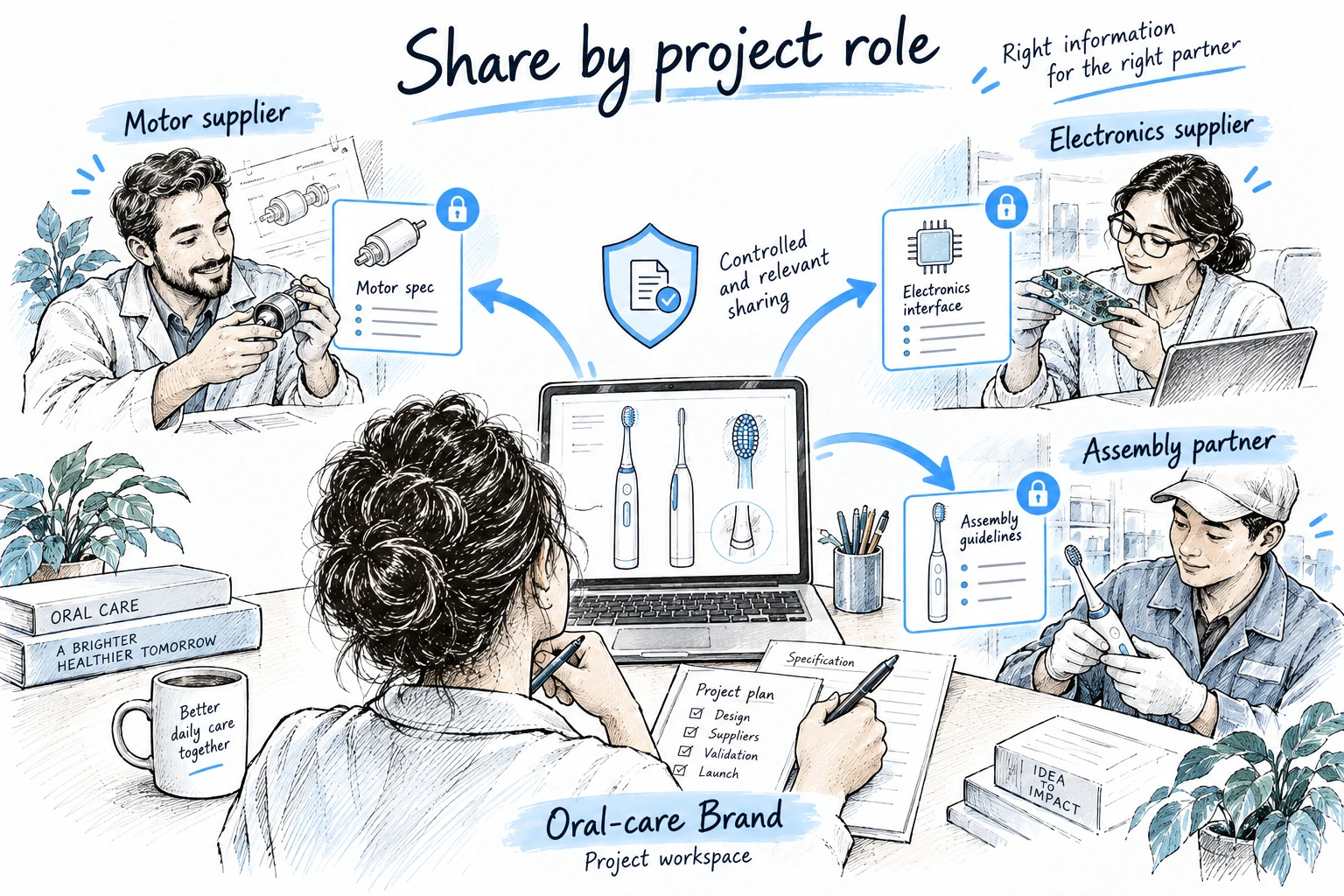
Supply chain segmentation can limit unnecessary disclosure alongside contracts and registered rights. Separate information by role while preserving the specifications needed for integration, safety and quality checks.
- Separate component information where practical: a motor supplier and PCB developer may receive different technical packages. Give the assembly factory the interface and performance information it needs, and define confidentiality obligations across the participants.
- Document tooling ownership: Record ownership, permitted use, maintenance, access and release arrangements in the manufacturing contract. Agree how tooling will be returned or stored if the relationship ends.
- Limit data sharing by role: Provide the information needed for each task without exposing unrelated proprietary details. Do not withhold settings needed for integration, testing or product safety.
- Manage supplier dependency: Qualify alternatives where useful, but assess compatibility and change-control requirements before moving components to a new supplier.
Need a China IP Protection Framework for Your OEM Project?
Relish Technology signs NNN Agreements as standard practice before any design discussion. We can share our template structure and connect you with a qualified China IP attorney. Start with a conversation.
Before engaging any manufacturer, verify their quality systems with a structured assessment. Our China Factory Audit Checklist covers 30 verification points including ISO 13485 certification, production capacity, and IP handling procedures. For a full picture of manufacturing costs and what to budget for tooling, see our OEM Manufacturing Cost Guide. And if you're comparing technology platforms before committing to a supplier relationship, our Sonic vs. Oscillating-Rotating OEM Guide covers motor selection, BOM cost structure, and certification implications.
Relish Technology's IP Protection Commitment
Our Commitment to Your Intellectual Property
At Relish Technology, protecting our clients' IP is foundational to our business model — we have built a 15-year reputation on it. Here's what we commit to every brand partner:
Our R&D team has developed proprietary technologies (Vibrosonic™, Rotasonic™) — we understand firsthand what IP protection means to a brand.
Frequently Asked Questions
Partner with a Manufacturer Who Protects Your IP
Relish Technology signs NNN agreements as standard practice. 15+ years, 300+ brand clients, zero IP breach history. Request a partnership inquiry today.
Request NNN Agreement & Quote →References & Sources
- World Intellectual Property Organization. How to Protect Trade Secrets? Source: https://www.wipo.int/en/web/trade-secrets/protection
- China National Intellectual Property Administration. How Can Foreign Applicants Apply for Trademark Registration? Source: https://english.cnipa.gov.cn/art/2026/3/17/art_2996_205374.html
- China National Intellectual Property Administration. Patent Law of the People’s Republic of China, amended in 2020; Articles 2, 11 and 42. Source: https://english.cnipa.gov.cn/art/2022/10/13/art_3068_179273.html
- Supreme People’s Court. Civil Code of the People’s Republic of China; Article 585 on agreed damages. Source: https://www.court.gov.cn/zixun/xiangqing/233181.html
- China International Economic and Trade Arbitration Commission. Arbitration Rules, effective January 1, 2024. Source: https://www.cietac.org/en/articles/32216