China Factory Audit Checklist: 30-Point Guide for OEM
China Factory Audit Checklist: 30-Point Guide for Oral Care Brands
Before placing your first order with a Chinese oral care manufacturer, use this 30-point factory audit checklist to assess certifications, quality systems, capacity and compliance. Built on 15 years of factory experience, it helps you turn supplier claims into practical checks.
ISO 13485 Verification30 Audit PointsCritical / Major / Minor PriorityThird-Party Audit Guidance
Key Takeaways
A factory audit is a key due-diligence step when sourcing oral care products from China.
This 30-point checklist covers six areas: certifications and legal compliance, quality systems, production capacity, intellectual property, component supply, and labor and environmental practices.
Priority levels: Critical (resolve before proceeding), Major (agree and verify corrective action), and Minor (follow up as part of improvement).
Use USD 400–900 as an illustrative audit allowance, then obtain a quote for the location, auditor days, technical scope, travel and follow-up work.
Resolve every Critical finding before proceeding. Use the remaining findings to agree corrective actions and decide whether a pilot order is appropriate.
At Relish, custom orders typically start at 1,000 units with flexibility for the specific order; wholesale orders for available stock start at 50 units. Match the audit scope to your product and sourcing risk.
🏭 20,000 m² Shenzhen Factory
✅ ISO 13485 Certified
🇺🇸 FDA Registered
🇪🇺 CE Certified
📋 Audit-Ready — Anytime
A factory audit helps you assess whether a promising supplier can become a dependable manufacturing partner. Reviewing production records, quality controls and relevant documentation before ordering can expose delivery, product-quality, compliance and intellectual-property risks while there is still time to address them.
This checklist focuses on electric toothbrushes, water flossers and related oral care products. Adapt the checks to the product and target market, including applicable FDA requirements, EU product legislation and relevant quality-system standards. Use it during a site visit, a remote screening call or when briefing a third-party auditor.
How to Use This China Factory Audit Checklist
Work through all 30 points and record evidence, findings, owners and due dates. Agree which checks are Critical for your product before the audit; do not let a high overall score conceal an unresolved safety or legal issue.
Critical: A fail on any Critical item is a hard stop — do not proceed until resolved. These items affect safety, legality, or fundamental quality capability.
Major: Agree corrective actions, owners and deadlines, then verify closure before the relevant production or shipment milestone.
Minor: Record the improvement needed and follow up. Repeated findings or signs of a wider control problem can justify a further audit.
Ready
All Critical findings resolved
Consider a pilot order after reviewing Major actions
Action needed
Corrective actions remain open
Agree deadlines and verify closure
Stop
Unresolved Critical finding
Resolve the issue or choose another supplier
Category 1: Certifications & Legal Compliance
Check the factory’s legal identity and the certificates or product documents relevant to your target markets. Request complete, legible documents and verify the issuer, validity and scope. For a market-by-market overview, see our Electric Toothbrush Certifications Guide.
01–06Certifications & Legal Compliance6 items
1
ISO 13485 certificate is valid and covers the relevant site and manufacturing scope.
Check the company name, address, certificate number and status in IAF CertSearch at iafcertsearch.org, or with the certification and accreditation bodies. Confirm that accreditation covers the relevant standard.
Critical
2
Business license is current and matches factory name, address, and legal representative
Request original; verify on China's GSXT enterprise registration portal
Critical
3
EU conformity documentation is available for the relevant product and configuration.
Review the Declaration of Conformity, supporting technical documentation and applicable legislation; experience with a similar product does not automatically cover a new model.
Major
4
Applicable FDA registration, listing and quality-system obligations have been identified.
Verify the legal entity and device classification, and review supporting records. For manufacturers subject to 21 CFR Part 820, the QMSR has applied since February 2, 2026 and incorporates ISO 13485:2016; review the required medical device files and production records.
Major
5
Applicable electrical-safety and lithium-battery transport documentation is available.
Check model coverage, test standards and laboratory scope, including IEC 60335-1 with IEC 60335-2-52 where appropriate. For lithium batteries, request the applicable UN 38.3 test summary and confirm the shipment route’s transport requirements.
Critical
6
RoHS and REACH evidence is available where applicable.
Review material declarations and relevant test reports against the product, substances and current requirements; a safety data sheet alone does not establish full product compliance.
Major
Category 2: Quality Management Systems
Beyond holding ISO 13485 on paper, a qualified factory must demonstrate that its quality management system
is operational. Ask to see records, not just policies. Factories that can pass this section of a china factory audit checklist consistently are those most likely to maintain quality across long-term production runs.
07–14Quality Management Systems8 items
7
Incoming Quality Control (IQC) covers motors, batteries, PCBs and other critical components.
Review the inspection criteria, sampling or full-inspection rules, supplier records and recent rejection data. Confirm how the factory responds when incoming parts fail.
Critical
8
In-Process Quality Control (IPQC) checkpoints address the risks at each production stage.
Review work instructions, inspection records and responses to deviations. Use SPC or AOI where these methods suit the process.
Critical
9
Outgoing Quality Control (OQC) follows an agreed finished-product test plan.
Check functional tests, water-ingress tests, motion or pressure output and battery performance. Distinguish sample qualification tests from routine checks on each unit.
Critical
10
The sampling plan defines defect classes, inspection level, sample size, acceptance and rejection numbers, and any agreed AQL values.
Verify records against the selected standard, such as ANSI/ASQ Z1.4. Specify a zero-acceptance rule for Critical defects and the required safety checks; do not assign them an ordinary 1.5% allowance.
Major
11
Defect records use clear definitions and show the number of inspected units, failures and customer returns over the review period.
Compare like-for-like products and inspection stages, and examine trends and corrective actions rather than relying on an undefined industry benchmark.
Major
12
Non-conforming product quarantine area clearly marked and segregated
Rejected goods must never re-enter production flow without documented approval
Major
13
Corrective Action / Preventive Action (CAPA) system with documented resolution records
Ask for 2–3 examples of CAPA cycles — quality improvement process maturity
Major
14
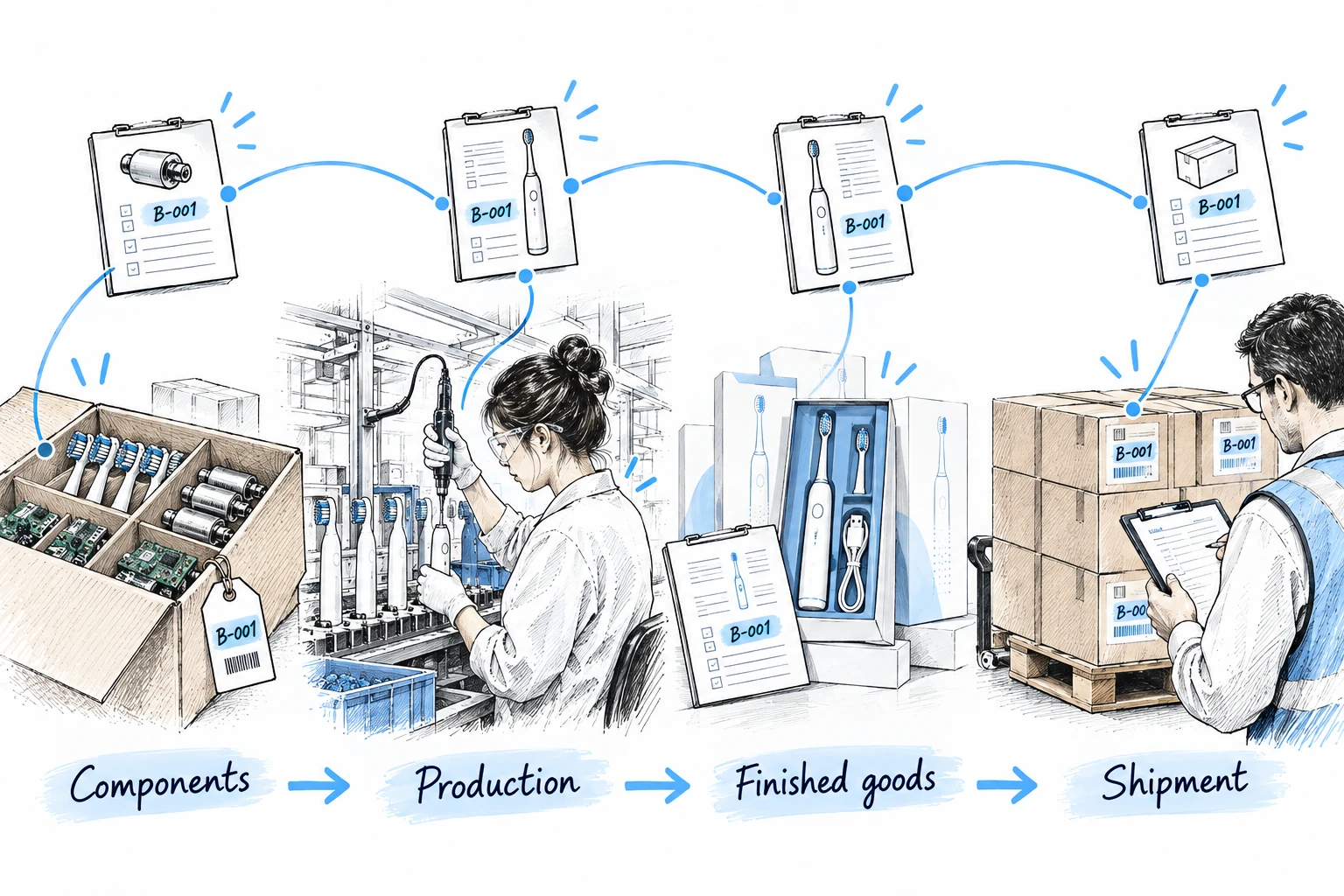
Batch records link incoming materials, production, finished goods and shipments.
Trace a sample batch through the records and review complaint or recall procedures. For regulated medical devices, check the applicable ISO 13485 and FDA QMSR record requirements.
Critical
Follow batch records from incoming components through production and finished goods to shipment. Concept illustration; B-001 is an illustrative batch identifier.
Audit Relish Technology Before You Commit
ISO 13485 certified · <0.3% defect rate · FDA registered · CE certified · Audit-ready on short notice. Request our factory documentation package today.
Verify the factory can actually deliver your volume, on your timeline, with the technology your product requires. This section is particularly important when evaluating factories against your MOQ requirements — capacity claims without evidence are one of the most common issues found during a china factory audit.
MOQ and tooling: Relish custom orders typically start at 1,000 units, with flexibility for the specific order; wholesale orders for available stock start at 50 units. Confirm the MOQ basis for each SKU, color, pack or set. Quote tooling separately, identify its ownership, and clarify which packaging, accessories, firmware and testing are included.
15–20Production Capacity & Capability6 items
15
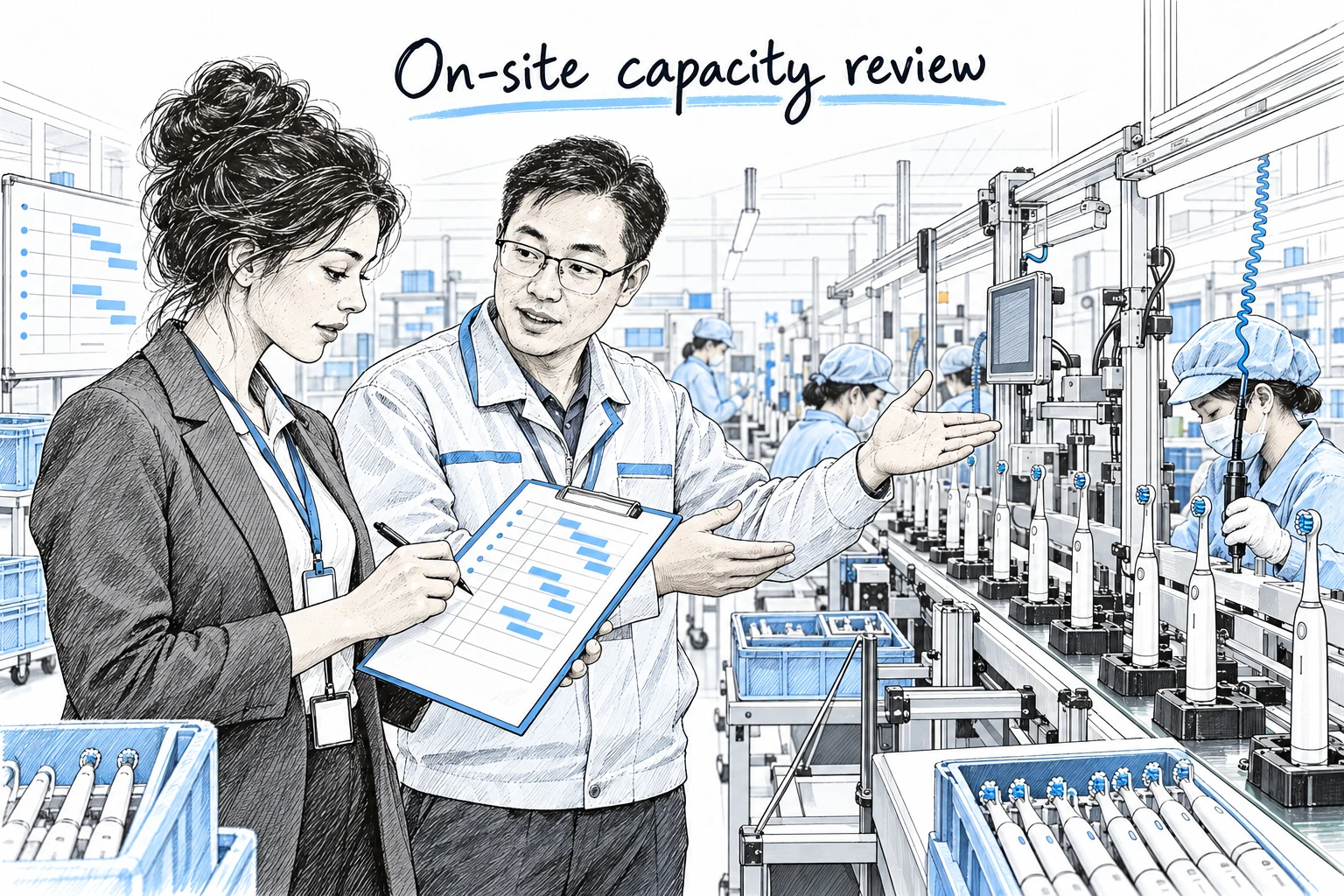
Monthly capacity is supported by production and shipment records.
Cross-check machine availability, staffing, shifts, utilization and existing orders, then confirm capacity for your product and delivery window.
Critical
16
Equipment can verify the agreed toothbrush motion specification.
Confirm the measurement method, load condition and distinction between motor frequency, brush-head movement and marketing strokes per minute. Check calibration records or the qualified external testing arrangement.
Critical
17
Water-ingress testing matches the claimed IP rating and the agreed quality plan.
IPX5 water-jet testing and IPX7 temporary-immersion testing are different. Review the applicable IEC 60529 method, test conditions, equipment and records; agree appropriate routine leak checks separately.
Critical
18
Injection molding is performed in-house or by a qualified, documented partner.
Review tooling control, dimensional inspection, change approval and delivery arrangements across both sites.
Major
19
The R&D team and sample facilities support the required development work.
Review relevant staff experience, prototype records and agreed sample lead times; assess capability against your project rather than a fixed engineer headcount.
Major
20
The supplier can provide relevant customer references with the customers’ permission.
Where available, contact two or three references to discuss comparable products, quality, communication and delivery performance.
Major
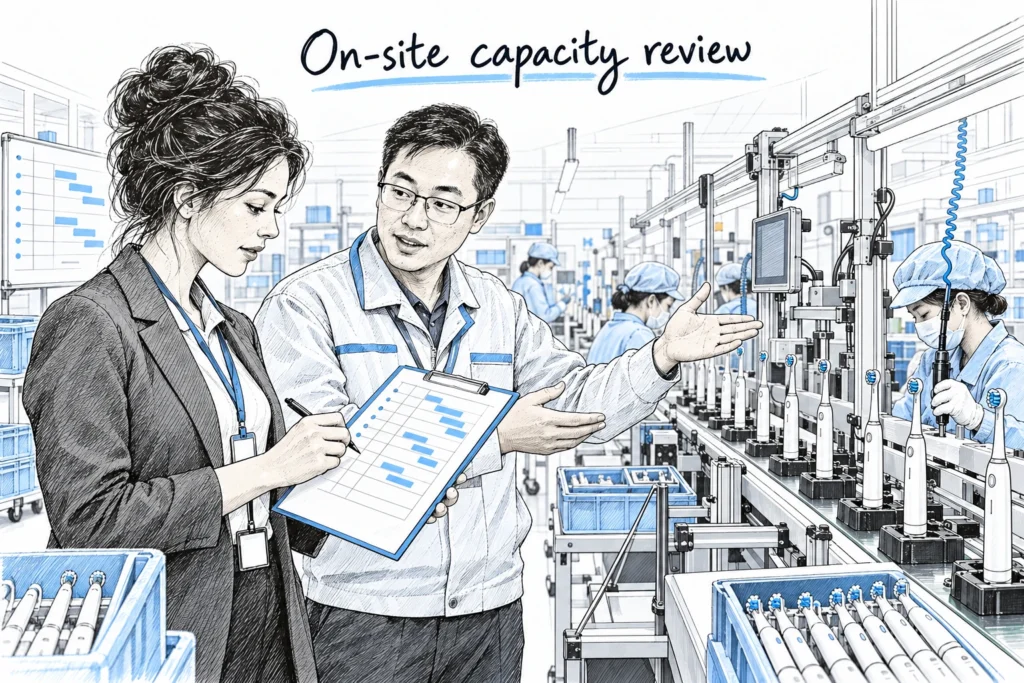
Compare observed equipment and production activity with the factory's capacity records. Concept illustration.
Category 4: IP & Confidentiality
When your project involves proprietary designs, review intellectual-property and confidentiality arrangements before sharing detailed files. Put the agreed obligations, permitted use, access controls and tooling rights in writing. Our NNN Agreement guide provides a starting point for reviewing these issues.
21–24IP & Confidentiality4 items
21
A suitable NNN or confidentiality agreement is signed before proprietary information is shared.
Confirm the legal parties, permitted use, disclosure controls, non-circumvention terms and applicable law. Resolve material disagreements before releasing sensitive designs.
Critical
22
The contract clearly states who owns custom tooling and who may use it.
Identify each mold, the payment and acceptance conditions, storage and maintenance duties, and transfer rights. Verify these terms rather than assuming ownership follows from who paid for the mold.
Critical
23
IT security: CAD files and product specs stored on restricted internal systems (not personal WeChat/email)
Ask about document management policies; factory staff using personal phones for file transfer is a red flag
Major
24
Any promised exclusivity is defined and followed.
Distinguish shared ODM designs from buyer-owned designs, and review the agreed product, territory and duration. Similar-looking standard products alone do not prove a breach of a buyer’s rights.
Major
Category 5: Supply Chain & Component Quality
Motors, batteries, PCBs and brush materials deserve particular attention in oral care products. Review the Approved Vendor List and qualification records for the components that affect your design. Check supplier approval, traceability and change control. Our Sonic vs. Oscillating-Rotating Technology guide compares relevant component considerations.
25–28Supply Chain & Component Quality4 items
25
An Approved Vendor List (AVL) identifies qualified suppliers and the approval criteria for key components.
Check how suppliers and substitute parts are assessed, approved and traced to production batches.
Critical
26
Continuity plans address critical components with a single source.
Review stock, lead times, approved alternatives and the requalification needed before substitution; a second supplier is useful only if its parts meet the agreed requirements.
Major
27
Battery records identify the cell or pack manufacturer, model and specification.
Review applicable safety evidence, such as IEC 62133-2 reports where relevant, and the UN 38.3 transport test summary. Confirm that the documents cover the battery actually used in the product.
Critical
28
Brush filament specifications identify the material, supplier and agreed performance requirements.
Review relevant safety evidence, tuft retention and filament-tip quality for the product design. Verify any material or recycled-content claim rather than treating a brand name or “food-grade” label as complete proof of compliance.
Critical
Category 6: Labor, Social & Environmental Compliance
Review labor and environmental practices against local law, customer requirements and any applicable due-diligence obligations. The EU CSDDD has a defined scope and application timetable; it does not make one social-audit certificate a universal requirement for all oral care brands. Buyer requirements can extend to suppliers through their sourcing programs.
29–30Labor, Social & Environmental Compliance2 items
29
Current social-compliance evidence matches the buyer’s requirements.
Distinguish an SA8000 certificate from an amfori BSCI or Sedex SMETA audit report. Review the site, date, findings and corrective actions, then agree the appropriate follow-up interval.
Major
30
Environmental controls cover permits, waste handling, chemical inventories and applicable restricted substances.
Review actual records and corrective actions against local requirements and the relevant product or buyer obligations.
If you cannot visit the factory or need independent technical assessment, compare qualified third-party auditors. Agree the scope, relevant oral care experience, report format and follow-up arrangements. Our Sourcing Oral Care from China Guide explains how supplier audits fit into the sourcing process.
SGS
Illustrative allowance: USD 500–900
Ask SGS to quote the relevant factory-audit scope, technical checks and written report.
Bureau Veritas
Illustrative allowance: USD 450–800
Ask Bureau Veritas about the auditor’s relevant product and quality-system experience, scope and report schedule.
Intertek
Illustrative allowance: USD 400–750
Ask Intertek to confirm local auditor availability, relevant technical expertise and the scope included in its quote.
QIMA
Illustrative allowance: USD 299–500
Ask QIMA to confirm the audit scope, booking availability, report format and any travel or follow-up charges.
Relish Technology tip: Send your product specification and this 30-point checklist to the auditor in advance. Ask for evidence and findings on the relevant oral care checks, including water-ingress testing, battery documentation and brush-material quality.
Warning sign: A supplier that refuses reasonable independent audit access needs further investigation. Clarify the reason, confidentiality rules and scheduling constraints. If access or essential evidence remains unavailable, resolve that gap before committing to the order.
For a complete framework on working with Chinese oral care manufacturers, start with our Sourcing Oral Care from China Guide. For IP-specific protection after the audit, see our NNN Agreement guide. If you're also evaluating which technology platform to manufacture — sonic versus oscillating-rotating — our OEM Technology Comparison covers motor selection, BOM cost, and certification implications. For ongoing quality control after the factory audit, see our OEM Quality Control Guide.
Frequently Asked Questions About China Factory Audits
What is a China factory audit and why is it important?
A China factory audit reviews a manufacturer’s facilities, quality systems, relevant documents, capacity and working practices. For oral care brands, it helps assess whether the supplier can meet the agreed product, delivery and compliance requirements. Record the findings and verify corrective actions before making the sourcing decision.
How much does a China factory audit cost?
The figures in this guide are illustrative allowances, ranging from USD 299 to USD 900 across the listed providers. Obtain a current quote for the site, auditor days, technical scope, travel and follow-up work. Set the audit budget according to the product and supplier risk rather than assuming a fixed order value guarantees a return.
What certifications should an oral care manufacturer in China have?
Choose requirements according to the product and market. ISO 13485 can be relevant to medical-device quality systems; applicable FDA registration, listing and QMSR obligations must be checked separately. For electrical oral care products, review the relevant EU conformity documents, electrical-safety reports, lithium-battery transport evidence and RoHS/REACH records. Confirm exact model and site coverage.
Can I audit a China factory remotely?
Yes. A remote video audit can help with initial screening, document review and follow-up. Plan the areas and records to review and note what cannot be independently observed. Use an on-site audit when product risk, order scope or unresolved findings require direct verification.
What is the difference between a factory audit and a pre-shipment inspection?
A factory audit evaluates the supplier’s capability and systems. A pre-shipment inspection checks a particular order against agreed specifications, samples and acceptance criteria when the goods are ready for the agreed inspection stage. They address different questions and can be combined in the quality plan.
What is an AQL inspection and what level should I use?
AQL means Acceptance Quality Limit in ANSI/ASQ Z1.4. A sampling plan also requires the lot size, inspection level, defect classification and acceptance/rejection numbers. Agree these before inspection. Use a zero-acceptance rule and appropriate safety tests for Critical defects; set Major and Minor criteria for the product and risk. An AQL value is not a guaranteed defect rate or the number of defects allowed in every sample.
What is the typical MOQ for Chinese oral care OEM manufacturers?
Relish custom orders typically start at 1,000 units, with flexibility for the specific order; wholesale orders for available stock start at 50 units. Confirm whether the quantity applies to each SKU, color, pack or set, and obtain separate tooling and customization quotes where needed. Use these details to plan the audit and first order.
How do I verify a factory's ISO 13485 certificate is genuine?
Search IAF CertSearch at iafcertsearch.org by company name or certificate number where the record is available. Check status, legal entity, site, standard and scope, then verify the certification body’s relevant accreditation. If a record is absent or unclear, contact the issuer and accreditation body directly before drawing a conclusion.
Ready to Audit Relish Technology's Factory?
We welcome audits — by you or any accredited third party. ISO 13485 certified, <0.3% defect rate, FDA registered, CE certified, 15 years of OEM experience. Request an audit invitation today.
International Organization for Standardization. (2016). ISO 13485:2016 — Medical devices — Quality management systems — Requirements for regulatory purposes. ISO. Retrieved from https://www.iso.org/standard/59752.html.
American Society for Quality. ANSI/ASQ Z1.4 and Z1.9: acceptance sampling systems and Acceptance Quality Limit (AQL). Source: https://asq.org/quality-resources/z14-z19
International Electrotechnical Commission. IEC 60335-2-52:2021: safety requirements for electric oral hygiene appliances, used with the relevant Part 1 requirements. Source: https://webstore.iec.ch/en/publication/67807
United Nations Economic Commission for Europe. UN Manual of Tests and Criteria, Rev.8 (2023) and Amendment 1 (2025), including subsection 38.3 on lithium cells and batteries. Source: https://unece.org/transport/dangerous-goods/rev8-files