

Jak działają elektryczne szczoteczki do zębów?
Kompletny przewodnik techniczny 2026
Explore the motors, batteries, electronics and sealing systems inside electric toothbrushes, with practical engineering choices for OEM product development.
Runtime examples assume two brushing sessions of two minutes each per day. Brush movement rates and battery performance depend on the model and operating mode.
Elektryczne szczoteczki do zębów to zwodniczo skomplikowane urządzenia. Łączą w sobie precyzyjne silniki, inteligentne systemy sterowania, ładowalne źródła zasilania i ergonomiczną konstrukcję w urządzeniu, które mieści się w dłoni - a jednocześnie wykonuje dziesiątki tysięcy precyzyjnych ruchów mechanicznych podczas każdej sesji szczotkowania. Niniejszy przewodnik dokładnie opisuje działanie elektrycznych szczoteczek do zębów, od fizyki wibracji dźwiękowych po decyzje inżynieryjne, które kształtują produkcję OEM.
Najważniejsze wnioski
- The three platforms covered here are soniczny, oscillating-rotating i combination systems such as Relish Technology’s Rotasonic™. Each offers different drive mechanisms and product development options.
- Sonic toothbrushes clean through styk włosia and agitate the liquid around the brush head. Effective cleaning still depends on reaching tooth surfaces with the bristles.
- The motor, PCB and battery sit inside a sealed handle. IPX7 applies to the tested enclosure, rather than separately certifying every internal component.
- Technologia baterii (Li-ion vs NiMH) ma bezpośredni wpływ na waga, czas pracy i czas ładowania, wszystkie krytyczne punkty decyzyjne OEM
- Pressure feedback can use force sensing, mechanical deflection or motor-load measurement to alert users when they exceed a model-specific brushing-pressure setting.
- Inteligentne szczoteczki do zębów dodają Bluetooth connectivity, sensors and a companion app. The underlying cleaning platform may be shared with a non-connected model.
- For OEM buyers, the motor, battery, electronics, brush head, housing, finishing and packaging all affect the bill of materials (BOM) and the final quotation.
- Relish Technology’s Platforma Vibrosonic offers up to 48 000 skoków/min with a dual-harmonic drive approach. Select the operating profile to suit the product specification.
Trzy podstawowe technologie elektrycznych szczoteczek do zębów
This guide compares sonic, oscillating-rotating and combination platforms. Their drive mechanisms influence head movement, noise, power consumption and cost, while the complete product design determines the final performance.
1. Technologia soniczna: Wibracje cewki magnetycznej
Many sonic toothbrushes use an electromagnetic drive system to create rapid movement at the brush head. The motor’s magnetic circuit, suspension and output shaft determine whether that movement is linear, angular or a combination. “Sonic” describes the operating approach; it does not mean every model uses the same voice-coil or linear resonant actuator.
In an electromagnetic drive, controlled current in the coil produces a changing magnetic force that moves the drive assembly. The shaft transfers that motion to the brush head. Keep frequency and movement counts separate: 120–240 Hz equals 7,200–14,400 complete cycles per minute. If each direction is counted as one stroke, that is 14,400–28,800 strokes/min. Compare models only after checking how the manufacturer counts strokes.
Rapid brush-head movement also agitates toothpaste and saliva near the bristles. This fluid movement is distinct from demonstrated clinical cleaning at a fixed distance. Guide the bristles over the tooth surfaces and gumline; a stated movement rate alone does not establish cleaning depth or a gingivitis-reduction result.
Relish Technology’s proprietary Platforma Vibrosonic uses a controlled secondary harmonic layer alongside the main drive profile. For an OEM project, our engineers can help specify the movement rate, amplitude and brushing modes to achieve the intended brushing feel and product positioning.
2. Technologia obrotowo-oscylacyjna: Silnik z przekładnią DC
Oscillating-rotating toothbrushes move the brush head back and forth through an angle. In a geared design, a small Silnik prądu stałego drives a transmission that converts shaft rotation into this alternating motion. Other architectures use different actuators or linkages, so the actual drive system should be checked in the product specification.
Head movement is described by its oscillation rate and angular travel. An advertised 5,000–10,000 movements per minute should not be labelled “rpm” unless it measures complete revolutions. Cleaning relies on styk włosia, with the alternating movement helping the user clean tooth surfaces.
A geared DC drive can be a cost-effective option for an OEM project. Compare the complete transmission, noise, durability, head compatibility and assembly requirements with the sonic alternatives; motor price alone does not determine the best platform.
3. Technologia kombinowana / rotacyjna
Zrozumienie sposobu działania elektrycznych szczoteczek do zębów z technologią łączoną ujawnia podejście Rotasonic™. Trzecia kategoria to podejście kombinowane lub hybrydowe - urządzenia, które wykorzystują jednocześnie wibracje dźwiękowe i działanie rotacyjno-oscylacyjne. W tym przypadku Rotasonic™ technologia opracowana w Relish Technology, sits.
Rotasonic™ brings sonic vibration and oscillating-rotating action into a dual-action cleaning platform. The actuator and transmission configuration depends on the model. OEM buyers can work with our engineers to compare head movement, brushing feel, noise and cost against the target specification.
Anatomia elektrycznej szczoteczki do zębów
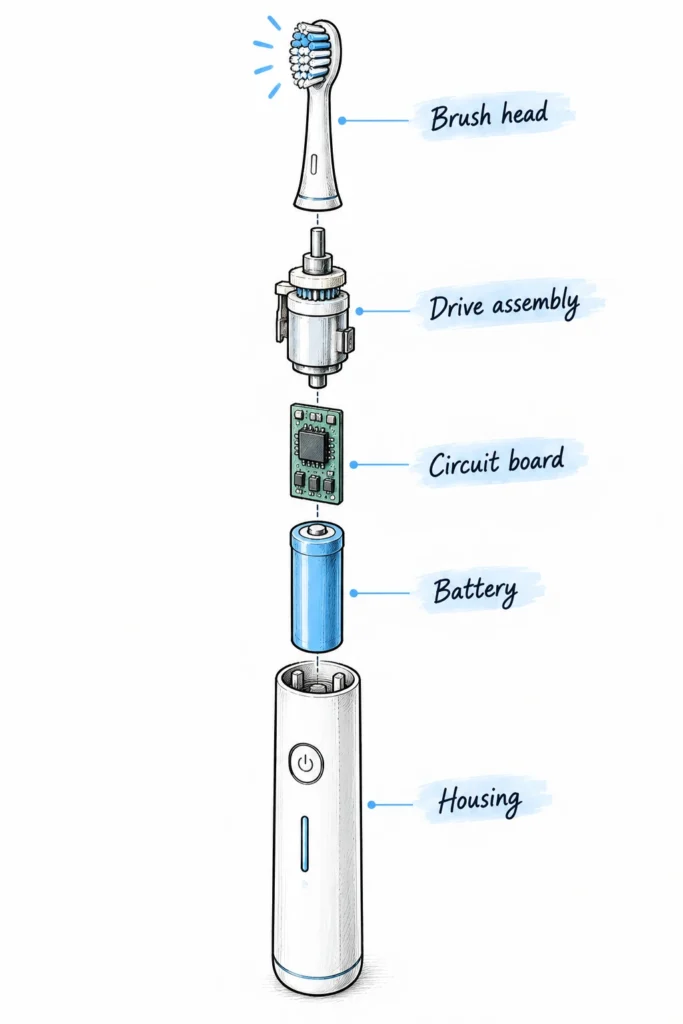
Poza podstawową technologią czyszczenia, każda elektryczna szczoteczka do zębów zawiera system połączonych ze sobą komponentów, które współpracują ze sobą, aby zapewnić niezawodne, bezpieczne i przyjazne dla użytkownika szczotkowanie zębów. Zrozumienie sposobu działania elektrycznych szczoteczek do zębów na poziomie komponentów pomaga nabywcom OEM w ocenie jakości i kompromisów kosztowych podczas opracowywania produktu. Oto podział na poszczególne komponenty.
Akumulator
Rechargeable models may use Li-ion or NiMH cells. The existing 600–2,000 mAh range is a product-planning example; compare cell voltage and energy in Wh as well as capacity. Runtime and cycle life depend on the cell, charging system, load and temperature.
Obwód silnika i sterownika
The motor and driver circuit convert electrical power into brush-head movement. Electromagnetic and geared DC designs may require different power stages; an H-bridge is one possible arrangement.
Płytka drukowana i mikrokontroler
8-32-bitowy MCU zarządza trybami szczotkowania, timerem, wejściem czujnika ciśnienia, wskaźnikami LED i komunikacją BLE w inteligentnych modelach.
Czujnik ciśnienia
Pressure detection may use a force sensor, a deflection mechanism or motor-load measurement. The controller compares the signal with a model-specific setting, then activates a warning or adjusts the motor.
System ładowania
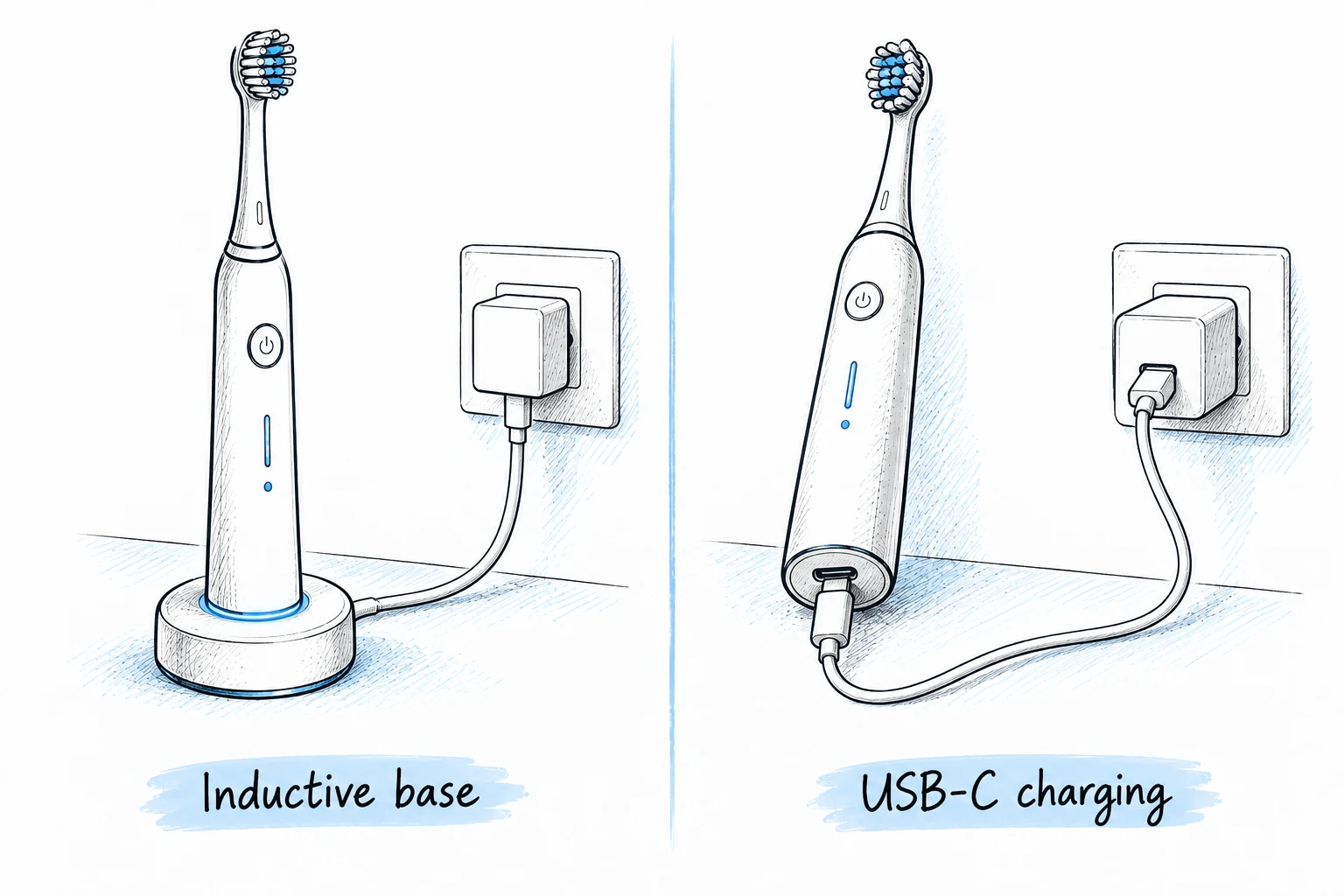
Charging may use a dedicated inductive base or a wired connection such as USB-C. The input rating, charging time and compatible charger depend on the design. An inductive base is not automatically Qi-compatible.
Głowica szczotki i wałek napędowy
Wymienna głowica z włosiem nylonowym lub PBT. Połączenie z silnikiem za pomocą wału napędowego ze stali nierdzewnej lub nylonu. Mechanizm mocowania typu "click-fit" lub "twist-lock".
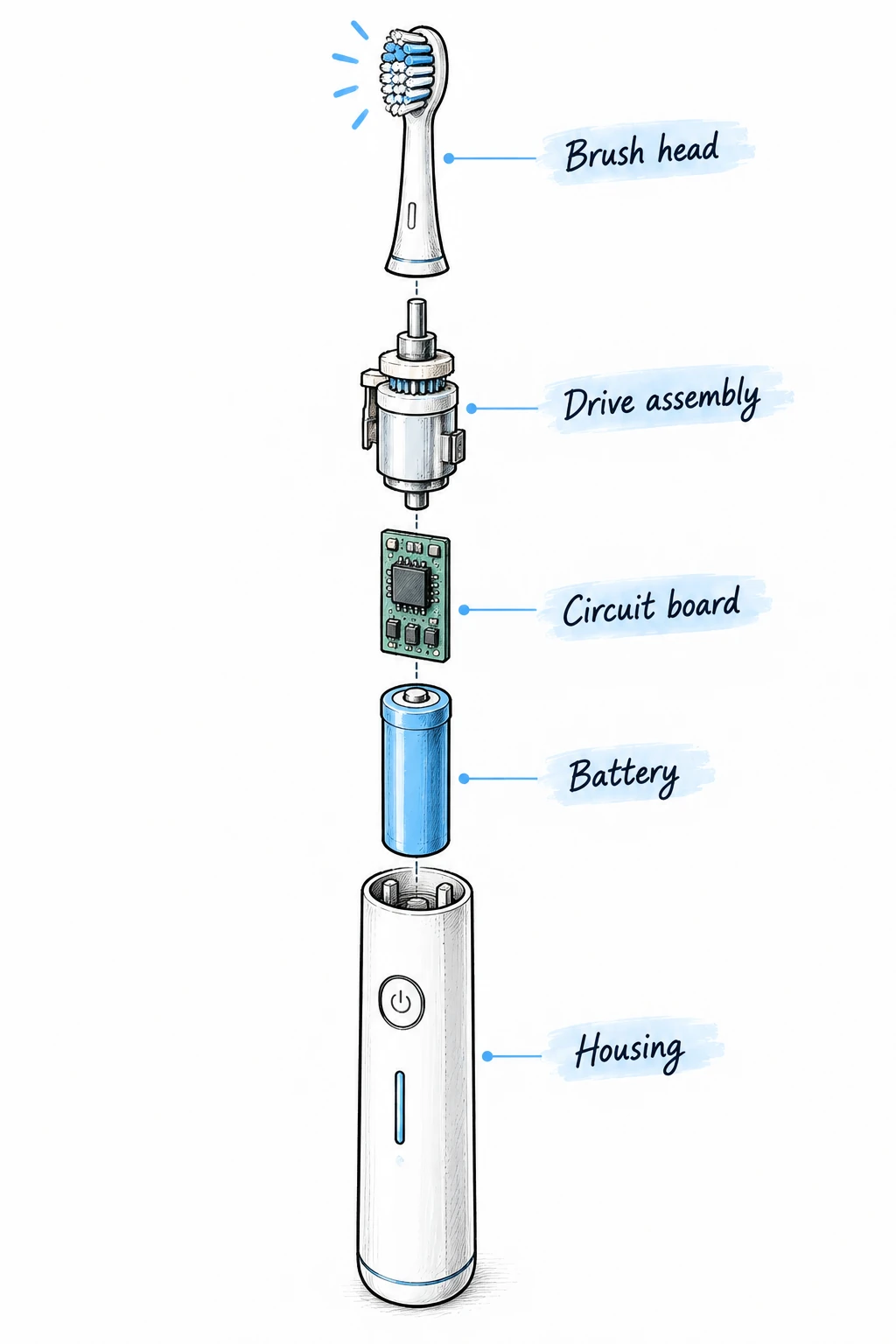
Płytka drukowana i system sterowania
The printed circuit board (PCB) carries the electronics that control modes, timing, indicators and optional sensors or connectivity. A 20–50 mm × 10–25 mm board is one layout example; dimensions depend on the handle and circuit design. Typical functions include:
- Microcontroller (MCU): An 8-bit or 32-bit controller runs the firmware. Select the device for processing, memory, power and interface requirements; a Bluetooth SoC may also perform this role.
- Sterownik silnika: A power stage controlled by the MCU supplies the waveform and current required by the selected motor. The circuit may use an H-bridge, depending on the drive architecture.
- Clock source: An internal oscillator or external crystal provides the controller’s timing reference. Some designs use a 32.768 kHz crystal for low-power timekeeping; the required clocks depend on the chosen controller.
- Interfejs czujnika ciśnienia: Kanał przetwornika analogowo-cyfrowego (ADC), który odczytuje zmiany napięcia z czujnika ciśnienia.
- Sterownik LED: Rezystor ograniczający prąd + obwód tranzystora sterujący diodami LED wskaźnika trybu pracy
- SoC BLE (tylko modele smart): Układ Bluetooth Low Energy (Nordic nRF52832 lub podobny), który obsługuje komunikację bezprzewodową z aplikacją towarzyszącą.
- Charging and battery protection: Charging control, voltage monitoring, temperature checks and protection functions are selected for the cell chemistry and product design. They may be integrated or implemented with separate circuits.
Tryby szczotkowania i timer kwadrantu
Jedną z najcenniejszych cech nowoczesnych elektrycznych szczoteczek do zębów - zarówno z perspektywy konsumenta, jak i producenta OEM - jest system trybu szczotkowania. Sposób działania elektrycznych szczoteczek do zębów z wieloma trybami zależy od kontrolowanych przez oprogramowanie sprzętowe profili częstotliwości i amplitudy zarządzanych przez mikrokontroler. Każdy tryb ma inną częstotliwość, amplitudę i profil czasowy, zapewniając użytkownikom elastyczność w zakresie różnych potrzeb związanych z pielęgnacją jamy ustnej.
Typowe tryby szczotkowania
| Tryb | Częstotliwość | Amplituda | Czas trwania | Intended Use |
|---|---|---|---|---|
| Czystość | Pełna częstotliwość (np. 40 000 obrotów na minutę) | Standardowe | 2 min | Codzienne użytkowanie, wszechstronne czyszczenie |
| Biały / Polski | Pełny + przerywany impuls | Wyższy | 2 min | Usuwanie plam z powierzchni, napoje kawowe/herbaciane |
| Wrażliwy | 60-70% maksymalnej częstotliwości | Zmniejszony | 2 min | Users who prefer a gentler brushing feel |
| Pielęgnacja dziąseł / Miękkie | 40-50% maks., pulsujący | Niski | 3 min | Gentle gumline brushing |
| Czyszczenie języka | Niska częstotliwość, stała | Światło | 30 sek | Odświeżanie oddechu, powlekanie języka |
| Wybielanie | Naprzemiennie wysoki/niski | Zmienna | 3 min | Ulepszone cykle usuwania plam |
A timer kwadrantowy gives a brief pause or signal every 30 seconds to prompt a change of brushing area. Four intervals support a two-minute session. This is a pacing aid; users still need to guide the brush over the inner, outer and chewing surfaces.
Technologia akumulatorów i systemy ładowania
Battery selection affects handle weight, runtime, charging and cost. For an OEM project, compare the cell together with the motor load, standby consumption and charging circuit to match the target use pattern and retail positioning.
Litowo-jonowy (Li-ion) vs niklowo-wodorkowy (NiMH)
Li-ion cells are widely used in rechargeable toothbrush designs. Check the supplier’s cell drawing and datasheet for voltage, dimensions and capacity. Cylindrical format names are approximate: a 14500 cell is nominally about 14 mm × 50 mm, while 14450 denotes about 14 mm × 45 mm. Dimensions, terminal details and capacity must be confirmed for the selected cell. Key selection factors include:
- Energy density: Compare the selected cells in Wh/kg and Wh/litre; a fixed threefold advantage does not apply to every Li-ion and NiMH design.
- Self-discharge: Cell chemistry, temperature and storage conditions affect charge retention. Low-self-discharge NiMH cells are available, so compare the selected cells’ storage specifications.
- Charging habits: Li-ion cells can normally be topped up within the approved charging limits. Follow the cell supplier’s voltage, current and temperature requirements.
- Cycle life: A full-equivalent cycle is cumulative discharge equal to the cell’s rated capacity, not one brushing session. A 500-cycle rating must state the test conditions and retained-capacity criterion. Brushing frequency alone cannot convert that rating into years of service.
- Charging time: A 1–3 hour charge is possible on a design built for that rate. The battery, charger, thermal limits and power-management circuit determine the result, rather than the connector type alone.
NiMH remains an option where cost, cell availability and the established charging design fit the project. It still requires appropriate charge control and protection against damaging operating conditions. Low-self-discharge variants can retain charge well, and memory-effect behaviour should not be generalised from NiCd batteries.
Systemy ładowania: Indukcyjne vs USB-C
Inductive charging transfers energy between coils in the base and handle. The receiver rectifies and regulates that energy to charge the battery. Removing an exposed charging connector can simplify sealing, but charging efficiency, alignment, heat and full-charge time must be evaluated for the selected design. A dedicated toothbrush base does not necessarily support the Qi standard.
USB-C charging provides a convenient wired connection. Specify the input voltage and current, supported power protocol, charger compatibility and charging time. USB-C does not itself guarantee USB Power Delivery or a 1–3 hour charge. The port, surrounding housing and any cover must form a tested sealing system.
Wodoodporność: IPX7 i wyzwania inżynieryjne
Water resistance depends on the complete enclosure and its seals. IPX7 addresses temporary immersion under defined test conditions, commonly described for a small device as 1 metre for 30 minutes. It does not establish protection against water jets, all shower conditions or indefinite immersion, and it does not automatically apply to the charger. Follow the product’s stated cleaning and charging instructions.
Zalewanie i spawanie ultradźwiękowe
Potting or encapsulation can protect selected electronics with a compatible epoxy or silicone material. It is one part of the sealing strategy alongside housing joints, shaft seals and charging interfaces. The existing USD 0.80–2.50 per-unit allowance is a planning example; material volume, curing, labour and repairability affect the final cost.
Zgrzewanie ultradźwiękowe can join compatible plastic housing parts using high-frequency mechanical vibration. Equipment in the 20–40 kHz range is one example. Joint geometry, material and process settings determine weld strength and sealing quality; verify both on the finished assembly.
W obszarze mocowania głowicy szczotki - najbardziej obciążonym mechanicznie punkcie uszczelnienia - stosowane są silikonowe O-ringi lub płynne uszczelki. Wał napędowy przechodzi przez to uszczelnienie za pośrednictwem tulei o ścisłej tolerancji, zachowując wodoszczelność, jednocześnie umożliwiając ruch obrotowy lub liniowy.
Potrzebujesz pomocy w wyborze elektrycznej szczoteczki do zębów?
Ciekawi Cię, jak elektryczna szczoteczka do zębów sprawdzi się w przypadku Twojej marki? Nasi inżynierowie mogą przeprowadzić Cię przez proces wyboru silnika, strategii wodoodporności i optymalizacji kosztów BOM dla Twojego rynku docelowego.
Porozmawiaj z naszym zespołem inżynierówInteligentne szczoteczki do zębów: Czujniki, BLE i łączność z aplikacjami
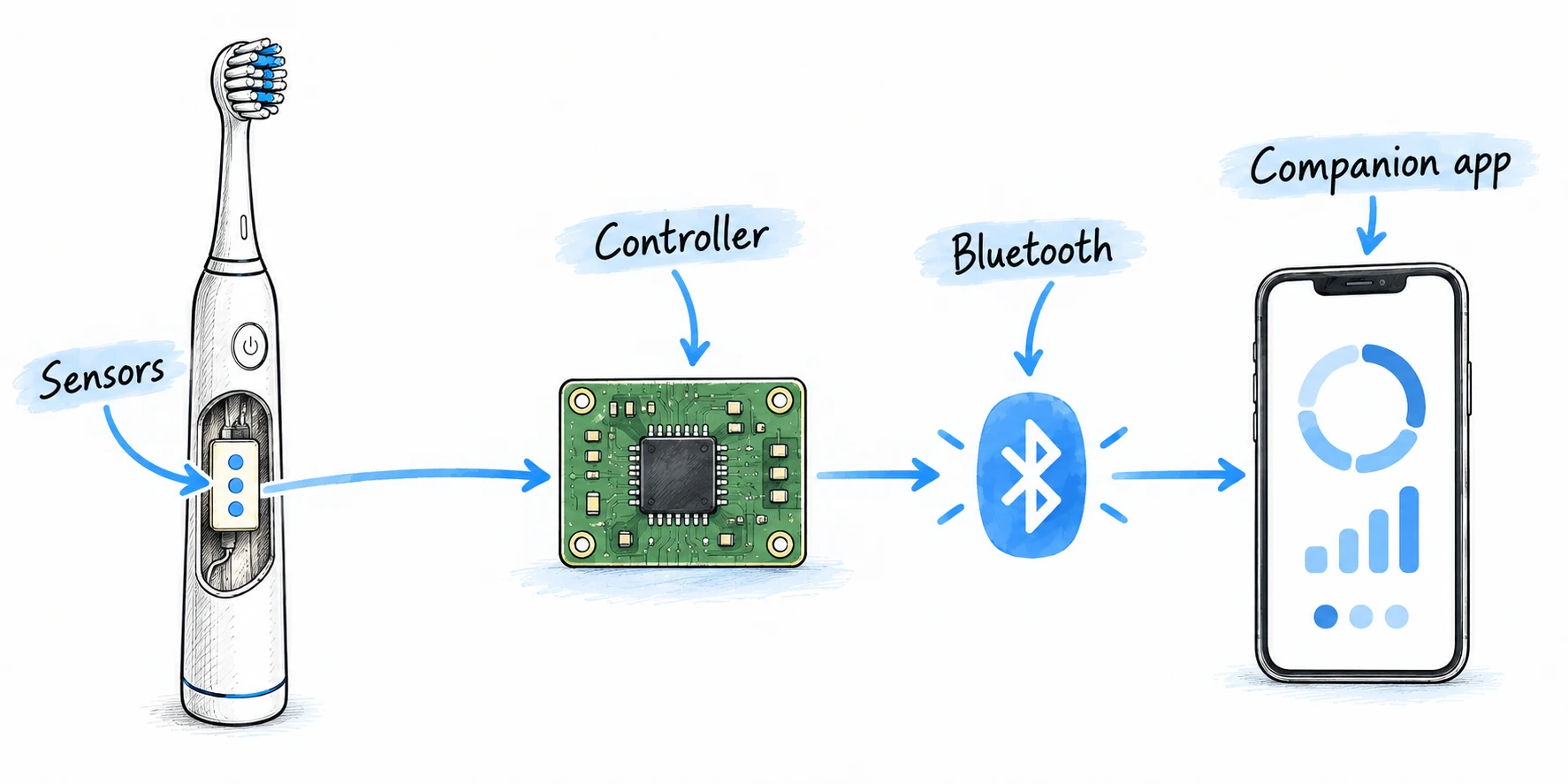
Smart toothbrushes combine a brushing platform with Łączność Bluetooth, optional sensors and companion software. A connected and non-connected model may share a motor or brush head, while other designs use different components. Specify the physical cleaning performance and the data functions separately.
Kluczowe inteligentne funkcje i ich czujniki
| Inteligentna funkcja | Używany czujnik | Szczegóły techniczne |
|---|---|---|
| Czas szczotkowania | Zegar czasu rzeczywistego (zegar MCU) | Wbudowany w MCU - nie wymaga dodatkowego czujnika |
| Wykrywanie ciśnienia | Force sensor, deflection sensing or motor-load measurement | Position and calibration depend on the sensing design |
| Wykrywanie położenia | 6-osiowy IMU (akcelerometr + żyroskop) | Estimates movement and brushing zones through a validated algorithm |
| Zużycie głowicy szczotki | Usage timer or session counter; additional sensing if fitted | Prompts replacement based on use; does not directly measure every bristle’s condition |
| Kondycja baterii | Wskaźnik paliwa IC (licznik kulombów) | Estimates remaining charge; cycle and health data depend on the implementation |
| Parowanie Bluetooth | Bluetooth Low Energy SoC | For example, a Nordic nRF52-series device; select for the required features |
A six-axis inertial measurement unit (IMU) combines a three-axis accelerometer and three-axis gyroscope. Software can use these signals to estimate brushing movement and mouth zones. Accuracy depends on sensor placement, calibration, the algorithm and user behaviour. Zone feedback is an estimate of brushing activity, rather than a direct measurement of plaque removal or oral health.
Perspektywa OEM na koszty inteligentnych szczoteczek do zębów
Smart functions add connectivity, sensing and software to a product that already uses electronic control. The existing USD 8–25 per-unit estimate is a planning allowance for additional hardware, not an app-development quotation. Check which components are already included in the base platform to avoid double-counting. Example budget items include:
- BLE SoC and antenna: USD 2.50–5.00 as a planning allowance. Nordic nRF52840 and Realtek RTL8762 are examples; suitability depends on the selected part and software requirements.
- Six-axis IMU: USD 1.50–4.00 as a planning allowance. Examples include TDK InvenSense ICM-42670 and Bosch Sensortec BMI270.
- Pressure sensing: USD 0.30–1.00 as a planning allowance; the sensing method and required calibration determine the actual cost.
- App development: An illustrative one-time budget of USD 30,000–150,000 for iOS and Android. Scope separately for maintenance, cloud services, privacy controls and operating-system updates.
- Additional PCB layers and components: USD 1.00–3.00 as a planning allowance; confirm overlap with the selected connectivity and sensor modules.
A USD 25–60 retail premium is a positioning example for a connected model. Assess the selling price alongside channel costs, software maintenance, returns and the complete product cost before estimating profitability.
Technologia odkażania UV
A UV sanitizing base uses a separate UV-C light system to reduce microorganisms on exposed brush-head surfaces. Wavelength, dose, exposure time, lamp placement, shadows and the tested organism determine the result. A 254 nm lamp and a 5–10 minute cycle describe particular designs; they do not establish a universal 99.9% reduction for all bacteria and viruses. Use product-specific test results for performance claims, and prevent eye or skin exposure with an enclosed design and suitable interlocks.
UV-C sources may include low-pressure mercury lamps or UV-C LEDs. Compare wavelength, delivered dose, thermal management, service life, material compatibility and disposal requirements for the selected source. Lamp type alone does not determine which complete sanitizer is more effective or durable.
The existing USD 3.50–8.00 BOM allowance illustrates a UV-base option. The light source, enclosure, control system and safety interlocks affect cost and packaging size. Position the feature using the selected product’s tested performance.
Główki szczoteczek: Nauka i inżynieria włosia
Podczas gdy rękojeść zawiera całą elektroniczną inteligencję, główka szczoteczki jest miejscem, w którym faktycznie odbywa się czyszczenie. Zrozumienie, w jaki sposób elektryczne szczoteczki do zębów działają, aby zapewnić skuteczną pielęgnację jamy ustnej, wymaga znajomości inżynierii główki szczoteczki - materiał włosia, średnica, konfiguracja kępek i właściwości zginania wpływają na wydajność czyszczenia i wrażenia użytkownika.
Materiały włosia
Brush-head performance depends on filament material, diameter, length, taper and tuft arrangement. Nylon 612 and PBT are material options; PBT is not automatically softer than nylon. Define the required brushing feel and inspect filament ends, tuft retention and mechanical performance against the applicable specification. ISO 20127:2025 covers physical properties of powered toothbrushes; its end-rounding requirements have exceptions for specified filament types, so a universal tip-radius rule is inappropriate.
Włosie wskaźnika
Colour-fading indicator bristles provide a visual replacement reminder. Fading depends on the filament treatment, brushing habits and exposure; it is not a precise three-month clock. The existing USD 0.05–0.15 per-head allowance is a planning example. Colour-treated or mixed-colour filaments do not inherently require two-material injection moulding. Follow the brush-head replacement instructions and replace sooner when the bristles are worn.
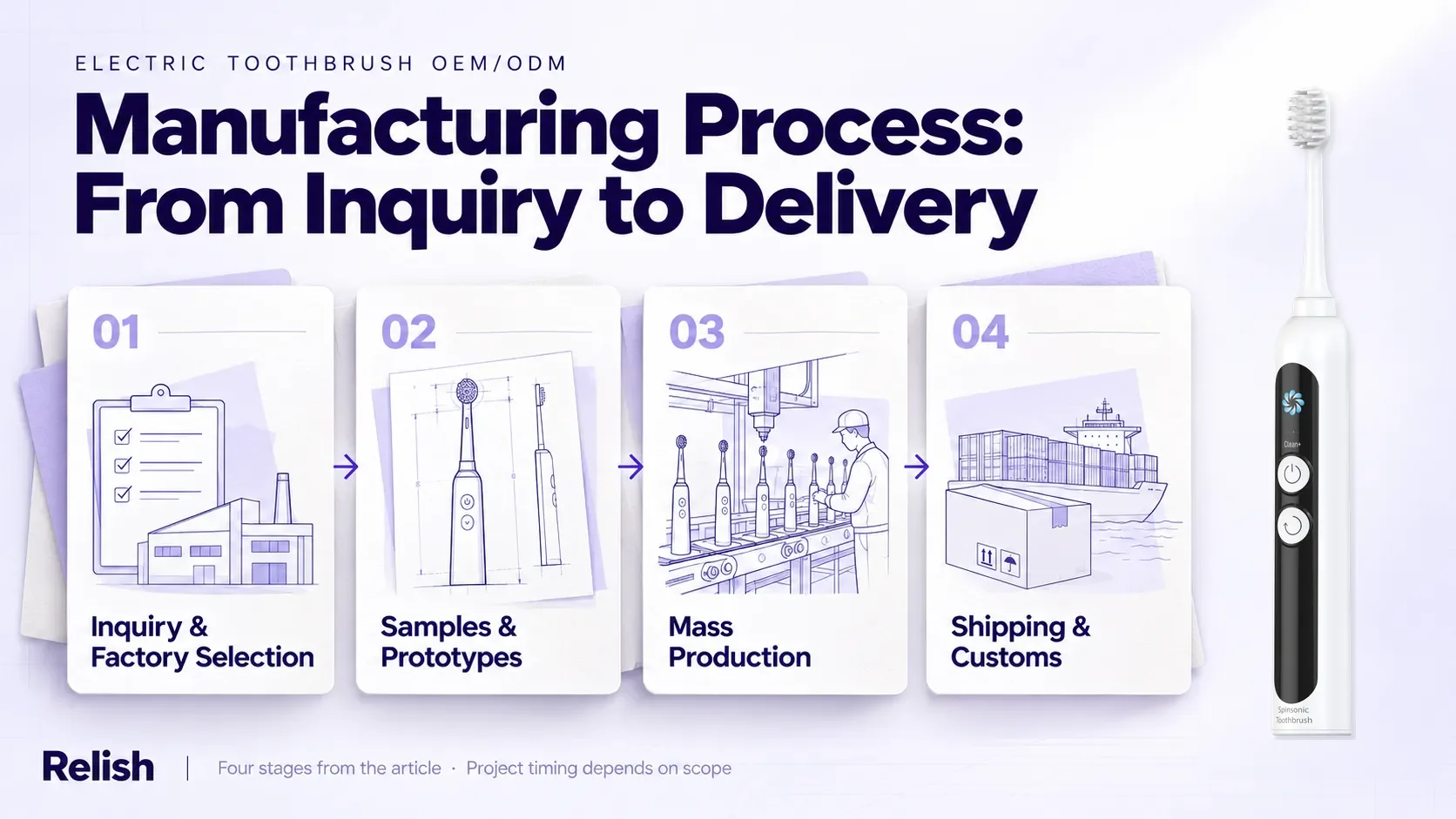
Produkcja OEM: Od wyboru komponentów do masowej produkcji
Zrozumienie sposobu działania elektrycznych szczoteczek do zębów z perspektywy produkcji jest podstawą do podejmowania inteligentnych decyzji dotyczących zaopatrzenia OEM. Każdy wybór techniczny - typ silnika, pojemność baterii, metoda wodoodporności, integracja inteligentnych czujników - ma bezpośredni, wymierny wpływ na koszty produkcji, jakość produktu i pozycję w sprzedaży detalicznej. Przeczytaj nasz przewodnik po szczoteczkach elektrycznych OEM aby dowiedzieć się więcej o ścieżce produkcyjnej.
At Relish Technology, motor engineering, electronics, sealing and app connectivity inform the development process. The following 28-week schedule illustrates a new-product project; an existing platform or a more complex programme will follow a different timeline.
- Weryfikacja koncepcji (tygodnie 1-4): Określenie specyfikacji produktu - typ technologii (soniczna/rotacyjna/rotacyjna), rynki docelowe, wymagane certyfikaty, poziom cenowy. Ma to wpływ na wszystkie kolejne decyzje.
- Rozwój prototypu (tygodnie 5-12): Budowa funkcjonalnych prototypów uchwytu, elektroniki i główki szczoteczki. Testowanie wydajności silnika, czasu pracy baterii, wodoodporności i oprogramowania układowego PCB. Typowa ilość prototypów: 3-10 sztuk.
- Walidacja przedprodukcyjna (tygodnie 13-20): Inżynieryjne testy walidacyjne (EVT) i testy walidacyjne projektu (DVT) - testy zanurzeniowe IPX7, testy upadkowe, testy EMC, testy cyklu baterii i testy zgodności wstępnej z przepisami.
- Przygotowanie produkcji masowej (tygodnie 21-28): Ukończenie oprzyrządowania, kontrola pierwszego artykułu, seria pilotażowa (100-300 sztuk) i konfiguracja systemu jakości, w tym plany próbkowania AQL.
- Production and shipment: Full production combines in-process checks, functional testing and agreed sampling inspections. Define defect categories and acceptance criteria in the quality agreement. Safety-critical defects require a zero-acceptance approach; an AQL value must not be presented as permission to ship a known critical defect. Zwiedzanie naszych zakładów produkcyjnych aby zobaczyć nasze możliwości produkcyjne z pierwszej ręki.
Jak wybrać odpowiednią technologię dla swojej marki
Mając ustalone podstawy techniczne, przedstawiamy ramy decyzyjne dla właścicieli marek i kierowników ds. zaopatrzenia wybierających partnera OEM do opracowania elektrycznej szczoteczki do zębów. Zrozumienie sposobu działania elektrycznych szczoteczek do zębów we wszystkich trzech kategoriach technologicznych - sonicznej, rotacyjno-oscylacyjnej i Rotasonic™ - umożliwia bardziej świadome rozmowy z producentami i dokładniejsze specyfikacje produktów.
| Kryteria | Soniczna | Obrotowy - oscylacyjny | Rotasonic™ (kombinacja) |
|---|---|---|---|
| Zakres kosztów BOM | $12-$28 | $8-$20 | $18-$38 |
| Pozycjonowanie cen detalicznych | Średnia do Premium | Wejście do Mid | Premium do Ultra-Premium |
| Poziom hałasu | Depends on drive, mounting and operating mode | Depends on drive, gearing and operating mode | Depends on the combined drive design |
| Cleaning Action | Bristle movement and nearby liquid agitation | Alternating angular movement with bristle contact | Combined sonic and oscillating-rotating movement |
| Najlepsze dopasowanie do rynku | Marki konsumenckie klasy premium | Marki wartościowe, Amazon FBA | Brands seeking a dual-action platform |
| Przydatność inteligentnych funkcji | Doskonały | Dobry | Doskonały |
Gotowy do rozpoczęcia projektu elektrycznej szczoteczki do zębów OEM?
Niezależnie od tego, czy wprowadzasz na rynek nową markę, rozszerzasz istniejącą linię, czy też zaopatrujesz się w zamówienia detaliczne - zespół inżynierów Relish Technology może pomóc Ci wybrać odpowiednią platformę technologiczną i przeprowadzić Cię przez całą podróż od koncepcji do masowej produkcji.
Porozmawiaj z naszym zespołem inżynierówISO 13485 · FDA/CE Compliance Support · 15+ Years OEM Experience · 20,000 m² Manufacturing Facility
Często zadawane pytania
Answers to common questions about electric toothbrush mechanisms, components, charging, sensors and OEM product development.
Literatura i źródła
- Amerykańskie Stowarzyszenie Stomatologiczne. Szczoteczki. Szczoteczki.
- Międzynarodowa Komisja Elektrotechniczna. IEC 60335-2-52:2021 — Particular requirements for oral hygiene appliances. IEC 60335-2-52:2021 — Particular requirements for oral hygiene appliances.
- International Organization for Standardization. ISO 20127:2025 — Dentistry — Physical properties of powered toothbrushes. ISO 20127:2025 — Dentistry — Physical properties of powered toothbrushes.
- Amerykańska Agencja ds. Żywności i Leków. Powered toothbrush classification: JEQ, 21 CFR 872.6865, Class I; 510(k)-exempt within applicable limits. Powered toothbrush classification: JEQ, 21 CFR 872.6865, Class I; 510(k)-exempt within applicable limits.
- Nordic Semiconductor. nRF52840 Product Specification. nRF52840 Product Specification.
- Bosch Sensortec. BMI270 inertial measurement unit. BMI270 inertial measurement unit.