

Brosse à dents électrique à tête ronde : que faut-il savoir avant d’acheter ?
A round head is commonly associated with an oscillating-rotating electric toothbrush. The head moves back and forth through a short arc, helping you guide the bristles around one tooth at a time. Many sonic models use an elongated head, but head shape alone does not identify the drive mechanism. This guide explains round-head brushing, compares it with common sonic designs, and outlines what to check before buying.
- A small round head is typical of an oscillating-rotating brush, although shape alone does not tell you how a toothbrush moves.
- The head reverses direction through a short arc while you guide it along each tooth and the gumline.
- Cochrane found benefits for powered brushing over manual brushing, with the largest evidence base for oscillating-rotating designs. A later review favored these designs for some outcomes compared with other powered brushes.
- Consider a compact round head if you prefer tooth-by-tooth brushing or need a head that feels easy to position around back teeth, crowded teeth, or braces.
Vous lancez une gamme de brosses à tête rotative ? Découvrir les options en marque blanche →
Qu’est-ce qu’une brosse à dents électrique à tête ronde ?
A round head has a small circular brushing surface rather than an elongated one. On an oscillating-rotating toothbrush, the drive moves it back and forth through a short arc. Guide the bristles around each tooth and along the gumline; the circular shape does not mean that the head spins continuously through complete revolutions.
Pourquoi la forme compte
In a common oscillating-rotating design, the head turns partway in one direction and then reverses. Some models add pulsation or other motion. Shoppers may call these rotating-head, spinning-head, or circular toothbrushes, but the product specification should identify the actual motion and its rate. Shape, oscillation rate, and motor RPM describe different features.
En quoi le nettoyage d’une tête rotative diffère
Both oscillating-rotating and sonic toothbrushes clean through bristle movement and contact with tooth surfaces. A common sonic design moves an elongated head rapidly; fluid movement around the bristles may also contribute, but does not replace correct positioning. An oscillating-rotating brush moves a compact round head through short alternating arcs for tooth-by-tooth cleaning.
The compact head can be convenient to position around back teeth and inner tooth surfaces, especially if a larger head feels awkward. Whether it is easier to use depends on the head dimensions, your mouth, and your technique. The American Dental Association recognizes both manual and powered brushes as effective options when used properly.
The drive system must suit the head motion. Relish offers an industrial-grade servo-drive platform with a stated vibration rating of up to 31,000 VPM, and checks motor-frequency consistency on the production line. For a rotating-head SKU, confirm the head’s oscillation rate, arc, and torque separately: a VPM rating is not the number of complete head rotations per minute.
Tête ronde ou tête sonique : les principales différences
Les deux types de brosses électriques éliminent efficacement la plaque, mais leurs mécanismes diffèrent. Voici une comparaison des deux conceptions courantes.
Pour comparer les deux mécanismes, consultez notre guide sur les brosses à dents électriques soniques et oscillantes-rotatives. Notre article sur le fonctionnement des brosses à dents électriques explique le moteur et les vibrations de chaque type.
Une brosse rotative est-elle meilleure ?
A 2014 Cochrane review found that powered brushes reduced plaque and gingivitis more than manual brushes overall, with the largest body of evidence for oscillating-rotating designs. That finding does not establish that every round-head model outperforms every sonic model. The review noted that the clinical importance of the differences remained unclear; brushing technique and regular use also matter.
Comparaison des têtes rotatives et soniques
Clark-Perry and Levin’s 2020 systematic review compared oscillating-rotating brushes with other powered brushes, particularly sonic designs. It found statistically significant advantages for whole-mouth plaque measured with the Rustogi Modified Navy Plaque Index and for the number of bleeding sites, but not for the modified gingival index or gingival bleeding index. These are outcomes from the included studies, rather than a guarantee for every model or user. Compare the evidence alongside comfort, technique, and the features you will use consistently.
À qui convient une brosse à dents électrique à tête ronde ?
Une tête ronde n’est pas forcément le meilleur choix pour tout le monde, mais elle peut bien convenir dans plusieurs situations :
Situations Where a Compact Round Head May Help
- Small mouths and crowded teeth. A compact head may be easier to position around back teeth or in crowded areas; check the actual head size and how comfortably you can reach.
- Braces and orthodontics. A compact head may help you position the bristles around brackets and wires. Use an appropriate head and follow your dental professional’s advice for cleaning the remaining gaps.
- Tooth-by-tooth brushing. The round head supports a deliberate technique in which you guide it around each tooth rather than relying on the head to surround the whole tooth automatically.
- Brushing pressure. Choose a model with a pressure sensor if you want feedback when pressing too hard. This feature depends on the model and is available with different head styles.
En cas de dents ou de gencives sensibles, les deux types de tête peuvent convenir si vous choisissez des brins souples et une brosse dotée d’un mode doux. Pour en savoir plus, lisez notre article sur les brosses à dents électriques pour dents sensibles.
Durée d’utilisation d’une tête ronde
Replace the head about every three to four months, or sooner if the bristles become matted or frayed. If the head has indicator bristles, follow the manufacturer’s guidance on color changes. Our guide to how often to change a toothbrush head explains the signs, and our guide to how to clean an electric toothbrush head covers care between replacements.
Pour les marques : intégrer des têtes rotatives à une gamme OEM
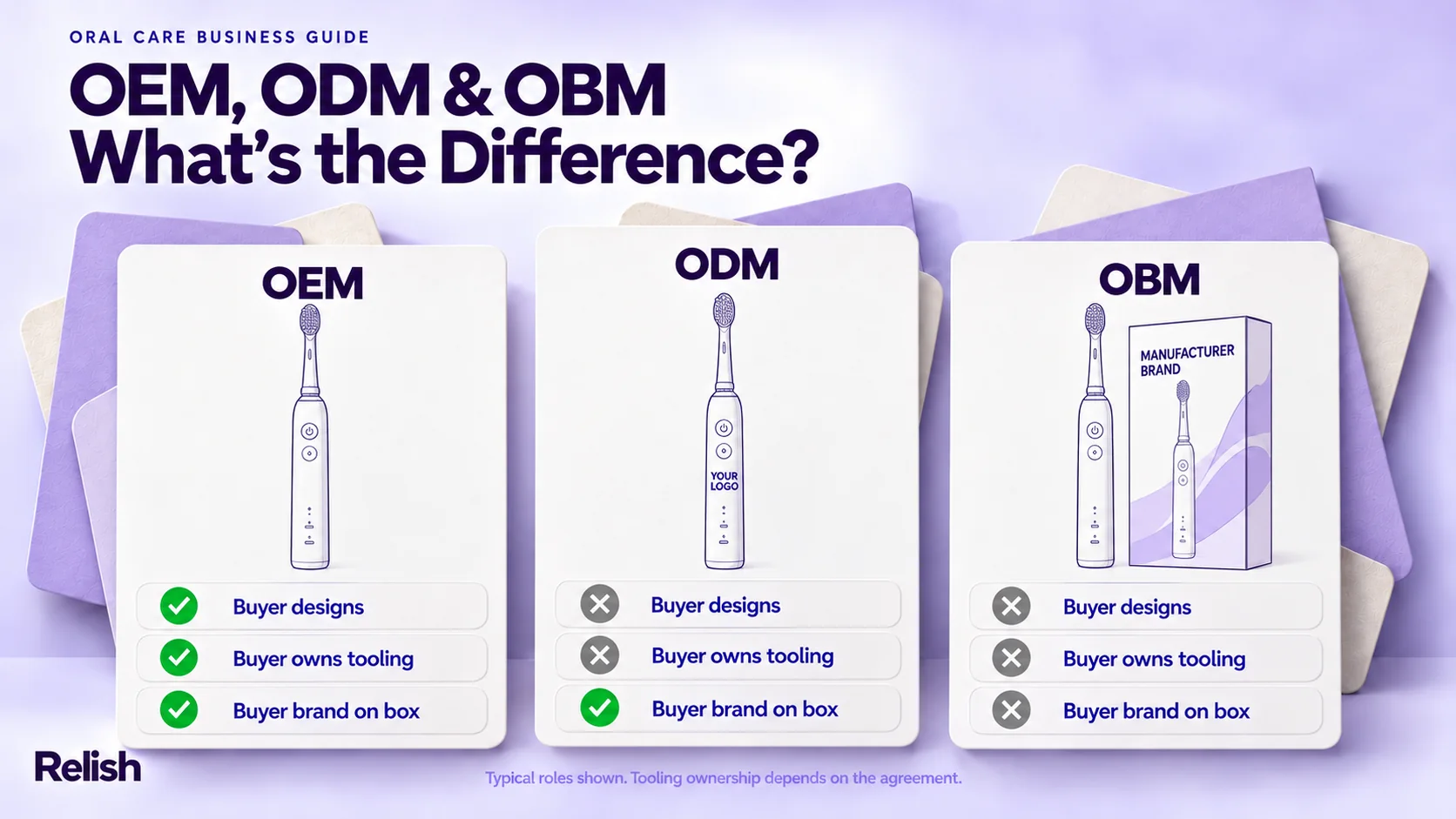
For OEM and private-label buyers, an oscillating-rotating round-head design affects the drive, transmission, replacement-head system, and product positioning. Plan these elements together. Use terms such as “round head electric toothbrush” and “rotating head toothbrush” naturally to describe the product and help buyers compare its mechanism with sonic alternatives.
- Match the drive to the intended motion. For an oscillating-rotating SKU, verify the head’s alternating arc, rate, torque, and compatibility during quality control; a round outline alone does not establish the mechanism.
- Explain the brushing technique. Show how to guide the compact head around each tooth and reach back teeth without promising that one head shape automatically cleans better.
- Proposez plusieurs têtes de rechange. Des options souples, pour dents sensibles ou pour appareils orthodontiques, peuvent élargir l’offre et encourager le réachat pour un même manche.
- Positionnez-vous face aux modèles soniques. La comparaison entre tête ronde et tête sonique aide les distributeurs et les acheteurs à situer votre brosse.
Customized products, including private-label replacement heads, typically start at 1,000 units, with flexibility for the specific order. Wholesale orders for available stock start at 50 units. Prototype samples are ready in 3–7 days, and mass production takes 25–35 days after sample approval. The factory holds ISO 9001 and ISO 13485 certification and FDA establishment registration, and can supply CE, RoHS, and FCC documentation where applicable to the product and destination market.
Our reliability laboratory has logged more than 450 test items over nine months. Production checks include motor-frequency and oscillation consistency on every handle. Sample-based reliability testing includes a 72-hour full-unit life test, a one-metre drop onto six faces under GB/T 2423.7-2008, 48-hour salt spray under GB/T 2423.17-2008, and temperature testing from -20 °C to 60 °C with humidity testing at 80% RH where specified by the test protocol. Matching heads undergo sample-based tuft-retention testing at a minimum of 1.5 kgf per tuft and whole-bristle-plate testing at a minimum of 50 N under GB 39669-2020. These destructive and durability tests are separate from routine checks on every production unit. Reports are available on request.
Options de personnalisation. La tête ronde est une plateforme, pas un moule unique. Une fois les volumes et l’outillage convenus, sa géométrie, les brins, les réglages du moteur et la finition peuvent être adaptés à la marque de l’acheteur ; le tableau ci-dessous est un point de départ, pas une limite.
Relish Tech fabrique des brosses à dents électriques rotatives et soniques pour les projets OEM/ODM et les marques sous marque propre. Des têtes rondes de rechange sont disponibles ; leur compatibilité est vérifiée selon les références concernées. Consultez le catalogue de brosses à dents électriques pour voir les modèles rotatifs proposés.
Vous cherchez une brosse à tête rotative pour votre catalogue ? Contactez Relish Tech →
Questions fréquentes
Qu’est-ce qu’une brosse à dents électrique à tête ronde ?
Une brosse rotative est-elle meilleure qu’une brosse sonique ?
Les têtes rondes atteignent-elles mieux les dents du fond ?
Qui devrait utiliser une brosse électrique à tête rotative ?
À quelle fréquence remplacer une tête ronde ?
Puis-je utiliser une tête ronde si j’ai les dents sensibles ?
Relish Tech fournit des brosses à dents électriques OEM/ODM avec des têtes rondes rotatives et des têtes de rechange correspondantes. La compatibilité est évaluée pour les références concernées. Consultez le catalogue numérique ou demandez une fiche technique et un échantillon pour évaluation.
Conseils sur la conception des têtes compilés à partir de revues systématiques Cochrane et de références techniques de fabricants. Ils ne remplacent pas les conseils d’un professionnel de santé dentaire.
Références
- American Dental Association. (s.d.). Toothbrushes. Disponible sur https://www.ada.org/resources/ada-library/oral-health-topics/toothbrushes
- Yaacob, M., Worthington, H. V., Deacon, S. A., Deery, C., Walmsley, A. D., Robinson, P. G., & Glenny, A.-M. (2014). Powered versus manual toothbrushing for oral health. Cochrane Database of Systematic Reviews, (6), CD002281. https://doi.org/10.1002/14651858.CD002281.pub3
- Ng, C., Tsoi, J. K. H., Lo, E. C. M., & Matinlinna, J. P. (2020). Safety and design aspects of powered toothbrush—A narrative review. Dentistry Journal, 8(1), Article 15. https://doi.org/10.3390/dj8010015
- Clark-Perry, D., & Levin, L. (2020). Systematic review and meta-analysis of randomized controlled studies comparing oscillating-rotating and other powered toothbrushes. Journal of the American Dental Association, 151(4), 265–275.e6. https://doi.org/10.1016/j.adaj.2019.12.012