

Spazzolino elettrico con testina rotonda: cosa sapere prima dell’acquisto
A round head is commonly associated with an oscillating-rotating electric toothbrush. The head moves back and forth through a short arc, helping you guide the bristles around one tooth at a time. Many sonic models use an elongated head, but head shape alone does not identify the drive mechanism. This guide explains round-head brushing, compares it with common sonic designs, and outlines what to check before buying.
- A small round head is typical of an oscillating-rotating brush, although shape alone does not tell you how a toothbrush moves.
- The head reverses direction through a short arc while you guide it along each tooth and the gumline.
- Cochrane found benefits for powered brushing over manual brushing, with the largest evidence base for oscillating-rotating designs. A later review favored these designs for some outcomes compared with other powered brushes.
- Consider a compact round head if you prefer tooth-by-tooth brushing or need a head that feels easy to position around back teeth, crowded teeth, or braces.
Stai lanciando una linea di spazzolini con testina rotante? Scopri le opzioni a marchio privato →
Che cos’è uno spazzolino elettrico con testina rotonda?
A round head has a small circular brushing surface rather than an elongated one. On an oscillating-rotating toothbrush, the drive moves it back and forth through a short arc. Guide the bristles around each tooth and along the gumline; the circular shape does not mean that the head spins continuously through complete revolutions.
Perché la forma è importante
In a common oscillating-rotating design, the head turns partway in one direction and then reverses. Some models add pulsation or other motion. Shoppers may call these rotating-head, spinning-head, or circular toothbrushes, but the product specification should identify the actual motion and its rate. Shape, oscillation rate, and motor RPM describe different features.
Come pulisce una testina rotante
Both oscillating-rotating and sonic toothbrushes clean through bristle movement and contact with tooth surfaces. A common sonic design moves an elongated head rapidly; fluid movement around the bristles may also contribute, but does not replace correct positioning. An oscillating-rotating brush moves a compact round head through short alternating arcs for tooth-by-tooth cleaning.
The compact head can be convenient to position around back teeth and inner tooth surfaces, especially if a larger head feels awkward. Whether it is easier to use depends on the head dimensions, your mouth, and your technique. The American Dental Association recognizes both manual and powered brushes as effective options when used properly.
The drive system must suit the head motion. Relish offers an industrial-grade servo-drive platform with a stated vibration rating of up to 31,000 VPM, and checks motor-frequency consistency on the production line. For a rotating-head SKU, confirm the head’s oscillation rate, arc, and torque separately: a VPM rating is not the number of complete head rotations per minute.
Testina rotonda o sonica: le differenze principali
Entrambi i tipi di spazzolino elettrico rimuovono bene la placca, ma funzionano in modo diverso. Ecco un confronto affiancato dei due design più comuni.
Per un confronto tecnico più approfondito dei due meccanismi, consulta la nostra guida agli spazzolini sonici e oscillanti-rotanti. Se vuoi capire il motore e la vibrazione di ciascun tipo, la nostra spiegazione su come funzionano gli spazzolini elettrici ne illustra i componenti interni.
Uno spazzolino rotante è migliore?
A 2014 Cochrane review found that powered brushes reduced plaque and gingivitis more than manual brushes overall, with the largest body of evidence for oscillating-rotating designs. That finding does not establish that every round-head model outperforms every sonic model. The review noted that the clinical importance of the differences remained unclear; brushing technique and regular use also matter.
Confronto tra testina rotante e sonica
Clark-Perry and Levin’s 2020 systematic review compared oscillating-rotating brushes with other powered brushes, particularly sonic designs. It found statistically significant advantages for whole-mouth plaque measured with the Rustogi Modified Navy Plaque Index and for the number of bleeding sites, but not for the modified gingival index or gingival bleeding index. These are outcomes from the included studies, rather than a guarantee for every model or user. Compare the evidence alongside comfort, technique, and the features you will use consistently.
Chi dovrebbe scegliere uno spazzolino elettrico con testina rotonda?
La testina rotonda non è automaticamente migliore per tutti, ma si adatta particolarmente bene a diverse situazioni:
Situations Where a Compact Round Head May Help
- Small mouths and crowded teeth. A compact head may be easier to position around back teeth or in crowded areas; check the actual head size and how comfortably you can reach.
- Braces and orthodontics. A compact head may help you position the bristles around brackets and wires. Use an appropriate head and follow your dental professional’s advice for cleaning the remaining gaps.
- Tooth-by-tooth brushing. The round head supports a deliberate technique in which you guide it around each tooth rather than relying on the head to surround the whole tooth automatically.
- Brushing pressure. Choose a model with a pressure sensor if you want feedback when pressing too hard. This feature depends on the model and is available with different head styles.
Se hai denti o gengive sensibili, entrambe le forme di testina possono essere adatte, purché tu scelga setole morbide e una modalità delicata. Per saperne di più, leggi il nostro articolo sugli spazzolini elettrici per denti sensibili.
Quanto dura una testina rotonda?
Replace the head about every three to four months, or sooner if the bristles become matted or frayed. If the head has indicator bristles, follow the manufacturer’s guidance on color changes. Our guide to how often to change a toothbrush head explains the signs, and our guide to how to clean an electric toothbrush head covers care between replacements.
Testine rotanti nella gamma OEM
For OEM and private-label buyers, an oscillating-rotating round-head design affects the drive, transmission, replacement-head system, and product positioning. Plan these elements together. Use terms such as “round head electric toothbrush” and “rotating head toothbrush” naturally to describe the product and help buyers compare its mechanism with sonic alternatives.
- Match the drive to the intended motion. For an oscillating-rotating SKU, verify the head’s alternating arc, rate, torque, and compatibility during quality control; a round outline alone does not establish the mechanism.
- Explain the brushing technique. Show how to guide the compact head around each tooth and reach back teeth without promising that one head shape automatically cleans better.
- Proponi diverse testine di ricambio. Le opzioni morbide, per denti sensibili e per apparecchi ortodontici possono ampliare la gamma e favorire riacquisti per lo stesso manico.
- Posizionalo rispetto al sonico. Il confronto tra testina rotonda e sonica aiuta rivenditori e acquirenti a capire la collocazione dello spazzolino.
Customized products, including private-label replacement heads, typically start at 1,000 units, with flexibility for the specific order. Wholesale orders for available stock start at 50 units. Prototype samples are ready in 3–7 days, and mass production takes 25–35 days after sample approval. The factory holds ISO 9001 and ISO 13485 certification and FDA establishment registration, and can supply CE, RoHS, and FCC documentation where applicable to the product and destination market.
Our reliability laboratory has logged more than 450 test items over nine months. Production checks include motor-frequency and oscillation consistency on every handle. Sample-based reliability testing includes a 72-hour full-unit life test, a one-metre drop onto six faces under GB/T 2423.7-2008, 48-hour salt spray under GB/T 2423.17-2008, and temperature testing from -20 °C to 60 °C with humidity testing at 80% RH where specified by the test protocol. Matching heads undergo sample-based tuft-retention testing at a minimum of 1.5 kgf per tuft and whole-bristle-plate testing at a minimum of 50 N under GB 39669-2020. These destructive and durability tests are separate from routine checks on every production unit. Reports are available on request.
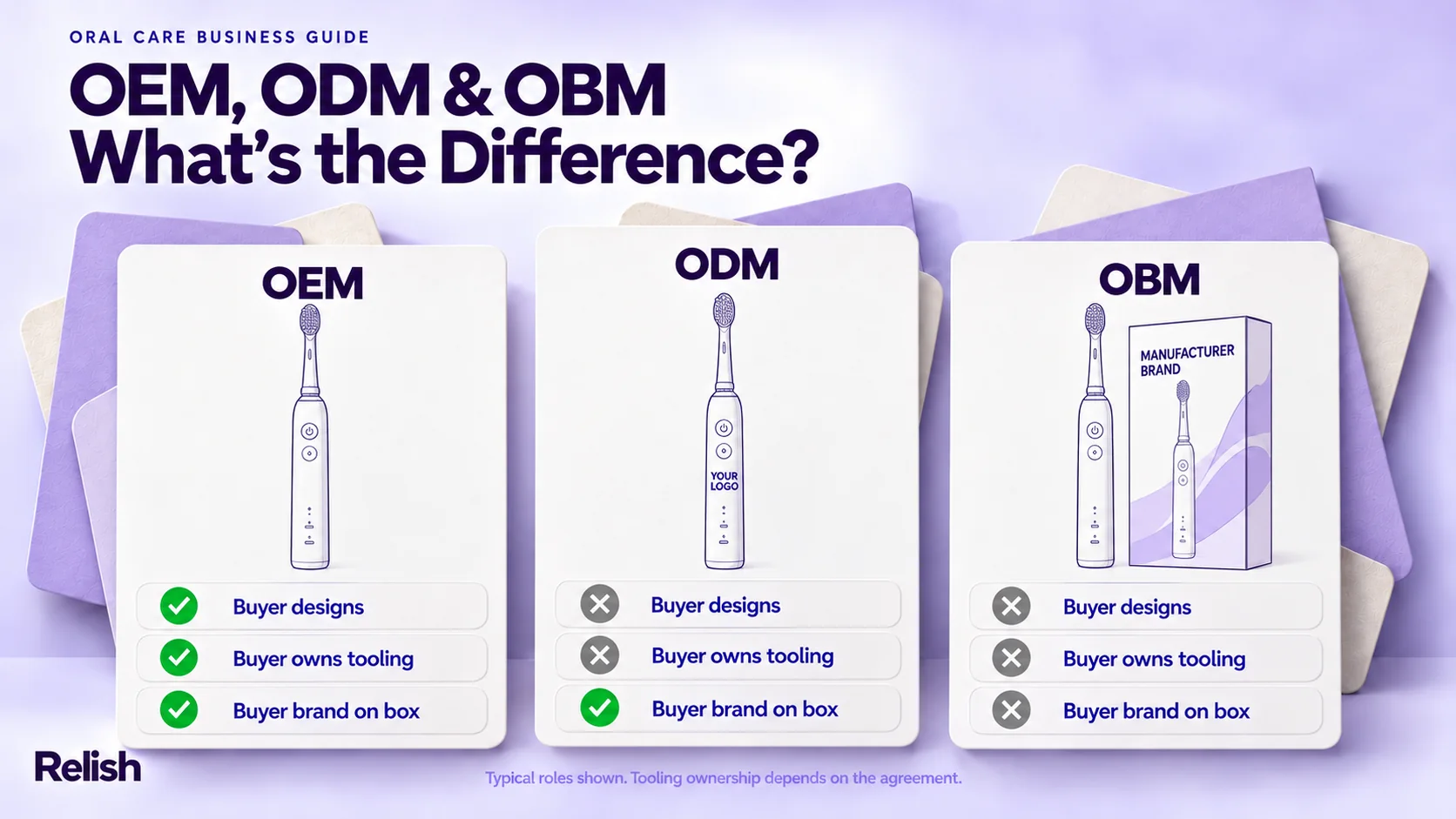
Opzioni di personalizzazione. La testina rotonda è una piattaforma, non un unico stampo. Geometria della testina, setole, taratura del motore e finitura possono essere ridefinite per il marchio del cliente, una volta concordati volumi e costi degli stampi. La tabella seguente è quindi un punto di partenza, non un limite.
Relish Tech produce spazzolini elettrici rotanti e sonici per progetti OEM/ODM e prodotti a marchio del cliente. Sono disponibili testine rotonde di ricambio; la compatibilità viene verificata per i modelli interessati. Consulta il catalogo degli spazzolini elettrici per vedere i modelli rotanti disponibili.
Ti serve uno spazzolino rotante per il tuo catalogo? Contatta Relish Tech →
Domande frequenti
Che cos’è uno spazzolino elettrico con testina rotonda?
Uno spazzolino rotante è migliore di uno sonico?
Le testine rotonde raggiungono meglio i denti posteriori?
Chi dovrebbe usare uno spazzolino elettrico con testina rotante?
Ogni quanto devo cambiare una testina rotonda?
Posso usare una testina rotonda se ho denti sensibili?
Relish Tech fornisce spazzolini elettrici OEM/ODM con testine rotonde rotanti e le relative testine di ricambio. La compatibilità viene valutata per i modelli interessati. Apri il catalogo digitale dei prodotti oppure richiedi una scheda tecnica e un campione per la valutazione.
Indicazioni sulla progettazione delle testine elaborate da revisioni sistematiche Cochrane e riferimenti tecnici dei produttori. Non sostituiscono il parere di un professionista odontoiatrico.
Riferimenti
- American Dental Association. (s.d.). Toothbrushes. Disponibile su https://www.ada.org/resources/ada-library/oral-health-topics/toothbrushes
- Yaacob, M., Worthington, H. V., Deacon, S. A., Deery, C., Walmsley, A. D., Robinson, P. G., & Glenny, A.-M. (2014). Powered versus manual toothbrushing for oral health. Cochrane Database of Systematic Reviews, (6), CD002281. https://doi.org/10.1002/14651858.CD002281.pub3
- Ng, C., Tsoi, J. K. H., Lo, E. C. M., & Matinlinna, J. P. (2020). Safety and design aspects of powered toothbrush—A narrative review. Dentistry Journal, 8(1), Article 15. https://doi.org/10.3390/dj8010015
- Clark-Perry, D., & Levin, L. (2020). Systematic review and meta-analysis of randomized controlled studies comparing oscillating-rotating and other powered toothbrushes. Journal of the American Dental Association, 151(4), 265–275.e6. https://doi.org/10.1016/j.adaj.2019.12.012