










OEM電動歯ブラシのタイムライン:週ごとのプロセスガイド(2026年)
ほとんどのブランドは12週間のOEMスケジュールを計画します。実際に期日通りに出荷するブランドは16週間を計画しています。ここに完全な内訳を示します—毎週何が起こるか、遅延の原因、そして守れるスケジュールを組む方法です。.
エグゼクティブサマリー:OEM電動歯ブラシ生産スケジュール
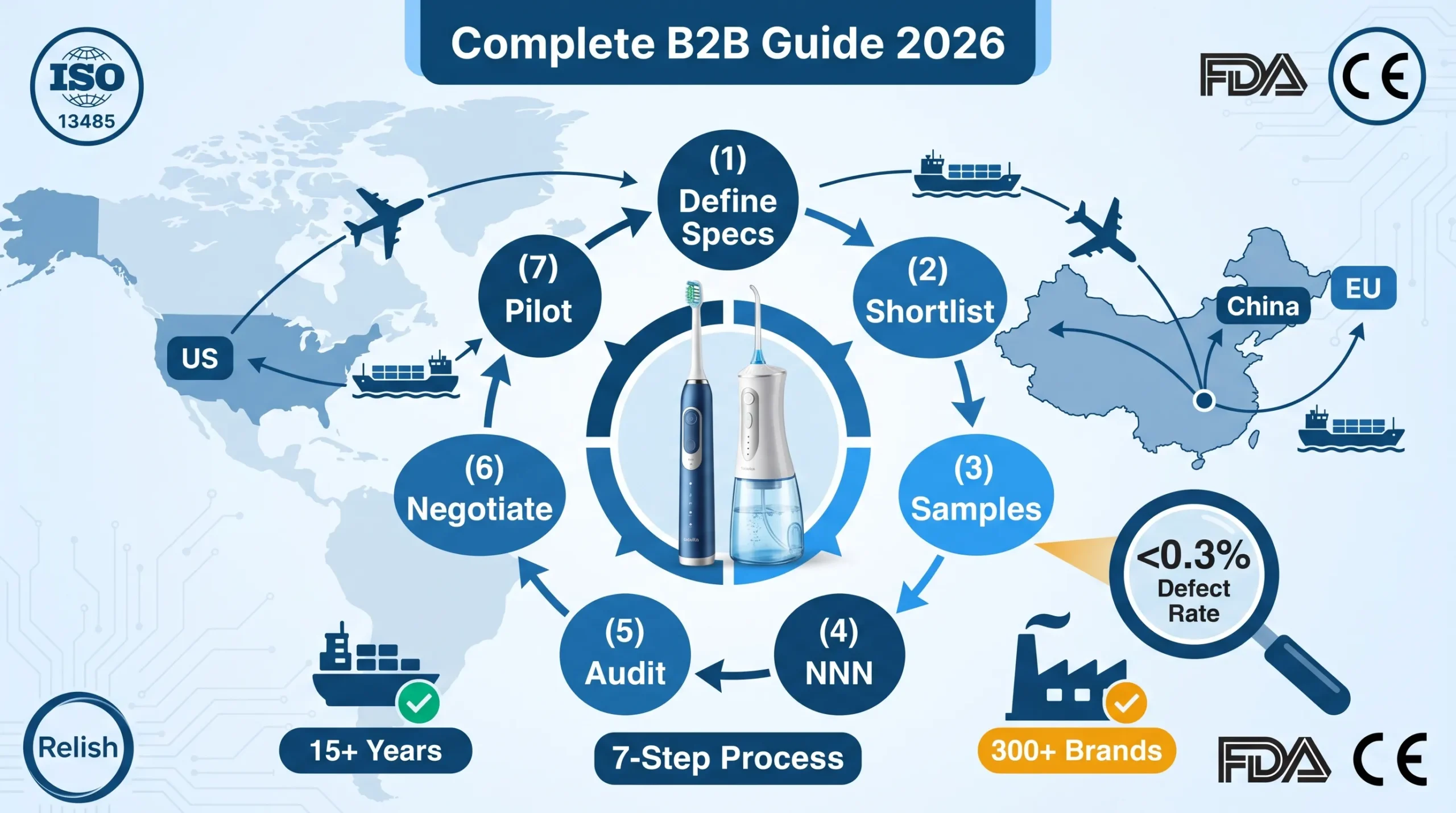
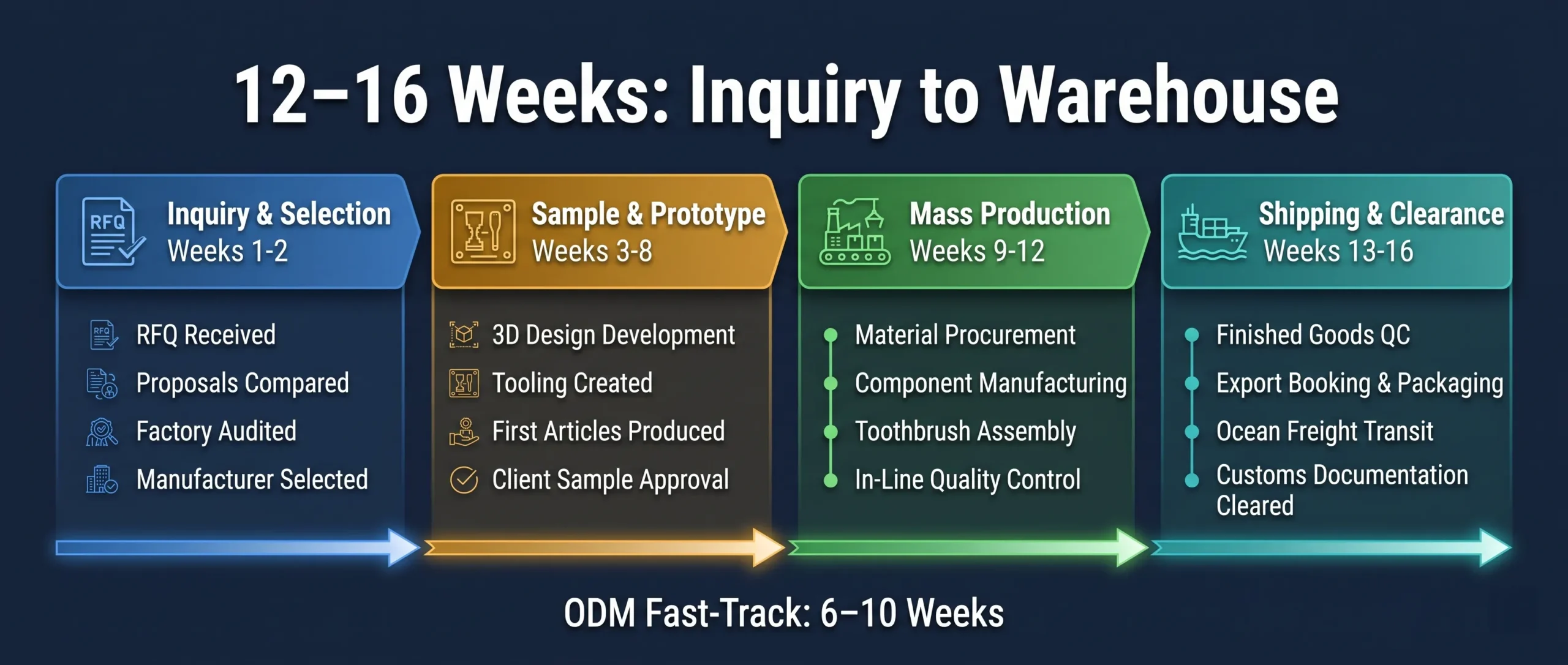
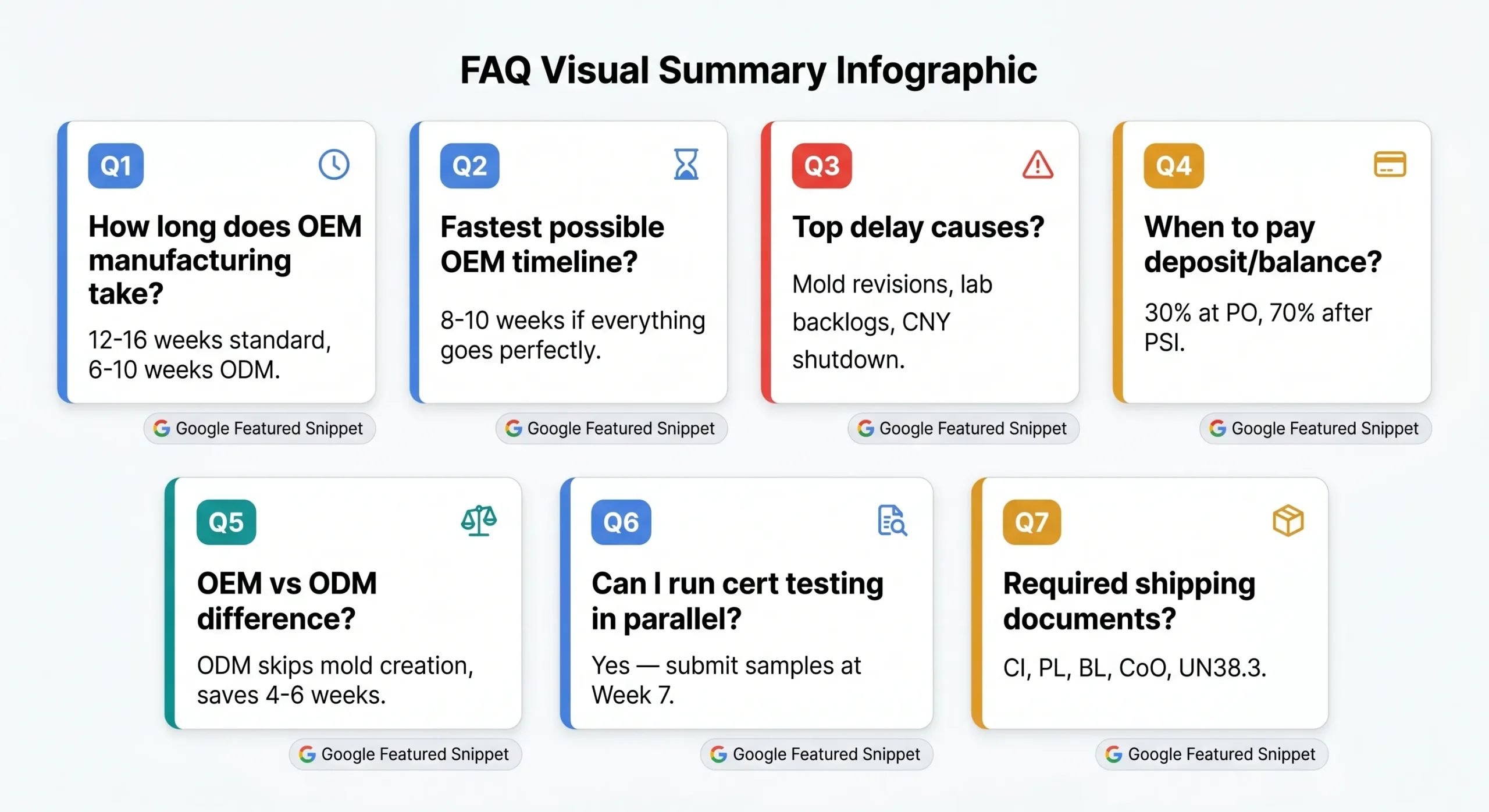
- 標準OEMスケジュール: 12~16週間(84~112日)で問い合わせから倉庫納品まで。4つのフェーズ:問い合わせと選定(第1~2週)→ サンプルとプロトタイプ(第3~8週)→ 量産(第9~12週)→ 出荷と通関(第13~16週)。.
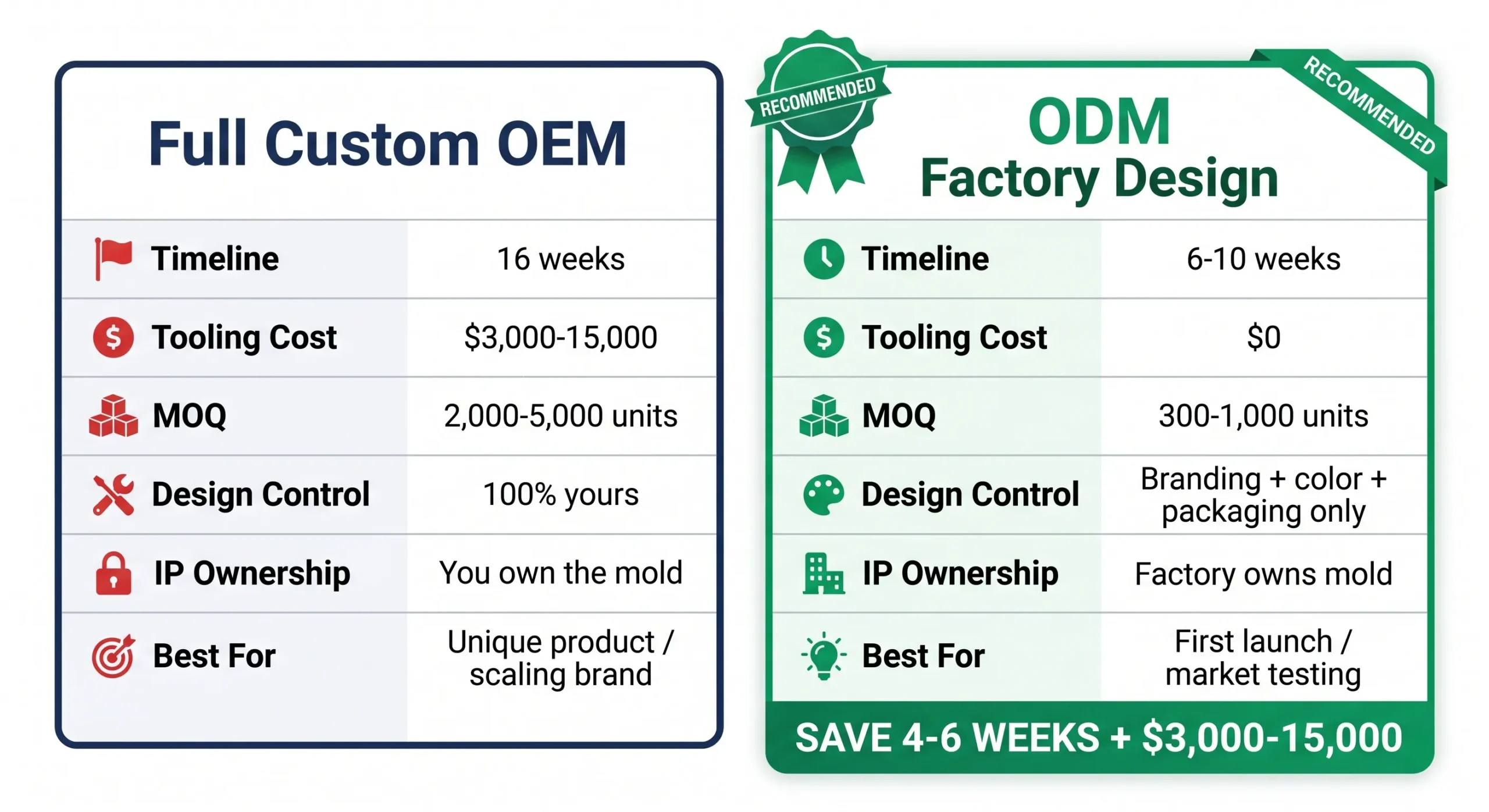
- ODMファストトラック: 6~10週間。金型/治具工程を完全に省略。4~6週間と3,000~15,000ドルの金型コストを節約。初回購入者に推奨。.
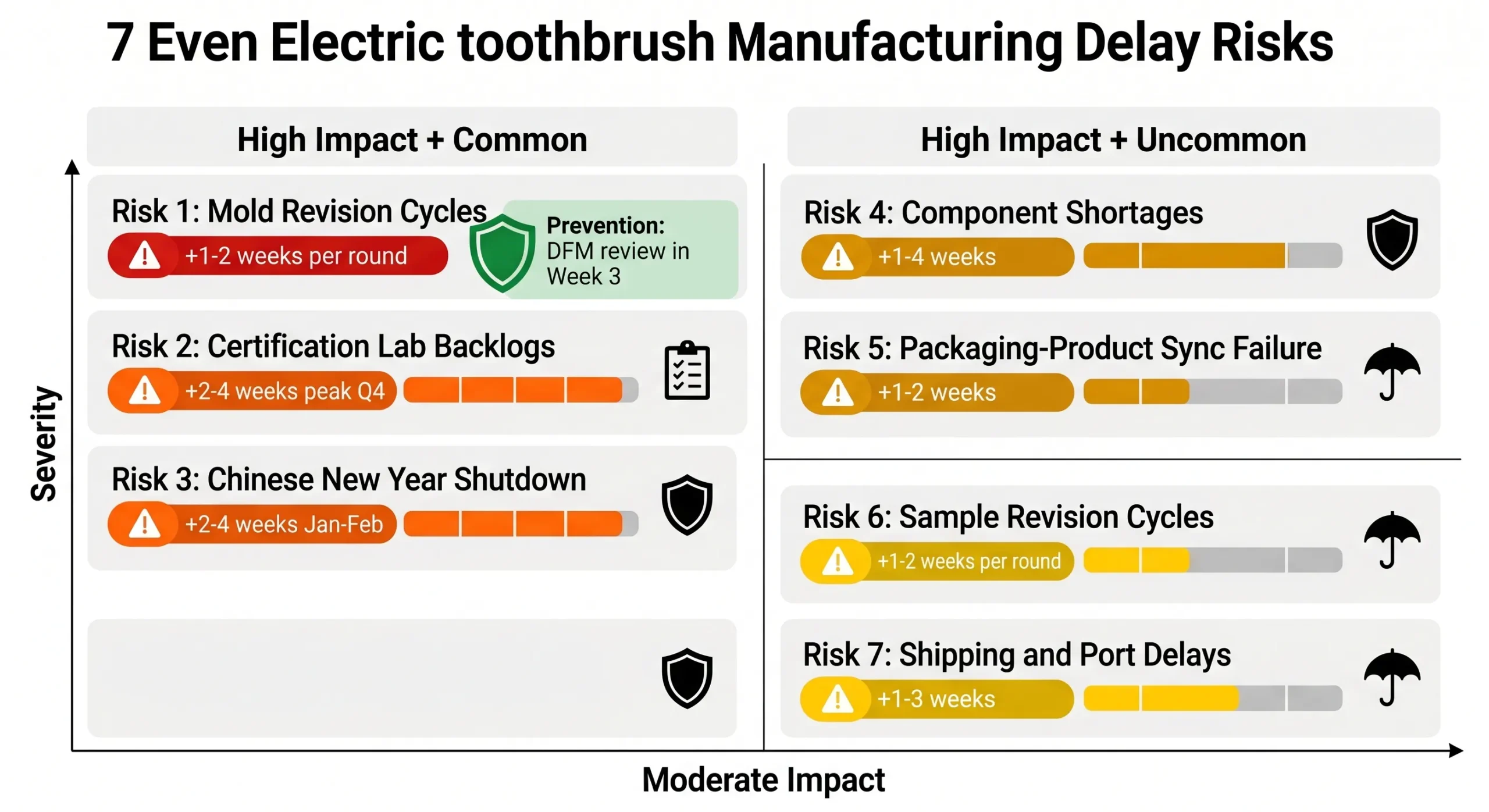
- 主な遅延リスク: (1) 金型修正サイクル(各+1~2週)。(2) 第4四半期の認証ラボのバックログ(+2~4週)。(3) 旧正月の操業停止(+2~4週)。2~3週間のバッファーを確保。.
- 主要な支払いマイルストーン: 発注時(第8週)に30%のデポジット、出荷前検査後(第12週)に70%の残金。金型:50%前払い、T1サンプル後に50%。.
このガイドの内容
スケジュール全体の概要
各週の詳細に入る前に、全体像をご確認ください。スケジュールの全体的な形状を理解することで、工場との交渉、現実的な発売日の設定、バッファー時間が最も重要な箇所の特定に役立ちます。.
🏭 メーカーについて:Relish Technology
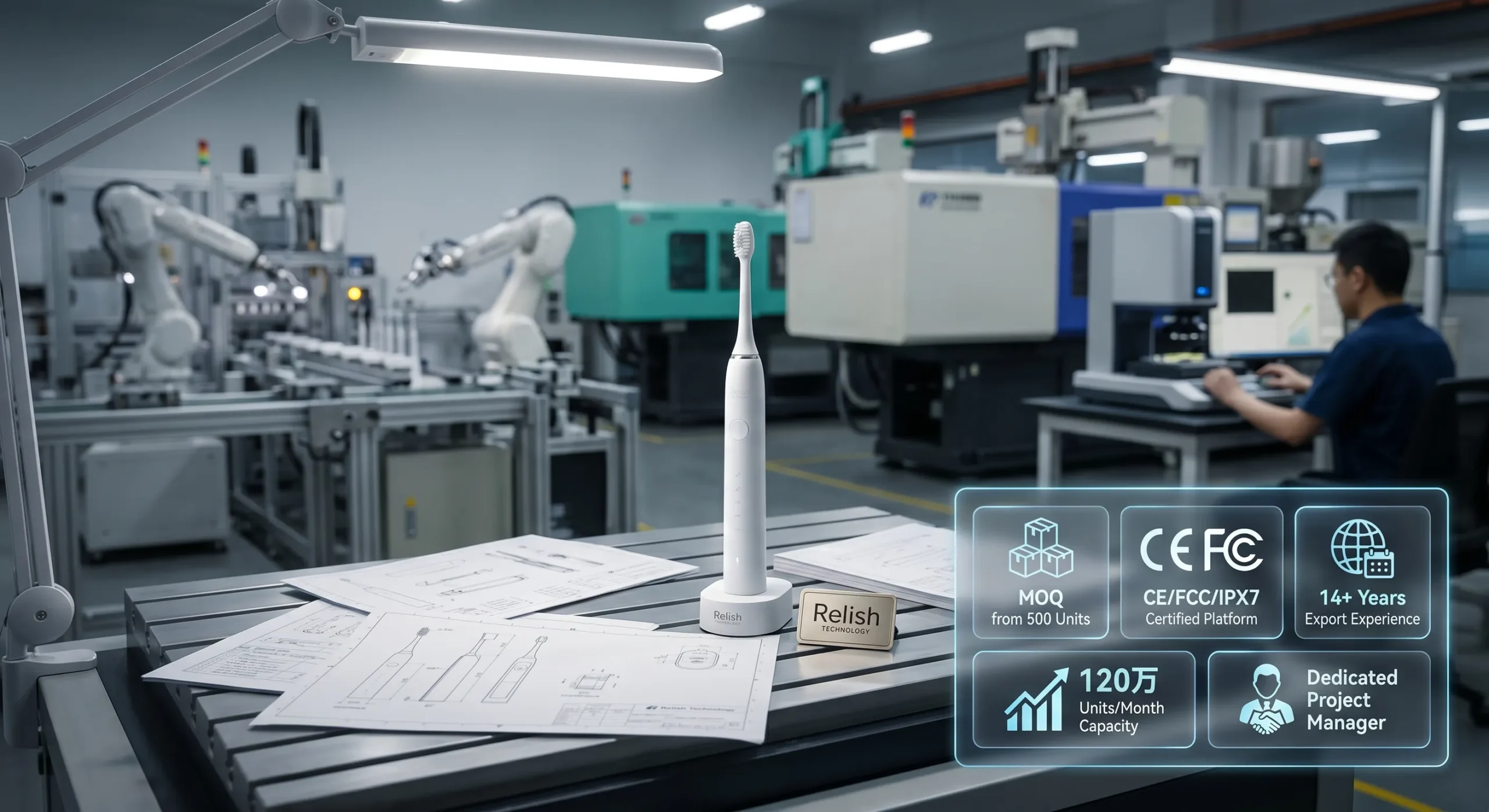
Relish Technologyは、深センを拠点とするオーラルケアOEM/ODM工場である。 14年以上の輸出経験 電動歯ブラシとウォーターフロッサーの製造において。当社の能力:
- 20,000 m² 広東省深センにある無塵生産施設
- 120万台以上 電動歯ブラシとウォーターフロッサーラインの月産能力
- 300人以上の熟練工 を越えて 12自動化生産ライン
- 30人以上の研究開発エンジニア ソニックモーター設計、バッテリー管理、IoT統合に特化
- 輸出先 120カ国以上 世界中
- 資格: CE、FCC、FDA、ISO 9001、ISO 13485、RoHS、REACH、IPX7
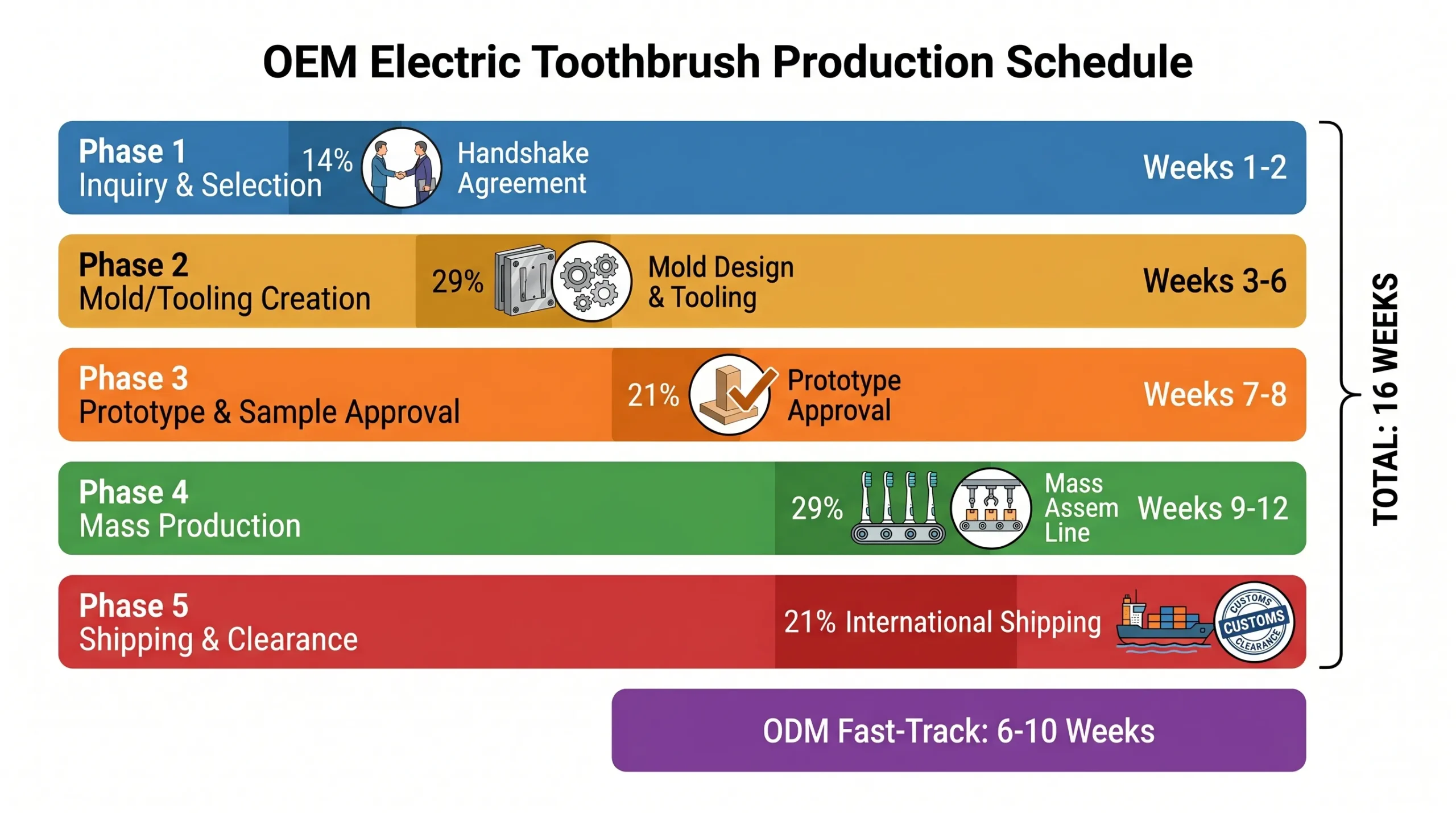
OEM電動歯ブラシ:標準14週間スケジュール(視覚的概要)
| フェーズ | 週 | 主要な活動 | あなたの判断ポイント |
|---|---|---|---|
| Inquiry & Selection | 1–2 | RFQ、見積比較、NDA締結、工場選定 | 工場選定、仕様確定 |
| Mold Creation | 3–6 | エンジニアリングレビュー、金型製作、初回金型トライアル | 金型設計承認、金型デポジット支払い |
| Prototype & Approval | 7–8 | 初回サンプル、テスト、修正、量産前承認 | サンプル承認、注文書署名 |
| 4.大量生産 | 9–12 | 30%デポジット、インラインQC、パッケージ生産、出荷前検査 | 検査合格、70%残金支払い |
| Shipping & Clearance | 13–16 | 海上/航空貨物、通関業者、ラストマイル配送 | 受領確認、在庫記録 |
覚えておくべき数字
16週間を計画し、12週間で完了したら祝いましょう。. 私たちが見てきた調達の失敗のほとんどは、最良のシナリオを想定して計画した人から発生しています。金型修正1回、サンプル修正サイクル1回、出荷遅延1週間分のバッファーを組み込みましょう。そのバッファーは計画するのにコストはかからず、製品ローンチ全体を救う可能性があります。.
Phase 1 — Inquiry & Factory Selection (Weeks 1–2)
第1週と第2週に何が起こるかが、プロジェクト全体の方向性を決めます。ここで適切な工場審査を怠ると、第9~14週で本来なら事前に発見できたはずの品質問題に対処することになります。.
RFQ準備と複数工場への問い合わせ
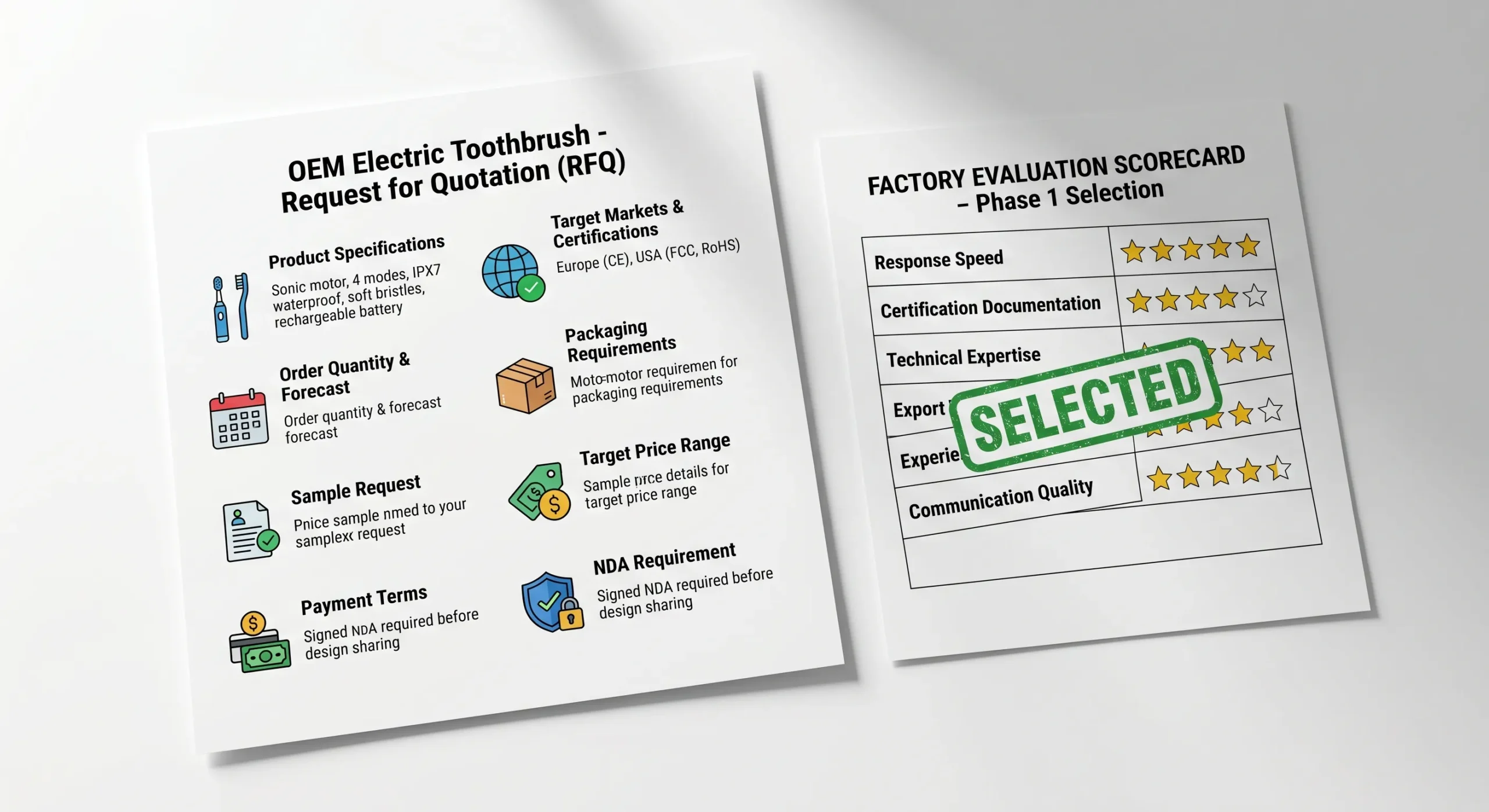
問い合わせ第1週は、明確で詳細な 見積依頼書(RFQ) を作成し、4~6社の工場に同時に送信することから始めましょう。RFQの質が、得られる見積もりの質を決定します。曖昧な依頼には曖昧な回答が返り、後になるまで明らかにならない inflated な価格が含まれます。.
- 製品仕様を定義する: モータータイプ(ソニック/ロータリー/超音波)、バッテリー容量(mAh)、防水等級(IPX5/7)、ハンドル寸法、ブラシヘッドタイプ、充電方法(誘導式/USB-C)、動作モード
- 目標数量を設定する: 初回注文数量と予想年間数量を明記する。工場は500台と5,000台で価格設定が異なります
- 必要な認証をリストアップする: 対象市場を指定する(米国→FCC + CA Prop 65、EU→CE + RoHS、日本→PSEなど)。工場が見積もりに認証コストを含められるようにします
- パッケージ要件を指定する: 小売箱寸法、インサートカード、マスターカートン、Amazon対応ラベリング要件
- 4~6社の候補工場を特定する: 広州交易会のディレクトリ、Alibaba Gold Supplierフィルター、Made-in-China.com、または直接紹介を利用する
完全なRFQは以下の8項目をカバーします
製品名と1~2行の説明。寸法、材料、性能目標を含む技術仕様書。対象市場と必要な認証。初回注文数量と12ヶ月の数量予測。小売箱とマスターカートンの両方のパッケージ仕様。サンプル数量とリードタイム要件。目標FOB価格帯(任意だが、競争力のない工場を事前に除外するのに役立ちます)。そして希望する支払条件。.
見積評価と工場選定
選定見積もりが届き始めます。最も安いオプションをデフォルトで選ぶ衝動に抵抗してください。最低価格の見積もりが、総コストが最も低いことはほとんどありません。2,000台の注文で$1.50/台の節約(合計$3,000)は、1回のQC検査不合格(手数料$400 + 再作業$8,000)で瞬時に消え去る可能性があります。.
- 同じ基準で見積もりを比較する: すべての見積書で同一のインコタームズ(通常はFOB深セン)が使用され、同じ認証が含まれ、同一の包装仕様をカバーしていることを確認する
- 工場の資格情報を確認する: 営業許可証、ISO 9001認証、および製品固有の認証(既存製品のCE/FCC)を要求する。中国のSAMR登録データベースでクロスチェックする
- コミュニケーション速度を評価する: 簡単な見積依頼に5日かかる工場は、生産問題への対応に10日かかる
- 工場プロフィールを要求する: 生産ライン数は?年間生産能力は?現在の主要顧客(匿名化)は?対象市場への輸出実績はあるか?
- Shortlist to 2 factories: 上位2社にビデオ工場見学を依頼する。予算が許せば、工場監査(QIMA、Bureau Veritas:約300~500米ドル)を委託する
信頼できる工場の特徴
24時間以内に詳細な項目別見積書で応答する。仕様に関する潜在的な技術的問題を指摘し、すべてに「はい」と言わない。類似製品のCE/FCC試験報告書を提示できる。専任の輸出部門と英語対応のプロジェクトマネージャーがいる。コミット前にライブビデオ工場見学に応じる。.
以下の場合は取引を中止する
見積書が他社より30%以上低い場合——通常は仕様のすり替えか後で追加される費用。NDAに署名せずに設計を確認しようとしない。既存の認証文書を提示できない。生産能力や現在の顧客について曖昧。または100%前払いを要求する。これらのいずれかがあれば取引を中止すべき。.
フェーズ2 — サンプル・プロトタイプ開発(第3~8週)
このフェーズが最も時間を要する。修正ラウンドごとに1~2週間追加され、フィードバックメールを送るたびに時計がリセットされる。サンプル開発を最も迅速に進めるブランドは、すべてのメモをラウンドごとに1つの文書にまとめ、迅速に意思決定を行う。金型切削後に新たな要件を追加するスコープクリープは、この段階で最も高くつくミスである。.
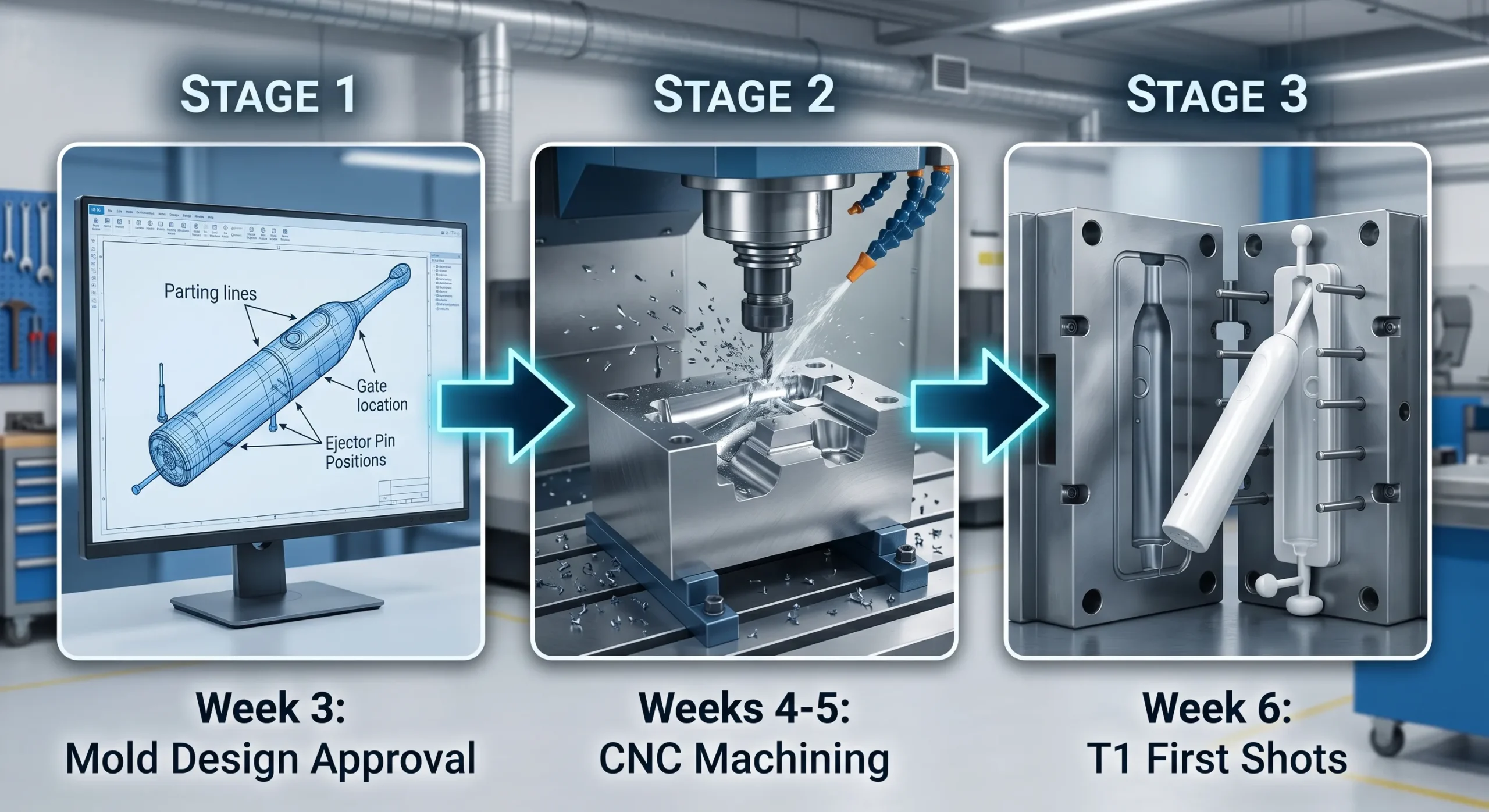
エンジニアリングレビューと金型設計確認
金型製作開始契約締結後、工場のエンジニアリングチームが仕様を詳細に検討する。3~5件の質問や反論が予想される——機械加工が困難、金型コストが高い、生産ラインに適合しない設計特徴を指摘し、代替案を提案する。迅速な対応が金型切削への移行を早める。.
- DFMレビュー(製造性を考慮した設計): 工場のエンジニアが壁厚、アンダーカット、パーティングライン、組立複雑性を分析する。3~5件の技術的質問や提案が予想される
- 金型設計図面(3D CAD): 工場は金属切削前に承認用の射出成形金型設計ファイルを作成する。注意深くレビューすること。金型切削後の変更は高額
- 材料確認: ハンドル材料(ABS/PC/ABS+PCブレンド)、ブラシ毛材料(ナイロングレード/デュポンTynex)、TPE/ラバーオーバーモールド仕様を確認する
- PCBとモーター仕様の確定: モーターモデル、PCB設計、バッテリーサプライヤーを確認する。ソニックモーターの場合、発振周波数(通常31,000~40,000ストローク/分)を検証する
- 金型着手金の支払い: 金型費用は複雑さに応じて3,000~15,000米ドル。通常50%前払い、50%は初回金型トライアル後
金型製作(CNC加工)
金型製作金属切削中。今週はやることはほとんどないが、時間を有効活用すること。工場からの進捗更新は2~3日ごとにあるべき。5日間連絡がない場合はフォローアップする。CNC金型加工は精密だが、ツールパスプログラミングのエラーがないわけではない。 CNC加工リードタイム:. 標準鋼金型(P20/H13工具鋼)は2~3週間。アルミ試作金型は5~7日で可能だが、生産寿命が短い.
- 進捗写真を要求する: CNC加工の50%完了時と100%完了時の写真を依頼する
- 待機中の並行タスク: ブランドロゴと金型テクスチャリング用カラーパレットを確定する
- 小売包装デザイン案を工場レビュー用に作成する
- 試験ラボでCE/FCC認証の事前評価を開始する
- 工場レビュー用の小売パッケージデザイン案
- 試験ラボとCE/FCC認証の事前評価を開始する
- Prepare Import of Record (IOR) setup if needed for US market
- Mold steel grade matters: P20 steel handles ~300K shots (fine for initial runs). H13 steel handles 1M+ shots (worth the premium if you expect high volume)
Don't waste Weeks 4-5 waiting
Use the mold fabrication period to finalize packaging design and send it to the factory for a mockup. Register your barcodes (EAN/UPC) for all SKUs now—it's a two-day task that becomes urgent at the worst possible moment if you skip it. Draft your Amazon listing, confirm your 3PL warehouse, engage the certification lab, and prepare user manuals in your target market languages. None of this requires the physical product.
First Mold Trial & T1 Samples
First ShotsThe first physical samples emerge from the new mold. Called "T1 samples" (Trial 1), these are injection-molded housing pieces that get checked for dimensional accuracy, surface finish, and fit before full assembly. Do not expect perfection at T1. It almost never happens, and that's normal.
- T1 dimensional inspection: Factory measures critical dimensions against your approved drawings using CMM (Coordinate Measuring Machine) or calipers
- Surface finish review: Check texture, gloss level, parting line visibility, and any sink marks or weld lines
- Assembly trial: Housing halves are assembled with the internal components (PCB, motor, battery) to check fit and tolerance stack-up
- Common T1 issues and typical fixes:
- Parting line flash → mold steel polishing (1–3 days)
- Sink marks on thick walls → gate repositioning or wall thickness reduction (3–7 days)
- Snap-fit too loose or too tight → steel welding or EDM machining adjustment (2–5 days)
- Surface texture not matching spec → re-texturing (3–5 days)
- Request T1 samples physically shipped: Even with photos, hands-on evaluation reveals things a camera misses. Tactile quality, weight distribution, button feel
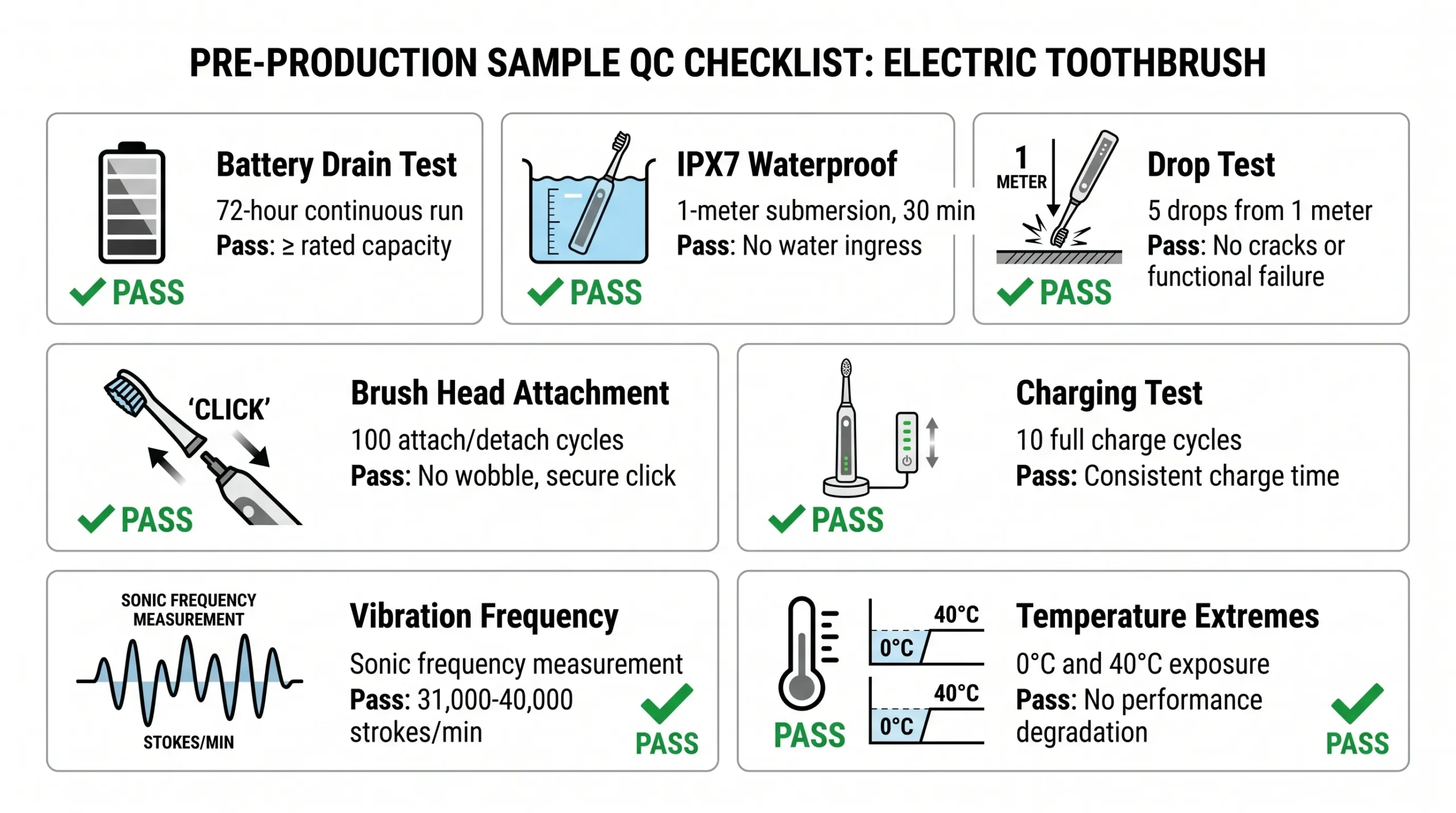
Pre-Production Sample (Functional Prototype) & Testing
Sample TestingWeek 7 is where the T1 fixes come together and the first fully assembled, functional samples get produced. The product now looks, feels, and works like the final version. What you sign off on here is exactly what gets mass-produced. Do not rush the approval.
- Fully assembled functional sample testing:
- 72時間バッテリー消耗テスト: Run continuously at all modes, measure actual vs. rated battery life
- IPX7 waterproof test: 1-meter submersion for 30+ minutes (go beyond the standard)
- 落下テスト: 5 drops from 1 meter onto hard floor. Check for housing cracks, motor damage
- ブラシヘッド取り付け: Attach/detach 100 times. Verify click mechanism and no wobble
- Charging test: Full charge/discharge cycle 10 times. Check charging dock and cable compatibility
- Vibration frequency measurement: Use a vibration meter to confirm sonic frequency matches specification
- Temperature extremes: Leave in 0°C and 40°C for 4 hours each. Verify no performance degradation
- Packaging prototype review: Check retail box printed colors (request Pantone-accurate proof), barcode scanability, and insert card fit
- User manual review: Verify regulatory compliance language for each target market (CE Declaration of Conformity statement, FCC ID location)
Before you sign off on the pre-production sample
Verify test results against your specs—not the factory's marketing materials. Check surface finish and color against your physical color standard, not a photo. Test every button and mode manually. Confirm packaging dimensions, colors, and copy. Verify FCC ID and CE mark placement on the actual product. Read the user manual for each target market's regulatory language. And weigh the unit: net weight and gross weight need to be on your customs filing.
Purchase Order Confirmation & Production Scheduling
Mass Production KickoffWith the pre-production sample approved and signed off, the formal Purchase Order is issued. This is the legal trigger for mass production. The factory schedules your order on their production line and starts procuring components.
- Issue formal PO: Your signed Purchase Order should specify exact quantities per SKU, unit price, Incoterms, delivery deadline, packaging specifications, and payment terms
- Production schedule confirmation: Factory provides a Gantt chart or production schedule showing start date, estimated completion, and QC milestones
- Component procurement: Factory orders long-lead items (PCBs, batteries, motors, specialized materials). Verify availability. Post-COVID supply chains can still create 2-3 week delays for some components
- Packaging production kickoff: If packaging is produced by a separate supplier, confirm it will be ready before product completion. Synchronization failures between product and packaging are a common cause of 1-2 week delays
- Third-party inspection booking: Pre-book your inspection appointment for Weeks 11-12 (QIMA, Asia Inspection, Intertek). Inspection slots fill up, especially in Q3-Q4
4. Phase 3 — Mass Production (Weeks 9–12)
Production is running. At this point, active micromanagement usually hurts more than it helps — but that doesn't mean you sit back. Set up a weekly check-in rhythm with your factory contact. Require photo/video updates, not just verbal status updates. If a factory can't show you their production line on demand, that's a problem worth investigating.
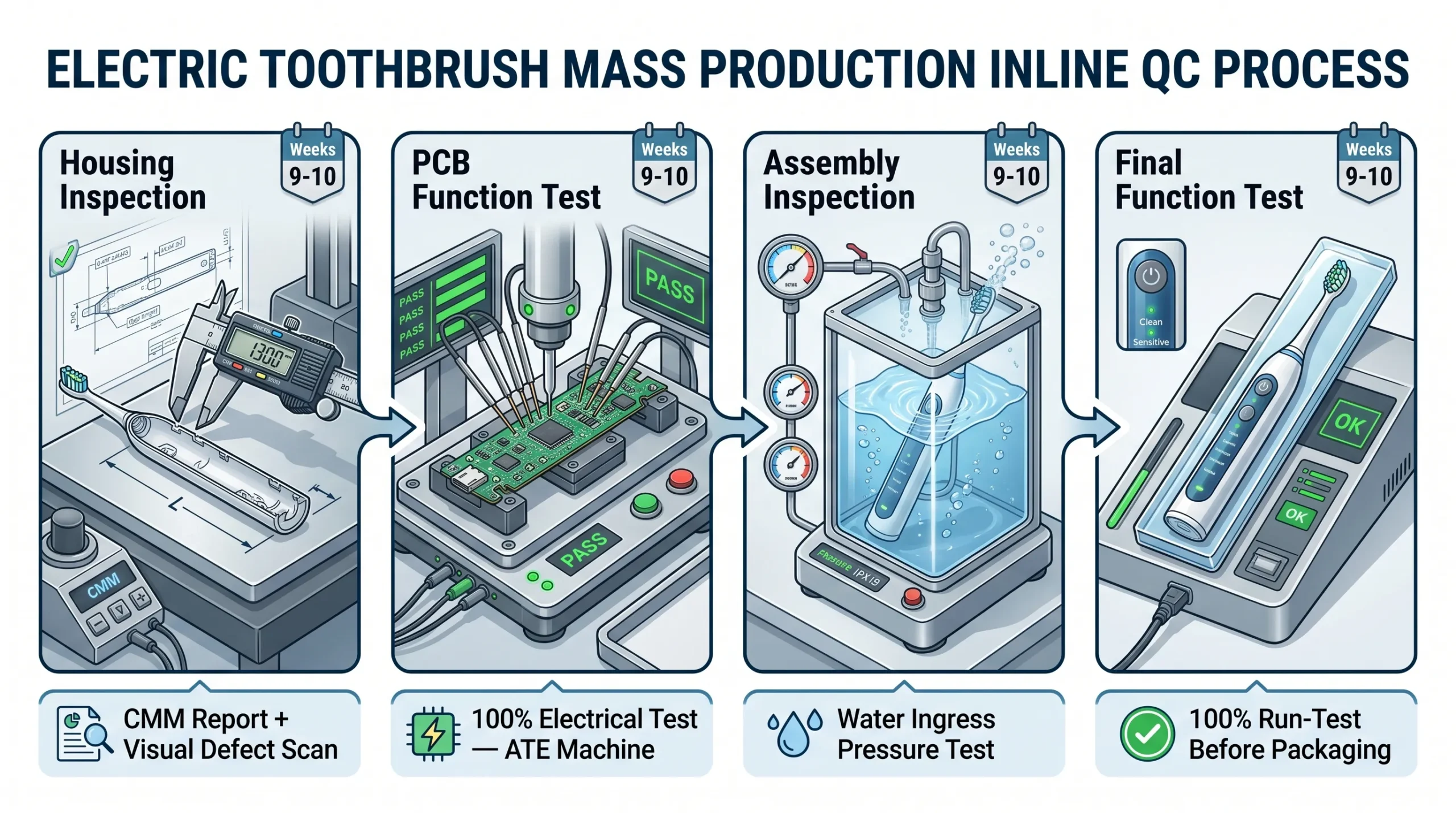
Active Production & Inline Quality Control
生产The production line is running. Components are being assembled, tested, and packaged. Factory QC teams perform inline inspections at multiple checkpoints: typically after housing injection, after PCB assembly, after final assembly, and after packaging.
- Inline QC checkpoints (ask factory to document):
- Housing inspection: dimensional check, surface defect screening
- PCB function test: 100% electrical test on automated tester
- Assembly inspection: motor alignment, waterproof seal integrity (IPX pressure test)
- Final product test: 100% function check before packaging
- Packaging line check: correct SKU, barcode scan, correct accessories in box
- Request weekly production photos/videos: Completed units on the line, QC inspection records, and packaging line in operation
- Track production progress: If your order is 3,000 units and 2 weeks in the factory reports only 500 units complete, investigate immediately. Don't wait until Week 12
- Certification testing: If CE/FCC testing wasn't completed during the sample phase, the factory should be submitting production samples to the testing lab now. Lab turnaround is typically 2-3 weeks
Mid-production red flags: act on these immediately
If the factory goes quiet without explanation, something is wrong. If they suddenly ask to substitute a component because of "stock issues," push back—get the original spec or a written explanation. If production pace falls significantly behind schedule with no clear reason, escalate. And if a factory asks for early balance payment before inspection, refuse. Payment is your leverage until goods pass QC.
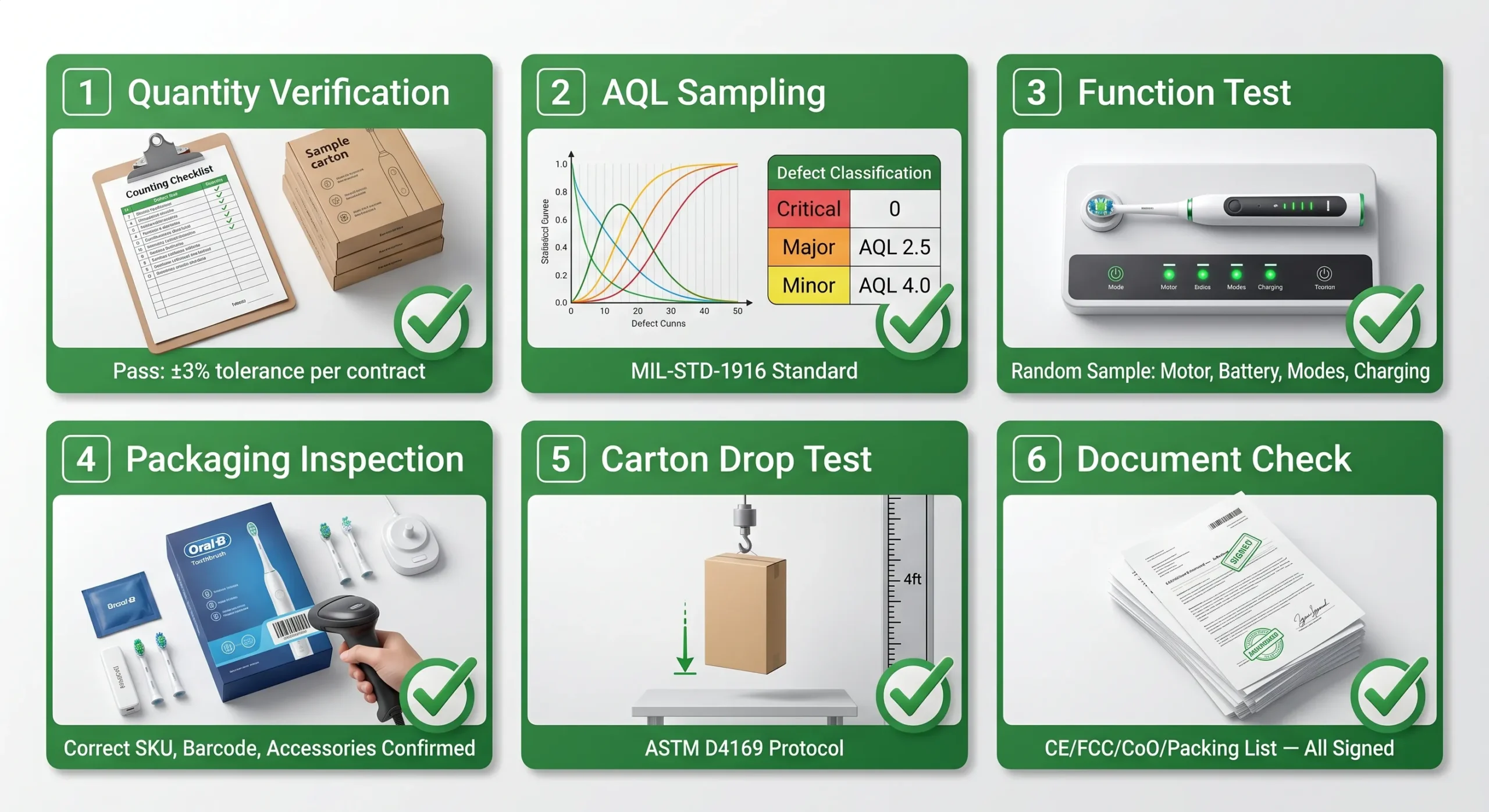
Production Completion & Pre-Shipment Inspection
QC & InspectionProduction is complete or nearly complete. The pre-shipment inspection (PSI) is the final quality gate before goods leave the factory. Never skip this step. It is your last leverage point. Once goods are shipped, the factory has your money and the goods are on a boat.
- Pre-shipment inspection scope:
- Quantity verification: physical count against PO quantity
- AQL sampling: typically AQL 2.5 for major defects, AQL 4.0 for minor defects (MIL-STD-1916)
- Workmanship inspection: surface defects, color consistency, assembly quality
- Function test on random sample: motor, battery, charging, modes
- Packaging inspection: correct carton marking, correct accessories, UPC/EAN scan
- Carton drop test: 4-foot drop on corners and faces
- Who should conduct the inspection: You have three options: (1) third-party inspection company (QIMA/Intertek/Bureau Veritas, roughly $300-500 per man-day), (2) send your own QC representative, (3) rely on factory self-inspection (not recommended for first orders)
- If inspection fails: Do not ship. Issue a Corrective Action Request (CAR) spelling out what needs to be fixed. Factory addresses issues and re-inspection is conducted. This adds 3-7 days but is always worth it
- Export documentation prep: Commercial invoice, packing list, certificate of origin (Form A for EU), CE Declaration of Conformity, FCC ID documentation
Pass criteria for pre-shipment inspection
The inspector checks: quantity matches the PO (with ±3% tolerance written into your contract), AQL sampling passes at your agreed defect levels, function tests pass on a random sample, packaging and labeling are correct, CE/FCC marks are in the right spot, carton markings are legible, and all export documents are signed. If anything fails, do not authorize shipment. Issue a Corrective Action Request, get it fixed, and re-inspect.
5. Phase 4 — Shipping & Customs Clearance (Weeks 13–16)
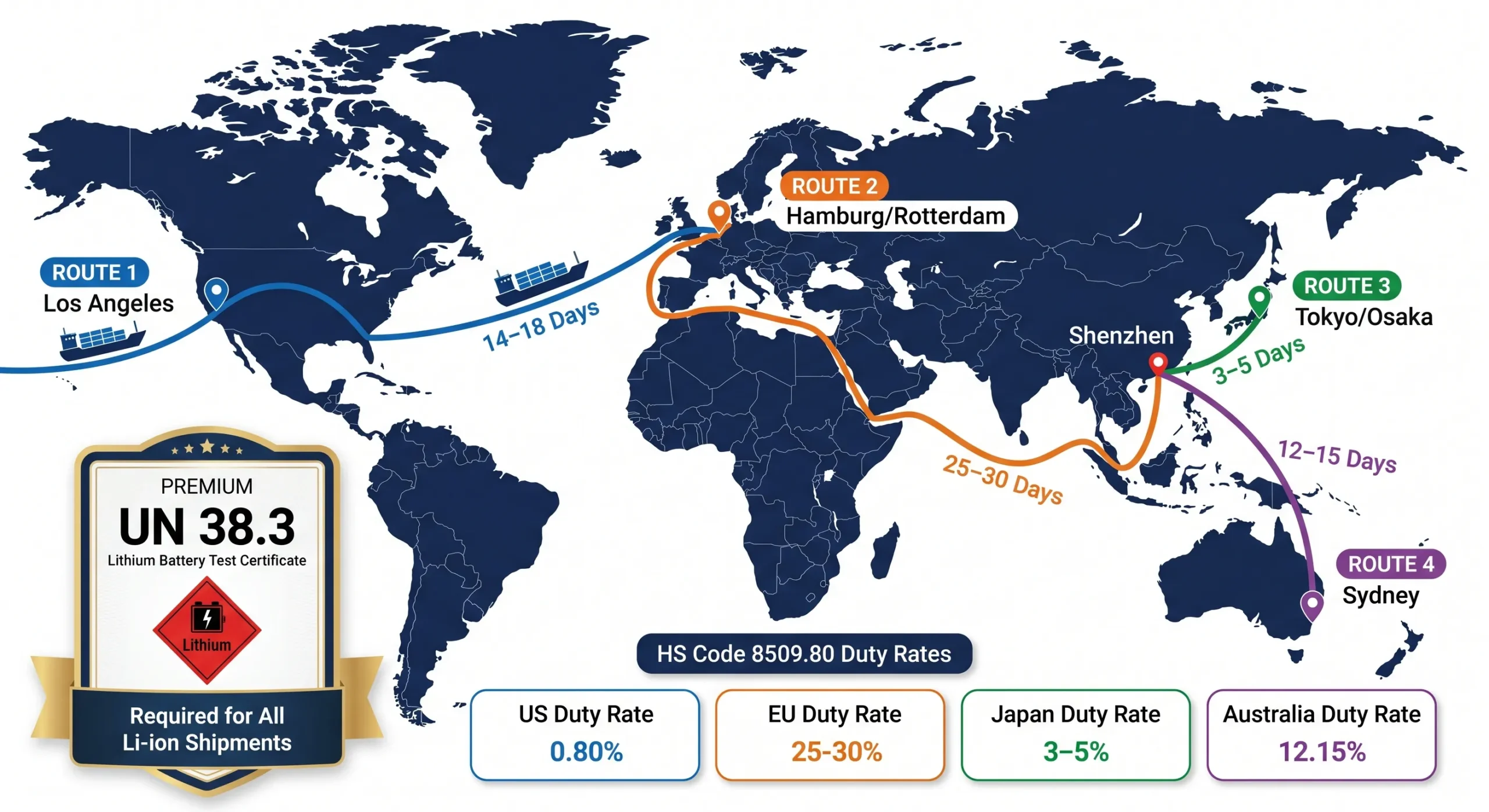
The goods are moving. You've done the hard work, and most of the active decisions are behind you. But this phase kills timelines through paperwork, not production — a missing UN38.3 battery certificate, a wrong HS code, or a documentation filing gap can hold your cargo in customs longer than any mold revision ever could.
Cargo Pickup & Export Customs (China Side)
DepartureYour freight forwarder arranges cargo pickup from the factory and delivery to the port or consolidation warehouse. Export customs clearance in China is typically fast (1-2 days) but requires complete, accurate documentation.
- Sea freight timeline to major markets:
- Shenzhen → Los Angeles: 14–18 days (transpacific)
- Shenzhen → Hamburg/Rotterdam: 25–30 days
- Shenzhen → Tokyo/Osaka: 3–5 days
- Shenzhen → Sydney: 12–15 days
- Air freight timeline (urgent shipments): 3–5 days to any major market, but 5–8× more expensive than sea freight. Viable for samples, urgent small orders, or high-value products
- HS code classification: Electric toothbrushes typically fall under HS 8509.80 (electromechanical domestic appliances). Correct classification prevents customs holds and ensures proper duty rates
- Document checklist before cargo departs:
- Commercial invoice (correct declared value, not undervalued)
- Packing list (carton count, weights, dimensions)
- Bill of Lading / Air Waybill (issued by carrier)
- Certificate of Origin (Form A for EU GSP, or standard CO)
- CE Declaration of Conformity (for EU-bound shipments)
- FCC documentation (for US-bound shipments)
- Battery UN38.3 test report (required for lithium battery shipments)
Critical: Lithium Battery Shipping Compliance
Electric toothbrushes contain lithium batteries and are subject to IATA/IMDG dangerous goods regulations. Your factory must provide a valid UN 38.3 test report and the shipment must be declared per IATA regulations. Failure to comply can result in shipment rejection, fines, or in rare cases cargo being seized. Always confirm with your freight forwarder before booking.
In-Transit & Import Customs Preparation
TransitCargo is in transit. Use this time to complete all import customs paperwork so you can clear goods immediately upon arrival and avoid costly port demurrage fees ($150-400/day after free days expire).
- Engage customs broker early: Provide all documents 5-7 days before estimated arrival. A good broker will identify any documentation gaps before the ship docks
- US customs specifics: File ISF (Importer Security Filing) 24 hours before cargo is loaded at origin port. File entry with CBP through your broker. For commercial import, FCC Part 15 compliance must be on file
- EU customs specifics: Customs Union applies across member states. Ensure CE Declaration of Conformity and RoHS declaration are current. UKCA (UK Conformity Assessed) is separate if shipping to UK post-Brexit
- Import duties to budget for:
- US: HS 8509.80 duty rate 0% (standard), but verify current Section 301 tariffs on China-origin goods (may be 7.5-25%)
- EU: HS 8509.80 standard duty rate 1.7%
- UK: 0% for most electric personal care devices
- Prepare warehouse receiving instructions: If shipping to Amazon FBA, ensure cartons and products meet FBA requirements (labeling, poly-bag requirements, max carton weight). Ship to FBA requirements differ from standard 3PL
Delivery, Receiving & Inventory Go-Live
ArrivalCargo clears customs and is delivered to your warehouse or fulfillment center. The OEM project is complete. But the work isn't over. Receiving is a quality checkpoint that many brands skip to their detriment.
- Receiving inspection: Even with a pre-shipment inspection done in China, verify on arrival: carton count vs. packing list, visible carton damage, spot-check 5–10% of units for functionality
- Inventory system update: Log lot numbers, production dates, and batch codes. This matters for warranty claims and potential recalls
- Amazon FBA check-in (if applicable): Create shipment plan in Seller Central, print FBA labels, arrange delivery appointment with Amazon's receiving warehouse
- Photography and listing update: If you don't have product photography already, arrange an in-house or studio shoot immediately. You want listings live within days of inventory being available
- Debrief the project: Document what went well, what caused delays, and what you'd do differently. This becomes your manufacturing SOP for the next production run
Ready to Start Your OEM Electric Toothbrush Project?
Relish Tech manages 1.2M+ units/month from our Shenzhen facility. Get a detailed quote with timeline within 24 hours.
What's your target launch date? Include it in the form—we'll tell you if the timeline is realistic.
6. ODM Fast-Track: The 6–10 Week Alternative
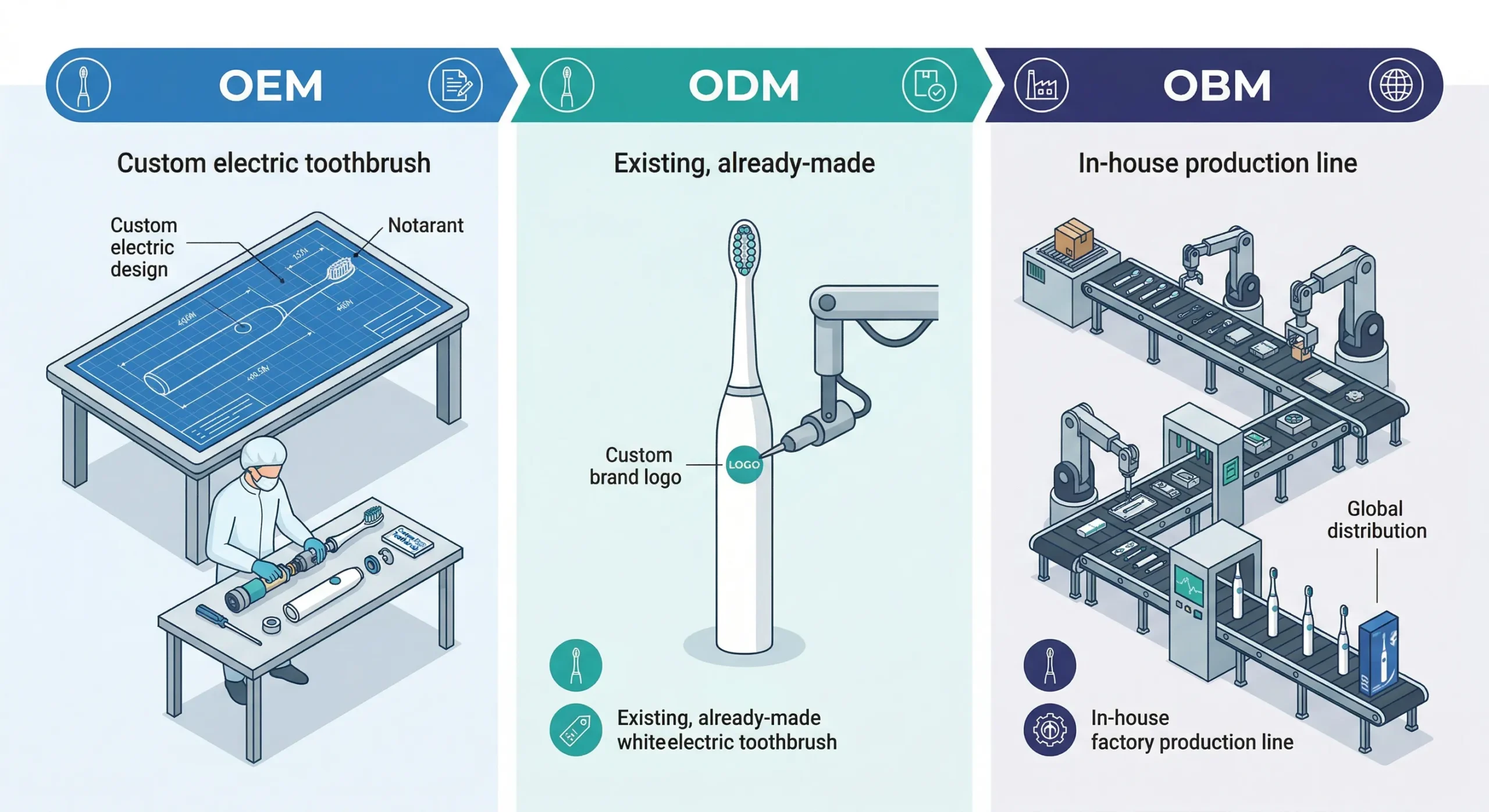
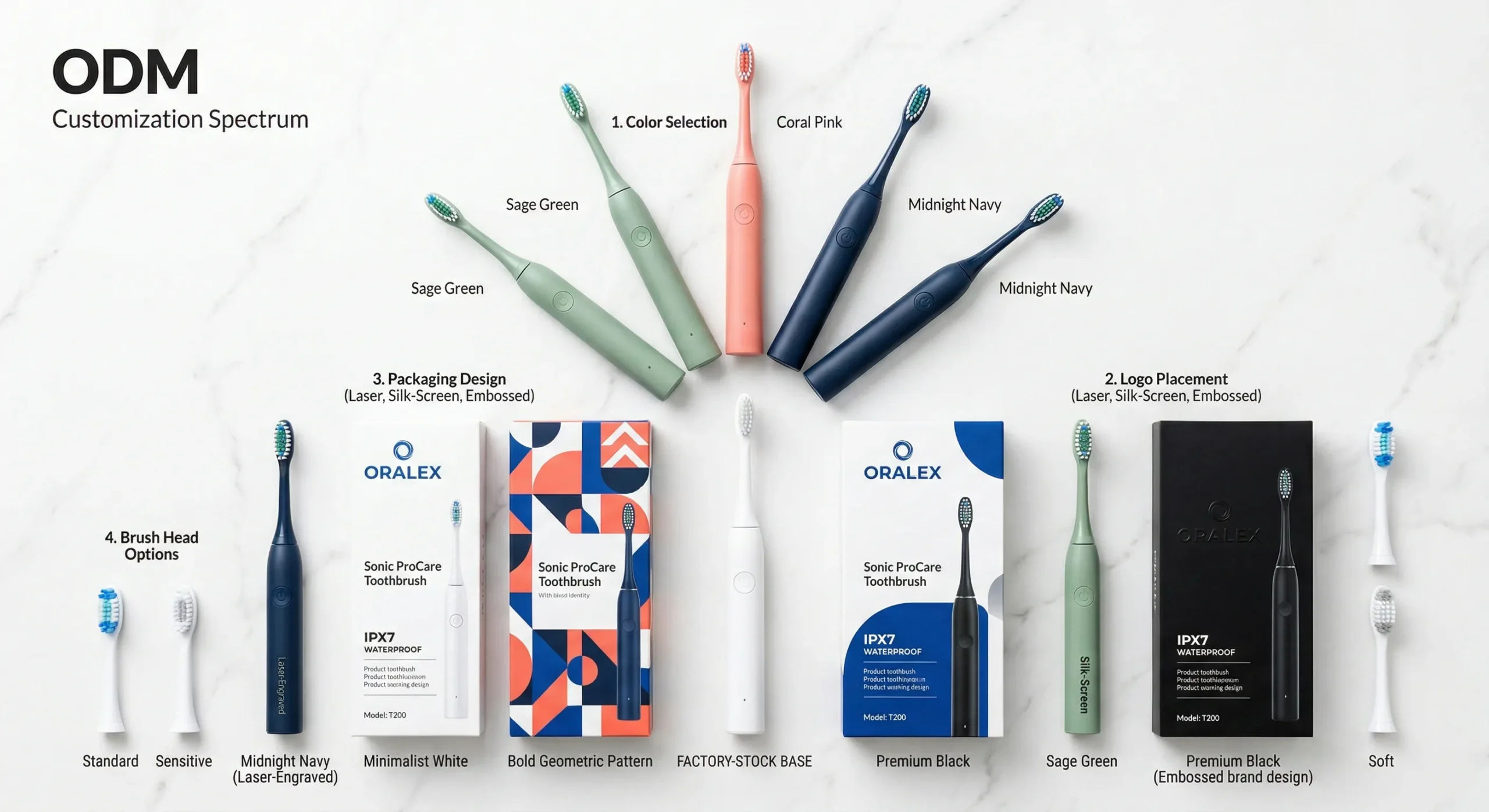
If you're launching your first product, testing a new market, or working with a limited budget, ODM (Original Design Manufacturer) is worth serious consideration. ODM lets you skip the mold creation phase entirely by picking from the factory's existing, proven product designs and customizing them with your brand.
ODM Week-by-Week Timeline
| Week | 活動内容 | Key Action for You |
|---|---|---|
| Week 1 | Browse factory ODM catalog, select model, request samples | Evaluate 3–5 models; pick one |
| Week 2 | Receive sample units; test functionality; confirm selection | Approve product model |
| Week 3 | Submit branding: logo, colors, packaging design | Provide complete brand assets |
| Week 4 | Factory prepares customized pre-production sample | Review and approve sample |
| Week 5 | Sign PO, pay 30% deposit, production begins | Issue PO |
| Weeks 6–8 | Mass production, inline QC, packaging | Monitor progress, book PSI |
| Week 9 | Pre-shipment inspection, pay 70% balance, ship | Approve inspection, arrange freight |
| Week 10 | Customs clearance, delivery | Receive inventory, activate listings |
When ODM beats OEM
ODM is the right call if this is your first product launch and you want to validate the market before spending $5,000–$15,000 on custom tooling. It's also the practical choice if you're already in August and need inventory by Q4—the standard OEM timeline won't make it. And if you just want to test a new product category without a large upfront commitment, ODM with a 300-unit order is a reasonable starting point.
7. Where OEM Timelines Actually Break Down
After tracking hundreds of OEM projects, the same failure points show up again and again. These seven account for roughly 80% of the overruns we see. Most are preventable if you know what to look for.
Mold revisions — the biggest timeline killer
Every revision cycle adds 1–2 weeks. We worked with a brand last year who went through three T1 revision rounds because the mold design wasn't reviewed carefully enough at the CAD stage. They ended up paying an extra $4,800 in tooling modification fees and missed their Q4 launch window entirely. The fix is simple: spend an extra day on Week 3's mold design review. If possible, have an engineer who understands injection molding look at the CAD files before the factory cuts any steel.
Certification lab backlogs — invisible until you're stuck
Lab slots in Q4 are booked solid by August. We had a client who submitted their samples for CE/FCC testing in Week 11, thinking it was the logical next step after production finished. The lab had a 4-week backlog. Their goods sat in the factory warehouse for a month waiting for certificates. The right move: submit pre-production samples (Week 7) while mass production is still running. Certificates typically come back in 2–4 weeks, ready before you're ready to ship.
Chinese New Year — the disruption you can see coming 12 months out
CNY factory shutdowns run roughly January 25 – February 15, but the ripple effects start in mid-January and don't fully resolve until early March. If your production window crosses that period, add 3–4 weeks automatically. There's no workaround—factories are closed and the supply chain backs up regardless of what your factory promises. Check the official CNY schedule for the specific year and plan your start date accordingly.
Packaging and product arriving at different times
This one surprises brands who are focused on the product itself. Packaging is often made by a separate supplier, and if their lead time isn't tracked in parallel, you end up with 3,000 toothbrushes sitting in boxes that haven't arrived yet. One brand had the product ready on a Friday; the packaging didn't show up until the following Wednesday. That week of warehouse storage cost $1,200. Confirm packaging lead time at Week 3 and assign someone to track it separately from product production.
Sample revision loops — feedback that keeps coming
Each revision round adds 1–2 weeks. The brands that get through sample approval fastest are the ones who consolidate all their feedback into one document per round. If you're sending updates over five different emails, you're resetting the clock each time. Make a list. Rank issues by severity. Send everything at once. This alone can cut a 3-week sample phase down to 2 weeks.
Component shortages — the supply chain problem that surfaces mid-production
PCBs and batteries are the most common culprits. A factory that confirms component availability at Week 3 might discover a battery shortage at Week 9 when they actually place the order. The fix: ask the factory to show you confirmed inventory or pre-ordered stock, not just verbal assurance. Also identify a secondary battery and PCB supplier upfront. Single-source components are a liability.
Shipping and port delays — the last mile that adds weeks
Sea freight from Shenzhen to LA takes 14–18 days under normal conditions. But "normal" includes port congestion, customs holds, and carrier scheduling gaps that can add another 1–3 weeks with zero warning. One client's cargo sat at the Port of Los Angeles for 11 days because their customs broker filed the entry under the wrong HS code. Budget 2 weeks of buffer in your shipping estimates and confirm your HS code classification with a licensed customs broker before cargo leaves the factory.
The one rule that prevents most of these
Track each phase actively. Weekly factory updates aren't a nice-to-have—they're your early warning system. When a factory stops communicating without explanation, that's the red flag. Act immediately, not at the end of the phase.
8. Reverse Calendar Planning: Work Backwards from Your Launch Date
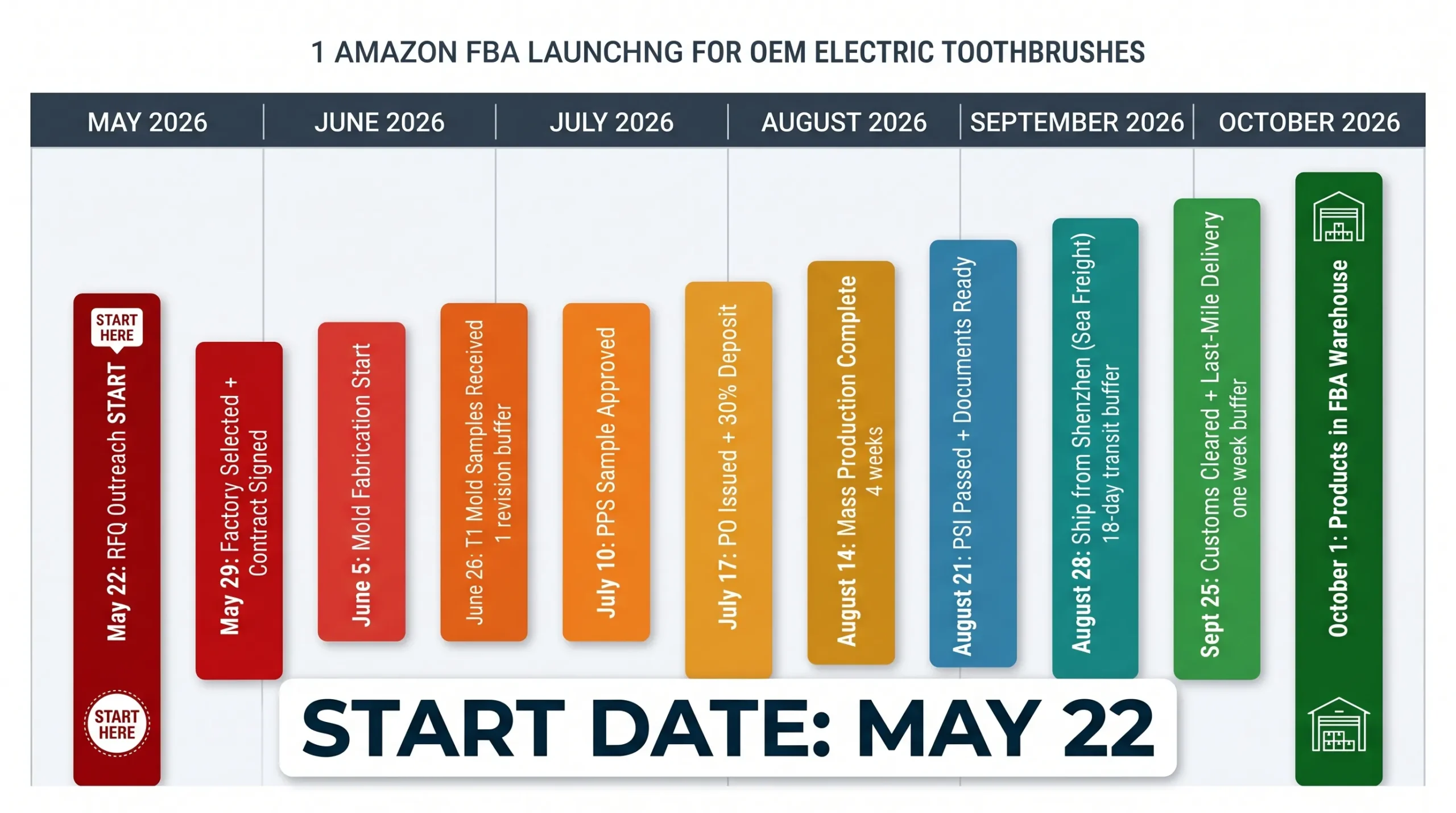
The most useful exercise any brand can do before starting an OEM project is reverse calendar planning. Instead of asking "when will the product be ready?", ask "what is my launch date, and when do I need to start to hit it?"
Example: Planning for an Amazon Q4 Holiday Season Launch
Target: Products available in Amazon FBA warehouse by October 1 (to be eligible for Prime Day holiday deals window and have inventory buffer).
| Milestone | Target Date | 備考 |
|---|---|---|
| Products received in FBA warehouse | October 1 | Hard deadline. Amazon FBA intake can take 1-2 weeks to activate |
| Customs clearance + last-mile delivery | September 25 | Allow 1 week from port to warehouse |
| Ship from Shenzhen (sea freight) | August 28 | LA transit: 14–18 days; allow 18 days + buffer |
| Pre-shipment inspection passed | August 21 | 1 week before ship date for inspection + documentation |
| Mass production complete | August 14 | 4 weeks of production (Weeks 9–12) |
| Purchase Order issued / 30% deposit paid | July 17 | Start of mass production |
| Pre-production sample approved | July 10 | 2 weeks sample review + testing |
| T1 mold samples received | June 26 | Allows 1 revision round before PPS |
| Mold fabrication start | June 5 | 3 weeks CNC machining |
| Factory selected, contract signed | May 29 | NDA, mold design approved |
| Start RFQ outreach | May 22 | Begin factory search here |
For an October 1 Amazon FBA launch: Start your factory search by May 22
That's a 19-week runway, slightly more than the standard 16 weeks to account for mold revision and shipping buffer. Starting in June leaves no margin for error. Starting in July makes October 1 essentially impossible for a full OEM project.
If you missed the May window: Switch to ODM (saves 6 weeks), or plan for a January launch instead. A January launch actually puts you ahead of the Q1 "New Year, New You" dental care purchase peak.
Peak Season Timing Guide
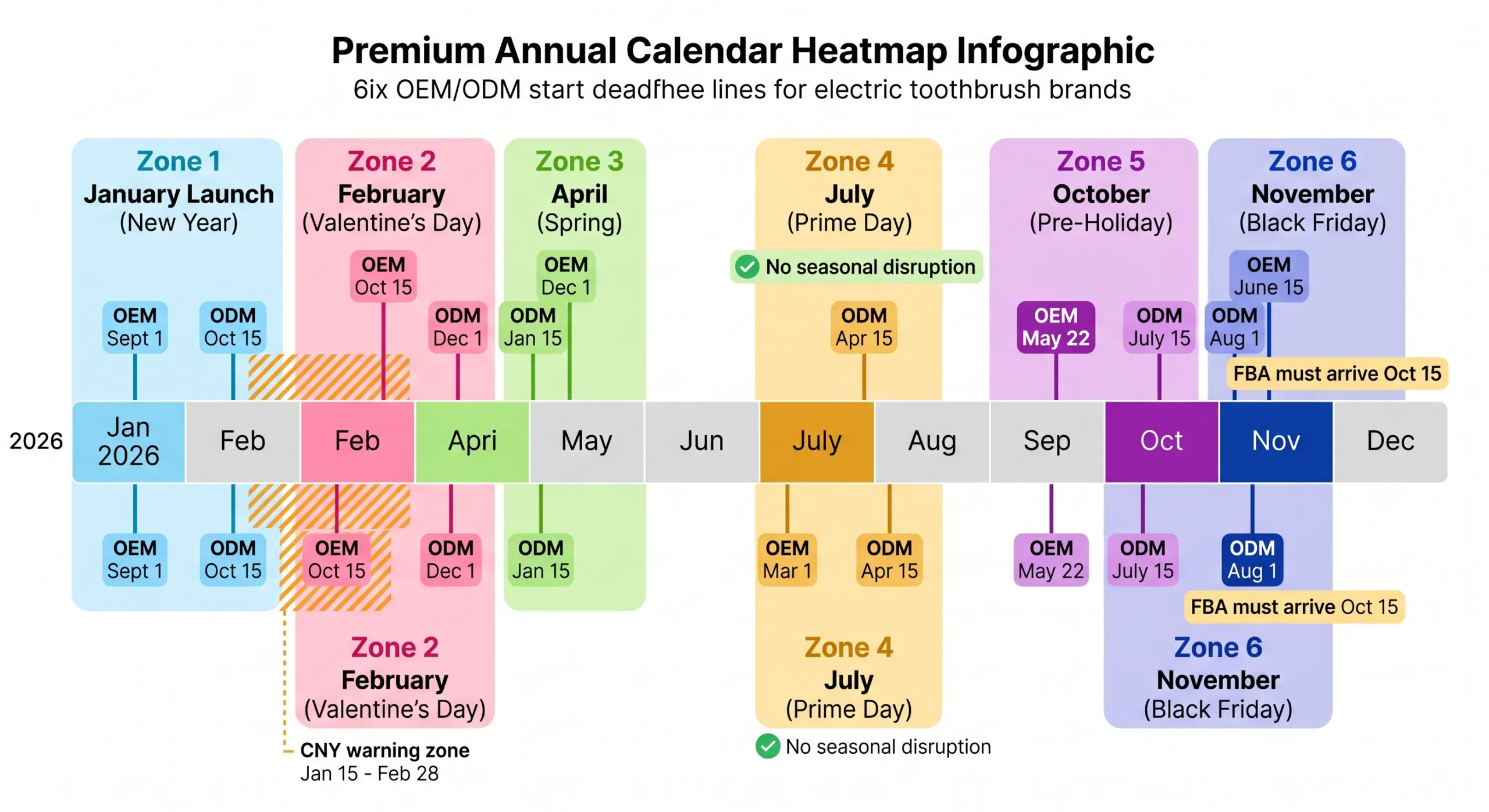
| Target Launch Window | Latest OEM Start Date | Latest ODM Start Date | 備考 |
|---|---|---|---|
| January (New Year) | September 1 | October 15 | Avoid CNY overlap in production |
| February (Valentine's Day) | October 15 | December 1 | Must clear CNY before production |
| April (Spring) | December 1 | January 15 | Post-CNY production restart |
| July (Prime Day) | March 1 | April 15 | Good timing, no seasonal factory disruption |
| October (Pre-Holiday) | May 22 | July 15 | Most competitive period on Amazon |
| November (Black Friday) | June 15 | August 1 | FBA inventory must arrive by Oct 15 |
📚 References
- Statista. (2025). Electric Toothbrush Market Size & Forecast. Market projected to reach $8.70B by 2033, CAGR 6.6%.
- American Dental Association. (2024). ADA Statement on Electric Toothbrush Efficacy. Powered toothbrushes reduce plaque by 21% and gingivitis by 11% vs. manual brushing.
- ISO 19452:2022. Dentistry — Powered Toothbrushes — Test Methods for Measuring Performance. International Organization for Standardization.
- International Trade Administration, U.S. Department of Commerce. (2025). China Export: Electronics & Consumer Goods Compliance Guide. Certification requirements for oral care devices.
よくある質問
Get a Personalized OEM Timeline for Your Project
Tell us your target launch date and product requirements. Our project managers will give you a week-by-week schedule with realistic milestones. No obligation, free of charge.
Tip: Brands that share their launch date upfront get a more accurate feasibility assessment.