







CE認証電動歯ブラシ:EU市場参入ガイド2026
EU市場に参入する電動歯ブラシのCE認証要件を理解するための包括的なガイド。MDR 2017/745、EMC指令、RoHSコンプライアンス、およびOEMメーカーが規制上の成功をどのように支援するかを解説します。.
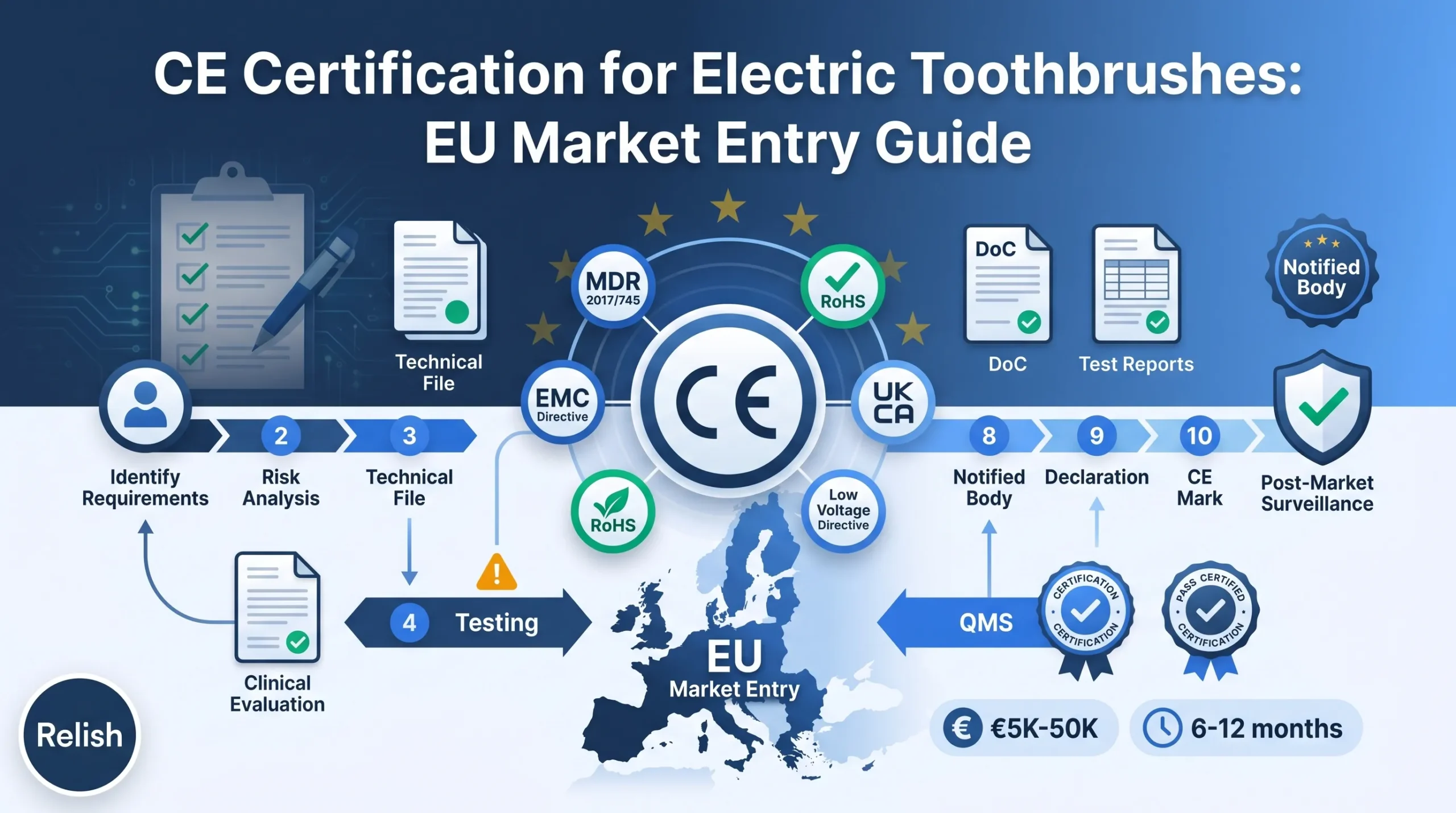
CE認証電動歯ブラシ規格の規制環境
CEマークは単なる品質のシンボルではなく、全27のEU加盟国にアイスランド、リヒテンシュタイン、ノルウェーを加えた欧州経済領域(EEA)への市場アクセスに法的に必須の要件です。EU法の下では、有効なCEマークなしに電動歯ブラシを市場に出すことは違法であり、製品リコール、多額の罰金、および会社役員の刑事責任につながる可能性があります。.
CEマーキング制度は、EEA内で販売される製品が一貫した安全性、健康、および環境保護要件を満たすことを保証するために設立されました。電動歯ブラシの場合、これは電気的安全性、電磁干渉、有害物質含有量など、製品の安全性のさまざまな側面に対処する複数のEU指令への準拠を実証することを意味します。.
市場の観点から、CE認証は、欧州の小売業者が製品を在庫する前に必要とする規制コンプライアンスの文書化された証拠を提供します。欧州のヘルスケア小売業者、薬局チェーン、およびAmazon EUを含むオンラインマーケットプレイスはすべて、電動歯ブラシの出品にCE宣言および関連する試験報告書を義務付けています。.
規制コンプライアンスを超えて、CE認証プロセスは製品品質の向上を促進します。リスク分析、試験、および文書化要件により、設計上の弱点が早期に明らかになり、保証請求や現場での故障が減少します。徹底したCEコンプライアンスに投資するブランドは、通常、市販後の安全性インシデントが少なく、製品に対する消費者の信頼がより強固になります。.
中国から調達するオーラルケアブランドにとって、CEコンプライアンスは自然な品質ゲートも生み出します。CE認証の試験報告書、工場監査、および文書化要件は、標準以下のメーカーをふるい落とし、製品が欧州の消費者に届く前に満たさなければならない明確な品質ベンチマークを確立します。. 電動歯ブラシOEMガイドをお読みください 経験豊富なメーカーがどのようにコンプライアンスプロセスを支援するかについての詳細をご覧いただけます。.
電動歯ブラシに適用されるEU指令
電動歯ブラシは通常、複数のEU指令に同時に該当します。特定の製品にどの指令が適用されるかを理解することは、正確なコンプライアンスロードマップを構築するために不可欠です。適用される指令は、製品の機能、電源、意図された主張、およびターゲット市場セグメントによって異なります。.
MDR 2017/745(医療機器規則)
2021年5月26日に医療機器指令93/42/EECを完全に置き換えた医療機器規則(EU)2017/745は、製造業者が医療または治療効果を主張する場合に電動歯ブラシに適用されます。製品が歯科疾患の治療または予防、プラーク低減、歯茎の健康改善、または治療効果の提供を目的として販売されている場合、MDRに基づく医療機器に分類される可能性があります。.
MDRのリスクベースの分類システム(クラスIからIII)では、治療効果を主張しない一般的なウェルネス製品として販売される場合、ほとんどの電動歯ブラシはクラスIに分類されます。ただし、臨床効果が主張される場合、分類はクラスIIaまたはIIbに上がる可能性があります。分類が高くなると、適合性評価のために指定機関(Notified Body)の関与が必須になります。.
クラスI機器は、製造業者が品質管理システムを維持し、テクニカルファイルを編集することを条件に、一般的にMDRに基づく自己宣言ルートに従うことができます。ただし、すべての機器(クラスIを含む)は、登録モジュールが完全に運用可能になった時点で、EUDAMED(欧州医療機器データベース)に登録する必要があります。.
EMC指令2014/30/EU(電磁両立性)
すべての電動歯ブラシには、電磁放射を発生させ、その影響を受けやすい電子回路が含まれています。EMC指令2014/30/EUは、製品が他の電子機器に干渉せず、一般的な電磁妨害がある環境でも正しく動作できることを保証します。.
電動歯ブラシの場合、EMC試験は通常、放射エミッション、伝導エミッション、静電気放電に対するイミュニティ、放射RFイミュニティ、電気的高速過渡現象イミュニティ、およびサージイミュニティを対象とします。試験規格には、EN 55014-1(家庭用電気機器のエミッション)およびEN 55014-2(イミュニティ要件)が含まれます。.
電動歯ブラシの充電ベースは、多くの場合、別途EMC評価が必要です。これは、大きな伝導および放射エミッションを発生させる可能性のあるパワーエレクトロニクスが含まれているためです。ワイヤレス充電式歯ブラシは、ワイヤレス電力転送機能について無線機器指令2014/53/EU(RED)にも準拠する必要があるため、さらに複雑さが増します。.
低電圧指令2014/35/EU
低電圧指令は、電圧定格が50~1,000 VAC(交流)または75~1,500 VDC(直流)の範囲で使用するように設計された電気機器に適用されます。ほとんどの電動歯ブラシは充電式バッテリーで動作し、主電源に接続する充電ベースが含まれています。.
如果牙刷充电底座使用市电电压(欧洲通常为220-240V),则适用低电压指令。关键安全要求由协调标准EN 60335-1(家用电器通用要求)及相关产品特定标准规定。测试涵盖电击防护、机械完整性、热安全及异常操作条件。.
部分不连接市电的低压电池供电牙刷可能不在低电压指令范围内。然而,它们仍可能需要根据适用于所有消费品的《通用产品安全指令》(EU) 2023/988进行测试。.
RoHS指令2011/65/EU(有害物质限制)
有害物质限制(RoHS)指令限制了在欧盟销售的电气电子产品中十种危险化学物质的使用。电动牙刷属于第11类,涵盖其他类别未包含的电气电子产品。.
受限物质包括铅、汞、镉、六价铬、多溴联苯(PBB)、多溴二苯醚(PBDE)以及RoHS 3(EU 2015/863)新增的四种邻苯二甲酸酯(DEHP、BBP、DBP、DIBP)。合规性通常通过供应商声明、物料清单分析和选择性实验室测试来证明。.
对于OEM制造商,RoHS合规需要与组件供应商协调,特别是电池、电机、控制电子设备和外壳材料。信誉良好的中国OEM制造商会为标准组件保留RoHS合规文件,并可应要求提供测试报告。.
MDR 2017/745
适用于声称具有治疗/医疗功效的产品。决定设备分类和符合性评估路径。.
EMC指令2014/30/EU
所有电动牙刷强制要求。确保与其他设备和环境的电磁兼容性。.
低電圧指令2014/35/EU
适用于连接市电的充电底座。确保在市电电压下运行的产品的电气安全。.
RoHS指令2011/65/EU
限制所有电气组件中的10种有害物质。所有在欧盟销售的电动牙刷均需遵守。.
电动牙刷CE认证流程——分步指南
获得电动牙刷CE认证涉及一个系统化流程,逐步建立合规文件。虽然具体步骤因产品分类和所选符合性评估路径而异,但以下框架适用于大多数电动牙刷制造商。.
确定适用要求
确定哪些欧盟指令和协调标准适用于您的特定产品。这需要分析产品的技术特性、预期用途、营销声明和目标市场。在法规适用性矩阵中记录您的理由。.
进行风险分析
按照EN ISO 14971(医疗器械)或EN 12182(一般消费品)进行全面的风险评估。识别危害、评估风险、评价风险可接受性并实施风险控制措施。记录所有风险分析活动和结果。.
编制技术文件
汇编全面的技术文档,包括产品规格、设计图纸、物料清单、制造工艺、风险分析、适用标准文档和测试报告。技术文件必须在测试开始前完成。.
进行实验室测试
委托经认可的测试实验室,根据适用的协调标准进行所有必要测试。对于电动牙刷,这通常包括电气安全测试、EMC测试和RoHS物质分析。获取英文签字的测试报告。.
臨床評価
製品がMDRに基づく医療機器に分類される場合、EN ISO 14155に従って臨床評価を実施します。これには、文献レビュー、市販機器との同等性分析、または臨床試験が含まれる場合があります。一般消費者向け製品の場合は、安全性評価で十分な場合があります。.
品質マネジメントシステムの導入
製品分類に適した品質マネジメントシステムを確立し維持します。MDRクラスI機器の場合、自己宣言が可能です。より高いクラスではEN ISO 13485認証が必要です。一般製品の場合、EN ISO 9001が認知された枠組みを提供します。.
認証機関審査(必要な場合)
認証機関の関与が必要な高リスク製品の場合、技術文書を審査に提出します。質問や追加文書の要求に対応します。審査合格後、適合証明書を受け取ります。.
適合宣言書の発行
該当するすべての指令と規格を記載したEU適合宣言書(DoC)を作成し署名します。DoCは組織内の責任者が署名し、最終製品が市場に投入されてから10年間保管する必要があります。.
CEマークの貼付
製品、包装、および付属文書にCEマークを適用します。CEマークは視認可能で、読みやすく、消えないものでなければなりません。該当する場合は、認証機関番号をCEマークの隣に含めます。.
市販後調査の確立
市場における製品性能の継続的な監視を実施します。顧客からのフィードバック、有害事象報告、および現場性能データを収集します。必要に応じて技術文書と適合宣言書を更新します。重大なインシデントは、要求される期間内に関連当局に報告します。.
認証機関 vs 自己宣言:製品に適した選択は?
CE認証における最も重要な決定の一つは、認証機関の関与と自己宣言ルートの選択です。この選択は、スケジュール、予算、市場の信頼性、およびCEマークが持つ外部検証のレベルに影響します。.
| 要素 | 自己宣言 | 認証機関審査 |
|---|---|---|
| 規制要件 | 認証機関の義務要件がないクラスI一般製品に利用可能 | クラスIIa、IIb、III医療機器に必須。一部のクラスI機器は自主的に認証機関を利用 |
| タイムライン | 4~8週間(試験を除く) | 3~6ヶ月(準備を除く) |
| コスト範囲 | 2,000~10,000ユーロ | 15,000~50,000ユーロ以上 |
| 市場の信頼性 | 基本的なコンプライアンスレベル | 小売業者や医療専門家との高い信頼性 |
| 監査要件 | 内部QMS宣言 | 認証機関によるオンサイト監査 |
| 製品変更 | 更新されたDoCで自己管理 | 重要な変更には認証機関の審査が必要な場合あり |
治療効果を謳わない一般消費者向け製品として販売される電動歯ブラシの場合、自己宣言が通常適切かつ法的に十分なルートです。しかし、多くのブランドは、混雑した市場で製品を差別化し、第三者による検証をますます期待する欧州の小売バイヤーとの信頼を構築するために、認証機関の審査を選択します。.
電動歯ブラシが医療機器の主張を行う場合、またはより高いリスククラスに該当する場合、認証機関の関与が必須です。電気/口腔ケア製品の経験を持つ認証機関を選択することで、審査プロセスが加速され、技術文書の技術的に適切な評価が保証されます。.
MDRに基づく臨床評価要件
臨床評価は、医療機器分類を持つ製品に対するMDRコンプライアンスの基盤です。一般消費者向け製品として販売されるほとんどの電動歯ブラシは正式な臨床評価を必要としませんが、このプロセスを理解することは、治療効果を計画しているブランドや医療機器分類の拡大を検討しているブランドにとって不可欠です。.
MDR第61条および附属書XIVに基づき、臨床評価は、医療機器の臨床的利益が、意図された使用時に残存リスクを上回ることを実証する必要があります。口腔ケア機器の場合、臨床評価には通常以下が含まれます:
- 文献レビュー: 類似機器または特定製品に関する公開臨床データの系統的な検索と分析。これには、査読付き研究、臨床試験結果、市販後調査データ、および同等機器からの有害事象報告が含まれます。.
- 同等性分析: 自社製品が、技術的特性、生物学的特性、臨床的特性、および意図された使用において、市販機器と同等であることを実証します。同等性により、自社の臨床試験を実施する代わりに、同等機器からの臨床データを活用できます。.
- 臨床試験: 文献や同等性を通じて十分な臨床データが得られない場合、臨床試験が必要になる場合があります。電動歯ブラシの場合、プラーク低減、歯肉改善、またはその他の臨床エンドポイントを測定する管理試験が含まれる可能性があります。.
- 市販後臨床フォローアップ(PMCF): 製品ライフサイクル全体にわたる機器の安全性と性能を検証するために、市場投入後に臨床データを継続的に収集します。PMCF計画は、クラスIIa以上の機器に必要です。.
臨床評価報告書は、製品ライフサイクル全体にわたって定期的に更新され、技術文書に含まれなければなりません。製造業者は、医療機器分類の電動歯ブラシの正式な臨床評価を実施する際には、MDR要件に精通した臨床業務の専門家を関与させる必要があります。.
Brexit後の英国CAマーキング
英国のEU離脱後、CEマーキングは英国(イングランド、ウェールズ、スコットランド)で販売される製品には適用されなくなりました。代わりに、英国は独自の適合マーキングであるUKCA(英国適合評価)マークを導入しました。ただし、北アイルランドは北アイルランド議定書に基づき、引き続きCEマーキングが必要です。.
UKCAマーキング要件は、EUのCE枠組みとほぼ同じですが、規格の調和、承認機関、技術文書要件において顕著な違いがあります。英国市場をターゲットとする電動歯ブラシ製造業者向けの主な考慮事項は次のとおりです:
- 別途認証: CE marking and UKCA marking are separate requirements. A CE certificate does not automatically grant UKCA compliance, and vice versa.
- UK Approved Bodies: Unlike EU Notified Bodies, UK Approved Bodies for medical devices are limited in number. The Medicines and Healthcare products Regulatory Agency (MHRA) oversees device registration and market surveillance.
- Technical Documentation: UKCA technical file requirements are similar to CE but may reference different designated standards (British Standards that align with international standards).
- UKCA Mark Placement: The UKCA mark must be visible on the product or packaging and accompanied by the UKCA logo and importer information.
- MDR Equivalence: Under UK MDR 2002 (as amended), the classification and approval requirements differ from EU MDR 2017/745. Some devices approved in the EU may not automatically be approved in the UK.
For brands sourcing from China and selling in both EU and UK markets, planning for dual compliance from the outset is more efficient than retrofitting certifications. Your OEM manufacturer should be able to support both CE and UKCA testing requirements simultaneously where standards overlap.
How Relish Tech Supports EU Compliance
Navigating CE certification for electric toothbrushes requires close coordination between the brand owner, OEM manufacturer, testing laboratories, and potentially Notified Bodies. Relish Tech's OEM/ODM manufacturing process coordinates technical file development, accredited testing, and regulatory submissions to reduce the compliance burden on oral care brands entering the EU market.
Our existing certifications and compliance infrastructure provide a strong foundation for EU market entry. We maintain ISO 13485 quality management systems, FDA-registered facilities, and extensive experience with international regulatory requirements including EU directives.
Relish Tech's EU compliance support capabilities include:
- Technical File Development: Our regulatory affairs team assists in compiling comprehensive technical files that meet EU documentation requirements. We provide design specifications, risk analyses, and manufacturing documentation in standardized formats that simplify Notified Body review.
- Pre-Compliance Testing Support: Before formal testing, we conduct internal design verification to identify potential non-compliances early. This reduces the risk of testing failures, redesign requirements, and project delays.
- Accredited Testing Coordination: We work with accredited third-party laboratories for all required testing, including EMC, electrical safety, and RoHS analysis. Our relationships with major test houses accelerate scheduling and often result in preferred pricing for our clients.
- Component Compliance Library: We maintain a database of RoHS and REACH compliance documentation for standard components, reducing the documentation burden for new product introductions.
- Labeling Support: Our team understands EU labeling requirements, including multilingual instructions for use, CE mark placement specifications, and importer information requirements.
- Factory Audit Documentation: For brands requiring supply chain verification, we provide comprehensive audit documentation including ISO 13485 certificates, facility photographs, production capacity data, and quality system summaries.
By partnering with an experienced OEM manufacturer from the outset, oral care brands can significantly reduce the time, cost, and complexity of EU market entry. Learn more about our approach to regulatory compliance by exploring our certifications page or contacting our team directly.
- MOQ: CE compliance support available for orders starting at 500 units per SKU
- リードタイム 4–6 weeks for pre-compliance sample; 8–12 weeks for technical file readiness; 60–120 days for full production with completed CE documentation
- QC基準: ISO 13485 quality system, pre-shipment AQL 1.5/2.5 inspection, CE documentation review prior to dispatch
- 資格: ISO 13485, FDA 21 CFR Part 820, CE MDR compliance documentation, RoHS/REACH testing, EMC and electrical safety test coordination
Common Pitfalls in EU Market Entry for Oral Care Devices
Despite the apparent straightforwardness of CE marking requirements, many oral care brands encounter obstacles that delay market entry and inflate costs. Understanding these common pitfalls enables proactive mitigation strategies.
- Incomplete Technical Files: Test laboratories cannot begin testing without complete technical files. Brands that underestimate documentation preparation time face extended project timelines. Allocate 4-8 weeks for technical file development before testing commencement.
- Standard Version Updates: Harmonized standards are periodically updated, and older versions may lose their presumption of conformity. Using outdated standard versions results in non-compliant declarations. Verify current standard versions at project initiation and monitor for updates during the certification process.
- Battery Compliance Gaps: Electric toothbrush batteries are subject to specific regulations including UN 38.3 for transport testing. Many brands overlook battery-specific requirements until late in the project. Ensure battery compliance documentation is included from the beginning. 当社の電動歯ブラシ製品ラインナップを見る to see how Relish Tech manages battery compliance across standard models.
- Insufficient EMC Pre-Testing: EMC testing is often a source of delays and unexpected redesigns. Investing in pre-compliance EMC testing or engineering reviews before formal testing reduces first-pass failure risk.
- RoHS Component surprises: Sub-suppliers sometimes provide incorrect RoHS declarations, leading to failed compliance documentation audits. Establish clear RoHS compliance requirements in purchase specifications and verify supplier declarations through random sampling.
- Labeling Localization: EU requirements mandate instructions for use in the official language of each member state where the product is sold. Some brands underestimate the cost and complexity of multilingual documentation.
- Post-Market Surveillance Neglect: Many brands focus exclusively on initial certification and neglect the ongoing post-market surveillance requirements. Establish surveillance systems before market entry to avoid compliance gaps.
要点
- CE marking is a legal requirement for selling electric toothbrushes in the EU—failure to comply risks product recalls, fines, and criminal liability.
- Multiple EU directives apply to electric toothbrushes: MDR (if claiming therapeutic benefits), EMC, Low Voltage, and RoHS. Identify all applicable requirements before starting certification.
- Class I electric toothbrushes can generally follow the self-declaration route; higher-risk products require Notified Body involvement.
- Planning for CE certification from product design inception reduces costs and timelines compared to retrofitting compliance.
- UK CA marking is a separate requirement from CE marking—plan for dual compliance if targeting both EU and UK markets.
- Partnering with an OEM manufacturer experienced in EU compliance streamlines documentation, testing coordination, and regulatory submissions.
Get a Free Compliance Assessment for Your Electric Toothbrush
Not sure which directives apply to your product or which certification route suits your business? Relish Tech offers a free initial compliance assessment for oral care brands exploring EU market entry.
Request a Compliance AssessmentReady to Enter the EU Market?
Relish Tech has helped hundreds of oral care brands achieve CE certification and successfully launch in the European market. Our experienced regulatory affairs team can guide you through the entire compliance process.
Contact Our Teamよくある質問
参考文献
- European Commission. "Regulation (EU) 2017/745 on medical devices." Official Journal of the European Union. https://eur-lex.europa.eu/eli/reg/2017/745/oj
- European Commission. "Directive 2014/30/EU on electromagnetic compatibility." Official Journal of the European Union. https://eur-lex.europa.eu/eli/dir/2014/30/oj
- European Commission. "Directive 2014/35/EU on electrical equipment designed for use within certain voltage limits." Official Journal of the European Union. https://eur-lex.europa.eu/eli/dir/2014/35/oj
- European Parliament and Council. "Directive 2011/65/EU (RoHS) on the restriction of the use of certain hazardous substances in electrical and electronic equipment." Official Journal of the European Union. https://eur-lex.europa.eu/eli/dir/2011/65/oj
- British Standards Institution. "BS EN ISO 14971:2019 Medical devices — Application of risk management to medical devices." BSI Standards Limited.
- European Commission. "MDCG 2019-16 Rev. 1: Guidance notes for manufacturers of Class I devices." European Commission Medical Devices Coordination Group. Retrieved from https://health.ec.europa.eu/document/download_en
- Medicines and Healthcare products Regulatory Agency. "Medical devices: EU exit and the UKCA marking." UK Government. Retrieved from https://www.gov.uk/guidance/medical-devices-mdr-2002