






The Complete History of Water Flossers: From 1962 to 2026
Explore the evolution of water flossers from their 1962 origins to today’s cordless and connected designs. This B2B guide covers technology milestones, leading brands, market forecasts and the specifications to check before sourcing in 2026.
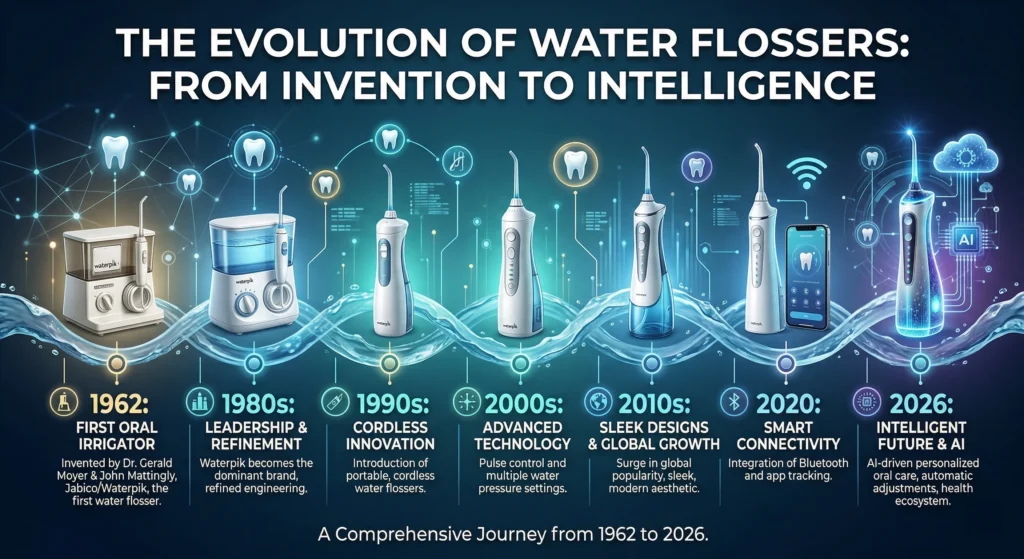
Dentist Gerald Moyer and engineer John Mattingly developed the Waterpik oral irrigator in Fort Collins, Colorado, in 1962. It introduced pulsating water as a practical way to clean between teeth and along the gumline. Waterpik remains a leading brand, with specific models carrying the American Dental Association (ADA) Seal of Acceptance.
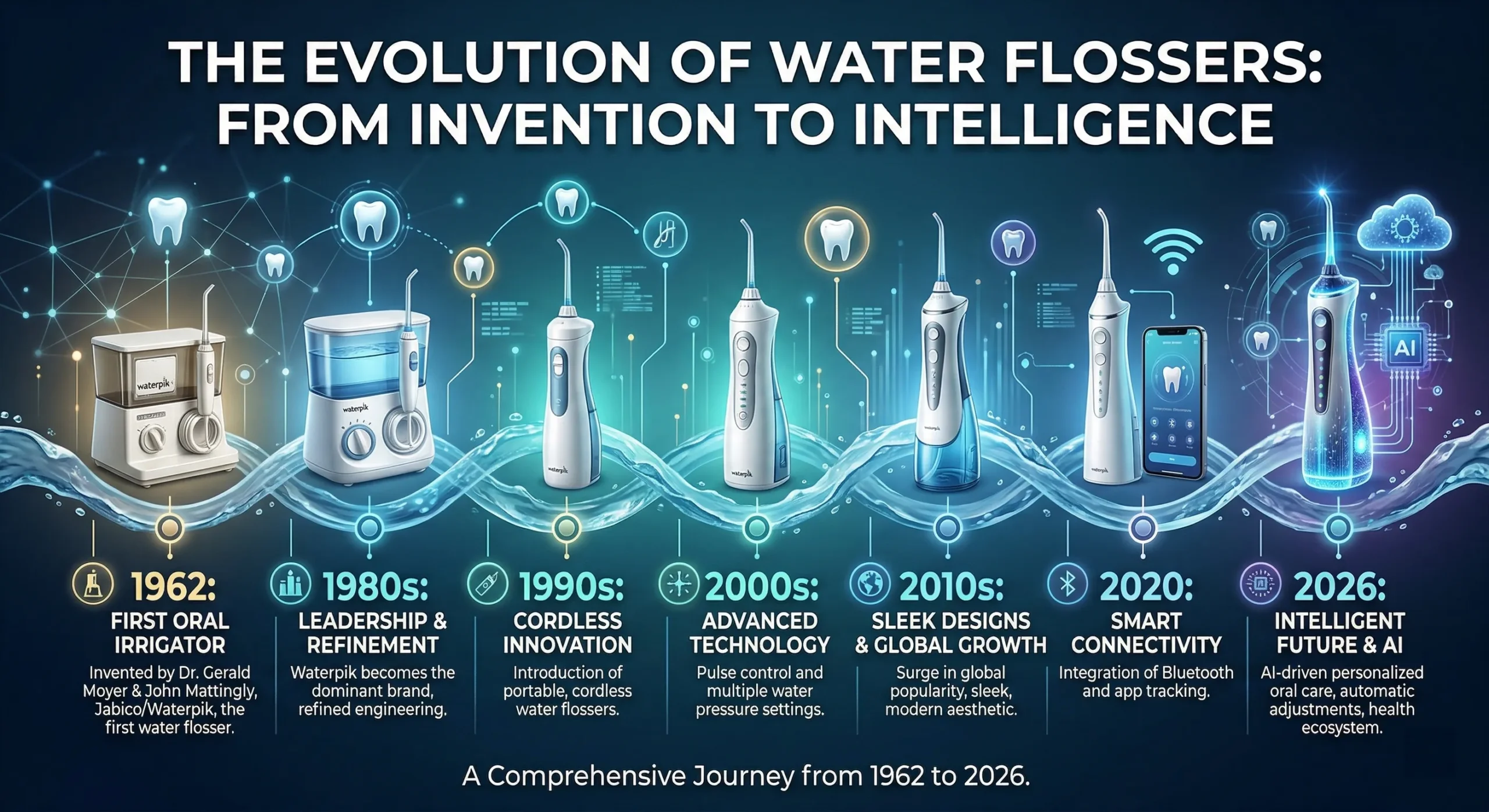
The Origins: A Dentist and an Engineer (1962)
The water flosser’s story begins in Fort Collins, Colorado, where a dentist and an engineer combined their expertise to develop a practical approach to interdental cleaning.
In 1962, dentist Gerald Moyer and engineer John Mattingly developed the Waterpik oral irrigator. Their design used pulsating water to help clean between teeth and along the gumline—areas that a toothbrush can miss.
The business began as Aqua Tec, the predecessor of Waterpik. The first water flosser was introduced in 1962; 1967 marked the company’s acquisition by Teledyne, rather than the invention or first commercial launch of the device.
Waterpik remains the benchmark against which all other water flossers are measured — and increasingly, the target that OEM manufacturers aim to match or exceed at better price points for private label brands.
How Water Flossers Work
Understanding the mechanism matters for both clinical efficacy and product specification when you're sourcing units for your brand.
Three features define a water flosser’s cleaning system:
- Pump system: Generates continuous or pulsating water pressure
- Pulsation: Repeated water pulses help dislodge debris and biofilm; the rate varies by model.
- Nozzle design: Directs water between teeth and along the gumline; specialized periodontal tips require the appropriate technique and pressure setting.
A 2009 laboratory study reported that a Waterpik standard jet tip removed 99.99% of an ex vivo salivary biofilm after three seconds at medium pressure. This was a controlled test on tooth specimens, rather than a whole-mouth clinical result. A 2023 typodont study also examined biofilm removal using a water flosser. Study methods and devices matter when interpreting these results.[1][2]
Why Plaque Removal Matters for B2B Buyers
When evaluating water flosser OEM suppliers, compare pressure range, pulsation, nozzle design and the supporting test reports. Match any efficacy claim to the finished model and test conditions. Research on another device helps inform development but does not establish your product’s results.
Evolution of Water Flosser Technology (1962–2026)
The four stages below summarize broad changes in product design. The dates overlap, and features vary by model; this is a buyer’s overview rather than an industry generation standard.
- Bulky desktop units
- Mechanical pressure controls
- Mains-powered countertop designs
- Nozzle tip variety begins
- Early dental and home use
- Handheld portable models
- Battery-powered operation
- Multiple pressure modes
- Travel-friendly designs
- Consumer market expands
- Rechargeable lithium batteries
- LED pressure indicators
- IPX7 waterproof rating
- Noise reduction technology
- Multiple nozzle attachments
- Bluetooth app integration
- UV nozzle sanitization
- Magnetic fast charging
- Up to 90 days per charge on selected models
- Multi-mode systems
- BPA-free materials and packaging options
App connectivity, UV nozzle disinfection and magnetic charging give private label brands more ways to differentiate. A capable OEM manufacturer can help balance these features with reliability, tooling costs and the target retail price. Select the features your customers will value and validate them on the finished product.
Water Flosser Pressure Settings: A Buyer’s Guide
Pressure is a key performance specification, alongside pulsation, nozzle design and water flow. Compare the adjustable range and consistency across production batches. Users should start at the lowest setting and follow the model’s instructions, especially when using specialized tips.
| PSI Range | Pressure intensity | Example use | Selection note |
|---|---|---|---|
| 10–30 psi | Gentle | Gentle starting settings, where supported by the model | Check age guidance and individual comfort |
| 30–50 psi | Moderate | Everyday cleaning at a comfortable setting | Increase gradually according to the instructions |
| 50–70 psi | Strong | Higher settings on compatible devices | Use appropriate tips for braces and dental work |
| 70–100 psi | High-pressure | Upper range on some home-use devices | Use only as directed; highest pressure is not always needed |
These ranges are illustrative product comparisons, not universal clinical prescriptions or “2026 standards.” Some home-use Waterpik countertop models offer 10–100 psi. Follow the exact device and tip instructions; periodontal pocket tips, for example, are used at the lowest setting.
Major Brands: Waterpik vs Panasonic vs Emerging Players
Understanding what the established brands do well — and where they leave gaps — is essential for positioning your own private label water flosser brand.
- ADA Seal of Acceptance on specific models
- 60+ global patents
- #1 in North American retail
- Countertop and cordless product ranges
- Cordless Advanced models: magnetic charging
- Strong dental professional network
- Air-in and ultrasonic waterjet technologies, depending on model
- Water-and-air or microbubble cleaning designs
- Retractable tank designs (ultra-portable)
- Rechargeable and travel-oriented options
- Strong in Asian & Japanese markets
- Established international oral care brand
- Cordless, rechargeable and connected design options
- Competitive private label pricing
- Order quantities vary by model and customization
- Custom branding & packaging
- Production schedules agreed for the order
- Growing retail channel presence
For B2B buyers, Waterpik illustrates the value of brand recognition, clinical research and a developed patent portfolio. A capable OEM partner can help you build a distinctive product at your target cost. Compare measured performance and customer experience, and review intellectual property before committing to tooling.
Water Flosser Market Size & 2026 Trends
The numbers tell a clear story: the water flosser market is not a niche — it's a growing global category that smart brand owners and distributors are positioning for now.
Key Trends Shaping 2026
1. Connected Features Create New Product Options
Bluetooth connectivity, usage tracking and adjustable pressure profiles can help differentiate a water flosser range. For OEM manufacturers, the key is choosing a practical hardware and software package that fits the bill of materials (BOM), support needs and retail position. Explore our water flosser range.
2. Sustainability as a Differentiator
Retailers and consumers increasingly look for replaceable nozzles, recyclable packaging and carefully specified materials. BPA-free materials address a particular substance requirement; packaging recyclability depends on its construction and local collection systems. Build these choices into product development and the relevant regulatory compliance work.
3. Southeast Asia Offers Distribution Opportunities
Rising disposable income, greater oral health awareness and expanding e-commerce channels create opportunities in Southeast Asia. Compare demand, retail pricing and import requirements country by country when planning wholesale and distribution channels.
4. Premium Features for Home Use
UV nozzle disinfection, adjustable pressure and multiple cleaning modes can strengthen a premium product offer. Validate each feature and explain its benefit clearly; pressure up to 100 psi is a model specification, rather than evidence of professional treatment or superior cleaning.
5. Kid-Specific Models: An Untapped Segment
Children’s models offer room for thoughtful product design. Prioritize age-appropriate instructions, adult supervision, an easy-to-hold body and gentle starting settings. Pressure alone does not establish that a model is suitable for a child.
B2B Sourcing: What Buyers Need to Know
Sourcing water flossers for private label or wholesale distribution involves more than comparing unit prices. Here are the factors that separate a successful launch from a costly import mistake.
8-Point Water Flosser OEM Factory Checklist
- Certifications and market access: Check the exact manufacturer, model and target-market documents, including applicable FDA registration and device listing, EU conformity documentation and RoHS records. Review ISO 9001 and, where relevant, ISO 13485 quality-system certificates. Read our OEM certifications guide.
- R&D capability: Can they develop custom enclosures, integrate smart features, and provide 3D prototyping? Or do they only copy existing designs? Discover our R&D capabilities.
- Pressure consistency: Agree the test method, operating conditions and tolerance before ordering. If your specification uses ±10%, verify that production samples meet that agreed limit.
- Waterproofing validation: Request an IPX7 test report for the exact model, with the test method and conditions identified. Independent testing can strengthen verification; an IP code alone does not establish third-party certification.
- Nozzle compatibility: Confirm the exact fitting, approved replacement tips and long-term supply arrangements. There is no single connector that makes all brands’ nozzles interchangeable.
- MOQ flexibility: Understand the MOQ for first orders vs. reorders. A good water flosser OEM manufacturer should be able to accommodate smaller initial runs to validate market demand.
- Lead time transparency: Confirm production and shipping schedules separately. A 15–30 day production window can be a planning reference for suitable standard orders; tooling, customization and quantity can change the schedule.
- Sample quality: Evaluate pressure, pulsation, runtime and nozzle fit before approving bulk production. Review the waterproofing test evidence and agree a controlled test plan rather than improvising an immersion test.
🏭 Relish Technology: Your Water Flosser Manufacturing Partner
Shenzhen Relish Technology Co., Ltd. is a specialized OEM/ODM manufacturer for oral care products, with 15+ years of experience producing water flossers, electric toothbrushes, and related devices for global brands. Tour our manufacturing facilities.
Certifications: ISO 9001 and ISO 13485 certified facilities · FDA registered · CE and RoHS documentation for the relevant models
Services: Full private label manufacturing · Custom branding · OEM/ODM from concept to packaging · Custom orders from 1,000 units, with flexibility for the order · Available-stock wholesale from 50 units · 15–30 day production schedules for suitable standard orders · English-speaking account team
Partner with Relish Technology
Whether you're launching a new private label oral care brand, expanding your existing product range, or sourcing wholesale water flossers for distribution, Relish offers the manufacturing capability, quality assurance, and commercial flexibility to support your growth. Read our client case studies and see what our clients say.
Ready to Source Water Flossers?
Get a factory-direct quotation for private label or OEM water flosser manufacturing. ISO certified. Samples available. Or download our product catalog first.
Frequently Asked Questions
Who invented the first water flosser?
What's the difference between a water flosser and string floss?
What market forecast does this guide use?
How many PSI should a home water flosser have?
What certifications should B2B buyers look for in water flosser OEM manufacturers?
What is the typical MOQ for OEM water flosser orders?
How often should water flosser nozzles be replaced?
Can children use water flossers?
References
- Gorur, A., Lyle, D. M., Schaudinn, C., & Costerton, J. W. (2009). Biofilm removal with a dental water jet. Compend Contin Educ Dent, 30(Spec No 1), 1–6. pubmed.ncbi.nlm.nih.gov/19385349
- Wang, Y., et al. (2023). Efficient removal of dental plaque biofilm from training typodont teeth via water flosser. Bioengineering (Basel), 10(9), 1061. pubmed.ncbi.nlm.nih.gov/37760162
- Sawan, N., et al. (2022). Effectiveness of Super Floss and Water Flosser in plaque removal for patients undergoing orthodontic treatment. Int J Dent. pubmed.ncbi.nlm.nih.gov/36090126
- Lyle, D. M., Goyal, C. R., Qaqish, J. G., & Schuller, R. (2016). Comparison of water flosser and interdental brush on plaque removal: A single-use pilot study. J Clin Dent, 27(1), 23–26. pubmed.ncbi.nlm.nih.gov/28390213
- Abdellatif, H., et al. (2021). Comparison between water flosser and regular floss in the efficacy of plaque removal. Saudi Dent J, 33(5), 256–259. pubmed.ncbi.nlm.nih.gov/34194188
- Goyal, C. R., Lyle, D. M., Qaqish, J. G., & Schuller, R. (2013). Evaluation of the plaque removal efficacy of a water flosser compared to string floss in adults after a single use. J Clin Dent, 24(2), 37–42. pubmed.ncbi.nlm.nih.gov/24282867
- American Dental Association. Dental Floss/Interdental Cleaners. ada.org/resources/ada-library/oral-health-topics/floss/
- Lyle, D. M. (2012). Relevance of the water flosser: 50 years of data. Compend Contin Educ Dent, 33(4), 278–280, 282. pubmed.ncbi.nlm.nih.gov/22536661
- Worthington, H. V., et al. (2019). Home use of interdental cleaning devices, in addition to toothbrushing, for preventing and controlling periodontal diseases and dental caries. Cochrane Database Syst Rev, 4(4), CD012018. pubmed.ncbi.nlm.nih.gov/30968949