







The Complete History of Water Flosser: From 1962 to 2026
Trace the evolution of oral irrigators from a niche dental device to a $2.8 billion global market. Understand the technology milestones, key players, and what B2B buyers need to know before sourcing in 2026.
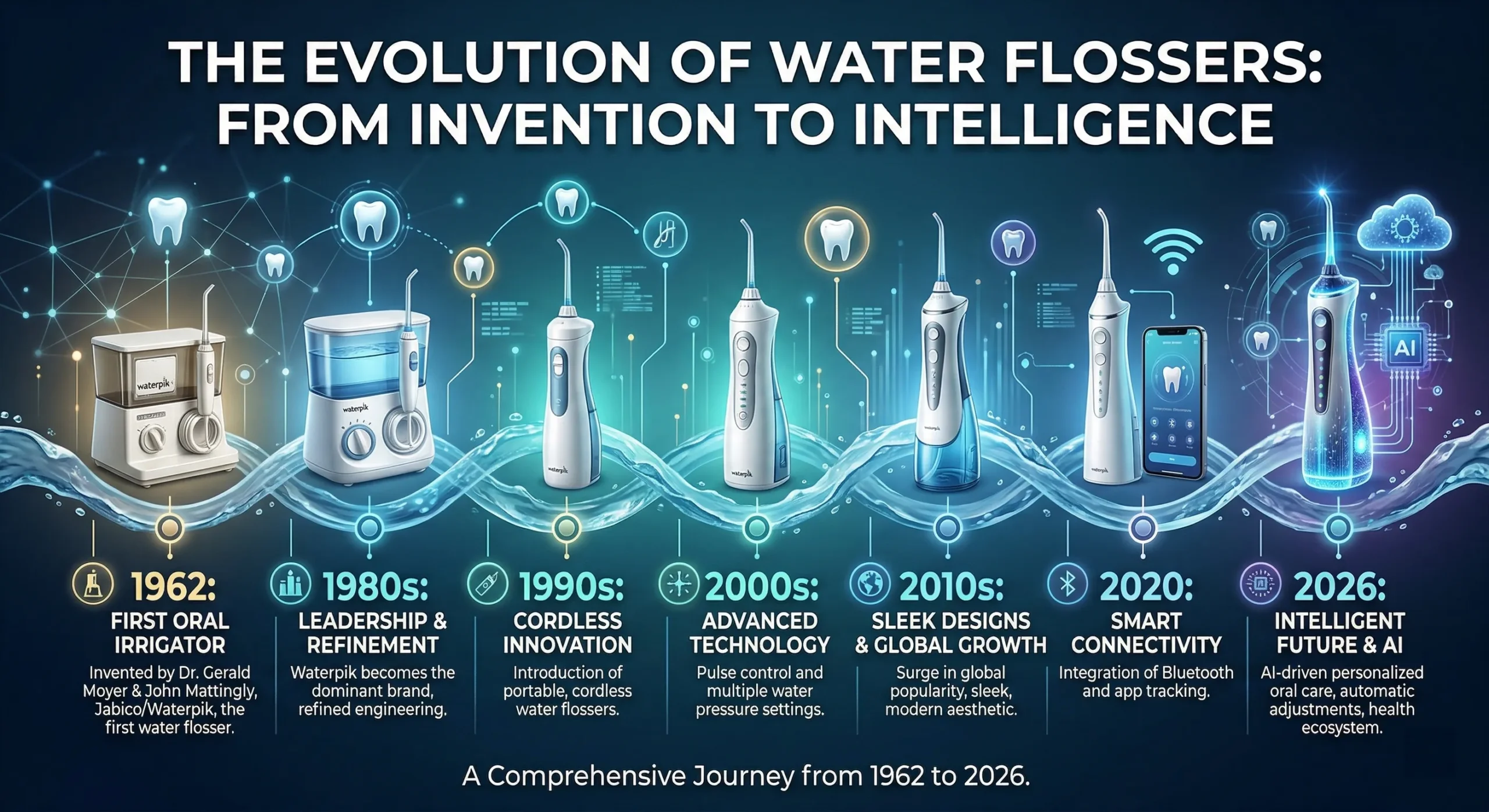
In 1962, American dentist Gerald Moyer and engineer John Mattingly co-invented the first water flosser in Fort Collins, Colorado. Their company, Jabico, launched the world's first commercial water flosser in 1967 — later rebranded as Waterpik, which remains the #1 water flosser brand in North America and the only oral irrigator with the American Dental Association (ADA) Seal of Acceptance.
The Origins: A Dentist and an Engineer (1962)
The story of the water flosser begins in Fort Collins, Colorado, where two men with complementary expertise — a dentist and an engineer — set out to solve a clinical problem that string floss alone couldn't handle.
In 1962, Gerald Moyer, an American dentist, collaborated with John Mattingly, a mechanical engineer, to develop the first oral irrigator. Their invention addressed a gap in interdental cleaning that traditional methods left untouched: reaching below the gumline and flushing out biofilm in periodontal pockets.
Their company, Jabico (a portmanteau of Jab and ico — for hydraulic irrigation), was the direct predecessor of Waterpik. In 1967, Jabico launched the world's first commercial water flosser, making the technology commercially available beyond dental clinics for the first time.
Waterpik remains the benchmark against which all other water flossers are measured — and increasingly, the target that OEM manufacturers aim to match or exceed at better price points for private label brands.
How Water Flossers Work
Understanding the mechanism matters for both clinical efficacy and product specification when you're sourcing units for your brand.
Most water flossers rely on three core components:
- Pump system: Generates continuous or pulsating water pressure
- Pulsating technology: Creates 1,200–1,400 micro-pulses per minute that mechanically dislodge biofilm
- Precision nozzle: Directs the water stream into interdental spaces and gum pockets at controlled angles
University of Southern California research found that 1,200 pulses per minute at 70 psi for 3 seconds removed 99.9% of plaque from treated areas.[1] A Tokyo Dental University study confirmed that a toothbrush + water flosser combination significantly outperforms brushing alone in plaque reduction.[2]
Why Plaque Removal Matters for B2B Buyers
When evaluating water flosser OEM suppliers, the clinical data above gives you a benchmark for what your products need to achieve. Look for manufacturers that can specify pulsation rate, pressure range, and nozzle design — these directly impact the efficacy claims you can make to your customers.
Evolution of Water Flosser Technology (1962–2026)
The technology has progressed through four distinct generations, each solving real consumer pain points — and creating new opportunities for OEM partners who can bring these features to market at scale.
- Bulky desktop units
- Single pressure setting
- Corded, clinic-bound
- Nozzle tip variety begins
- Dental practice exclusive
- Handheld portable models
- Battery-powered operation
- Multiple pressure modes
- Travel-friendly designs
- Consumer market expands
- Rechargeable lithium batteries
- LED pressure indicators
- IPX7 waterproof rating
- Noise reduction technology
- Multiple nozzle attachments
- Bluetooth app integration
- UV nozzle sanitization
- Magnetic fast charging
- Up to 90-day battery life
- Multi-mode systems
- BPA-free eco materials
The generational shift from Gen 3 to Gen 4 features — particularly app connectivity, UV sanitization, and magnetic charging — represents the biggest margin opportunity for private label brands. These features are now manufacturable at scale in China at competitive price points. Choosing the right OEM manufacturer determines whether you can deliver these at a price point that competes with Waterpik while preserving your margin.
Water Flosser Pressure Settings Guide (2026 Standards)
Pressure is the single most important performance specification for water flossers. Different use cases demand different ranges, and your OEM partner must be able to deliver consistent pressure across production batches.
| PSI Range | Water Flow | Best For | Target User |
|---|---|---|---|
| 10–30 psi | Gentle | Sensitive teeth, first-time users, children | Kids models, senior care |
| 30–50 psi | Moderate | Daily interdental maintenance | Mainstream consumer |
| 50–70 psi | Strong | Deep gum cleaning, orthodontic patients | Power users, braces wearers |
| 70–100 psi | High-pressure | Professional-level cleaning | Dentist-supervised use |
Pressure specification data is consistent across multiple clinical references, including the Journal of Clinical Dentistry[6] and systematic reviews published in PubMed.[1]
Major Brands: Waterpik vs Panasonic vs Emerging Players
Understanding what the established brands do well — and where they leave gaps — is essential for positioning your own private label water flosser brand.
- ADA Seal of Acceptance — only brand
- 60+ global patents
- #1 in North American retail
- Full range: entry to premium smart
- GS10 series: magnetic charging, app
- Strong dental professional network
- Proprietary Oxygen Injection Technology
- Fine-bubble water flow for sensitive gums
- Retractable tank designs (ultra-portable)
- Week-long travel battery life
- Strong in Asian & Japanese markets
- #2 global water flosser brand
- Full Gen 3–4 feature parity
- Competitive private label pricing
- Flexible MOQ from 500 units
- Custom branding & packaging
- Fast 15–30 day lead times
- Growing retail channel presence
The key insight for B2B buyers: Waterpik's premium positioning is built on clinical credibility and patent portfolio, not features that Chinese manufacturers can't replicate technically. If your brand strategy targets the mid-market or value tier — or even if you want to compete at the premium level on price — sourcing from a capable OEM partner lets you deliver comparable performance at a significantly lower landed cost.
Water Flosser Market Size & 2026 Trends
The numbers tell a clear story: the water flosser market is not a niche — it's a growing global category that smart brand owners and distributors are positioning for now.
Key Trends Shaping 2026
1. Smart Integration Is the New Baseline
Bluetooth connectivity, usage tracking apps, and pressure profile customization — once premium features — are becoming expected in mid-tier units. For OEM manufacturers, this means the BOM (bill of materials) for "smart" features has dropped enough to include them across product tiers. Explore our water flosser range.
2. Sustainability as a Differentiator
BPA-free materials, recyclable packaging, and replaceable nozzles are increasingly demanded by both retailers and end consumers. Brands that lead on sustainability credentials will have an edge in European markets where regulatory compliance is tightening.
3. Southeast Asia Is the Fastest Growing Region
While North America remains the largest market by revenue, Southeast Asia is growing fastest — driven by rising middle-class disposable income, increased oral health awareness, and e-commerce expansion. B2B buyers should factor this into wholesale and distribution channel planning.
4. The "Professional Grade at Home" Premium
UV sanitization, higher pressure options (up to 100 psi), and multi-mode systems (gum massage, orthodontic, tongue cleaning) command premium pricing. These are the features that differentiate your product line and protect your margin against price competition.
5. Kid-Specific Models: An Untapped Segment
Very few brands have committed to the kids' segment with properly designed products. Water flossers with lower pressure (10–30 psi), colorful designs, and kid-safe nozzles represent a high-growth, low-competition opportunity for private label brands.
B2B Sourcing: What Buyers Need to Know
Sourcing water flossers for private label or wholesale distribution involves more than comparing unit prices. Here are the factors that separate a successful launch from a costly import mistake.
8-Point Water Flosser OEM Factory Checklist
- Certifications: FDA registration (US), CE marking (EU), RoHS compliance, and ideally ISO 13485 for medical device quality systems. Read our OEM certifications guide.
- R&D capability: Can they develop custom enclosures, integrate smart features, and provide 3D prototyping? Or do they only copy existing designs? Discover our R&D capabilities.
- Pressure consistency: Ask for pressure testing data across production batches. Variance of more than ±10% from spec is unacceptable.
- Waterproofing validation: IPX7 rating must be verified with third-party testing, not just claimed in the product spec sheet.
- Nozzle compatibility: Check whether the standard nozzles they supply are compatible with industry-standard fittings — or if you're locked into proprietary replacement heads.
- MOQ flexibility: Understand the MOQ for first orders vs. reorders. A good water flosser OEM manufacturer should be able to accommodate smaller initial runs to validate market demand.
- Lead time transparency: Standard orders should be 15–30 days for production, plus shipping. Be wary of factories quoting unusually low prices with suspiciously short lead times.
- Sample quality: Always order samples before committing to bulk production. Test the pulsation rate, battery life, and waterproof seal yourself.
🏭 Relish Technology: Your Water Flosser Manufacturing Partner
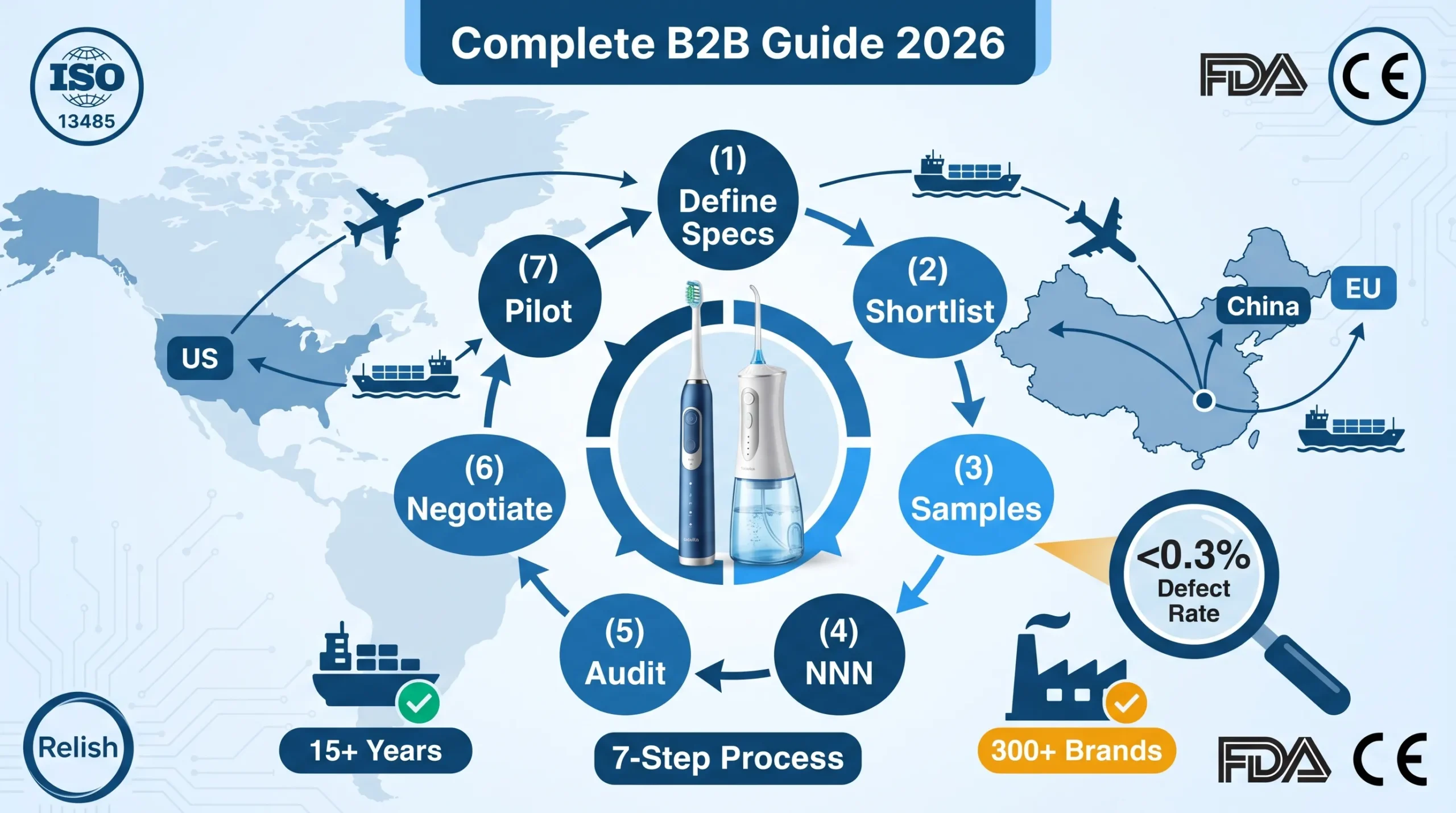
Shenzhen Relish Technology Co., Ltd. is a specialized OEM/ODM manufacturer for oral care products, with 15+ years of experience producing water flossers, electric toothbrushes, and related devices for global brands. Tour our manufacturing facilities.
Certifications: ISO 9001, ISO 13485 certified facilities · FDA registered · CE marked · RoHS compliant
Services: Full private label manufacturing · Custom branding · OEM/ODM from concept to packaging · Competitive MOQ from 500 units · 15–30 day lead time · English-speaking account team
Partner with Relish Technology
Whether you're launching a new private label oral care brand, expanding your existing product range, or sourcing wholesale water flossers for distribution, Relish offers the manufacturing capability, quality assurance, and commercial flexibility to support your growth. Read our client case studies and see what our clients say.
Ready to Source Water Flossers?
Get a factory-direct quotation for private label or OEM water flosser manufacturing. ISO certified. Samples available. Or download our product catalog first.
Frequently Asked Questions
References
- Mohapatra, S., et al. (2023). Comparing the effectiveness of water flosser and dental floss in plaque reduction among adults. J Indian Soc Periodontol, 27(6), 559–567. pubmed.ncbi.nlm.nih.gov/38434511
- Wang, Y., et al. (2023). Efficient removal of dental plaque biofilm from training typodont teeth via water flosser. Bioengineering (Basel), 10(9), 1061. pubmed.ncbi.nlm.nih.gov/37760162
- Sawan, N., et al. (2022). Effectiveness of Super Floss and Water Flosser in plaque removal for patients undergoing orthodontic treatment. Int J Dent. pubmed.ncbi.nlm.nih.gov/36090126
- Goyal, C. R., Lyle, D. M., Qaqish, J. G., & Schuller, R. (2016). Comparison of water flosser and interdental brush on plaque removal: A single-use pilot study. J Clin Dent, 27(1), 23–26. pubmed.ncbi.nlm.nih.gov/28390213
- Abdellatif, H., et al. (2021). Comparison between water flosser and regular floss in the efficacy of plaque removal. Saudi Dent J, 33(5), 256–259. pubmed.ncbi.nlm.nih.gov/34194188
- Goyal, C. R., Lyle, D. M., Qaqish, J. G., & Schuller, R. (2013). Evaluation of the plaque removal efficacy of a water flosser compared to string floss in adults after a single use. J Clin Dent, 24(2), 37–42. pubmed.ncbi.nlm.nih.gov/24282867
- American Dental Association. (n.d.). Water flossers and water flossing. Retrieved from ada.org/resources/research/science-and-research-institute
- Lyle, D. M. (2012). Relevance of the water flosser: 50 years of data. Compend Contin Educ Dent, 33(4), 278–282. pubmed.ncbi.nlm.nih.gov/22536661
- Cochrane Database of Systematic Reviews. (2014). Interdental brushing for the prevention and control of periodontal diseases and dental caries in adults. pubmed.ncbi.nlm.nih.gov/24353078