


Europe Electric Toothbrush Market 2026: Size & OEM Guide
1. Europe Electric Toothbrush Market Overview
Europe offers a strong opportunity for electric toothbrush brands. The market outlook cited here values the region at approximately $3.8 billion in 2025 and projects 6.2% compound annual growth through 2032, reaching over $6.1 billion. For OEM buyers, the opportunity is to match the product, price and sales channel to each country.
High awareness of oral health and demand for clinically validated products support electric toothbrush sales across Europe. Premium features and sustainable design also shape purchase decisions, giving brands room to differentiate through technology, materials and the customer experience.
For brands sourcing from China, a successful European launch brings product design, regulatory preparation and channel planning together. Use the country comparison below to focus your electric toothbrush OEM brief and build a range that fits local buyers.
Relish combines product development, manufacturing and market-entry support for your European electric toothbrush range:
- MOQ: Custom-project MOQ starts at 1,000 units, with flexibility for the order. Wholesale MOQ for in-stock products is 50 units.
- Lead Time: Typical planning ranges are 8–10 weeks for production, 4–6 weeks for sea freight to Rotterdam or Hamburg, and about two weeks for customs clearance.
- Production Planning: A 20,000 m² facility, 350+ employees and 12 automated production lines support scalable OEM/ODM manufacturing.
- Quality Control: ISO 13485:2016-certified quality management, with AQL 1.5 for major defects and AQL 2.5 for minor defects.
- Compliance Documentation: CE, UKCA, FDA, ISO 13485, BSCI and FSC credentials and documentation.
Europe’s premium and connected segments give OEM brands several routes to growth. The country breakdown below connects market size and growth with the channels and product features that matter for a launch.
2. Selected European Country Estimates
Europe is a group of distinct markets. Compare the following countries and Nordic markets to shape your product range, pricing and sales strategy.
🇩🇪 Germany
Germany leads the regional comparison at an estimated $980 million, with 5.8% CAGR. Strong oral-health awareness, clinical validation and brand loyalty support premium positioning. Pharmacies, known as Apotheken, account for approximately 35% of premium electric toothbrush sales.
🇬🇧 United Kingdom
The UK market is estimated at $720 million, with 5.5% CAGR. Amazon UK accounts for over 40% of electric toothbrush sales, while Boots and Superdrug remain important pharmacy retailers. Connected features and easy-to-use apps can help a brand stand out. Plan Great Britain and Northern Ireland market access separately.
🇫🇷 France
France’s estimated $580 million market is growing at 6.8% CAGR. Pharmacies and parapharmacies account for approximately 30% of premium sales. Sonic technology and sustainable product features are useful points of differentiation.
🇮🇹 Italy
Italy’s estimated $340 million market is growing at 7.2% CAGR. Mid-range pricing, retail distribution and e-commerce offer opportunities, while dental-professional recommendations can support brand positioning.
🇸🇪 Scandinavia
The Nordic comparison shows an estimated $420 million market and 5.2% CAGR. Electric toothbrush penetration exceeds 45% of households, with strong interest in sustainable materials, refillable systems and premium design. Apotek Hjärtat in Sweden and pharmacy channels in Norway are relevant routes to buyers.
🇪🇸 Spain
Spain’s estimated $290 million market has the highest CAGR in this comparison, at 7.8%. Growing oral-health awareness and comparatively lower penetration create room for new brands. Build the offer around suitable pricing and a mix of pharmacy, retail and online channels.
3. Regulatory Environment in Europe
CE Marking and Applicable Product Legislation
CE marking is a manufacturer’s declaration that a product meets the EU legislation that applies to it; it is not a general-purpose certificate. Requirements depend on product design, intended purpose, components, and claims. Identify the relevant legislation and conformity-assessment steps for the specific model.
Low Voltage Directive (2014/35/EU), where applicable: The LVD covers electrical equipment rated from 50–1,000 V AC or 75–1,500 V DC. A battery-powered brush below these limits is not automatically within its scope because it has a charger; assess any supplied mains adapter separately. The manufacturer carries out the LVD conformity assessment; the directive does not require a notified body.
Electromagnetic Compatibility (EMC) Directive (2014/30/EU), where applicable: Where the EMC Directive applies, assess emissions and immunity for the intended equipment and operating conditions. Select relevant standards and tests for the actual configuration. A Bluetooth-enabled model also needs an assessment under the Radio Equipment Directive.
EU Medical Device Regulation (MDR 2017/745)
An electric toothbrush is not automatically a medical device. MDR applies when the product meets the regulation’s definition, including its intended medical purpose. Review the intended purpose and claims before determining classification and obligations.
- Determine whether the product falls within the MDR definition and applicable device class.
- Prepare technical documentation required for the product and conformity route.
- Support any clinical evaluation with evidence appropriate to the intended purpose and claims.
- Establish post-market processes if the product is regulated as a medical device.
- Use a notified body only where the applicable conformity procedure requires one.
Confirm the regulatory implications before adding medical claims to product listings or packaging.
Environmental Claims and Product Information
Support environmental claims with evidence for the actual product and packaging. Check the applicable national measures implementing Directive (EU) 2024/825, which are to apply from 27 September 2026, and avoid broad claims that imply benefits beyond the evidence. For product and sourcing considerations, see our guide to sustainable oral care market trends.
Electromagnetic Field (EMF) Exposure
EMC concerns electromagnetic interference; EMF exposure is a separate topic. Determine which requirements and tests apply to the product. Do not describe an EMC test as proof of EMF safety.
WEEE Directive for Electronic Components
Where WEEE rules apply, producers have registration, reporting, and financing obligations in relevant countries. Confirm responsible producers, national registrations, and take-back duties for each destination market.
Marking rules differ between Great Britain and Northern Ireland and can change. Check current government guidance for the product category and destination. Do not assume UKCA is required for every product or add a standard testing fee without a product-specific quotation.
4. Distribution Channels in Europe
Pharmacy and Para-Pharmacy
Pharmacies and parapharmacies are particularly influential in Germany and France, accounting for roughly 30–35% of premium sales. Clear product benefits, clinical evidence and professional recommendations can strengthen a brand’s proposition for these buyers.
Retailer examples are starting points for research. They do not indicate a Relish partnership or endorsement.
Mass Market Retail
General retail can include supermarkets, drugstores, department stores, and discount retailers. Product range, packaging, pricing, and supplier onboarding differ by buyer; assess each route against the brand and order economics.
Private-label electric toothbrushes account for 15–20% of volume in some markets. For retailers, OEM manufacturing offers a way to develop an own-brand range; for brand owners, it raises the importance of a clear product proposition and consistent quality.
E-Commerce
Online sales may involve a brand store, local marketplaces, or cross-border platforms. Review current seller, labeling, safety, fulfillment, and customer-service requirements for each destination.
Dental Professional Channel
Dental practices and professional distributors may be relevant to the product’s positioning. Obtain permission and supporting evidence before using a professional endorsement or clinical claim.

5. Consumer Preferences in Europe
Sonic vs. Rotating-Oscillating Technology
Sonic and rotating-oscillating designs offer different head movements and product configurations. Compare the proposed specifications, price and buyer requirements; the cited regional figures do not establish country-level technology preferences.
Choose pressure sensing, cleaning modes and connectivity to suit the intended user and channel. Confirm each feature on the proposed model and test the offer with buyers.
Sustainability Expectations
Environmental claims should match the product, packaging, and supporting evidence. Confirm material composition, recyclability, sourcing documentation, and local rules before describing an item as recyclable, recycled, compostable, or certified.
Sustainable materials and packaging can strengthen premium positioning in Germany and the Nordic markets. Explore our sustainability initiatives and manufacturing approach, or read our guide to eco-friendly materials and OEM solutions.
Smart/Connected Toothbrush Adoption
App-connected electric toothbrushes have captured approximately 18% of the European electric toothbrush market, with higher adoption rates in the UK at 25% (Grand View Research, 2025) and lower rates in Southern European markets (10-12%). Primary use cases include real-time brushing feedback, gamification for children's oral health, and integration with broader health tracking applications.
Connected features can add software, privacy, security, and customer-support work. Define the data collected, who controls it, where it is processed, and how users can exercise applicable rights before launch.
Price Sensitivity vs. Premiumization
European electric toothbrush markets show pronounced premiumization trends, with consumers increasingly willing to invest in higher-quality products with advanced features. This trend is most pronounced in Germany and Scandinavia, where average selling prices continue rising. However, Southern European markets remain more price-sensitive, with strong demand for products in the €30-60 range rather than premium €100+ offerings.
Launch Your Electric Toothbrush Range in Europe
Build a Europe-ready range with Relish’s electric toothbrush OEM/ODM services, CE documentation, charging options and multilingual packaging support.
Request a Quote6. OEM Sourcing Strategy for the European Market
CE Marking and Manufacturing Support
Start with product design, power source, intended purpose, claims, packaging, and destinations. Identify applicable EU legislation and conformity routes, prepare required documentation, and confirm testing with a competent laboratory where needed. The manufacturer remains responsible for the product and its declaration of conformity.
For an overview of the product-specific assessment and documentation process, see our guide to CE requirements for electric toothbrushes.
Build CE preparation into the project schedule. A standard electric-toothbrush project typically allows 8–14 weeks for testing and documentation; medical-device work can take longer. Relish supports technical-file preparation and test coordination, with the assessment route matched to the product.
Voltage Compatibility
Many European markets use nominal 230 V at 50 Hz, but check the destination plug, adapter input, and charging-base specification for each model. Confirm supported voltage and frequency; do not assume charging systems are interchangeable.
Language and Labeling Requirements
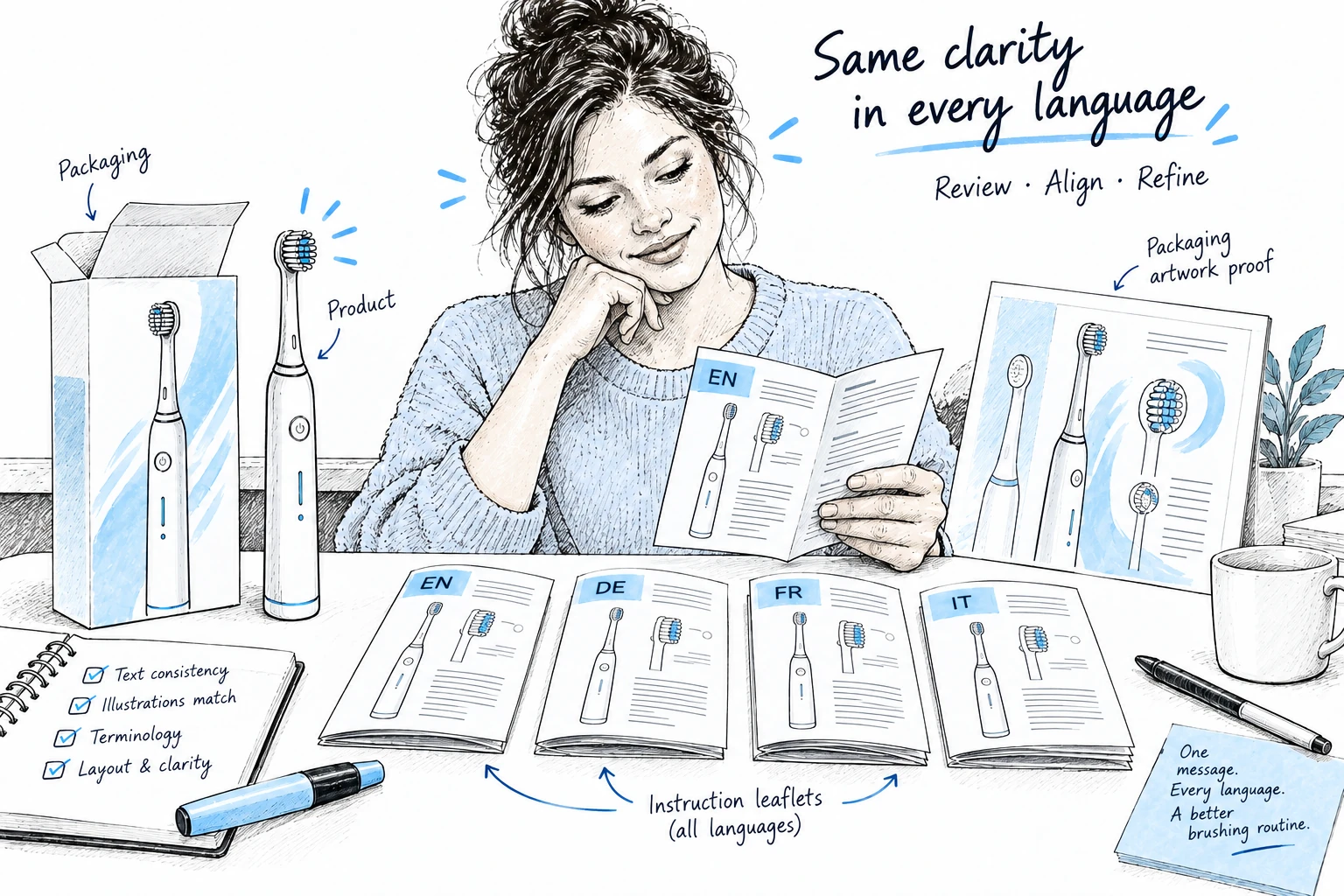
Packaging and instructions must meet language and information rules for each destination. Map country language needs and responsible economic operators before artwork approval; do not assume one insert or label satisfies every market.
Confirm product identification, manufacturer and importer details, instructions, warnings, electrical ratings, and disposal markings for the product and destination. Additional fields may apply under legislation or retailer requirements.
Lead Time Considerations
Use 8–10 weeks for production, 4–6 weeks for sea freight and about two weeks for customs as a planning framework: around 14–18 weeks in total. Align the production slot, packaging, launch date and stock plan early.
Air freight offers a shorter 1–2 week transit option for launch stock or promotions. Compare its cost with sea freight and plan regular replenishment around the expected demand.
How Relish Tech Supports Your European Launch
Relish brings a 20,000 m² manufacturing base, 350+ employees and 12 automated production lines to your electric toothbrush OEM project. Our ISO 13485-certified quality system and in-house engineering team support a coordinated route from development to production.
Our engineering team supports charging configurations, multilingual labeling and European-market documentation. We also coordinate technical files and testing to help you prepare a product for its intended market. Explore our certifications portfolio, including FDA, CE and ISO 13485 credentials.
For a sustainable product range, Relish offers FSC-certified bamboo options, GRS recycled-plastic manufacturing and packaging customization. Combine suitable materials with the product design and supporting documentation for your brand’s positioning. Discover our OEM manufacturing services.
Our ISO 13485:2016-certified quality system and AQL 1.5/2.5 inspection protocols support consistent manufacturing and quality documentation. See our OEM/ODM electric toothbrush manufacturing guide for the production workflow, technical-file preparation, risk assessment and test-report coordination.
| Country | Market Size | Growth Rate | Key Channel | Special Considerations |
|---|---|---|---|---|
| Germany | $980M | 5.8% | Pharmacy (Apotheke) | Reimbursement systems favor premium |
| United Kingdom | $720M | 5.5% | E-commerce (Amazon UK) | Plan the applicable CE/UKCA route |
| France | $580M | 6.8% | Para-pharmacy | Strong sonic technology preference |
| Italy | $340M | 7.2% | Mass retail + E-commerce | Price-sensitive market |
| Scandinavia | $420M | 5.2% | Pharmacy chains | Sustainability-driven adoption |
| Spain | $290M | 7.8% | Mass retail | High growth potential |
Key Takeaways
A European launch plan should connect country demand, product requirements and channel economics. Resolve the following points before committing to production:
- Europe’s electric toothbrush market is projected to reach over $6.1 billion by 2032, with 6.2% CAGR.
- Germany leads by market size; Spain and Italy offer strong growth opportunities.
- Pharmacy and parapharmacy channels are particularly influential in Germany and France.
- CE marking depends on the legislation and conformity route applicable to the product.
- Great Britain and Northern Ireland have different market-access arrangements; select the applicable CE/UKCA route for the product.
- Sustainable materials and packaging help shape premium positioning, especially in Northern Europe.
- Multilingual labeling and market documentation belong in the product brief from the start.
- Plan production, sea freight and customs together: the ranges above total approximately 14–18 weeks.
Bring Your Brand to the European Market
Turn your European market plan into a distinctive electric toothbrush range with Relish Tech. Our OEM/ODM team combines product engineering, scalable manufacturing, certification support and multilingual packaging to help you launch with confidence.
Contact Our TeamFrequently Asked Questions
What is the size and growth outlook for Europe’s electric toothbrush market?
The outlook presented here values Europe at approximately $3.8 billion in 2025 and projects 6.2% CAGR through 2032, reaching over $6.1 billion. Germany leads at $980 million, followed by the UK at $720 million, France at $580 million, Scandinavia at $420 million, Italy at $340 million and Spain at $290 million.
Which European country has the largest electric toothbrush market?
Germany leads the comparison at approximately $980 million. Oral-health awareness, premium positioning and the pharmacy channel support this market; Apotheken account for roughly 35% of premium electric toothbrush sales.
What CE marking requirements apply to electric toothbrushes sold in the EU?
Requirements depend on product design, intended purpose, components, and claims. CE marking is the manufacturer’s declaration of conformity with applicable EU legislation, not a general-purpose certificate. Determine the product-specific route before using the mark.
What voltage standard applies to electric toothbrushes in Europe?
Many European markets use nominal 230 V, 50 Hz mains. Confirm the destination plug, adapter input, and charging-base specification for each model; configurations can differ by market.
How long should I plan for CE marking preparation?
A standard electric-toothbrush project typically allows 8–14 weeks for testing and documentation. Medical-device requirements can add work. For the UK, choose the applicable market-access route first rather than automatically budgeting for separate CE and UKCA testing.
What are the key distribution channels for electric toothbrushes in Europe?
Routes include pharmacies and parapharmacies, mass retail, e-commerce and dental-professional recommendations. Pharmacies and parapharmacies account for roughly 30–35% of premium sales in Germany and France, while online channels are particularly important in the UK.
References
- Mordor Intelligence. (2025). Europe Electric Toothbrush Market — Growth, Trends, and Forecasts (2025–2030). https://www.mordorintelligence.com/industry-reports/europe-electric-toothbrush-market
- European Parliament and Council. (2014). Low Voltage Directive 2014/35/EU. Official Journal of the European Union. Directive 2014/35/EU: full text
- European Parliament and Council. (2014). Electromagnetic Compatibility Directive 2014/30/EU. Requirements for electromagnetic compatibility. Directive 2014/30/EU: full text
- European Parliament and Council. (2017). Medical Device Regulation (EU) 2017/745. Requirements for medical device classification and compliance. Regulation (EU) 2017/745: full text
- Department for Business and Trade. (2026). Placing UKCA or CE marked products on the market in Great Britain. Guidance for manufactured products; check the rules for the destination and product category. Great Britain product-marking guidance
- European Parliament and Council. (2024). Directive (EU) 2024/825: empowering consumers for the green transition. Directive (EU) 2024/825: full text
- European Parliament and Council. (2012). Directive 2012/19/EU on waste electrical and electronic equipment (WEEE). Directive 2012/19/EU: full text