

Smart Toothbrush Market 2026: AI Trends & OEM Guide
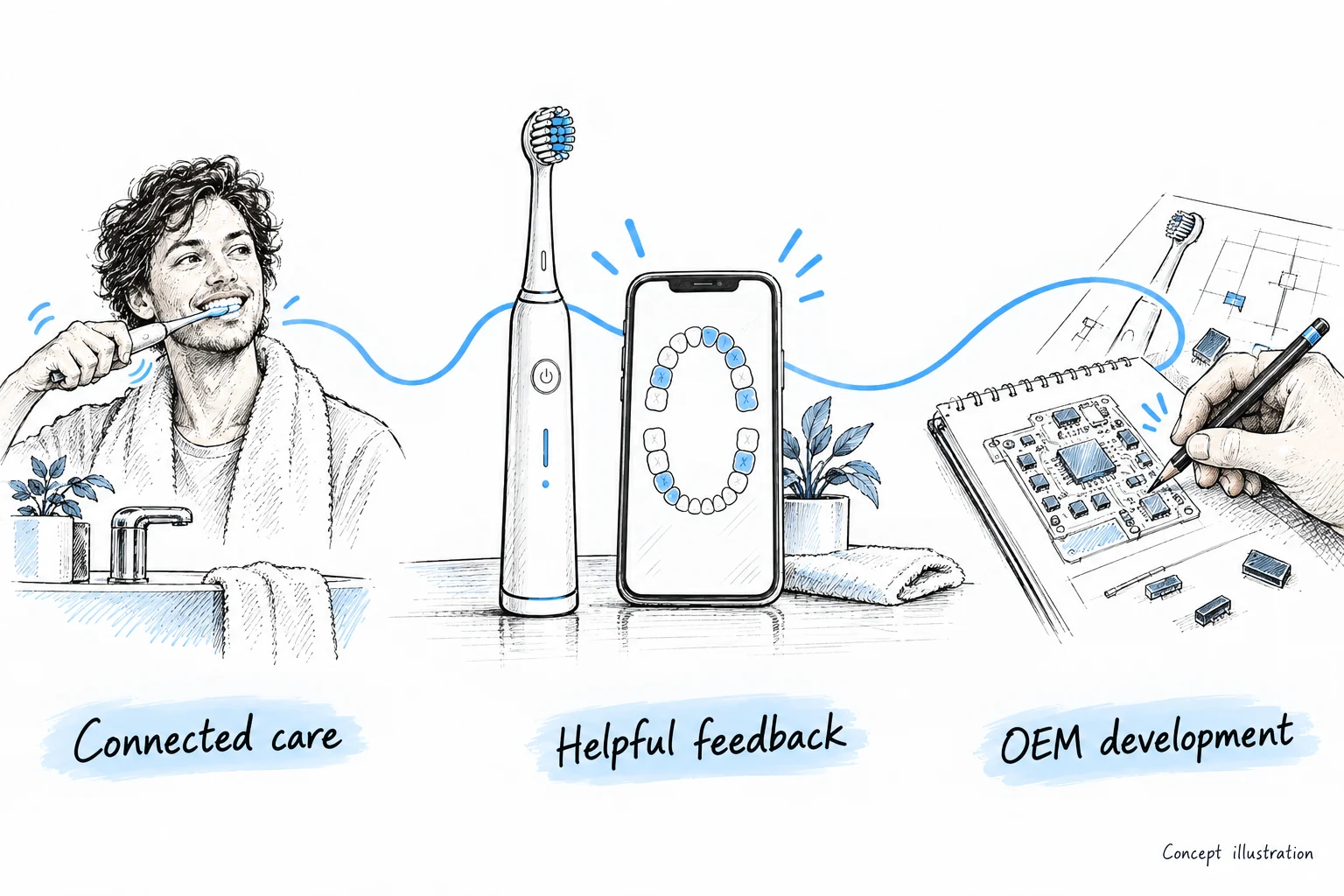
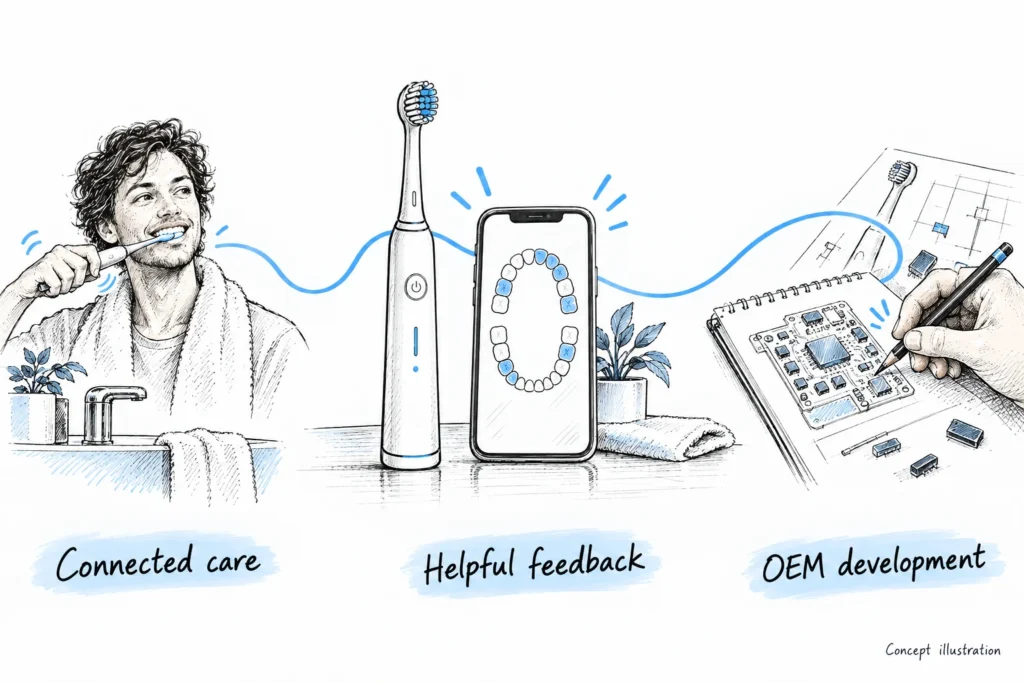
Smart toothbrushes bring sensing, connectivity and software into everyday oral care. For brands, pressure feedback, brushing analysis and engaging apps create ways to stand out. The opportunity is to turn those features into a product that users find useful and easy to use.
This guide connects smart toothbrush market trends with the engineering and OEM decisions behind a launch. Explore sensors, Bluetooth, apps and manufacturing, then build a product brief around your target users and price position.
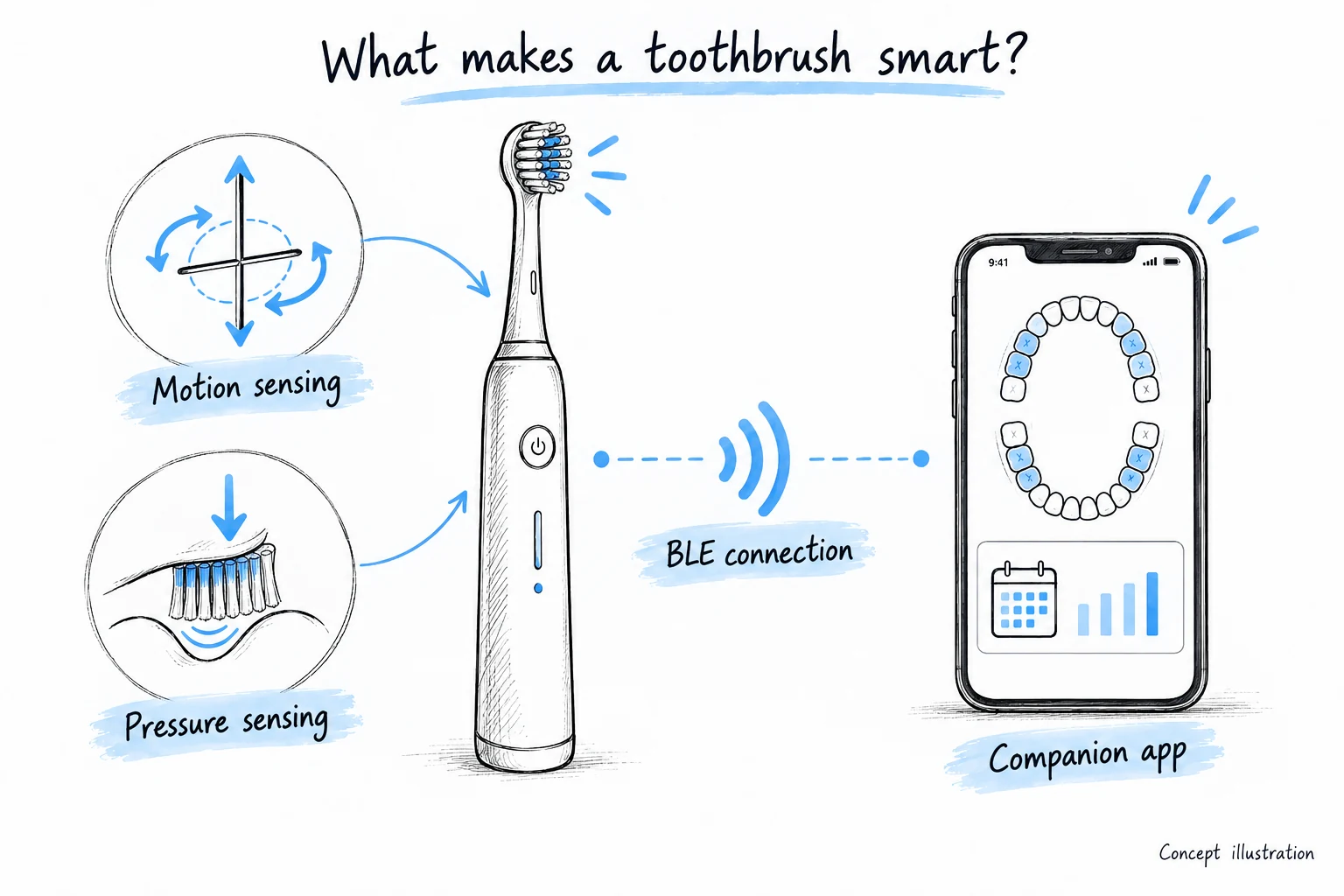
What Makes a Toothbrush Smart?
“Smart toothbrush” is used for products with different combinations of sensors, connectivity and software. These features can record brushing data or provide feedback; any claim of a clinical benefit needs evidence for the specific product and use.
A connected design may combine the following elements, depending on the functions required.
Motion Sensors
Accelerometers measure linear acceleration, while gyroscopes measure angular velocity. MEMS sensors with ranges such as ±2g to ±16g can help capture movement and orientation. Sensor placement, vibration and the analysis method determine how that data becomes brushing feedback.
Pressure Sensors
A pressure-feedback design estimates applied force using a suitable sensor or sensing mechanism. The threshold, response and feedback method depend on the product. Specify how the measurement will be calibrated and tested; a configured alert threshold is not a universal clinical limit.
Bluetooth Connectivity
Bluetooth Low Energy (BLE) can carry data between a toothbrush and a companion application. The Bluetooth SIG primer explains the underlying technology. Connection behaviour, data transfer and power use depend on the design and configuration; the radio alone does not establish app compatibility.
Companion Application
A companion app can display session duration, recorded pressure events or other supported feedback. Estimated coverage and personalized recommendations require suitable sensors and validated analysis. Define what the app actually measures, what it estimates and how limitations will be explained to users.
Smart Toothbrush Market Overview
The smart toothbrush market combines a $1.2 billion 2024 base with annual growth of 12–15% and a projected value above $2.5 billion by 2030. For OEM brands, that growth creates room for connected products across more price tiers.
Smart features represent approximately 15% of the electric toothbrush market. As connectivity moves beyond flagship models, brands can differentiate through useful feedback, easy-to-use software and a clear product proposition.
Regional Market Opportunities
Different regions create different opportunities for connected oral care:
- North America — Strong interest in consumer technology, fitness tracking and premium connected products supports adoption, especially in the United States.
- Europe — Dental-professional recommendations, privacy-conscious software and durable product design support growth across European markets.
- Asia-Pacific — China, Japan and South Korea offer strong growth opportunities, supported by smartphone use and familiarity with connected products.
- Other markets — Urban markets offer opportunities for brands that combine clear product benefits, accessible pricing and local sales support.
Connected Features to Consider
The following options involve different hardware, software and validation work. Select the ones that address a clear user need and fit the project’s development and support budget.
Brushing Analysis and AI
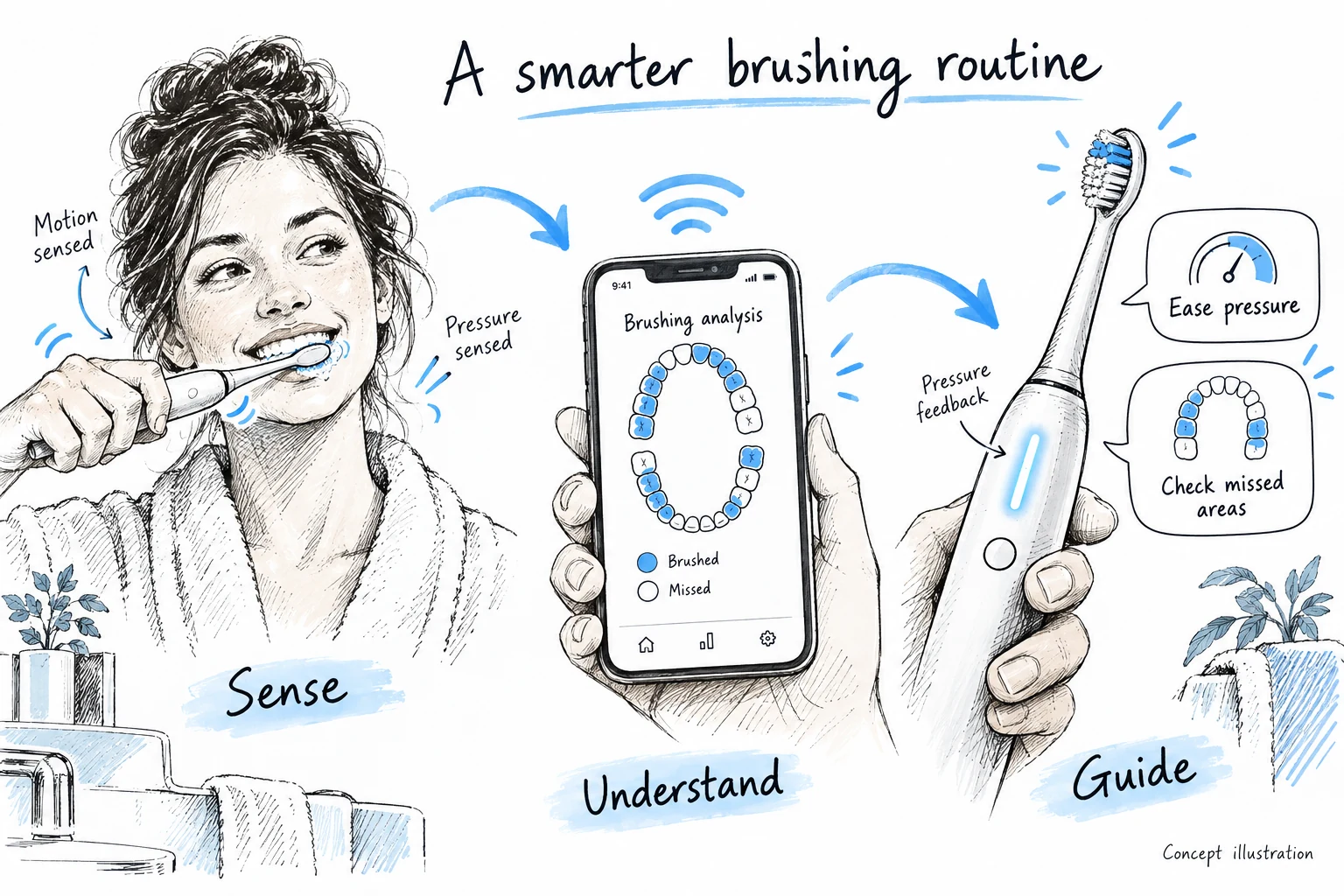
AI analysis adds a layer of personalized feedback beyond a simple timer. Motion and pressure data can help an app identify patterns and guide the next session. Good product design makes the feedback understandable, with accuracy assessed for the functions offered.
Possible analysis approaches include:
Computer Vision Approach
A vision-based design could use a phone camera to estimate brushing position. Assess lighting, phone placement, visibility and privacy, and validate the function under the conditions in which users will operate it.
Motion Analysis Approach
Motion analysis uses accelerometer or gyroscope signals to estimate movement or coverage. Sensor placement, training data, validation methods and individual brushing behaviour affect accuracy. Explain those limits in the product’s feedback and instructions.
Feature selection: Specify the required sensing, brush-head recognition, feedback or coverage display. When comparing existing products, check the exact model and software version against current manufacturer documentation.
Pressure Sensing and Feedback
Pressure feedback can alert users when the estimated force exceeds a configured threshold. Define the threshold and response for the product, validate the measurement and explain the alert in the instructions.
Possible feedback channels include:
- Visual pressure feedback — Lights or other indicators can signal a pressure event. Explain the colours and thresholds using the model’s instructions.
- Haptic Feedback — A change in vibration can signal a threshold. Test whether intended users can recognize the signal comfortably during brushing.
- App Notifications — An app can display recorded pressure events and explain the configured alerts.
- Pressure History — A history can show recorded patterns over time. Define measurement accuracy, data retention and how users should interpret the information.
Bluetooth LE and App Integration
Choose the Bluetooth LE functions and connection behaviour required by the project. Test pairing, reconnection, data transfer and power use with the supported phones and operating systems; a Bluetooth version number alone does not establish performance.
Define the following items in the connectivity specification:
Low-Energy Operation
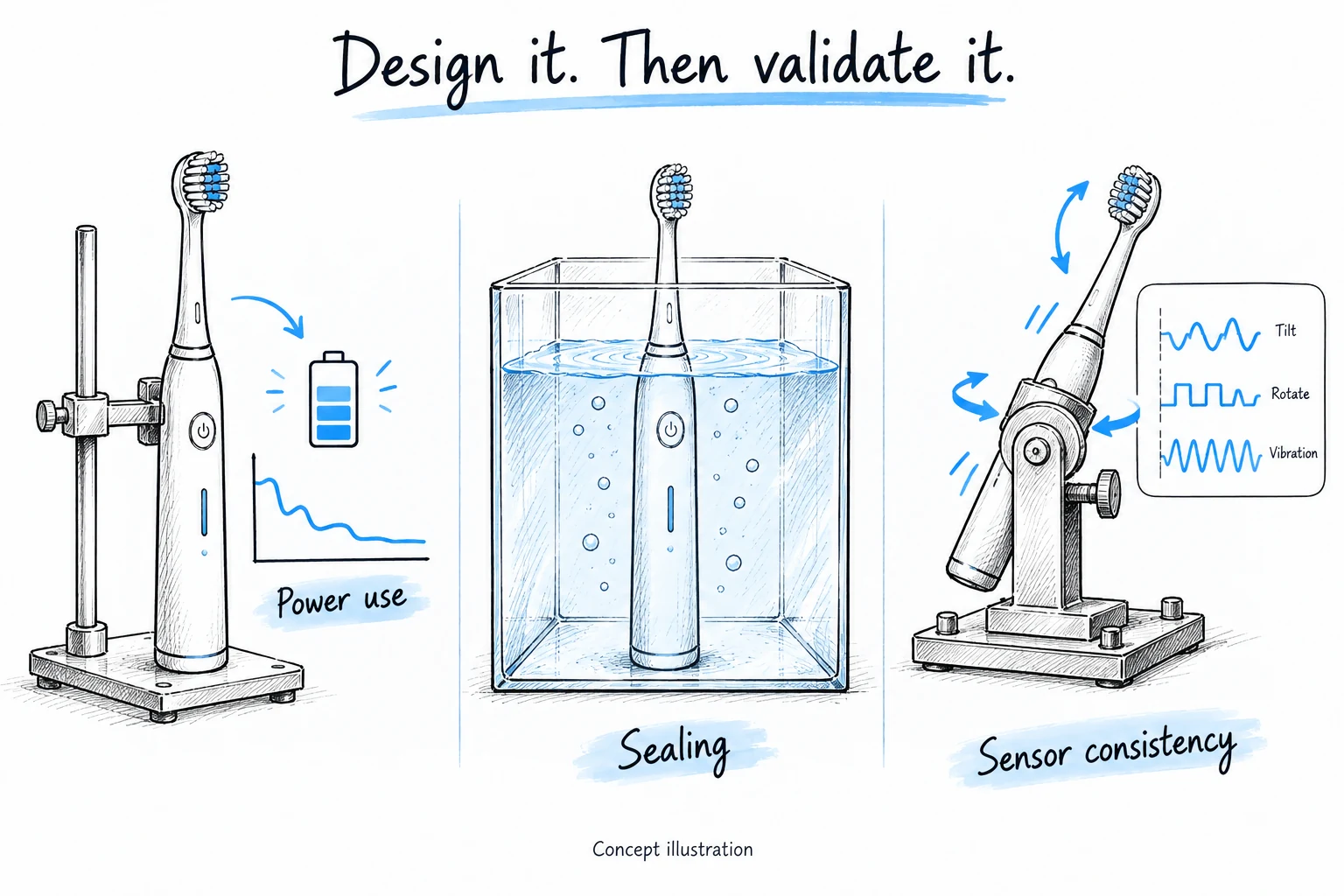
Set a runtime target for the model, battery capacity and use profile. Validate it with the chosen motor, sensors, radio settings, firmware and charging conditions.
App Data Storage & Brushing History
A brushing history can show supported measures such as session frequency, duration and recorded pressure events. Decide which information is useful, how accurately it can be measured and how it will be stored, explained and deleted.
Multi-User Family Accounts
A family-account function can support separate user profiles if the product and app implement it. Define account permissions, child privacy, data separation, and caregiver controls for the intended users.
Cloud Synchronization
Cloud synchronization is optional. Specify access controls, export, retention, deletion and any secondary use in the service terms. Pseudonymized or aggregated information may still be personal data, so assess the actual dataset and its identifiability.
Engagement Features for Kids and Adults
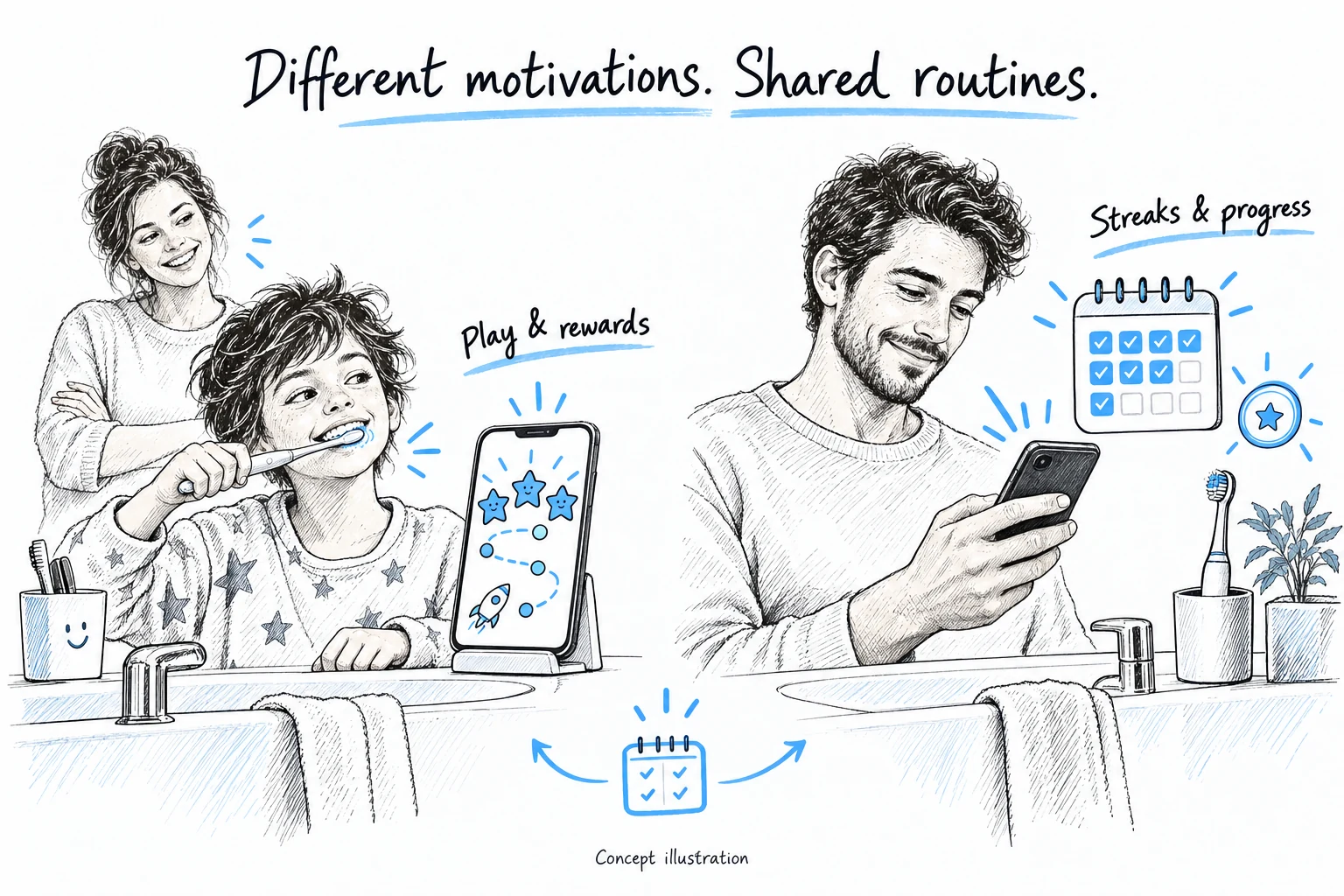
Brushing games, rewards and progress displays turn routine sessions into an engaging experience. The comparison presented in this guide shows 30–40% higher adherence for gamified approaches than for nongamified routines. Choose age-appropriate interactions that make the brushing task clear and rewarding.
Brushing Timer Games
A timer or app activity can structure a session. The American Dental Association recommends brushing twice a day for two minutes with fluoride toothpaste. Follow age-appropriate product instructions and professional advice when choosing a children’s design.
Rewards and Streaks
Reminders, rewards and streaks are optional app functions. Test whether they are useful and understandable for the intended users, and define any notifications or account settings.
Kid-Specific Models
Match children’s features to the intended age range, product design and safety requirements. Review licensed characters, sounds, caregiver controls and privacy together with the brushing instructions.
Choose engagement features through user research rather than assumptions about age. Simple progress displays, games or reminders may suit different audiences; usability and accessibility testing can guide the selection.
UV-C Options and Charging
A UV-C dock and a charging system are separate engineering choices. Define the purpose, safety requirements and validation work for each option before including it in a product brief.
UV-C Sanitizing Stations
A UV-C claim needs validation for the stated organism, exposure conditions and accessible surfaces. The design must protect users from harmful UV exposure. For material and packaging topics, see our sustainability guide .
Smart Charging Docks
Charging docks can add convenience and a distinctive product experience. Match wireless charging, battery monitoring and other functions to the selected design and package them clearly for the user.
Connected Features to Compare
The configurations below are planning examples, not Relish catalogue models or confirmed OEM packages. Choose functions based on user needs, development scope and validation cost.
| Configuration | Main function | Potential user value | Development cost drivers | What to confirm |
|---|---|---|---|---|
| Session tracking | BLE session data | Duration and brushing history | Pairing, storage and app screens | Data fields and offline behaviour |
| Pressure feedback | Force sensing and alerts | Feedback on applied force | Sensor integration and calibration | Thresholds and validation |
| Motion feedback | Accelerometer or gyroscope inputs | Estimated movement or coverage | Algorithms and user studies | Accuracy and limitations |
| Family profiles | Separate user accounts | Individual session histories | Accounts, permissions and testing | Child privacy and data separation |
| Engagement features | Reminders, games or streaks | Support for a regular routine | Content, licensing and accessibility | Age appropriateness and claims |
| Cloud services | Optional sync and backup | History across supported devices | Hosting, security and ongoing support | Retention, deletion and provider roles |
Use these feature combinations to shape your smart toothbrush OEM brief. Relish can bring product design, electronics, firmware and manufacturing together, with the app scope and commercial terms agreed for your project.
OEM Manufacturing Challenges for Smart Toothbrushes
Smart-toothbrush projects combine product engineering, electronics, software, testing, and manufacturing planning. Our electric toothbrush OEM manufacturing guide describes the production workflow. Agree the development scope, inspection criteria and schedule for the selected product and order.
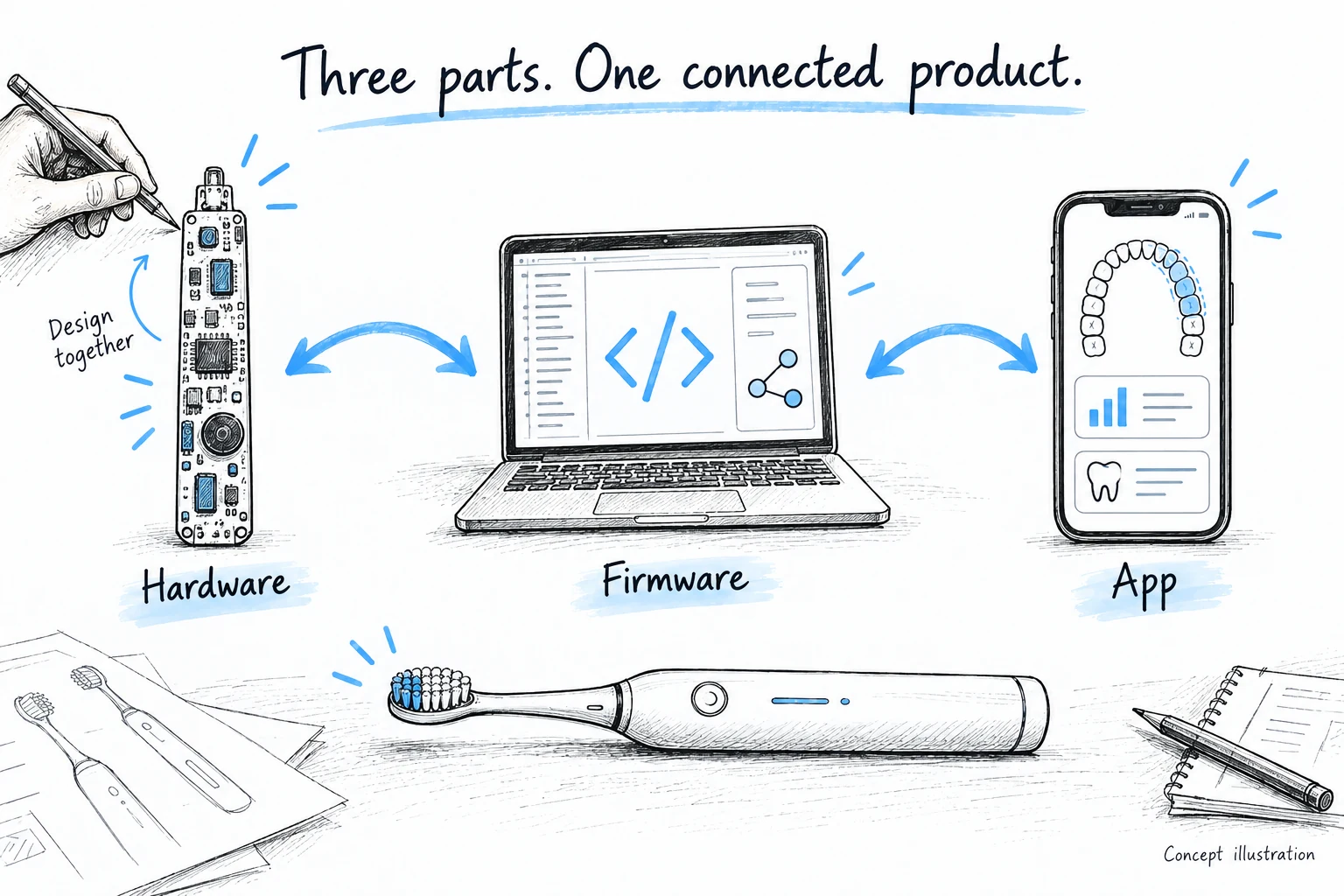
PCB Design and Firmware
A toothbrush PCB must fit the handle while meeting power, wireless and sensor-signal requirements. Review layout, battery and motor interfaces, interference and assembly constraints together rather than treating the connected module as a separate add-on.
Microcontroller Unit Selection
Select the microcontroller for the required sensors, radio functions, processing and power budget. Development tools, security features, supply availability and component lifecycle also affect the choice.
BLE Module Integration
Evaluate antenna options in the finished enclosure, including typical grip and use positions. Module documentation can support the assessment but does not automatically cover the finished product’s radio, EMC or electrical requirements. See our electric toothbrush certifications guide for product-specific compliance planning.
Firmware Development Lifecycle
Define sensor acquisition, radio communication, motor control, power management and update handling in the firmware scope. Agree validation, security controls, ownership and the period of ongoing support.
App Development
App budgets scale with features, integrations and supported platforms. The planning ranges below run from $30,000 for a basic app to $150,000 or more for advanced software, with annual maintenance around 15–20% of development cost.
Native and cross-platform approaches have different development and maintenance tradeoffs. Evaluate the required Bluetooth functions, platform integrations, accessibility and testing on both operating systems. Agree ownership of the source code, licences and app-store accounts.
Data privacy and security should be assessed against the actual data flows, intended users, markets and service providers. Include account permissions, child privacy where relevant, retention, deletion and incident responsibilities in the design.
- GDPR (where applicable) — Determine whether personal data is processed within the regulation’s scope, identify an appropriate legal basis, and apply relevant special-category rules if health data is involved.
- CCPA (where applicable) — Check whether the business or service provider is subject to the law, and implement the applicable notices and consumer rights.
- HIPAA (where applicable) — HIPAA obligations apply to covered entities and business associates in specified circumstances. Assess the parties and data flows before determining whether the rule applies.
- App-store policies — Review current Apple and Google developer policies, privacy disclosures, permissions, and data-safety requirements for the app and its distribution regions.
For brands building connected products, an experienced app partner helps bring hardware and software together. Relish coordinates engineering and app-development work so the product, user experience and launch plan move in the same direction.
Battery Life Optimization
A 14+ day runtime is a useful target for a connected toothbrush. Low-power electronics, efficient sensing and well-designed firmware help balance brushing performance, connectivity and battery capacity.
Runtime Test Profile
- Runtime: define brushing frequency, session duration, modes, connected functions and charging conditions.
- Standby current: record the operating state, measurement method and test conditions.
- BLE advertising: specify the broadcast interval, transmit power and reconnection requirements.
- Sensor response: define wake-up latency and how it will be measured.
Optimization Strategies
Possible measures include low-power components, suitable converters, sensor power control and sleep modes. Evaluate each against response time and required functions, then balance battery capacity with handle size, weight and cost.
Water Resistance and Electronics
Define exposure to water, toothpaste, cleaning and bathroom conditions in the product requirements. The enclosure, controls, charging interfaces and assembly process all affect water resistance.
Understanding IPX7
IPX7 concerns temporary immersion under specified test conditions. It does not establish protection against every water exposure, permanent waterproofing or the condition of every production unit. State the exact configuration, test method and limitations.
Sealing Technologies
- Ultrasonic Welding — Can join compatible plastic housing parts; joint geometry, material and process settings need validation.
- Potting Compound — Encapsulation may protect selected electronics but affects heat transfer, inspection and repair. Evaluate material compatibility and the assembly sequence.
- Gasket Seals — Control gasket compression, alignment and assembly. Assess wear and ageing for the expected use conditions.
- Protective Coatings — A suitable conformal coating may provide secondary protection for selected electronics. Check material and process compatibility; it does not replace enclosure validation.
Testing Requirements
Agree the test methods and sampling plan for the model. Production leak checks and design type tests serve different purposes; specify reports and qualified laboratory involvement where required.
Sensor Calibration and Consistency
Sensor offsets, tolerances and assembly variation can affect measurement. Evaluate the system’s sensitivity to these differences and determine whether calibration is needed to meet the product’s accuracy requirements.
Calibration Planning
Define the sensor axes, operating range, calibration method and acceptance limits. A controlled calibration process helps deliver consistent brushing feedback across production units.
Batch Variation Management
Assess component and sensor-lot changes against the approved design and acceptance criteria. Revalidate or adjust calibration when the change assessment identifies a need.
How Relish Tech Delivers Smart Toothbrush OEM
Relish combines a 20,000 m² manufacturing base, 350+ employees, 12 automated production lines and ISO 13485:2016-certified quality management. With 200+ smart toothbrush PCB designs delivered since 2020, our engineering experience helps brands build connected products at different stages of development.
In-House Engineering Capabilities
Our team of 30+ structural, hardware and software engineers brings the key disciplines together:
- PCB Design — BLE and mixed-signal engineering, reference architectures and custom board design support brand-specific functions.
- Firmware Development — Sensor acquisition, brushing analysis, BLE communication, motor control and power management work together, with over-the-air updates supporting improvements after launch.
- Water-Resistance Testing — Environmental testing, leak checks and immersion testing support design validation, with accredited external laboratory testing for the applicable assessment work.
Coordinated App Development
A connected product needs hardware and software that work together. Relish coordinates specialist app-development partnerships alongside our research and development team to bring the electronics, brushing functions and user experience into one project.
This coordinated approach gives brands room to differentiate through software while drawing on Relish’s manufacturing and hardware expertise. Plan feature delivery, integration and ongoing support together from the start.
Prototype-to-Production Timeline
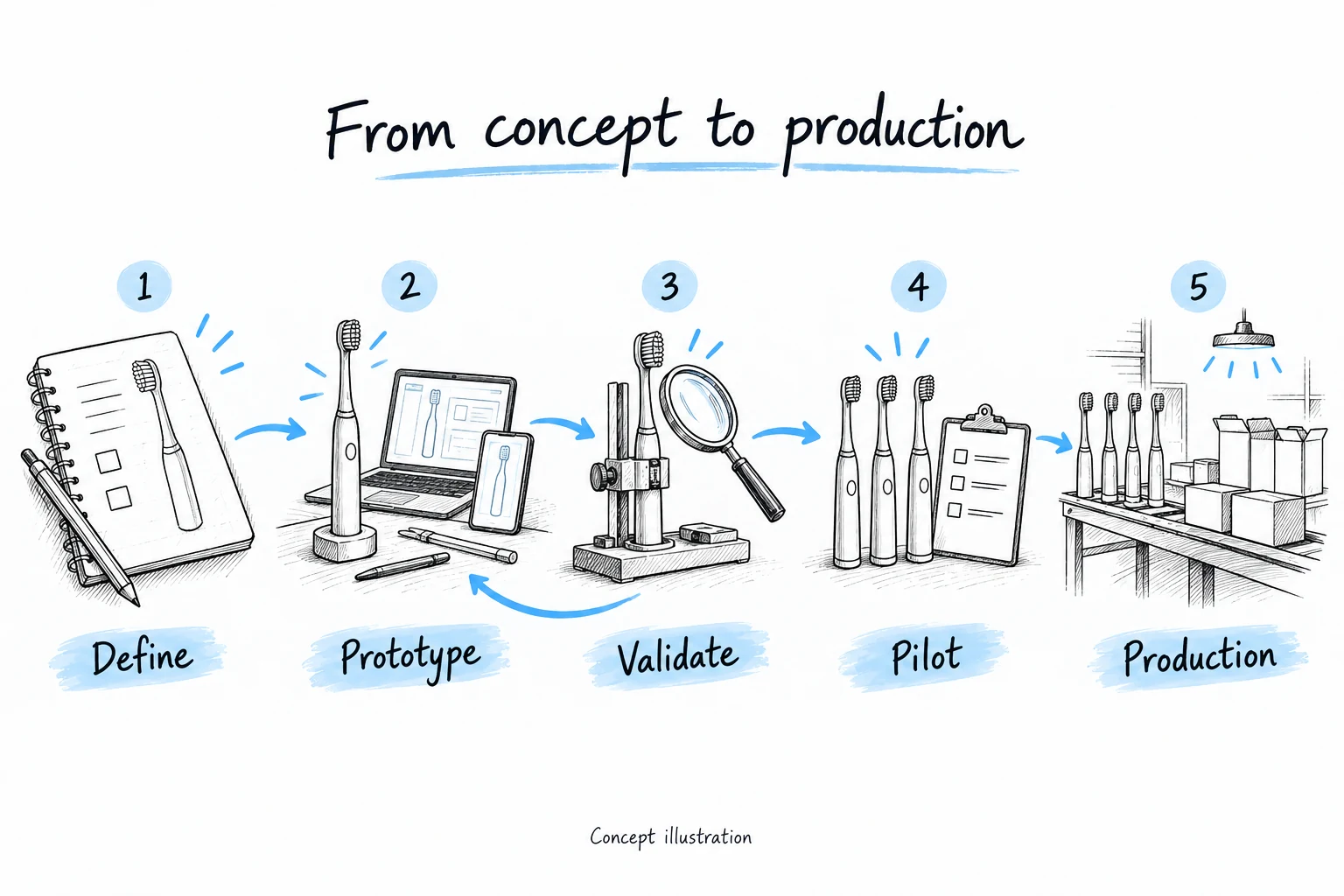
A typical smart toothbrush project takes 6–9 months from concept to production readiness with Relish’s platform approach:
- Months 1–2 — Validate the concept, finalize specifications and select components.
- Months 3–4 — Develop prototypes and the first firmware functions.
- Months 5–6 — Verify the design, refine firmware and develop the app.
- Months 7–8 — Adjust production tooling and complete the pilot run.
- Month 9 — Qualify production and prepare for launch.
A Modular Route to Your Product Range
Relish’s platform approach combines established hardware with modular smart functions. These feature levels help brands shape a distinctive range:
- Essential Smart — BLE connectivity, session tracking, pressure feedback and the core app experience.
- Connected Coach — Additional sensing, brushing analysis, games and a richer app experience.
- Premium Smart — Advanced coaching, charging accessories and UV-C options, matched to the selected design.
A modular approach helps brands get to market faster while keeping room for product and software differentiation. Start with the functions your customers value, then build the range around them.
Market Outlook: When Will Smart Become Standard?
Connected features are moving into a broader range of electric toothbrushes. The opportunity for brands is to choose the right level of sensing, software and support for their customers and price position.
Adoption Outlook
The following stages summarize the market outlook used in this guide:
- 2024–2026 (Current) — Smart functions expand across price tiers, while advanced AI features remain strongest in flagship products.
- 2027–2028 — Connectivity becomes more common in mid-range products priced around $50–$100.
- 2029–2030 — Basic connectivity broadens further, while advanced coaching helps premium models stand out.
Component Cost Trends
Declining component costs help make connected functions more accessible:
- BLE Module Cost — Declined from $8–12 (2019) to $2–4 (2024), approaching $1 for high-volume applications by 2026
- Accelerometer/Gyroscope — Combined MEMS sensors now available under $1 in volume, down from $5+ five years ago
- Pressure Sensors — Force-sensitive resistors under $0.50, enabling basic pressure sensing in value products
The hardware cost added by basic smart features has moved from approximately $25–$40 in 2019 to $15–$25 in 2024, with a projected range of $10–$15 by 2027. Include app development and service costs alongside hardware when planning the product margin.
Our 2030 Market Outlook
By 2030, we expect 40%+ of mid-range electric toothbrushes priced around $35–$55 to include Bluetooth connectivity. Basic connection and pressure feedback will become more common, while advanced coaching provides room for premium differentiation.
For OEM brands, the opportunity is to build a connected product roadmap that balances useful features, pricing and the ability to support users after launch.
OEM Sourcing Essentials — Smart Toothbrush
- MOQ: Custom-project MOQ starts at 1,000 units and can be adjusted to the actual order. Wholesale MOQ for in-stock products is 50 units. Confirm model, customization and packaging terms in the quotation.
- Lead Time: Standard-platform production typically takes 8–10 weeks, with 4–6 additional weeks for custom features and a two-week pre-shipment quality stage.
- Manufacturing: A 20,000 m² facility, 350+ employees, 12 automated lines and ISO 13485:2016-certified quality management support scalable production.
- QC: Product-specific inspection plans, sampling and clear acceptance criteria support consistent quality, including controls for critical defects.
- Certifications and Compliance: Relish’s FDA, CE, FCC, RoHS, CB and ISO 13485 credentials support market preparation. Match the product’s technical documentation and assessment route to its intended use and destination.
Key Takeaways
- Market growth: The market is growing at 12–15% annually, with a projected value above $2.5 billion by 2030.
- AI and engagement: Personalized feedback and gamified brushing can support engagement; the comparison in this guide shows a 30–40% improvement in adherence.
- Component Economics: Lower BLE and sensor costs make connected features more accessible across price tiers.
- Cost Structure: Plan hardware, app development and ongoing service together; app budgets range from $30,000 to $150,000 or more.
- Engineering Feasibility: Validate the enclosure and assembly using appropriate water-resistance test methods and a production control plan.
- Market direction: Our 2030 outlook expects Bluetooth in 40%+ of mid-range electric toothbrushes, creating an opportunity for brands to build connected ranges.
Frequently Asked Questions
What is the difference between a connected toothbrush and a smart toothbrush?
The terms overlap. “Connected” usually describes communication with an app or service, while “smart” may describe sensors or software feedback. Specify the functions rather than assuming that the label means the product uses AI.
How much does it cost to develop a smart toothbrush app?
Planning budgets range from $30,000–$50,000 for a basic app, $50,000–$100,000 for richer feedback and games, and $100,000–$150,000 or more for advanced software and integrations. Annual maintenance is around 15–20% of the development budget. A defined feature scope gives you a useful basis for a quotation.
What data privacy regulations apply to smart toothbrush apps?
The applicable rules depend on the operator, users, markets and actual data flows. Assess GDPR scope and health-data conditions, CCPA coverage, child privacy and platform policies. Product claims may also require an assessment of medical-device classification. HIPAA applies to covered entities and business associates in specified circumstances; sharing data with a health professional does not automatically make every consumer app subject to HIPAA. Define data-access, retention, deletion and security responsibilities.
How does Relish optimize battery life in smart toothbrushes?
Relish combines low-power BLE electronics, efficient sensor configurations and firmware power management to achieve 14+ day battery life. Sleep modes and carefully controlled sensing reduce idle consumption, while runtime modeling and usage testing support the finished design.
What is the typical OEM minimum order quantity for smart electric toothbrushes?
Custom-project MOQ starts at 1,000 units and can be adjusted to the actual order. Wholesale MOQ for in-stock products is 50 units. Our team can help match product options, customization and packaging to your launch plan.
When will smart toothbrush features become standard?
Our outlook expects connected functions to become more common through 2027–2028, with Bluetooth included in 40%+ of mid-range models by 2030. Brands can prepare by choosing a platform that supports the right sensing, app and pricing strategy for their customers.
References
- Bluetooth SIG. (n.d.). The Bluetooth Low Energy Primer. https://www.bluetooth.com/bluetooth-le-primer/
- European Commission. (n.d.). Legal Grounds for Processing Data. https://commission.europa.eu/law/law-topic/data-protection/information-business-and-organisations/legal-grounds-processing-data_en
- California Privacy Protection Agency. (n.d.). Frequently Asked Questions. https://www.cppa.ca.gov/faq.html
- U.S. Department of Health and Human Services. (n.d.). Covered Entities and Business Associates. https://www.hhs.gov/hipaa/for-professionals/covered-entities/index.html
- U.S. Food and Drug Administration. (n.d.). How to Determine if Your Product Is a Medical Device. https://www.fda.gov/medical-devices/classify-your-medical-device/how-determine-if-your-product-medical-device
- American Dental Association. (n.d.). Toothbrushes. https://www.ada.org/resources/ada-library/oral-health-topics/toothbrushes
- International Electrotechnical Commission. (n.d.). IEC 60529: Degrees of protection provided by enclosures (IP Code). IEC standard overview
- U.S. Food and Drug Administration. (n.d.). Beware of Ultraviolet Wands That Give Off Unsafe Levels of UV Radiation. FDA consumer guidance.