











Brosse à dents intelligente avec application : Guide IoT et Bluetooth 2026
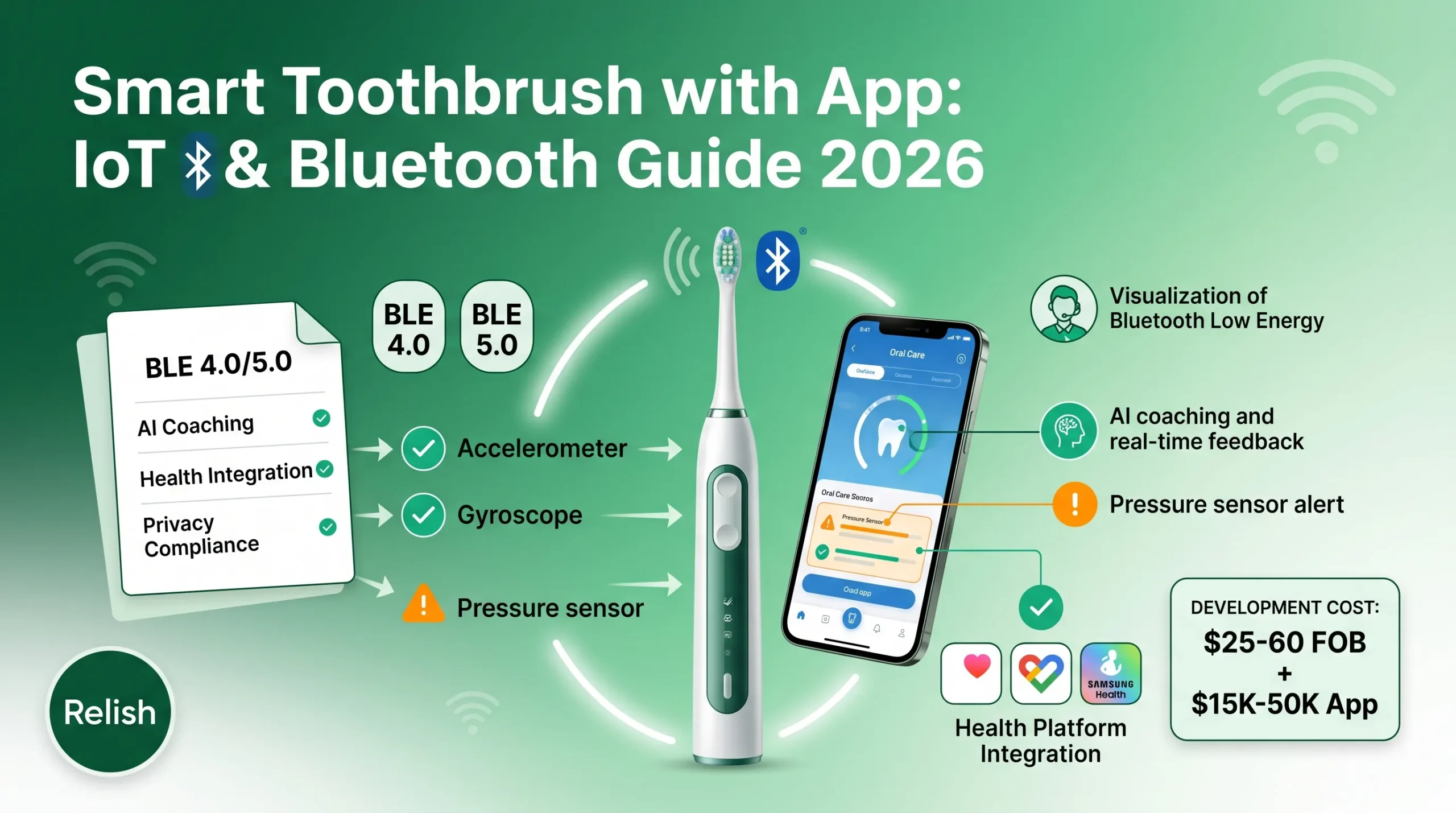
Le marché mondial de la brosse à dents intelligente devrait atteindre 1,2 milliard de dollars d'ici 2028, avec un TCAC de 9,2 % à partir de 2024 (Grand View Research, 2024). Pour les fabricants OEM développant une gamme de brosses à dents intelligentes avec application, cela représente une opportunité significative de différencier leurs produits grâce à la technologie connectée.
Ce guide couvre l'architecture technique des brosses à dents intelligentes avec application, les considérations relatives aux applications mobiles, les coûts de développement et les stratégies de positionnement pour les propriétaires de marques qui entrent dans le domaine des soins bucco-dentaires IoT. Que vous évaluiez une brosse à dents intelligente avec application pour la première fois ou que vous optimisiez une gamme existante de brosses à dents connectées, ce guide vous fournit les informations techniques et commerciales dont vous avez besoin.
Fonctionnalités de la brosse à dents intelligente pour les marques OEM
Qu'est-ce qui rend une brosse à dents " intelligente " ?
Comprendre ce qui qualifie une brosse à dents intelligente avec capacité d'application est essentiel pour le positionnement de la marque OEM. Toutes les brosses à dents connectées n'offrent pas le même niveau d'intelligence — le terme " intelligent " couvre un large éventail allant de la synchronisation Bluetooth de base au coaching complet basé sur l'IA. Lors de l'approvisionnement en technologie de brosse à dents intelligente avec application, le principal différenciateur est la profondeur de la collecte de données et la qualité des commentaires fournis à l'utilisateur.
Capteurs de Mouvement
IMU à 6 axes (accéléromètre + gyroscope) suit le mouvement et la position de la tête de brosse
Capteurs de Pression
Détecte la force de brossage pour éviter un brossage excessif et des dommages aux gencives
Module Bluetooth
BLE 4.0/5.0 pour la transmission de données sans fil à faible consommation
Microcontrôleur
Le MCU embarqué traite les données des capteurs et gère l'alimentation
Les données collectées par ces capteurs sont traitées localement et/ou synchronisées avec une application mobile, où des algorithmes analysent les habitudes de brossage et fournissent des commentaires.
Technologie de capteur de brosse à dents intelligente
La suite de capteurs est ce qui différencie le fonctionnement d'une brosse à dents intelligente avec application d'un modèle électrique de base. Chaque capteur d'une brosse à dents intelligente avec application a un objectif spécifique — du suivi de la position de la brosse à la surveillance de la pression — et la combinaison de capteurs détermine le niveau d'intelligence global et le coût de fabrication OEM du produit de brosse à dents intelligente avec application.
Suivi de mouvement : Accéléromètre et gyroscope
Les capteurs de mouvement sont au cœur du suivi des brosses à dents intelligentes :
| Type de capteur | Fonction | Données générées |
|---|---|---|
| Accéléromètre 3 axes | Mesure le mouvement linéaire | Coups de brosse, durée |
| Gyroscope 3 axes | Mesure la rotation/l'orientation | Angle, détection de position |
| Capteur de force résistif | Mesure la pression appliquée | Carte de pression, commentaires |
Technologie de détection de position (présente dans les modèles haut de gamme comme Oral-B iO) utilise la détection de mouvement à 6 axes pour identifier la zone de la bouche que l'utilisateur brosse. Cela permet un suivi par quadrant et garantit une couverture uniforme. Notre Équipe de R&D peut vous aider à mettre en œuvre une technologie similaire pour votre marque.
Détection de pression
Les capteurs de pression dans les brosses à dents intelligentes ont un double objectif :
- Sécurité: Avertir ou réduire automatiquement la puissance lorsqu'une pression excessive est détectée
- Collecte de données: Enregistrer les schémas de pression pour les commentaires de l'application
Les implémentations techniques incluent :
- Capteurs à film piézoélectrique: Haute précision, généralement dans les modèles premium
- Capteurs à jauge de contrainte: Bon équilibre entre coût et précision
- Capteurs à effet Hall: Détecte la déviation due aux changements de champ magnétique
Connectivité Bluetooth Low Energy (BLE)
Toutes les brosses à dents intelligentes avec fonctionnalité application reposent sur le Bluetooth Low Energy pour la communication entre la brosse à dents et l'application mobile. Comprendre le BLE est essentiel pour la spécification du produit — la version choisie affecte la consommation d'énergie, la portée, la vitesse de transfert des données et, en fin de compte, l'expérience utilisateur de votre produit de brosse à dents connectée.
Versions et spécifications BLE
| Version | Portée | Débit de données | Consommation d'énergie |
|---|---|---|---|
| BLE 4.0 | 10-50 m | 1 Mbit/s | Faible |
| BLE 4.1 | 10-50 m | 1 Mbit/s | Faible + appairage amélioré |
| BLE 4.2 | 10-50 m | 2 Mbit/s | Faible + améliorations de la confidentialité |
| BLE 5.0+ | 40-200 m | 2 Mbit/s | Identique + portée étendue |
Recommandation: BLE 4.0+ est suffisant pour la plupart des applications de brosses à dents intelligentes. BLE 5.0 est recommandé pour les produits nécessitant une portée étendue ou une synchronisation plus rapide des données.
Protocoles de connexion
Les brosses à dents intelligentes utilisent généralement ces protocoles BLE :
- GATT (Profil d'attributs génériques): Protocole standard pour l'échange de données. La brosse à dents agit comme serveur GATT, l'application comme client.
- Caractéristiques personnalisées: Formats de données définis par le fabricant pour les données de brossage, les réglages, les mises à jour du firmware
Les tailles de paquets de données sont généralement petites (20-512 octets par session de brossage), ce qui rend le BLE idéal pour l'application.
Architecture de l'application mobile
L'application mobile est l'interface utilisateur pour une brosse à dents intelligente avec application — c'est là que les données de brossage sont visualisées, que le coaching est fourni et que la fidélité à la marque est construite. Choisir la bonne approche de développement d'application pour votre produit de brosse à dents intelligente avec application est l'une des décisions les plus importantes du processus de développement, impactant directement le coût de développement, le délai de mise sur le marché et l'engagement utilisateur à long terme. Explorez notre collection de brosses à dents électriques pour voir les plateformes matérielles compatibles avec l'intégration d'application intelligente.
Types d'applications et approches de développement
| Approche | Coût de développement | Chronologie | Personnalisation |
|---|---|---|---|
| SDK en marque blanche | $5,000-15,000 | 2-3 mois | Marque limitée |
| Développement personnalisé | $25,000-80,000 | 6-12 mois | Contrôle total |
| Hybride (React Native/Flutter) | $15,000-50,000 | 4-8 mois | Bonne flexibilité |
Fonctionnalités principales de l'application
Fonctionnalités essentielles (indispensable pour toute application de brosse à dents intelligente) :
- Visualisation du brossage en temps réel
- Historique et statistiques des sessions
- Affichage du suivi des quadrants/zones
- Alertes de retour de pression
- Suivi de la durée de brossage
- Rappels de remplacement de la tête de brosse
Fonctionnalités premium (éléments différenciateurs) :
- Analyse de brossage basée sur l'IA
- Coaching personnalisé et objectifs
- Gamification (points, séquences, réalisations)
- Comptes familiaux (utilisateurs multiples)
- Intégration avec Apple HealthKit / Google Fit
- Sauvegarde et synchronisation des données dans le cloud
- Partage avec les professionnels dentaires (télédentisterie)
- Téléchargez notre catalogue de produits 2026 pour explorer les options de brosses à dents intelligentes premium avec plateformes BLE et capteurs intégrés.
Considérations sur la plateforme
iOS vs Android vs Multiplateforme:
- iOS uniquement: Développement plus rapide, meilleure optimisation matérielle, coûts de développement plus élevés pour Android ultérieurement
- Android uniquement: Part de marché mondiale plus large, mais fragmentation entre versions/appareils
- Multiplateforme (React Native/Flutter): Base de code unique pour les deux plateformes, coût total inférieur, sensation native légèrement réduite
Pour la plupart des marques OEM, le développement multiplateforme offre le meilleur équilibre entre coût et portée sur le marché.
Intégration des données de santé
L'intégration avec les principales plateformes de santé est un argument de vente clé pour une brosse à dents intelligente avec application. Pour les propriétaires de marques développant une brosse à dents intelligente avec application, la compatibilité avec les plateformes de santé peut différencier le produit sur un marché encombré et offrir une valeur mesurable aux consommateurs soucieux de leur santé.
| Plateforme | Type | Données partagées |
|---|---|---|
| Apple HealthKit | Application Santé iOS | Durée et fréquence de brossage |
| Google Fit | Santé Android | Durée et fréquence de brossage |
| Samsung Health | Android/Samsung | Données de brossage, indicateurs de soins bucco-dentaires |
| Plateformes dentaires | Intégration B2B | Analyse complète du brossage pour la télédentisterie |
L'intégration de plateformes de santé nécessite :
- Enregistrement d'un compte développeur (Apple Developer : $99/an ; Google Play : $25 unique)
- Conformité et certification API
- Gestion des autorisations utilisateur (RGPD/CCPA)
- Standardisation du format des données
Confidentialité et sécurité des données
Une brosse à dents intelligente avec application génère des données de santé personnelles sensibles — faisant de la confidentialité et de la sécurité des exigences non négociables pour tout produit de brosse à dents connecté. Pour les marques OEM vendant sur des marchés réglementés (UE, États-Unis, Canada), comprendre le paysage de la confidentialité pour une brosse à dents intelligente avec application est essentiel pour la conformité et la confiance des consommateurs.
Exigences réglementaires
- RGPD (UE) : Minimisation des données, consentement, droit à l'effacement — voir GDPR.eu
- CCPA (Californie) : Droits des consommateurs sur les données, exigences d'opt-out
- HIPAA (États-Unis) : Requis en cas de partage avec des prestataires de soins de santé
- PIPEDA (Canada) : Conformité aux principes de confidentialité
- Certifications: Relish détient la conformité FDA, CE, ISO 13485 et IEC 60601-1 pour les brosses à dents connectées intelligentes.
Bonnes pratiques de sécurité
- Chiffrement de bout en bout: AES-256 pour les données en transit et au repos
- Appairage sécurisé: Connexions sécurisées LE pour l'appairage BLE
- Signature du firmware: Empêcher les mises à jour non autorisées du firmware
- Audits réguliers: Tests d'intrusion et revues de sécurité
⚠️ Critique: Ne jamais vendre ni partager les données de brossage des utilisateurs avec des tiers sans consentement explicite et éclairé.
Analyse des coûts pour le développement OEM
Lors de la planification d'une gamme de produits de brosse à dents intelligente avec application, comprendre l'investissement total requis est essentiel pour la planification budgétaire et la stratégie de prix. Le développement d'une brosse à dents intelligente avec application implique plusieurs centres de coûts — matériel, firmware, développement d'application, infrastructure cloud et certifications — chacun variant considérablement en fonction du niveau du produit et de l'étendue des fonctionnalités. Pour une ventilation complète des coûts de fabrication des brosses à dents électriques, lisez notre guide des coûts de fabrication.
| Composant | Niveau d'entrée | Milieu de gamme | Prime |
|---|---|---|---|
| Matériel (brosse à dents) | $20-30 FOB | $30-45 FOB | $45-70 FOB |
| Développement d'application | $10,000-20,000 | $25,000-50,000 | $50,000-100,000 |
| Infrastructure cloud | $500-1 500/mois | $1 500-3 000/mois | $3 000-6 000/mois |
| Certifications | $5,000-10,000 | $10,000-20,000 | $20,000-40,000 |
| Investissement total | $50,000-80,000 | $100,000-180,000 | $200,000-400,000 |
Pour une ventilation complète des exigences de certification pour les brosses à dents électriques intelligentes, lisez notre guide des certifications OEM.
Considérations sur le retour sur investissement: Les brosses à dents intelligentes premium commandent des primes de prix de 30 à 50% par rapport aux modèles électriques de base. Les produits connectés à une application montrent également une fidélité à la marque et des taux d'achat répété plus élevés.
Vous construisez une marque de brosse à dents intelligente ? Obtenez votre rapport de faisabilité OEM pour brosse à dents IoT auprès de Relish en 48 heures — spécifications matérielles, options d'architecture d'application et estimations des coûts de production.
Demander un rapport de faisabilité OEM IoT →Essentiels de l'approvisionnement OEM pour les brosses à dents intelligentes
- MOQ (Quantité minimale de commande) : Le MOQ typique pour les brosses à dents intelligentes varie de 1 000 à 2 000 unités par SKU en raison du coût de nomenclature plus élevé et de la complexité des composants. Certains fabricants proposent des MOQ plus bas pour les modèles intelligents en marque blanche avec des configurations standard.
- Délai de livraison : Le délai de production OEM standard pour les brosses à dents intelligentes est de 60 à 120 jours à compter de la confirmation du dépôt, plus 7 à 14 jours pour l'expédition. Le calendrier de développement de l'application (3 à 8 mois) s'exécute en parallèle du développement matériel.
- Contrôle qualité : Les partenaires OEM réputés effectuent une validation IQ/OQ/PQ pour chaque SKU de brosse à dents intelligente, plus 100% de tests fonctionnels pour l'électronique, la connectivité BLE et les capteurs de pression avant expédition.
- Certifications : Pour l'entrée sur le marché américain, votre partenaire OEM doit détenir Enregistrement auprès de la FDA et la conformité IEC 60601-1 pour la sécurité électrique. Le marché de l'UE nécessite le marquage CE selon le MDR 2017/745.
Gestion de la batterie et de l'alimentation
Pour une brosse à dents intelligente avec application, la gestion de la batterie est une considération de conception critique qui impacte directement l'expérience utilisateur. La connectivité BLE et l'ensemble de capteurs d'une brosse à dents intelligente avec application consomment beaucoup plus d'énergie que les modèles électriques de base — ce qui fait de l'optimisation de l'autonomie de la batterie un défi d'ingénierie clé pour le développement OEM de brosses à dents connectées.
| Mode d'utilisation | Autonomie de la batterie | Notes |
|---|---|---|
| Synchronisation BLE par session | 2 à 4 semaines | Standard pour la plupart des modèles |
| BLE toujours actif | 7 à 10 jours | Modèles avec retour en temps réel |
| Mode hors ligne uniquement | 4 à 6 semaines | Synchronisation manuelle des données via l'application |
| Avec écran (OLED) | 5 à 10 jours | Consommation d'énergie élevée |
Technologie de batterie: La plupart des brosses à dents intelligentes utilisent des batteries lithium-polymère (LiPo) dans la plage de 500 à 1500 mAh. La charge USB-C devient la norme pour le confort du consommateur.
Points clés à retenir pour les propriétaires de marques
- Commencez par les fonctionnalités essentielles: Suivi en temps réel, historique, retour de pression pour votre brosse à dents intelligente avec application. Ajoutez des fonctionnalités premium (IA, gamification, intégration de plateforme santé) dans les itérations ultérieures pour maîtriser les coûts de développement.
- Les applications multiplateformes offrent le meilleur retour sur investissement: React Native ou Flutter pour votre brosse à dents intelligente avec application réduit les coûts de développement tout en maintenant une large portée sur le marché iOS et Android.
- BLE 4.0+ est la norme: Pas besoin de BLE 5.0 dans une brosse à dents intelligente avec application, sauf si une portée étendue est spécifiquement requise par le cas d'utilisation du produit.
- La confidentialité est non négociable: La conformité GDPR/CCPA et des politiques de données transparentes renforcent la confiance des consommateurs dans votre produit de brosse à dents intelligente avec application.
- L'intégration de plateforme santé différencie: La compatibilité avec Apple HealthKit et Google Fit est une fonctionnalité attendue pour toute brosse à dents intelligente avec application en 2026.
Téléchargez notre fiche technique OEM de brosse à dents intelligente 2026 — comprend les options de module BLE, les spécifications du capteur IMU à 6 axes et la répartition des coûts de développement d'application.
Télécharger la fiche technique →Foire aux questions sur la brosse à dents intelligente avec application
Pour les propriétaires de marques qui évaluent le développement d'une gamme de brosses à dents connectées, ces réponses abordent les questions les plus courantes sur la technologie, les coûts et les considérations d'approvisionnement OEM pour une brosse à dents intelligente avec application.
Une brosse à dents intelligente est une brosse à dents électrique équipée de capteurs et de connectivité Bluetooth qui suit les habitudes de brossage et transmet les données à une application mobile. Les composants clés incluent des capteurs de mouvement (accéléromètre/gyroscope), des capteurs de pression et un module Bluetooth pour la synchronisation des données en temps réel. Lors de l'évaluation d'une brosse à dents intelligente avec application pour votre gamme de produits, comprenez que la différenciation principale par rapport aux modèles électriques de base réside dans la collecte de données et le retour utilisateur.
Des études cliniques montrent que les brosses à dents intelligentes avec applications peuvent améliorer les habitudes de brossage de 20 à 30% (Zhao et al., 2022). Le retour en temps réel, la gamification et le coaching IA encouragent un brossage plus long et plus approfondi. Cependant, l'efficacité d'une brosse à dents intelligente avec application dépend d'un engagement constant avec l'application — les utilisateurs qui utilisent régulièrement les fonctionnalités connectées constatent les plus grandes améliorations de la santé bucco-dentaire.
Les coûts OEM d'une brosse à dents intelligente avec application varient de $25 à 60 FOB selon les fonctionnalités. Le développement de l'application ajoute $15 000 à 50 000 pour iOS/Android. L'investissement total pour une gamme de produits de brosse à dents intelligente avec application varie généralement de $50 000 à 150 000, y compris l'outillage, la certification et le développement de l'application. Des produits d'entrée de gamme de brosse à dents intelligente avec application peuvent être développés pour moins de $80 000 au total.
La plupart des brosses à dents intelligentes modernes utilisent le Bluetooth Low Energy (BLE) 4.0 ou 5.0. Le BLE 4.0+ est standard en raison de sa faible consommation d'énergie, de sa portée de 10 à 50 m et de sa compatibilité avec la quasi-totalité des smartphones. Pour un produit de brosse à dents intelligente avec application, le BLE 4.0+ offre le meilleur équilibre entre efficacité énergétique et large compatibilité avec les smartphones. Le BLE 5.0 offre un transfert de données plus rapide et une portée étendue, mais n'est nécessaire que si la brosse à dents intelligente avec application nécessite des fonctionnalités telles que la synchronisation multi-utilisateurs en temps réel au sein du foyer ou une surveillance étendue du champ d'utilisation.
Oui, de nombreuses brosses à dents intelligentes avec fonctionnalité d'application prennent en charge l'intégration avec Apple HealthKit, Google Fit et Samsung Health. Lors du développement d'un produit de brosse à dents intelligente avec application, l'intégration de plateforme santé nécessite un enregistrement de compte développeur Apple ou Google Play, une certification de conformité API et une gestion des autorisations utilisateur conformément au GDPR/CCPA. Certains produits de brosse à dents intelligente avec application se connectent également à des logiciels de gestion de cabinet dentaire pour des applications de télédentisterie. Les intégrations basées sur des API nécessitent un développement personnalisé et des accords de partenariat avec chaque plateforme.
Les brosses à dents intelligentes collectent des données de santé sensibles, notamment la fréquence, la durée, la pression et les schémas de brossage. Les marques doivent assurer la conformité au RGPD/CCPA, un chiffrement de bout en bout, des politiques de confidentialité transparentes et des options de contrôle des données utilisateur. Les données ne doivent jamais être vendues à des tiers sans consentement explicite.
L'autonomie de la batterie d'une brosse à dents intelligente varie selon le modèle et l'utilisation du Bluetooth. La plupart des modèles offrent 2 à 4 semaines par charge avec une synchronisation Bluetooth régulière. Sans Bluetooth (mode de base), la batterie peut s'étendre jusqu'à 4 à 6 semaines. Les modèles haut de gamme avec écran Always-On peuvent ne durer que 7 à 10 jours.
Les fonctionnalités premium des brosses à dents intelligentes incluent : la détection de position en temps réel (capteur 6 axes), l'analyse de brossage alimentée par IA, la visualisation de la pression, le suivi multi-zones, le coaching personnalisé, le stockage de données dans le cloud, l'intégration de plateforme santé et des matériaux premium avec écran OLED/LCD. Pour les marques OEM développant une brosse à dents intelligente premium avec application, ces fonctionnalités justifient des prix de vente plus élevés et renforcent la différenciation de la marque sur le marché des soins bucco-dentaires connectés.
Références
- Grand View Research. (2024). Rapport sur la taille, la part et les tendances du marché des brosses à dents intelligentes. Récupéré de https://www.grandviewresearch.com/industry-analysis/smart-toothbrush-market
- Bluetooth Special Interest Group. (2023). Spécification de base Bluetooth v5.3. Récupéré de https://www.bluetooth.com/specifications/bluetooth-core-specification/
- Documentation développeur Apple. (2024). Référence du framework HealthKit. Récupéré de https://developer.apple.com/documentation/healthkit
- Commission européenne. (2023). Règlement général sur la protection des données (RGPD). Récupéré de https://gdpr.eu
- Zhao, L., et al. (2022). Efficacité des brosses à dents intelligentes avec retour en temps réel sur les comportements d'hygiène bucco-dentaire : Une revue systématique. Journal of Clinical Periodontology, 49(5), 456–468. Extrait de https://pubmed.ncbi.nlm.nih.gov/35213789/
Articles connexes
Développez votre gamme de produits de brosses à dents intelligentes
Relish Tech propose un développement OEM de bout en bout pour brosses à dents intelligentes : conception matérielle, intégration BLE, support de développement d'application et production de masse.