










How to Design Electric Toothbrush:
From Concept to Mass Production
Designing an electric toothbrush requires balancing motor technology, battery life, waterproofing, and user experience — all within a manufacturable form factor. This 7-step guide walks brand owners through the complete electric toothbrush design process, from initial concept to OEM mass production, with real cost data and engineering specifications.
Key Takeaways
- How to design electric toothbrush starts with choosing motor technology: sonic (31,000–40,000 strokes/min) vs oscillating-rotating (7,000–10,000 movements/min)
- Core components: DC motor, PCB controller, Li-ion battery (500–2000mAh), IPX5–IPX7 housing, brush head mechanism
- Typical OEM unit cost: $6–$28 depending on technology tier and features
- Prototype turnaround in Shenzhen: 2-4 semanas; full mass production: 60-90 días
- Required certifications: FDA (US), CE/MDR (EU), PSE (Japan), ISO 13485 (manufacturer baseline)
- Cantidad mínima de pedido: 500–2,000 units for ODM; 2,000–10,000 units for custom OEM tooling
Learning how to design an electric toothbrush is the first critical step for any brand entering the oral care market. Whether you are launching a private label product, developing a smart connected device, or creating a premium sonic toothbrush, the design process follows a structured engineering framework — from motor selection and PCB layout to waterproof housing and regulatory certification.
This guide is written for brand owners, product managers, and entrepreneurs who want to understand the complete electric toothbrush design process before engaging an OEM manufacturer. For those already sourcing from China, see our complete guide to sourcing oral care from China.
1. Understanding Electric Toothbrush Technology
Before you can design an electric toothbrush, you need to understand the two dominant motor technologies that define the product category. The choice between sonic and oscillating-rotating shapes every downstream design decision — from motor selection to brush head geometry to battery requirements.
Sonic Technology
Sonic toothbrushes use a high-frequency vibration motor that generates 31,000–40,000 brush strokes per minute. The motor drives a magnetically attached brush head that moves in a lateral sweeping motion. Sonic technology creates fluid dynamics that clean beyond the bristle tips — pushing toothpaste and water between teeth and along the gumline.
Key design considerations for sonic toothbrushes:
- Motor type: Magnetic resonance motor or piezoelectric actuator
- Power consumption: 1.5–3W during operation
- Noise level: 50–65 dB (quieter than oscillating)
- Brush head: Slim, replaceable, magnetically attached
Oscillating-Rotating Technology
Oscillating-rotating toothbrushes use a small round brush head that rotates 7,000–10,000 times per minute, alternating between clockwise and counterclockwise directions. Some models add a pulsating motion (20,000–40,000 pulsations/min) for 3D cleaning action.
Key design considerations:
- Motor type: Stepper motor with cam mechanism
- Power consumption: 2–4W during operation
- Noise level: 55–70 dB
- Brush head: Round, small-diameter, mechanically attached
For a detailed comparison of both technologies, read our sonic vs oscillating-rotating toothbrush guide. For an overview of how electric toothbrushes work internally, see our technology deep dive.
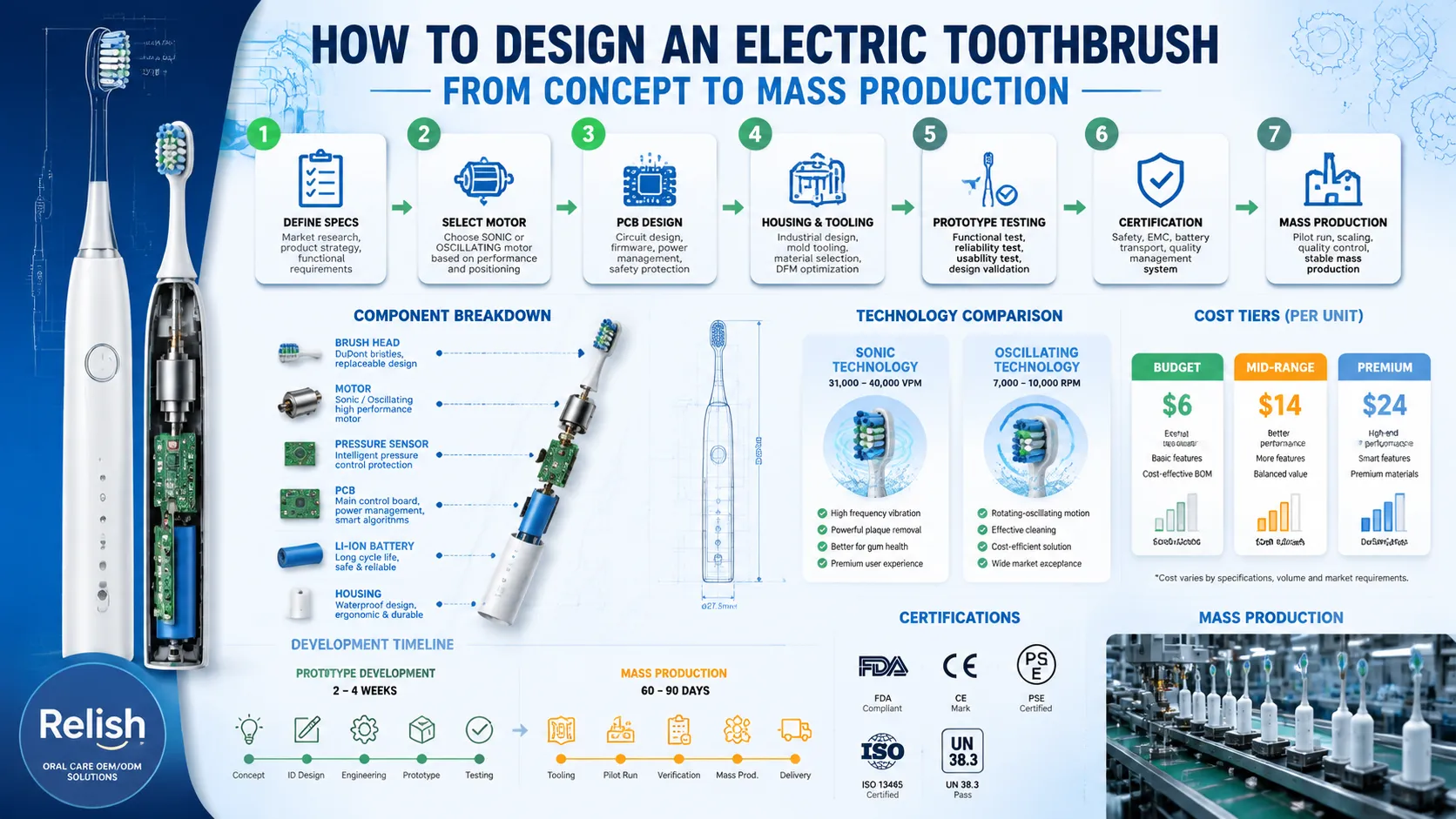
2. The 7-Step Electric Toothbrush Design Process
Knowing how to design an electric toothbrush means following a structured process. Skip steps — especially testing and certification — and you risk costly production failures and regulatory rejection.
| Step | Actividad | Duration | Key Deliverable |
|---|---|---|---|
| 1 | Define product specifications | 1-2 semanas | Product Requirements Document (PRD) |
| 2 | Select motor and core components | 1-2 semanas | Bill of Materials (BOM) |
| 3 | PCB design and firmware development | 3–4 weeks | Functional prototype board |
| 4 | Housing design and tooling | 4 a 6 semanas | Injection mold + first shots |
| 5 | Prototype assembly and testing | 2-3 semanas | Working prototype + test report |
| 6 | Certification testing | 4-8 semanas | FDA/CE/PSE certificates |
| 7 | Mass production setup | 2-4 semanas | Production-ready line |
Step 1: Define Product Specifications
Before any engineering work begins, document your product requirements in a PRD (Product Requirements Document). This document defines every aspect of your electric toothbrush design:
- Motor technology: Sonic vs oscillating-rotating
- Brushing modes: Clean, sensitive, whitening, massage, deep clean (1–5 modes typical)
- Battery: Type (Li-ion), capacity (500–2000 mAh), charging method (inductive/USB-C), battery life (14–60 days)
- Waterproof rating: IPX5 (splash-resistant) or IPX7 (submersible 1m for 30 min)
- Smart features: Bluetooth, pressure sensor, app connectivity, LED display
- Target retail price: $15 (budget) to $350 (premium)
- Target markets: US, EU, Japan, global — determines certification requirements
Step 2: Select Motor and Core Components
The motor is the heart of any electric toothbrush design. Your OEM manufacturer will source from their existing supplier network, but you need to specify performance parameters:
| Componente | Specification Range | Repercusión en los costes |
|---|---|---|
| Sonic motor | 31,000–40,000 VPM, 1.5–3W | $1.20–$3.50 |
| Oscillating motor | 7,000–10,000 RPM, 2–4W | $1.80–$4.00 |
| Li-ion battery | 500–2000 mAh, 3.7V | $0.80–$2.50 |
| PCB controller | MCU + motor driver + charger IC | $1.50-$4.00 |
| BLE module (smart) | nRF52 or similar | $2.00–$4.50 |
| Sensor de presión | Strain gauge or Hall sensor | $0.50-$1.50 |
| Housing (ABS/PC) | Injection molded, IPX5–IPX7 | $0.80-$2.00 |
| Brush head | Nylon bristles + POM base | $0.30-$0.80 |
Step 3: PCB Design and Firmware
The PCB (Printed Circuit Board) controls every function of your electric toothbrush — motor speed, brushing modes, battery charging, pressure sensing, and Bluetooth connectivity. For smart toothbrush designs, the firmware also handles app communication protocols.
Key PCB design considerations when learning how to design an electric toothbrush:
- MCU selection: ARM Cortex-M0 or M4 (low power, sufficient for motor control)
- Motor driver: H-bridge for bidirectional control (oscillating) or PWM driver (sonic)
- Charging circuit: Inductive charging coil (Qi-compatible) or USB-C PD controller
- Battery management: Overcharge/over-discharge protection, temperature monitoring
- Waterproofing: Conformal coating on PCB to prevent moisture damage
Firmware development typically takes 3–4 weeks for basic models and 6–8 weeks for smart connected toothbrushes with app integration. For smart toothbrush technology trends, see our smart toothbrush IoT guide.
Step 4: Housing Design and Tooling
The housing is what users see and hold — it defines the product's aesthetic and ergonomic identity. Electric toothbrush housings are typically injection-molded from ABS or PC (polycarbonate) plastic, with overmolded TPE grips for comfort.
Design requirements:
- Wall thickness: 1.5–2.5mm for structural integrity
- Waterproofing: Ultrasonic welding or silicone gaskets at all seams
- Ergonomics: 25–30mm diameter grip, 180–200mm total length
- Accesorio para el cabezal del cepillo: Magnetic (sonic) or mechanical bayonet (oscillating)
- Charging port: Inductive charging base or USB-C with waterproof cap
Custom tooling for a new housing design costs $3,000–$8,000 for a standard electric toothbrush and $8,000–$25,000 for a premium design with complex geometry. Tooling lead time is typically 3–5 weeks in Shenzhen. For cost analysis, see our electric toothbrush manufacturing cost guide.
Step 5: Prototype Assembly and Testing
Once all components are sourced and tooling is complete, your OEM partner assembles the first functional prototype. This is where you validate that the electric toothbrush design works as intended.
Critical prototype tests:
- Motor performance: Verify vibration frequency, amplitude, and noise level
- Battery life: Charge to full, run continuously until depletion, verify advertised runtime
- Waterproofing: IPX7 submersion test (1m depth, 30 minutes)
- Charging efficiency: Full charge time, charging temperature
- Brush head compatibility: Fit, attachment force, vibration transfer
- Prueba de caída: 1.5m drop on hard surface, 6 faces
Prototype iteration typically requires 2–3 rounds, with each round taking 1–2 weeks. A factory audit during prototyping helps verify your OEM partner's quality processes. Shenzhen-based manufacturers can complete prototyping in 2-4 semanas, compared to 8–16 weeks in Europe or North America.
Step 6: Certification Testing
Certification is non-negotiable for market entry. Your electric toothbrush design must pass regulatory testing before it can be sold in any major market.
| Mercado | Certificación | Cronología | Cost |
|---|---|---|---|
| Estados Unidos | FDA Registration (21 CFR Part 880) | 3-6 meses | $5,000–$15,000 |
| Unión Europea | CE Marking (LVD + EMC + MDR) | 2 a 4 meses | $3,000–$10,000 |
| Japón | PSE Mark (METI) | 3-6 meses | $3,000–$8,000 |
| Global (Quality) | ISO 13485 | Ongoing | Manufacturer cost |
| Battery Safety | UN 38.3 | 2-4 semanas | $500–$2,000 |
For full certification requirements, see our OEM certifications guide. A qualified OEM partner should hold ISO 13485 as a baseline and ideally have existing CE/FDA technical files from previous production runs — reducing your certification timeline by 3–6 months.
Step 7: Mass Production Setup
Once certification is secured, your OEM partner sets up the mass production line. This includes finalizing assembly jigs, quality control stations, and packaging.
Production parameters:
- MOQ (ODM): 500–2,000 units for standard designs
- MOQ (OEM): 2,000–10,000 units for custom tooling
- Lead time: 30–45 days for standard, 60–90 days for custom
- Quality control: AQL 1.5 for major defects, AQL 2.5 for minor defects
- Inspección previa al envío: Recommended for orders above 1,000 units
For details on quality control processes, read our OEM quality control guide. For an overview of the entire OEM timeline, see our electric toothbrush OEM timeline.
Designing an Electric Toothbrush?
Relish Technology — 15+ years of OEM design and manufacturing in Shenzhen. From concept to mass production: motor selection, PCB design, tooling, certification, and full assembly.
Request a Design Consultation →3. Electric Toothbrush Design Cost Breakdown
Understanding how to design an electric toothbrush also means understanding the cost structure. Below is a realistic cost breakdown for three product tiers:
| Componente | Budget Sonic | Mid-Range Smart | Premium Smart |
|---|---|---|---|
| Motor | $1.20 | $2.00 | $3.50 |
| Battery (Li-ion) | $0.80 | $1.50 | $2.50 |
| PCB + firmware | $1.50 | $2.50 | $4.00 |
| BLE module | — | $2.00 | $4.50 |
| Sensor de presión | — | $0.80 | $1.50 |
| Housing + tooling | $0.80 | $1.50 | $2.00 |
| Brush head | $0.30 | $0.50 | $0.80 |
| Assembly + QC | $1.40 | $2.00 | $3.20 |
| Embalaje | $0.50 | $0.80 | $1.50 |
| Total FOB cost | $6.50 | $13.60 | $23.50 |
| Precio de venta al público habitual | $15–$30 | $40–$80 | $120–$350 |
| Margen bruto | 57–78% | 66–83% | 80–93% |
Tooling costs for custom designs add $3,000–$25,000 as a one-time investment, amortized across the production run. For a 5,000-unit order, tooling adds $0.60–$5.00 per unit.
4. Common Design Mistakes to Avoid
When learning how to design an electric toothbrush, certain mistakes appear repeatedly. Avoiding these saves significant time and money:
- Underestimating waterproofing: IPX5 is splash-resistant but not submersible. If users rinse the toothbrush under running water (they will), specify IPX7 minimum.
- Choosing the wrong motor for the target market: Asian markets prefer sonic technology (quieter, gentler). Western markets accept both. Designing an oscillating toothbrush for Japan risks low adoption.
- Neglecting battery thermal management: Li-ion batteries in sealed waterproof housings can overheat during charging. Add temperature sensing and thermal cutoff protection.
- Over-engineering for the price point: A $15 retail toothbrush doesn't need BLE connectivity. Match features to target price tier.
- Ignoring brush head as a consumable: Design the brush head attachment for easy replacement and consider a subscription model. Brush head sales often generate more revenue than the base unit.
- Skipping pre-shipment inspection: A $300–500 inspection fee prevents accepting a container of defective products worth $20,000+.
5. Choosing an OEM Design Partner
Most brand owners do not design electric toothbrushes in-house — they partner with an OEM manufacturer who handles the engineering, prototyping, and production. When selecting a partner for your electric toothbrush design:
- Technical capability: Verify in-house PCB design, firmware development, and motor testing capability. Some "OEMs" are actually trading companies that outsource engineering.
- Certification history: Ask for redacted FDA/CE/PSE certificates from previous clients. A manufacturer with existing certification files reduces your timeline by 3–6 months.
- Capacidad de producción: Verify the factory has 10+ production lines and documented capacity of 50,000+ units/month.
- Quality management: ISO 13485 certification is the baseline. Verify AQL inspection records and defect rate history (target <0.3%).
- IP protection: Sign an NNN Agreement before sharing any design files.
Use our 30-point factory audit checklist to verify any prospective manufacturing partner before committing to a design project.
Preguntas frecuentes
Ready to Design Your Electric Toothbrush?
Relish Technology — 15+ years of OEM design and manufacturing in Shenzhen. From concept to mass production: motor selection, PCB design, tooling, certification, and global logistics.
Request a Design Consultation →References & Sources
- Grand View Research. (2025). Electric Toothbrush Market Size, Share & Trends Analysis Report, 2025–2030. Extraído de https://www.grandviewresearch.com/industry-analysis/electric-toothbrush-market
- International Electrotechnical Commission. (2023). IEC 60335-2-13: Safety of Household and Similar Electrical Appliances — Particular Requirements for Oral Hygiene Appliances. Extraído de https://webstore.iec.ch/publication/61574
- U.S. Food & Drug Administration. (2024). Class II Dental Devices: Electric Toothbrush (21 CFR Part 880). Extraído de https://www.fda.gov/medical-devices/classify-your-medical-device
- Organización Internacional de Normalización. (2016). ISO 13485:2016 — Medical Devices — Quality Management Systems. Extraído de https://www.iso.org/standard/59752.html
- American Dental Association. (2024). Powered Toothbrush Efficacy Evidence Summary. Extraído de https://www.ada.org/resources/research/science-and-research-institute/oral-health-topics/powered-toothbrushes
- Statista Research Department. (2025). Global Electric Toothbrush Manufacturing Cost Analysis. Extraído de https://www.statista.com/outlook/cmo/beauty-personal-care/oral-care/electric-toothbrushes/worldwide