







NNN Agreement & IP Protection Guide:
Sourcing from China Safely
Your intellectual property is your brand's most valuable asset. Learn how to protect it when manufacturing in China — with NNN agreements, trademark registration, patent strategy, and supply chain segmentation.
Key Takeaways
- An NNN Agreement is specifically designed for China — more enforceable than a US-style NDA in Chinese courts
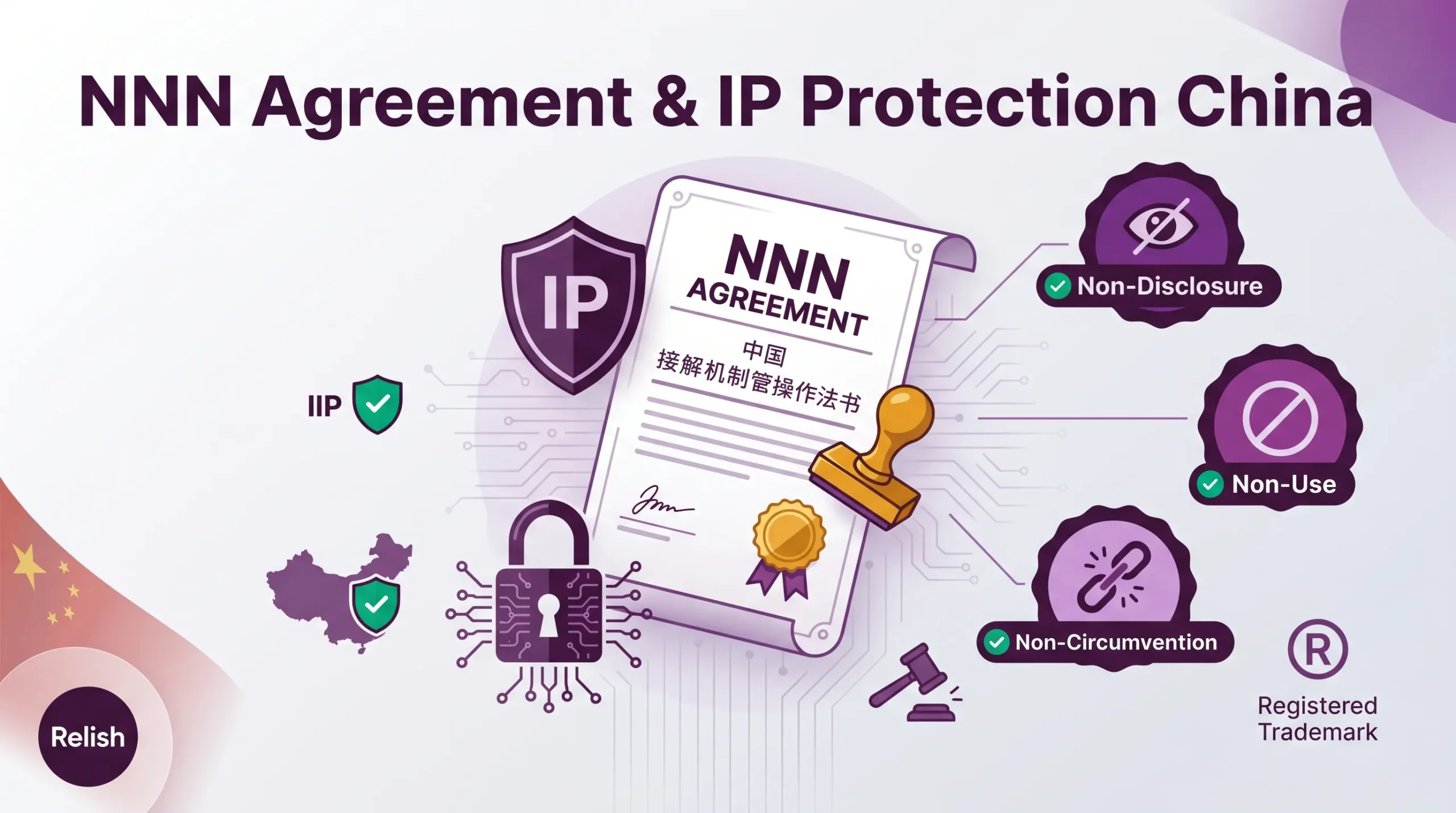
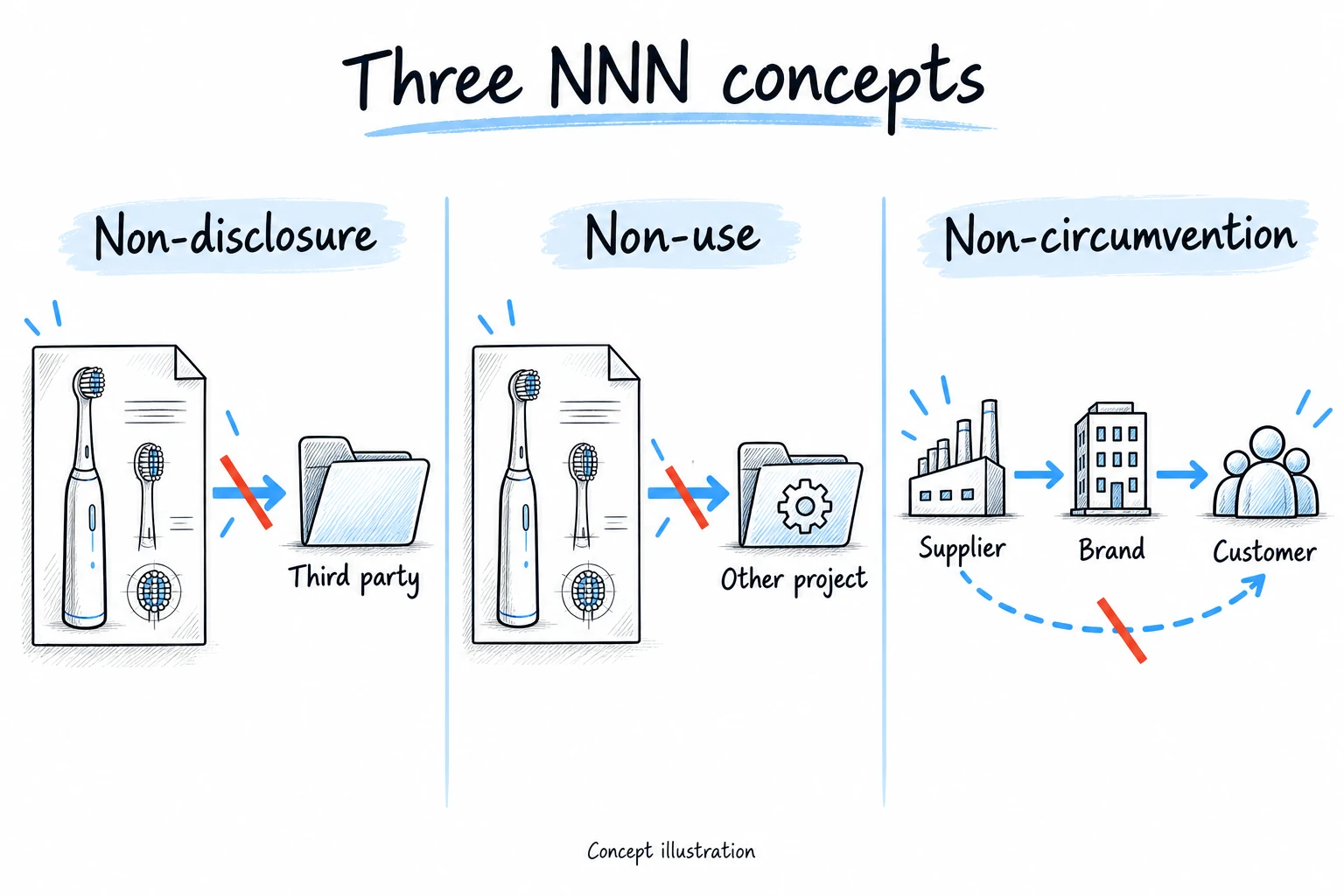
- It covers three critical protections: Non-Disclosure, Non-Use, and Non-Circumvention
- Sign before sharing any design — even a rough sketch or a product photo with proprietary details
- Register trademarks in China directly — China is first-to-file: someone else can register your brand name before you do
- China's IP enforcement has materially improved: foreign plaintiffs win 80%+ of fully contested IP cases in Shenzhen courts (MOFCOM, 2024)
- A well-drafted NNN + China trademark + utility model patent creates a 3-layer IP shield that deters most IP violations
IP theft is the most commonly cited fear among brand owners considering Chinese manufacturing. The concern is legitimate — and the solution is concrete. Thousands of Western brands successfully protect their IP while manufacturing in China every year. The brands that lose IP typically share one of two failure modes: they relied on a US-style NDA (unenforceable in China), or they shared designs before any agreement was in place.
NNN Agreement vs NDA: Why the Distinction Matters
Most Western brand owners are familiar with NDAs (Non-Disclosure Agreements). When working with Chinese manufacturers, a standard NDA is insufficient — particularly when sourcing OEM products where you share product designs, formulations, and supply chain details. The reasons are legal and structural:
| Attribute | Standard NDA (Western) | NNN Agreement (China-Specific) |
|---|---|---|
| Governing Law | US / UK / EU law | PRC (Chinese) law |
| Jurisdiction | Western courts | Chinese courts or CIETAC arbitration |
| Non-Disclosure | Yes | Yes |
| Non-Use (no competing products) | Usually absent | Yes — explicit |
| Non-Circumvention (no cutting you out) | Usually absent | Yes — explicit |
| Enforceable in China without translation | No | Yes (if in Chinese) |
| Liquidated damages clause (RMB) | Rare | Standard |
| Employee bind-down | Sometimes | Best practice |
| Cost to enforce | Very high (international enforcement) | Lower (local Chinese court) |
The non-use clause is particularly critical for OEM manufacturing. Without it, a Chinese factory could legally take your concept and create a competing product under a different brand name — your NDA only prevents them from disclosing your information to third parties, not from using it themselves.
The 3 Core Clauses of an NNN Agreement
Confidentiality Protection
The manufacturer agrees not to share your confidential information — product specifications, designs, formulas, pricing, customer data — with any third party. This includes employees not directly involved in your project. The clause should define "confidential information" broadly and explicitly, and state that it survives contract termination for a defined period (typically 3–5 years).
No Competing Products
The manufacturer agrees not to use your confidential information to create, develop, manufacture, or market any product that competes with yours — even after the manufacturing relationship ends. This is the clause most commonly absent from standard NDAs. Without it, a factory can "reverse-engineer" your design the moment they've produced your first order.
No Cutting You Out
The manufacturer agrees not to approach your customers, distributors, investors, or business contacts directly — bypassing you entirely. This prevents the scenario where a factory learns your retail customers through your orders and starts selling directly. Particularly important for Amazon sellers and brands with visible retail distribution.
What a China-Compliant NNN Agreement Must Include
A generic NDA downloaded from the internet will likely fail in a Chinese court. A proper NNN Agreement for Chinese manufacturing must include:
- Chinese-language version as controlling: Chinese courts require Chinese-language documents. Have your agreement drafted or translated by a China-qualified IP attorney — not Google Translate.
- Governing law: PRC Contract Law (or its successor, the PRC Civil Code 2021). Do not specify your home country's law as governing — it's unenforceable in China.
- Jurisdiction: Chinese courts or CIETAC arbitration. CIETAC (China International Economic and Trade Arbitration Commission) is preferred by many brands for its neutrality.
- Liquidated damages in RMB: Specify a concrete penalty for breach (e.g., ¥500,000–¥2,000,000 depending on your order volume). Courts need a predetermined damages figure to enforce quickly.
- Employee bind-down: The agreement should require the factory to bind all employees with access to your information to the same confidentiality obligations.
- Scope of confidential information: Define explicitly what is covered — CAD files, mold designs, product specifications, customer lists, pricing, manufacturing processes.
- Survival clause: Obligations survive termination for 3–5 years minimum.
For brand owners weighing a China NDA vs NNN Agreement approach, the cost difference is modest — drafting by a qualified China IP attorney runs $800–2,500 USD for a comprehensive bilateral version. This is a fraction of the trademark filing cost ($300–800/class at CNIPA) or the enforcement cost of recovering IP after a breach. Treat the NNN Agreement as an insurance premium, not a formality.
Registering Your Trademark in China: First-to-File Rules
China operates a first-to-file trademark system — whoever files first owns the trademark, regardless of who used it first anywhere in the world. This means a competitor (or a "trademark squatter") can register your brand name in China before you do, then demand payment for you to use it in Chinese manufacturing or sales.
Step-by-Step: China Trademark Registration
Search for Conflicts (1–2 days)
Search the CNIPA trademark database (cnipa.gov.cn) for identical or similar marks in your target Nice classes. Class 21 (personal care tools) and Class 10 (medical/dental devices) are most relevant for oral care brands.
Engage a China-Qualified IP Attorney (1 week)
Use an attorney registered with the All-China Patent Agents Association. Cost: $300–800 per class including attorney fees. Do not use an agent promising unusually fast approval — the process takes 6–12 months regardless.
File in Latin Script AND Chinese Characters
Register your brand name in both scripts. A squatter can register a phonetic Chinese translation of your brand (e.g., "Naikè" for Nike-like brands). Filing both prevents this vector of attack.
Register in All Relevant Classes
At minimum: Class 21 (toothbrushes, oral care tools), Class 10 (dental apparatus), Class 3 (toothpaste, oral care preparations). Each class requires a separate application and fee.
Use and Renew
Chinese trademarks are valid for 10 years and renewable. You must demonstrate use within 3 years or the trademark can be challenged and cancelled. Keep records of product packaging and sales that display the mark.
Patent Strategy for Oral Care OEM Brands
Patents add a layer of protection beyond NNN agreements and trademarks — they give you exclusive rights to use, manufacture, and sell your invention in China. Three types are available:
Supply Chain Segmentation: The 4th Layer of Protection
Even with an NNN Agreement, trademark, and patent in place, supply chain segmentation adds a practical barrier against IP leakage. The principle is simple: no single supplier has your complete product specification.
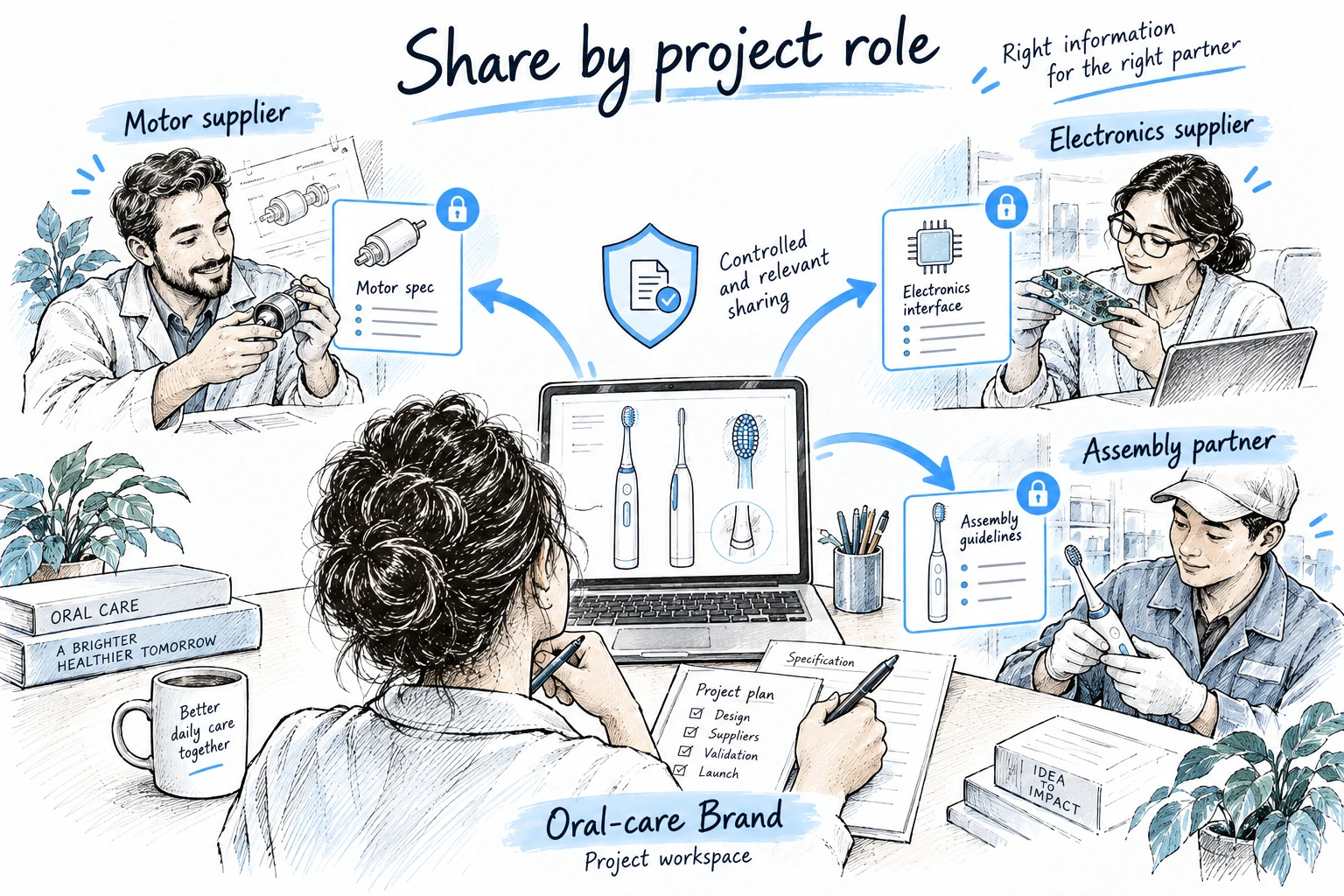
- Source key components separately: If your product has a proprietary motor configuration, source motors from Supplier A; have the PCB programmed by Supplier B; handle final assembly at your primary OEM factory. No single party sees the complete picture.
- Split tooling ownership: Own your molds in your own company name, not the factory's. Store tooling at a neutral warehouse if the relationship ends.
- Limit production data sharing: Share only what each supplier needs to do their specific job. Assembly instructions don't need to include your motor's proprietary frequency settings.
- Rotate suppliers for non-critical components: Avoid single-source dependencies that create leverage in your supplier's hands.
Need a China IP Protection Framework for Your OEM Project?
Relish Technology signs NNN Agreements as standard practice before any design discussion. We can share our template structure and connect you with a qualified China IP attorney. Start with a conversation.
Before engaging any manufacturer, verify their quality systems with a structured assessment. Our China Factory Audit Checklist covers 30 verification points including ISO 13485 certification, production capacity, and IP handling procedures. For a full picture of manufacturing costs and what to budget for tooling, see our OEM Manufacturing Cost Guide. And if you're comparing technology platforms before committing to a supplier relationship, our Sonic vs. Oscillating-Rotating OEM Guide covers motor selection, BOM cost structure, and certification implications.
Relish Technology's IP Protection Commitment
Our Commitment to Your Intellectual Property
At Relish Technology, protecting our clients' IP is foundational to our business model — we have built a 15-year reputation on it. Here's what we commit to every brand partner:
Our R&D team has developed proprietary technologies (Vibrosonic™, Rotasonic™) — we understand firsthand what IP protection means to a brand.
Frequently Asked Questions
Partner with a Manufacturer Who Protects Your IP
Relish Technology signs NNN agreements as standard practice. 15+ years, 300+ brand clients, zero IP breach history. Request a partnership inquiry today.
Request NNN Agreement & Quote →References & Sources
- China Ministry of Commerce (MOFCOM). (2024). Annual Report on Intellectual Property Protection in China 2024. MOFCOM. Retrieved from https://www.mofcom.gov.cn/article/zcfb/zcblgg/202404/20240403503045.shtml.
- China National Intellectual Property Administration (CNIPA). (2025). Trademark Registration Guidelines. CNIPA. Retrieved from https://www.cnipa.gov.cn.
- Harris, D., & Nord, M. (2019). Protecting IP in China: The NNN Agreement vs NDA. China Law Blog. Retrieved from https://www.chinalawblog.com/2019/11/protecting-ip-in-china-the-nnn-agreement-vs-nda/.
- PRC National People's Congress. (2021). Civil Code of the People's Republic of China — Contract Law Provisions (Book III). NPC. Retrieved from https://www.npc.gov.cn/npc/c30834/202012/a8a4c6b9e2e94e65a23b5e3d18fbdcfb.shtml.
- China International Economic and Trade Arbitration Commission (CIETAC). (2024). CIETAC Arbitration Rules 2024. CIETAC. Retrieved from https://www.cietac.org/index.php?m=Page&a=index&id=183&l=en.