








How to Choose a Water Flosser OEM Manufacturer:
10-Point Checklist (2026)
Not all water flosser factories in China are created equal. This structured 10-point evaluation framework helps you shortlist qualified suppliers, identify red flags, and protect your brand before you commit to an order.
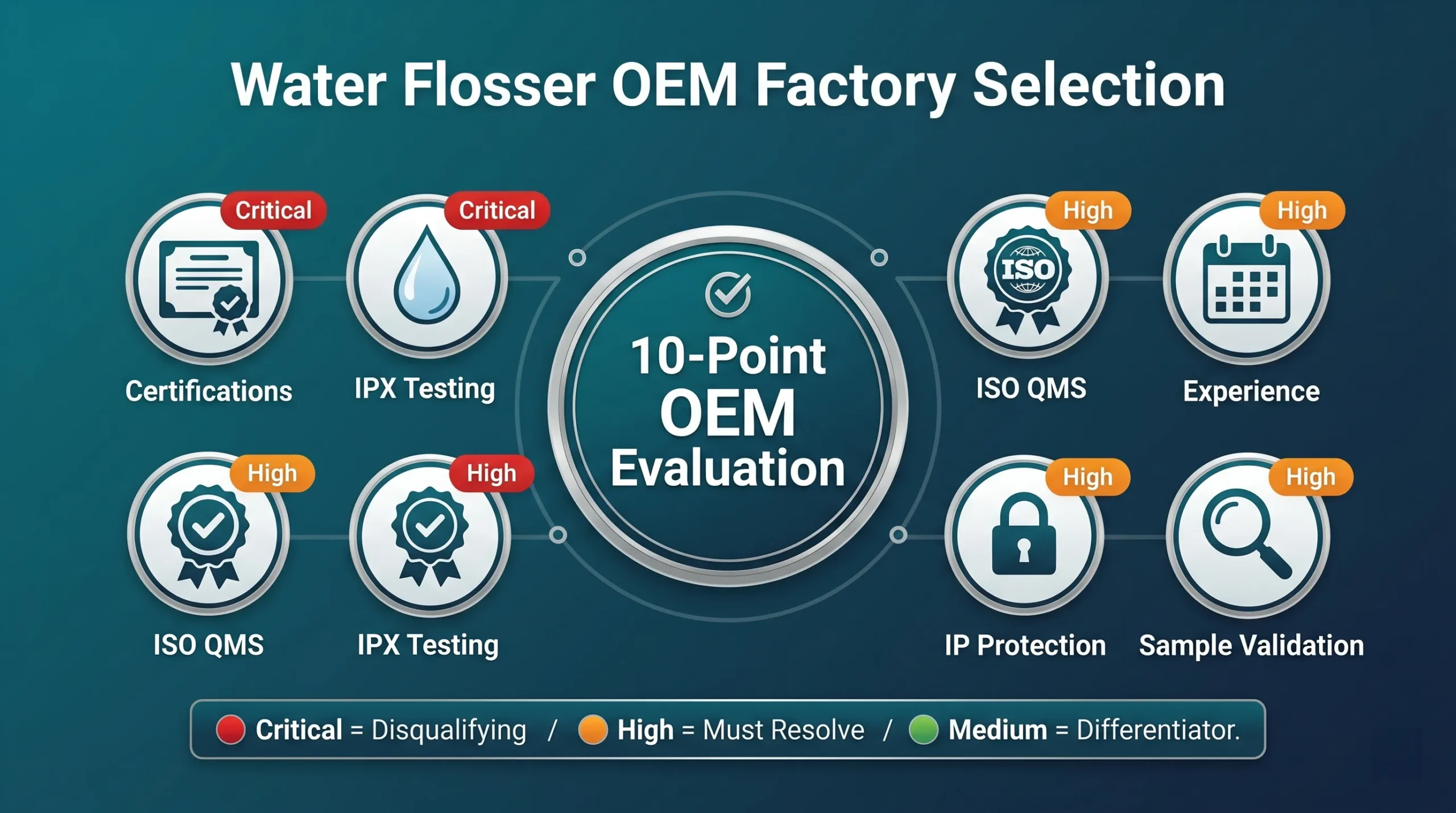
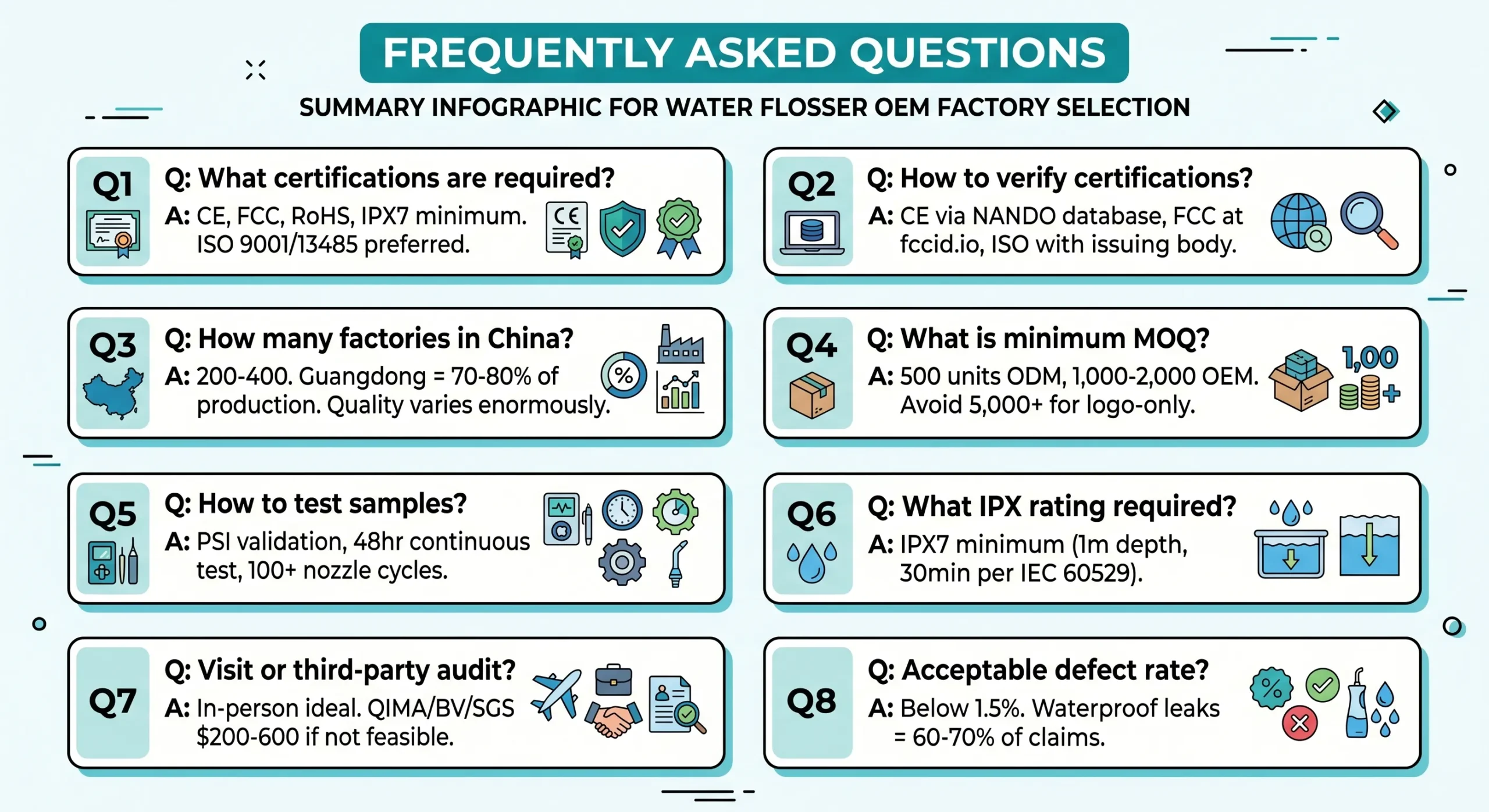
There are an estimated 200–400 factories in China producing water flosser products, and the quality gap between the best and worst is enormous. A good factory delivers consistent IPX7 waterproof performance, certified products, and reliable QC. A bad one ships you a batch with 15% leak rates, fake CE certificates, and no after-sales support.
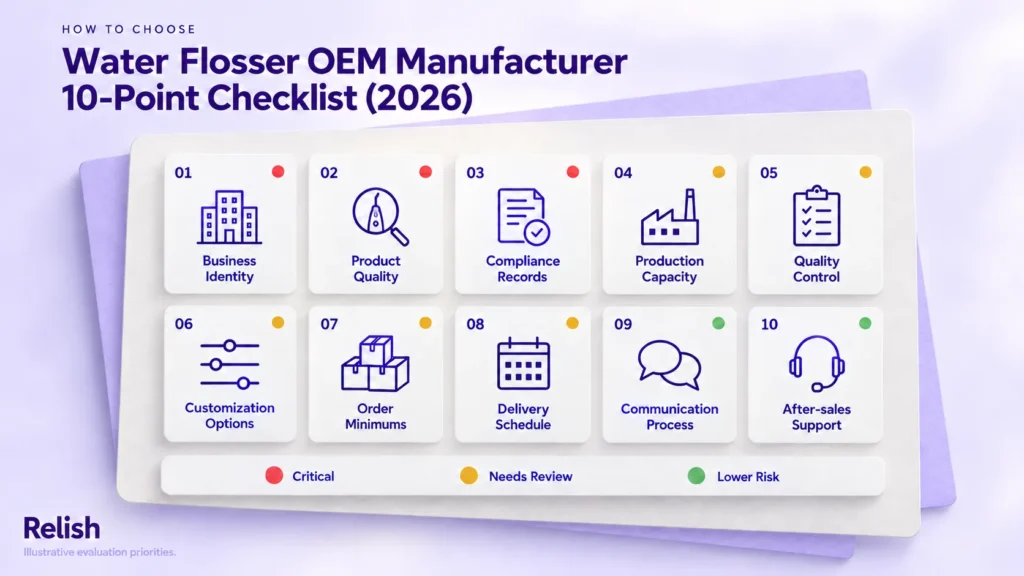
This 10-point checklist walks you through how to evaluate water flosser OEM manufacturers before placing an order. It is organized by priority level so you know which checks are non-negotiable.
The 10-point water flosser OEM evaluation covers certifications (CE/FCC/IPX7[1]), in-house waterproof testing, ISO 9001/13485 QMS, IP protection, sample validation, MOQ, and supply chain stability.
| Certifications | CE, FCC Part 15, RoHS, IPX7 (IEC 60529)[1] |
|---|---|
| Factory MOQ | 500–2,000 units (ODM) |
| Cordless FOB Range | $8–$12/unit[2] |
| Acceptable Defect Rate | <1.5% (waterproof seal failures are #1 risk) |
Factory Credentials: Relish Technology
Relish Technology is a Shenzhen-based water flosser OEM/ODM factory with 14+ years in oral care manufacturing. Passes all 10 evaluation checkpoints.
- 20,000 m² ISO-certified assembly lines · 1.2M+ units monthly capacity
- Certifications: CE, FCC, FDA, ISO 9001, ISO 13485, RoHS, REACH, IPX7
- In-house IPX waterproof testing, 100% unit leak testing before packaging
💡 How to Use This Checklist
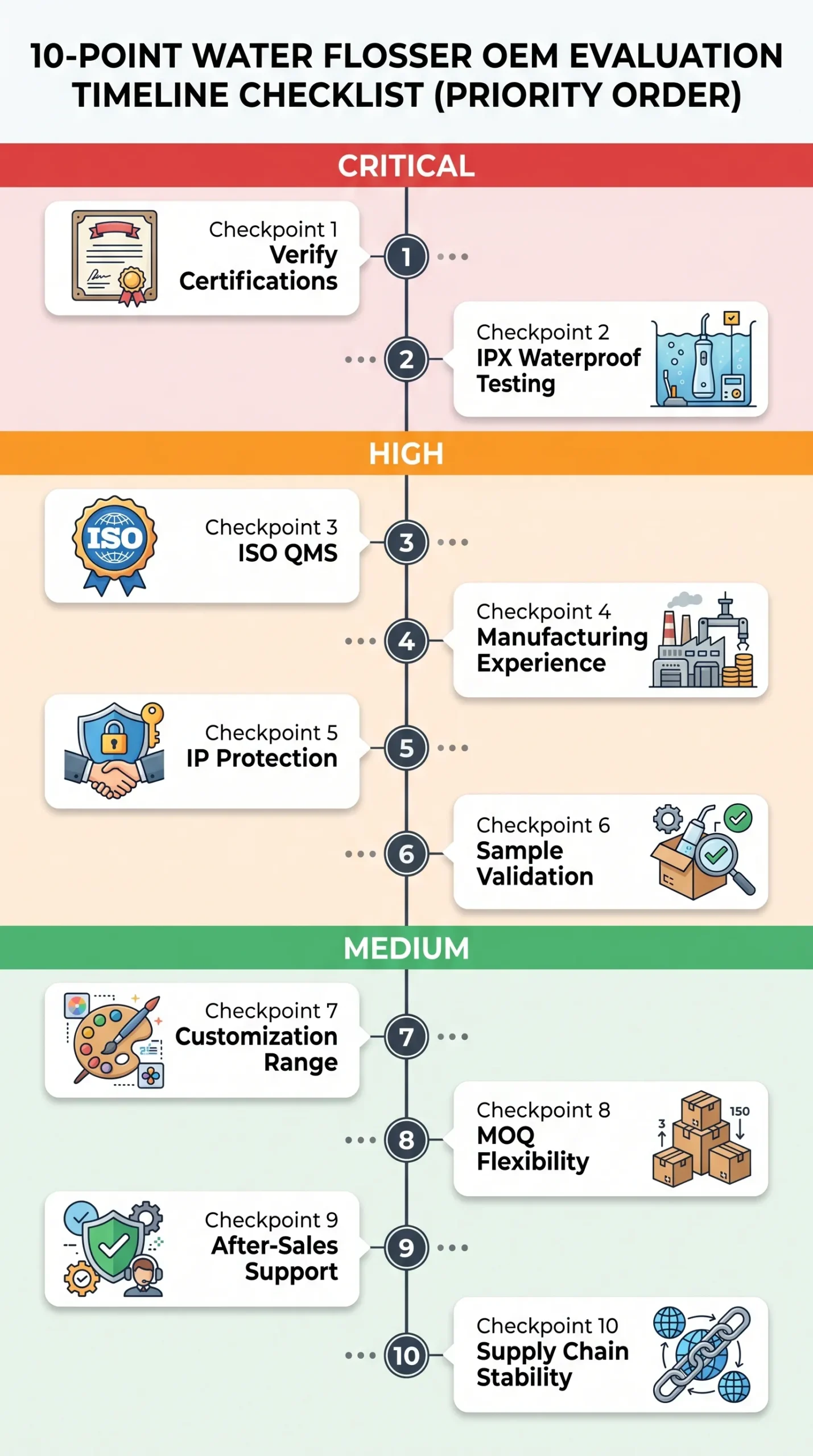
Run every supplier through these 10 checks before shortlisting to 3 for sample evaluation. Items marked CRITICAL are disqualifying if failed. HIGH items should be resolved before ordering. MEDIUM items are differentiators between otherwise qualified suppliers.
The 10-Point Water Flosser OEM Evaluation Checklist
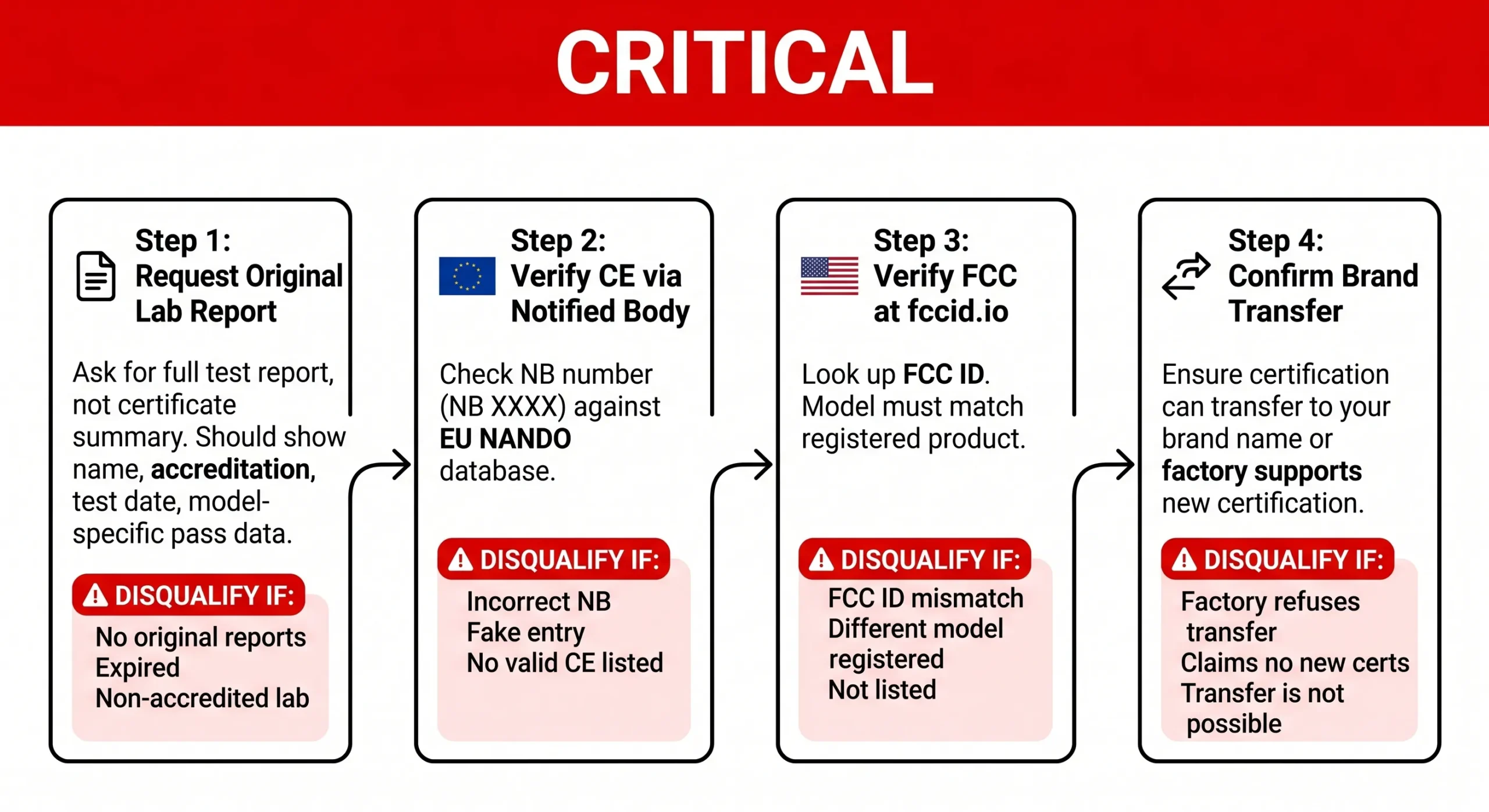
Verify Certifications with Original Lab Reports
Every credible water flosser factory should hold CE marking and FCC Part 15 certification on their platform products, plus IPX waterproof rating test reports (IEC 60529) and RoHS compliance. The key word is "verify," not just "claim."
- Request the original test report, not a certificate summary. Reports should show the lab name, accreditation body, test date, and model-specific pass data.
- Verify CE certificates via the Notified Body number (format: NB XXXX) against the EU's official Notified Body database.
- Verify FCC certifications at fccid.io. The FCC ID on the product must match the registered ID.
- Confirm that the certification can be transferred to your brand name or that the factory will support getting new certifications issued in your brand name.
Disqualify if: Factory cannot provide original lab reports, certificates are expired, or lab is not internationally accredited (CNAS, A2LA, UKAS, DAkkS).
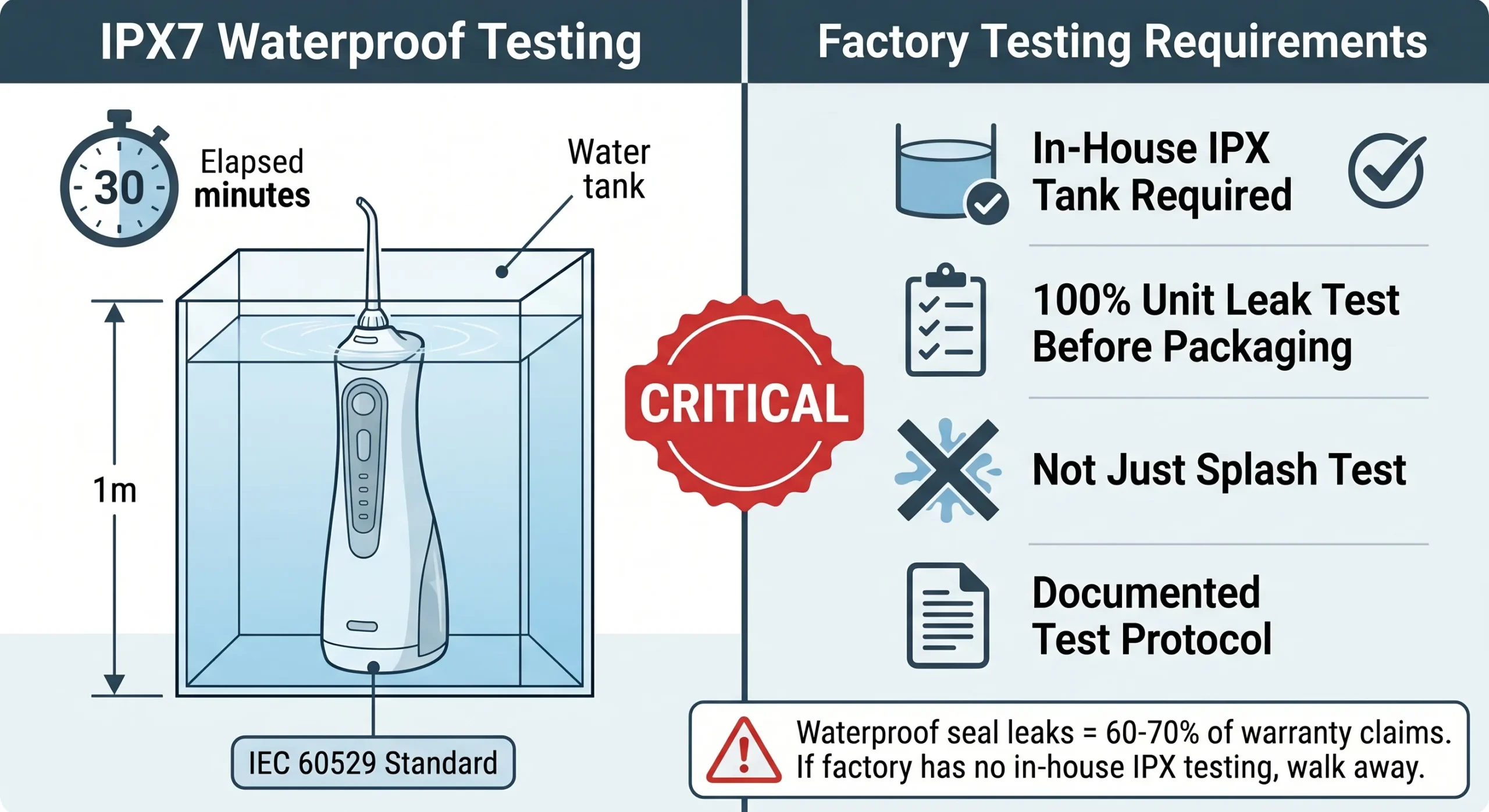
Confirm In-House IPX / Waterproof Testing Capability
Water flossers are water-involved products, which makes waterproof integrity your biggest quality risk. A factory without in-house IPX testing will catch failures only at the third-party test stage, potentially after production is complete.
- Ask directly: "Do you have an in-house IPX testing facility?" Request photos or a factory tour segment showing the water immersion tank.
- Confirm testing protocol: IPX7 requires immersion at 1 meter depth for 30 minutes, not just a quick splash test.
- Ask about 100% leak testing on finished units before packaging. This should be standard, not sampling-only.
- For countertop models with AC power, confirm dielectric strength testing is also performed.
Disqualify if: Factory relies solely on visual inspection or third-party lab testing without any in-house waterproof quality gatekeeping.
Verify Quality Management System (ISO Certification)
A documented QMS is your structural guarantee that quality processes are repeatable. Look for:
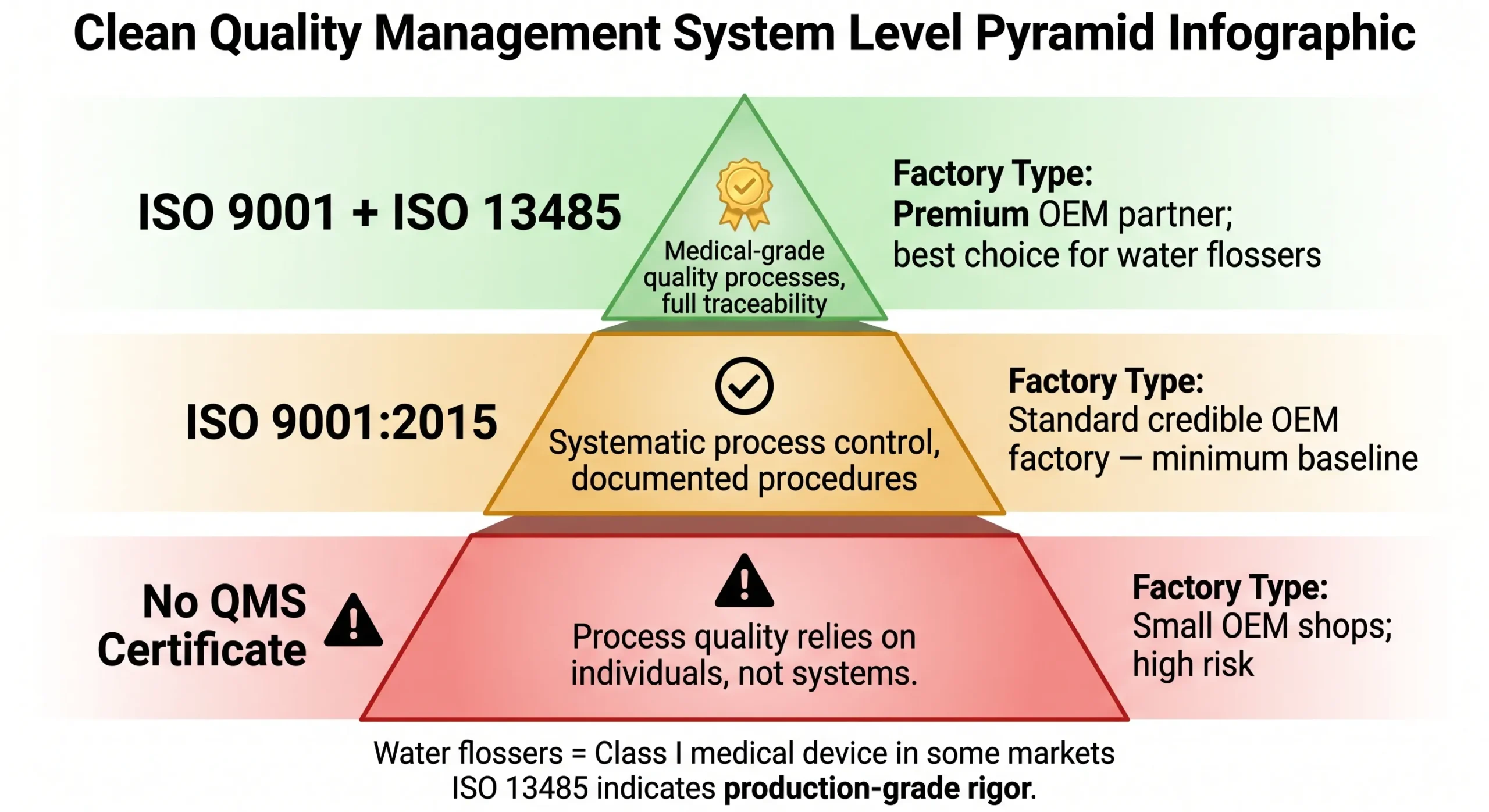
- ISO 9001:2015. General manufacturing quality management. Minimum standard for credible OEM partners.
- ISO 13485. Medical device quality management. Water flossers are classified as Class I medical devices in some markets; ISO 13485 certification indicates production-grade process rigor.
- Verify certificates are current (check expiry date) and issued by a recognized certification body (SGS, TÜV SÜD, Bureau Veritas, Intertek, BSI).
| QMS Level | What It Means | Typical Factory Type |
|---|---|---|
| No QMS certificate | Process quality relies on individuals, not systems | Small OEM shops; high risk |
| ISO 9001 | Systematic process control, documented procedures | Standard credible OEM factory |
| ISO 9001 + ISO 13485 | Medical-grade quality processes, full traceability | Premium OEM partner; best choice |
Assess Water Flosser-Specific Manufacturing Experience
Many factories in Shenzhen/Dongguan claim to make water flossers but are primarily electronics assemblers who added water flossers as a secondary category. You want a factory where water flossers are a core product line, not an afterthought.
- Ask for their full product catalog. Water flosser models should be a significant portion, not just 2–3 models among 50 unrelated products.
- Request information on annual production volume specifically for water flossers.
- Ask how many years they've been producing water flossers (minimum 3 years indicates genuine category expertise).
- Inquire about their R&D investment. Do they have engineers working specifically on fluid dynamics and motor performance optimization?
Evaluate IP Protection & Confidentiality Practices
When you share custom design files, brand specifications, and packaging concepts, you're exposing your brand's competitive assets. Confirm the factory's IP protection practices before sharing any confidential materials.
- NDA first, then designs. Any factory that resists signing an NDA before you share custom product specs is a red flag.
- Confirm mold ownership terms: who owns the tooling after it's created? You should own all custom molds you've paid for.
- Ask about their policy on selling to your competitors using your ODM customizations. Ensure exclusivity terms are in the contract.
- Check if they manufacture for multiple brands in the same product category. Cross-contamination of trade secrets is a real risk.
Review Sample Quality and Turnaround Time
Sample performance is your most reliable predictor of mass production quality. It also reveals how the factory operates under pressure.
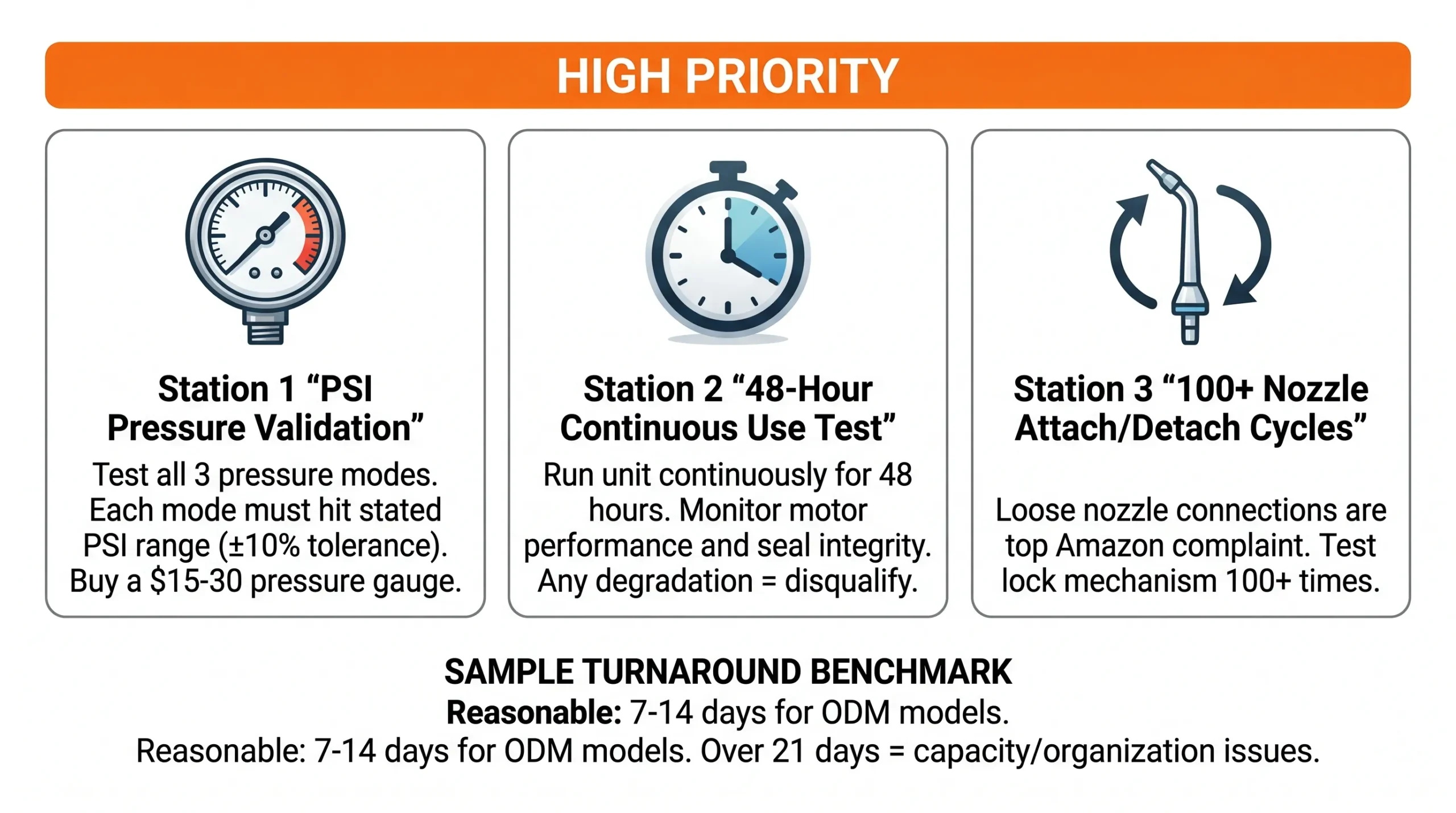
- Request samples of 3 different pressure modes. Validate each mode hits its stated PSI range with a pressure gauge (you can buy one for $15–30).
- Run a 48-hour continuous use test on the sample. If the motor or seal degrades, you'll know before committing to production.
- Test the nozzle lock mechanism repeatedly (100+ attach/detach cycles). Loose nozzle connections are a top Amazon review complaint for private label water flossers.
- Reasonable sample turnaround: 7–14 days for ODM models. Longer than 21 days suggests capacity or organizational issues.
Check Customization Range and Surface Treatment Capabilities
Your brand differentiation will largely come from customization, so understand what's actually possible in-house vs. outsourced (outsourcing adds lead time and quality control complexity).
- In-house painting/coating: UV coating, soft-touch rubber coating, Pantone color matching
- Laser engraving for logo on housing (premium look, no label peel risk)
- Custom nozzle tip colors and configurations
- Packaging: full-color retail box, window box, gift set packaging. In-house or outsourced?
- Multi-language manual printing and localization support
Confirm MOQ Flexibility and Production Scheduling
MOQ and lead time flexibility will become important as your business scales, or when you need to re-order quickly for a viral product moment.
- Minimum: 500 units for ODM, 1,000–2,000 for full customization. Factories demanding 5,000+ for logo-only customization are not brand-friendly.
- Ask about re-order priority: how quickly can they fit a re-order once you're an established customer?
- Confirm whether they batch multiple clients' orders on shared production runs (common for smaller orders) or dedicate production lines. Dedicated lines reduce cross-contamination risk.
Assess After-Sales Support and Warranty Policy
Product warranty claims and returns will happen. Your factory's after-sales support policy directly affects your customer experience and cash flow.
- Confirm warranty replacement parts availability: motors, PCB modules, and charging cables should be available for 24+ months post-shipment.
- Ask about their defect rate benchmarks. A well-run factory will know their historical defect rates (should be <1.5% for water flossers).
- Confirm RMA (Return Merchandise Authorization) policy: what happens if you receive a batch with higher-than-expected defect rates? Will they replace units or provide credit?
Verify Supply Chain Stability and Component Sourcing
Global supply chain disruptions (2020–2024) taught buyers that component sourcing stability is not a nice-to-have. It is a business continuity requirement.
- Ask about their motor supplier relationships. Motors are the most important component and the most supply-chain-sensitive. Do they have dual-source suppliers?
- Confirm battery supplier qualification: lithium batteries require UN38.3 and IEC 62133 certification. Sub-spec batteries are the #1 safety liability in portable water flossers.
- Ask about their strategic inventory policy for key components. Do they maintain 60–90 day buffer stock?
🚨 8 Red Flags That Mean Walk Away
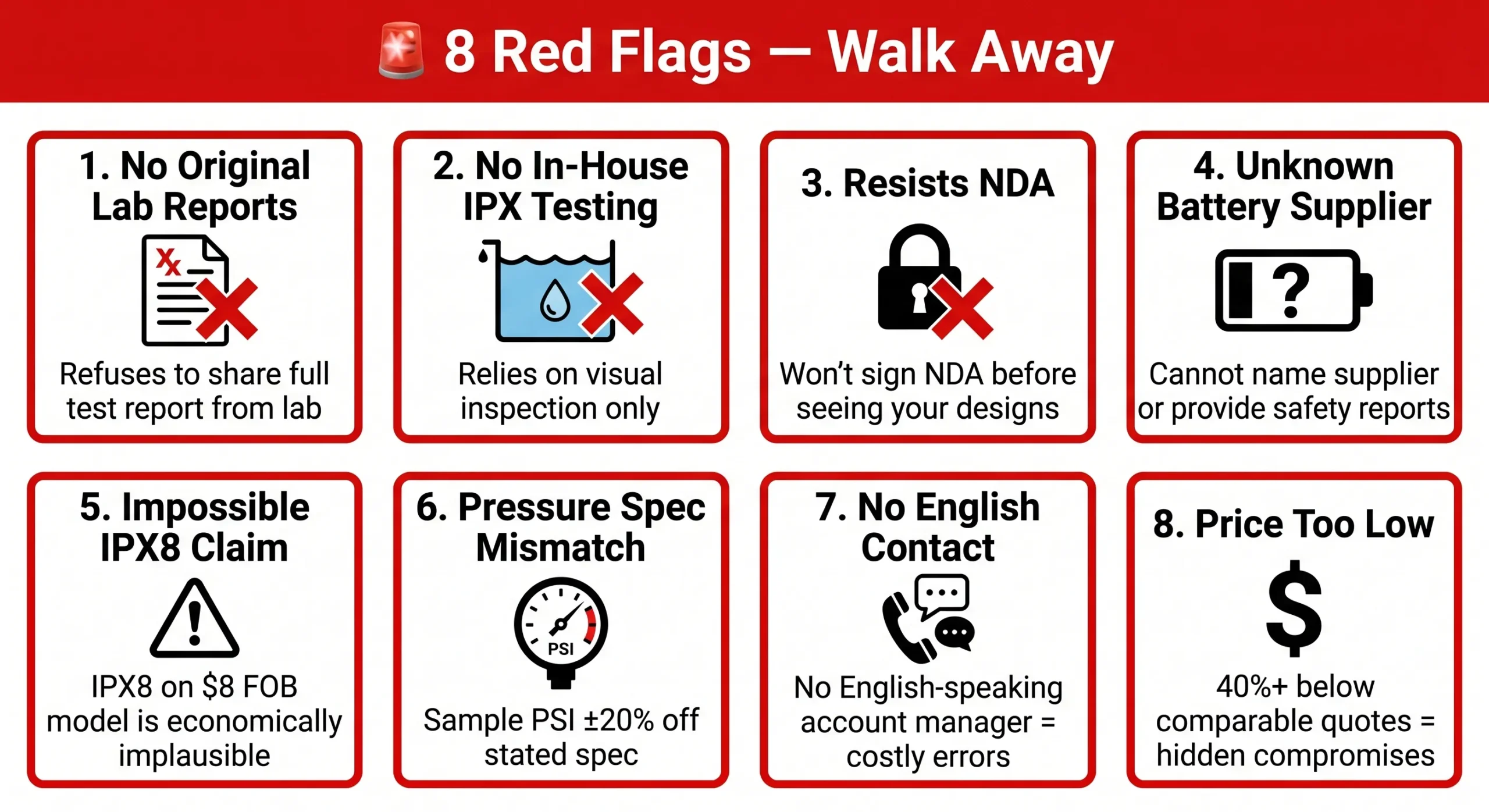
- Provides CE/FCC certificate but refuses to share the full original test report from the lab
- No in-house IPX waterproof testing equipment. Relies entirely on visual inspection.
- Resists signing NDA before seeing your custom design specifications
- Cannot tell you the battery supplier name or provide battery safety test reports
- Claims IPX8 certification on a $8 FOB cordless model (physically and economically implausible)
- Sample pressure readings don't match stated spec by more than ±20%. Indicates quality or calibration problems.
- No English-speaking account manager. Communication gaps become costly production problems.
- Price quote is 40%+ below all other comparable quotes. Indicates hidden quality compromises.
Quick Scoring Scorecard
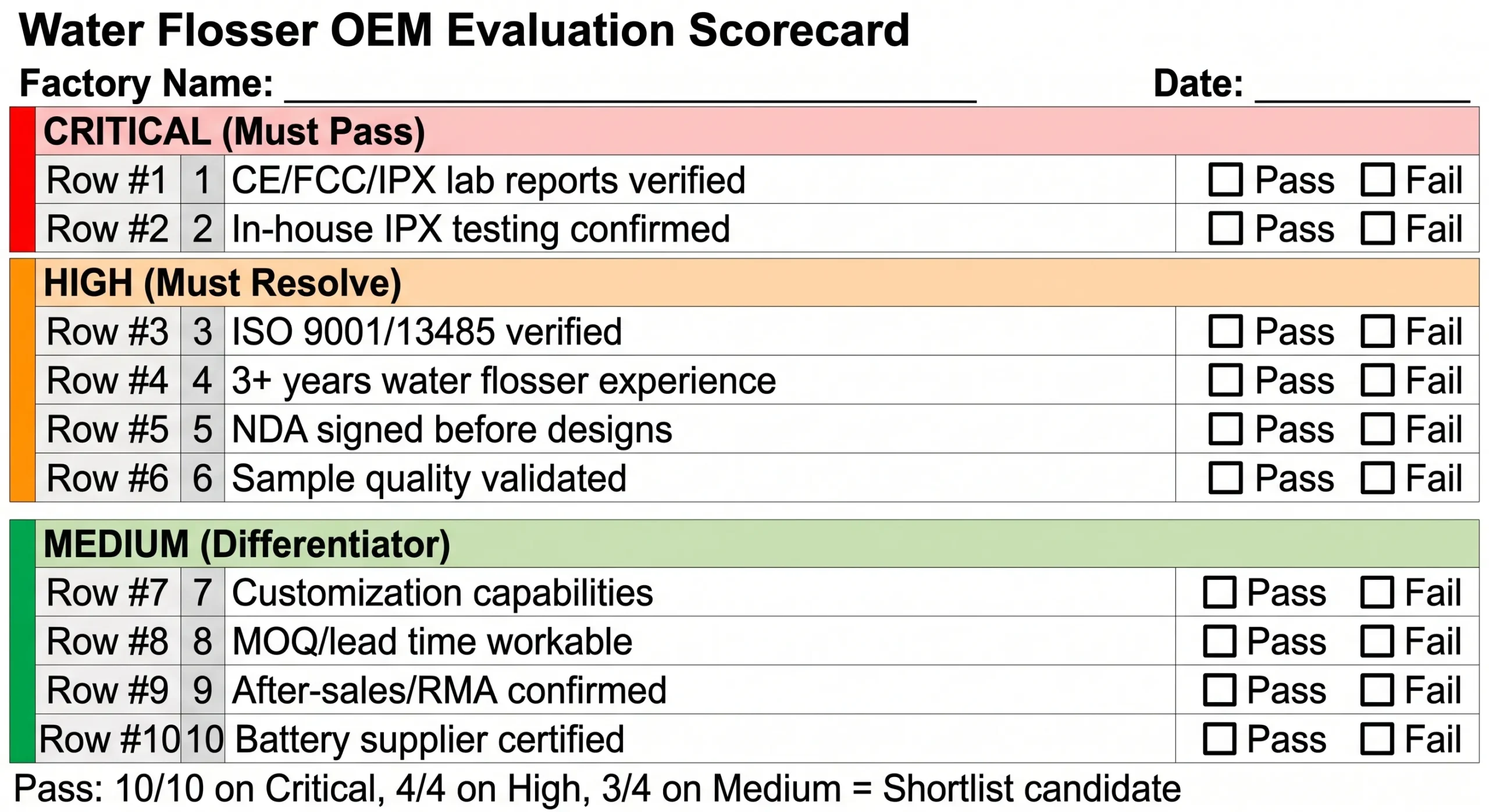
| # | Checkpoint | Priority | Pass / Fail |
|---|---|---|---|
| 1 | CE/FCC/IPX original lab reports verified | 🔴 Critical | ☐ Pass ☐ Fail |
| 2 | In-house IPX testing facility confirmed | 🔴 Critical | ☐ Pass ☐ Fail |
| 3 | ISO 9001 / ISO 13485 certificate verified | 🟠 High | ☐ Pass ☐ Fail |
| 4 | 3+ years water flosser-specific experience | 🟠 High | ☐ Pass ☐ Fail |
| 5 | NDA signed before sharing designs | 🟠 High | ☐ Pass ☐ Fail |
| 6 | Sample quality validated (PSI, leak, nozzle) | 🟠 High | ☐ Pass ☐ Fail |
| 7 | Customization capabilities meet your needs | 🟢 Medium | ☐ Pass ☐ Fail |
| 8 | MOQ and lead time terms are workable | 🟢 Medium | ☐ Pass ☐ Fail |
| 9 | After-sales/RMA policy confirmed in writing | 🟢 Medium | ☐ Pass ☐ Fail |
| 10 | Battery supplier certified, supply chain stable | 🟢 Medium | ☐ Pass ☐ Fail |
A factory should score 10/10 on items 1–2 (no exceptions), 4/4 on items 3–6, and at least 3/4 on items 7–10 to be shortlisted for sample ordering.
Relish Tech Passes All 10 Checkpoints
CE/FDA/FCC certified, ISO 13485 QMS, in-house IPX7 testing, 10+ years water flosser manufacturing, flexible MOQ from 500 units. Let's talk about your project.
Request Factory Audit Documents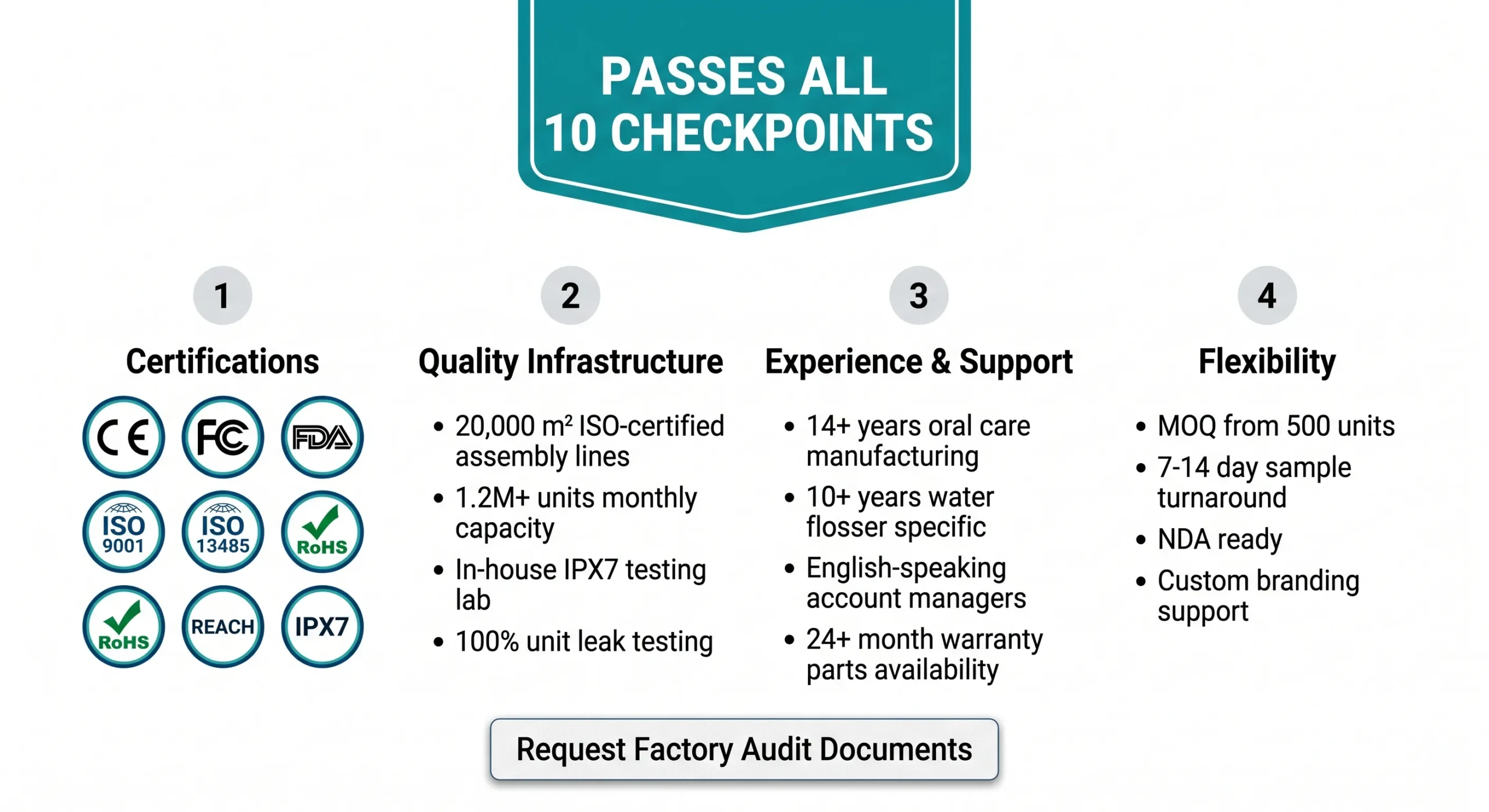
References
- IEC. (2013). IEC 60529:2013 Degrees of Protection Provided by Enclosures (IP Code). IPX7 waterproof testing standard. [Source]
- Persistence Market Research. (2025). Water Flosser Market Report 2025-2033. Cordless FOB pricing $8-12/unit range. [Source]
- International Trade Administration. (2024). China Medical Device Manufacturing Sector Report. Guangdong accounts for 70-80% of oral care device exports. [Source]