











Electric Toothbrush Quality Control:
OEM QC Guide 2026
A complete walkthrough of the electric toothbrush quality control process at a world-class oral care OEM factory — covering IQC, IPQC, OQC, waterproof testing, bristle standards, and pre-shipment inspection.
Defect rate benchmarks based on documented QC records at Relish Technology's ISO 13485-certified production facility (Shenzhen, 2024–2025).
Key Takeaways
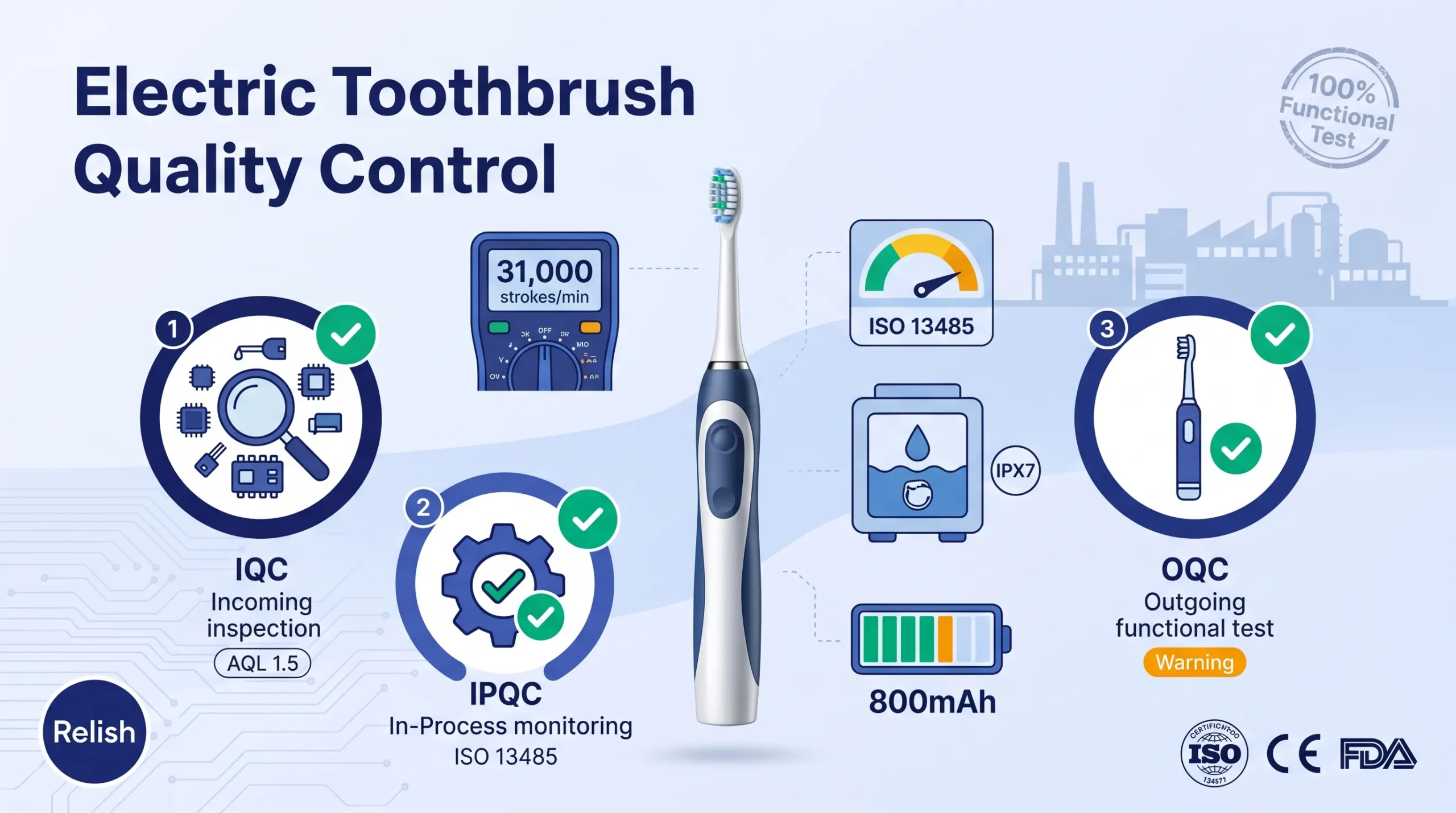
- Top-tier Chinese electric toothbrush manufacturers achieve defect rates below 0.3% through three-layer electric toothbrush quality control: IQC → IPQC → OQC
- 100% functional testing of every finished unit is non-negotiable — sampling alone is insufficient for electronics
- The #1 cause of field failures is substandard batteries from unqualified suppliers — always verify UN 38.3 certification from named suppliers (ATL, EVE, BYD, Samsung SDI)
- IPX7 waterproofing requires in-factory submersion chamber testing — verify this equipment exists before ordering electric toothbrushes
- Bristle end-rounding must exceed 90% per ADA guidance — this is a common quality failure at low-cost factories manufacturing electric toothbrushes
- Pre-shipment inspection (SGS/Bureau Veritas) on orders above 1,000 units protects against production substitution during the electric toothbrush quality control process
Quality control in electric toothbrush manufacturing is more complex than most brand owners expect. Unlike passive consumer goods, electric toothbrushes are electronic-mechanical devices that must perform reliably in wet environments — and they go in people's mouths. The consequences of quality failure are severe: Amazon returns and negative reviews in the short term, regulatory action and brand reputation damage in the long term.
Understanding the electric toothbrush quality control process allows you to ask the right questions when evaluating OEM suppliers, and to set contractual quality requirements that protect your brand. This guide explains every stage, from raw material intake to container loading.
The 3-Layer Electric Toothbrush Quality Control Framework: IQC → IPQC → OQC
A complete quality management system for electric toothbrush OEM production covers three distinct stages of production:
Stage 1: Incoming Quality Control (IQC) for Electric Toothbrushes
IQC is the first and most leverage-rich stage of electric toothbrush quality control. Substandard components that pass through IQC become defective finished goods — expensive to fix and potentially impossible to recall once shipped.
Critical Components Requiring 100% IQC Inspection
| Componente | Key Tests | Pass Criteria | Priority |
|---|---|---|---|
| DC Motor (sonic) | Vibration frequency (Hz), RPM, noise level, current draw | 31,000±500 strokes/min; <45dB; current within spec | Critical |
| Lithium-Ion Battery | Capacity (mAh), voltage, cycle life, temperature; UN 38.3 test certificate required | Within 5% of rated capacity; UN 38.3 cert required | Critical |
| PCB / Electronic Control | Circuit continuity, timer function, mode switching | All functions per spec; no cold solder joints | Critical |
| Handle Body (injection) | Dimensional tolerances, surface finish, color match | ±0.2mm tolerances; Pantone color match | Major |
| Nylon Bristles | Diameter (mm), material (food-grade nylon), end-rounding per ADA guidance | Soft: 0.15mm; Medium: 0.2mm; >90% ball-tipped ends | Critical |
| IPX Sealing Components | O-ring dimensions, material elasticity, seating geometry | Shore A hardness 60–70; no gaps on assembly jig | Critical |
| Charger / Charging Base | Output voltage, current regulation, CE/UL mark | 5V±0.25V; 1A±0.1A; certified marks present | Critical |
Stage 2: In-Process Quality Control (IPQC) for Electric Toothbrush Manufacturing
IPQC monitors quality as units are being assembled during the electric toothbrush manufacturing process. Problems caught during IPQC cost far less to fix than those discovered after full assembly. The most advanced factories use Statistical Process Control (SPC) to detect quality drift before defects occur.
IPQC Checkpoints by Production Stage
| Stage | IPQC Check | Method | Frequency |
|---|---|---|---|
| Motor Installation | Torque spec, mounting alignment, wire routing | Torque wrench, visual | Every 50 units |
| PCB Assembly | Automated optical inspection (AOI), solder joint quality per IEC 60335 safety standards | AOI machine + visual | 100% AOI |
| Battery Installation | Polarity, seating, weld quality | Visual + continuity test | 100% |
| Handle Assembly | Snap-fit torque, gap dimensions, cosmetic appearance | Go/No-Go gauge, visual | Every 100 units |
| Bristle Tufting | Tuft count, anchoring force, end-rounding confirmation per ADA guidance | Pull test, microscope sample | Every 200 heads |
| IPX Seal Assembly | O-ring seating, compressed air leak test per IEC 60529 IP Code | Pressure decay tester | 100% |
| Label/Branding Application | Position, adhesion, legibility, regulatory text accuracy | Visual + go/no-go template | Every 50 units |
Statistical Process Control (SPC)
SPC uses real-time data from production to detect trends before they become defects. Top-tier factories track control charts for critical parameters (motor frequency, IPX seal pressure, battery voltage) and trigger corrective action when readings approach control limits — before any defective unit is made.
Stage 3: Outgoing Quality Control (OQC) — 100% Functional Testing for Electric Toothbrushes
OQC is the final quality gate before products enter packaging. 100% functional testing — not sampling — is the standard for electronics in the electric toothbrush quality control process. Sampling finished units allows defective products to reach customers; 100% testing catches every unit that fails before it ships.
Functional Test Specs
Waterproofing Tests
Appearance Standards
Packaging Verification
Need a Manufacturer with Proven Electric Toothbrush Quality Control?
Relish Technology operates an ISO 13485-certified 20,000㎡ facility with documented defect rates below 0.3%. Request a QC sample order today.
Request QC Sample Order →Defect Classification System for Electric Toothbrush Quality Control
Defects are classified into three levels that determine how they are handled in the electric toothbrush quality control process:
| Class | Definition | Examples | Action | AQL Level |
|---|---|---|---|---|
| Critical | Safety risk or regulatory non-compliance | Battery failure, waterproofing breach, electrical shock risk, incorrect voltage | 100% rejection, root cause analysis required | AQL 1.5 (0 tolerance) |
| Major | Functional failure affecting usability | Motor below spec, missing brushing mode, timer malfunction, bristle shedding | Batch hold, rework or reject | AQL 1.5 |
| Minor | Cosmetic defect not affecting function | Surface scratch (not on grip), minor color variation, packaging crease | Record and release with written approval | AQL 2.5 |
Bristle Quality: The Most Overlooked QC Factor in Electric Toothbrush Manufacturing
Bristle quality is frequently underspecified by brand owners and under-inspected by factories manufacturing electric toothbrushes. Yet bristle quality directly affects dental outcomes and drives some of the most common consumer complaints.
Bristle End-Rounding: The ADA Standard
En ADA (American Dental Association) requires that at least 90% of bristle ends are properly rounded (ball-tipped) for a toothbrush to receive ADA endorsement. Un-rounded bristle ends are sharp and cause gum abrasion — this is a primary cause of negative reviews and dental professional complaints.
Proper end-rounding requires a separate mechanical ball-tipping process after bristle cutting. Low-cost factories skip this step to reduce per-unit cost. Always request microscope inspection photos of bristle ends as part of your electric toothbrush quality control protocol — this is explicitly required by the ADA endorsement program.
Pre-Shipment Inspection: Your Last Line of Defense
A pre-shipment inspection by an accredited third party (SGS, Bureau Veritas, Intertek) provides an independent quality verification after production is complete (typically when 80–100% of goods are finished and packaged). For orders above 1,000 units, this investment is essential for any electric toothbrush quality control strategy.
What a Pre-Shipment Inspection Should Cover
- Random sample selection from cartons (AQL 2.5 for cosmetic defects)
- Functional testing: vibration frequency, all modes, timer, charging
- Waterproof test (IPX5 minimum for every sample)
- Packaging accuracy: barcode scan, manual language, label accuracy for destination market
- Carton drop test (1.2m onto each face)
- Quantity count against commercial invoice
- Documentation check: CE Declaration, FDA labeling, UN 38.3 for battery transport
Preguntas frecuentes
Source from a Factory with <0.3% Defect Rate
Relish Technology's three-stage QC system, ISO 13485 certification, and 15 years of OEM experience deliver the quality your brand depends on. Request a factory audit and sample order today.
Request Samples & QC Report →Referencias y fuentes
- ISO. (2016). ISO 13485:2016 — Medical devices — Quality management systems. Retrieved from https://www.iso.org/standard/59752.html
- ANSI/ASQ. (2008). Z1.4-2008: Sampling Procedures for Inspection by Attributes. American Society for Quality. Retrieved from https://webstore.ansi.org/Standards/ASQ/ANSIZ12008
- IEC. (2020). IEC 60335-2-52: Safety — Oral hygiene appliances. International Electrotechnical Commission. Retrieved from https://www.iec.ch/
- ADA (American Dental Association). (2023). Toothbrush Endorsement Program Technical Requirements. ADA.org. Retrieved from https://www.ada.org/
- IEC. (2021). IEC 60529: Degrees of protection provided by enclosures (IP Code). International Electrotechnical Commission. Retrieved from https://www.iec.ch/basecamp/pyramid/