









China Supply Chain Risks:
7 Key Threats & Mitigation Strategies
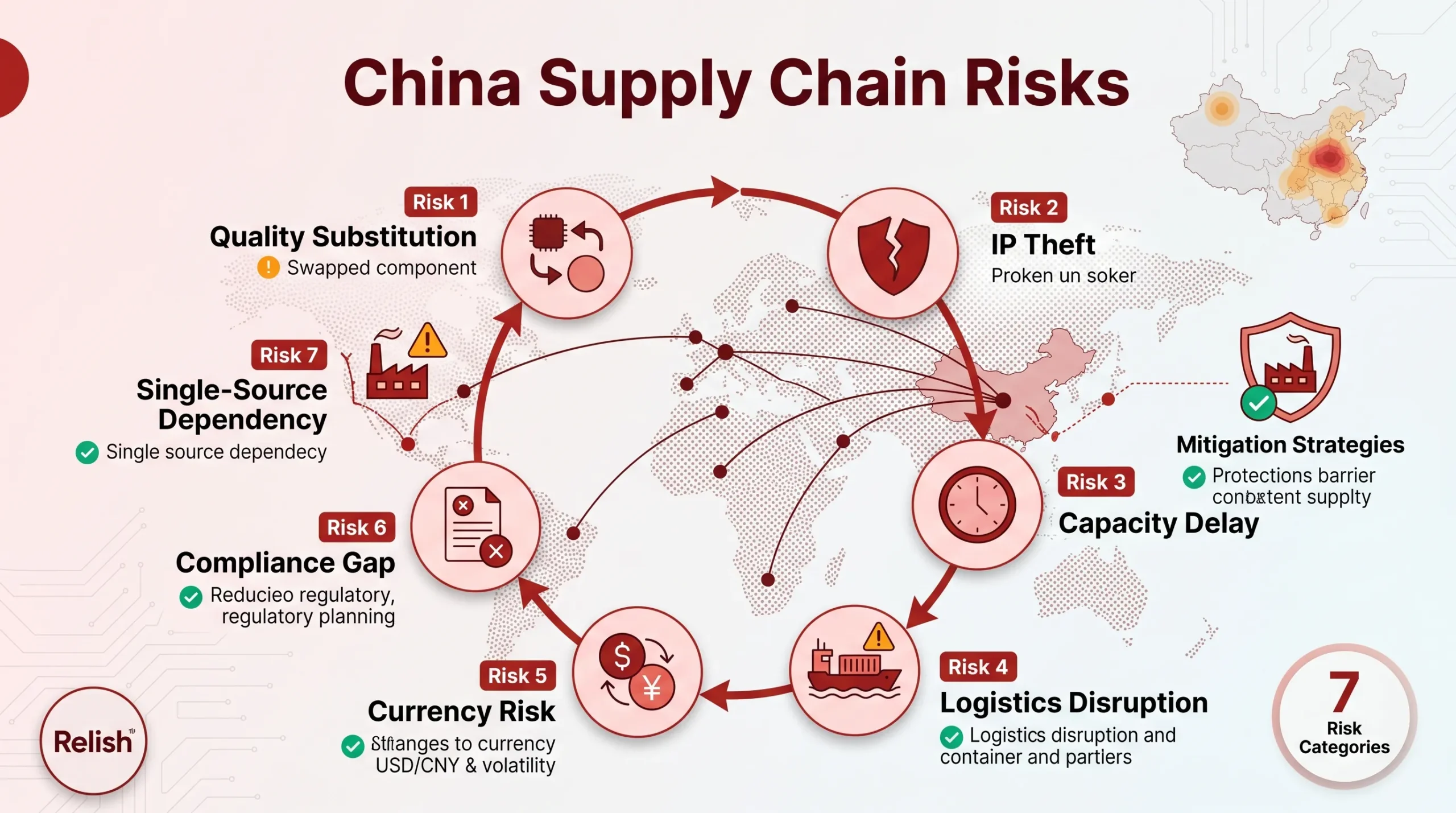
Every OEM brand sourcing from China faces supply chain risks. This guide covers 7 major China supply chain risks - from quality substitution to currency exposure - with concrete mitigation strategies that experienced importers apply daily.
Key Takeaways
- The 7 primary China supply chain risks: quality substitution, IP theft, capacity constraints, logistics disruption, currency/payment risk, compliance gaps, and single-source dependency
- Quality substitution - swapping approved components after sampling - is among the most frequently reported supply chain risk for brands who import from China without systematic inspection protocols
- Maintain 60-90 days of safety stock for core SKUs to buffer against lead time variation
- Chinese New Year creates a 3-4 week production gap - plan orders by October for spring delivery
- Dual-source your core product: qualify two factories so no single supplier holds your brand hostage
- Working with a long-term OEM partner (5+ year relationship) eliminates most of these China supply chain risks through trust and systems
China supply chain risks are real - but they are not mysterious or unmanageable. Every risk in this guide has a documented mitigation strategy that experienced importers use every day. The goal is not to eliminate all risk (impossible in any global supply chain), but to reduce your exposure to levels your business can absorb.
| # | Risk | Likelihood | Business Impact | Mitigation Effort |
|---|---|---|---|---|
| 1 | Quality Substitution | Alta | Alta | Medio |
| 2 | IP Theft | Medio | Alta | Medio |
| 3 | Capacity & Lead Time Risk | Alta | Medio | Bajo |
| 4 | Logistics Disruption | Medio | Medio | Bajo |
| 5 | Currency & Payment Risk | Low-Med | Medio | Bajo |
| 6 | Regulatory Compliance Gap | Medio | Alta | Medio |
| 7 | Single-Source Dependency | Bajo | Alta | Alta |
Risk 1: Quality Substitution - China's #1 Supply Chain Risk for Brands
Mitigation Strategies
- Golden sample clause: Include in your OEM agreement that the approved sample is legally binding as the production standard. Photograph and seal the golden sample with both parties' signatures.
- Pre-shipment inspection every order: Hire SGS, Bureau Veritas, or Intertek for AQL inspection and functional testing on every production run - not just the first.
- Specify component suppliers by name: List your approved motor, battery, and PCB suppliers in the OEM contract. Any substitution requires written approval and new QC sign-off.
- Resident quality agent: For brands placing 3+ orders per year, a local quality agent in Shenzhen ($500-$1,500/month) provides eyes on production without requiring your travel.
Risk 2: IP Theft - A High-Impact China Supply Chain Risk in OEM Relationships
Mitigation Strategies
- NNN Agreement first: Sign before sharing any design data. See our complete NNN Agreement guide for what this must include to be enforceable in China.
- Register trademarks and patents in China directly before approaching any manufacturer - trademark registration with CNIPA (China National Intellectual Property Administration) costs approximately $150-$500 per class.
- Supply chain segmentation: No single supplier receives your complete product specification.
- Mold ownership in your name: Custom tooling must be registered to your company - prevents the factory from using your molds for competitors after contract end.
Risk 3: Production Capacity & Lead Time - Critical China Supply Chain Risk in Peak Season
Mitigation Strategies
- Production slot booking: Confirm your production slot in writing 8-10 weeks before needed ship date. Include a contractual penalty clause for late delivery (1-2% of order value per week).
- 60-90 day safety stock: For your best-selling SKUs, never let inventory fall below 60 days of sales - this buffers most lead time variations.
- Seasonal timing awareness: Chinese New Year (late Jan - mid Feb) creates a 3-4 week production gap. Place orders by October-November for spring delivery. See the seasonal calendar below.
- Dual-source qualification: Qualify a second factory for your core product. Even if you never activate the second factory, its existence gives you negotiating leverage and emergency capacity.
Seasonal Risk Calendar: China Manufacturing
Need a Risk Assessment for Your China Supply Chain?
Relish Technology's OEM team provides a complimentary supply chain risk review for brands evaluating their first or next China manufacturing partner.
Schedule a Risk Review CallRisk 4: Logistics & Freight Disruption - Planning Around China Supply Chain Risks
Mitigation Strategies
- Book freight 4-6 weeks in advance during Q3 peak season. Spot market freight rates during peak can be 3-5x normal (see Statista China Ocean Freight Rate Index).
- Use multiple ports: Yantian (Shenzhen), Nansha (Guangzhou), and Hong Kong are all viable export points - flexibility prevents single-port congestion from halting your shipment.
- Cargo insurance: $500-$800 for a container - eliminates catastrophic loss exposure. Particularly important for lithium battery shipments subject to IATA DGR / UN 38.3 requirements.
- Freight forwarder relationship: A dedicated forwarder with China office presence has relationships to expedite customs and find alternative vessel space.
- Air freight buffer: Build the option of air freight into your pricing model for small urgent replenishments (5-10x cost, but prevents stockout on top sellers).
Risk 5: Currency & Payment - Managing Financial China Supply Chain Risks
Mitigation Strategies
- USD-denominated contracts: Negotiate all OEM agreements in USD to eliminate exchange rate exposure at the factory level.
- Payment verification protocol: Always call your supplier's verified phone number to confirm bank details before any transfer. Never change payment details based on email alone - Business Email Compromise (BEC) fraud costs importers millions annually.
- Payment structure: Standard 30% deposit + 70% against Bill of Lading copy. For first orders with new suppliers, consider Alibaba Trade Assurance or Letter of Credit for additional protection.
- Currency hedging: For large annual order volumes exceeding $500,000, forward contracts through your bank can lock in exchange rates.
Risk 6: Regulatory Compliance Gaps - A High-Impact China Supply Chain Risk at Customs
Mitigation Strategies
- Confirm regulatory scope before ordering: Clarify which certifications apply to your product and market (FDA, CE, PSE, RCM). See our OEM certifications guide for full requirements for oral care products.
- Request test reports before production: IEC 60335 (electrical safety), UN 38.3 (battery transport), and REACH/RoHS reports should be on file before your production run starts. ISO 13485 certified factories maintain stricter quality systems.
- Label review for destination market: Have your freight forwarder or regulatory consultant review packaging artwork before mass print - label corrections post-production are expensive.
- Stay current on regulatory changes: EU MDR changes, FDA enforcement updates, and Amazon compliance policies shift annually. Subscribe to regulatory update services for your categories.
Risk 7: Single-Source Dependency - Eliminating Concentration China Supply Chain Risks
Mitigation Strategies
- Dual-source qualification: Qualify at least one backup factory for your core SKU. You do not need to split orders actively - having a qualified second source creates both risk insurance and negotiating leverage with your primary.
- Extended safety stock: Single-source brands should maintain 90+ days of safety stock, not 60. The extra cost of excess inventory is cheap insurance against supply disruption.
- Factory diversification over time: As your volume grows, naturally route new SKUs to a second manufacturer to build that relationship without disrupting existing production.
- Mold and tooling backup: Keep digital copies of all your mold specifications and tooling drawings - if a factory closes, another can re-create your tooling faster with complete documentation.
Preguntas frecuentes
Reduce China Supply Chain Risks with a Proven Partner
Relish Technology has served 300+ brands over 15 years with zero major supply chain incidents. ISO 13485 certified, pre-shipment inspection included, NNN agreement standard. Start with a risk-free sample order.
Request a Risk Assessment CallReferencias y fuentes
- McKinsey & Company. (2023). Risk, resilience, and rebalancing in global value chains. McKinsey Global Institute. Retrieved from https://www.mckinsey.com/business-functions/operations/our-insights/risk-resilience-and-rebalancing-in-global-value-chains
- Resilinc. (2024). Annual Supply Chain Disruption Report 2024. Resilinc Inc. Retrieved from https://www.resilinc.com/biannual-global-supply-chain-disruptions-report
- FBI Internet Crime Complaint Center (IC3). (2024). Business Email Compromise: The $55 Billion Scam. FBI.gov. Retrieved from https://www.ic3.gov
- Statista. (2025). China Ocean Freight Rate Index - Shenzhen to US West Coast 2022-2025. Extraído de https://www.statista.com/statistics/1265619/china-ocean-freight-rate-index/
- China Ministry of Commerce (MOFCOM). (2024). Annual Report on China's Foreign Trade. Extraído de https://www.mofcom.gov.cn