






China Factory Audit Checklist:30-Point Guide for Oral Care Brands

China Factory Audit Checklist:30-Point Guide for Oral Care Brands

Cluster 5 · Article 1

China Factory Audit Checklist:
30-Point Guide for Oral Care Brands

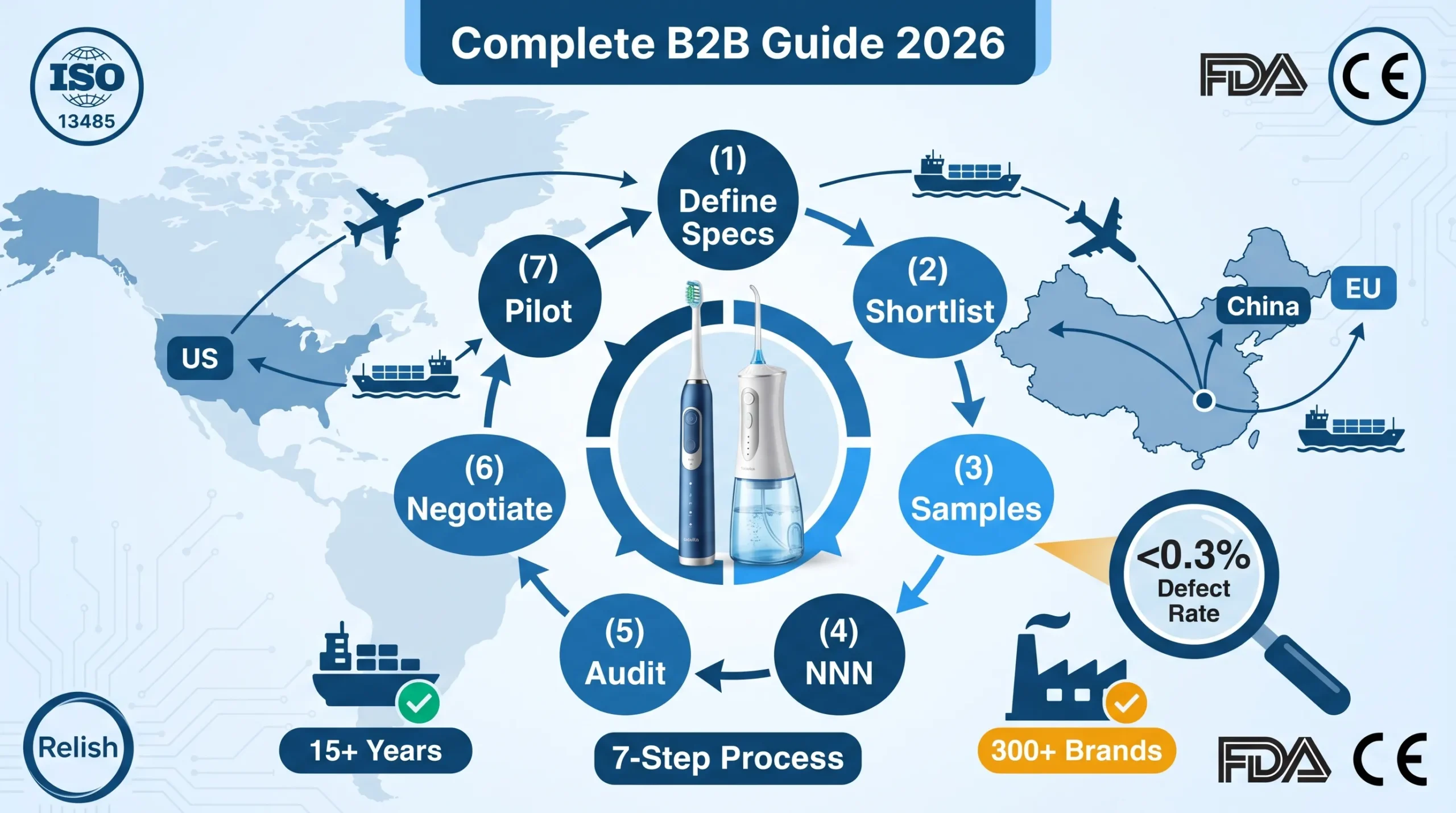
Before you place your first order with a Chinese oral care manufacturer, run through this 30-point china factory audit checklist. Built from 15 years of factory experience — covering certifications, quality systems, capacity, and compliance.

ISO 13485 Verification 30 Audit Points Critical / Major / Minor Priority Third-Party Audit Guidance
factory audit checklist oral care oem

Key Takeaways

  • A china factory audit checklist is your single most important due-diligence step before sourcing oral care products from China
  • This 30-point checklist covers 6 categories: Certifications, Quality Systems, Production Capacity, Product Compliance, IP & Confidentiality, and Labor Standards
  • Priority levels: Critical (must pass), Major (strongly recommended), Minor (best practice)
  • Third-party audits (SGS, Bureau Veritas, Intertek) cost $400–$900 and pay for themselves on orders above $10,000
  • Score your factory: 90%+ Critical items pass = proceed. Below 70% = do not order
  • Most China OEM factories have an MOQ of 500–2,000 units per SKU — always audit before committing at this scale
🏭 20,000 m² Shenzhen Factory
ISO 13485 Certified
🇺🇸 FDA Registered
🇪🇺 CE Certified
📋 Audit-Ready — Anytime

A factory audit is the bridge between a promising supplier and a trusted manufacturing partner. Brand owners who skip this step routinely report the same outcomes: late deliveries, quality rejections, regulatory failures, and in some cases, IP theft. The cost of a china factory audit checklist review — in time or money — is trivial compared to the cost of any one of these failures.

This checklist is designed for oral care products specifically: electric toothbrushes, water flossers, and related devices. It reflects the regulatory requirements for FDA (US), CE (EU), and ISO 13485 compliance. Use it for in-person audits, video audits, or when briefing a third-party inspection agency.

How to Use This China Factory Audit Checklist

Each audit item is rated by priority. Run through all 30 points systematically — skipping even one Critical item can lead to costly production failures or regulatory blocks after orders are placed.

  • Critical: A fail on any Critical item is a hard stop — do not proceed until resolved. These items affect safety, legality, or fundamental quality capability.
  • Major: A fail on Major items requires corrective action before the first production order. These affect consistency and compliance.
  • Minor: Minor items represent best practices. Three or more Minor fails should trigger a follow-up audit.
90–100%
Critical Items Pass
Proceed with pilot order
70–89%
Critical Items Pass
Corrective action plan required
<70%
Critical Items Pass
Do not proceed — find alternative

Category 1: Certifications & Legal Compliance

These items verify that the factory operates legally and holds the certifications required for your target markets. Request original documents — not copies — and verify directly with the issuing body where possible. For a deeper overview of what certifications to prioritize by market, see our Electric Toothbrush Certifications Guide.

01–06 Certifications & Legal Compliance 6 items
1
ISO 13485 certificate is current (check expiry date) and issued by an accredited certification body
Verify at IAF CertSearch: iaf.nu — confirm certificate is not suspended and scope covers medical device manufacturing
Critical
2
Business license is current and matches factory name, address, and legal representative
Request original; verify on China's GSXT enterprise registration portal
Critical
3
CE technical files or Declaration of Conformity available for equivalent product categories
Indicates experience with EU market compliance; reduces your certification cost
Major
4
FDA establishment registration (or equivalent product test reports for FDA submission)
For US market; verify FDA registration at accessdata.fda.gov. Per 21 CFR Part 820, medical device manufacturers must maintain a Device Master Record (DMR) and Device History Record (DHR)
Major
5
IEC 60335 (electrical safety) and UN 38.3 (battery transport) test reports available
Reports must be from accredited test labs (SGS, Intertek, TÜV, etc.). UN 38.3 is mandatory for lithium battery air shipments under IATA DGR
Critical
6
RoHS and REACH compliance documentation available for materials
Required for EU export; Material Safety Data Sheets for key components
Major

Category 2: Quality Management Systems

Beyond holding ISO 13485 on paper, a qualified factory must demonstrate that its quality management system is operational. Ask to see records, not just policies. Factories that can pass this section of a china factory audit checklist consistently are those most likely to maintain quality across long-term production runs.

07–14 Quality Management Systems 8 items
7
Incoming Quality Control (IQC) procedure: 100% inspection of motors, batteries, and PCBs
Ask to see IQC records from the past 3 months; rejection rate should be documented
Critical
8
In-Process Quality Control (IPQC) checkpoints at each production stage
SPC charts or automated optical inspection (AOI) systems are strong positive indicators
Critical
9
Outgoing Quality Control (OQC): 100% functional testing of finished products
Verify waterproof testing (IPX5/IPX7 submersion), vibration frequency, and battery duration tests
Critical
10
AQL sampling plan documented and followed (AQL 1.5 for Critical defects, AQL 2.5 for Major)
Ask to see actual AQL inspection records — verify against ANSI/ASQ Z1.4. Top-tier factories maintain AQL 1.5 for all functional and safety defects
Major
11
Documented defect rate records for the past 12 months (target: <0.3% defect rate for top-tier factories)
A factory unwilling to share defect rate data should be treated with caution. Industry average for oral care electronics: 0.8–1.5%; best-in-class: <0.3%
Major
12
Non-conforming product quarantine area clearly marked and segregated
Rejected goods must never re-enter production flow without documented approval
Major
13
Corrective Action / Preventive Action (CAPA) system with documented resolution records
Ask for 2–3 examples of CAPA cycles — quality improvement process maturity
Major
14
Traceability system: batch records link materials → production → finished goods → shipment
Critical for recall management; required under ISO 13485 and FDA 21 CFR Part 820 (Device History Record)
Critical

Audit Relish Technology Before You Commit

ISO 13485 certified · <0.3% defect rate · FDA registered · CE certified · Audit-ready on short notice. Request our factory documentation package today.

Request Audit Docs →

Category 3: Production Capacity & Capability

Verify the factory can actually deliver your volume, on your timeline, with the technology your product requires. This section is particularly important when evaluating factories against your MOQ requirements — capacity claims without evidence are one of the most common issues found during a china factory audit.

MOQ Considerations: Most oral care OEM factories in China operate with MOQs of 500–2,000 units per SKU. Custom mold development typically requires a separate tooling investment of $3,000–$8,000, independent of MOQ. Always clarify whether a factory's stated MOQ includes packaging, accessories, and firmware customization — or just the base unit. Smaller MOQs (<500 units) are often available for rebranded standard models without custom tooling.
15–20 Production Capacity & Capability 6 items
15
Monthly production capacity confirmed and evidenced (production orders, shipping records)
Watch for capacity inflation; cross-check with actual machine count and shift schedules. Typical mid-tier factories: 30,000–80,000 units/month for electric toothbrushes
Critical
16
Motor vibration frequency testing equipment on site (target: 31,000 strokes/min for sonic)
For sonic toothbrushes, frequency is a core spec — must be verified in-house
Critical
17
IPX waterproofing test chamber on site (submersion at 1m depth for 30 minutes)
Required for IPX7; IPX5 splash testing should be 100% of units
Critical
18
Injection molding machines on site or documented tier-1 subcontractor relationship
Factories subcontracting all plastic molding have less control over tolerances and lead times
Major
19
R&D team and sample room: can produce prototype within documented lead time
Minimum: 3–5 engineers dedicated to product development; sample room reflects real capability
Major
20
References from at least 2–3 Western brand clients (contactable)
Ask for introduction emails or LinkedIn profiles; a factory with no verifiable brand clients is higher risk
Major

Category 4: IP & Confidentiality

IP protection audit items are often overlooked but are critical for brand owners with proprietary designs. During your china factory audit, always verify these items in writing — verbal commitments are not enforceable under Chinese commercial law. For detailed contract templates, see our NNN Agreement guide.

21–24 IP & Confidentiality 4 items
21
Factory willing to sign NNN Agreement (Non-Disclosure, Non-Use, Non-Circumvention) under Chinese law
Refusal to sign is a hard disqualification for any brand with proprietary designs
Critical
22
Mold ownership clause: custom molds are registered in the client's name, not the factory's
Without this, the factory retains legal ownership and can use your molds for competitors
Critical
23
IT security: CAD files and product specs stored on restricted internal systems (not personal WeChat/email)
Ask about document management policies; factory staff using personal phones for file transfer is a red flag
Major
24
No evidence of selling competing products under the same specification to multiple buyers without permission
Check Alibaba listings and made-in-China.com for identical products under different brand names
Major

Category 5: Supply Chain & Component Quality

Component quality is where most product field failures originate. In oral care OEM manufacturing, the three highest-risk components are motors, lithium batteries, and PCBs. When running your china factory audit checklist, always ask for Approved Vendor List documentation and cross-check supplier names against known brands. For a detailed comparison of component specifications by technology type, see our Sonic vs. Oscillating-Rotating Technology guide.

25–28 Supply Chain & Component Quality 4 items
25
Approved Vendor List (AVL) for key components (motors, batteries, PCBs) with documented qualification criteria
Factories without an AVL substitute components opportunistically — a primary source of quality inconsistency across production batches
Critical
26
No single-source dependency for any critical component (motor, battery, PCB)
Single-source risk: one supplier disruption halts your entire production run
Major
27
Battery suppliers hold UN 38.3 and IEC 62133 certification; batteries are sourced from named brand suppliers
Generic, uncertified batteries are among the leading causes of field failures and return claims for electric toothbrushes sold on Amazon and in EU retail. Always request battery supplier certificates during your china factory audit.
Critical
28
Bristle material certified food-grade nylon (Dupont or equivalent); no recycled nylon content
Recycled nylon bristles shed particles and fail ADA endorsement standards
Critical

Category 6: Labor, Social & Environmental Compliance

Social and environmental compliance is no longer optional for brands selling into the EU or major US retail channels. The EU's Corporate Sustainability Due Diligence Directive (CSDDD) creates legal liability for brands that cannot document their supply chain's labor practices. Including these items in your china factory audit checklist protects you from both regulatory and reputational risk.

29–30 Labor, Social & Environmental Compliance 2 items
29
SA8000 or BSCI social compliance audit passed within the past 2 years
Or equivalent audit from SEDEX, amfori, or major retail buyers. Increasingly required by EU importers under CSDDD
Major
30
Environmental management: waste disposal records, no banned substances in chemical inventory
Relevant for EU REACH compliance and brand ESG reporting requirements
Minor

Third-Party Audit Options: Cost & Scope Comparison

If you cannot visit the factory in person, or want an objective third-party assessment, hire an accredited inspection company. Each has different strengths. For context on when to use third-party versus in-house audits, see our Sourcing Oral Care from China Guide.

SGS
$500–$900
Gold standard for EU/US compliance. Strongest regulatory expertise. Detailed written report.
Bureau Veritas
$450–$800
Strong in consumer electronics. ISO 13485 audit expertise. Good turnaround times.
Intertek
$400–$750
Competitive pricing. Broad certification coverage. Offices throughout Guangdong.
QIMA
$299–$500
Digital-first platform. Quick booking. Good for SMBs on tighter budgets.
Pro Tip from Relish Technology: When inviting third-party auditors, always send them this 30-point china factory audit checklist in advance and ask them to include it in their report. Generic factory audits often miss oral-care-specific items like IPX testing and ADA bristle certification.
Red Flag Alert: If a factory refuses third-party audit access — or requires 2+ weeks notice before allowing any audit — treat this as a critical red flag. Factories with nothing to hide welcome audits on short notice.

For a complete framework on working with Chinese oral care manufacturers, start with our Sourcing Oral Care from China Guide. For IP-specific protection after the audit, see our NNN Agreement guide. If you're also evaluating which technology platform to manufacture — sonic versus oscillating-rotating — our OEM Technology Comparison covers motor selection, BOM cost, and certification implications. For ongoing quality control after the factory audit, see our OEM Quality Control Guide.

Frequently Asked Questions About China Factory Audits

What is a China factory audit and why is it important?
A China factory audit is a systematic inspection of a manufacturer's facilities, quality management system, certifications, production capacity, and labor compliance. For oral care brands, it's critical because product safety, regulatory compliance, and IP protection all depend on choosing a verified manufacturer. Brands that skip factory audits face significantly higher rates of defect returns, regulatory rejections, and IP disputes.
How much does a China factory audit cost?
Third-party audits (SGS, Bureau Veritas, Intertek) cost $400–$900 per factory. QIMA and similar digital platforms offer audits from $299. For orders above $20,000, this cost is easily justified by defect prevention alone — a single quality rejection on a 5,000-unit order typically exceeds the audit cost by 10x.
What certifications should an oral care manufacturer in China have?
Minimum: ISO 13485 quality management certification. Recommended additionally: FDA establishment registration, CE technical files, IEC 60335 electrical safety test reports, UN 38.3 battery transport reports, and RoHS/REACH compliance documentation.
Can I audit a China factory remotely?
Yes — video audits are valid for initial screening and many buyers use them routinely. But for orders above 5,000 units, an in-person or third-party physical audit is strongly recommended. Cameras cannot show you actual machine conditions, warehouse management, or worker behavior — all of which are meaningful quality signals.
What is the difference between a factory audit and a pre-shipment inspection?
A factory audit assesses overall manufacturing capability before you place your first order. A pre-shipment inspection checks a specific production batch against your specs — done when production is 80–100% complete. Both are recommended and serve different purposes: the audit qualifies the partner, the inspection verifies each order.
What is an AQL inspection and what level should I use?
AQL (Acceptable Quality Level) is the international sampling standard for goods inspection. For oral care electronics, use AQL 1.5 for critical defects (safety/functional) and AQL 2.5 for major defects (cosmetic). AQL 4.0 is too lenient. Require the factory to follow ANSI/ASQ Z1.4 sampling tables and document all inspection results.
What is the typical MOQ for Chinese oral care OEM manufacturers?
Most oral care OEM factories in China set MOQs of 500–2,000 units per SKU for standard models. Custom tooling (new molds) requires a separate investment of $3,000–$8,000 and typically unlocks lower ongoing per-unit pricing at volumes of 3,000+ units. Some factories offer rebranding programs with MOQs as low as 200–500 units for existing product lines. Always clarify whether MOQ includes packaging, accessories, and localization before running your factory audit checklist.
How do I verify a factory's ISO 13485 certificate is genuine?
Search the IAF CertSearch database (iaf.nu) using the certificate number or company name. Confirm the certificate is not suspended, the scope covers your product category, and the issuing certification body is IAF-accredited. Never rely solely on a PDF provided by the factory — certificate fraud is not uncommon in supplier databases.

Ready to Audit Relish Technology's Factory?

We welcome audits — by you or any accredited third party. ISO 13485 certified, <0.3% defect rate, FDA registered, CE certified, 15 years of OEM experience. Request an audit invitation today.

Request Factory Audit Invitation →

Referencias

  1. Organización Internacional de Normalización. (2016). ISO 13485:2016 — Medical devices — Quality management systems — Requirements for regulatory purposes. ISO. Retrieved from https://www.iso.org/standard/59752.html.
  2. American Society for Quality. (2008). ANSI/ASQ Z1.4-2008: Sampling procedures and tables for inspection by attributes. ASQ. Retrieved from https://www.asq.org/quality-standards/ansi-asq-z14.
  3. Bureau Veritas Group. (2024). Factory audit services for consumer electronics — China operations. Bureau Veritas. Retrieved from https://www.bureauveritas.com/services/factory-audit.
  4. International Electrotechnical Commission. (2020). IEC 60335-2-52: Household and similar electrical appliances — Safety — Particular requirements for oral hygiene appliances. IEC. Retrieved from https://webstore.iec.ch/publication/6828.
  5. European Commission. (2021). Regulation (EU) 2017/745 on medical devices (MDR). Official Journal of the European Union. Retrieved from https://eur-lex.europa.eu/eli/reg/2017/745/oj.
  6. United Nations Economic and Social Council. (2023). UN Manual of Tests and Criteria, Part III, Section 38.3: Lithium metal and lithium ion batteries. ST/SG/AC.10/11/Rev.8. Retrieved from https://unece.org/sites/default/files/2024-03/UN Manual of Tests and Criteria Rev.8 Amendment 1.pdf.
  7. U.S. Food and Drug Administration. (2023). 21 CFR Part 820 — Quality system regulation for medical devices (Device Master Record and Device History Record requirements). U.S. Department of Health and Human Services. Retrieved from https://www.accessdata.fda.gov/scripts/cdrh/cfdocs/cfcfr/CFRSearch.cfm?CFRPart=820.
  8. International Accreditation Forum. (2024). IAF CertSearch — Global certification body accreditation database. Retrieved from https://iaf.nu/search.

Este artículo fue revisado, probado y escrito por los equipos de ingeniería y laboratorio de Relish.


SOLICITAR PAQUETE DE MUESTRAS GRATUITAS

Experimente nuestra calidad de primera mano. Obtenga una caja seleccionada de nuestros cepillos de dientes eléctricos más vendidos, cabezales y opciones de empaquetado personalizadas.