










Electric Toothbrush Packaging Design: From Product Brief to Release Approval
Create packaging that protects your electric toothbrush, presents your brand clearly and fits your sales channel. This OEM guide covers the packaging brief, labels, materials, prototypes and final production approval.
Key Packaging Decisions
- Prepare product identification, any required protective packaging and battery transport documentation for the exact product, marketplace and shipping route.
- Check eligibility for Amazon’s Ships in Product Packaging (SIPP) program and validate the packaging against its current requirements.
- Measure the finished package and compare the actual weight, dimensional weight and current fee rules before approving its size.
- Sustainability is a competitive advantage: FSC paper, recycled plastics, and compostable materials resonate with health-conscious oral care consumers
- Use insert cards for setup, care and appropriate customer contact, with optional marketing consent and the sales channel’s rules in mind.
- Allow around 4–6 weeks for a standard prototype and approval cycle; schedule production and shipping separately.
Packaging is the first physical contact many customers have with your brand. It needs to protect the toothbrush and accessories in transit, carry the required product information and make unpacking straightforward. For Amazon FBA, confirm the applicable barcode, preparation and battery-document requirements before signing off the design.
Treat packaging as part of product development. Poor protection can lead to damage and returns, while unclear artwork can make the product harder to understand online. For US FBA shipments created from January 1, 2026, sellers must arrange preparation and item labeling before sending inventory; Amazon’s former prep fees are not a current service option.
This guide covers everything from FBA prep requirements to sustainability trends, structural engineering for electric toothbrushes, and cost optimization strategies that your OEM manufacturer can implement from day one. For a complete manufacturing overview, see our OEM manufacturing guide.
Why Packaging Matters More for E-commerce
Retail packaging needs to stand out on a shelf. E-commerce packaging also has to communicate through product photos and protect the order on its way to the customer. Design for both the online presentation and the experience of opening the box.
The Three Packaging Touchpoints on Amazon
- Search results: keep the product and branding recognizable when the image is reduced to a small thumbnail. Check the current image rules for your marketplace and category before deciding how to show the packaging.
- Product Detail Page Gallery: Customers view multiple angles of your packaging. Design every visible panel — front, back, and sides — with the same care you give the front panel.
- Unboxing: make the contents easy to identify, remove and use. A well-planned opening sequence can support your brand presentation and give customers something worth sharing.
FBA Packaging Requirements for Electric Toothbrushes
Amazon FBA preparation rules depend on the product and marketplace. A rechargeable toothbrush may also need battery classification and transport information. Use the requirements for the exact model and route, and consult our electric toothbrush certifications guide.
Product and Shipment Checks
| Requirement | Specification | What to Check Before Dispatch |
|---|---|---|
| Product Barcode | Use the barcode type allowed for the product and selling account. Under Amazon’s rules effective March 31, 2026, eligible Brand Registry brand representatives can use existing manufacturer barcodes; resellers and products without manufacturer barcodes require Amazon barcode stickers. Keep the correct barcode visible and scannable. | Confirm barcode eligibility and scan the final packaged unit. |
| Case Labeling | Use the shipment’s FBA box ID and carrier labels on the correct cartons. Keep these separate from unit-level product barcodes and add the shipping marks required for the route. | Check each carton against the shipping plan and label files. |
| Units per Case | Match the contents and quantities entered in the shipping plan. Check the current carton size and weight limits rather than assuming a universal 6–24-unit limit. | Verify carton quantities, dimensions and weights before booking freight. |
| Poly Bagging | Use a poly bag only where the product’s preparation requirements call for one. Amazon’s bagging guidance specifies at least 1.5 mil thickness and a suffocation warning for a flat bag opening of 5 inches or more; check the applicable marketplace instructions. | Confirm bag thickness, seal, warning and barcode visibility where applicable. |
| Expiration Dates | Check whether the product or any bundled consumable has an expiration date or shelf-life requirement. Apply the category-specific labeling and remaining shelf-life rules where required. | Check the product category and any dated contents. |
Battery-Specific FBA Requirements
Confirm the actual battery chemistry and configuration before arranging shipment. A lithium-ion battery contained in equipment has different documentation and packing requirements from other battery types and shipping configurations.
- UN 38.3 test summary: obtain the summary for the applicable cell or battery design and make it available to the logistics provider. It records transport testing; it is not a general product certification or a substitute for route-specific shipping documents.
- Battery information: confirm the battery’s watt-hour rating and the product information required by the marketplace and carrier. Apply the relevant marks and labels for the specific shipment.
- Transport classification: agree the correct classification, packing instructions and documents for batteries contained in or packed with equipment, using the actual chemistry and shipping mode.
- Protection: prevent short circuits, damage and accidental activation, and secure the product and accessories inside the packaging.
Structure Design for Electric Toothbrushes
An electric toothbrush combines a handle, motor, brush heads, charging accessories and, in many models, a rechargeable battery. Design the internal supports around the actual components, with enough retention and cushioning to prevent movement and damage.
Internal Packaging Architecture
Build the internal packaging around these functions:
- Product retention: use a fitted tray, molded pulp or suitable cushioning to hold the handle securely. An internal 3-foot drop check can help compare prototypes, but it does not replace the complete test protocol required for your shipping or packaging program.
- Brush head protection: support each brush head without crushing the bristles. Use separate pockets or fitted supports and keep the bristles away from surfaces that could deform them.
- Handle protection: provide cushioning at impact-sensitive points and confirm its performance with the actual handle weight and package structure.
- Accessories compartmentalization: Charging bases, travel cases, and additional brush heads should be held in their own compartments — never loose in the same cavity as the main unit.
- Moisture control: choose suitable packaging, storage conditions and any desiccant for the route. A desiccant packet can support moisture control, but it cannot compensate for unsuitable materials or an unsealed shipment.
Travel Case and Portable Models
If the product includes a travel case, fit both the case and the toothbrush into a clear, protective packing arrangement. Options include:
- Dual-cavity box: One compartment for the main unit, one for the travel case. Common for premium models.
- Nested design: place the toothbrush and suitable accessories inside the travel case, then secure the case in the retail box. Check that this arrangement protects the finish and bristles.
- Slip-over sleeve: Main box accommodates both units in a side-by-side layout with a partial sleeve that covers both during retail display.
Branding Your OEM Packaging
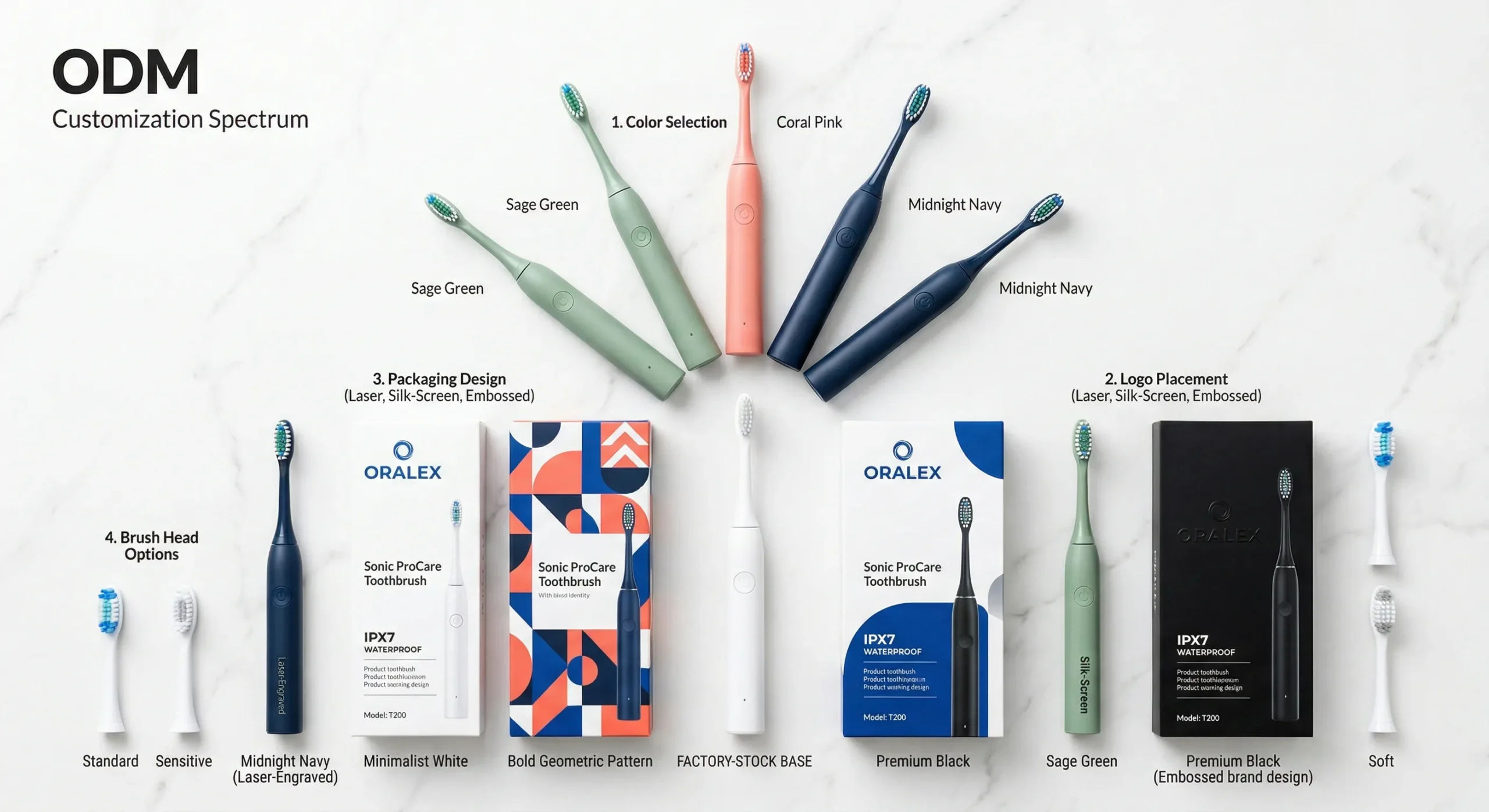
OEM packaging gives your brand more room to communicate than a logo alone. Coordinate the structure, colors, product information and opening sequence. Our custom packaging solutions guide covers ways to develop that presentation.
Logo Placement and Visibility
Check how the packaging appears in approved product images at thumbnail size. Give the front panel a clear visual hierarchy:
- Logo placement: Upper third of the front panel — the area most visible at thumbnail size
- Logo size: test readability in the actual product image and at thumbnail scale instead of relying on a fixed percentage of panel height.
- Brand color: Choose a brand color distinct from the dominant blue/white/green palette common in oral care. Relish Tech's clients have succeeded with coral, mint green, charcoal, and even black packaging that stands out in search results.
- Product visibility: At minimum, show the brush head prominently — it is the most recognizable element of an electric toothbrush
Insert Card Strategy
Insert cards can connect setup instructions, care reminders and customer communication. Relish’s 2025 customer data records QR scan rates of 0.3–1.2%. Place the card where it is easy to find and make the next step useful to the customer.
Insert card best practices for electric toothbrushes (internal customer data, 2025):
- QR code: link to useful product information or an optional email signup where the sales channel permits it. Explain the purpose and obtain any required marketing consent; check marketplace rules before adding discounts or external links.
- Brush head reminder: provide the replacement interval recommended for the model and remind customers to replace worn or damaged heads sooner.
- Social sharing: invite customers to share photos voluntarily and obtain permission before reusing their content. Keep this separate from review requests and follow the platform’s review and promotion rules.
- Product registration: offer a clear route to warranty support. Keep optional marketing consent separate and do not make statutory warranty rights depend on joining an email list.
Sustainability Trends in Oral Care Packaging
Sustainable packaging can help express your brand’s priorities, but the material needs to work for the product and the customer’s disposal options. McKinsey’s March 2025 survey of 1,000 US consumers examined packaging sustainability; its results do not establish a universal personal-care purchase or price-premium rate. Our sustainability guide covers material options for your project.
Available Sustainable Packaging Materials
| Material | Properties | Illustrative Cost Difference | Checks for the Finished Package |
|---|---|---|---|
| FSC-certified paperboard | Choose the appropriate FSC label and certified supply chain for the paperboard. Select inks and coatings for print performance and the intended recycling route. | +5–15% | Check structure, labeling and any packaging-program requirements. |
| Recycled PET (rPET) | Recycled PET can be used for clear or tinted trays. Confirm the recycled-content specification, retention performance and local disposal guidance. | +10–20% | Check tray retention, protection and the complete package. |
| Molded pulp (palm fiber) | A fiber-based alternative to foam inserts. Verify cushioning performance and any compostability claim for the actual material and local disposal route. | Neutral to +10% | Test retention and protection with the finished package. |
| Compostable cellulose film | A possible window material. Use the certification and disposal instructions for the specific film rather than treating all cellulose film as certified compostable. | +15–30% | Check film strength, attachment and package performance. |
| Water-activated tape | A paper-based sealing option; select the tape and reinforcement to suit carton weight, handling and recycling requirements. | Neutral | Confirm sealing strength for the carton and route. |
| Seed paper | Paper containing seeds can be used for a brand insert where appropriate. Check destination import and plant-health restrictions before including it in a cross-border order. | +20–40% | Check destination restrictions and channel rules before use. |
Cost Optimization for Electric Toothbrush Packaging Design
Reduce total packaging cost by balancing materials, assembly time, product protection and shipping dimensions. Compare complete designs, rather than selecting the cheapest material in isolation.
Dimensional Weight Optimization
Dimensional weight depends on the carrier or platform rules. Where the US inch-based divisor of 139 applies, length × width × height ÷ 139 gives pounds. The following calculations illustrate the effect of package volume; they are not current FBA fee tiers or quotations.
| Package Dimensions (in) | Volume (in³) | Dimensional Weight (lb) | Design Check |
|---|---|---|---|
| 8 × 6 × 2 | 96 | 0.69 | Check product fit and protection before reducing size. |
| 9.6 × 7.2 × 2.8 | 193.54 | 1.39 | Use finished external dimensions, including any bulging. |
| 10 × 8 × 3 | 240 | 1.73 | Compare dimensional and actual weight under the applicable rules. |
| 15 × 12 × 8 | 1,440 | 10.36 | Check the relevant size category and current fee calculator. |
For example, 9.6 × 7.2 × 2.8 inches gives approximately 1.39 lb using a divisor of 139. A height of 2.8 inches is 0.05 inches above 2.75, but neither that difference nor the dimensional-weight result alone proves a fee-tier change. Enter the finished size, actual weight, product category and marketplace into the current calculator.
MOQ Impact on Packaging Cost
| Order Quantity | Box Unit Cost | Insert Card Unit Cost | Tooling/Amortization | Total Packaging Cost |
|---|---|---|---|---|
| 500 units | $0.85 | $0.18 | $0.40 (custom dies) | $1.43/unit |
| 2,000 units | $0.65 | $0.10 | $0.10 | $0.85/unit |
| 5,000 units | $0.52 | $0.07 | $0.04 | $0.63/unit |
| 10,000 units | $0.44 | $0.05 | $0.02 | $0.51/unit |
Larger print runs can reduce unit cost, but compare the total order value, storage space and risk of obsolete artwork. Coordinate packaging quantities with the product order and approved design rather than automatically choosing the largest run.
Ready to Optimize Your Electric Toothbrush Packaging Design for Amazon FBA?
Relish’s packaging team develops the structure, artwork and documentation for your product and sales channel. Packaging print runs can start from 500 units depending on the design. Custom product orders normally start from 1,000 units, with flexibility for the project; stocked products are available wholesale from 50 units.
Design-to-Cost Approach
Rather than designing packaging and then asking what it will cost, work backward from your target packaging cost per unit:
- Set a target unit cost against your retail price and channel economics. The 8–12% range can be a planning reference, not a universal consumer-electronics benchmark.
- Set package dimensions using product protection, actual weight and the current channel or carrier cost rules.
- Compare structures within budget. A standard tuck-end box may cost less than a more complex mailer, but it must provide the protection required for its shipping arrangement.
- Compare printing quotations at your actual quantity, artwork and finish requirements. Digital, offset and flexographic printing have different setup costs and economical run lengths.
- Specify board thickness and test the finished structure. The 20 pt and 24 pt figures describe thickness, not grammage; use a thinner board only if it provides the required protection.
Prototyping & Sampling for Electric Toothbrush Packaging Design
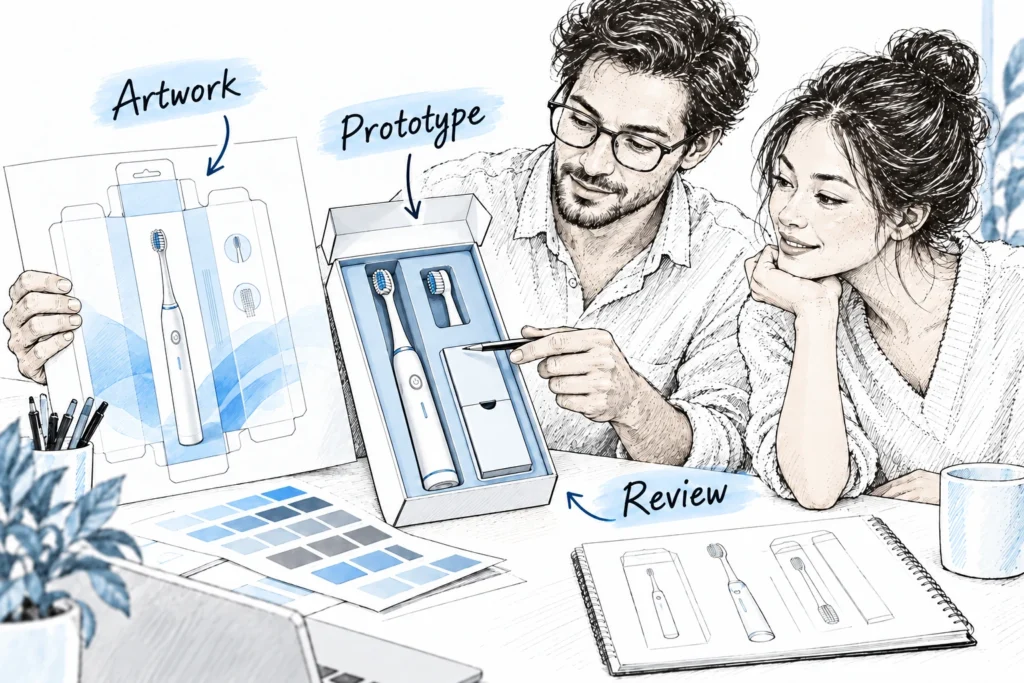
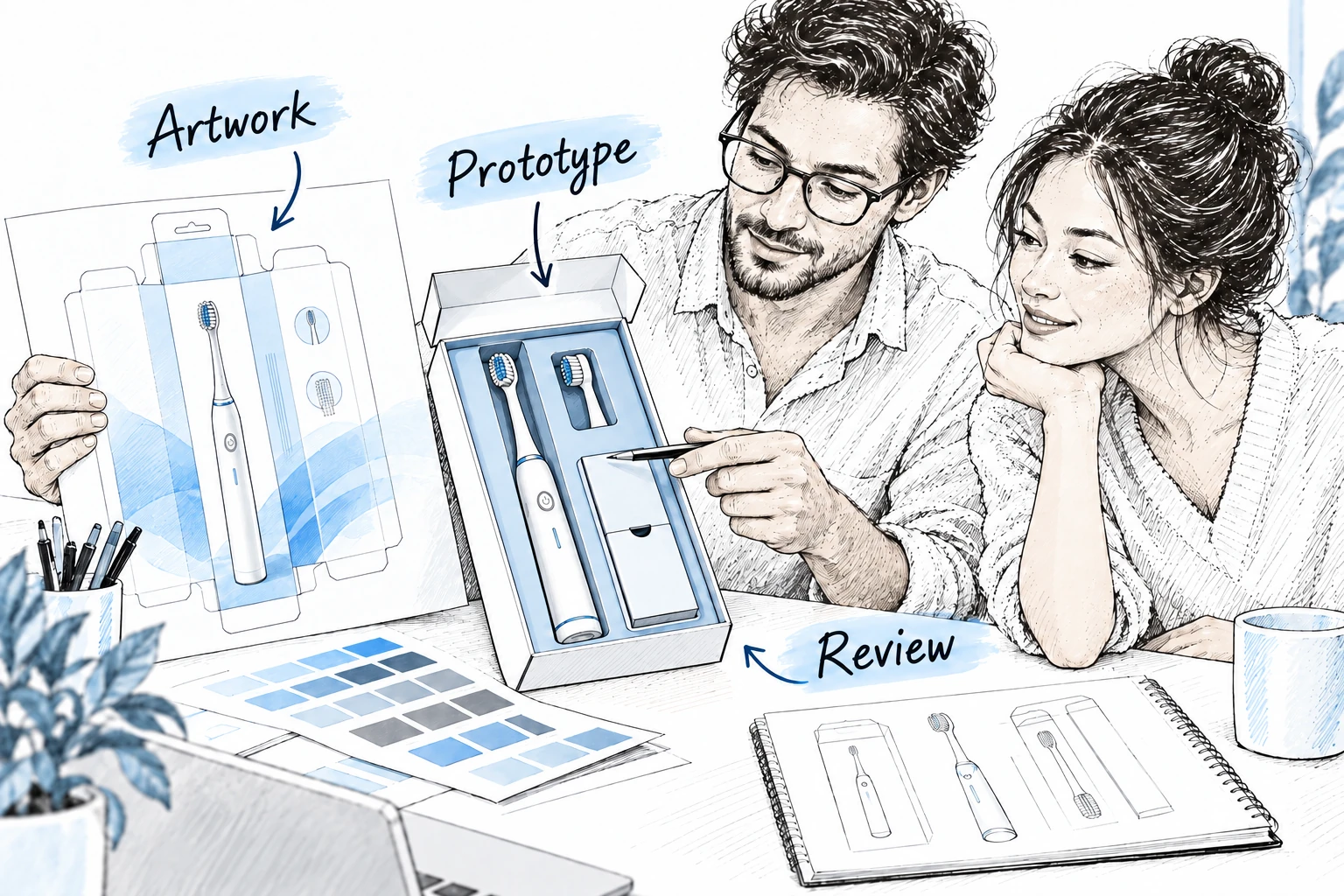
Use three approval stages to keep the design, physical sample and production files aligned. Agree the schedule with the manufacturer before committing to a launch date.
Phase 1: Design Phase (Week 1–2)
Provide your OEM manufacturer with:
- Final artwork in the agreed AI, EPS or print-ready PDF format. Check raster-image resolution at final size, and confirm bleed and dieline requirements with the printer; vector artwork itself does not have a DPI requirement.
- Brand guidelines (color codes in Pantone, CMYK, and RGB)
- Structural requirements (maximum dimensions, FBA fee tier targets)
- Market and channel requirements: required languages, applicable warnings, transport markings and any packaging-program certification you are seeking. Proposition 65 is a warning requirement where applicable, not a product certification.
- Bill of materials for internal packaging (foam type, blister material, insert card quantity)
Review the dieline and 3D render before sampling. Check dimensions, panel orientation, text, barcode position and artwork version. A render supports review but cannot replace a physical sample and print check.
Phase 2: Sample Phase (Week 3–5)
Agree the sample quantity with the manufacturer; a 5–20-sample run may be suitable for an initial review. Check:
- Structure: check retention, cushioning and opening with the actual product. Use the agreed transport-test protocol where required; a single 3-foot drop is only an internal screening check.
- Print quality: Do colors match your brand standards? Check for ink banding, misalignment, or color variation.
- Barcode readability: scan the correct product barcode on the printed and assembled sample with suitable equipment. Check contrast, size, quiet zones and any folds, coatings or seals that could obstruct scanning.
- Label review: check the required information and languages for the product, market and route, including any applicable suffocation or Proposition 65 warning and country-of-origin marking.
- Assembly: time the packing process and identify awkward steps. Use 60 seconds as a review prompt where helpful, not a universal acceptance limit.
Phase 3: Approval and Production Scheduling
Approve the physical sample, artwork version, materials and inspection criteria before releasing production. Tooling and production are scheduled separately from prototyping; the following are planning ranges to confirm with the manufacturer.
- Standard tuck-end boxes: 2–3 weeks
- Custom die-cut boxes: 3–4 weeks
- Blister trays and molded foam inserts: 3–5 weeks
- Printing stage: around 1–2 weeks, depending on the process; include this within the agreed production schedule rather than adding it twice.
Coordinate packaging with the product manufacturing schedule. Agree when approved packaging must reach the packing site and allow a suitable buffer for inspection and delivery.
OEM Sourcing Essentials
Packaging runs: typically 500–2,000 units per design; custom product MOQ normally 1,000, flexible by project
Around 4–6 weeks for standard prototyping and approval; production and shipping follow separately
Agreed transport test, such as the applicable ISTA 6-Amazon.com procedure; AQL sampling plan with defined defect categories and inspection level
FSC material claims · UN 38.3 battery test summary · applicable Amazon packaging program · market-specific warnings
Ready to Optimize Your Electric Toothbrush Packaging Design?
Relish develops electric toothbrush and oral care packaging from structure and artwork through production. We coordinate material choices, product protection and the documents needed for the agreed market and sales channel.
Talk to Our Packaging EngineersFrequently Asked Questions
These questions draw on Relish’s experience supporting more than 500 oral care brands with packaging prototypes and approval work. Check the current requirements for the exact product, marketplace and shipping route before releasing a shipment.
References
- Amazon. FBA Prep Service: US preparation and item-labeling changes effective January 1, 2026. Source: https://sellercentral.amazon.com/help/hub/reference/external/G201023020
- International Safe Transit Association (ISTA). Current changes to ISTA 3A, 6-Amazon.com Over Boxing and 6-Amazon.com SIOC procedures. Source: https://ista.org/news_manager.php?page=16054
- Forest Stewardship Council (FSC). What the FSC labels mean: FSC 100%, FSC Recycled and FSC Mix. Source: https://fsc.org/en/label
- United Nations Economic Commission for Europe (UNECE). Manual of Tests and Criteria: Part III, subsection 38.3, lithium metal and lithium-ion cells and batteries. Source: https://unece.org/transport/dangerous-goods/rev8-files
- McKinsey & Company. (2025). Do US consumers care about sustainable packaging in 2025? US survey, March 2025, n = 1,000. Source: https://www.mckinsey.com/industries/packaging-and-paper/our-insights/do-us-consumers-care-about-sustainable-packaging-in-2025
- European Union. Regulation (EU) 2025/40 on packaging and packaging waste: application and transitional provisions. Source: https://eur-lex.europa.eu/eli/reg/2025/40/oj/eng