









CE Certification Electric Toothbrushes: EU Market Entry Guide 2026
A comprehensive guide to navigating CE certification requirements for electric toothbrushes entering the European market. Understand MDR 2017/745, EMC directives, RoHS compliance, and how your OEM manufacturer supports regulatory success.
Regulatory Landscape for CE Certification Electric Toothbrush Standards
The CE mark is not merely a quality symbol—it is a legal requirement for market access to the European Economic Area (EEA), which comprises all 27 EU member states plus Iceland, Liechtenstein, and Norway. Under EU legislation, placing an electric toothbrush on the market without a valid CE mark is illegal and can result in product recalls, substantial fines, and criminal liability for company directors.
The CE marking system was established to ensure that products sold within the EEA meet consistent safety, health, and environmental protection requirements. For electric toothbrushes, this means demonstrating compliance with multiple EU directives that address different aspects of product safety—from electrical safety and electromagnetic interference to hazardous substance content.
From a market perspective, CE certification provides documented proof of regulatory compliance that European retailers require before stocking products. European health retailers, pharmacy chains, and online marketplaces—including Amazon EU—all mandate CE declaration and supporting test reports for electric toothbrush listings.
Beyond regulatory compliance, the CE certification process drives product quality improvement. The risk analysis, testing, and documentation requirements expose design weaknesses early, reducing warranty claims and field failures. Brands that invest in thorough CE compliance typically experience fewer post-market safety incidents and enjoy stronger consumer confidence in their products.
For oral care brands sourcing from China, CE compliance also creates a natural quality gate. The test reports, factory audits, and documentation requirements of CE certification filter out substandard manufacturers and establish clear quality benchmarks that must be met before products reach European consumers. Przeczytaj nasz przewodnik po szczoteczkach elektrycznych OEM for a detailed look at how experienced manufacturers support the compliance process.
Which EU Directives Apply to Electric Toothbrushes
Electric toothbrushes typically fall under multiple EU directives simultaneously. Understanding which directives apply to your specific product is essential for building an accurate compliance roadmap. The applicable directives depend on your product's features, power source, intended claims, and target market segment.
MDR 2017/745 (Medical Device Regulation)
The Medical Device Regulation (EU) 2017/745, which fully replaced the Medical Devices Directive 93/42/EEC on May 26, 2021, applies to electric toothbrushes when manufacturers make medical or therapeutic claims. If your product is marketed for treating or preventing dental disease, reducing plaque, improving gum health, or providing therapeutic benefits, it may be classified as a medical device under MDR.
Under MDR's risk-based classification system (Classes I through III), most electric toothbrushes will fall into Class I if marketed as general wellness products without therapeutic claims. However, if clinical claims are made, classification could increase to Class IIa or IIb. Higher classification triggers mandatory involvement of a Notified Body for conformity assessment.
Class I devices can generally follow the self-declaration route under MDR, provided the manufacturer maintains a Quality Management System and compiles a technical file. However, all devices—including Class I—must register with EUDAMED (the European database for medical devices) once the registration module is fully operational.
EMC Directive 2014/30/EU (Electromagnetic Compatibility)
All electric toothbrushes contain electronic circuits that generate and are susceptible to electromagnetic emissions. The EMC Directive 2014/30/EU ensures that products do not interfere with other electronic equipment and can operate correctly in environments with typical electromagnetic disturbances.
For electric toothbrushes, EMC testing typically covers radiated emissions, conducted emissions, immunity to electrostatic discharge, radiated RF immunity, electrical fast transient immunity, and surge immunity. Test standards include EN 55014-1 (emissions for household appliances) and EN 55014-2 (immunity requirements).
The charging base of an electric toothbrush often requires separate EMC evaluation, as it contains power electronics that can generate significant conducted and radiated emissions. Wireless charging toothbrushes face additional complexity, as they must also comply with Radio Equipment Directive 2014/53/EU (RED) for the wireless power transfer functionality.
Low Voltage Directive 2014/35/EU
The Low Voltage Directive applies to electrical equipment designed for use with a voltage rating between 50 and 1,000 VAC (for alternating current) or between 75 and 1,500 VDC (for direct current). Most electric toothbrushes operate on rechargeable batteries and include charging bases that connect to mains electricity.
If the toothbrush charging base operates at mains voltage (typically 220-240V in Europe), the Low Voltage Directive applies. Key safety requirements are specified in harmonized standard EN 60335-1 (General Requirements for Household Appliances) and the relevant product-specific standard. Testing covers electric shock protection, mechanical integrity, thermal safety, and abnormal operation conditions.
Some low-voltage battery-powered toothbrushes that do not connect to mains electricity may fall outside the scope of the Low Voltage Directive. However, they may still require testing under the General Product Safety Directive (EU) 2023/988, which applies to all consumer products.
RoHS Directive 2011/65/EU (Hazardous Substances)
The Restriction of Hazardous Substances (RoHS) Directive limits ten dangerous chemicals in electrical and electronic products sold in the EU. Electric toothbrushes fall under Category 11, which covers electrical and electronic products not included in other categories.
Restricted substances include lead, mercury, cadmium, hexavalent chromium, polybrominated biphenyls (PBB), polybrominated diphenyl ethers (PBDE), and four phthalates (DEHP, BBP, DBP, DIBP) added under RoHS 3 (EU 2015/863). Compliance is typically demonstrated through supplier declarations, bill of materials analysis, and selective laboratory testing.
For OEM manufacturers, RoHS compliance requires coordination with component suppliers, particularly for the battery, motor, control electronics, and housing materials. A reputable China OEM manufacturer will maintain RoHS compliance documentation for standard components and can provide test reports upon request.
MDR 2017/745
Applies if claiming therapeutic/medical benefits. Determines device classification and conformity assessment route.
EMC Directive 2014/30/EU
Mandatory for all electric toothbrushes. Ensures electromagnetic compatibility with other devices and environments.
Low Voltage Directive 2014/35/EU
Applies to mains-connected charging bases. Ensures electrical safety for products operating at mains voltage.
RoHS Directive 2011/65/EU
Restricts 10 hazardous substances in all electrical components. Required for all electric toothbrushes sold in the EU.
Electric Toothbrush CE Certification Process – Step by Step
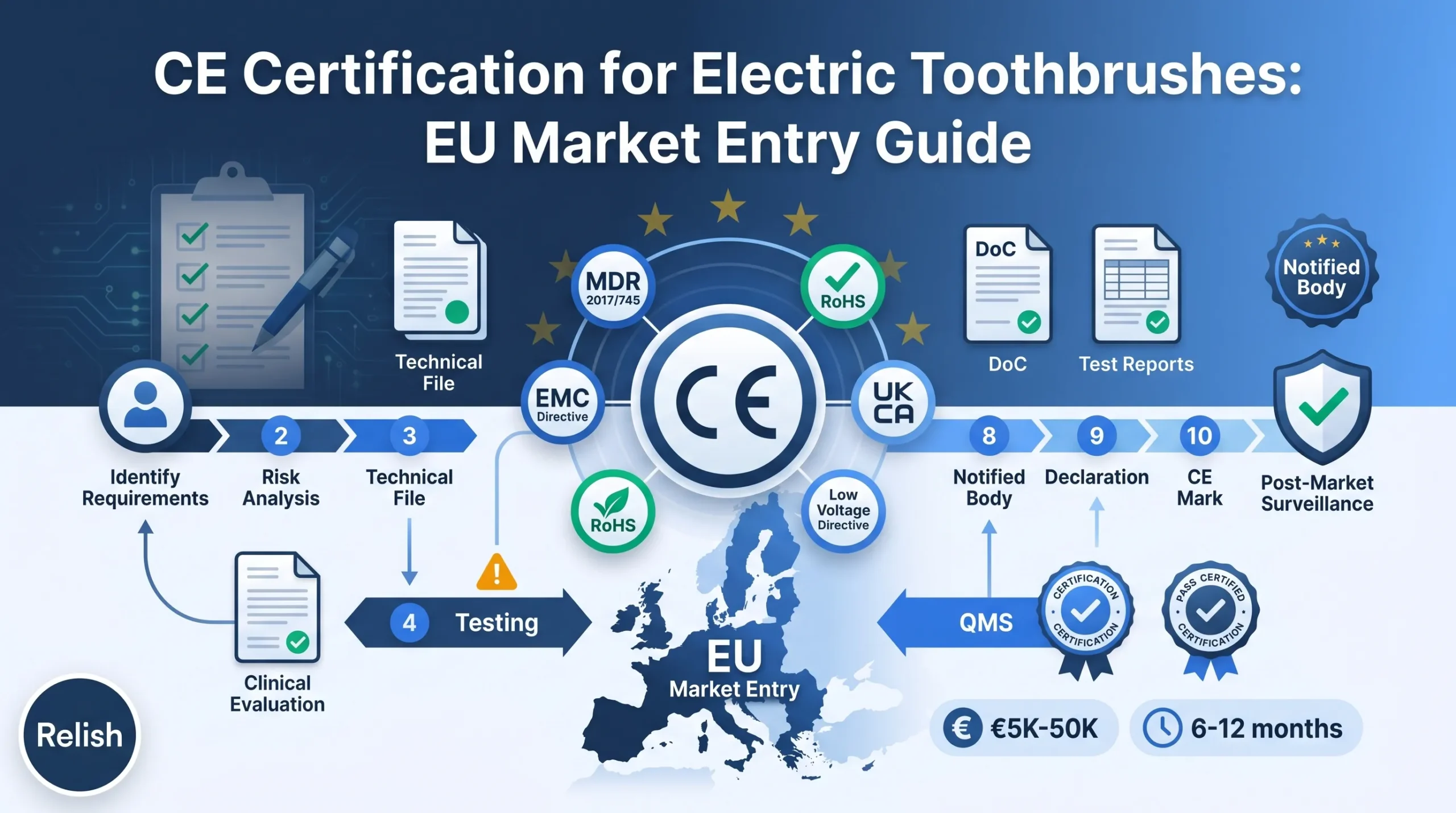
Achieving CE certification for an electric toothbrush involves a systematic process that builds compliance documentation progressively. While the exact steps vary based on your product classification and chosen conformity assessment route, the following framework applies to most electric toothbrush manufacturers.
Identify Applicable Requirements
Determine which EU directives and harmonized standards apply to your specific product. This requires analyzing your product's technical characteristics, intended use, marketing claims, and target market. Document your rationale in a regulatory applicability matrix.
Conduct Risk Analysis
Perform a comprehensive risk assessment following EN ISO 14971 (Medical devices) or EN 12182 (General consumer products). Identify hazards, estimate risks, evaluate risk acceptability, and implement risk control measures. Document all risk analysis activities and outcomes.
Develop Technical File
Compile comprehensive technical documentation including product specifications, design drawings, bill of materials, manufacturing processes, risk analysis, applicable standards documentation, and test reports. The technical file must be complete before testing begins.
Conduct Laboratory Testing
Engage an accredited testing laboratory to perform all required testing against applicable harmonized standards. For electric toothbrushes, this typically includes electrical safety testing, EMC testing, and RoHS substance analysis. Obtain signed test reports in English.
Clinical Evaluation
If your product is classified as a medical device under MDR, conduct a clinical evaluation per EN ISO 14155. This may involve literature review, equivalence analysis with marketed devices, or clinical investigations. For general consumer products, a safety assessment may suffice.
Implement Quality Management System
Establish and maintain a Quality Management System appropriate to your product classification. For MDR Class I devices, this can be self-declared. Higher classes require EN ISO 13485 certification. For general products, EN ISO 9001 provides a recognized framework.
Notified Body Review (if required)
For higher-risk products requiring Notified Body involvement, submit your technical file for review. Respond to any queries or requests for additional documentation. Receive your certificate of conformity upon successful review.
Issue Declaration of Conformity
Prepare and sign the EU Declaration of Conformity (DoC), listing all applicable directives and standards. The DoC must be signed by a responsible person within your organization and kept for 10 years after the last product is placed on the market.
Affix CE Mark
Apply the CE mark to your product, packaging, and accompanying documentation. The CE mark must be visible, legible, and indelible. Ensure the Notified Body number (if applicable) is included adjacent to the CE mark.
Establish Post-Market Surveillance
Implement ongoing monitoring of product performance in the market. Collect customer feedback, adverse event reports, and field performance data. Update technical file and Declaration of Conformity as needed. Report serious incidents to relevant authorities within required timeframes.
Notified Body vs Self-Declaration: Which Is Right for Your Product?
One of the most consequential decisions in CE certification is choosing between Notified Body involvement and the self-declaration route. This choice affects your timeline, budget, market credibility, and the level of external validation your CE mark carries.
| Czynnik | Self-Declaration | Notified Body Review |
|---|---|---|
| Regulatory Requirement | Available for Class I general products without mandatory Notified Body requirement | Required for Class IIa, IIb, and III medical devices; some Class I devices voluntarily use Notified Body |
| Oś czasu | 4–8 weeks (excluding testing) | 3–6 months for review (excluding preparation) |
| Cost Range | EUR 2,000–10,000 | EUR 15,000–50,000+ |
| Market Credibility | Basic compliance level | Higher credibility with retailers and healthcare professionals |
| Audit Requirement | Internal QMS declaration | On-site audits by Notified Body |
| Product Changes | Self-managed with updated DoC | May require Notified Body review for significant changes |
For electric toothbrushes marketed as general consumer products without therapeutic claims, self-declaration is typically the appropriate and legally sufficient route. However, many brands opt for Notified Body review to differentiate their products in a crowded market and build trust with European retail buyers who increasingly expect third-party validation.
If your electric toothbrush makes any medical device claims or falls into a higher risk class, Notified Body involvement is mandatory. Choosing a Notified Body with experience in electrical/oral care products accelerates the review process and ensures technically sound evaluation of your technical file.
Clinical Evaluation Requirements Under MDR
Clinical evaluation is a cornerstone of MDR compliance for products with medical device classification. While most electric toothbrushes marketed as general consumer products do not require formal clinical evaluation, understanding this process is essential for brands planning therapeutic claims or considering medical device classification expansion.
Under MDR Article 61 and Annex XIV, clinical evaluation must demonstrate that the clinical benefits of a medical device outweigh any residual risks when used as intended. For oral care devices, clinical evaluation typically involves:
- Literature Review: Systematic search and analysis of published clinical data on similar devices or the specific product. This includes peer-reviewed studies, clinical trial results, post-market surveillance data, and adverse event reports from equivalent devices.
- Equivalence Analysis: Demonstrating that your device is equivalent to marketed devices in terms of technical characteristics, biological characteristics, clinical characteristics, and intended use. Equivalence allows you to leverage clinical data from equivalent devices rather than conducting your own clinical investigations.
- Clinical Investigations: If sufficient clinical data cannot be obtained through literature and equivalence, clinical investigations may be required. For electric toothbrushes, this could involve controlled trials measuring plaque reduction, gingival improvement, or other clinical endpoints.
- Post-Market Clinical Follow-Up (PMCF): Ongoing collection of clinical data after market entry to verify device safety and performance over the product lifecycle. PMCF plans are required for Class IIa and higher devices.
The clinical evaluation report must be updated periodically throughout the product lifecycle and included in the technical file. Manufacturers should engage clinical affairs specialists familiar with MDR requirements when conducting formal clinical evaluations for medical device classification electric toothbrushes.
UK CA Marking After Brexit
Following the United Kingdom's departure from the EU, CE marking no longer applies to products sold in Great Britain (England, Wales, Scotland). Instead, the UK introduced its own conformity marking: the UKCA (UK Conformity Assessed) mark. Northern Ireland, however, continues to require CE marking under the Northern Ireland Protocol.
The UKCA marking requirements largely mirror the EU CE framework but with notable differences in standards harmonization, approved bodies, and technical documentation requirements. Key considerations for electric toothbrush manufacturers targeting the UK market include:
- Separate Certification: CE marking and UKCA marking are separate requirements. A CE certificate does not automatically grant UKCA compliance, and vice versa.
- UK Approved Bodies: Unlike EU Notified Bodies, UK Approved Bodies for medical devices are limited in number. The Medicines and Healthcare products Regulatory Agency (MHRA) oversees device registration and market surveillance.
- Technical Documentation: UKCA technical file requirements are similar to CE but may reference different designated standards (British Standards that align with international standards).
- UKCA Mark Placement: The UKCA mark must be visible on the product or packaging and accompanied by the UKCA logo and importer information.
- MDR Equivalence: Under UK MDR 2002 (as amended), the classification and approval requirements differ from EU MDR 2017/745. Some devices approved in the EU may not automatically be approved in the UK.
For brands sourcing from China and selling in both EU and UK markets, planning for dual compliance from the outset is more efficient than retrofitting certifications. Your OEM manufacturer should be able to support both CE and UKCA testing requirements simultaneously where standards overlap.
How Relish Tech Supports EU Compliance
Navigating CE certification for electric toothbrushes requires close coordination between the brand owner, OEM manufacturer, testing laboratories, and potentially Notified Bodies. Relish Tech's OEM/ODM manufacturing process coordinates technical file development, accredited testing, and regulatory submissions to reduce the compliance burden on oral care brands entering the EU market.
Our existing certifications and compliance infrastructure provide a strong foundation for EU market entry. We maintain ISO 13485 quality management systems, FDA-registered facilities, and extensive experience with international regulatory requirements including EU directives.
Relish Tech's EU compliance support capabilities include:
- Technical File Development: Our regulatory affairs team assists in compiling comprehensive technical files that meet EU documentation requirements. We provide design specifications, risk analyses, and manufacturing documentation in standardized formats that simplify Notified Body review.
- Pre-Compliance Testing Support: Before formal testing, we conduct internal design verification to identify potential non-compliances early. This reduces the risk of testing failures, redesign requirements, and project delays.
- Accredited Testing Coordination: We work with accredited third-party laboratories for all required testing, including EMC, electrical safety, and RoHS analysis. Our relationships with major test houses accelerate scheduling and often result in preferred pricing for our clients.
- Component Compliance Library: We maintain a database of RoHS and REACH compliance documentation for standard components, reducing the documentation burden for new product introductions.
- Labeling Support: Our team understands EU labeling requirements, including multilingual instructions for use, CE mark placement specifications, and importer information requirements.
- Factory Audit Documentation: For brands requiring supply chain verification, we provide comprehensive audit documentation including ISO 13485 certificates, facility photographs, production capacity data, and quality system summaries.
By partnering with an experienced OEM manufacturer from the outset, oral care brands can significantly reduce the time, cost, and complexity of EU market entry. Learn more about our approach to regulatory compliance by exploring our certifications page or contacting our team directly.
- MOQ: CE compliance support available for orders starting at 500 units per SKU
- Lead Time: 4–6 weeks for pre-compliance sample; 8–12 weeks for technical file readiness; 60–120 days for full production with completed CE documentation
- QC Standards: ISO 13485 quality system, pre-shipment AQL 1.5/2.5 inspection, CE documentation review prior to dispatch
- Certyfikaty: ISO 13485, FDA 21 CFR Part 820, CE MDR compliance documentation, RoHS/REACH testing, EMC and electrical safety test coordination
Common Pitfalls in EU Market Entry for Oral Care Devices
Despite the apparent straightforwardness of CE marking requirements, many oral care brands encounter obstacles that delay market entry and inflate costs. Understanding these common pitfalls enables proactive mitigation strategies.
- Incomplete Technical Files: Test laboratories cannot begin testing without complete technical files. Brands that underestimate documentation preparation time face extended project timelines. Allocate 4-8 weeks for technical file development before testing commencement.
- Standard Version Updates: Harmonized standards are periodically updated, and older versions may lose their presumption of conformity. Using outdated standard versions results in non-compliant declarations. Verify current standard versions at project initiation and monitor for updates during the certification process.
- Battery Compliance Gaps: Electric toothbrush batteries are subject to specific regulations including UN 38.3 for transport testing. Many brands overlook battery-specific requirements until late in the project. Ensure battery compliance documentation is included from the beginning. Explore our electric toothbrush product range to see how Relish Tech manages battery compliance across standard models.
- Insufficient EMC Pre-Testing: EMC testing is often a source of delays and unexpected redesigns. Investing in pre-compliance EMC testing or engineering reviews before formal testing reduces first-pass failure risk.
- RoHS Component surprises: Sub-suppliers sometimes provide incorrect RoHS declarations, leading to failed compliance documentation audits. Establish clear RoHS compliance requirements in purchase specifications and verify supplier declarations through random sampling.
- Labeling Localization: EU requirements mandate instructions for use in the official language of each member state where the product is sold. Some brands underestimate the cost and complexity of multilingual documentation.
- Post-Market Surveillance Neglect: Many brands focus exclusively on initial certification and neglect the ongoing post-market surveillance requirements. Establish surveillance systems before market entry to avoid compliance gaps.
Kluczowe wnioski
- CE marking is a legal requirement for selling electric toothbrushes in the EU—failure to comply risks product recalls, fines, and criminal liability.
- Multiple EU directives apply to electric toothbrushes: MDR (if claiming therapeutic benefits), EMC, Low Voltage, and RoHS. Identify all applicable requirements before starting certification.
- Class I electric toothbrushes can generally follow the self-declaration route; higher-risk products require Notified Body involvement.
- Planning for CE certification from product design inception reduces costs and timelines compared to retrofitting compliance.
- UK CA marking is a separate requirement from CE marking—plan for dual compliance if targeting both EU and UK markets.
- Partnering with an OEM manufacturer experienced in EU compliance streamlines documentation, testing coordination, and regulatory submissions.
Get a Free Compliance Assessment for Your Electric Toothbrush
Not sure which directives apply to your product or which certification route suits your business? Relish Tech offers a free initial compliance assessment for oral care brands exploring EU market entry.
Request a Compliance AssessmentReady to Enter the EU Market?
Relish Tech has helped hundreds of oral care brands achieve CE certification and successfully launch in the European market. Our experienced regulatory affairs team can guide you through the entire compliance process.
Contact Our TeamCzęsto zadawane pytania
Referencje
- European Commission. "Regulation (EU) 2017/745 on medical devices." Official Journal of the European Union. https://eur-lex.europa.eu/eli/reg/2017/745/oj
- European Commission. "Directive 2014/30/EU on electromagnetic compatibility." Official Journal of the European Union. https://eur-lex.europa.eu/eli/dir/2014/30/oj
- European Commission. "Directive 2014/35/EU on electrical equipment designed for use within certain voltage limits." Official Journal of the European Union. https://eur-lex.europa.eu/eli/dir/2014/35/oj
- European Parliament and Council. "Directive 2011/65/EU (RoHS) on the restriction of the use of certain hazardous substances in electrical and electronic equipment." Official Journal of the European Union. https://eur-lex.europa.eu/eli/dir/2011/65/oj
- British Standards Institution. "BS EN ISO 14971:2019 Medical devices — Application of risk management to medical devices." BSI Standards Limited.
- European Commission. "MDCG 2019-16 Rev. 1: Guidance notes for manufacturers of Class I devices." European Commission Medical Devices Coordination Group. Retrieved from https://health.ec.europa.eu/document/download_en
- Medicines and Healthcare products Regulatory Agency. "Medical devices: EU exit and the UKCA marking." UK Government. Retrieved from https://www.gov.uk/guidance/medical-devices-mdr-2002