








Water Flosser OEM/ODM Manufacturing:
The Complete B2B Buyer's Guide (2026)
Everything B2B buyers need to know about sourcing and private-labeling water flossers from China, including product types, technical specs, costs, certifications, and factory selection. The cordless water flosser market doubled in three years. Private label brands captured most of that growth, not Waterpik.
Water flosser OEM manufacturing in China costs $8–$45 per unit FOB depending on type (cordless vs countertop), features, and volume. MOQ starts at 500 units for standard ODM models, 2,000+ for custom tooling. Lead time: 30–45 days (ODM) or 60–90 days (full OEM). Required certifications: CE (EU), FCC + FDA (USA), IPX4/IPX7 (waterproof). Key success factors: factory audit, sample testing, and a multi-market certification strategy via CB Scheme.
Executive Summary: Water Flosser OEM Sourcing
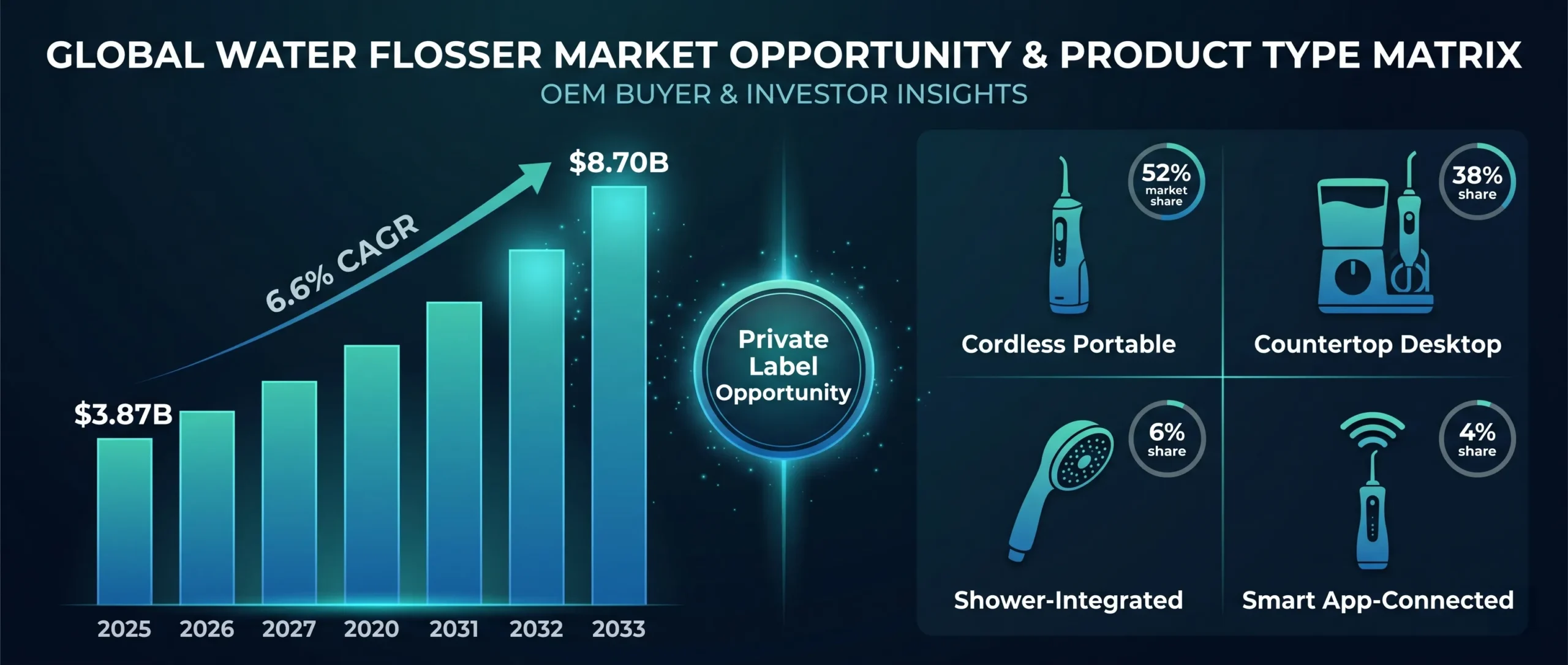
- Market Size: $3.87B (2025) → $8.70B (2033), CAGR 6.6% (Persistence Market Research, 2025). Cordless/portable segment holds 52% share with highest OEM demand.
- Cost Structure: Factory FOB $8–$15 (basic cordless) to $20–$45 (premium countertop). Customization adds 15–30%.
- MOQ & Timeline: 500–1,000 units (ODM), 2,000–5,000 (custom OEM). Lead time 30–45 days (ODM) or 60–90 days (full OEM with tooling).
- Success Factors: (1) Verify IPX4/IPX7 waterproof testing. (2) Use CB Scheme for multi-market certification. (3) Audit factory QC process (IQC/IPQC/OQC). (4) Test samples under real-world conditions before production.
Table of Contents
- Water Flosser Market Overview 2026
- Water Flosser Types: Countertop vs Portable vs Shower
- Key Technical Specifications Explained
- OEM/ODM Customization Options
- Manufacturing Cost & MOQ Reference
- Quality Testing Standards & Methods
- Required Certifications by Market
- How to Choose Your Water Flosser OEM Factory
- FAQ: 6 Questions Buyers Always Ask
1. Water Flosser Market Overview 2025
The global water flosser market is valued at approximately $3.87 billion in 2025 and is projected to reach $8.70 billion by 2033, growing at a CAGR of 6.6%[1]. Water flossers are now one of the fastest-growing categories in personal oral care, well ahead of manual toothbrushes.
Several macro forces are driving this expansion:
- Dental health awareness: Post-pandemic consumer health consciousness has pushed preventive oral care into mainstream daily routines. Clinical studies show water flossers are 51% more effective than traditional floss for reducing gingival bleeding[3].
- Aging populations: Older demographics with implants, braces, and bridges make up a fast-growing user base. Dentists specifically recommend water flossers to these patients.
- Travel and portability trend: The rise of premium travel accessories has made cordless water flossers a top-selling category on Amazon and DTC channels.
- Room for private labels: Unlike electric toothbrushes, where Oral-B and Philips dominate, water flossers still have shelf space available for private label and challenger brands.
OEM Opportunity for B2B Buyers
Organic search competition for water flossers is lower than for electric toothbrushes. Brands that move now have a 12–18 month window to build category authority before the space gets crowded.
Key Market Segments
| Segment | 2026 Share | Growth Driver | OEM Opportunity |
|---|---|---|---|
| Cordless / Portable | ~52% | Travel, e-commerce | High. Fast turnover, repeat purchase |
| Countertop / Home | ~38% | Family use, premium segment | Medium. Higher ASP, longer sales cycle |
| Shower-integrated | ~6% | European bathroom design trend | Niche. Strong EU demand |
| Smart / App-connected | ~4% | IoT health tech adoption | Emerging. Premium tier opportunity |
About the Manufacturer: Relish Technology
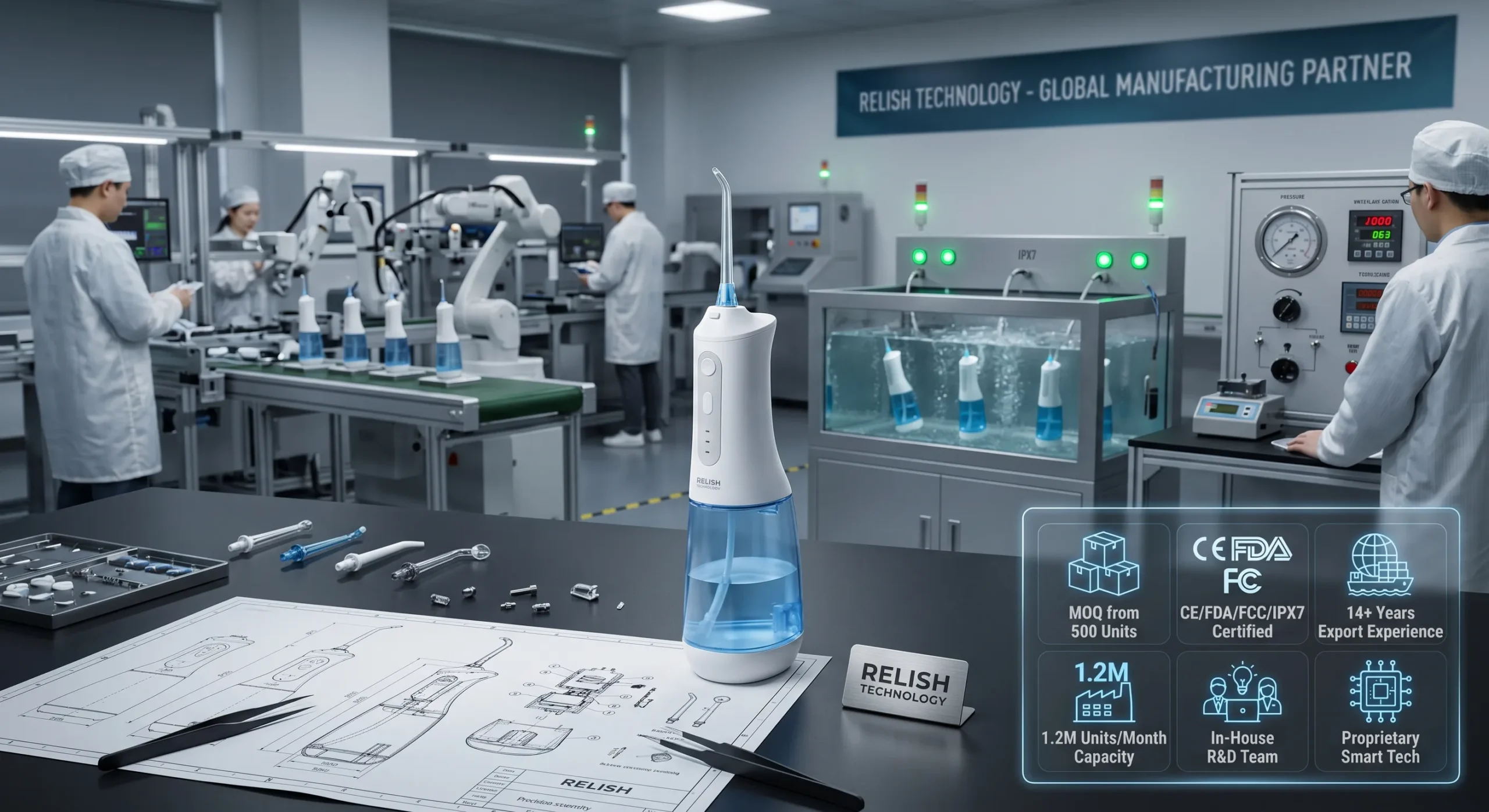
Relish Technology is a Shenzhen-based oral care OEM/ODM factory with 14+ years of export experience in water flosser manufacturing. Our capabilities:
- 20,000 m² ISO-certified assembly lines in Shenzhen
- 1.2 million+ units monthly capacity across water flosser and electric toothbrush lines
- 300+ skilled workers across 12 automated production lines
- 30+ R&D engineers with expertise in fluid dynamics, motor design, and IoT integration
- Products exported to 120+ countries
- Certifications: CE, FCC, FDA, ISO 9001, ISO 13485, RoHS, REACH, IPX7
Learn more → · Client case studies → · View certifications →
2. Water Flosser Types: Countertop vs Portable vs Shower
Understanding product types is the first decision in your water flosser OEM project. Each type has different manufacturing requirements, target consumers, price points, and market channels.
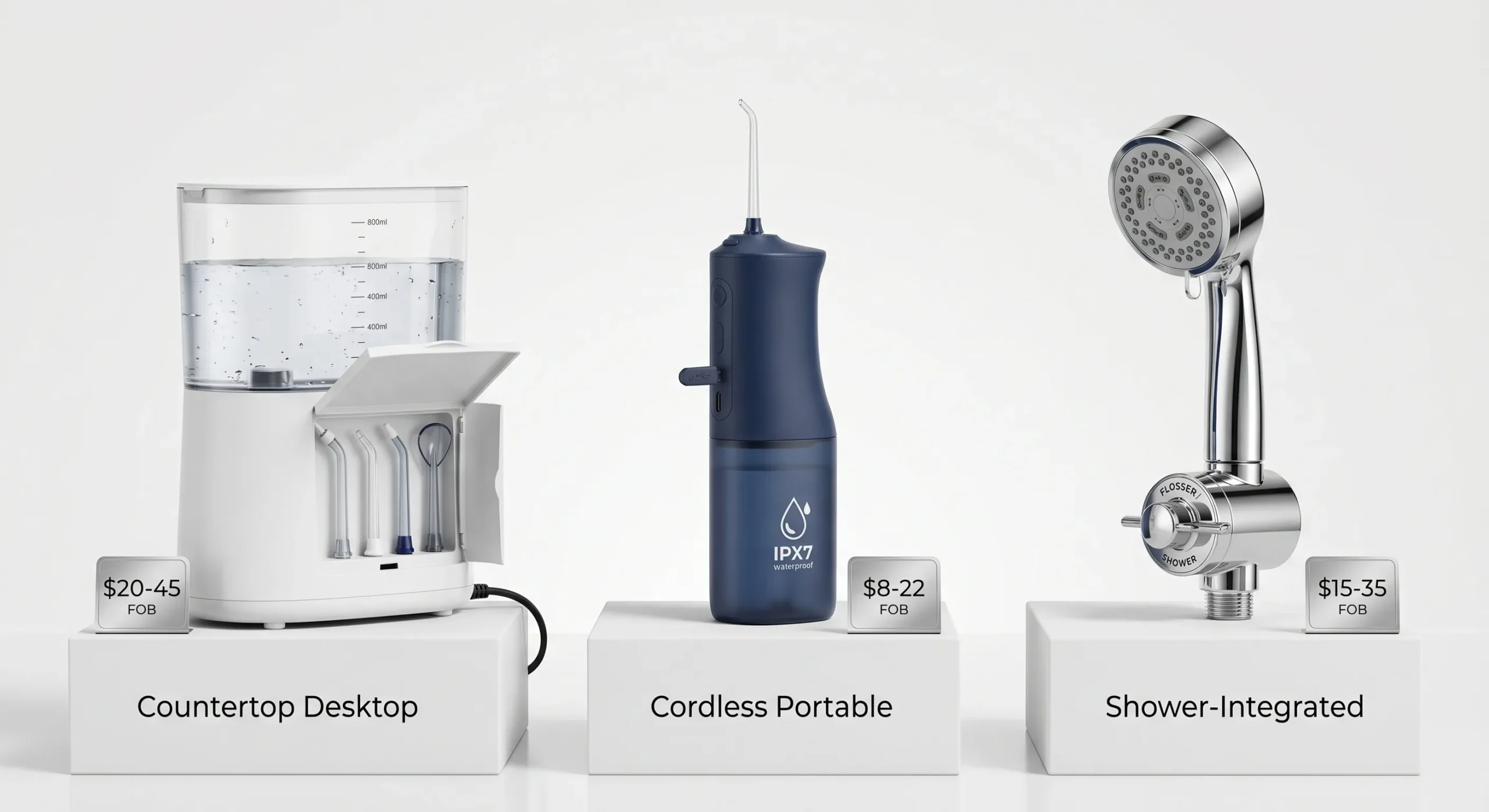
Countertop (Desktop)
600–1000ml reservoir, corded AC power, 60–100 PSI, multiple nozzle tips. Best for families and home users. Dominant in North America.
Cordless / Portable
150–350ml reservoir, USB rechargeable battery, 40–80 PSI, compact design. Top-selling category on Amazon, DTC, and travel retail.
Shower-Integrated
Connects to shower hose, water-pressure powered, no reservoir needed. Growing in EU markets, especially Germany and Netherlands.
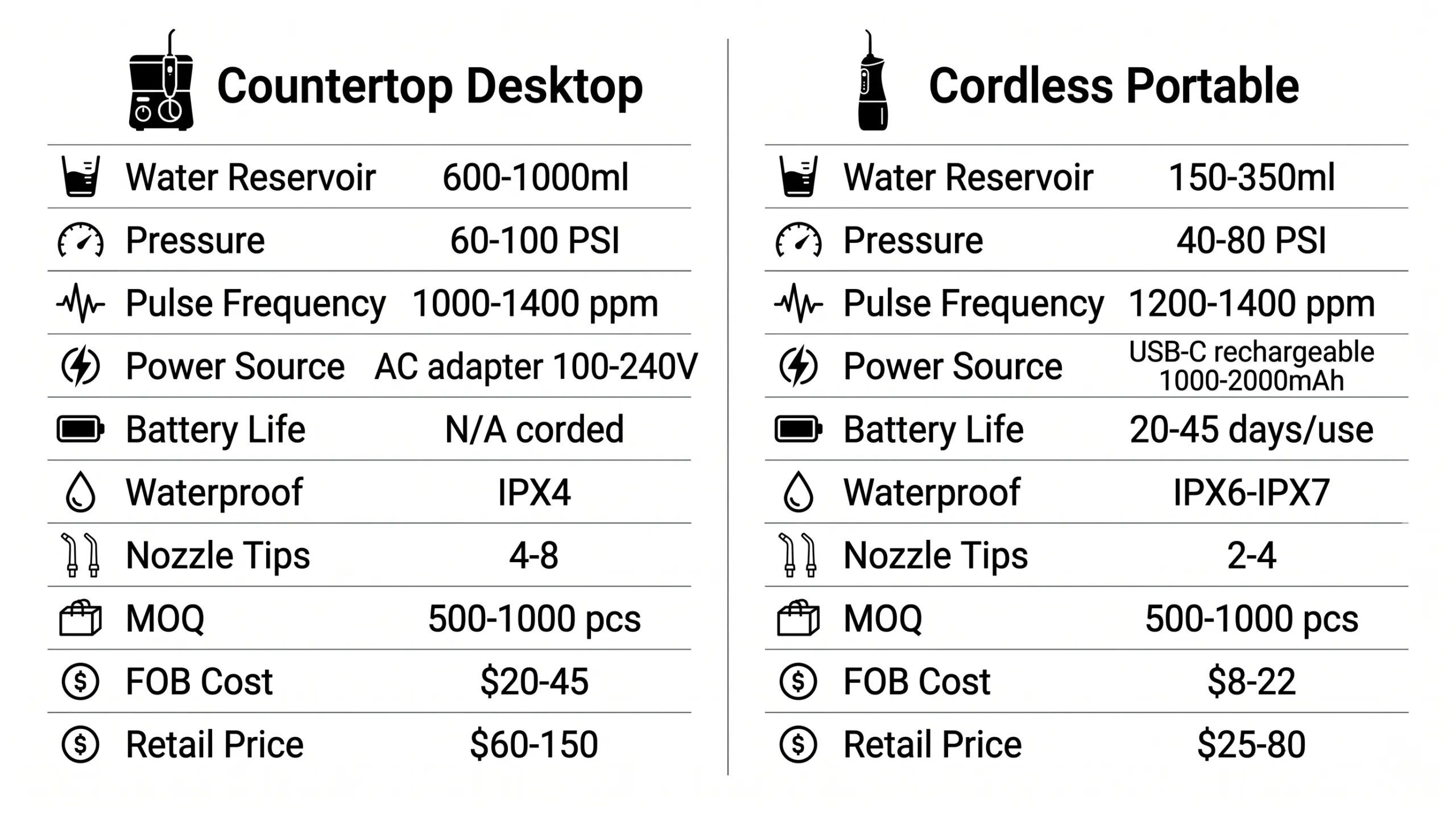
Detailed Comparison: Countertop vs Cordless
| Parameter | Countertop | Cordless / Portable |
|---|---|---|
| Water Reservoir | 600–1,000 ml | 150–350 ml |
| Water Pressure | 60–100 PSI | 40–80 PSI |
| Pulse Frequency | 1,000–1,400 ppm | 1,200–1,400 ppm |
| Power Source | AC adapter (100–240V) | USB-C rechargeable (1,000–2,000 mAh) |
| Battery Life | N/A (corded) | 20–45 days per charge (1x/day use) |
| Waterdichtheid | IPX4 (splash-proof) | IPX6–IPX7 (submersible) |
| Included Nozzle Tips | 4–8 tips | 2–4 tips |
| MOQ (standard OEM) | 500–1,000 pcs | 500–1,000 pcs |
| Factory Cost (FOB) | $20–$45 | $8–$22 |
| Retail Price Range | $60–$150 | $25–$80 |
| Primary Sales Channel | Retail, pharmacy chains | E-commerce, DTC, travel retail |
| Certification Complexity | Higher (CE LVD + EMC, FCC) | Medium (CE EMC, FCC, IPX) |
Recommendation for New Brands
If you're launching your first water flosser SKU, start with a cordless/portable model. Lower unit cost ($8–22 FOB) means lower initial investment risk, and the e-commerce channel allows faster sell-through and consumer feedback loops. Add a countertop model at 12–18 months once you've validated market fit.
3. Key Technical Specifications Explained
Before briefing your OEM supplier, you need to understand the key technical parameters that define water flosser performance and how each one affects consumer experience and manufacturing cost.
Water Pressure (PSI)
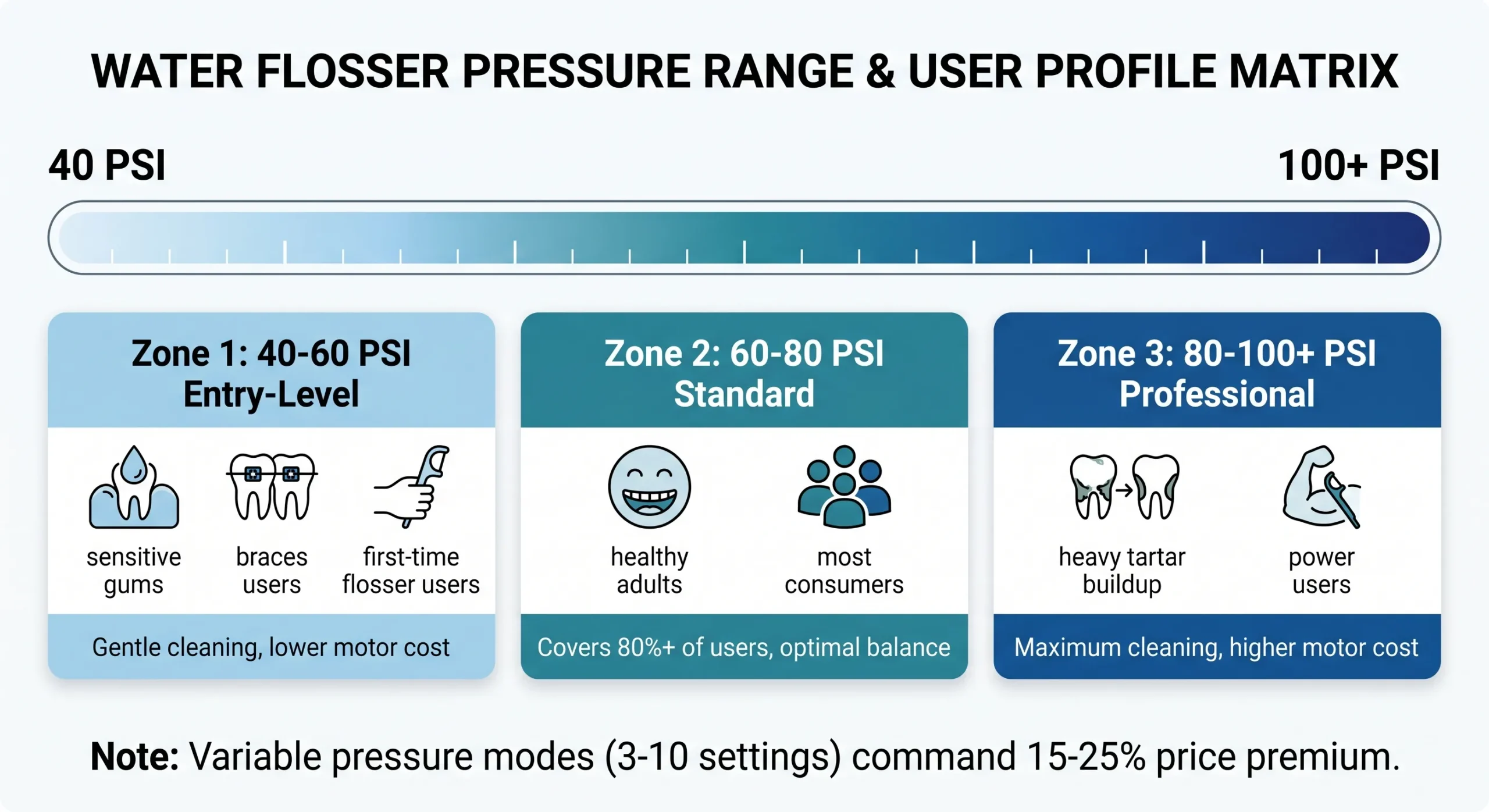
Pressure is the #1 differentiator perceived by consumers. Most dental associations recommend 50–90 PSI for optimal cleaning without gum damage. Key considerations:
- 40–60 PSI: Entry-level, suitable for sensitive gums, braces users, and first-time flosser users
- 60–80 PSI: Standard range, covers 80%+ of healthy adults
- 80–100+ PSI: Professional/power users, people with heavy tartar buildup
- Variable pressure modes (3–10 settings): Higher perceived value, commands 15–25% price premium in retail
Pulse Frequency (Pulses Per Minute)
Standard range is 1,000–1,400 ppm. Higher frequency increases cleaning efficiency but also motor cost. For most consumer SKUs, 1,200–1,400 ppm is the sweet spot balancing performance and battery life.
Nozzle Tip System
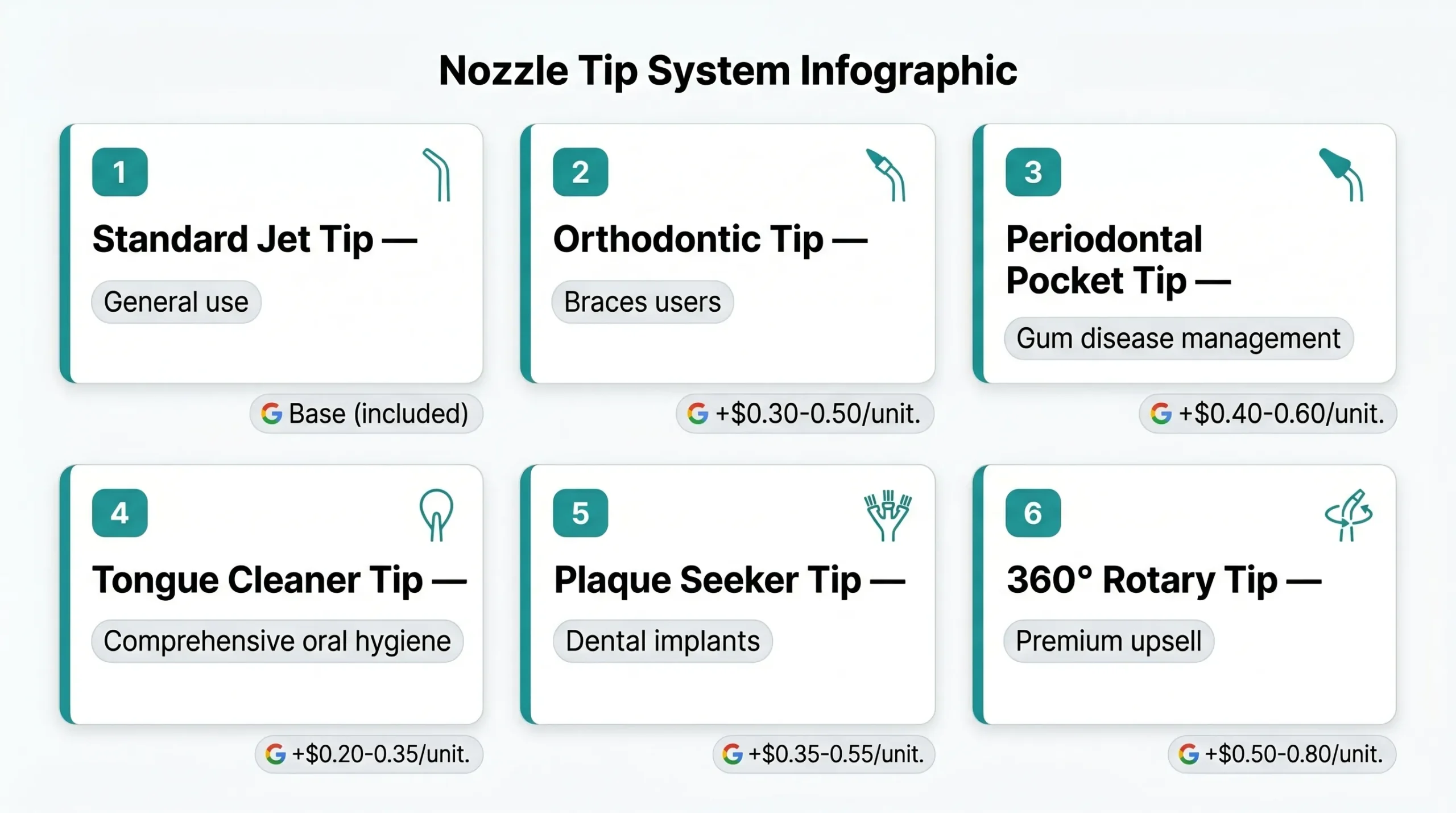
The nozzle tip system is a key driver for repeat purchases and upsell:
| Tip Type | Doelgebruiker | Manufacturing Cost Add |
|---|---|---|
| Standard Jet Tip | General use | Base (included) |
| Orthodontic Tip | Braces users | +$0.30–0.50/unit |
| Periodontal Pocket Tip | Gum disease management | +$0.40–0.60/unit |
| Tongue Cleaner Tip | Comprehensive oral hygiene | +$0.20–0.35/unit |
| Plaque Seeker Tip | Dental implants | +$0.35–0.55/unit |
| 360° Rotary Tip | Premium upsell | +$0.50–0.80/unit |
Battery & Charging
For cordless models, battery specification directly impacts consumer satisfaction and return rates:
- 1,000–1,200 mAh: Entry-level; 14–21 uses per charge. Adequate for solo travelers.
- 1,500–2,000 mAh: Standard; 30–45 uses. Sweet spot for most consumers.
- USB-C vs Micro-USB: USB-C is now table stakes; Micro-USB will hurt Amazon reviews in 2026.
- Magnetic charging dock: Premium tier, adds $1.50–3.00 to FOB cost but lifts brand perception noticeably.
4. OEM/ODM Customization Options
Customization depth determines whether you're doing surface-level private labeling or building a differentiated brand. Here's what's possible at each tier:
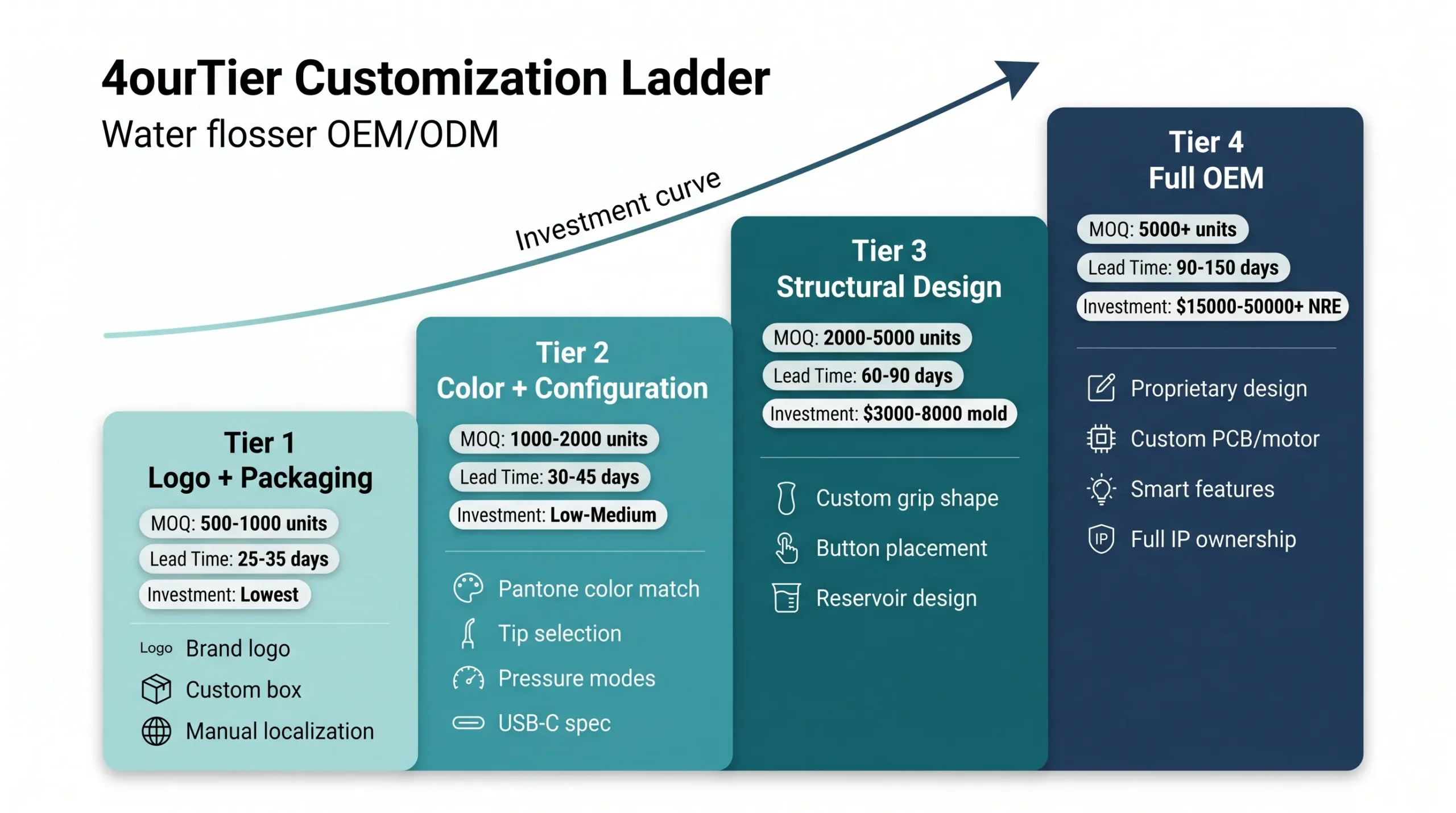
Tier 1: Logo + Packaging (Lowest Investment)
Add your brand logo to an existing ODM model. Custom retail box design, instruction manual localization, product color selection from existing options. MOQ: 500–1,000 units. Lead time: 25–35 days.
Tier 2: Color + Configuration Customization
Custom Pantone color match for housing, choice of nozzle tip set, pressure mode configuration, USB-C/charging dock specification, custom display window, blister pack or box-style packaging. MOQ: 1,000–2,000 units. Lead time: 30–45 days.
Tier 3: Structural Design Customization
Custom grip shape, button placement, LED indicator design, custom water reservoir size and shape. Requires new tooling ($3,000–$8,000 one-time mold cost). MOQ: 2,000–5,000 units. Lead time: 60–90 days.
Tier 4: Full OEM (Complete Proprietary Design)
Proprietary product design, custom PCB/motor spec, smart features (app connectivity, pressure sensors), custom nozzle tip system. Full IP ownership. Investment: $15,000–$50,000+ in tooling/NRE. MOQ: 5,000+ units. Lead time: 90–150 days.
Relish Tech's OEM Capabilities
Relish Tech supports Tier 1 through Tier 3 customization with dedicated project managers, in-house design team, and flexible MOQ starting at 500 units. We handle product documentation, regulatory submissions, and multi-language packaging for all major markets.
5. Manufacturing Cost & MOQ Reference (2026)
Cost transparency matters in OEM sourcing. The table below reflects realistic factory (FOB Shenzhen) pricing ranges based on current industry data.
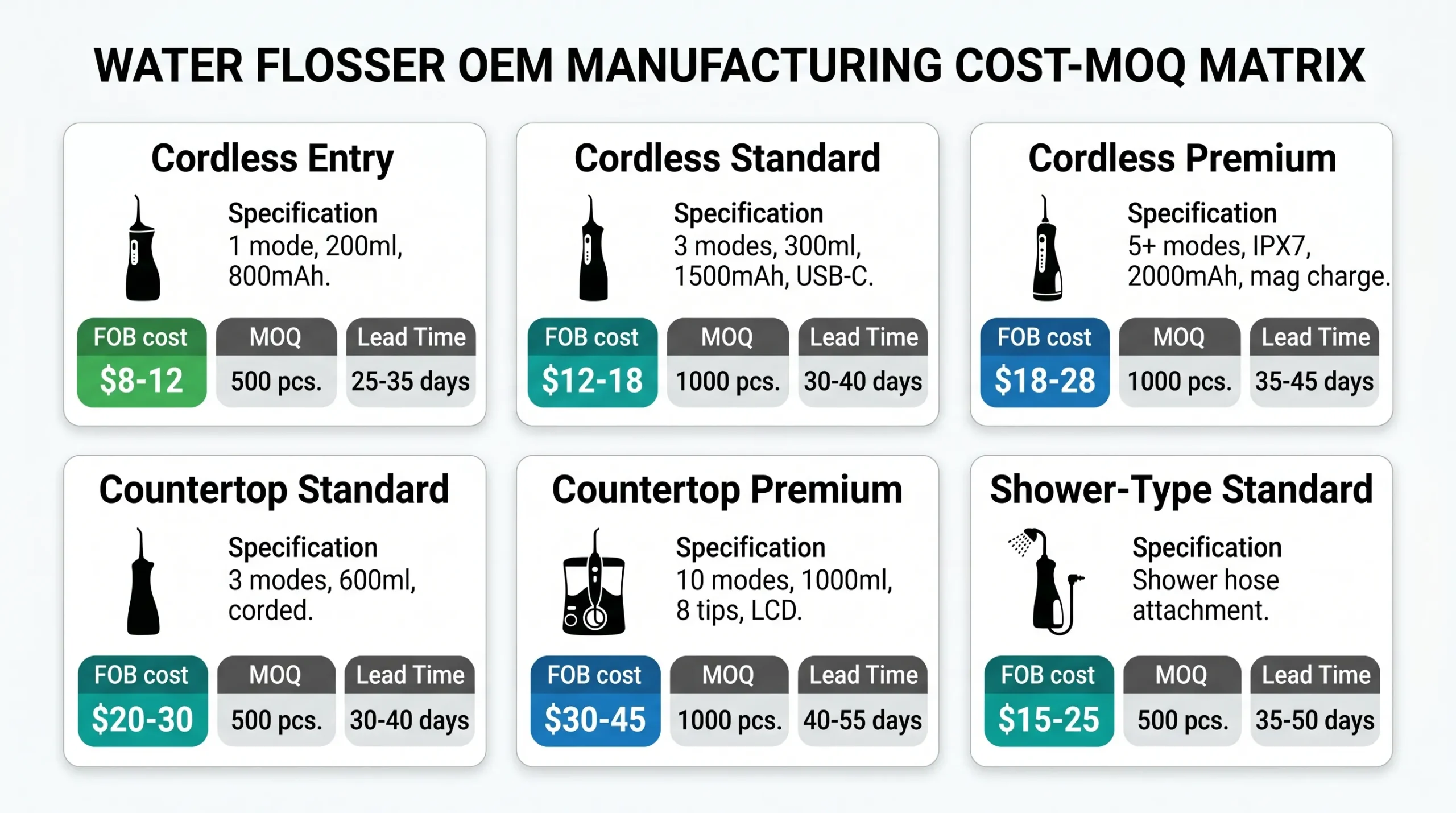
| Product Type | Spec Level | FOB Factory Cost | MOQ | Doorlooptijd |
|---|---|---|---|---|
| Cordless / Portable | Entry (1 mode, 200ml, 800mAh) | $8–$12 | 500 pcs | 25–35 days |
| Cordless / Portable | Standard (3 modes, 300ml, 1500mAh, USB-C) | $12–$18 | 1,000 pcs | 30–40 days |
| Cordless / Portable | Premium (5+ modes, IPX7, 2000mAh, mag charge) | $18–$28 | 1,000 pcs | 35–45 days |
| Countertop / Desktop | Standard (3 modes, 600ml, corded) | $20–$30 | 500 pcs | 30–40 days |
| Countertop / Desktop | Premium (10 modes, 1000ml, 8 tips, LCD) | $30–$45 | 1,000 pcs | 40–55 days |
| Shower-type | Standaard | $15–$25 | 500 pcs | 35–50 days |
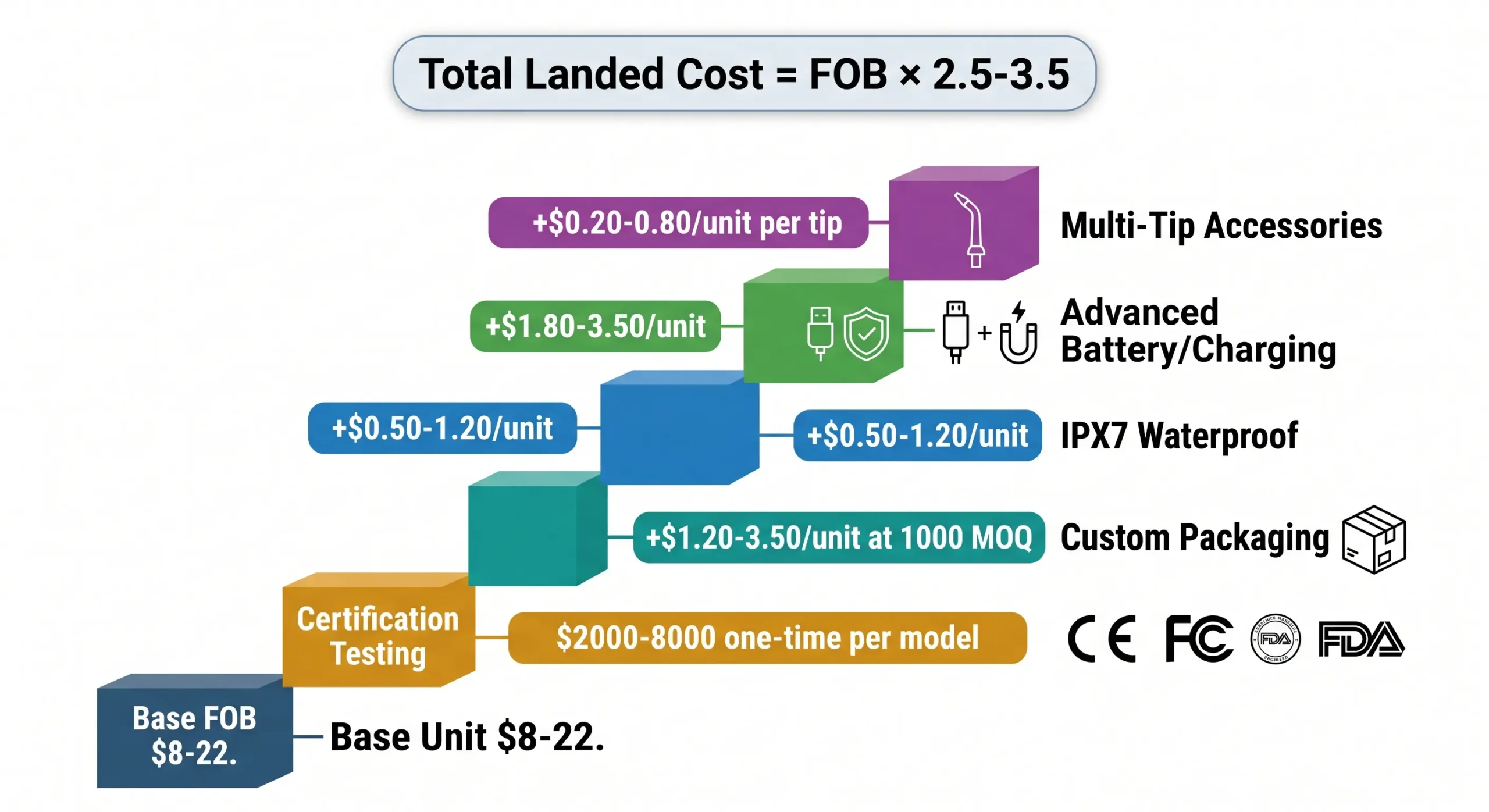
What Drives Cost Up?
- Certification testing fees: CE + FCC + FDA registration adds $2,000–$8,000 to project cost (one-time per model)
- Custom packaging: Premium retail box with full-color printing, insert tray, and accessories adds $1.20–$3.50 per unit at 1,000 MOQ
- IPX7 waterproof testing: More rigorous than IPX4/5; adds $0.50–$1.20 to unit cost through enhanced sealing and testing
- Advanced battery/charging: Upgrading from Micro-USB to USB-C + magnetic dock adds $1.80–$3.50 per unit
- Multi-tip accessories: Each additional nozzle tip adds $0.20–$0.80 per unit depending on tip complexity
Watch Out: Hidden Costs in Water Flosser OEM
- Certification transfer fees: Some factories won't transfer existing CE/FCC certification to your brand. Confirm brand name inclusion upfront
- Tooling amortization: Custom mold costs may be spread into unit price rather than charged upfront. Get a clear itemized quote
- Warranty replacement stock: Budget 2–3% of order for warranty claims; confirm factory's RMA policy before ordering
- Multi-language packaging: If you need 5+ languages, print plate setup fees apply for each language variant
6. Quality Testing Standards & Methods
Water flossers are personal care electrical products with water exposure. That combination makes quality control more demanding than for most consumer electronics. Here's what a thorough QC framework looks like:
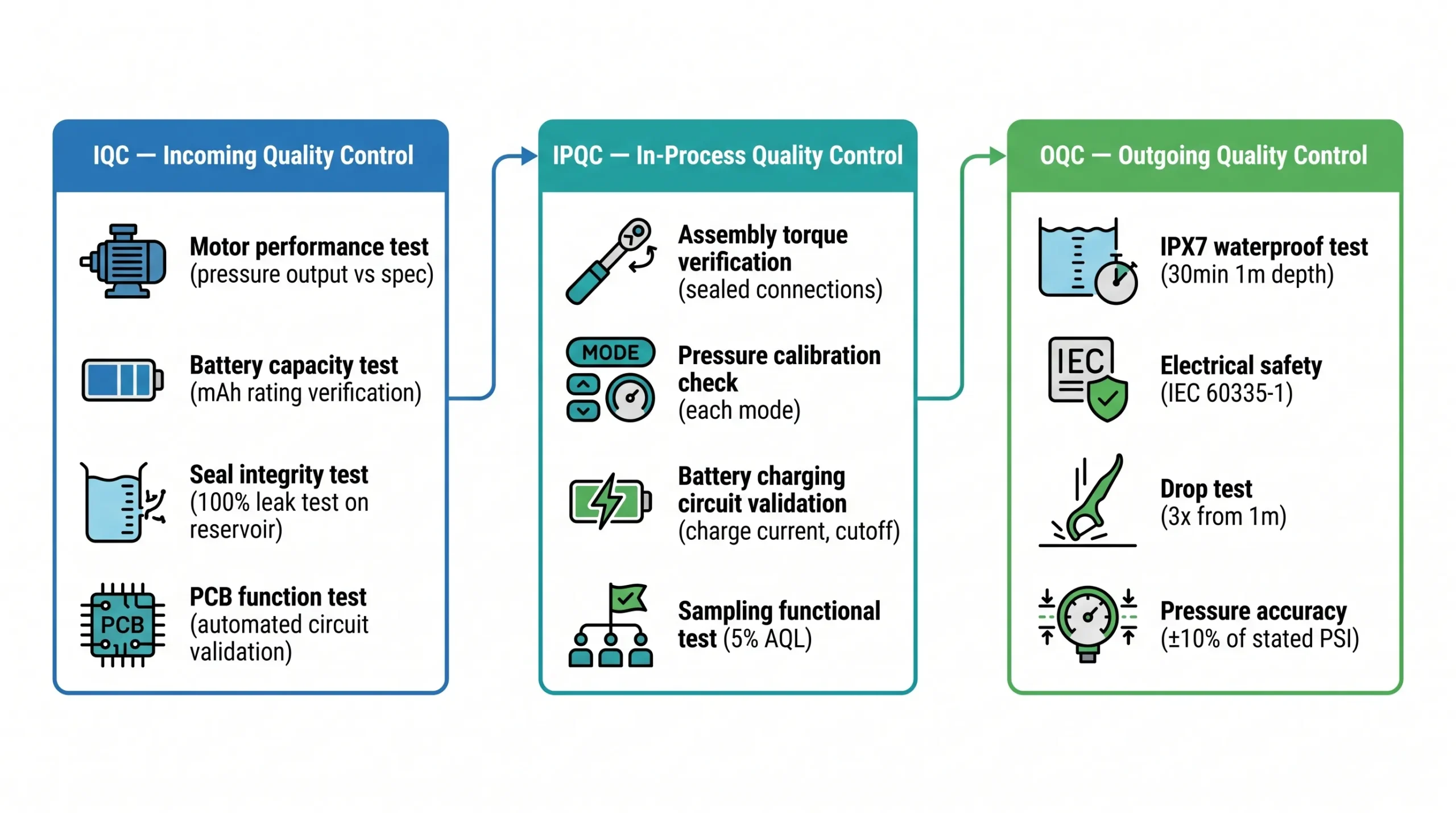
Incoming Quality Control (IQC)
- Motor performance test: pressure output at multiple settings vs. specification
- Battery capacity test: confirm mAh rating under standard discharge cycle
- Seal integrity test: 100% leak test on reservoir and nozzle connections before assembly
- PCB function test: automated circuit validation before installation
In-Process Quality Control (IPQC)
- Assembly torque verification for all sealed connection points
- Pressure calibration check at each pressure setting mode
- Battery charging circuit validation (charge current, cutoff voltage, protection circuit)
- Sampling-based functional test: 5% AQL during production run
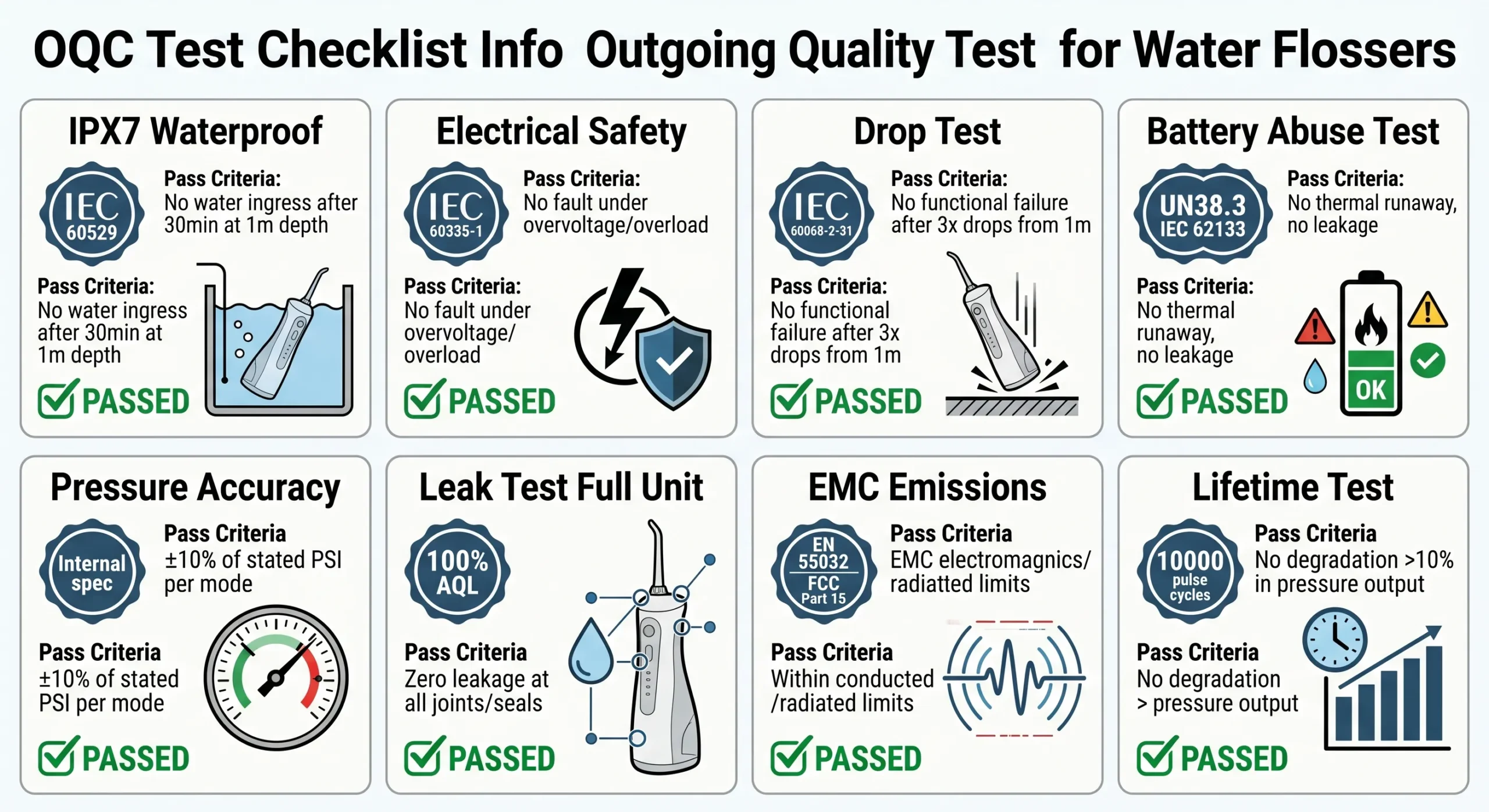
Outgoing Quality Control (OQC)
| Test | Standard / Method | Pass Criteria |
|---|---|---|
| Waterproof / IPX7 | IEC 60529 | No water ingress after 30 min at 1m depth |
| Electrical Safety | IEC 60335-1 | No fault under overvoltage/overload conditions |
| Drop Test | IEC 60068-2-31 | No functional failure after 3x drops from 1m |
| Battery Abuse Test | UN38.3 / IEC 62133 | No thermal runaway, no leakage |
| Pressure Accuracy | Internal spec | ±10% of stated PSI per mode |
| Leak Test (full unit) | 100% AQL | Zero leakage at all joints/seals |
| EMC Emissions | EN 55032 / FCC Part 15 | Within conducted/radiated limits |
| Lifetime Test | 10,000 pulse cycles | No degradation >10% in pressure output |
Third-Party Inspection Best Practice
For orders above 2,000 units, always commission a third-party pre-shipment inspection (SGS, Bureau Veritas, QIMA) with a full AQL 2.5 sampling plan. This adds approximately $300–$400 per inspection but saves multiples in potential return costs.
7. Required Certifications by Market
Certification requirements vary by destination market. A well-prepared OEM supplier should already hold most of these on their platform products. Confirm this before shortlisting.
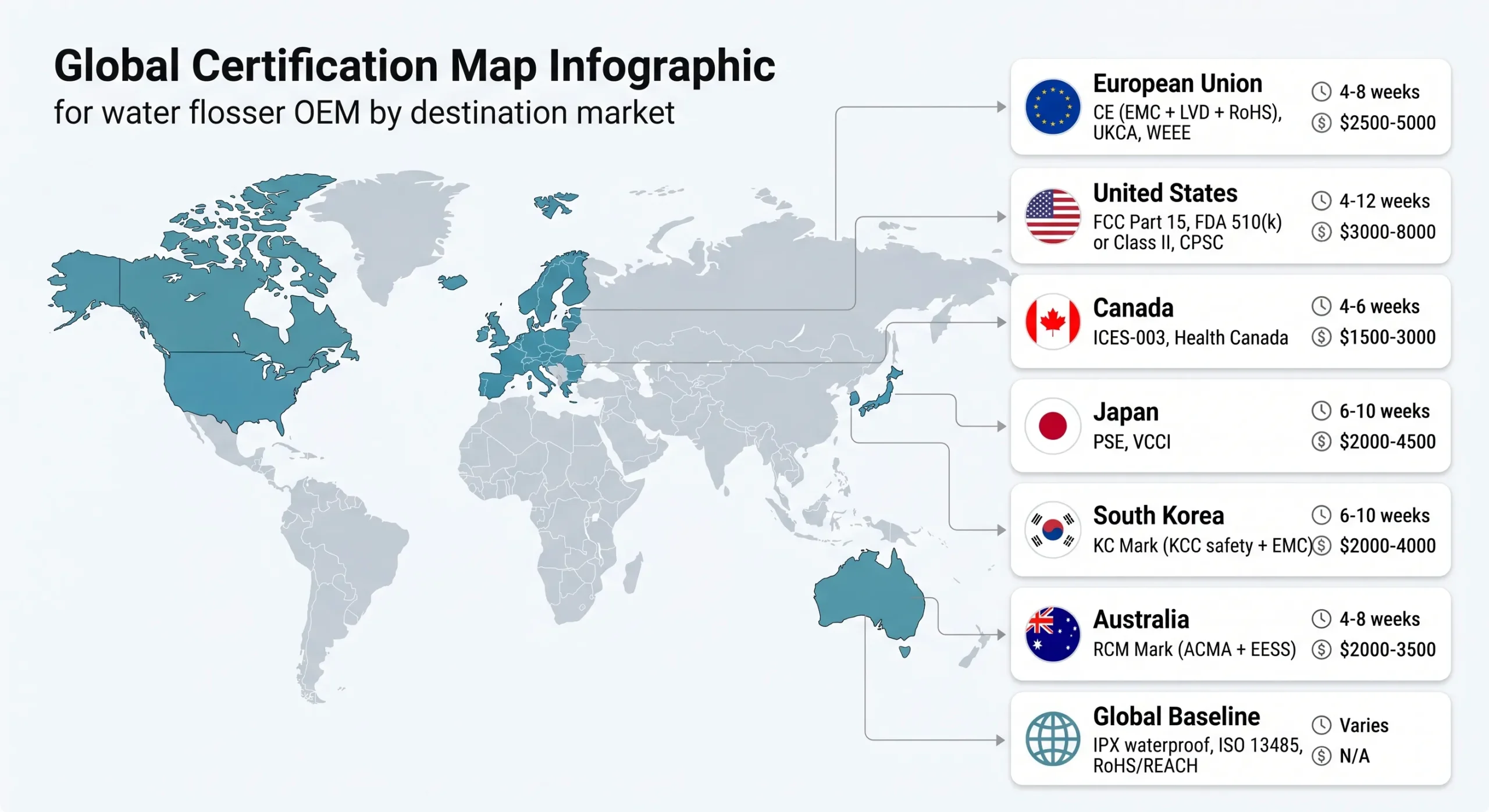
| Market | Required Certifications | Timeline | Approx. Cost |
|---|---|---|---|
| 🇪🇺 European Union | CE (EMC + LVD + RoHS), UKCA (for UK post-Brexit), WEEE registration | 4–8 weeks | $2,500–$5,000 |
| 🇺🇸 United States | FCC Part 15 (for cordless), FDA 510(k) clearance or Class II registration, CPSC compliance | 4–12 weeks | $3,000–$8,000 |
| 🇨🇦 Canada | ICES-003 (RF), Health Canada notification | 4–6 weeks | $1,500–$3,000 |
| 🇯🇵 Japan | PSE (Electrical Appliance Safety Act), VCCI (EMC) | 6–10 weeks | $2,000–$4,500 |
| 🇰🇷 South Korea | KC Mark (KCC safety + EMC) | 6–10 weeks | $2,000–$4,000 |
| 🇦🇺 Australia | RCM Mark (ACMA + EESS) | 4–8 weeks | $2,000–$3,500 |
| Global baseline | IPX waterproof rating (IEC 60529), ISO 13485 (medical-grade QMS), RoHS/REACH | Varies | Varies |
The CB Scheme: Most Efficient Multi-Market Strategy
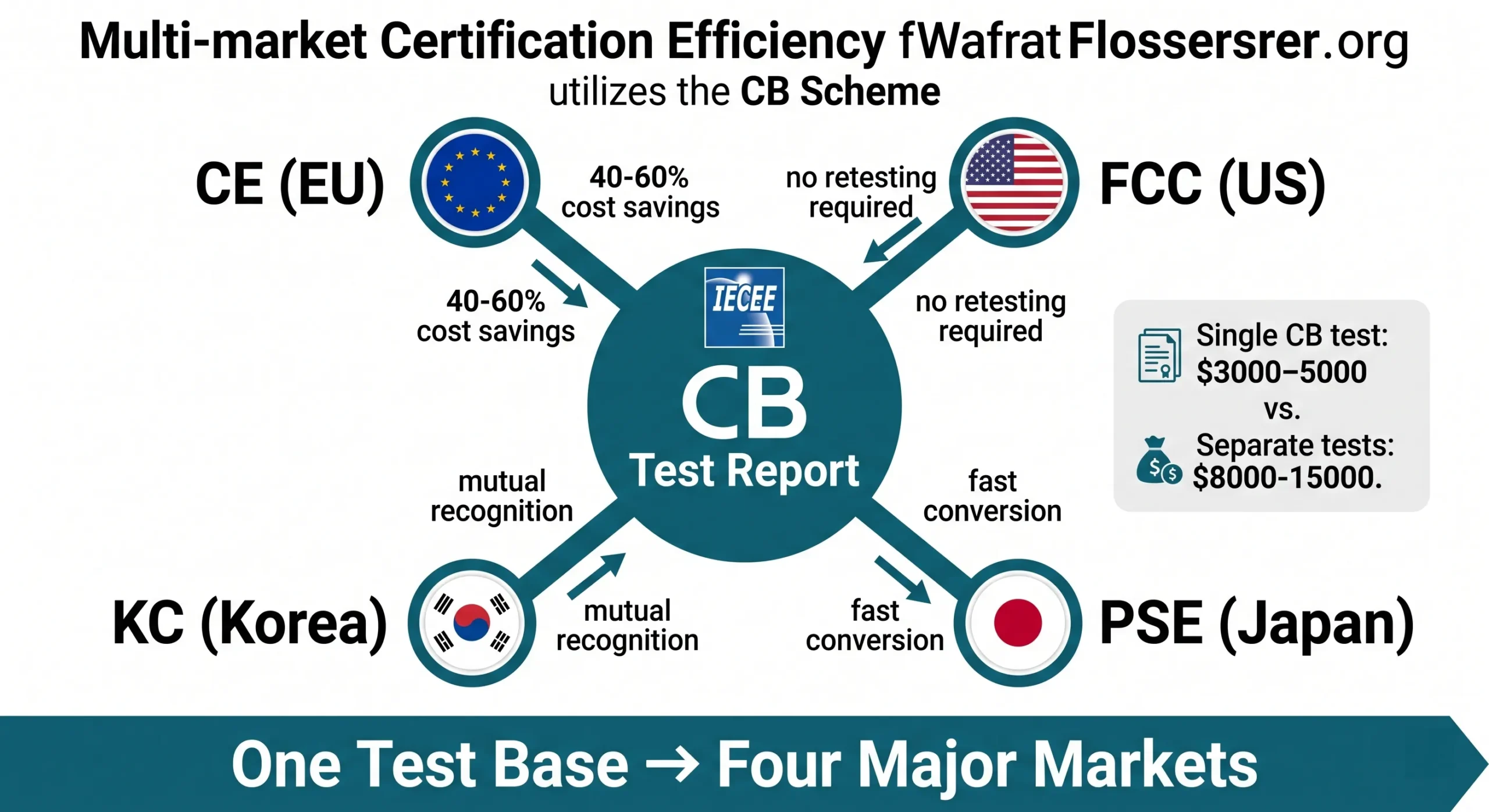
If you're targeting 3+ markets simultaneously, the CB Scheme (IEC System for Conformity Testing) is your most cost-effective approach. A single CB test report from one IECEE-accredited lab can be converted to national certifications in 50+ countries, reducing duplicate testing costs by 40–60%.
Recommended workflow: CB Report → CE (EU) → FCC (US) → PSE (Japan) → KC (Korea). One test base, four major markets.
8. How to Choose Your Water Flosser OEM Factory
Not all water flosser factories are equal. Here's an evaluation framework to shortlist qualified partners:
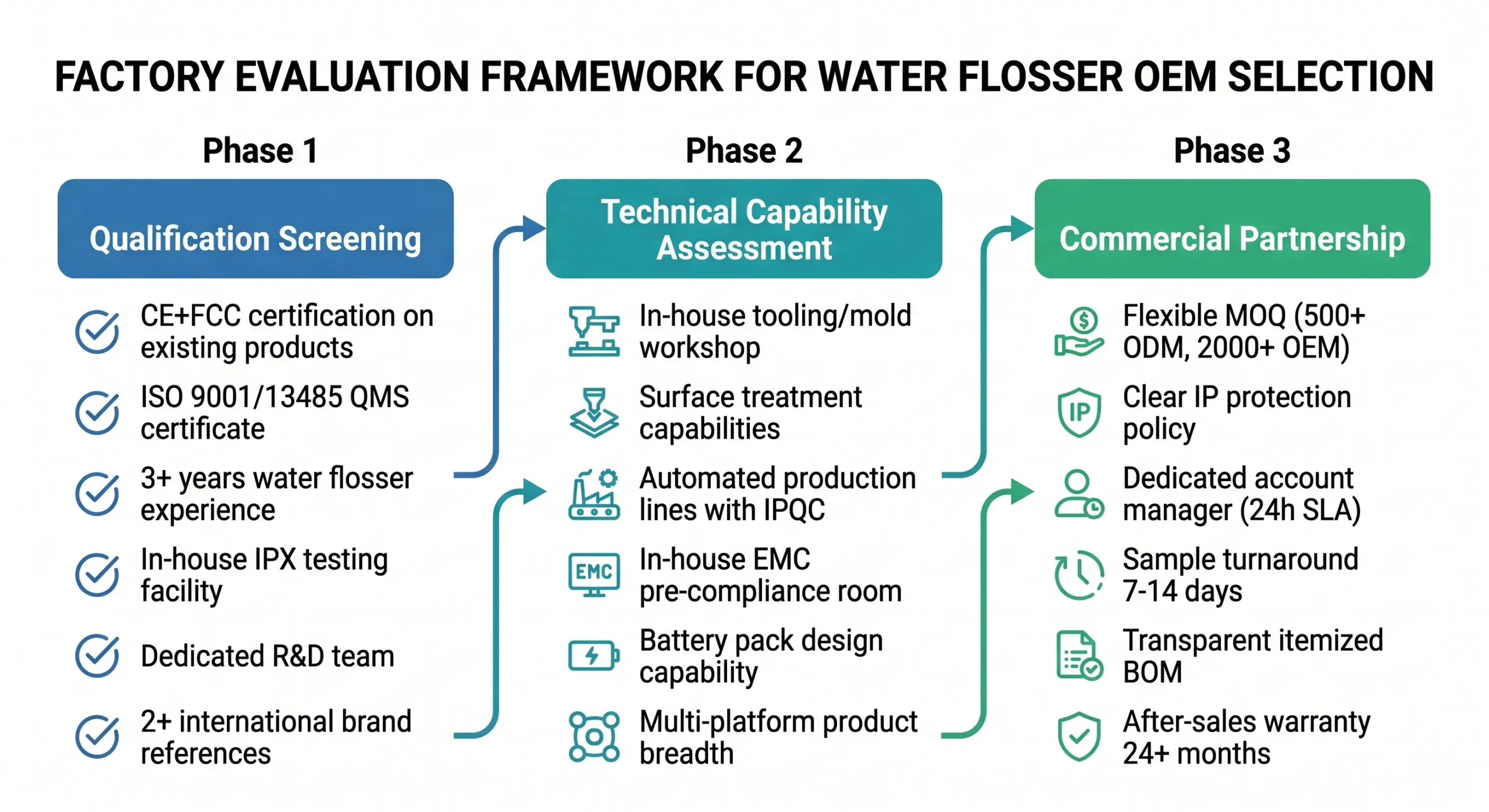
Phase 1: Qualification Screening
Before requesting samples, run these checks. One pattern we see repeatedly: brands verify that a factory has CE and FCC certification, but don't confirm that the certificate covers their specific product variant. We've worked with brands who received certification documentation for a countertop model, then found their cordless order was covered by a different, less-complete test report. Ask for the test report and match the model number on it to your target SKU before assuming you're covered.
- Factory holds at least CE + FCC certification on existing platform products (not just claiming to)
- ISO 9001:2015 or ISO 13485 quality management system certification (request certificate with audit body verification)
- Minimum 3 years of experience specifically in water flosser manufacturing (not just general electronics)
- Has in-house waterproof IPX testing facility. This is critical for quality consistency
- Has dedicated R&D team for product development (not just assembly)
- References from at least 2 verifiable international brand clients
Phase 2: Technical Capability Assessment
- In-house tooling/mold workshop or long-term partnership with tooling supplier
- Surface treatment capabilities: painting, electroplating, soft-touch coating, laser engraving
- Automated production lines with documented IPQC checkpoints
- In-house EMC pre-compliance testing room
- Battery pack design capability (not just purchasing standard packs)
- Multi-platform product breadth (countertop + cordless + accessories)
Phase 3: Commercial & Partnership Assessment
- Flexible MOQ for your volume stage (500 pcs minimum for ODM, 2,000+ for full OEM)
- Clear IP protection policy. NDA before sharing custom designs, mold ownership terms in contract
- Dedicated account manager with responsive communication (24-hour response SLA)
- Sample turnaround within 7–14 days for standard ODM models
- Transparent costing with itemized BOM. No bundled "packaging included" ambiguity
- After-sales warranty support: replacement parts supply for 24+ months post-shipment
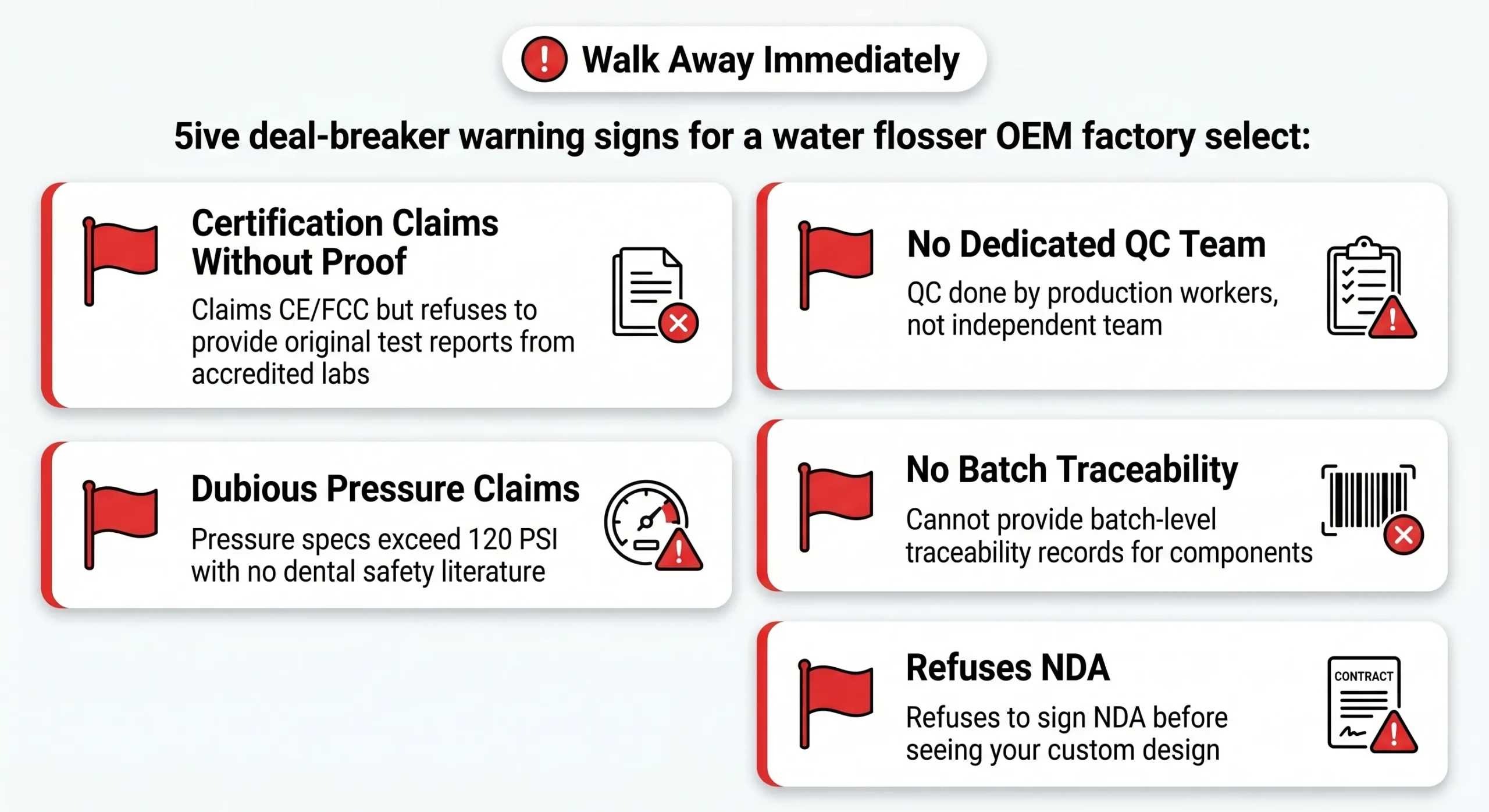
Red Flags to Walk Away From
- Claims CE/FCC certification but refuses to provide original test reports from accredited labs
- No dedicated QC team. QC done "by production workers"
- Pressure specs that exceed 120 PSI with no dental safety literature. Indicates dubious claims
- Cannot provide batch-level traceability records for components
- Refuses to sign NDA before seeing your custom design
Ready to Source Your Water Flosser Line?
Relish Tech is a CE/FDA/FCC certified oral care OEM manufacturer in China. We specialize in water flossers, electric toothbrushes, and complete oral care product lines with flexible MOQ from 500 units.
Request Free Sample Get an OEM QuoteReferenties
- Persistence Market Research. (2025). Global Water Flosser Market Report 2025–2033. Market size $3.87B (2025) → $8.70B (2033), CAGR 6.6%.
- Fortune Business Insights. (2025). Water Flosser Market Size, Share & Industry Analysis. Verified market growth projections.
- American Dental Association. (2024). Water Flosser Efficacy Study. Water flossers demonstrated 51% greater reduction in gingival bleeding compared to string floss.
9. FAQ: 6 Questions Buyers Always Ask