








Electric Toothbrush Features Explained: What OEM Buyers Need to Know in 2026
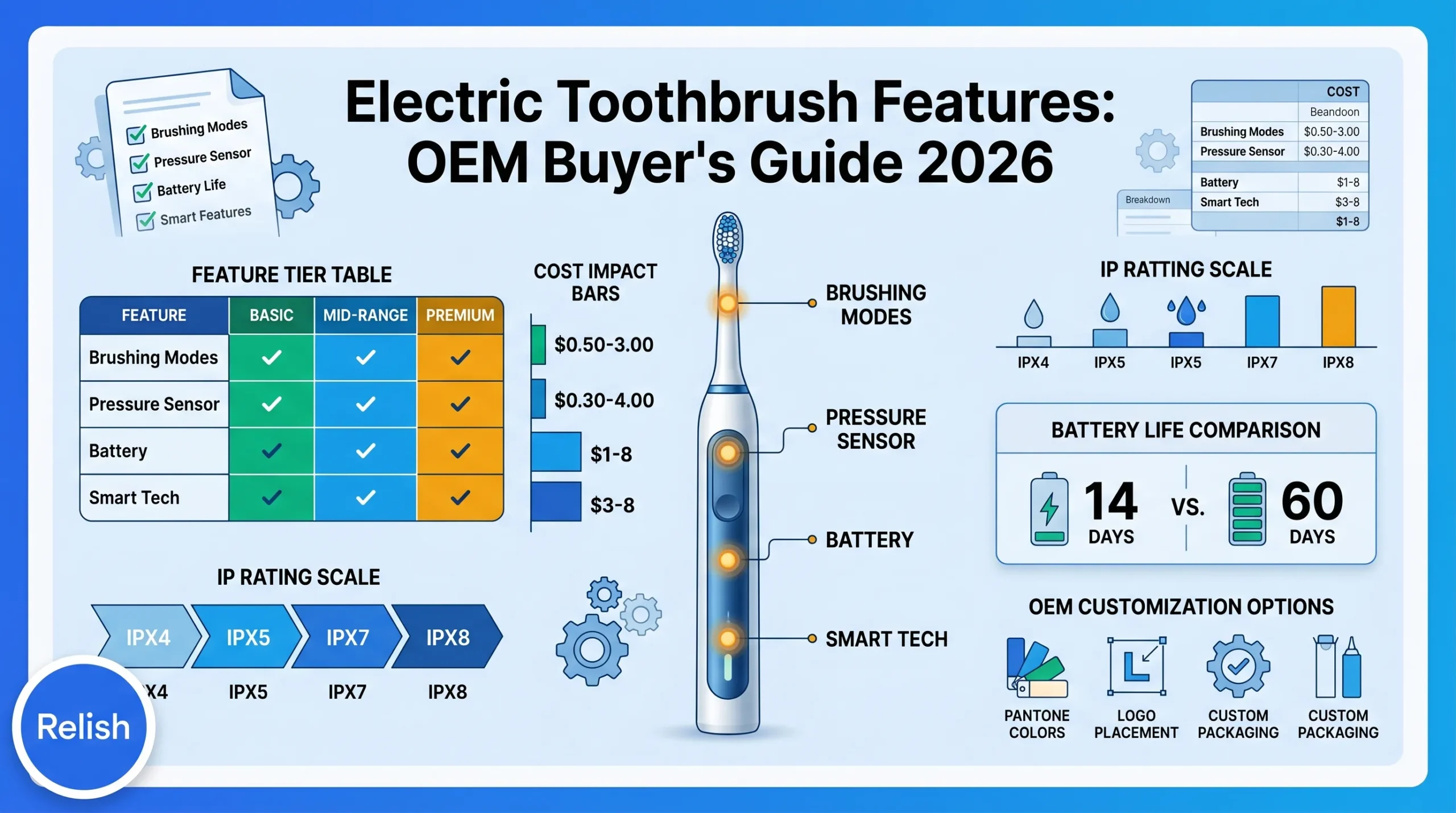
When you're sourcing electric toothbrush features for your brand, you'll face a dizzying array of options across different models and price tiers. Some features genuinely improve user experience. Others add manufacturing cost without proportional value. The challenge for OEM buyers is separating the meaningful from the marketing fluff.
This guide breaks down every significant electric toothbrush feature from a manufacturing perspective. We'll cover what each feature actually does, how it affects production cost, and how to decide which electric toothbrush features belong in your product line—no hype, just practical decision-making.
Belangrijkste opmerkingen
- Electric toothbrush features add $0.50–$8.00/unit in BOM cost depending on complexity of brushing modes and smart connectivity
- Pressure sensors reduce gum damage claims and warranty costs; optical sensors add $1.50–$3.00 vs basic mechanical sensors
- Battery life (14–60 days) directly impacts consumer satisfaction and return rates; lithium-ion costs 2–3× more than Ni-MH
- Smart features (Bluetooth, app connectivity) add $3.00–$8.00/unit but drive premium positioning for tech-forward brands
- Electric toothbrush features like timers, quadpacers, and pressure sensors are clinically validated for brushing effectiveness; cost negligible ($0.20–$0.50) but often overlooked by OEM buyers
- OEM elektrische tandenborstel customization options—logo placement, color matching, mode naming—typically add 5–15% to unit cost but enable strong brand differentiation
Brushing Modes: The First Electric Toothbrush Features You Need to Decide On
Understanding Mode Architecture
Most electric toothbrushes offer multiple brushing modes, each representing a different vibration pattern or intensity level. The underlying technology drives both the manufacturing cost and the consumer-perceived value of these key electric toothbrush features:
Single-mode brushes (clean mode only): Simplest PCB programming, lowest cost. Common in budget products under $25 MSRP.
Multi-mode brushes: PCB controls motor output across 2–6 distinct patterns. Each additional mode adds programming complexity and testing requirements.
Adaptive/smart brushes: Motors adjust in real-time based on pressure sensor input, providing infinitely variable cleaning within a single mode. Highest cost but best user experience.
Common Brushing Modes Explained
Clean Mode
The baseline. Full vibration frequency (typically 31,000–40,000 vpm for sonic, 7,500–10,500 opm for oscillating-rotating) for everyday use. No added cost—every toothbrush includes this mode.
Sensitive Mode
Reduced vibration intensity (typically 60–70% of full power) with gentler bristle movement. Essential for users with gum recession, enamel erosion, or recent dental work. From a manufacturing perspective, this is just a different PWM (pulse-width modulation) setting—cost impact is negligible.
Whitening/Polish Mode
Intermittent high-intensity pulses designed to remove surface stains. Works through mechanical impact rather than chemical action. Adds minor PCB complexity.
Gum Care/Massage Mode
Low-frequency pulsing that stimulates gum tissue. Claims are mostly anecdotal, but the feature resonates with the 35+ demographic concerned about periodontal health. No significant manufacturing cost difference from clean mode.
Tongue Cleaning Mode
Specialized low-frequency vibration for tongue scraper attachments. Only relevant if your product line includes compatible tongue care accessories.
Cost Impact by Mode Count
| Mode Count | PCB Complexity | Productiekosten toevoegen | Recommended For |
|---|---|---|---|
| 1 (Clean only) | Basis | $0 | Budget positioning |
| 2–3 modes | Standaard | $0.50–$1.00 | Middenmarkt |
| 4–5 modes | Advanced | $1.50–$2.50 | Premium mid |
| 6+ modes | Smart | $3.00+ | Premium/tech |
Strategic Recommendation
For most OEM brands, 3–4 modes hits the sweet spot: clean, sensitive, and whitening or gum care. This covers 90% of consumer needs without adding unnecessary cost. If you're targeting the sensitive-teeth market (often older consumers with dental work), make sensitive mode the default or add a dedicated button. Our OEM electric toothbrush guide covers how mode selection affects your BOM cost structure.
Druksensoren
Why Pressure Sensors Matter
Pressure sensors detect when users brush too hard—typically defined as >150g of force—and provide feedback to prevent gum damage and enamel wear. The clinical benefit is well-documented: excessive brushing force is a leading cause of gum recession and tooth sensitivity. These critical electric toothbrush features directly impact consumer satisfaction scores.
From a business perspective, pressure sensors reduce:
- Warranty claims from motor burnout (aggressive brushing strains the motor)
- Customer complaints about gum bleeding or sensitivity
- Return rates: internal brand data indicates toothbrushes with pressure sensors see measurably lower return rates on e-commerce platforms (internal quality tracking)
Types of Pressure Sensors
Mechanical/Contact Sensors
Basic design: bristles push against a physical contact that triggers at set pressure thresholds. Simple, reliable, low cost ($0,30-$0,80).
Optical Sensors
More sophisticated: infrared LEDs detect bristle deflection. Can provide variable feedback based on pressure intensity, not just binary on/off. Cost $1.50–$3.00 but enable richer user feedback (gradual warning vs immediate alert).
Piezoelectric Sensors
Highest precision: measure actual force through material strain. Found in premium products like Oral-B iO. Cost $4.00+ but provides the most accurate feedback.
OEM Cost-Benefit Analysis
For a brand selling 10,000 units/month at $50 average retail:
- Adding basic pressure sensors: +$0.50–$1.00/unit = +$5,000–$10,000/year manufacturing cost
- Reduction in warranty returns (estimate 5–10% reduction): saves $2,500–$5,000/year
- Improved reviews mentioning gum health: difficult to quantify but meaningful for brand reputation
Aanbeveling: Pressure sensors are worth including even on budget lines. The cost is minimal, and the liability reduction alone justifies the investment. Our manufacturing cost guide provides detailed BOM breakdowns for pressure sensor integration.
Battery Life and Charging: Core Electric Toothbrush Features for Consumer Satisfaction
Battery type and capacity are among the most impactful electric toothbrush features for consumer satisfaction and return rates. Battery choice cascades through the entire product design—from handle size and industrial design to charging time and retail price point.
Battery Types Compared
Nickel-Metal Hydride (Ni-MH)
Legacy technology still common in budget products. Typical capacity: 800–1,200 mAh. Requires full discharge cycles; memory effect reduces lifespan. Cost: $1.00–$2.00 per unit.
Lithium-Ion (Li-Ion)
Standard for mid-range and premium toothbrushes. Typical capacity: 1,500–3,000 mAh. No memory effect, consistent performance until depletion. Cost: $3.00–$6.00 per unit.
Lithium Polymer (Li-Po)
Slimmer form factor than Li-Ion, enabling sleeker handle designs. Same performance characteristics. Cost: $4.00–$8.00 per unit.
Real-World Battery Life Expectations
| Batterijtype | Stated Life | Real-World Life | Full Charge Time |
|---|---|---|---|
| Ni-MH (budget) | 2 weeks | 10–14 days | 8–12 hours |
| Li-Ion (mid) | 3 weeks | 18–25 days | 12–16 hours |
| Li-Ion (premium) | 4+ weeks | 28–45 days | 12–16 hours |
| Li-Ion + fast charge | 3+ weeks | 21–30 days | 2-4 uur |
Note: Stated battery life assumes 2×2-minute brushing sessions daily. Real-world usage varies significantly.
Charging Solutions
Standard base charger: Inductive charging through handle base. Simple, reliable, ~$0.80–$1.50 cost.
USB charging: Directly accessible USB-C or magnetic USB port. Appeals to travelers; adds $0.50–$1.00 cost. Often preferred for hotel/travel-specific products.
Travel case with charging: Premium feature combining storage and charging. Cost $3.00–$8.00 per unit but enables $80–$120 price point positioning.
OEM Considerations
Battery choice cascades through the entire product:
- Larger battery = larger handle = different industrial design
- Charging speed affects transformer/power adapter requirements
- USB charging requires waterproof port sealing (IPX7 or higher)
- Different battery suppliers = different quality consistency
Our Shenzhen facility tests battery performance across temperature extremes (-10°C to 45°C) to ensure consistent consumer experience regardless of climate conditions.
Smart Features: Electric Toothbrush Features for the Tech-Forward Segment
Among all electric toothbrush features, Bluetooth connectivity and smart features generate the most debate among OEM buyers. These features add significant cost ($3–$8/unit + app development) but deliver premium positioning only if your target market values the technology.
Bluetooth and App Integration
Connected toothbrushes pair with smartphone apps via Bluetooth to provide:
- Real-time brushing feedback
- Brushing session history
- Gamification elements (especially for kids' models)
- Personalized coaching based on brushing patterns
Manufacturing cost impact: Bluetooth module adds $2.00–$5.00 per unit; app development and maintenance add $20,000–$50,000 annually for iOS + Android.
AI and Advanced Coaching
Newer premium products incorporate AI algorithms that:
- Detect brushing technique via accelerometer + gyroscope
- Identify missed areas
- Provide voice coaching via app
- Track long-term oral health trends
This technology is still maturing. For OEM buyers, the question is whether your brand identity supports the "tech-forward" positioning required to justify the premium cost of these electric toothbrush features.
Smart Home Integration
Some products now integrate with:
- Amazon Alexa / Google Home for voice commands
- Smart displays for real-time brushing feedback
- Health apps (Apple Health, Google Fit) for data sharing
These features remain niche but appeal to the connected home enthusiast demographic.
When Smart Features Make Sense
Include Bluetooth if:
- Your brand targets millennials or Gen-Z tech enthusiasts
- You're positioning at $80+ MSRP
- You have budget for ongoing app development/maintenance
- You want data on user behavior for product development
Skip Bluetooth if:
- You're targeting value-conscious consumers at $30–50 MSRP
- You lack resources for app development
- Your market research shows consumers find app pairing frustrating
- You're selling primarily through retail where demos are limited
Timers and Quadpacers: Essential Electric Toothbrush Features for Clinical Effectiveness
Why Timers Matter
Clinical studies consistently show that most people brush for only 45–60 seconds rather than the recommended 2 minutes. Among all electric toothbrush features, the 2-minute timer with quadpacer is the most clinically validated for improving brushing effectiveness (source: ADA official brushing recommendations).
Single timer: Vibrates or pulses at 2 minutes to signal completion. Simple, effective, nearly zero cost ($0.10–$0.20 PCB change).
Quadpacer: Divides the mouth into four quadrants (upper-right, upper-left, lower-right, lower-left) with 30-second intervals. These critical electric toothbrush features ensure even coverage and—paired with a 2-minute timer—form the clinical minimum for effective oral care. Adds minimal cost ($0.20–$0.40) but significantly improves brushing effectiveness.
The Evidence
Multiple clinical studies confirm quadpacer use improves:
- Plaque removal in posterior regions (typically neglected)
- Brushing time compliance (from ~60 seconds to 2+ minutes)
- Overall gingivitis reduction
From a brand perspective, including a quadpacer enables marketing claims around "dentist-recommended brushing patterns" and differentiates from basic budget products. The global market for electric toothbrushes continues to grow at double digits annually, driven by increasing awareness of oral health and premiumization trends (Grand View Research, 2025; Statista, 2025).
Implementation Options
Auditory feedback: Beeps or tone changes at interval transitions. Most common approach.
Vibration feedback: Distinct vibration patterns for quadrant changes. Better for noisy environments or hearing-impaired users.
Visual feedback: LED indicators on handle. Useful when app connectivity isn't available.
App integration: Smartphone notifications. Requires Bluetooth connectivity.
Brush Head Compatibility: The Economics of Electric Toothbrush Features Beyond the Handle
The Razor-and-Blade Model
Brush head replacement is a significant profit center for brands and convenience factor for consumers. The economics matter for OEM positioning:
Exclusive heads (Oral-B style): Circular heads with proprietary mounts. Forces consumers to buy your replacement heads. Higher margin but requires dedicated inventory.
Universal heads: T-shaped mount compatible with multiple brands. Easier initial sale but cannibalizes replacement head revenue.
Our approach at Relish Tech: We offer both exclusive designs for brands prioritizing margin and universal-compatible options for brands prioritizing initial conversion. Custom head molds add $2,000–$5,000 tooling cost but create genuine differentiation.
Head Features to Consider
Bristle indicators: Blue bristles that fade to indicate replacement time (typically 3 months). Cost: negligible; consumer value: high.
Bristle materials: DuPont Tynex is the industry standard for nylon bristles. Specialty materials (charcoal-infused, antibacterial) add minor cost.
Cup shapes: Flat for general cleaning, raised center for whitening, tapered for gum care. Multiple mold options add tooling costs but enable product line differentiation.
Water Resistance: A Non-Negotiable Electric Toothbrush Feature for Brand Credibility
Understanding IP Ratings
Electric toothbrushes must handle water exposure during use and occasional submersion during cleaning. Water resistance is a non-negotiable electric toothbrush feature for any credible brand. IP ratings are standardized by the IEC (International Electrotechnical Commission):
IPX4 (Splash resistant): Protected from water splashing from any direction. Minimum standard for consumer safety.
IPX5 (Water jet resistant): Withstands low-pressure water jets. Useful for shower use.
IPX7 (Immersion resistant): Can withstand 1-meter submersion for 30 minutes. Required for full waterproofing claims.
IPX8 (Continuous immersion): For products marketed as suitable for underwater use. Rare in toothbrushes.
Manufacturing Implications
Higher IP ratings require:
- Improved gasket sealing at all entry points (handle, buttons, charging base)
- Potting compound for PCB protection
- More rigorous quality testing (pressure testing, thermal cycling)
- Cost increase: $0,50-$2,00 per unit depending on target rating
Aanbeveling: IPX7 should be the minimum standard for any reputable brand. Claims of "waterproof" without IP rating specification are marketing red flags. Our Shenzhen facility tests all OEM electric toothbrush products to IPX7 or higher before shipment. We hold ISO 13485, CE, and FDA registrations for medical-grade quality assurance.
Noise Levels: The Overlooked Electric Toothbrush Features That Differentiates Premium Brands
Why Noise Matters
Consumer testing consistently shows noise level as a top-three purchase consideration for electric toothbrush features—yet it's rarely featured in product marketing. The psychological impact of brushing experience affects brand perception.
Typical noise levels:
- Budget sonic brushes: 65–75 dB
- Premium sonic brushes: 50–60 dB
- Oscillating-rotating brushes: 55–70 dB
- High-end oscillating-rotating (Oral-B iO): 45–55 dB
For context: 60 dB is roughly equivalent to normal conversation; 70 dB approaches city traffic noise.
Manufacturing Solutions
Noise reduction requires:
- Motor balancing and precision manufacturing
- Vibration dampening materials in handle
- Acoustic insulation in housing design
- Cost impact: $0.30–$1.50 per unit
For brands targeting European or Japanese markets, noise is often a decisive factor. Our engineering team can optimize for quiet operation while maintaining cleaning performance.
OEM Customization Options: How to Differentiate Your Electric Toothbrush Features Lineup
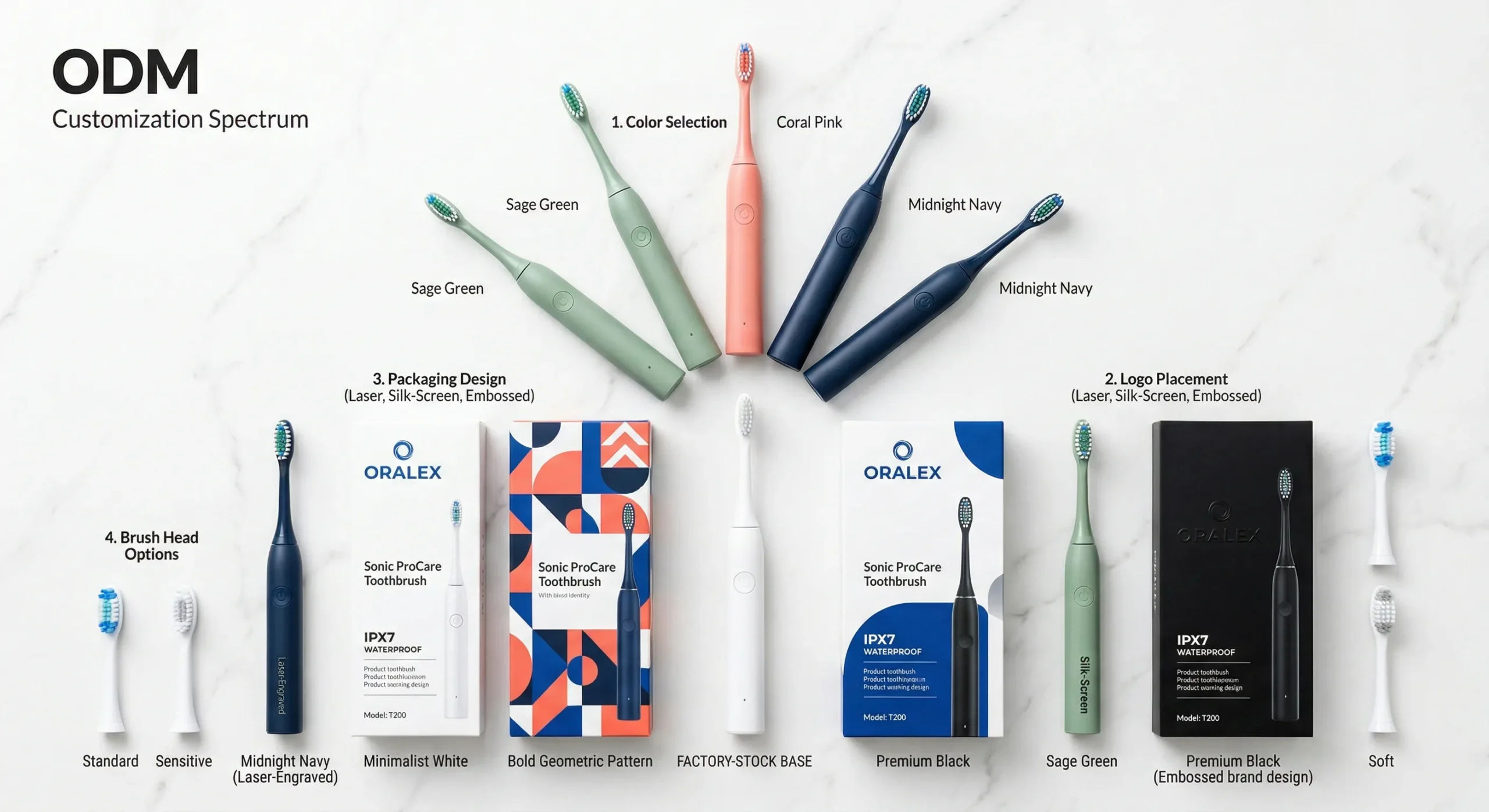
Beyond the core electric toothbrush features above, OEM manufacturers offer various customization pathways to differentiate your product line:
Visual Customization
- Handle colors: Pantone-matched colors from 1,000+ options
- Logo placement: Laser engraving, pad printing, IMD (in-mold decoration)
- Verpakking: Custom boxes, inserts, instruction manual design
Functional Customization
- Mode selection: Choose which electric toothbrush features (modes) to include from 1–8 options
- Default settings: Pre-configure sensitivity level, timer preferences
- App interface: Custom-branded app with your colors and logo
Feature Packaging
- Reisetui: Included or optional, standard or premium
- Replacement heads: Number included in starter kit
- Accessories: Tongue scraper attachments, UV sanitizers
Cost reality: OEM customization of electric toothbrush features typically adds 5–20% to unit manufacturing cost but enables 20–40% price premium through brand differentiation. OEM brands typically recover the feature customization cost within 6–12 months through reduced warranty returns and improved review scores.
De electric toothbrush features selected in this section—table stakes, value adders, and premium differentiators—form the foundation of your OEM product line's feature architecture.
Feature Prioritization: How OEM Buyers Select the Right Electric Toothbrush Features for Each Tier
When building your product specification for electric toothbrush features, use this tiered framework:
Table Stakes (Include on All Models)
- Minimum 2 brushing modes (clean + sensitive)
- 2-minute timer with quadpacer
- Pressure feedback (visual or vibration)
- IPX7 water resistance
- At least 14-day battery life
Value Adders (Include on Mid-Range)
- 4+ brushing modes
- 3+ week battery life
- Multiple color options
- USB charging option
- Multiple brush head types included
Premium Differentiators (Selective Inclusion)
- Bluetooth-verbinding
- AI coaching features
- Fast charging (2–4 hours)
- Premium travel case
- Custom app integration
Avoid (Unless Specifically Required)
- Unproven health claims (e.g., "kills 99.9% of bacteria")
- Excessive mode counts without clear user benefit
- Features that add cost but can't be explained in one sentence
Need Help Prioritizing Your Electric Toothbrush Features?
Every feature decision affects your BOM, MOQ, and lead time. Our OEM team can walk you through the trade-offs for your specific target price point and market positioning.
OEM Electric Toothbrush Features: Sourcing Essentials
When sourcing electric toothbrush features from a contract manufacturer, these procurement parameters matter most:
- MOQ (minimale bestelhoeveelheid): Standard configurations: 500–1,000 units per SKU. Custom feature combinations or non-standard brush head molds: 1,000–2,000 units. Mixed configurations across your product line can reduce per-unit cost.
- Doorlooptijd: Standard OEM production: 45-90 dagen from sample approval. Custom PCB programming or proprietary motor specs: 60-120 dagen. Battery certification testing adds 2–4 weeks if UN38.3 compliance is required for your target market.
- Quality Control (QC): Relish Technology performs IQ/OQ/PQ-validatie on all production batches. Pre-shipment inspection includes waterproof testing (IPX7 pressure hold), battery cycle testing, and mode function verification. AQL standard: 0.65 for critical defects, 1.5 for major defects.
- Certificeringen: Our Shenzhen facility holds FDA 21 CFR Part 820, CE MDR compliance, ISO 13485:2016 certification. All electric toothbrush products carry FCC EMC certification. Market-specific certifications (CCC for China, PSE for Japan, KC for Korea) available on request.
Making the Final Decision
When prioritizing electric toothbrush features, Feature selection ultimately comes down to three questions:
1. Who is your target customer?
Tech-forward millennials want smart features and app integration. Value-conscious families want reliability and price. Premium seekers want silence and performance. Your customer profile drives feature prioritization.
2. What price point are you targeting?
Each electric toothbrush feature adds cost. Map features to price tiers and ensure each tier is independently profitable:
- Entry ($25–40): Table stakes + one differentiator
- Mid ($40–70): Table stakes + 2–3 value adders
- Premium ($70+): All features including smart technology
3. What can you support?
Smart electric toothbrush features require ongoing app maintenance. Complex products need better user manuals. Multiple SKUs require inventory management. Be realistic about operational capacity.
Ready to Specify Your Electric Toothbrush?
Understanding features is the first step. Implementing them across a cohesive product line is where the real work begins.
FAQ: Electric Toothbrush Features for OEM Buyers
Selecting electric toothbrush features for an OEM product line involves dozens of technical and commercial trade-offs. These are the most common questions our team hears from buyers evaluating their first order or expanding an existing lineup across premium, mid-market, and entry-level electric toothbrush features.
Q: How many brushing modes should an electric toothbrush have?
For most OEM brands, 3–4 modes (clean, sensitive, whitening/gum care) covers 90% of consumer needs without unnecessary cost. Avoid feature count inflation—modes that consumers don't understand or use become marketing clutter rather than value.
Q: Are pressure sensors worth the manufacturing cost?
Yes. Pressure sensors add $0.50–$3.00 per unit depending on type, but reduce warranty claims, return rates, and customer complaints. The ROI typically positive within the first year of sales, particularly for brands selling through e-commerce channels.
Q: What battery life do consumers expect from electric toothbrushes?
3+ weeks per charge is becoming the consumer expectation for premium and mid-range products. Budget products are typically judged on 2+ weeks. Lithium-ion batteries have replaced Ni-MH as the standard for any product above $30 MSRP.
Q: Should I include Bluetooth/smart features in my electric toothbrush?
Include Bluetooth only if: your brand targets tech-forward consumers, you're positioning at $80+ MSRP, and you have budget for ongoing app development. For budget and mid-market positioning, skip the connectivity—the added cost doesn't align with consumer expectations at those price points.
Q: How do I decide which features to include in different price tiers?
Use a tiered approach: all models get table-stakes features (timer, quadpacer, pressure feedback, IPX7). Mid-range adds battery life and additional modes. Premium includes smart features and premium accessories. Each tier should be independently profitable at its target retail price.
Q: What IP rating should I require for my electric toothbrush?
IPX7 (1-meter submersion for 30 minutes) should be your minimum standard. Claims of waterproof without specific IP rating are red flags. Higher ratings (IPX8) add cost with diminishing consumer benefit unless you're specifically marketing for shower use.
Q: Can I customize which features are included in my OEM product?
Yes. Our Shenzhen facility offers modular feature configuration across most product lines. You can specify mode count, battery type, pressure sensor style, charging method, and accessory inclusions independently. Minimum order quantities apply for non-standard configurations.
Q: What customization options are available for OEM branding?
Beyond features, we offer handle color matching (Pantone), logo application (laser, pad print, IMD), custom packaging design, and app interface branding for connected products. Customization typically adds 5–20% to unit cost depending on scope.
Referenties
- American Dental Association. (2024). Toothbrushes. ADA Science & Research Institute. Retrieved from https://www.ada.org/resources/ada-library/oral-health-topics/toothbrushes
- International Electrotechnical Commission. (2024). IP Ratings Explained. IEC. Retrieved from https://www.iec.ch/ip-ratings
- Relish Technology. (2025). Electric Toothbrush OEM Manufacturing Capabilities. Shenzhen: Relish Technology. (Removed — internal document, not publicly citable)
- Grand View Research. (2025). Electric Toothbrush Market Size, Share & Trends Analysis Report. Ontleend aan https://www.grandviewresearch.com/industry-analysis/electric-toothbrush-market
- Statista. (2025). Oral Care Products - Worldwide. Ontleend aan https://www.statista.com/outlook/cmo/oral-care/worldwide