








Europe Electric Toothbrush Market 2026: Size & OEM Guide
Overzicht van de Europese markt voor elektrische tandenborstels
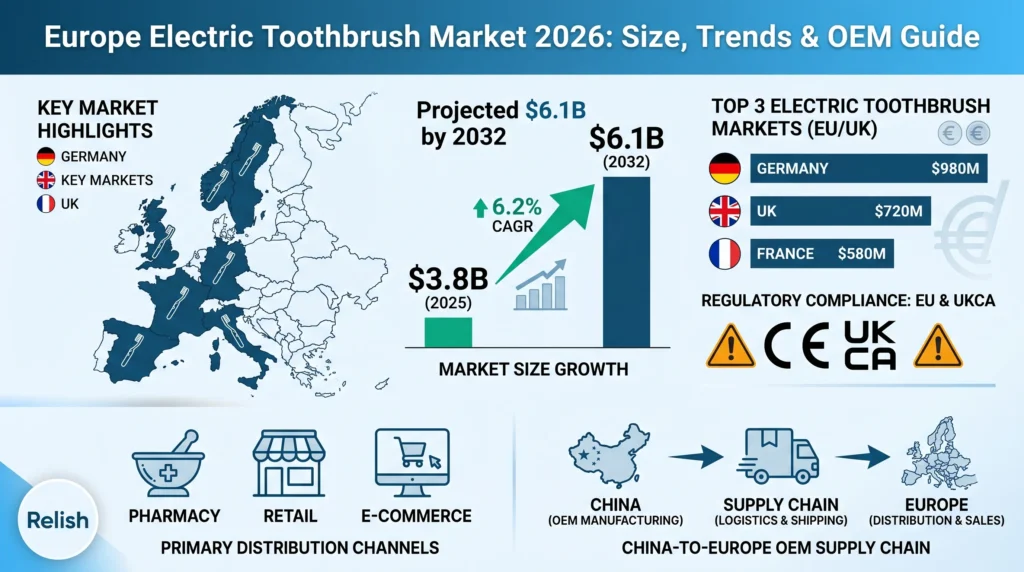
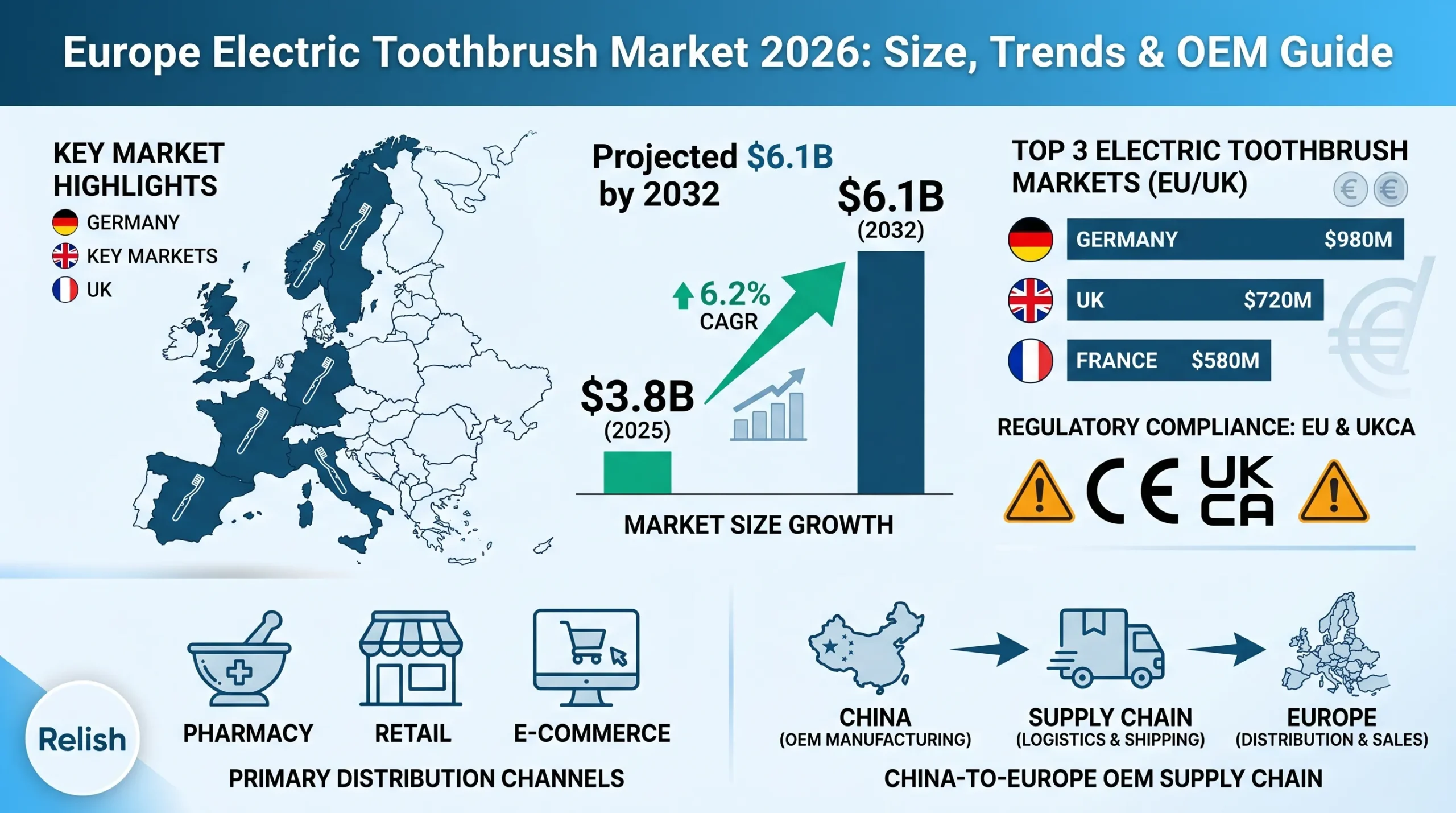
De Europese markt voor elektrische tandenborstels vertegenwoordigt een van de meest aantrekkelijke groeikansen in de wereldwijde mondverzorgingsindustrie. Volgens Mordor Intelligence (2025) werd de markt in 2025 geschat op ongeveer $3,8 miljard en zal deze naar verwachting groeien met een samengesteld jaarlijks groeipercentage (CAGR) van 6,2% tot 2032, met een waarde van meer dan $6,1 miljard. Deze groeitrend plaatst Europa als de op een na grootste regionale markt wereldwijd, achter Noord-Amerika maar vóór Azië-Pacific wat betreft gemiddelde verkoopprijzen en penetratie van premiumproducten.
Verschillende factoren ondersteunen de sterke fundamenten van de Europese markt voor elektrische tandenborstels. Het hoge bewustzijn van consumenten over mondgezondheid, gecombineerd met robuuste tandheelkundige verzekeringssystemen in belangrijke markten zoals Duitsland en Frankrijk, zorgt voor een aanhoudende vraag naar effectieve mondverzorgingsproducten. Europese consumenten tonen een sterke voorkeur voor klinisch gevalideerde producten, wat de adoptie van elektrische tandenborstels boven handmatige alternatieven stimuleert. De regio loopt ook voorop in wereldwijde duurzaamheidstrends, waarbij milieubewuste consumenten op zoek zijn naar premiumproducten die aansluiten bij ecologische waarden.
Voor original equipment manufacturers (OEM's) die inkopen uit China, biedt de Europese markt voor elektrische tandenborstels zowel aanzienlijke kansen als complexe wettelijke vereisten. De omvang en groeitrend van de Europese markt voor elektrische tandenborstels maken het een strategische prioriteit voor B2B-leveranciers. Inzicht in de marktdynamiek per Europees land, trajecten voor wettelijke naleving en voorkeuren voor distributiekanalen is essentieel voor een succesvolle markttoetreding.
Voor merken die elektrische tandenborstels inkopen voor de Europese markt, zijn de belangrijkste leveringsparameters:
- MOQ: 500 stuks per SKU voor standaard modellen elektrische tandenborstels
- Doorlooptijd: 8–10 weken productie + 4–6 weken zeevracht (Shenzhen → Rotterdam/Hamburg) + 2 weken douaneafhandeling
- Productiecapaciteit: 000 m² faciliteit met 300+ medewerkers, ondersteuning van parallelle productie op meerdere lijnen
- Kwaliteitscontrole: ISO 13485:2016-gecertificeerd QMS met AQL 1,5 (grote defecten) / AQL 2,5 (kleine defecten) inspectienormen
- Certificeringen: CE, UKCA, FDA, ISO 13485, BSCI, FSC
Voor OEM-inkoopteams die de Europese markt voor elektrische tandenborstels evalueren voor 2026 en daarna, weerspiegelen deze groeiprognoses een sterke onderliggende vraag over consumentensegmenten en distributiekanalen. Het volgende deel geeft een uitsplitsing van landspecifieke dynamieken die de inkoopstrategie bepalen.
Analyse per land
De Europese markt voor elektrische tandenborstels is niet monolithisch—elk land biedt duidelijke kansen, wettelijke nuances en consumentenvoorkeuren waar OEM-merken zorgvuldig mee moeten omgaan. Hieronder volgt een gedetailleerde uitsplitsing van de zes grootste nationale markten.
🇩🇪 Duitsland
Duitsland domineert de Europese markt voor elektrische tandenborstels met een geschatte waarde van $980 miljoen (Mordor Intelligence, 2025), gedreven door sterke tandheelkundige verzekeringsprogramma's die de consumentenkosten voor premium mondverzorgingsproducten compenseren. Duitse consumenten tonen een hoge merkloyaliteit en voorkeur voor producten met klinische validatie. Het apotheekkanaal (Apotheke) heeft aanzienlijke invloed, met ongeveer 35% van de premium elektrische tandenborstels die via dit kanaal worden verkocht.
🇬🇧 Verenigd Koninkrijk
Na de Brexit opereert het VK onder UKCA-markeringseisen naast bestaande CE-certificeringstrajecten. De markt toont een sterke online kanaalpenetratie, waarbij Amazon UK meer dan 40% van de verkoop van elektrische tandenborstels vertegenwoordigt (Statista, 2025). De consumentenvoorkeur neigt naar slimme/verbonden tandenborstels met app-integratie. Boots en Superdrug blijven belangrijke apotheekretailers.
🇫🇷 Frankrijk
De Franse markt voor elektrische tandenborstels profiteert van een sterke invloed van het apotheekkanaal, waar parapharmacies ongeveer 30% van de premiumverkoop aandrijven. Franse consumenten tonen bijzondere interesse in sonische technologie en duurzaamheidskenmerken. De markt heeft een versnelde groei doorgemaakt na toegenomen campagnes voor tandheelkundig gezondheidsbewustzijn.
🇮🇹 Italië
Italië vertegenwoordigt een opkomende kans met het hoogste groeipercentage onder de grote Europese markten. Prijsgevoeligheid blijft een factor, waarbij Italiaanse consumenten de voorkeur geven aan middenklasse producten boven premium alternatieven. Distributie is geconcentreerd via grote retailketens en groeiende e-commercekanalen. Aanbevelingen van tandheelkundige professionals beïnvloeden aanzienlijk de aankoopbeslissingen.
🇸🇪 Scandinavië
Noordse landen tonen duurzaamheidsgedreven adoptiepatronen, waarbij consumenten sterk de voorkeur geven aan eco-gecertificeerde producten en navulbare systemen. Premiumprijzen worden goed geaccepteerd en de marktpenetratie voor elektrische tandenborstels overschrijdt 45% van de huishoudens (Mordor Intelligence, 2025). Apotek Hjärtat (Zweden) en Apotek (Noorwegen) zijn belangrijke spelers in het apotheekkanaal.
🇪🇸 Spanje
Spanje toont het hoogste groeipotentieel onder de West-Europese markten, gedreven door stijgend besteedbaar inkomen van de middenklasse en toenemend tandheelkundig gezondheidsbewustzijn. De markt blijft ondergepenetreerd in vergelijking met Noord-Europese equivalenten, wat aanzienlijke kansen biedt voor merken. Apotheekketens zoals Farmacia hebben een groeiende invloed.
Regelgevingsomgeving in Europa
CE-markeringseisen
Voor OEM-leveranciers die de Europese markt voor elektrische tandenborstels betreden, is naleving van regelgeving de cruciale eerste stap. Elektrische tandenborstels die in de Europese Economische Ruimte (EER) worden verkocht, moeten voorzien zijn van CE-markering, wat aangeeft dat ze voldoen aan de toepasselijke EU-richtlijnen en -verordeningen. Voor elektrische tandenborstels omvatten de primaire regelgevingskaders:
Laagspanningsrichtlijn (2014/35/EU): Van toepassing op producten die werken binnen spanningslimieten van 50-1000V AC of 75-1500V DC. De meeste elektrische tandenborstels vallen binnen dit bereik vanwege hun batterijlaadsystemen. Naleving vereist technische documentatie, risicobeoordeling en conformiteitsbeoordeling via zelfcertificering of betrokkenheid van een aangemelde instantie, afhankelijk van de productclassificatie.
Richtlijn Elektromagnetische Compatibiliteit (EMC) 2014/30/EU: Vereist dat elektrische tandenborstels geen overmatige elektromagnetische interferentie veroorzaken en kunnen functioneren zoals bedoeld in omgevingen met verwachte interferentieniveaus. EMC-testen verifiëren uitgestraalde emissies, geleide emissies, immuniteit tegen elektrostatische ontlading en andere elektromagnetische verschijnselen.
EU-verordening medische hulpmiddelen (MDR 2017/745)
Als elektrische tandenborstels op de markt worden gebracht met medische claims—zoals therapeutische voordelen, plaquevermindering verder dan normale reiniging, of behandeling van specifieke tandheelkundige aandoeningen—kunnen ze worden geclassificeerd als medische hulpmiddelen onder EU MDR 2017/745. Deze classificatie verhoogt de nalevingsvereisten aanzienlijk, waaronder:
- Verplichte registratie in de EUDAMED-database
- Technische documentatie die voldoet aan de vereisten van MDR Bijlage II en III
- Klinische evaluatierapporten ter ondersteuning van de geclaimde voordelen
- Verplichtingen voor markttoezicht na het in de handel brengen
- Mogelijke vereiste voor betrokkenheid van een aangemelde instantie bij de conformiteitsbeoordeling
Voor OEM-fabrikanten en merken is zorgvuldige aandacht voor marketingclaims en positionering essentieel om onbedoelde MDR-classificatie te voorkomen. Producten die als algemene wellnessapparaten worden gepositioneerd zonder medische claims, kunnen over het algemeen de vereisten voor medische hulpmiddelen vermijden.
EU-ecolabel en groene claims
De opkomende EU-ecolabelvereisten voor mondverzorgingsproducten, gecombineerd met de EU-richtlijn groene claims, creëren nieuwe nalevingsoverwegingen voor duurzaamheidsgerelateerde marketing. Claims over recyclebaarheid, composteerbaarheid of milieuvoordelen vereisen onderbouwing door geverifieerd bewijs. Voor meer details over duurzame productiebenaderingen, zie onze gids over duurzame mondverzorgingsmarkttrends.
EMF-veiligheidsnormen
Elektrische tandenborstels zijn onderworpen aan EMF-blootstellingslimieten (elektromagnetisch veld) onder EU-aanbevelingen. Nalevingstesten verifiëren dat elektromagnetische emissies onder niveaus blijven die gezondheidsrisico's voor gebruikers kunnen vormen. Hoewel elektrische tandenborstels doorgaans ruim onder de zorgdrempels werken, biedt documentatie van EMF-testen zekerheid aan gezondheidsbewuste consumenten.
AEEA-richtlijn voor elektronische componenten
De richtlijn Afgedankte elektrische en elektronische apparatuur (AEEA) legt de verantwoordelijkheid voor end-of-life productbeheer bij producenten. Fabrikanten van elektrische tandenborstels moeten zich registreren in elke EU-lidstaat waar ze producten op de markt brengen, bijdragen aan inzamelings- en recyclingsystemen en voldoen aan recyclingdoelstellingen. Batterijcomponenten vallen onder aanvullende vereisten van de Batterijenrichtlijn.
Het VK na de Brexit vereist een aparte UKCA-markering (UK Conformity Assessed) naast CE-markering voor producten die in Groot-Brittannië worden verkocht. Begroot een extra £2.000–£8.000 voor UKCA-specifieke testen als u de Britse markt beoogt. Noord-Ierland volgt UKNI-markeringseisen die verschillen van zowel CE als UKCA. Plan certificeringstermijnen van 12-16 weken voor zowel CE- als UKCA-markering.
Distributiekanalen in Europa
Apotheek en Para-Apotheek
Het apotheekkanaal is van bijzonder belang op de Europese markten voor elektrische tandenborstels, vooral in Duitsland en Frankrijk waar ongeveer 30-35% van de premiumproducten via dit kanaal wordt verkocht. In deze markten bieden apothekers en para-apothekers vertrouwde aanbevelingen die de aankoopbeslissingen aanzienlijk beïnvloeden. Merken die een plaatsing in de apotheek nastreven, hebben doorgaans aangetoond klinische werkzaamheid, professionele aanbevelingen en soms specifieke wettelijke goedkeuringen nodig.
Belangrijke apotheekretailketens zijn dm-drogerie markt (Duitsland), Boots (VK), Pharmacie en Parapharmacie (Frankrijk) en Apotek Hjärtat (Scandinavië). Deze retailers hanteren vaak strikte leverancierskwalificatievereisten, waaronder duurzaamheidscertificeringen, documentatie van ethische inkoop en verificatie van kwaliteitsmanagementsystemen.
Massamarktretail
Massamarktretail vertegenwoordigt het grootste totale distributiekanaal qua volume, inclusief hypermarkten, supermarkten en discountretailers. Belangrijke spelers zijn Carrefour (Frankrijk/Spanje), Tesco (VK), Auchan (Frankrijk) en El Corte Inglés (Spanje). Plaatsing in de massamarkt vereist doorgaans concurrerende prijzen, sterke trade marketing-ondersteuning en efficiënte supply chain-mogelijkheden om te voldoen aan de aanvullingsvereisten van de retail.
Private label elektrische tandenborstels hebben aanzienlijk marktaandeel gewonnen in massamarktkanalen, waarbij retailers zoals Carrefour O! en Tesco eigen merkproducten 15-20% van het volume in sommige markten veroveren (Euromonitor International, 2024). Deze trend creëert zowel concurrentie voor merkproducten als OEM-partnerschapsmogelijkheden voor retailers die op zoek zijn naar merkalternatieven.
E-Commerce
Onlinekanalen blijven marktaandeel winnen op de Europese markt voor elektrische tandenborstels, waarbij Amazon EU het dominante platform vertegenwoordigt. Amazon's pan-Europese fulfillmentprogramma's (Fulfillment by Amazon) vereenvoudigen grensoverschrijdende logistiek, maar platformconcurrentie om zichtbaarheid vereist sterke zoekoptimalisatie en advertentie-investeringen. Regionale e-commerceplatforms zijn Zalando (uitbreiding naar gezondheid), online apotheekretailers en landspecifieke platforms zoals Bol.com (Nederland/België).
Tandheelkundig professioneel kanaal
Het kanaal van aanbevelingen door tandheelkundige professionals, hoewel kleiner in volume, heeft een onevenredig grote invloed op de positionering van premiummerken op de Europese markt voor elektrische tandenborstels. Tandheelkundige professionals in Duitsland, Oostenrijk en Zwitserland bevelen vaak specifieke merken aan, en hun aanbeveling heeft een aanzienlijke invloed op de aankopen van patiënten. Klinische studies gepubliceerd in tandheelkundige tijdschriften en aanbevelingen van beroepsverenigingen bieden geloofwaardigheid die de positionering in apotheken en premiumretail ondersteunt.

Consumentenvoorkeuren in Europa
Sonic versus roterend-oscillerende technologie
Technologievoorkeuren variëren aanzienlijk op de Europese markt voor elektrische tandenborstels. Sonic-tandenborstels domineren in Duitsland, Nederland en Scandinavische landen, waar consumenten de technologie associëren met zachte reiniging en geavanceerde techniek. Roterend-oscillerende technologie heeft een sterke voorkeur in Frankrijk en het Verenigd Koninkrijk, waar merken zoals Oral-B marktleiderschap hebben gevestigd via deze technologiebenadering.
De Italiaanse en Spaanse markten tonen geen dominante technologievoorkeur, waarbij beide benaderingen effectief concurreren. Als algemene trend tonen consumenten in heel Europa een toenemende interesse in druksensoren, meerdere reinigingsstanden en whitening-specifieke functies, ongeacht de onderliggende technologie.
Duurzaamheidsverwachtingen
Op de Europese markt voor elektrische tandenborstels verwachten consumenten steeds vaker duurzaamheidscertificeringen van premium mondverzorgingsproducten. Belangrijke verwachtingen zijn onder andere recyclebare verpakkingen met duidelijke materiaalidentificatie, verminderd plasticgebruik in vergelijking met conventionele alternatieven, duurzame materiaalinkoop (FSC-gecertificeerd bamboe, gerecycled plastic) en documentatie van de CO2-voetafdruk of compensatieprogramma's voor premiumproducten.
Voor merken die zich richten op Scandinavische en Duitse markten zijn duurzaamheidscertificeringen feitelijk een basisvereiste voor premiumpositionering. Lees meer over onze duurzaamheidsinitiatieven en milieuvriendelijke productiepraktijken. Voor meer informatie over duurzame productiebenaderingen voor mondverzorging, zie onze analyse van milieuvriendelijke materialen en OEM-oplossingen.
Adoptie van slimme/verbonden tandenborstels
App-verbonden elektrische tandenborstels hebben ongeveer 18% van de Europese markt voor elektrische tandenborstels veroverd, met hogere adoptiepercentages in het Verenigd Koninkrijk van 25% (Grand View Research, 2025) en lagere percentages in Zuid-Europese markten (10-12%). Primaire gebruiksscenario's zijn onder andere real-time terugkoppeling over het poetsen, gamification voor de mondgezondheid van kinderen en integratie met bredere gezondheidsmonitoringtoepassingen.
Zorgen van consumenten over gegevensprivacy en de complexiteit van apps temperen de adoptie onder oudere demografische groepen. Merken die succesvol zijn in dit segment bieden intuïtieve apps met duidelijke privacybeleidsregels en optionele (niet verplichte) connectiviteitsfuncties.
Prijsgevoeligheid versus premiumisering
Europese markten voor elektrische tandenborstels vertonen uitgesproken premiumiseringstrends, waarbij consumenten steeds meer bereid zijn te investeren in producten van hogere kwaliteit met geavanceerde functies. Deze trend is het meest uitgesproken in Duitsland en Scandinavië, waar de gemiddelde verkoopprijzen blijven stijgen. Zuid-Europese markten blijven echter prijsgevoeliger, met een sterke vraag naar producten in het bereik van €30-60 in plaats van premiumaanbiedingen van €100+.
Heeft u CE-gecertificeerde elektrische tandenborstelproductie nodig?
Ontvang een op maat gemaakte offerte voor OEM-productie voor de Europese markt voor elektrische tandenborstels, inclusief CE-documentatie, 230V/50Hz-compatibiliteit en ondersteuning voor meertalige verpakkingen.
Vraag een offerte aanOEM-inkoopstrategie voor de Europese markt
CE-certificeringstraject voor Chinese fabrikanten
Het verkrijgen van CE-markering via een in China gevestigde productiepartner vereist een systematische aanpak. Het proces omvat doorgaans het opstellen van een technisch dossier (inclusief productbeschrijving, ontwerpspecificaties, risicobeoordeling en testrapporten), identificatie van toepasselijke richtlijnen en geharmoniseerde normen, testen via door de EU erkende laboratoria, en het opstellen van de conformiteitsverklaring en CE-markeringdocumentatie.
Voor een gedetailleerde uitleg van de CE-certificeringseisen voor mondverzorgingsapparaten, raadpleeg onze uitgebreide gids over CE-certificering voor elektrische tandenborstels.
Samenwerken met een ervaren aangemelde instantie of EU-gemachtigde versnelt het certificeringsproces voor bedrijven die de Europese markt voor elektrische tandenborstels betreden. Typische doorlooptijden variëren van 8-14 weken voor standaard CE-certificering van elektrische tandenborstels, met extra tijd indien naleving van de EU MDR vereist is. Budgetoverwegingen moeten testkosten, certificeringsinstantiekosten, kosten voor gemachtigde vertegenwoordigers en doorlopend onderhoud van naleving omvatten.
Spanningscompatibiliteit
Producten voor de Europese markt moeten werken op 230V/50Hz, de standaard elektriciteitsvoorziening in EU-lidstaten en vele andere landen. Laadstations en transformatoren moeten voor deze specificatie zijn ontworpen. Producten voor het VK vereisen een BS 1363-stekkerconfiguratie, die verschilt van EU Schuko (Type F) of Franse (Type E) stekkers. Producten voor meerdere regio's kunnen verwisselbare stekkeradapters bevatten, maar moeten nog steeds voldoen aan de spannings-/frequentievereisten voor elke doelmarkt.
Taal- en etiketteringsvereisten
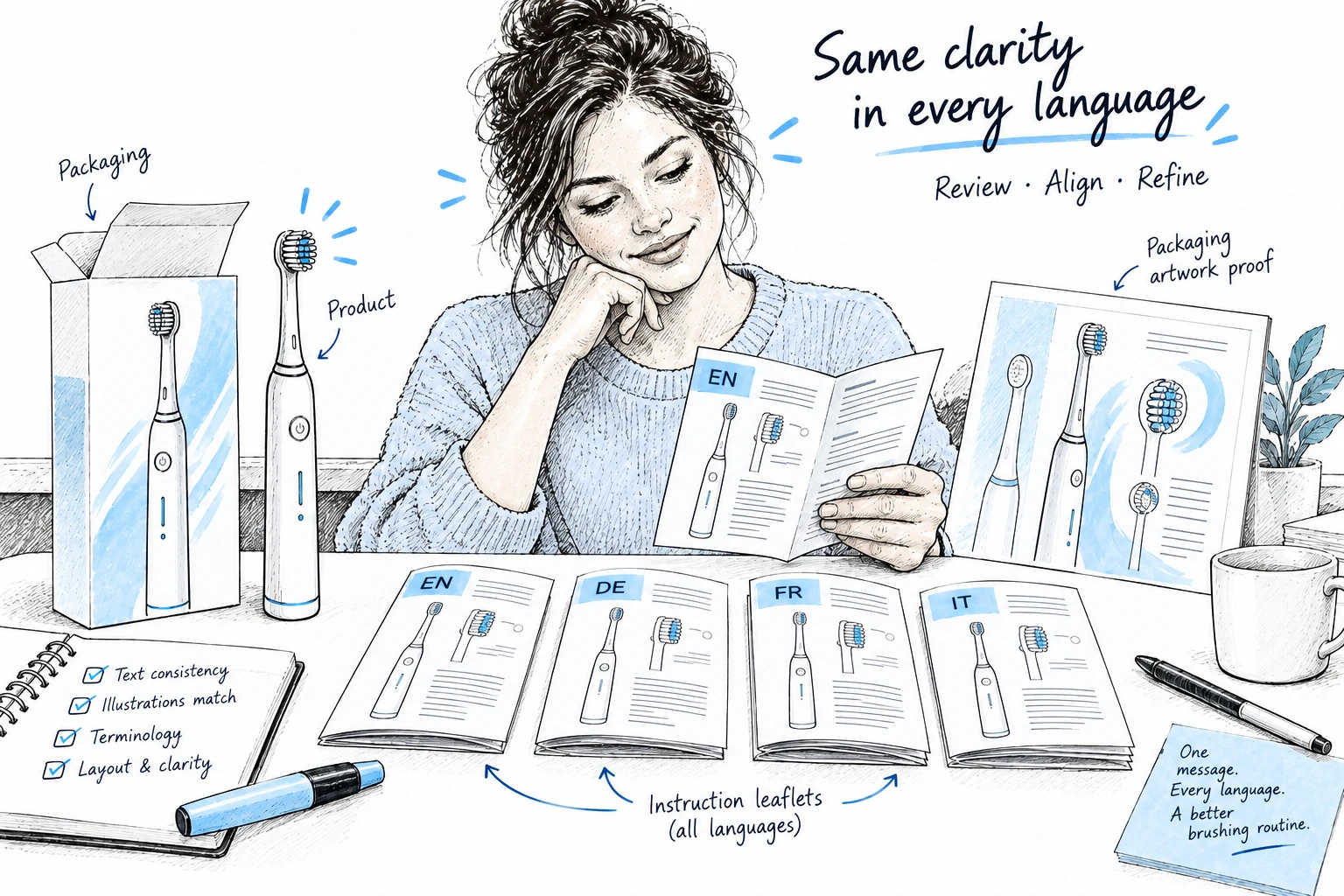
Productverpakkingen en instructies moeten beschikbaar zijn in de officiële taal/talen van elke EU-lidstaat waar het product wordt verkocht. Deze vereiste heeft een aanzienlijke impact op de complexiteit van de verpakking voor merken die zich richten op pan-Europese distributie op de Europese markt voor elektrische tandenborstels. Meertalige verpakkingsinlegvellen zijn gebruikelijk, waarbij soms aparte verpakkings-SKU's nodig zijn voor land-specifieke retailvereisten.
Vereiste informatie omvat doorgaans productnaam en -model, fabrikant- en importeurgegevens (EU-verantwoordelijke persoon vereist voor niet-EU-fabrikanten), gebruiksaanwijzingen, veiligheidswaarschuwingen, elektrische specificaties en WEEE-/symboolmarkering voor afvalverwijdering.
Overwegingen met betrekking tot doorlooptijd
De retailtoeleveringsketens van de Europese markt voor elektrische tandenborstels werken doorgaans met ordercycli van 8-12 weken met seizoensaanpassingen voor de terug-naar-school- en feestdagenperiodes. De doorlooptijd van productie in China tot Europees magazijn bedraagt doorgaans 4-6 weken extra, inclusief verzending (zeevracht van Shenzhen naar Europese havens) en douaneafhandeling. De totale doorlooptijd van orderplaatsing tot beschikbaarheid in de winkel is opgesplitst in 8-10 weken productie, 4-6 weken zeevracht (Shenzhen naar Europese havens) en 2 weken douaneafhandeling — in totaal 14-18 weken voor nieuwe productintroducties.
Luchtvracht verkort de transporttijd tot 1-2 weken, maar verhoogt de kosten aanzienlijk—geschikt voor initiële voorraadbestellingen of promotionele voorraad, maar niet duurzaam voor regelmatige aanvulling. Merken moeten de voorraadposities 4-5 maanden vóór de verwachte vraag plannen, rekening houdend met certificeringstijdlijnen, productieplanning en logistiek transport.
Hoe Relish Tech de toegang tot de Europese markt ondersteunt
Relish Tech exploiteert een productiefaciliteit van 20.000 m² met meer dan 300 medewerkers en een ISO 13485-gecertificeerd kwaliteitsmanagementsysteem, ter ondersteuning van de toegang tot de Europese markt voor elektrische tandenborstels voor OEM-merken. Onze productiefaciliteiten onderhouden CE-nalevingsdocumentatie en kunnen testen coördineren via erkende EU-laboratoria. We werken samen met gevestigde EU-gemachtigden om te voldoen aan de vereisten voor niet-EU-fabrikanten die producten op de Europese markt brengen.
Ons technisch team ontwikkelt producten specifiek voor de Europese markt voor elektrische tandenborstels, inclusief 230V/50Hz-oplaadcompatibiliteit, ondersteuning voor meertalige etikettering en WEEE-nalevingsdocumentatie. We onderhouden relaties met door de Europese detailhandel goedgekeurde componentleveranciers voor materialen die specifieke certificeringen vereisen. Bekijk onze volledige certificeringsportfolio, inclusief FDA-, CE- en ISO 13485-referenties.
Voor merken die geïnteresseerd zijn in duurzame productpositionering, ondersteunen onze FSC-gecertificeerde bamboe- en GRS-gerecyclede plastic productiecapaciteiten de Europese duurzaamheidsverwachtingen. We bieden FSC-gecertificeerde bamboe handgreepopties, gerecyclede plastic componenten en documentatie ter ondersteuning van EU Ecolabel-aanvragen. Voor meer informatie over onze productiecapaciteiten en aanpak voor de Europese markt, verken onze OEM-productiediensten.
Ons ISO 13485:2016-gecertificeerde QMS met AQL 1.5/2.5-inspectieprotocollen biedt de documentatiebasis voor naleving van de regelgeving op de Europese markt voor elektrische tandenborstels. Voor een gedetailleerd overzicht van OEM-productieprocessen, zie onze OEM/ODM-productiegids voor elektrische tandenborstels en kwalificatieprocessen voor retailleveranciers. We bieden uitgebreide voorbereiding van nalevingsdossiers, inclusief technische documentatie, risicobeoordelingen en coördinatie van testrapporten.
| Land | Marktomvang | Groeipercentage | Belangrijkste kanaal | Speciale overwegingen |
|---|---|---|---|---|
| Duitsland | $980M | 5.8% | Apotheek (Apotheke) | Vergoedingssystemen geven de voorkeur aan premium |
| Verenigd Koninkrijk | $720M | 5.5% | E-commerce (Amazon UK) | UKCA-markering vereist |
| Frankrijk | $580M | 6.8% | Para-apotheek | Sterke voorkeur voor sonische technologie |
| Italië | $340M | 7.2% | Massaretail + E-commerce | Prijsgevoelige markt |
| Scandinavië | $420M | 5.2% | Apotheekketens | Duurzaamheidsgedreven adoptie |
| Spanje | $290M | 7.8% | Massaretail | Hoog groeipotentieel |
Belangrijkste opmerkingen
Voor merken en OEM's die de Europese markt voor elektrische tandenborstels evalueren, volgen hier de essentiële inzichten uit deze analyse:
- De Europese markt voor elektrische tandenborstels zal in 2032 $6,1B bereiken, met een CAGR van 6,2%, gedreven door premiumisering en adoptie van slimme apparaten
- Duitsland blijft de grootste nationale markt binnen de Europese markt voor elektrische tandenborstels, maar Spanje en Italië tonen de hoogste groeicijfers en marktpenetratiemogelijkheden
- Apotheek- en para-apotheekkanalen hebben een onevenredige invloed in Duitsland en Frankrijk, wat vraagt om op maat gemaakte go-to-market strategieën
- CE-markering vereist naleving van de Laagspanningsrichtlijn, EMC-richtlijn en mogelijk EU MDR voor producten met medische claims
- UKCA-markering is een aparte vereiste voor Groot-Brittannië, wat £2.000-8.000 en 4-6 weken toevoegt aan de certificeringstijdlijnen
- Duurzaamheidscertificaten beïnvloeden steeds vaker de aankoopbeslissingen van Europese consumenten, met name in Noord-Europese markten
- Meertalige etikettering en vereisten voor een gemachtigde vertegenwoordiger in de EU voegen complexiteit toe voor in China gevestigde fabrikanten die Europa betreden
- De totale doorlooptijd van bestelling tot beschikbaarheid in de winkel bedraagt doorgaans 12-18 weken, wat vooruitlopende productieplanning vereist
Klaar om de Europese markt te betreden?
Of u nu een nieuw merk lanceert of bestaande productlijnen uitbreidt, de Europese markt voor elektrische tandenborstels biedt aanzienlijke groeimogelijkheden. Werk samen met Relish Tech voor CE-conforme productie van elektrische tandenborstels, afgestemd op de Europese markt voor elektrische tandenborstels en de bijbehorende wettelijke vereisten.
Neem contact op met ons teamVeelgestelde vragen
Wat is de huidige omvang en groeisnelheid van de Europese markt voor elektrische tandenborstels?
De Europese markt voor elektrische tandenborstels wordt in 2025 gewaardeerd op ongeveer $3,8 miljard en zal naar verwachting groeien met een CAGR van 6,2% tot 2032, tot meer dan $6,1 miljard. Duitsland leidt met $980M, gevolgd door het VK ($720M), Frankrijk ($580M), Scandinavië ($420M), Italië ($340M) en Spanje ($290M).
Welk Europees land heeft de grootste markt voor elektrische tandenborstels?
Duitsland is de grootste markt voor elektrische tandenborstels in Europa, gewaardeerd op ongeveer $980 miljoen. Deze leidende positie wordt gedreven door sterke vergoedingsprogramma's van tandartsverzekeringen, een hoog consumentenbewustzijn van mondgezondheid en het invloedrijke apotheekkanaal (Apotheke) dat verantwoordelijk is voor ongeveer 35% van de verkoop van premium elektrische tandenborstels.
Welke CE-certificeringseisen zijn van toepassing op elektrische tandenborstels die in Europa worden verkocht?
Elektrische tandenborstels vereisen CE-markering onder de Laagspanningsrichtlijn (2014/35/EU) voor producten die werken op 50-1000V AC of 75-1500V DC, de EMC-richtlijn (2014/30/EU) voor elektromagnetische compatibiliteit, en mogelijk EU MDR 2017/745 indien op de markt gebracht met medische claims. Producten moeten technische documentatie, risicobeoordelingen, testrapporten en een EU-conformiteitsverklaring hebben.
Welke spanningsstandaard is van toepassing op elektrische tandenborstels in Europa?
De Europese standaardspanning is 230V AC bij 50Hz, van toepassing in alle EU-lidstaten. Producten moeten voor deze specificatie zijn ontworpen, inclusief oplaadbases en transformatoren. Het VK vereist 230V/50Hz met BS 1363-stekkers voor consumentenproducten. Producten bedoeld voor verkoop op meerdere markten moeten verwisselbare stekkeradapters bevatten, terwijl ze voldoen aan de spannings-/frequentievereisten.
Hoe lang duurt het doorgaans om een elektrische tandenborstel te certificeren voor de Europese markt?
Standaard CE-certificering voor elektrische tandenborstels duurt doorgaans 8-14 weken, inclusief testen en documentatievoorbereiding. Als EU MDR-naleving vereist is voor classificatie als medisch hulpmiddel, voeg dan 4-8 weken toe. UKCA-certificering vereist extra testen (budget £2.000-£8.000) en 4-6 weken extra tijd. De totale planning van de certificeringstijdlijn moet rekening houden met 12-16 weken.
Wat zijn de belangrijkste distributiekanalen voor elektrische tandenborstels in Europa?
Belangrijke distributiekanalen zijn apotheken en para-apotheken (cruciaal in Duitsland en Frankrijk, goed voor 30-35% van de premiumverkoop), massaretail (Carrefour, Tesco, dm-drogerie markt), e-commerce (Amazon EU domineert met 40%+ aandeel in sommige markten) en aanbevelingskanalen van tandheelkundige professionals die de premiumpositionering beïnvloeden.
Referenties
- Inlichtingendienst Mordor. (2025). Europese markt voor elektrische tandenborstels — Groei, trends en prognoses (2025–2030). https://www.mordorintelligence.com/industry-reports/europe-electric-toothbrush-market
- EU-Commissie. (2024). Laagspanningsrichtlijn 2014/35/EU. Publicatieblad van de Europese Unie. https://ec.europa.eu
- EU-Commissie. (2024). Richtlijn elektromagnetische compatibiliteit 2014/30/EU. Regelgevend kader voor EMF-naleving. https://ec.europa.eu
- EU-Commissie. (2024). Verordening medische hulpmiddelen (EU) 2017/745. Vereisten voor classificatie en naleving van medische hulpmiddelen. https://health.ec.europa.eu
- GOV.UK. (2025). UKCA-markeringrichtlijnen. Vereisten voor producten die na de Brexit in Groot-Brittannië worden verkocht. https://www.gov.uk/guidance/ukca-marking
- Statista. (2025). Verkoop van elektrische tandenborstels per kanaal — Verenigd Koninkrijk. https://www.statista.com
- Grand View Research. (2025). Marktomvang, aandeel en trendanalyserapport voor slimme tandenborstels. https://www.grandviewresearch.com