










Electric Toothbrush OEM Sourcing in China:
How to Compare Manufacturing Hubs
Choosing a location for an electric toothbrush or water flosser project is only one part of supplier selection. Compare each manufacturer’s product experience, engineering process, quality controls, documentation, MOQ, project schedule and shipping terms against your requirements. This guide outlines practical questions for evaluating suppliers in Shenzhen, Dongguan, Ningbo, Wenzhou and other manufacturing regions.
Punti chiave
- Location alone does not establish a supplier’s capability or prove a regional production share.
- Ask which components and processes are performed in-house and which are sourced from other suppliers.
- Confermare i project milestones, tooling responsibilities and production lead time in a schedule agreed with the supplier.
- Review a like-for-like quotation that separates product, tooling, packaging, testing, freight and other applicable costs.
- Check the shipping route and delivery terms for your destination using current carrier schedules.
- Verifica certificates and test reports against the issuing entity, product scope, model and target market.
When comparing suppliers in China, assess the specific factory, its component sources, engineering process, quality controls, logistics plan and project costs. Shenzhen is one of several manufacturing locations; the right fit depends on your product requirements and verified supplier capabilities.
Comparing Manufacturing Hubs for Oral Care Products
China has multiple manufacturing locations and supplier networks. Compare individual factories using the same product specification, documentation requirements, order quantity, delivery terms and project schedule. A regional label alone does not establish capability or performance.
- Confirm the factory address and which components are sourced in the region.
- Ask which assembly and testing steps are performed at the named site.
- Map component suppliers and identify outsourced processes.
- Check the proposed port, carrier and current route for your destination.
- Review project milestones, quality records and document scope.
- Agree confidentiality, IP ownership and tooling responsibilities in writing.
- Verify the contracting company and production address for the candidate.
- Map component and subcontractor locations against the factory site.
- Check equipment and process scope for your exact model.
- Ask how samples, testing and production milestones are managed.
- Compare an itemized quote and the proposed export route.
- Confirm which products and processes are handled at the proposed site.
- Identify external component suppliers and quality responsibilities.
- Compare port, carrier and inland transport options from the factory.
- Review evidence for the supplier’s relevant oral-care experience.
- Request a quote with matching model, quantity and delivery terms.
- Confirm factory and component-supplier addresses.
- Check the proposed sourcing plan and any subcontracted production.
- Include inland transport, port handling and destination terms in the quote.
- Compare quality records and sample results for the selected model.
How to Evaluate the Supplier Ecosystem
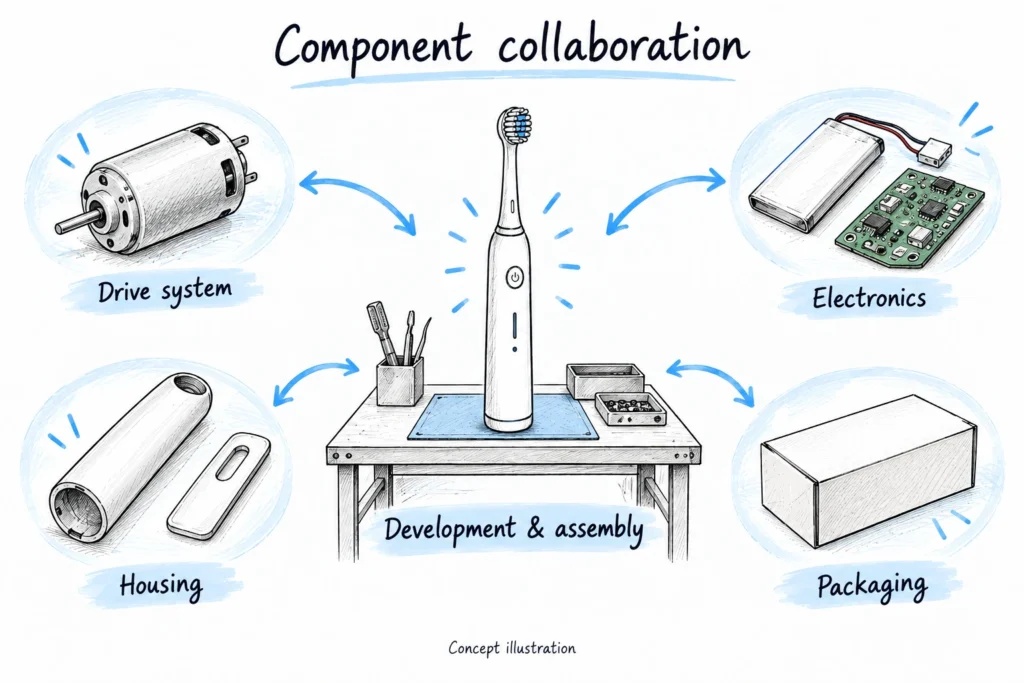
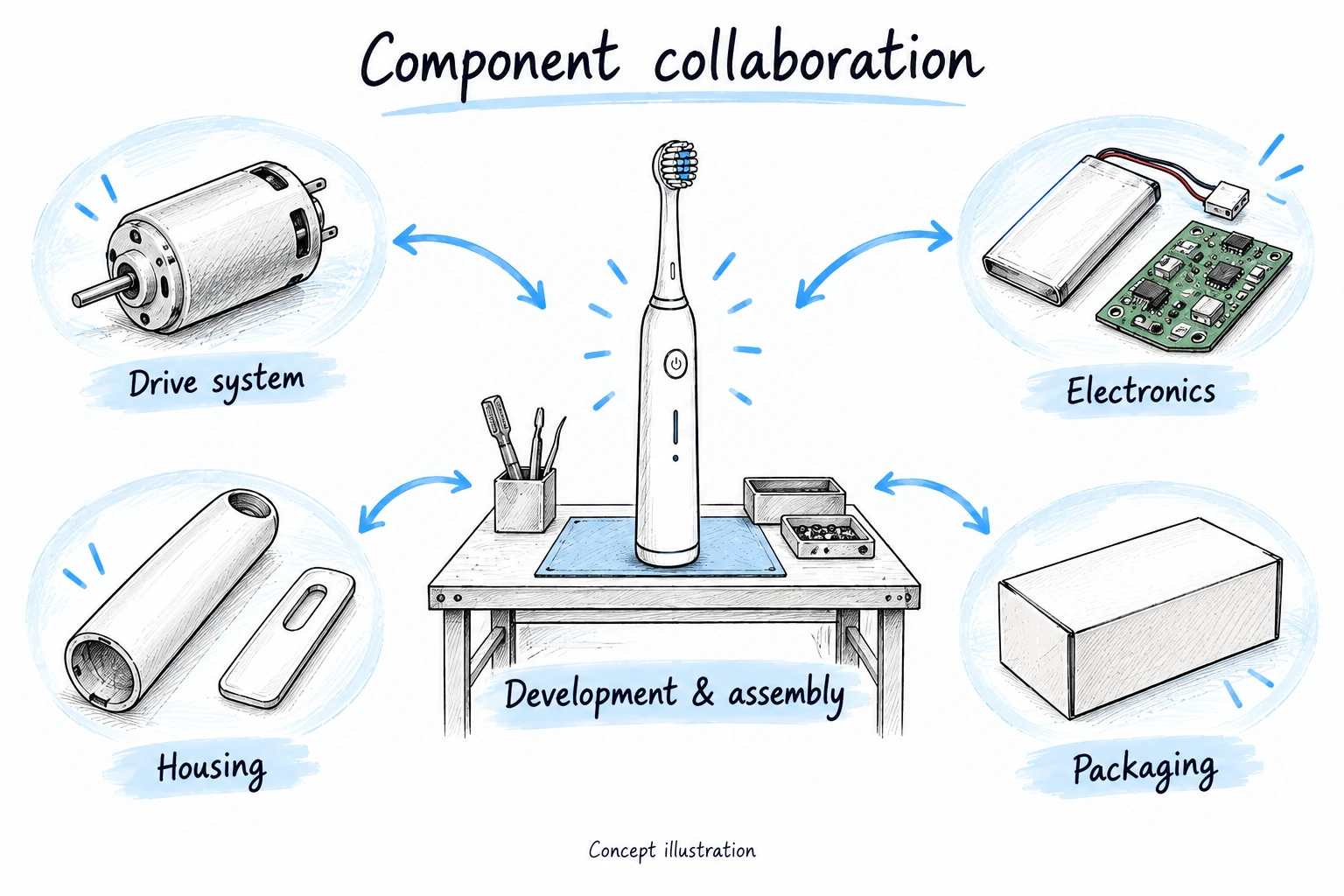
A supplier ecosystem can include component makers, assembly partners, testing providers and logistics companies. The available options depend on the product and the supplier’s current sourcing network. Ask for a project-specific supply-chain map and clarify who is responsible for qualification, incoming inspection and changes to each component.
For any location, validate the suppliers and processes that will serve your order. Request the proposed bill of materials, identify critical subcontractors, agree how changes will be approved and confirm who retains quality records. A regional cluster can offer options, but it does not replace supplier-level due diligence.
Plan Your Supplier and Component Review
Share your product requirements, target market and expected order scope with Relish Technology. We can discuss the development process, available documentation, MOQ and a project-specific quotation.
Richiedi un preventivo di produzione →A Supplier-by-Supplier Comparison Framework
| Review area | Shenzhen/PRD | Dongguan | Ningbo | Wenzhou | Regione di Shanghai |
|---|---|---|---|---|---|
| Site and product scope | Confirm named site and product scope | Confirm entity and production address | Confirm processes at proposed site | Confirm factory and sub-sites | Confirm entity and subcontractors |
| Component sourcing | Map local and external suppliers | List in-house and partner work | Identify component suppliers | Review the sourcing plan | Confirm sources by model |
| Sample and production schedule | Agree sample and test milestones | Confirm trial and line schedule | Set approval and delivery dates | Plan production and transport | Confirm team and milestones |
| Labor and assembly assumptions | Define labor and assembly scope | Confirm labor and shift basis | Ask for the labor and line-rate basis | Check labor scope and order volume | Confirm labor and overhead assumptions |
| Component cost | Request an itemized BOM quote | Separate parts and assembly | Identify sourced parts and quote basis | Include supplier and transport costs | Compare the same component scope |
| Shipping options | Confirm port and current route | Check factory-to-port transport | Compare carrier and inland options | Include the inland transport leg | Check origin and destination route |
| Engineering and testing | Review model-specific plans | Confirm responsible engineering team | Check sample and test records | Confirm test scope and ownership | Review team and test plan |
| Certificates and reports | Verify issuer, entity and scope | Check model and market coverage | Confirm document dates and scope | Match reports to the product | Verify named entity and model |
| Total delivered cost | Compare like-for-like terms | Include local and export charges | Use current freight and duty assumptions | Include inland and port handling | Compare the same delivery scope |
Comparing Supplier Locations and Routes
A regional manufacturing cluster may make it easier to coordinate suppliers, but the practical effect depends on factory addresses, process flow and the shipping plan. Confirm the actual factory and component sources before comparing locations.
Map the Factory-to-Destination Route
Shipping options depend on the factory and component-supplier addresses, selected port, carrier schedule and destination. Map these details against the order’s delivery terms.
- 🏭 Obtain addresses for the factory and critical component suppliers.
- 🚢 Confirm the export port, carrier, sailing schedule and destination.
- ✈️ Check whether air freight or sea freight fits the project schedule.
- 🏙️ Include customs, inland transport and delivery terms in the plan.
- 🌊 Compare current door-to-door estimates for the same shipment scope.
- 🌍 Reconfirm lead times before setting inventory assumptions.
Assess Port and Delivery Options
Yantian is one possible export port for shipments from Shenzhen. The appropriate route depends on the factory location, inland transport, carrier schedule, destination, customs handling and delivery terms. Verify the selected plan against the order before setting inventory or launch dates.
Build a Like-for-Like Total Cost Comparison
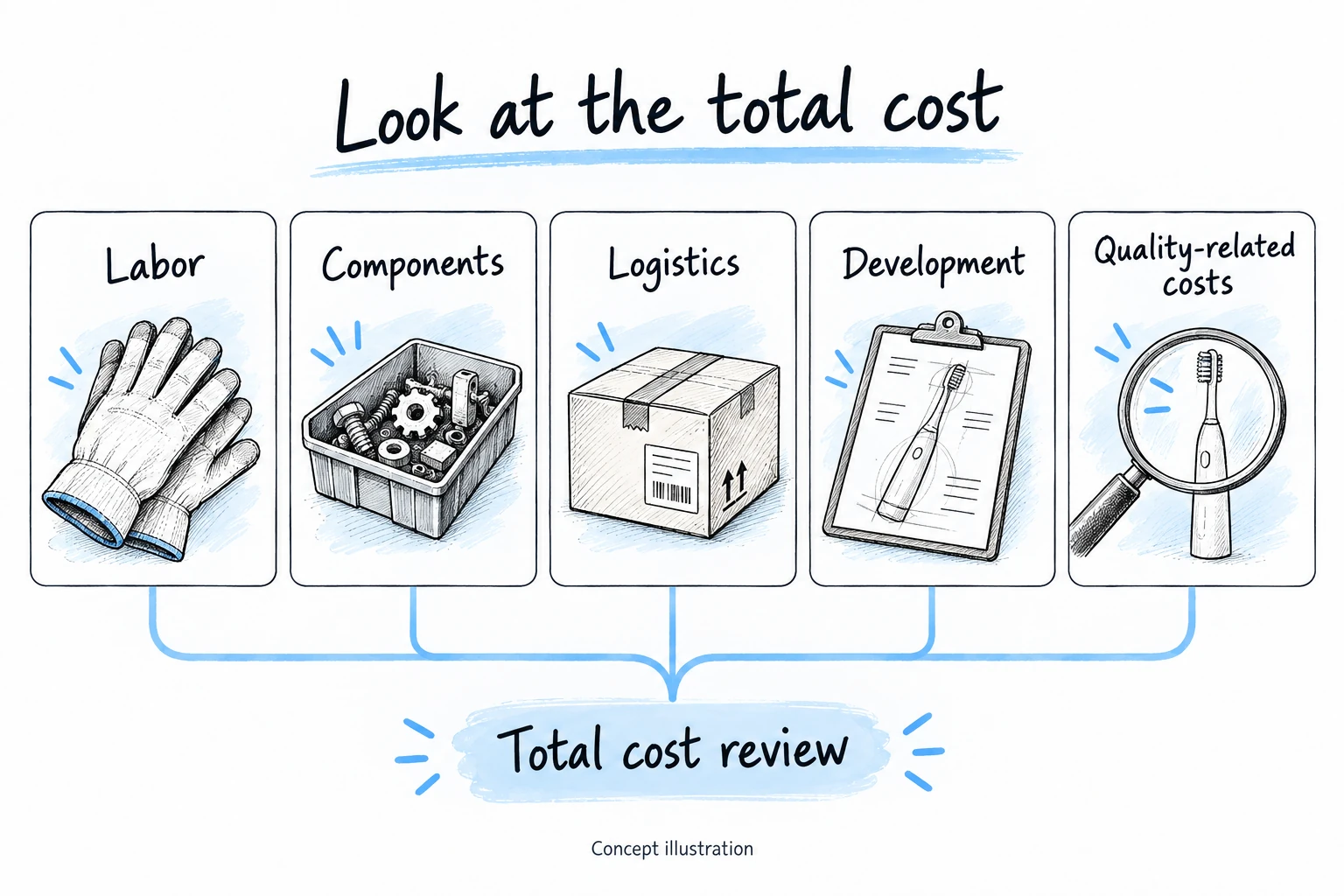
Regional cost claims require comparable, current quotations for the same product, quantity, quality requirements and delivery terms. Build a project-specific comparison that separates tooling, components, packaging, testing, freight, duties and other applicable charges.
| Elemento di Costo | Shenzhen | Wenzhou / other locations | Differenza Netta |
|---|---|---|---|
| Manodopera in fabbrica (per unità) | Quote required | Quote required | Compare same specification and quantity |
| Components (motor, battery, PCB) | Itemized quote required | Itemized quote required | Compare product scope and supplier responsibilities |
| Inland freight and export handling | Route quote required | Route quote required | Confirm factory, port and destination |
| Tooling and development | List one-time charges | List one-time charges | Agree scope and milestones |
| Testing and quality requirements | Specify requirements | Specify requirements | Compare equivalent evidence and scope |
| Total delivered cost | Calculate from current, comparable quotes | Project-specific; do not infer from region | |
Relish Technology has manufactured oral-care products since 2012. Its combined operations across Shenzhen and Huizhou cover 20,000 m². Our squadra di ricerca e sviluppo works on oral-care product development, including our Spinsonic™ e Vibrosonic™ technologies. Review our certificazioni for relevant documentation. Learn about our OEM/ODM process and contact us to discuss your model, target market and project requirements.
Domande frequenti
Discuss Your Oral Care Manufacturing Project
Relish has manufactured oral-care products since 2012 and operates across Shenzhen and Huizhou, with 20,000 m² of combined operations. Contact us to discuss your product, MOQ, development scope and documentation needs.
Richiedi Visita in Fabbrica →Riferimenti e fonti
- Grand View Research. Oral Care Market Size & Trends, 2026–2033. Grand View Research Inc. Recuperato da https://www.grandviewresearch.com/industry-analysis/oral-care-market
- Statista. Shenzhen — Statistiche e Fatti. Statista. Recuperato da https://www.statista.com/topics/4834/shenzhen/
- Yantian International Container Terminals. Port and service information. YICT. Recuperato da https://www.yict.com.cn/
- Shenzhen Municipal Bureau of Statistics. Government and statistical information. Shenzhen Municipal Bureau of Statistics. Retrieved from https://tjj.sz.gov.cn/
- Organizzazione internazionale per la standardizzazione. (2016). ISO 13485:2016 — Dispositivi Medici — Sistemi di Gestione della Qualità — Requisiti per Scopi Regolatori. ISO. Estratto da https://www.iso.org/standard/59752.html