




Mercato degli Spazzolini Elettrici in Europa 2026: Guida alle Dimensioni e all'OEM
Panoramica del Mercato degli Spazzolini Elettrici in Europa
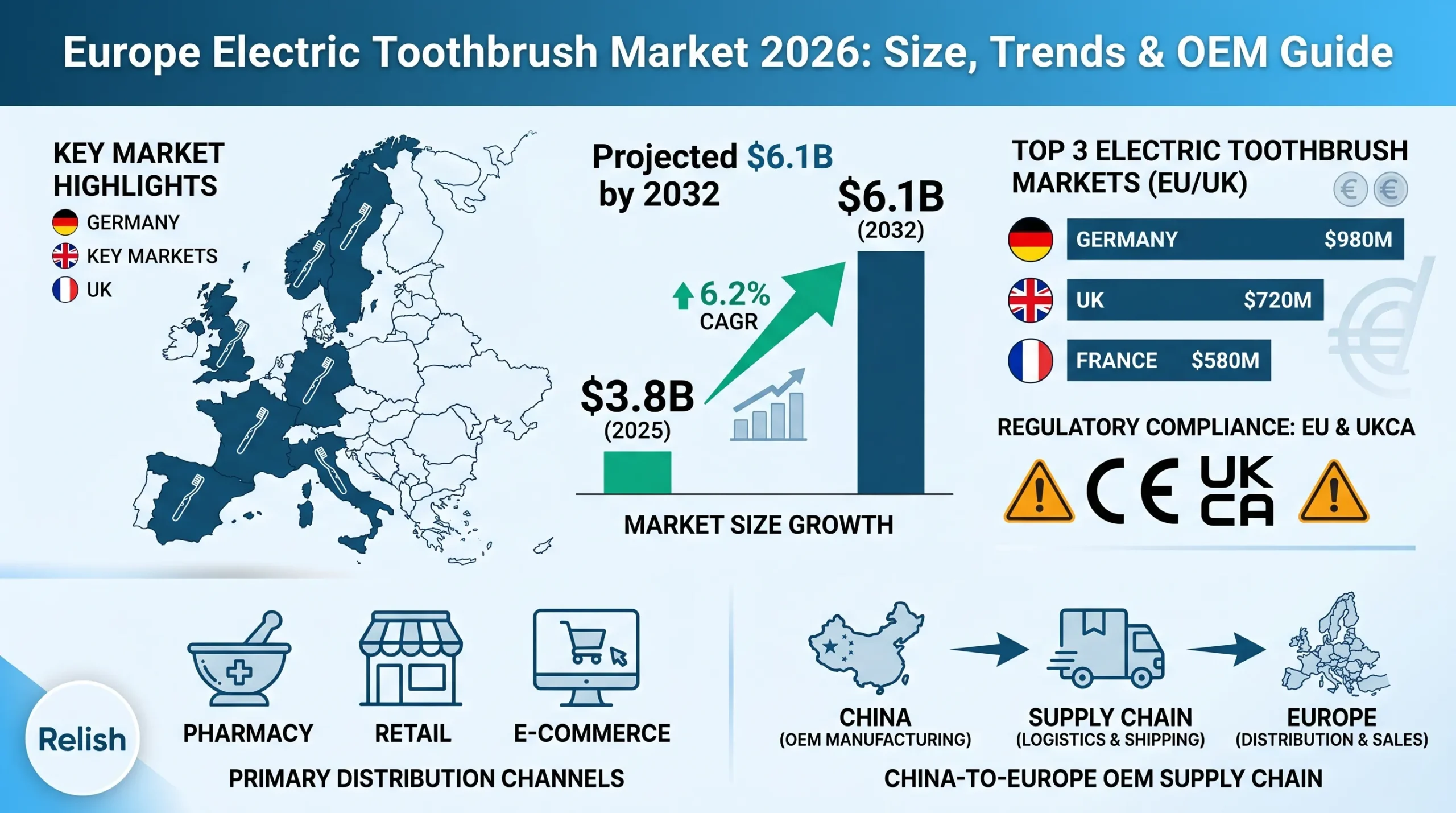
Il mercato europeo degli spazzolini elettrici rappresenta una delle opportunità di crescita più interessanti nel settore globale dell'igiene orale. Secondo Mordor Intelligence (2025), il mercato è stato valutato a circa 3,8 miliardi di dollari nel 2025 e si prevede che si espanderà a un tasso di crescita annuale composto (CAGR) del 6,21% fino al 2032, raggiungendo oltre 6,1 miliardi di dollari. Questa traiettoria di crescita posiziona l'Europa come il secondo mercato regionale più grande a livello globale, dietro il Nord America ma davanti all'Asia-Pacifico in termini di prezzi medi di vendita e penetrazione di prodotti premium.
Diversi fattori sostengono i solidi fondamentali del mercato europeo degli spazzolini elettrici. L'elevata consapevolezza dei consumatori sulla salute orale, combinata con robusti sistemi di assicurazione dentale nei mercati chiave come Germania e Francia, crea una domanda sostenuta per prodotti efficaci per l'igiene orale. I consumatori europei mostrano una forte preferenza per prodotti clinicamente validati, guidando l'adozione di spazzolini elettrici rispetto alle alternative manuali. La regione è anche leader nelle tendenze globali di sostenibilità, con consumatori eco-consapevoli che cercano prodotti premium in linea con i valori ambientali.
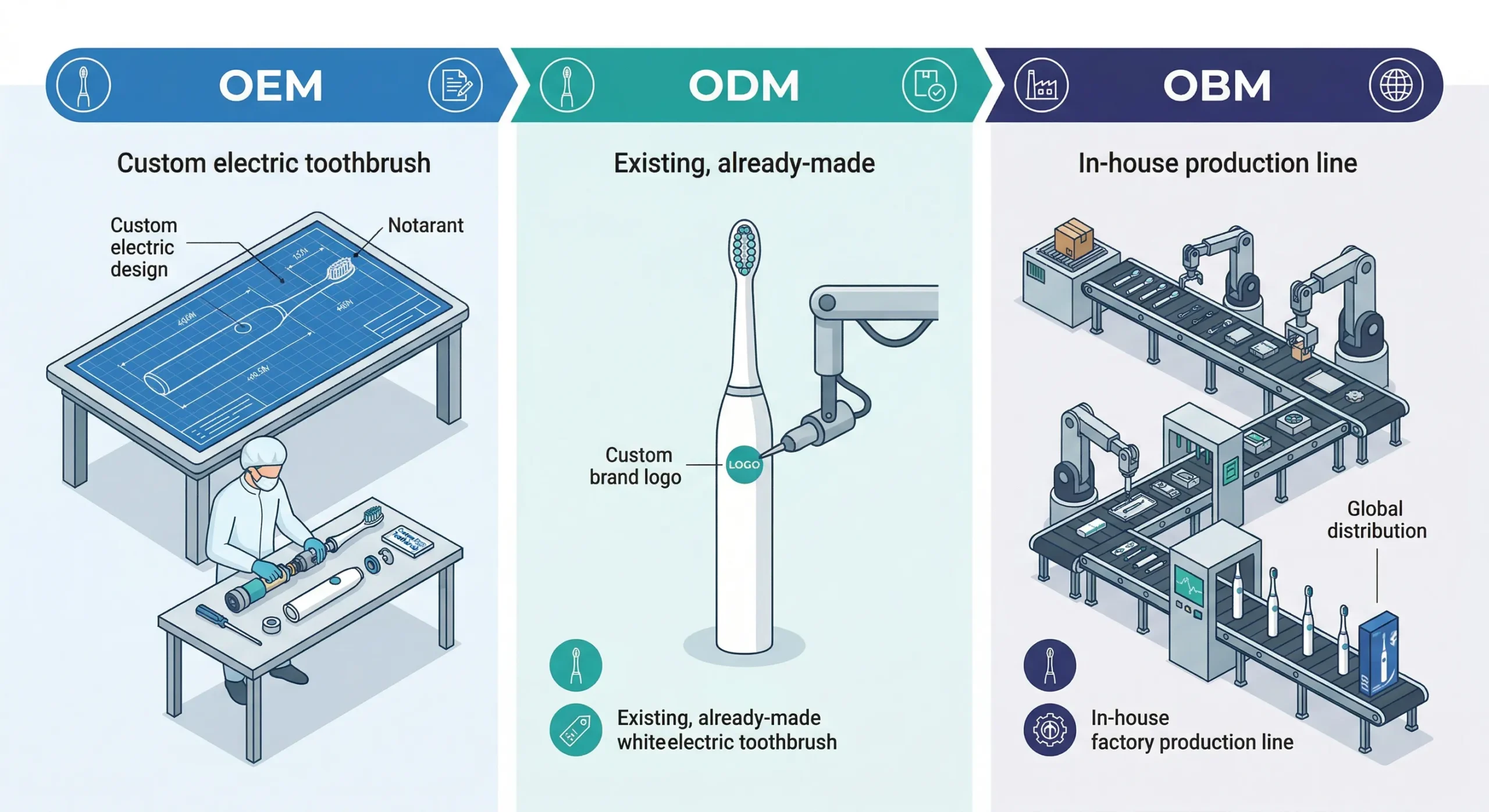
Per i produttori di apparecchiature originali (OEM) che si riforniscono dalla Cina, il mercato europeo degli spazzolini elettrici presenta sia opportunità significative che requisiti normativi complessi. Le dimensioni e la traiettoria di crescita del mercato europeo degli spazzolini elettrici lo rendono una priorità strategica per i fornitori B2B. Comprendere le dinamiche di mercato nei singoli paesi europei, i percorsi di conformità normativa e le preferenze dei canali di distribuzione è essenziale per un ingresso di successo sul mercato.
Per i marchi che si riforniscono di spazzolini elettrici per il mercato europeo, i parametri chiave di fornitura includono:
- MOQ: 500 unità per SKU per modelli standard di spazzolini elettrici
- Tempi di consegna: 8–10 settimane di produzione + 4–6 settimane di trasporto marittimo (Shenzhen → Rotterdam/Amburgo) + 2 settimane di sdoganamento
- Capacità Produttiva: Struttura di 20.000 m² con oltre 300 dipendenti, a supporto della produzione parallela su più linee
- Controllo qualità: Sistema di gestione della qualità certificato ISO 13485:2016 con standard di ispezione AQL 1,5 (difetti maggiori) / AQL 2,5 (difetti minori)
- Certificazioni: CE, UKCA, FDA, ISO 13485, BSCI, FSC
Per i team di approvvigionamento OEM che valutano il mercato europeo degli spazzolini elettrici per il 2026 e oltre, queste proiezioni di crescita riflettono una forte domanda sottostante in tutti i segmenti di consumatori e canali di distribuzione. La prossima sezione analizza le dinamiche specifiche per paese che modellano la strategia di approvvigionamento.
Analisi Paese per Paese
Il mercato europeo degli spazzolini elettrici non è monolitico: ogni paese presenta opportunità distinte, sfumature normative e preferenze dei consumatori che i marchi OEM devono navigare attentamente. Di seguito è riportata un'analisi dettagliata dei sei maggiori mercati nazionali.
🇩🇪 Germania
La Germania domina il mercato europeo degli spazzolini elettrici con una stima di 980 milioni di dollari (Mordor Intelligence, 2025), guidata da forti programmi di rimborso dell'assicurazione dentale che compensano i costi per i consumatori di prodotti premium per l'igiene orale. I consumatori tedeschi mostrano un'elevata fedeltà al marchio e preferenza per prodotti con validazione clinica. Il canale farmacia (Apotheke) ha un'influenza significativa, con circa il 35% degli spazzolini elettrici premium venduti attraverso questo canale.
🇬🇧 Regno Unito
Dopo la Brexit, il Regno Unito opera con i requisiti di marcatura UKCA insieme ai percorsi di certificazione CE esistenti. Il mercato mostra una forte penetrazione del canale online, con Amazon UK che rappresenta oltre il 40% delle vendite di spazzolini elettrici (Statista, 2025). La preferenza dei consumatori si orienta verso spazzolini intelligenti/connessi con integrazione di app. Boots e Superdrug rimangono i principali rivenditori farmaceutici.
🇫🇷 Francia
Il mercato francese degli spazzolini elettrici beneficia di una forte influenza del canale farmacia, dove le para-farmacie (parapharmacies) guidano circa il 30% delle vendite premium. I consumatori francesi mostrano un interesse particolare per la tecnologia sonica e le caratteristiche di sostenibilità. Il mercato ha registrato una crescita accelerata in seguito alle campagne di sensibilizzazione sulla salute dentale.
🇮🇹 Italia
L'Italia rappresenta un'opportunità emergente con il tasso di crescita più alto tra i principali mercati europei. La sensibilità al prezzo rimane un fattore, con i consumatori italiani che favoriscono prodotti di fascia media rispetto alle alternative premium. La distribuzione è concentrata attraverso grandi catene di vendita al dettaglio e canali di e-commerce in crescita. Le raccomandazioni dei professionisti del settore dentale influenzano significativamente le decisioni di acquisto.
🇸🇪 Scandinavia
I paesi nordici mostrano modelli di adozione guidati dalla sostenibilità, con i consumatori che favoriscono fortemente prodotti eco-certificati e sistemi ricaricabili. I prezzi premium sono ben accettati e la penetrazione del mercato per gli spazzolini elettrici supera il 45% delle famiglie (Mordor Intelligence, 2025). Apotek Hjärtat (Svezia) e Apotek (Norvegia) sono attori chiave nel canale farmacia.
🇪🇸 Spagna
Spain shows the highest growth potential among Western European markets, driven by rising middle-class disposable income and increasing dental health awareness. The market remains underpenetrated compared to Northern European equivalents, presenting significant opportunity for brands. Pharmacy chains like Farmacia hold growing influence.
3. Regulatory Environment in Europe
CE Marking Requirements
For OEM suppliers entering the European electric toothbrush market, regulatory compliance represents the critical first step. Electric toothbrushes sold in the European Economic Area (EEA) must bear CE marking, indicating conformity with applicable EU directives and regulations. For electric toothbrushes, the primary regulatory frameworks include:
Low Voltage Directive (2014/35/EU): Applies to products operating within voltage limits of 50-1000V AC or 75-1500V DC. Most electric toothbrushes fall within this scope due to their battery charging systems. Compliance requires technical documentation, risk assessment, and conformity assessment through self-certification or notified body involvement depending on product classification.
Electromagnetic Compatibility (EMC) Directive 2014/30/EU: Requires that electric toothbrushes do not cause excessive electromagnetic interference and can operate as intended in environments with expected interference levels. EMC testing verifies radiated emissions, conducted emissions, immunity to electrostatic discharge, and other electromagnetic phenomena.
EU Medical Device Regulation (MDR 2017/745)
If electric toothbrushes are marketed with medical claims—such as therapeutic benefits, plaque reduction beyond normal cleaning, or treatment of specific dental conditions—they may be classified as medical devices under EU MDR 2017/745. This classification significantly increases compliance requirements, including:
- Mandatory registration in EUDAMED database
- Technical documentation meeting MDR Annex II and III requirements
- Clinical evaluation reports supporting claimed benefits
- Post-market surveillance obligations
- Potential requirement for notified body involvement in conformity assessment
For OEM manufacturers and brands, careful attention to marketing claims and positioning is essential to avoid unintended MDR classification. Products positioned as general wellness devices without medical claims can generally avoid medical device requirements.
EU Ecolabel and Green Claims
The emerging EU Ecolabel requirements for oral care products, combined with the EU Green Claims Directive, create new compliance considerations for sustainability-related marketing. Claims about recyclability, compostability, or environmental benefits require substantiation through verified evidence. For more details on sustainable manufacturing approaches, see our guide on sustainable oral care market trends.
EMF Safety Standards
Electric toothbrushes are subject to EMF (electromagnetic field) exposure limits under EU recommendations. Compliance testing verifies that electromagnetic emissions remain below levels that could pose health risks to users. While electric toothbrushes typically operate well below concern thresholds, documentation of EMF testing provides assurance to health-conscious consumers.
WEEE Directive for Electronic Components
The Waste Electrical and Electronic Equipment (WEEE) Directive places responsibility on producers for end-of-life product management. Electric toothbrush manufacturers must register in each EU member state where they place products on the market, contribute to collection and recycling schemes, and meet recycling target rates. Battery components fall under additional Battery Directive requirements.
Post-Brexit UK requires separate UKCA (UK Conformity Assessed) marking in addition to CE marking for products sold in Great Britain. Budget an additional £2,000–£8,000 for UKCA-specific testing if targeting the British market. Northern Ireland follows UKNI marking requirements that differ from both CE and UKCA. Plan certification timelines of 12-16 weeks for both CE and UKCA marking.
4. Distribution Channels in Europe
Pharmacy and Para-Pharmacy
The pharmacy channel holds particular importance in European electric toothbrush markets, especially Germany and France where approximately 30-35% of premium products sell through this route. In these markets, pharmacists and para-pharmacists provide trusted recommendations that significantly influence purchase decisions. Brands seeking pharmacy placement typically require demonstrated clinical efficacy, professional endorsements, and sometimes specific regulatory clearances.
Key pharmacy retail chains include dm-drogerie markt (Germany), Boots (UK),Pharmacie and Parapharmacie (France), and Apotek Hjärtat (Scandinavia). These retailers often maintain strict vendor qualification requirements including sustainability certifications, ethical sourcing documentation, and quality management system verification.
Mass Market Retail
Mass market retail represents the largest overall distribution channel by volume, including hypermarkets, supermarkets, and discount retailers. Key players include Carrefour (France/Spain), Tesco (UK), Auchan (France), and El Corte Inglés (Spain). Mass market placement typically requires competitive pricing, strong trade marketing support, and efficient supply chain capabilities to support retail replenishment requirements.
Private label electric toothbrushes have gained significant market share in mass market channels, with retailers like Carrefour O! and Tesco own-brand products capturing 15-20% of volume in some markets (Euromonitor International, 2024). This trend creates both competition for branded products and OEM partnership opportunities for retailers seeking branded alternatives.
E-Commerce
Online channels continue gaining share across the European electric toothbrush market, with Amazon EU representing the dominant platform. Amazon's pan-European fulfillment programs (Fulfillment by Amazon) simplify cross-border logistics, but platform competition for visibility requires strong search optimization and advertising investment. Regional e-commerce platforms include Zalando (expanding into health), pharmacy online retailers, and country-specific platforms like Bol.com (Netherlands/Belgium).
Dental Professional Channel
The dental professional recommendation channel, while smaller in volume, holds disproportionate influence on premium brand positioning in the European electric toothbrush market. Dental professionals in Germany, Austria, and Switzerland frequently recommend specific brands, and their endorsement significantly influences patient purchases. Clinical studies published in dental journals and professional association endorsements provide credibility that supports pharmacy and premium retail positioning.
5. Consumer Preferences in Europe
Sonic vs. Rotating-Oscillating Technology
Technology preferences vary significantly across the European electric toothbrush market. Sonic toothbrushes dominate in Germany, the Netherlands, and Scandinavian countries, where consumers associate the technology with gentle cleaning and advanced engineering. Rotating-oscillating technology maintains strong preference in France and the UK, where brands like Oral-B have established market leadership through this technology approach.
Italian and Spanish markets show no dominant technology preference, with both approaches competing effectively. As a general trend, consumers across Europe demonstrate increasing interest in pressure sensors, multiple cleaning modes, and whitening-specific features regardless of underlying technology.
Sustainability Expectations
Across the European electric toothbrush market, consumers increasingly expect sustainability credentials from premium oral care products. Key expectations include recyclable packaging with clear material identification, reduced plastic content compared to conventional alternatives, sustainable material sourcing (FSC-certified bamboo, recycled plastics), and carbon footprint documentation or offset programs for premium products.
For brands targeting Scandinavian and German markets, sustainability credentials are effectively table stakes for premium positioning. Learn more about our sustainability initiatives and eco-friendly manufacturing practices. For more information on sustainable oral care manufacturing approaches, see our analysis of eco-friendly materials and OEM solutions.
Smart/Connected Toothbrush Adoption
App-connected electric toothbrushes have captured approximately 18% of the European electric toothbrush market, with higher adoption rates in the UK at 25% (Grand View Research, 2025) and lower rates in Southern European markets (10-12%). Primary use cases include real-time brushing feedback, gamification for children's oral health, and integration with broader health tracking applications.
Consumer concerns about data privacy and app complexity temper adoption among older demographics. Brands successful in this segment offer intuitive apps with clear privacy policies and optional (not mandatory) connectivity features.
Price Sensitivity vs. Premiumization
European electric toothbrush markets show pronounced premiumization trends, with consumers increasingly willing to invest in higher-quality products with advanced features. This trend is most pronounced in Germany and Scandinavia, where average selling prices continue rising. However, Southern European markets remain more price-sensitive, with strong demand for products in the €30-60 range rather than premium €100+ offerings.
Need CE-Certified Electric Toothbrush Manufacturing?
Get a tailored quote for European electric toothbrush market OEM production, including CE documentation, 230V/50Hz compatibility, and multi-language packaging support.
Request a Quote6. OEM Sourcing Strategy for European Market
CE Certification Pathway for China Manufacturers
Securing CE marking through a China-based manufacturing partner requires systematic approach. The process typically involves technical file preparation (including product description, design specifications, risk assessment, and test reports), identification of applicable directives and harmonized standards, testing through EU-recognized laboratories, and preparation of Declaration of Conformity and CE marking documentation.
For a detailed walkthrough of CE certification requirements for oral care devices, see our comprehensive guide to CE certification for electric toothbrushes.
Working with an experienced notified body or EU authorized representative accelerates the certification process for companies targeting the European electric toothbrush market. Typical timelines range from 8-14 weeks for standard electric toothbrush CE certification, with additional time required if EU MDR compliance is necessary. Budget considerations should include testing fees, certification body fees, authorized representative costs, and ongoing compliance maintenance.
Voltage Compatibility
European market products must operate at 230V/50Hz, the standard electrical supply across EU member states and many other countries. Charging bases and transformers must be designed for this specification. UK products require BS 1363 plug configuration, which differs from EU Schuko (Type F) or French (Type E) plugs. Multi-region products can incorporate interchangeable plug adapters, but must still meet voltage/frequency requirements for each target market.
Language and Labeling Requirements
Product packaging and instructions must be available in the official language(s) of each EU member state where the product is sold. This requirement significantly impacts packaging complexity for brands targeting pan-European distribution across the European electric toothbrush market. Multi-language packaging inserts are common, with separate packaging SKUs sometimes required for country-specific retail requirements.
Required information typically includes product name and model, manufacturer and importer details (EU responsible person required for non-EU manufacturers), operating instructions, safety warnings, electrical specifications, and WEEE/symbol marking for disposal information.
Lead Time Considerations
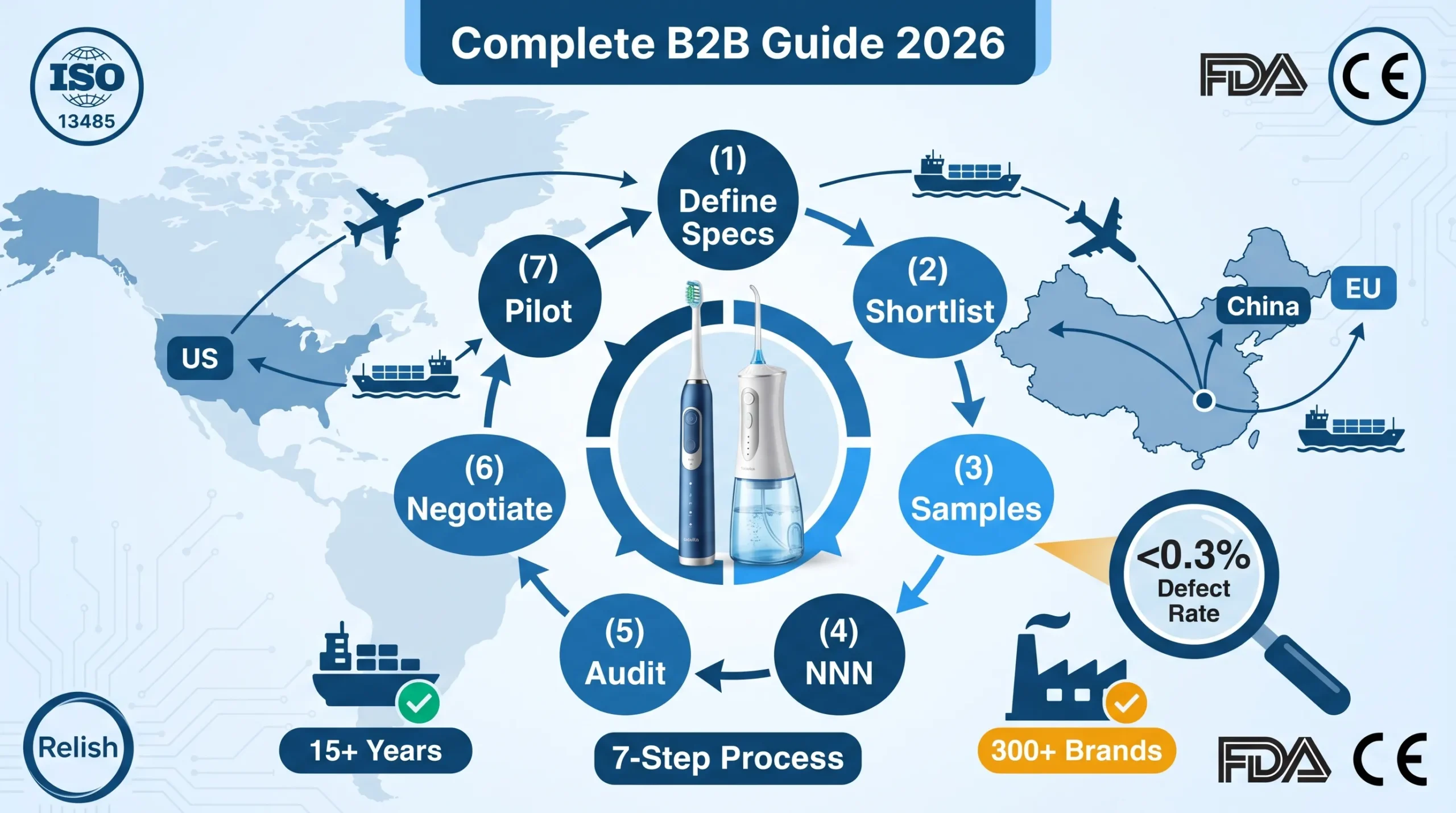
The European electric toothbrush market's retail supply chains typically operate on 8-12 week order cycles with seasonal adjustments for back-to-school and holiday periods. Lead time from China manufacturing to European warehouse typically adds 4-6 weeks including shipping (sea freight from Shenzhen to European ports) and customs clearance. Total lead time from order placement to retail availability breaks down as 8–10 weeks manufacturing, 4–6 weeks sea freight (Shenzhen to European ports), and 2 weeks customs clearance — totaling 14–18 weeks for new product introductions.
Air freight reduces transit time to 1-2 weeks but increases costs significantly—suitable for initial stock orders or promotional inventory but unsustainable for regular replenishment. Brands should plan inventory positions 4-5 months ahead of expected demand, accounting for certification timelines, production scheduling, and logistics transit.
7. How Relish Tech Supports European Market Entry
Relish Tech operates a 20,000 m² manufacturing facility with 300+ employees and ISO 13485-certified quality management, supporting European electric toothbrush market entry for OEM brands. Our manufacturing facilities maintain CE compliance documentation and can coordinate testing through recognized EU laboratories. We work with established EU authorized representatives to fulfill requirements for non-EU manufacturers placing products on the European market.
Our engineering team develops products specifically for the European electric toothbrush market, including 230V/50Hz charging compatibility, multilingual labeling support, and WEEE compliance documentation. We maintain relationships with European retail-approved component suppliers for materials requiring specific certifications. Browse our full certifications portfolio, including FDA, CE, and ISO 13485 credentials.
For brands interested in sustainable product positioning, our FSC-certified bamboo and GRS recycled plastic manufacturing capabilities support European sustainability expectations. We offer FSC-certified bamboo handle options, recycled plastic components, and documentation supporting EU Ecolabel applications. To learn more about our manufacturing capabilities and European market approach, explore our OEM manufacturing services.
Our ISO 13485:2016-certified QMS with AQL 1.5/2.5 inspection protocols provides the documentation foundation for European electric toothbrush market regulatory compliance. For a detailed overview of OEM manufacturing processes, see our OEM/ODM electric toothbrush manufacturing guide and retail vendor qualification processes. We offer comprehensive compliance file preparation, including technical documentation, risk assessments, and test report coordination.
| Country | Market Size | Growth Rate | Key Channel | Special Considerations |
|---|---|---|---|---|
| Germania | $980M | 5.8% | Pharmacy (Apotheke) | Reimbursement systems favor premium |
| United Kingdom | $720M | 5.5% | E-commerce (Amazon UK) | UKCA marking required |
| La Francia | $580M | 6.8% | Para-pharmacy | Strong sonic technology preference |
| Italy | $340M | 7.2% | Mass retail + E-commerce | Price-sensitive market |
| Scandinavia | $420M | 5.2% | Pharmacy chains | Sustainability-driven adoption |
| Spain | $290M | 7.8% | Mass retail | High growth potential |
Punti Chiave
For brands and OEMs evaluating the European electric toothbrush market, here are the essential insights from this analysis:
- The European electric toothbrush market will reach $6.1B by 2032, with 6.2% CAGR growth driven by premiumization and smart device adoption
- Germany remains the largest national market within the European electric toothbrush market, but Spain and Italy show highest growth rates and market penetration opportunities
- Pharmacy and para-pharmacy channels hold disproportionate influence in Germany and France, requiring tailored go-to-market strategies
- CE marking requires compliance with Low Voltage Directive, EMC Directive, and potentially EU MDR for products with medical claims
- UKCA marking is a separate requirement for Great Britain, adding £2,000-8,000 and 4-6 weeks to certification timelines
- Sustainability credentials increasingly influence European consumer purchase decisions, particularly in Northern European markets
- Multi-language labeling and EU authorized representative requirements add complexity for China-based manufacturers entering Europe
- Total lead time from order to retail availability typically spans 12-18 weeks, requiring advance production planning
Ready to Enter the European Market?
Whether you're launching a new brand or expanding existing product lines, the European electric toothbrush market offers substantial growth opportunities. Partner with Relish Tech for CE-compliant electric toothbrush manufacturing tailored to the European electric toothbrush market and its regulatory requirements.
Contatta il Nostro TeamDomande frequenti
Qual è l'attuale dimensione e il tasso di crescita del mercato europeo degli spazzolini elettrici?
The European electric toothbrush market is valued at approximately $3.8 billion in 2025 and is projected to grow at a CAGR of 6.2% through 2032, reaching over $6.1 billion. Germany leads with $980M, followed by the UK ($720M), France ($580M), Scandinavia ($420M), Italy ($340M), and Spain ($290M).
Quale paese europeo ha il più grande mercato di spazzolini elettrici?
Germany is the largest electric toothbrush market in Europe, valued at approximately $980 million. This leadership position is driven by strong dental insurance reimbursement programs, high consumer awareness of oral health, and the influential pharmacy (Apotheke) channel that accounts for approximately 35% of premium electric toothbrush sales.
Quali requisiti di certificazione CE si applicano agli spazzolini elettrici venduti in Europa?
Electric toothbrushes require CE marking under the Low Voltage Directive (2014/35/EU) for products operating at 50-1000V AC or 75-1500V DC, EMC Directive (2014/30/EU) for electromagnetic compatibility, and potentially EU MDR 2017/745 if marketed with medical claims. Products must have technical documentation, risk assessments, test reports, and an EU Declaration of Conformity.
Quale standard di tensione si applica agli spazzolini elettrici in Europa?
European standard voltage is 230V AC at 50Hz, applicable across all EU member states. Products must be designed for this specification, including charging bases and transformers. UK requires 230V/50Hz with BS 1363 plugs for consumer products. Products intended for multi-market sale should incorporate interchangeable plug adapters while meeting voltage/frequency requirements.
Quanto tempo ci vuole tipicamente per certificare uno spazzolino elettrico per il mercato europeo?
Standard CE certification for electric toothbrushes typically takes 8-14 weeks including testing and documentation preparation. If EU MDR compliance is required for medical device classification, add 4-8 weeks. UKCA certification requires additional testing (budget £2,000-£8,000) and 4-6 weeks additional time. Total certification timeline planning should account for 12-16 weeks.
Quali sono i principali canali di distribuzione per gli spazzolini elettrici in Europa?
Key distribution channels include pharmacy and para-pharmacy (critical in Germany and France, driving 30-35% of premium sales), mass market retail (Carrefour, Tesco, dm-drogerie markt), e-commerce (Amazon EU dominates with 40%+ share in some markets), and dental professional recommendation channels that influence premium positioning.
Riferimenti
- Mordor Intelligence. (2025). Europe Electric Toothbrush Market — Growth, Trends, and Forecasts (2025–2030). https://www.mordorintelligence.com/industry-reports/europe-electric-toothbrush-market
- EU Commission. (2024). Low Voltage Directive 2014/35/EU. Official Journal of the European Union. https://ec.europa.eu
- EU Commission. (2024). Electromagnetic Compatibility Directive 2014/30/EU. Regulatory framework for EMF compliance. https://ec.europa.eu
- EU Commission. (2024). Medical Device Regulation (EU) 2017/745. Requirements for medical device classification and compliance. https://health.ec.europa.eu
- GOV.UK. (2025). UKCA Marking Guidance. Requirements for products sold in Great Britain post-Brexit. https://www.gov.uk/guidance/ukca-marking
- Statista. (2025). Electric Toothbrush Sales by Channel — United Kingdom. https://www.statista.com
- Grand View Research. (2025). Rapporto di analisi delle dimensioni, della quota e delle tendenze del mercato degli spazzolini intelligenti. https://www.grandviewresearch.com