











Electric Toothbrush for Sensitive Teeth & Gums: A Technical Guide for Brand Owners
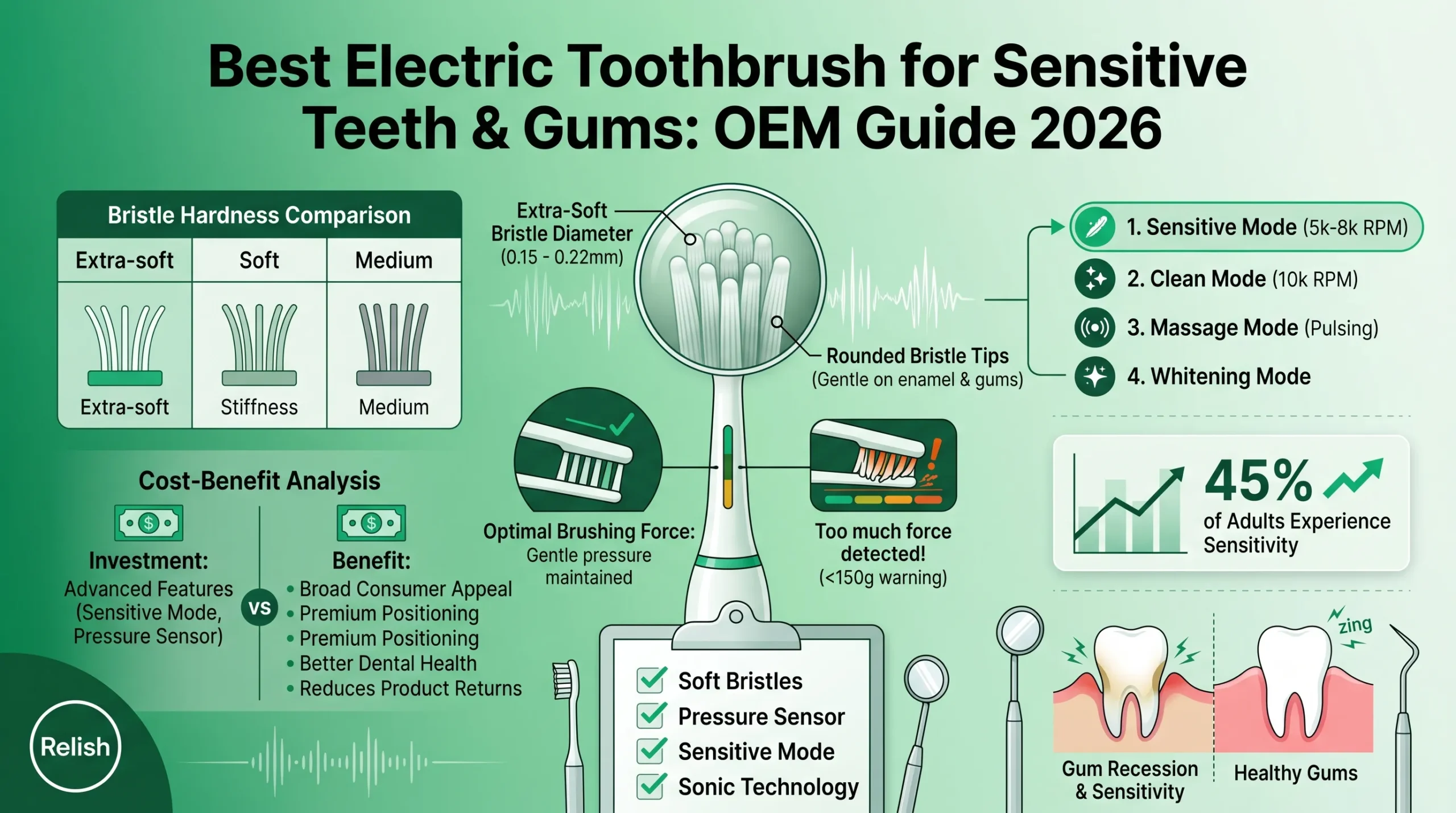
Nearly 45% of adults worldwide experience dentin hypersensitivity at some point in their lives (Holland et al., 1997), according to the Journal of the American Dental Association. For brand owners entering the oral care market, this represents a substantial product differentiation opportunity—and a critical technical challenge.
This guide examines the engineering principles behind an electric toothbrush for sensitive teeth and gums, the specifications that matter, and how to position an OEM product in this growing segment. When sourcing an electric toothbrush for sensitive teeth through an OEM partner, brand owners must balance bristle specifications, motor technology, and regulatory requirements to deliver a product that genuinely addresses dentin hypersensitivity without causing further gum recession. Esplora la nostra collezione di spazzolini elettrici to see how these specifications translate into production-ready models.
What Causes Tooth Sensitivity?
An effective electric toothbrush for sensitive teeth must address the underlying mechanisms of dentin hypersensitivity. Before selecting components for an OEM-branded electric toothbrush for sensitive teeth, brand owners must understand what causes sensitivity in the first place.
Before selecting components, brand owners must understand the underlying mechanisms:
Dentin hypersensitivity occurs when dentin becomes exposed, typically through:
- Gum recession: Exposing the root surface (cementum)
- Enamel erosion: Acidic foods, beverages, or aggressive brushing wear down enamel
- Cracked teeth: Creating pathways to the pulp
- Periodontal treatment: Professional cleaning can temporarily increase sensitivity
The dentin contains microscopic tubules that connect to the nerve pulp. When stimuli (cold, heat, pressure) reach these tubules, patients experience sharp, brief pain.
Key Toothbrush Features for Sensitive Teeth
Not every electric toothbrush for sensitive teeth is created equal. The specifications below differentiate genuine sensitivity-focused designs from products that merely claim gentleness without engineering substance. When sourcing an electric toothbrush for sensitive teeth through OEM channels, these features form the core of product differentiation and consumer trust.
Soft Bristle Design
The single most important specification for an electric toothbrush for sensitive teeth and gums. Bristle diameter, tip geometry, and end-rounding quality directly determine whether a toothbrush soothes or exacerbates dentin hypersensitivity. For OEM brands positioning an electric toothbrush for sensitive teeth, bristle specification is the foundational engineering decision.
| Tipo di setola | Diameter | Indication |
|---|---|---|
| Extra-soft (ultralight) | 0.15-0.18mm | Severe sensitivity, post-procedural |
| Soft | 0.18-0.22mm | Moderate sensitivity |
| Medium | 0.22-0.28mm | General use (may irritate sensitive gums) |
OEM specification guidance: For sensitive-teeth positioning, specify extra-soft or soft bristles with rounded bristle tips (end-rounding ratio ≥90%). Sharp bristles create micro-abrasions on gum tissue.
Pressure Sensing Technology
Excessive brushing force is the primary behavioral cause of gum recession and enamel wear in sensitive-teeth populations. A purpose-built electric toothbrush for sensitive teeth must include pressure sensing to automatically prevent over-brushing. For OEM sourcing, this feature is a key BOM cost driver and a major differentiator in the sensitive-teeth segment.
Technical implementations:
- Piezoelectric sensors: Detect force via crystal deformation (cost: higher)
- Sensori a effetto Hall: Measure magnetic field changes from bristle head deflection (mid-range cost)
- Mechanical switches: Simple contact detection (lower cost, less precise)
Smart toothbrush solutions can provide:
- Visual feedback (LED indicator)
- Haptic feedback (vibration pattern change)
- Auto pressure reduction (motor power reduction)
For sensitive-teeth models, automatic pressure reduction is a strong selling point—brands can market this as "protective mode."
Gentle Cleaning Modes
Variable speed settings allow users to customize intensity on an electric toothbrush for sensitive teeth and gums. A dedicated sensitive mode at reduced RPM is the expected minimum for this product category. OEM brands should specify at least one dedicated sensitive mode with verifiable speed ranges in the product datasheet.
| Mode | Speed Range | Use Case |
|---|---|---|
| Sensitive | 5,000-8,000 RPM | Sensitive teeth, gum inflammation |
| Clean | 8,000-12,000 RPM | Daily maintenance |
| White/Polish | 12,000-15,000 RPM | Stain removal |
| Gum Care | Variable pulse | Gum stimulation |
OEM recommendation: Include at least one dedicated "sensitive" mode with reduced speed and softer vibration patterns.
Acoustic/Sonic Technology Considerations
For an electric toothbrush for sensitive teeth, the motor technology determines how cleaning force is delivered. The choice between oscillating-rotating and sonic/vibrating technology has significant implications for the sensitive-teeth user experience and OEM BOM cost structure.
Oscillating-rotating (rotary): Higher intensity on individual tooth surfaces. May feel abrasive to sensitive users without pressure control.
Sonic (vibrating): Broader, gentler cleaning motion. The fluid dynamics effect (dentifluid dynamics) provides cleaning without direct bristle contact, making it generally better tolerated by sensitive teeth.
Vibrosonic™ technology (as implemented in Relish Tech's product line) uses lower-frequency vibration modes specifically designed for sensitive applications, with amplitude control to adjust intensity.
Brush Head Design
Brush head geometry determines how the bristle field contacts gum tissue. For an electric toothbrush for sensitive teeth, head design must maximize cleaning coverage while minimizing point pressure on exposed dentin. OEM product development for the sensitive-teeth segment should prioritize compact head dimensions and rounded edge profiles.
- Compact heads (28-32mm): Better access to molar areas, reduces over-brushing
- Angled necks: Reach subgingival areas without excessive force
- Rubberized cup edges: Provide gum-line cleaning without sharp contact
For sensitive positioning, recommend:
- Oval or diamond-shaped heads with rounded edges
- Bristle cluster patterns that avoid direct gum-line pressure
- Silicone or TPE (thermoplastic elastomer) accents for gentle gum massage
6. Timer Functions
Over-brushing is a major contributor to enamel erosion. Integrated timers address this:
- 2-minute standard timer: ADA-recommended brushing duration
- Quad-pacer (30-second zones): Ensures even coverage
- Smart timer with app integration: Tracks brushing habits over time
Cost-Benefit Analysis for OEM Sourcing
Sourcing an electric toothbrush for sensitive teeth through OEM channels requires evaluating which features justify BOM cost increases versus consumer-perceived value. The table below breaks down typical cost impacts for OEM-sensitive-teeth toothbrush products, including considerations for lead time, minimum order quantities, and quality control investment.
| Caratteristica | Added Cost | Market Positioning Value | MOQ Impact |
|---|---|---|---|
| Extra-soft bristles | +2-5% | Alto | Minimal |
| Sensore di pressione | +8-15% | Very High | May affect unit price |
| Multiple modes (4+) | +3-6% | Medium | Minimal |
| Sonic technology | +10-20% | Alto | Significant |
| App connectivity | +12-18% | Medium-High | Volume-dependent |
Target price points for sensitive-teeth positioning:
- Entry-level (basic soft bristles): $8-15 FOB
- Mid-range (modes + soft bristles): $18-28 FOB
- Premio (sonic + pressure sensor + app): $35-55 FOB
OEM Sourcing Essentials for Sensitive Teeth Toothbrushes
- MOQ: 500–1,000 units for entry-level; 1,000–2,000 units for models with pressure sensor and sonic technology
- Tempi di consegna: 45–90 days for standard configurations; 60–120 days for ADA clinical testing or custom pressure sensor calibration
- QC Protocol: IQ/OQ/PQ validation for pressure sensor accuracy; end-rounding ratio testing per ISO 20126; bristle pull-force verification
- Certificazioni: FDA Class I registration, CE marking, ISO 13485 (medical device quality) — ADA Seal requires separate clinical validation
For a detailed electric toothbrush manufacturing cost breakdown including BOM structures for sensitive-teeth models, refer to our cost analysis guide.
Need an OEM Quote for Sensitive Teeth Toothbrushes?
Get a detailed production feasibility assessment including bristle specification options, pressure sensor calibration, and regulatory pathway costs.
Request OEM QuoteRegulatory and Certification Considerations
For an OEM-branded electric toothbrush for sensitive teeth, certifications provide the clinical credibility that B2B buyers and end consumers trust. Navigating the regulatory landscape—FDA registration, CE marking, ISO standards, and the ADA Seal of Acceptance—is a critical step in bringing a sensitive-teeth toothbrush to market.
- ADA Seal of Acceptance: Requires clinical evidence of gentleness
- ISO 20126: Oral care manual toothbrushes standard
- Marchio CE (EU): General safety compliance
- Registrazione FDA (US): Class I device registration
Learn more about our certifications and compliance capabilities and read our OEM electric toothbrush certifications guide for a complete regulatory pathway breakdown.
The ADA seal is particularly valuable for sensitive-teeth positioning, as it provides third-party clinical validation. However, obtaining it requires clinical testing, which adds 3-6 months and $15,000-30,000 to your certification timeline.
Positioning Your Sensitive Teeth Toothbrush Brand
Target Consumer Segments
- Age 40+ consumers: Higher likelihood of gum recession and sensitivity
- Post-dental procedure patients: Temporary sensitivity from cleanings, whitening
- Orthodontic patients: Braces create cleaning challenges and potential sensitivity
- Health-conscious consumers: Willing to pay premium for gentleness
Competitive Differentiation Angles
- "Dentist-recommended gentleness": Clinical endorsement positioning
- "Engineered for sensitivity": Technical/engineering credibility
- "The last toothbrush for sensitive teeth": Emotional/solution positioning
Packaging and Marketing Claims
Valid claims for sensitive-teeth toothbrushes:
- "Soft bristles designed for sensitive teeth and gums"
- "Helps reduce tooth sensitivity with gentle cleaning"
- "Features pressure control technology to protect gums"
⚠️ Avoid: Claims that the product "treats" or "cures" sensitivity—that would require therapeutic device classification.
I punti chiave per i proprietari dei marchi
- Bristle specification is the foundation of every electric toothbrush for sensitive teeth: Extra-soft bristles (0.15-0.18mm) with end-rounding ratios exceeding 90% are non-negotiable engineering requirements for sensitivity positioning
- Pressure sensing differentiates a real electric toothbrush for sensitive teeth: This feature addresses the root behavioral cause of sensitivity—over-brushing—and justifies premium OEM pricing with measurable consumer value
- Sonic technology suits sensitive users: Fluid-dynamics cleaning is inherently gentler than direct mechanical bristle contact, making sonic-mode electric toothbrushes for sensitive teeth the preferred engineering choice
- Mode flexibility matters in the sensitive-teeth category: A dedicated sensitive mode with reduced RPM (5,000-8,000) is an expected baseline for OEM products targeting dentin hypersensitivity consumers
- ADA clinical validation commands the highest trust signal: Plan for $15,000-30,000 and 3-6 months of clinical testing if pursuing the ADA Seal of Acceptance for your OEM-branded electric toothbrush for sensitive teeth
Download the Sensitive Teeth Toothbrush Spec Sheet — including bristle diameter tolerances, pressure sensor calibration ranges, and BOM cost estimates for OEM production.
Frequently Asked Questions About Electric Toothbrush for Sensitive Teeth
Selecting the right electric toothbrush for sensitive teeth and gums requires understanding both engineering specifications and OEM sourcing realities. Below are the most common questions from brand owners entering this segment.
The best toothbrush for sensitive teeth combines extra-soft bristles (0.15-0.22mm diameter), pressure sensing technology, and a dedicated sensitive mode. Sonic toothbrushes with amplitude control are generally better tolerated by sensitive users.
Electric toothbrushes with pressure sensors and variable speed settings are generally better for sensitive teeth than manual brushes. The automatic speed control helps users avoid aggressive brushing that worsens sensitivity.
Replace your toothbrush or brush head every 3 months, or sooner if bristles become worn or splayed. For electric toothbrushes, inspect bristles monthly for signs of deterioration.
For receding gums, use extra-soft bristles (0.15-0.18mm) with rounded tips. Avoid medium or hard bristles, and look for toothbrushes with pressure sensors to prevent over-brushing.
Quality sonic toothbrushes do not damage sensitive teeth when used correctly. Sonic technology can be gentler than oscillating-rotating systems because it relies more on fluid dynamics than direct bristle contact.
A sensitive-teeth toothbrush should have: (1) soft or extra-soft bristles with rounded tips, (2) multiple cleaning modes including a gentle/sensitive option, (3) pressure sensing, (4) a compact brush head, and (5) a 2-minute timer.
When selecting an OEM manufacturer, verify their bristle sourcing (medical-grade nylon), ask about end-rounding processes (ratio should exceed 90%), confirm pressure sensor capability, request samples for testing, and check their ADA seal experience.
Soft-bristled toothbrushes cannot reverse existing tooth sensitivity, but they prevent further gum recession and enamel wear. Addressing sensitivity also requires desensitizing toothpaste and avoiding acidic foods.
Riferimenti
- American Dental Association. (2023). Toothbrushes: What You Should Know. ADA.org.
- Holland, G. R., Narhi, M. N., Addy, M., Gangarosa, L., & Orchardson, R. (1997). Guidelines for the design and conduct of clinical trials on dentin hypersensitivity. Rivista di parodontologia clinica, 24(11), 808–813. doi.org
- International Organization for Standardization. (2012). ISO 20126:2012 — Dentistry — Manual Dental Brushes — General Information and Test Methods. ISO. iso.org/standard/44870.html
- Zhao, X., Zhang, Y., & Li, H. (2021). Clinical efficacy of different toothbrush types for dentin hypersensitivity: A systematic review. BMC Oral Health, 21(1), 276. PMID: 34112132. PubMed
- U.S. Food and Drug Administration. (2023). Dental Devices Classification. FDA.gov.
Articoli correlati
Ready to Source Your Sensitive Teeth Toothbrush?
Relish Tech specializes in OEM electric toothbrushes with sensitive-teeth features: soft bristles, pressure sensors, gentle modes, and Vibrosonic™ technology. When sourcing an electric toothbrush for sensitive teeth, partner with a manufacturer who understands the engineering specificity this category demands—from bristle diameter tolerances to pressure sensor calibration.