











Brosse à dents sonique vs oscillo-rotative : Guide 2026
Brosse à dents sonique vs oscillante : cette comparaison couvre la technologie, l'efficacité d'élimination de la plaque, la santé des gencives, les prix et le verdict des dentistes sur le type qui nettoie le mieux.
Lorsque vous lancez une marque de soins bucco-dentaires, l'une des premières et des plus importantes décisions à prendre est de choisir votre technologie de brosse à dents sonique vs oscillante-rotative Ce choix ne concerne pas seulement les spécifications techniques : il s'agit de positionner votre marque, de comprendre votre marché cible et de construire des produits qui offrent des résultats cliniques mesurables.
Après plus de 15 ans de fabrication de brosses à dents électriques pour des marques vendues dans plus de 120 pays, nous avons aidé des centaines d'entrepreneurs à naviguer dans cette décision précise. Nous couvrirons la science, comparerons les résultats réels et vous aiderons à choisir la technologie qui correspond à votre marque—sans fioritures, juste ce dont vous avez besoin pour prendre une décision.
Contexte important : Cet article fait partie de notre Guide des technologies de brosses à dents électriques—si vous souhaitez une compréhension fondamentale du fonctionnement des brosses à dents électriques, commencez par là.
Principaux enseignements
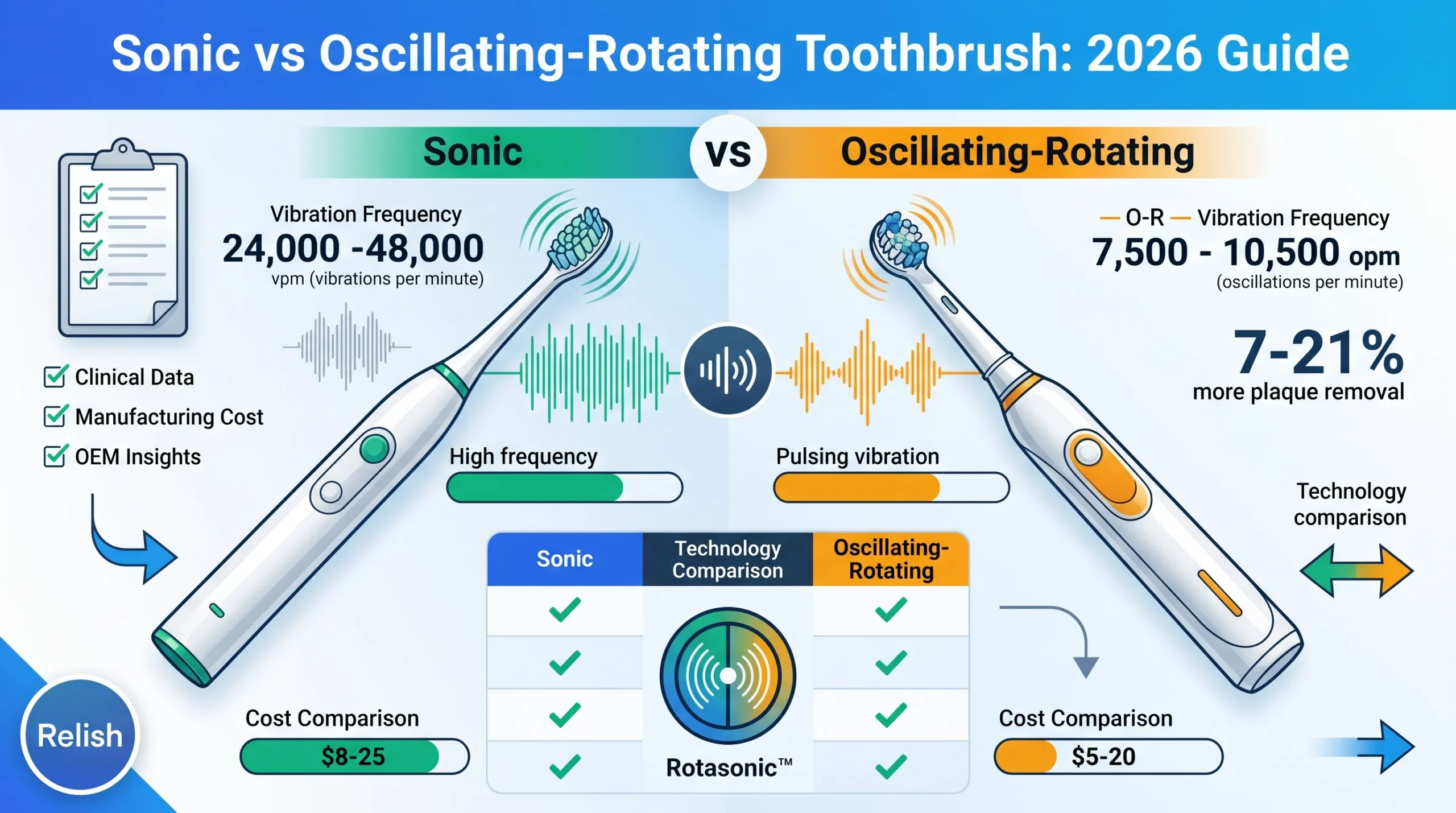
- Les brosses à dents soniques fonctionnent à 24 000–48 000 vibrations par minute, s'appuyant sur des vibrations haute fréquence et la dynamique des fluides pour le nettoyage
- Les brosses à dents oscillantes-rotatives (O-R) utilisent une rotation mécanique de la tête (généralement 7 500–10 500 oscillations par minute) avec un contact direct poils-dents
- Les études cliniques montrent que les brosses O-R peuvent réduire la plaque de 7–21% de plus que les brosses soniques dans des comparaisons directes, bien que la sonique reste très efficace (étude Nature 2025)
- Pour la santé des gencives, la technologie O-R montre une réduction de la gingivite de 4–29% supérieure dans les essais cliniques
- La technologie sonique convient à un positionnement de marque premium et axé sur la technologie ; La technologie O-R attire les consommateurs qui privilégient un pouvoir nettoyant éprouvé et un bon rapport qualité-prix
- Les technologies hybrides (comme le Rotasonic™ de Relish Tech) représentent la prochaine frontière de l'innovation en soins bucco-dentaires
Les Deux Technologies Expliquées : Comment Elles Fonctionnent Réellement
Qu'est-ce qu'une Brosse à Dents Sonique ?
Une brosse à dents sonique génère des vibrations haute fréquence via un moteur à lévitation magnétique. Ces vibrations vont généralement de 24 000 à 48 000 coups par minute, créant le " bourdonnement " caractéristique que les utilisateurs adorent ou trouvent surprenant au début.
Le mécanisme de nettoyage d'une brosse à dents sonique fonctionne par deux voies principales :
Brossage mécanique : Comme toute brosse à dents, les poils frottent physiquement les surfaces dentaires. La vibration haute fréquence amplifie considérablement cet effet.
Dynamique des fluides : C'est là que la technologie sonique se différencie vraiment. Les vibrations rapides créent de minuscules bulles qui génèrent des forces de nettoyage atteignant au-delà de là où les poils touchent—les espaces entre les dents et sous la ligne des gencives.
La physique : Lorsque les poils vibrent à des fréquences soniques (20 000+ Hz), ils créent des ondes de pression dans le milieu fluide. Ces ondes peuvent générer des forces de nettoyage à plusieurs millimètres au-delà des extrémités des poils. Ce n'est pas tout à fait un " brossage sans contact ", mais c'est vraiment différent du grattage mécanique.
Qu'est-ce qu'une Brosse à Dents Oscillante-Rotative ?
Une brosse à dents oscillante-rotative utilise une approche mécanique fondamentalement différente. La tête de brosse effectue de petits mouvements de rotation—généralement 45–90 degrés dans chaque direction—effectuant 7 500 à 10 500 oscillations par minute.
Oral-B a été le pionnier de cette technologie. Leur programme de recherche s'étend sur plus de 60 ans, faisant d'O-R la plateforme de brosse à dents la plus cliniquement validée.
Le mécanisme de nettoyage : Les brosses O-R reposent presque entièrement sur le contact direct des poils. La rotation oscillante frotte les dents comme un nettoyeur électrique, chaque passage couvrant une zone spécifique. Les brosses O-R modernes (comme la série Oral-B iO) ajoutent des micro-vibrations pour combiner le nettoyage mécanique avec une stimulation douce.
Au cœur de la technologie sonique : l'ingénierie rencontre les soins bucco-dentaires
Comment fonctionne la technologie Vibrosonic™
Chez Relish Tech, notre Vibrosonic™ plateforme représente notre approche d'ingénierie pour un brossage sonique haute performance. Construite sur des années de recherche et développement, la technologie repose sur un moteur à lévitation magnétique de précision qui produit des vibrations constantes et contrôlées sans l'usure associée aux moteurs à balais traditionnels.
Spécifications techniques pour Vibrosonic™:
| Paramètre | Spécifications |
|---|---|
| Fréquence de vibration | 31 000–40 000 vpm |
| Amplitude de vibration | 1,5–2,5 mm |
| Type de moteur | Lévitation magnétique (sans balais) |
| Efficacité énergétique | >85% |
| Niveau sonore | 55–65 dB |
Le moteur à lévitation magnétique élimine le contact physique entre les pièces mobiles, ce qui signifie :
- Durée de vie plus longue : L'absence d'usure des balais garantit des performances constantes sur la durée de vie de la tête de brosse
- Entretien réduit : Moins de défaillances mécaniques se traduisent par une meilleure satisfaction client
- Contrôle précis : Les circuits numériques peuvent moduler les motifs de vibration pour différents modes
Ce que cela signifie pour votre marque
Les brosses à dents soniques offrent plusieurs avantages de positionnement :
Perception premium : Le récit technologique haute fréquence séduit les consommateurs férus de technologie. " 40 000 vibrations par minute " semble impressionnant et justifie un prix premium.
Doux pour les gencives : Le mouvement non abrasif attire les consommateurs aux gencives sensibles ou ceux ayant subi une usure de l'émail. La dynamique des fluides assure un nettoyage sans action mécanique agressive.
Facteur de nouveauté : Le bourdonnement et la sensation de chatouillement doux sont mémorables : les consommateurs parlent de leurs brosses soniques, ce qui génère un bouche-à-oreille organique.
Profils plus fins : Les têtes de brosse soniques peuvent être plus fines que les têtes O-R, permettant une esthétique de produit plus élégante qui se photographie bien pour le commerce électronique.
Limites à considérer
La technologie sonique n'est pas sans compromis :
Dépendance à la technique : Les brosses soniques fonctionnent mieux lorsque les utilisateurs les maintiennent en place pendant 2 à 3 secondes par dent, permettant à la dynamique des fluides d'agir. Les utilisateurs habitués à frotter peuvent ne pas obtenir des résultats optimaux.
Coût de fabrication plus élevé : Les moteurs à lévitation magnétique sont plus chers que les moteurs à galette utilisés dans les brosses O-R d'entrée de gamme.
Au cœur de la technologie oscillo-rotative : l'ingénierie
La mécanique
La technologie oscillo-rotative fonctionne sur un principe simple mais efficace : un petit moteur entraîne un système d'engrenages qui fait pivoter la tête de brosse d'avant en arrière sur un arc limité. La conception de la tête de brosse ronde (pionnière d'Oral-B) correspond à la forme naturelle des dents individuelles.
Spécifications typiques O-R:
| Paramètre | Spécifications |
|---|---|
| Arc d'oscillation | 45–90 degrés par côté |
| Oscillations par minute | 7,500–10,500 |
| Vitesse de rotation | 2 800–4 000 tr/min |
| Consommation électrique | 3–8 W |
Le contact direct des brins signifie que l'efficacité du nettoyage dépend moins de la technique de l'utilisateur, un avantage significatif pour les produits grand public où la formation est minimale.
L'avantage clinique
En évaluant la technologie O-R, vous héritez de décennies de validation clinique. Le programme de recherche d'Oral-B a produit des centaines d'études évaluées par des pairs démontrant une élimination supérieure de la plaque et une réduction de la gingivite.
Principaux résultats de la littérature clinique :
- Un essai contrôlé randomisé de 8 semaines a montré que l'Oral-B iO offrait une réduction de la plaque de 21% supérieure et une réduction de la gingivite de 29% supérieure par rapport à une brosse à dents sonique leader
- Les études à long terme (6 mois et plus) montrent systématiquement que la technologie O-R maintient un contrôle supérieur de la plaque
- Le La liste officielle des brosses à dents électriques acceptées par l'ADA inclut plusieurs modèles O-R
Pour les marques cherchant les certifications ADA, FDA et ISO, l'historique établi de l'O-R rend le processus réglementaire plus fluide. Notre Équipe de R&D possède une vaste expérience avec les deux technologies.
Pour votre marque : Choisir la technologie O-R signifie s'aligner sur un récit clinique établi. Votre marketing peut se référer à la vaste base de recherche, ce qui est impossible avec les technologies plus récentes.
Implication stratégique
Crédibilité clinique : Vous pouvez vous appuyer sur une bibliothèque d'études indépendantes soutenant votre choix technologique.
Attrait grand public : La simplicité intuitive " placez-la sur la dent et passez à la suivante " fonctionne pour toutes les données démographiques.
Efficacité de fabrication : Les mécanismes O-R sont bien compris, avec des chaînes d'approvisionnement matures qui réduisent les coûts des composants. Si vous cherchez les certifications FDA, CE et autres certifications réglementaires, l'historique établi de l'O-R rend le processus plus fluide.
Héritage de marque : Si vous vous positionnez comme " éprouvé " ou " de confiance ", la technologie O-R porte ce message implicite.
Limites à considérer
Sensation premium moindre : L'action de " brossage ", même douce, manque de l'attrait futuriste de la technologie sonique.
Marques concurrentes : Oral-B domine la perception de l'O-R. Vous aurez besoin d'un budget marketing important pour établir une différenciation.
Taille de la tête de brosse : La conception de la tête ronde peut sembler maladroite pour les utilisateurs préférant les profils fins.
La vérité clinique : quelle technologie nettoie réellement le mieux ?
Comparaison de l'élimination de la plaque
Allons à la vraie question : quelle technologie élimine le plus de plaque ? La réponse nécessite des nuances.
Les études à court terme (utilisation unique à 4 semaines) favorisent systématiquement la technologie O-R :
- A méta-analyse évaluée par des pairs a constaté que les brosses O-R éliminaient 7 à 21% de plaque en plus que les brosses soniques dans les comparaisons d'utilisation immédiate
- Le mécanisme est simple : le brossage mécanique bat la dynamique des fluides lorsque le temps est limité
Études à long terme (8+ semaines) réduisent l’écart :
- Les deux technologies offrent une réduction cliniquement significative de la plaque dentaire
- La différence entre elles devient moins prononcée à mesure que les utilisateurs adaptent leurs techniques
- Les utilisateurs de brosses à dents soniques qui maîtrisent la technique de " maintien en place " peuvent égaler les performances O-R
Implication concrète pour votre marque : Si vos consommateurs cibles ont tendance à se brosser rapidement et de manière irrégulière, la technologie O-R peut offrir des résultats plus fiables. Si votre public valorise un brossage minutieux et réfléchi, la technologie sonique offre des performances comparables.
En matière de santé des gencives, les choses deviennent plus nuancées
Avantage O-R dans les comparaisons directes :
- Plusieurs études comparatives montrent une réduction de la gingivite de 4 à 29 % supérieure avec la technologie O-R
- L’action mécanique directe semble plus efficace pour perturber le biofilm de plaque dentaire responsable de la gingivite
La technologie sonique excelle également :
- Le brossage sonique montre des améliorations significatives de la santé des gencives par rapport au brossage manuel
- La dynamique fluide douce peut en fait moins irriter les gencives lors de la première utilisation
- Pour les consommateurs ayant une sensibilité gingivale existante, la technologie sonique offre un point d’entrée plus doux
Pour votre gamme de produits : Si vous ciblez le marché de la santé des gencives (consommateurs de 35 ans et plus de plus en plus préoccupés par la parodontite), la technologie O-R vous offre des allégations cliniques plus solides. Pour un positionnement " doux mais efficace " ciblant les jeunes consommateurs, la technologie sonique peut mieux résonner.
Ce que les utilisateurs réels préfèrent réellement
Mais les utilisateurs réels ne se soucient pas toujours des données cliniques. Voici ce que l’expérience subjective nous apprend :
Les utilisateurs de brosses à dents soniques rapportent :
- Une sensation initiale de " chatouillement " à laquelle la plupart s’adaptent en 1 à 2 semaines
- Une appréciation pour l’expérience " high-tech "
- Une satisfaction quant au fonctionnement silencieux (par rapport au bruit mécanique des brosses O-R)
Les utilisateurs de brosses à dents O-R rapportent :
- Un sentiment immédiat de nettoyage puissant
- Une satisfaction quant à la familiarité (la tête ronde rappelle les outils de nettoyage professionnels)
- Quelques inquiétudes initiales concernant le bruit mécanique
L’essentiel pour votre stratégie produit : L’expérience utilisateur l’emporte souvent sur les données cliniques dans les préférences des consommateurs. Réfléchissez à qui est votre client cible et à ce qui l’incitera à recommander votre marque à ses amis.
Choisissez votre combattant : Adapter la technologie à votre stratégie de marque
Quand choisir la technologie sonique
La technologie des brosses à dents soniques est stratégiquement pertinente lorsque :
Votre cible est constituée de consommateurs amateurs de technologies premium : Le récit des " 40 000 vibrations " se vend. Si vous vous positionnez à 80–150 $+, la technologie sonique justifie le prix par une ingénierie sophistiquée.
Vous servez des consommateurs aux dents/gencives sensibles : L’action douce sans brossage agressif attire les consommateurs à qui l’on a dit qu’ils se brossaient trop fort ou qu’ils avaient une érosion de l’émail.
Vous souhaitez une différenciation esthétique : Les têtes de brosse soniques peuvent être considérablement plus fines, permettant des designs de produits uniques qui se démarquent en rayon.
Vous ciblez les marchés asiatiques/européens : La technologie sonique a une part de marché plus forte dans ces régions, où les consommateurs sont plus familiers avec les avantages de la technologie.
Étude de cas : Succès d’une startup européenne avec Vibrosonic™
Une startup européenne avec laquelle nous avons travaillé a lancé une marque alimentée par Vibrosonic™ ciblant les millennials en quête d"" esthétique de salle de bain intelligente ". Ils ont positionné la technologie comme une " précision d’ingénierie allemande » et ont atteint 340 % de leur objectif de vente de première année en se différenciant à la fois par les allégations de performance et le design visuel.
Quand choisir la technologie oscillo-rotative
La technologie O-R est stratégiquement pertinente lorsque :
Vous ciblez des consommateurs soucieux de la valeur : La puissance de nettoyage éprouvée à des prix accessibles (30–80 $) fonctionne pour les marques de volume.
Vous souhaitez l’approbation de l’ADA ou d’une association dentaire régionale : Les données cliniques étendues soutiennent les allégations d’approbation réglementaire.
Vous êtes en concurrence avec Oral-B (ou souhaitez les éviter) : Se démarquer de la domination d'Oral-B nécessite soit une différenciation technologique complète, soit la recherche de niches O-R mal desservies.
Votre clientèle est plus âgée : Les consommateurs de 45 ans et plus préfèrent souvent le nettoyage simple et fiable de la technologie O-R et peuvent trouver la sensation du brossage sonore inhabituelle. Pour les marques axées sur les options de fabrication OEM de brosses à dents pour enfants, la conception intuitive d'O-R fonctionne bien pour les routines de soins bucco-dentaires des enfants.
La Troisième Voie : L'Innovation Hybride
Et si vous n'aviez pas à choisir ? Les technologies hybrides combinent plusieurs mécanismes de nettoyage dans une seule tête de brosse, et la plateforme Rotasonic™ de Relish Tech illustre cette approche.
La technologie Rotasonic™ combine :
- Des vibrations soniques haute fréquence (32 000 vpm) pour un nettoyage dynamique des fluides
- Une rotation oscillante précise pour l'élimination mécanique de la plaque dentaire
- Des ondes ultrasoniques pour un effet antimicrobien renforcé
Ce n'est pas seulement du marketing, c'est une véritable prouesse technique. En intégrant plusieurs mécanismes de nettoyage, Rotasonic™ offre :
- Une élimination supérieure de la plaque dentaire grâce à une action mécanique et fluidique combinée
- Une stimulation gingivale améliorée grâce à la technologie micro-vibratoire
- Une véritable histoire de différenciation pour un positionnement premium
Pour votre marque : La technologie hybride vous permet de vous positionner comme innovant plutôt que de rivaliser sur des revendications technologiques établies. C'est un choix stratégique pour les marques qui souhaitent perturber plutôt que suivre.
Considérations de Fabrication pour les Acheteurs OEM
Implications de Coût par Technologie
Comprendre les coûts de fabrication vous aide à définir des marges réalistes et des prix de détail. Pour une ventilation par composant, consultez notre guide des coûts de fabrication de brosses à dents électriques.
Brosses à dents soniques :
- Les moteurs à lévitation magnétique coûtent 2 à 3 fois plus que les moteurs à galette traditionnels
- La conception de la tête de brosse nécessite une ingénierie de précision pour des vibrations constantes
- La complexité du circuit imprimé augmente avec les modes de vibration et les fonctions intelligentes
- Fourchette de coût en usine : $8–25 par unité complète (selon les fonctionnalités)
Brosses à dents oscillo-rotatives :
- Technologie moteur mature avec des prix de composants compétitifs
- L'assemblage mécanique est bien maîtrisé avec un fort potentiel d'automatisation
- Les têtes rondes nécessitent plus de plastique, mais la fabrication est hautement optimisée
- Fourchette de coût en usine : $5–20 par unité complète (selon les fonctionnalités)
Les technologies hybrides (comme Rotasonic™) :
- Des coûts de composants plus élevés reflètent la complexité du double mécanisme
- L'investissement en ingénierie est rentabilisé par la capacité de positionnement premium
- Le coût varie considérablement en fonction de l'intégration de fonctionnalités spécifiques
Quantités Minimales de Commande et Planification de la Production
| Technologie | MOQ typique | Délai de Production |
|---|---|---|
| Sonique | 1 000–3 000 unités | 45-60 jours |
| Oscillant-Rotatif | 500–2 000 unités | 35 à 50 jours |
| Hybride (Rotasonic™) | 1 500–5 000 unités | 60 à 90 jours |
Notre installation de Shenzhen offre des options de MOQ flexibles à partir de 500 unités pour les marques testant la validation du marché, avec des avantages d'échelle à mesure que vos commandes augmentent. Explorez notre collection de brosses à dents électriques pour voir des exemples de chaque technologie en production, ou en savoir plus sur notre calendrier de fabrication OEM et comment nous accompagnons les marques du concept au marché.
Quality Metrics That Matter
2. When evaluating manufacturers, focus on quality systems backed by
3. FDA, CE, and ISO certifications
4. Defect rate:
5. We maintain
6. <0.3% defect rate across all product lines
7. Consistency:
8. Vibration frequency should remain within 5% of specifications throughout product life
9. Battery performance:
10. Real-world cycle testing (not just spec sheet compliance)
11. Motor lifespan:
12. Minimum 500 hours continuous operation under load
13. Your Technology Decision Checklist: 5 Questions to Ask
14. Use this framework to guide your decision:
15. Define your primary value proposition
16. "Most effective cleaning" → Choose O-R technology
17. "Gentlest and most advanced" → Choose sonic technology
18. "Most innovative and comprehensive" → Consider hybrid (Rotasonic™)
19. Identify your target customer
20. Tech-forward millennials → Sonic or hybrid
21. Value-conscious families → O-R technology
22. Premium-seeking professionals → Sonic or hybrid
23. Gum-health-focused 40+ → O-R technology
24. Set your price point
25. $100+ premium positioning → Sonic or hybrid
26. $50–100 mid-market → Both viable
27. Under $50 value → O-R technology more feasible
28. Assess your marketing resources
29. Strong clinical evidence needed → O-R technology
30. Innovation narrative possible → Sonic or hybrid
31. Limited differentiation options → Choose the path with less competition
32. Evaluate production scale
33. Starting small (<2,000 units) → Both viable; O-R may have slight cost advantage
34. Scaling rapidly → Both viable; ensure your manufacturer can scale
35. Complex hybrid features → Plan 60–90 days minimum
36. Beyond Technology: Other Factors
37. Technology choice is important, but remember:
38. Will replacement heads be available at reasonable prices?
39. Users increasingly expect 4+ weeks per charge
40. App connectivity, pressure sensors, and brushing timers add value
41. Warranty support:
42. Longer warranties signal quality confidence
43. The Bottom Line: Technology is a Tool, Not a Destination
44. Here's what 15 years of manufacturing has taught us: the "best" technology depends entirely on your brand strategy.
45. A sonic vs oscillating-rotating electric toothbrush isn't a binary right-or-wrong question. It's a strategic choice that should flow from understanding your target market, your positioning, and your manufacturing capabilities.
46. offers a premium narrative and gentle approach that resonates with specific audiences.
47. Oscillating-rotating technology
48. delivers proven clinical results and manufacturing efficiency.
49. Hybrid technology
50. (like Rotasonic™) enables genuine differentiation for brands seeking to disrupt.
When evaluating manufacturers, focus on quality systems backed by
FDA, CE, and ISO certifications
:
- Defect rate:
We maintain
<0.3% defect rate across all product lines - Consistency:
Vibration frequency should remain within 5% of specifications throughout product life - Battery performance:
Real-world cycle testing (not just spec sheet compliance) - Motor lifespan:
Minimum 500 hours continuous operation under load
Your Technology Decision Checklist: 5 Questions to Ask
Use this framework to guide your decision:
- Define your primary value proposition
"Most effective cleaning" → Choose O-R technology
"Gentlest and most advanced" → Choose sonic technology
"Most innovative and comprehensive" → Consider hybrid (Rotasonic™)
- Identify your target customer
Tech-forward millennials → Sonic or hybrid
Value-conscious families → O-R technology
Premium-seeking professionals → Sonic or hybrid
Gum-health-focused 40+ → O-R technology
- Set your price point
$100+ premium positioning → Sonic or hybrid
$50–100 mid-market → Both viable
Under $50 value → O-R technology more feasible
- Assess your marketing resources
Strong clinical evidence needed → O-R technology
Innovation narrative possible → Sonic or hybrid
Limited differentiation options → Choose the path with less competition
- Evaluate production scale
Starting small (<2,000 units) → Both viable; O-R may have slight cost advantage
Scaling rapidly → Both viable; ensure your manufacturer can scale
Complex hybrid features → Plan 60–90 days minimum
Beyond Technology: Other Factors
Technology choice is important, but remember:
- Compatibilité des têtes de brosse : Will replacement heads be available at reasonable prices?
- Autonomie de la batterie : Users increasingly expect 4+ weeks per charge
- Fonctionnalités intelligentes : App connectivity, pressure sensors, and brushing timers add value
- Warranty support:
Longer warranties signal quality confidence
The Bottom Line: Technology is a Tool, Not a Destination
Here's what 15 years of manufacturing has taught us: the "best" technology depends entirely on your brand strategy.
A sonic vs oscillating-rotating electric toothbrush isn't a binary right-or-wrong question. It's a strategic choice that should flow from understanding your target market, your positioning, and your manufacturing capabilities.
2. offers a premium narrative and gentle approach that resonates with specific audiences.
3. Oscillating-rotating technology
4. delivers proven clinical results and manufacturing efficiency.
5. Hybrid technology
6. (like Rotasonic™) enables genuine differentiation for brands seeking to disrupt.
La technologie sonique offers a premium narrative and gentle approach that resonates with specific audiences.
Oscillating-rotating technology delivers proven clinical results and manufacturing efficiency.
Hybrid technology (like Rotasonic™) enables genuine differentiation for brands seeking to disrupt.
Quelle que soit la technologie que vous choisissez, l'exécution est plus importante que le mécanisme sous-jacent. Une brosse à dents sonique bien fabriquée par un fabricant de qualité surpassera toujours une brosse O-R de mauvaise qualité.
Prêt à passer à l'étape suivante ?
Si vous évaluez la technologie des brosses à dents électriques pour votre marque, nous serions ravis de vous aider à trouver la solution adaptée. Notre équipe d'ingénierie possède une expérience avec toutes les principales plateformes technologiques. Téléchargez notre catalogue de produits pour les spécifications.
Questions fréquemment posées
Quelle technologie nettoie mieux, sonique ou oscillo-rotative ?
Les études cliniques montrent que les brosses à dents oscillo-rotatives (O-R) peuvent éliminer 7–21% de plaque en plus que les brosses soniques lors de comparaisons à court terme. Cependant, les deux technologies offrent des résultats cliniquement significatifs après 8 semaines ou plus d'utilisation régulière.
Le sonique ou l'oscillant-rotatif est-il meilleur pour les gencives sensibles ?
Les brosses à dents soniques sont souvent recommandées pour les gencives sensibles car la dynamique des fluides douce assure un nettoyage sans action mécanique agressive. Cependant, les brosses O-R modernes équipées de capteurs de pression peuvent également être douces.
Quel est le principal avantage des technologies hybrides comme Rotasonic™ ?
Les technologies hybrides combinent plusieurs mécanismes de nettoyage (par exemple, vibrations soniques + rotation oscillante + ondes ultrasoniques) pour offrir un décapage supérieur de la plaque dentaire tout en proposant une véritable histoire de différenciation pour un positionnement de marque premium.
Quelle technologie est la meilleure pour les coûts de fabrication OEM ?
Les brosses à dents oscillo-rotatives ont généralement des coûts de fabrication plus faibles en raison de chaînes d'approvisionnement matures et d'une technologie de moteur plus simple. Les brosses à dents soniques équipées de moteurs à lévitation magnétique coûtent plus cher mais justifient un prix de vente au détail premium.
Quels marchés préfèrent quelle technologie ?
La technologie sonique détient une part de marché plus importante en Asie et en Europe. La technologie oscillo-rotative domine en Amérique du Nord, où la recherche clinique d'Oral-B a été la plus largement promue.
Quel est le MOQ typique pour la production OEM de brosses à dents électriques ?
Les MOQ varient selon la technologie : les brosses oscillo-rotatives commencent généralement à 500–2 000 unités avec des délais de 35 à 50 jours, tandis que les brosses soniques vont de 1 000 à 3 000 unités avec des délais de 45 à 60 jours. Les technologies hybrides nécessitent 1 500 à 5 000 unités et 60 à 90 jours.
Une seule marque peut-elle proposer à la fois des brosses à dents soniques et oscillo-rotatives ?
Oui, et plusieurs marques établies le font. Proposer les deux technologies vous permet de servir différents segments de prix et préférences régionales. Cependant, gérer deux chaînes d'approvisionnement distinctes augmente la complexité opérationnelle et nécessite un partenaire de fabrication expérimenté dans les deux plateformes.
Références
- Yaacob, M., Lower, C. J., O'Connor, D., & Perera, S. (2014). An evaluation of the efficacy of powered toothbrushes in the removal of plaque. BDJ In Practice, 27(1), 23–27. Retrieved from https://www.nature.com/articles/s41432-025-01143-6
- Rosema, N. A. M., Hennequin-Hoenderdos, N. L., Versteeg, P. A., van der Velden, U., & van der Weijden, G. A. (2014). Plaque-removing efficacy of new and used manual toothbrushes: a professional brushing study. International Journal of Dental Hygiene, 12(1), 55–61.
- American Dental Association. (2026). ADA Seal of Acceptance: Powered toothbrushes. Récupéré de https://www.ada.org/resources/research/science-and-research-institute/ada-seal-acceptance-program
- Administration américaine des denrées alimentaires et des médicaments. (2025). Medical device classification: Electric toothbrushes. Récupéré de https://www.accessdata.fda.gov/scripts/cdrh/cfdocs/cfPCD/classification.cfm?ID=3297
- Grand View Research. (2026). Electric toothbrush market size, share & trends analysis report. Récupéré de https://www.grandviewresearch.com/industry-analysis/electric-toothbrush-market
- International Organization for Standardization. (2021). ISO 13485:2016 — Medical devices quality management systems. Récupéré de https://www.iso.org/standard/59752.html
- Procter & Gamble. (2025). Oral-B iO clinical study results: Plaque and gingivitis reduction. Récupéré de https://www.oralb.com/en-us/research