







Mercado de Cepillos de Dientes Eléctricos en Europa 2026: Guía de Tamaño y OEM
Resumen del Mercado de Cepillos de Dientes Eléctricos en Europa
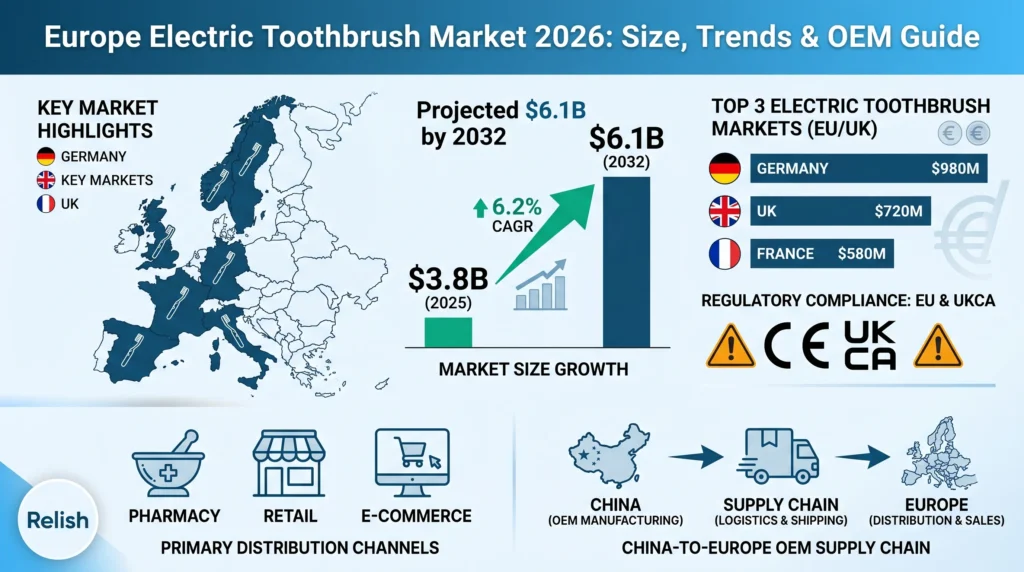
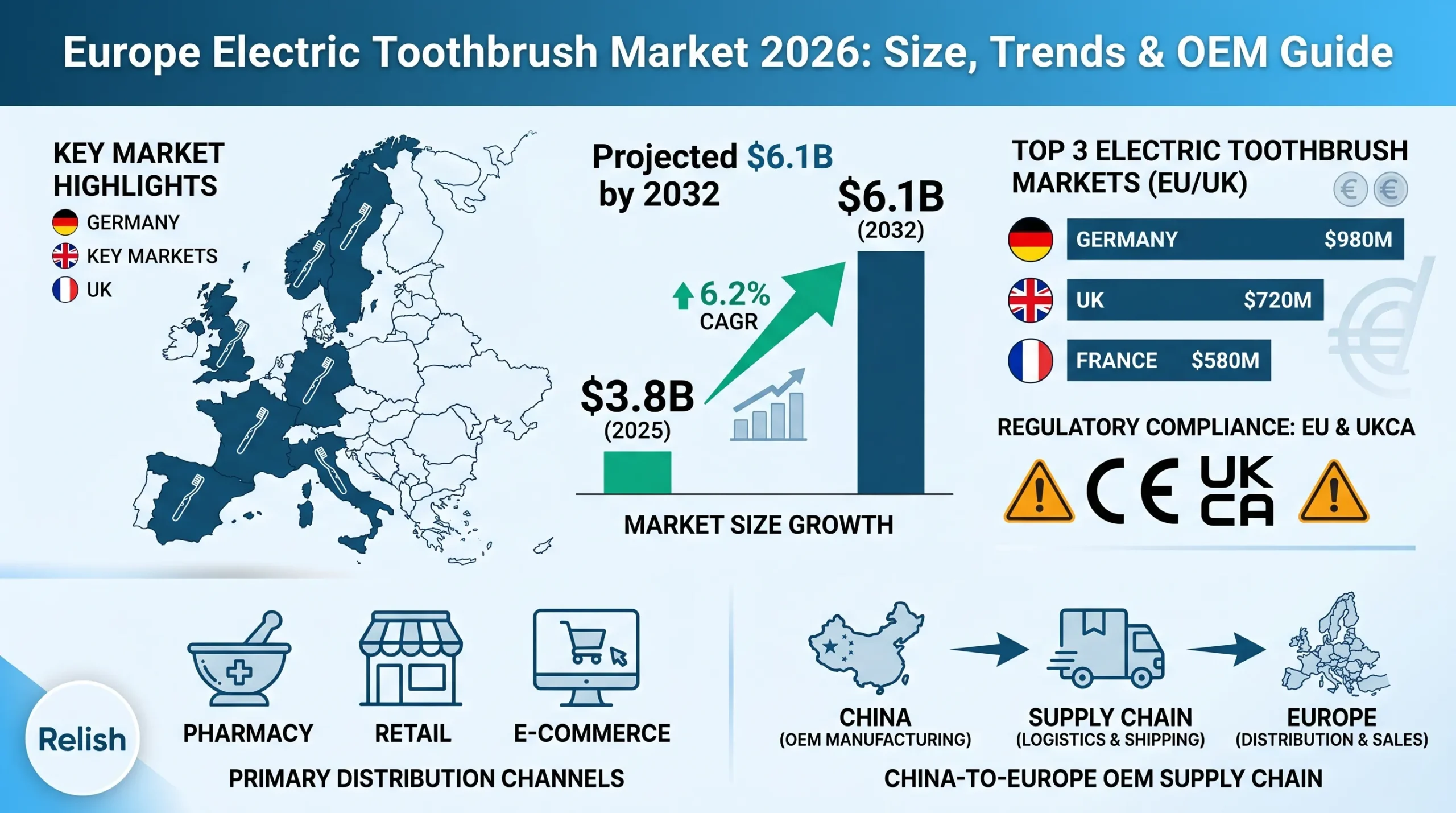
El mercado europeo de cepillos de dientes eléctricos representa una de las oportunidades de crecimiento más atractivas en la industria global de cuidado bucal. Según Mordor Intelligence (2025), el mercado fue valorado en aproximadamente $3.8 mil millones en 2025 y se proyecta que se expanda a una tasa de crecimiento anual compuesta (CAGR) del 6.2% hasta 2032, alcanzando más de $6.1 mil millones. Esta trayectoria de crecimiento posiciona a Europa como el segundo mercado regional más grande a nivel mundial, detrás de América del Norte pero por delante de Asia-Pacífico en términos de precios de venta promedio y penetración de productos premium.
Varios factores respaldan los sólidos fundamentos del mercado europeo de cepillos de dientes eléctricos. La alta conciencia del consumidor sobre la salud bucal, combinada con sistemas robustos de seguro dental en mercados clave como Alemania y Francia, crea una demanda sostenida de productos efectivos para el cuidado bucal. Los consumidores europeos muestran una fuerte preferencia por productos clínicamente validados, impulsando la adopción de cepillos de dientes eléctricos sobre alternativas manuales. La región también lidera las tendencias globales de sostenibilidad, con consumidores eco-conscientes que buscan productos premium que se alineen con los valores ambientales.
Para los fabricantes de equipos originales (OEM) que se abastecen desde China, el mercado europeo de cepillos de dientes eléctricos presenta tanto oportunidades significativas como requisitos regulatorios complejos. El tamaño y la trayectoria de crecimiento del mercado europeo de cepillos de dientes eléctricos lo convierten en una prioridad estratégica para los proveedores B2B. Comprender las dinámicas del mercado en los países europeos individuales, las vías de cumplimiento normativo y las preferencias de los canales de distribución es esencial para una entrada exitosa al mercado.
Para las marcas que se abastecen de cepillos de dientes eléctricos para el mercado europeo, los parámetros clave de suministro incluyen:
- Cantidad mínima de pedido: 500 unidades por SKU para modelos estándar de cepillos de dientes eléctricos
- Plazo de Entrega: 8–10 semanas de producción + 4–6 semanas de flete marítimo (Shenzhen → Róterdam/Hamburgo) + 2 semanas de despacho de aduana
- Capacidad de Producción: Instalación de 20,000 m² con más de 300 empleados, que admite producción paralela en múltiples líneas
- Control de Calidad: Sistema de Gestión de Calidad certificado ISO 13485:2016 con estándares de inspección AQL 1.5 (defectos mayores) / AQL 2.5 (defectos menores)
- Certificaciones: CE, UKCA, FDA, ISO 13485, BSCI, FSC
Para los equipos de abastecimiento OEM que evalúan el mercado europeo de cepillos de dientes eléctricos para 2026 y más allá, estas proyecciones de crecimiento reflejan una fuerte demanda subyacente en todos los segmentos de consumidores y canales de distribución. La siguiente sección desglosa las dinámicas específicas de cada país que dan forma a la estrategia de abastecimiento.
Análisis País por País
El mercado europeo de cepillos de dientes eléctricos no es monolítico: cada país presenta oportunidades distintas, matices regulatorios y preferencias de consumidores que las marcas OEM deben navegar cuidadosamente. A continuación, se presenta un desglose detallado de los seis mercados nacionales más grandes.
🇩🇪 Alemania
Alemania domina el mercado europeo de cepillos de dientes eléctricos con un estimado de $980 millones (Mordor Intelligence, 2025), impulsado por sólidos programas de reembolso de seguros dentales que compensan los costos del consumidor por productos premium de cuidado bucal. Los consumidores alemanes muestran una alta lealtad a la marca y preferencia por productos con validación clínica. El canal de farmacias (Apotheke) tiene una influencia significativa, con aproximadamente el 35% de los cepillos de dientes eléctricos premium vendidos a través de este canal.
🇬🇧 Reino Unido
Después del Brexit, el Reino Unido opera bajo los requisitos de marcado UKCA junto con las vías de certificación CE existentes. El mercado muestra una fuerte penetración del canal en línea, con Amazon UK representando más del 40% de las ventas de cepillos de dientes eléctricos (Statista, 2025). La preferencia del consumidor se inclina hacia cepillos de dientes inteligentes/conectados con integración de aplicaciones. Boots y Superdrug siguen siendo farmacias minoristas clave.
🇫🇷 Francia
El mercado de cepillos de dientes eléctricos en Francia se beneficia de una fuerte influencia del canal de farmacias, donde las parafarmacias impulsan aproximadamente el 30% de las ventas premium. Los consumidores franceses muestran un interés particular en la tecnología sónica y las características de sostenibilidad. El mercado ha experimentado un crecimiento acelerado después de las campañas de concienciación sobre la salud dental.
🇮🇹 Italia
Italia representa una oportunidad emergente con la tasa de crecimiento más alta entre los principales mercados europeos. La sensibilidad al precio sigue siendo un factor, ya que los consumidores italianos favorecen los productos de gama media sobre las alternativas premium. La distribución se concentra a través de grandes cadenas minoristas y canales de comercio electrónico en crecimiento. Las recomendaciones de profesionales dentales influyen significativamente en las decisiones de compra.
🇸🇪 Escandinavia
Los países nórdicos demuestran patrones de adopción impulsados por la sostenibilidad, con consumidores que favorecen fuertemente los productos con certificación ecológica y los sistemas recargables. Los precios premium son bien aceptados, y la penetración de mercado de los cepillos de dientes eléctricos supera el 45% de los hogares (Mordor Intelligence, 2025). Apotek Hjärtat (Suecia) y Apotek (Noruega) son actores clave en el canal de farmacias.
🇪🇸 España
España muestra el mayor potencial de crecimiento entre los mercados de Europa Occidental, impulsado por el aumento del ingreso disponible de la clase media y una mayor concienciación sobre la salud dental. El mercado sigue estando menos penetrado en comparación con sus equivalentes del norte de Europa, lo que presenta una oportunidad significativa para las marcas. Cadenas de farmacias como Farmacia tienen una influencia creciente.
Entorno Regulatorio en Europa
Requisitos de Marcado CE
Para los proveedores OEM que ingresan al mercado europeo de cepillos de dientes eléctricos, el cumplimiento normativo representa el primer paso crítico. Los cepillos de dientes eléctricos vendidos en el Espacio Económico Europeo (EEE) deben llevar el marcado CE, que indica conformidad con las directivas y regulaciones aplicables de la UE. Para los cepillos de dientes eléctricos, los marcos regulatorios principales incluyen:
Directiva de Baja Tensión (2014/35/UE): Se aplica a productos que operan dentro de límites de voltaje de 50-1000V CA o 75-1500V CC. La mayoría de los cepillos de dientes eléctricos se encuentran dentro de este alcance debido a sus sistemas de carga de batería. El cumplimiento requiere documentación técnica, evaluación de riesgos y evaluación de conformidad a través de autocertificación o participación de un organismo notificado según la clasificación del producto.
Directiva de Compatibilidad Electromagnética (CEM) 2014/30/UE: Exige que los cepillos de dientes eléctricos no causen interferencias electromagnéticas excesivas y puedan funcionar según lo previsto en entornos con niveles de interferencia esperados. Las pruebas CEM verifican las emisiones radiadas, las emisiones conducidas, la inmunidad a descargas electrostáticas y otros fenómenos electromagnéticos.
Reglamento de la UE sobre Productos Sanitarios (MDR 2017/745)
Si los cepillos de dientes eléctricos se comercializan con afirmaciones médicas, como beneficios terapéuticos, reducción de placa más allá de la limpieza normal o tratamiento de afecciones dentales específicas, pueden clasificarse como productos sanitarios según el MDR 2017/745 de la UE. Esta clasificación aumenta significativamente los requisitos de cumplimiento, incluyendo:
- Registro obligatorio en la base de datos EUDAMED
- Documentación técnica que cumpla con los requisitos del Anexo II y III del MDR
- Informes de evaluación clínica que respalden los beneficios reclamados
- Obligaciones de vigilancia poscomercialización
- Posible requisito de participación de un organismo notificado en la evaluación de conformidad
Para fabricantes OEM y marcas, es esencial prestar atención cuidadosa a las afirmaciones de marketing y al posicionamiento para evitar una clasificación MDR no deseada. Los productos posicionados como dispositivos de bienestar general sin afirmaciones médicas generalmente pueden evitar los requisitos de productos sanitarios.
Etiqueta Ecológica de la UE y Afirmaciones Ecológicas
Los requisitos emergentes de la Etiqueta Ecológica de la UE para productos de cuidado bucal, combinados con la Directiva de Afirmaciones Ecológicas de la UE, crean nuevas consideraciones de cumplimiento para el marketing relacionado con la sostenibilidad. Las afirmaciones sobre reciclabilidad, compostabilidad o beneficios ambientales requieren una justificación mediante evidencia verificada. Para más detalles sobre enfoques de fabricación sostenible, consulte nuestra guía sobre tendencias del mercado de cuidado bucal sostenible.
Normas de Seguridad sobre CEM
Los cepillos de dientes eléctricos están sujetos a límites de exposición a CEM (campos electromagnéticos) según las recomendaciones de la UE. Las pruebas de cumplimiento verifican que las emisiones electromagnéticas se mantengan por debajo de los niveles que podrían suponer riesgos para la salud de los usuarios. Si bien los cepillos de dientes eléctricos suelen funcionar muy por debajo de los umbrales de preocupación, la documentación de las pruebas CEM brinda garantía a los consumidores preocupados por la salud.
Directiva RAEE para Componentes Electrónicos
La Directiva sobre Residuos de Aparatos Eléctricos y Electrónicos (RAEE) responsabiliza a los productores de la gestión de productos al final de su vida útil. Los fabricantes de cepillos de dientes eléctricos deben registrarse en cada estado miembro de la UE donde comercialicen productos, contribuir a los sistemas de recogida y reciclaje, y cumplir con las tasas objetivo de reciclaje. Los componentes de baterías están sujetos a requisitos adicionales de la Directiva de Baterías.
El Reino Unido posterior al Brexit requiere un marcado UKCA (Evaluación de Conformidad del Reino Unido) independiente, además del marcado CE, para los productos vendidos en Gran Bretaña. Presupueste entre £2,000 y £8,000 adicionales para pruebas específicas de UKCA si se dirige al mercado británico. Irlanda del Norte sigue los requisitos de marcado UKNI que difieren tanto del CE como del UKCA. Planifique plazos de certificación de 12 a 16 semanas tanto para el marcado CE como para el UKCA.
Canales de Distribución en Europa
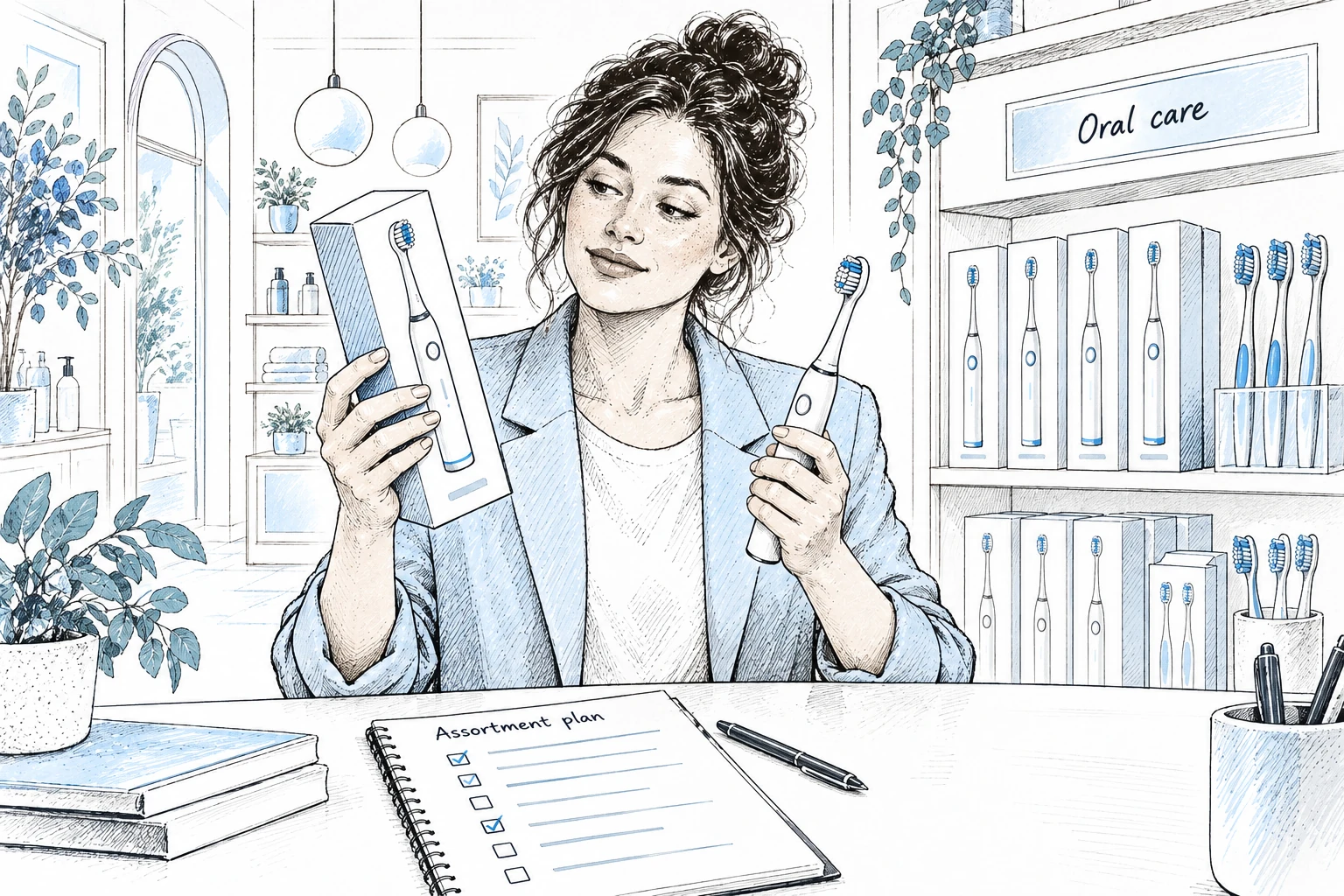
Farmacia y Parafarmacia
El canal de farmacia tiene una importancia particular en los mercados europeos de cepillos de dientes eléctricos, especialmente en Alemania y Francia, donde aproximadamente el 30-35% de los productos premium se venden a través de esta ruta. En estos mercados, los farmacéuticos y parafarmacéuticos brindan recomendaciones de confianza que influyen significativamente en las decisiones de compra. Las marcas que buscan colocación en farmacias generalmente requieren eficacia clínica demostrada, avales profesionales y, a veces, autorizaciones regulatorias específicas.
Las principales cadenas de farmacias minoristas incluyen dm-drogerie markt (Alemania), Boots (Reino Unido), Pharmacie y Parapharmacie (Francia) y Apotek Hjärtat (Escandinavia). Estos minoristas a menudo mantienen estrictos requisitos de calificación de proveedores, incluyendo certificaciones de sostenibilidad, documentación de abastecimiento ético y verificación del sistema de gestión de calidad.
Venta Minorista Masiva
La venta minorista masiva representa el canal de distribución más grande en volumen, incluyendo hipermercados, supermercados y minoristas de descuento. Los actores clave incluyen Carrefour (Francia/España), Tesco (Reino Unido), Auchan (Francia) y El Corte Inglés (España). La colocación en el mercado masivo generalmente requiere precios competitivos, un sólido apoyo de marketing comercial y capacidades eficientes en la cadena de suministro para respaldar los requisitos de reposición minorista.
Los cepillos de dientes eléctricos de marca blanca han ganado una cuota de mercado significativa en los canales de mercado masivo, con minoristas como Carrefour O! y productos de marca propia de Tesco capturando el 15-20% del volumen en algunos mercados (Euromonitor International, 2024). Esta tendencia crea tanto competencia para productos de marca como oportunidades de asociación OEM para minoristas que buscan alternativas de marca.
Comercio Electrónico
Los canales en línea continúan ganando participación en el mercado europeo de cepillos de dientes eléctricos, siendo Amazon EU la plataforma dominante. Los programas paneuropeos de cumplimiento de Amazon (Fulfillment by Amazon) simplifican la logística transfronteriza, pero la competencia por visibilidad en la plataforma requiere una fuerte optimización de búsqueda e inversión en publicidad. Las plataformas regionales de comercio electrónico incluyen Zalando (expandiéndose hacia la salud), farmacias en línea y plataformas específicas de cada país como Bol.com (Países Bajos/Bélgica).
Canal de Profesionales Dentales
El canal de recomendación de profesionales dentales, aunque de menor volumen, tiene una influencia desproporcionada en el posicionamiento de marcas premium en el mercado europeo de cepillos de dientes eléctricos. Los profesionales dentales en Alemania, Austria y Suiza recomiendan con frecuencia marcas específicas, y su respaldo influye significativamente en las compras de los pacientes. Los estudios clínicos publicados en revistas dentales y los respaldos de asociaciones profesionales brindan credibilidad que respalda el posicionamiento en farmacias y canales premium.
Preferencias del Consumidor en Europa
Tecnología Sónica vs. Rotación-Oscilación
Las preferencias tecnológicas varían significativamente en el mercado europeo de cepillos de dientes eléctricos. Los cepillos sónicos dominan en Alemania, Países Bajos y los países escandinavos, donde los consumidores asocian la tecnología con una limpieza suave y una ingeniería avanzada. La tecnología de rotación-oscilación mantiene una fuerte preferencia en Francia y el Reino Unido, donde marcas como Oral-B han establecido un liderazgo de mercado a través de este enfoque tecnológico.
Los mercados italiano y español no muestran una preferencia tecnológica dominante, compitiendo ambos enfoques de manera efectiva. Como tendencia general, los consumidores en toda Europa muestran un interés creciente en sensores de presión, múltiples modos de cepillado y características específicas para blanqueamiento, independientemente de la tecnología subyacente.
Expectativas de Sostenibilidad
En el mercado europeo de cepillos de dientes eléctricos, los consumidores esperan cada vez más credenciales de sostenibilidad en los productos premium de cuidado bucal. Las expectativas clave incluyen envases reciclables con identificación clara de materiales, contenido de plástico reducido en comparación con alternativas convencionales, abastecimiento de materiales sostenibles (bambú certificado FSC, plásticos reciclados) y documentación de huella de carbono o programas de compensación para productos premium.
Para las marcas que se dirigen a los mercados escandinavo y alemán, las credenciales de sostenibilidad son prácticamente un requisito básico para el posicionamiento premium. Obtenga más información sobre nuestras iniciativas de sostenibilidad y prácticas de fabricación ecológicas. Para obtener más información sobre enfoques de fabricación sostenible de cuidado bucal, consulte nuestro análisis de materiales ecológicos y soluciones OEM.
Adopción de Cepillos de Dientes Inteligentes/Conectados
Los cepillos de dientes eléctricos conectados a aplicaciones han capturado aproximadamente el 18% del mercado europeo de cepillos de dientes eléctricos, con tasas de adopción más altas en el Reino Unido (25%) (Grand View Research, 2025) y más bajas en los mercados del sur de Europa (10-12%). Los casos de uso principales incluyen retroalimentación de cepillado en tiempo real, gamificación para la salud bucal infantil e integración con aplicaciones más amplias de seguimiento de salud.
Las preocupaciones de los consumidores sobre la privacidad de los datos y la complejidad de las aplicaciones moderan la adopción entre los grupos demográficos de mayor edad. Las marcas exitosas en este segmento ofrecen aplicaciones intuitivas con políticas de privacidad claras y funciones de conectividad opcionales (no obligatorias).
Sensibilidad al Precio vs. Premiumización
Los mercados europeos de cepillos de dientes eléctricos muestran una pronunciada tendencia hacia la premiumización, con consumidores cada vez más dispuestos a invertir en productos de mayor calidad con funciones avanzadas. Esta tendencia es más notable en Alemania y Escandinavia, donde los precios de venta promedio continúan aumentando. Sin embargo, los mercados del sur de Europa siguen siendo más sensibles al precio, con una fuerte demanda de productos en el rango de 30-60 € en lugar de ofertas premium de más de 100 €.
¿Necesita fabricación de cepillos de dientes eléctricos con certificación CE?
Obtenga un presupuesto personalizado para la producción OEM de cepillos de dientes eléctricos para el mercado europeo, que incluye documentación CE, compatibilidad con 230 V/50 Hz y soporte para embalaje multilingüe.
Solicitar un PresupuestoEstrategia de Abastecimiento OEM para el Mercado Europeo
Ruta de Certificación CE para Fabricantes Chinos
Obtener el marcado CE a través de un socio de fabricación en China requiere un enfoque sistemático. El proceso generalmente implica la preparación de un expediente técnico (que incluye descripción del producto, especificaciones de diseño, evaluación de riesgos e informes de prueba), la identificación de directivas aplicables y normas armonizadas, pruebas a través de laboratorios reconocidos por la UE, y la preparación de la Declaración de Conformidad y la documentación del marcado CE.
Para obtener una guía detallada sobre los requisitos de certificación CE para dispositivos de cuidado bucal, consulte nuestra guía completa sobre certificación CE para cepillos de dientes eléctricos.
Trabajar con un organismo notificado experimentado o un representante autorizado de la UE acelera el proceso de certificación para las empresas que se dirigen al mercado europeo de cepillos de dientes eléctricos. Los plazos típicos oscilan entre 8 y 14 semanas para la certificación CE estándar de cepillos de dientes eléctricos, con tiempo adicional si es necesario cumplir con el MDR de la UE. Las consideraciones presupuestarias deben incluir tarifas de prueba, tarifas del organismo de certificación, costos del representante autorizado y el mantenimiento continuo del cumplimiento.
Compatibilidad de Voltaje
Los productos para el mercado europeo deben funcionar a 230 V/50 Hz, el suministro eléctrico estándar en todos los estados miembros de la UE y muchos otros países. Las bases de carga y los transformadores deben diseñarse para esta especificación. Los productos para el Reino Unido requieren una configuración de enchufe BS 1363, que difiere de los enchufes Schuko (Tipo F) de la UE o franceses (Tipo E). Los productos multirregión pueden incorporar adaptadores de enchufe intercambiables, pero aún deben cumplir con los requisitos de voltaje/frecuencia para cada mercado objetivo.
Requisitos de Idioma y Etiquetado
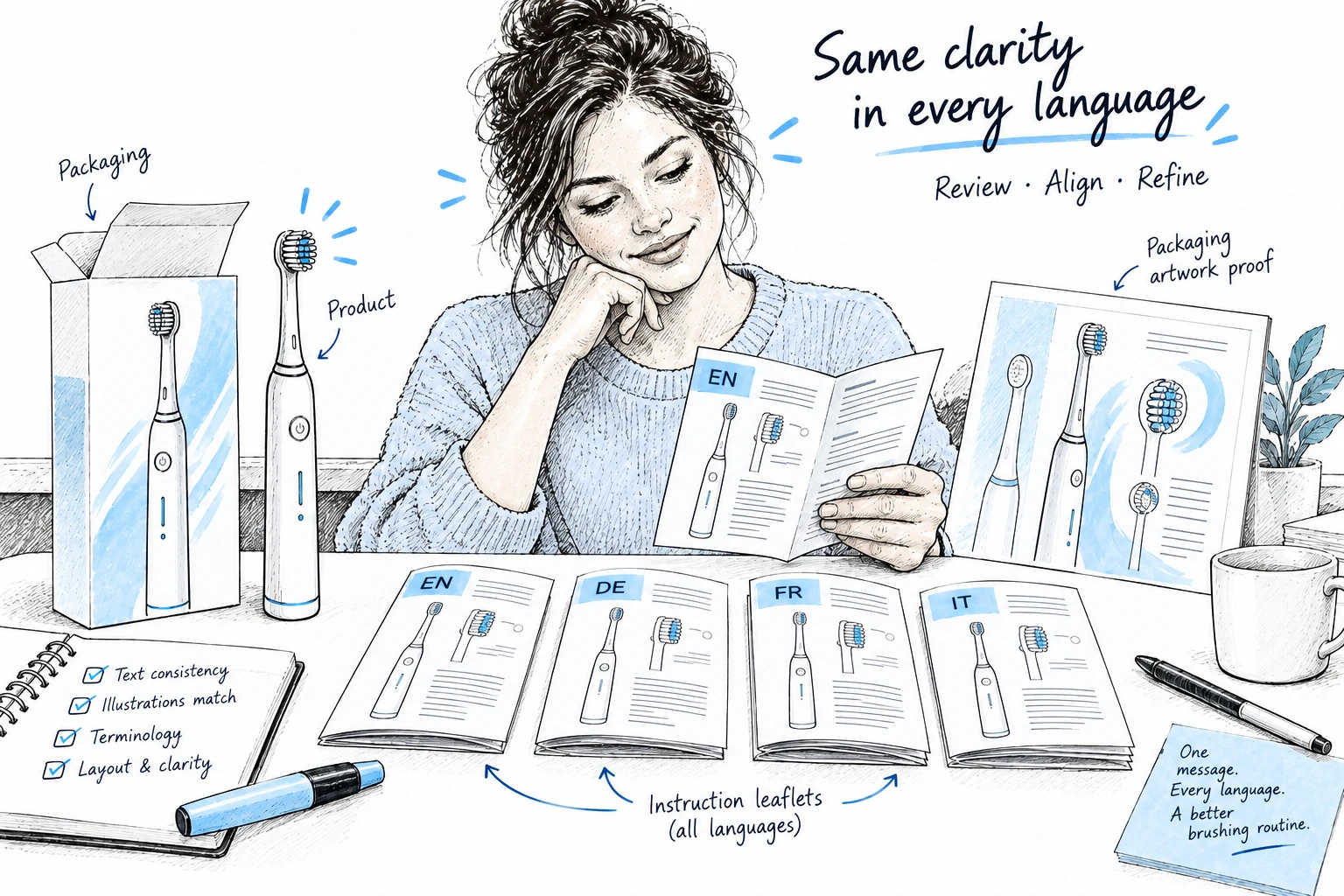
El embalaje del producto y las instrucciones deben estar disponibles en el idioma o idiomas oficiales de cada estado miembro de la UE donde se venda el producto. Este requisito impacta significativamente la complejidad del embalaje para las marcas que buscan una distribución paneuropea en el mercado de cepillos de dientes eléctricos europeo. Los insertos de embalaje multilingües son comunes, y a veces se requieren SKU de embalaje separados para requisitos minoristas específicos de cada país.
La información requerida generalmente incluye el nombre y modelo del producto, detalles del fabricante e importador (se requiere una persona responsable en la UE para fabricantes no pertenecientes a la UE), instrucciones de funcionamiento, advertencias de seguridad, especificaciones eléctricas y marcado WEEE/símbolo para información de eliminación.
Consideraciones sobre el Plazo de Entrega
Las cadenas de suministro minoristas del mercado europeo de cepillos de dientes eléctricos suelen operar con ciclos de pedido de 8 a 12 semanas con ajustes estacionales para los períodos de regreso a clases y festivos. El plazo de entrega desde la fabricación en China hasta el almacén europeo generalmente agrega de 4 a 6 semanas, incluido el envío (flete marítimo desde Shenzhen hasta puertos europeos) y el despacho de aduanas. El plazo de entrega total desde la realización del pedido hasta la disponibilidad minorista se desglosa en 8–10 semanas de fabricación, 4–6 semanas de flete marítimo (Shenzhen a puertos europeos) y 2 semanas de despacho de aduanas, totalizando de 14 a 18 semanas para nuevas introducciones de productos.
El flete aéreo reduce el tiempo de tránsito a 1-2 semanas, pero aumenta significativamente los costos; es adecuado para pedidos de stock inicial o inventario promocional, pero insostenible para el reabastecimiento regular. Las marcas deben planificar las posiciones de inventario con 4-5 meses de anticipación a la demanda esperada, teniendo en cuenta los plazos de certificación, la programación de la producción y el tránsito logístico.
Cómo Relish Tech Apoya la Entrada al Mercado Europeo
Relish Tech opera una instalación de fabricación de 20,000 m² con más de 300 empleados y un sistema de gestión de calidad certificado ISO 13485, que respalda la entrada al mercado europeo de cepillos de dientes eléctricos para marcas OEM. Nuestras instalaciones de fabricación mantienen la documentación de cumplimiento CE y pueden coordinar las pruebas a través de laboratorios reconocidos de la UE. Trabajamos con representantes autorizados establecidos en la UE para cumplir con los requisitos de los fabricantes no pertenecientes a la UE que colocan productos en el mercado europeo.
Nuestro equipo de ingeniería desarrolla productos específicamente para el mercado europeo de cepillos de dientes eléctricos, incluida la compatibilidad de carga de 230 V/50 Hz, soporte de etiquetado multilingüe y documentación de cumplimiento WEEE. Mantenemos relaciones con proveedores de componentes aprobados por minoristas europeos para materiales que requieren certificaciones específicas. Explore nuestro portafolio completo de certificaciones, que incluye credenciales FDA, CE e ISO 13485.
Para las marcas interesadas en un posicionamiento de producto sostenible, nuestras capacidades de fabricación de bambú certificado FSC y plástico reciclado GRS respaldan las expectativas de sostenibilidad europeas. Ofrecemos opciones de mangos de bambú certificado FSC, componentes de plástico reciclado y documentación de apoyo para solicitudes de la Etiqueta Ecológica de la UE. Para obtener más información sobre nuestras capacidades de fabricación y enfoque en el mercado europeo, explore nuestros servicios de fabricación OEM.
Nuestro SGC certificado ISO 13485:2016 con protocolos de inspección AQL 1.5/2.5 proporciona la base documental para el cumplimiento normativo del mercado europeo de cepillos de dientes eléctricos. Para una visión general detallada de los procesos de fabricación OEM, consulte nuestra guía de fabricación de cepillos de dientes eléctricos OEM/ODM y los procesos de calificación de proveedores minoristas. Ofrecemos una preparación integral de archivos de cumplimiento, que incluye documentación técnica, evaluaciones de riesgos y coordinación de informes de prueba.
| País | Tamaño del Mercado | Tasa de Crecimiento | Canal Clave | Consideraciones Especiales |
|---|---|---|---|---|
| Alemania | $980M | 5.8% | Farmacia (Apotheke) | Los sistemas de reembolso favorecen la gama premium |
| Reino Unido | $720M | 5.5% | Comercio Electrónico (Amazon UK) | Marcado UKCA requerido |
| Francia | $580M | 6.8% | Para-farmacia | Fuerte preferencia por tecnología sónica |
| Italia | $340M | 7.2% | Venta masiva + Comercio electrónico | Mercado sensible al precio |
| Escandinavia | $420M | 5.2% | Cadenas de farmacias | Adopción impulsada por la sostenibilidad |
| España | $290M | 7.8% | Venta al por mayor | Alto potencial de crecimiento |
Conclusiones clave
Para marcas y OEMs que evalúan el mercado europeo de cepillos de dientes eléctricos, aquí están los conocimientos esenciales de este análisis:
- El mercado europeo de cepillos de dientes eléctricos alcanzará $6.1B para 2032, con un crecimiento CAGR del 6.2% impulsado por la premiumización y la adopción de dispositivos inteligentes
- Alemania sigue siendo el mercado nacional más grande dentro del mercado europeo de cepillos de dientes eléctricos, pero España e Italia muestran las tasas de crecimiento más altas y oportunidades de penetración en el mercado
- Los canales de farmacia y parafarmacia tienen una influencia desproporcionada en Alemania y Francia, lo que requiere estrategias de comercialización adaptadas
- El marcado CE requiere cumplimiento con la Directiva de Baja Tensión, la Directiva EMC y potencialmente el MDR de la UE para productos con declaraciones médicas
- El marcado UKCA es un requisito separado para Gran Bretaña, añadiendo £2,000-8,000 y 4-6 semanas a los plazos de certificación
- Las credenciales de sostenibilidad influyen cada vez más en las decisiones de compra de los consumidores europeos, particularmente en los mercados del norte de Europa
- El etiquetado multilingüe y los requisitos de representante autorizado en la UE añaden complejidad para los fabricantes con sede en China que ingresan a Europa
- El tiempo total de entrega desde el pedido hasta la disponibilidad minorista generalmente abarca de 12 a 18 semanas, lo que requiere una planificación anticipada de la producción
¿Listo para ingresar al mercado europeo?
Ya sea que esté lanzando una nueva marca o expandiendo líneas de productos existentes, el mercado europeo de cepillos de dientes eléctricos ofrece oportunidades de crecimiento sustanciales. Asóciese con Relish Tech para la fabricación de cepillos de dientes eléctricos conformes con CE, adaptada al mercado europeo de cepillos de dientes eléctricos y sus requisitos regulatorios.
Contacte a Nuestro EquipoPreguntas frecuentes
¿Cuál es el tamaño actual y la tasa de crecimiento del mercado europeo de cepillos de dientes eléctricos?
El mercado europeo de cepillos de dientes eléctricos está valorado en aproximadamente $3.8 mil millones en 2025 y se proyecta que crecerá a una CAGR del 6.2% hasta 2032, alcanzando más de $6.1 mil millones. Alemania lidera con $980M, seguida del Reino Unido ($720M), Francia ($580M), Escandinavia ($420M), Italia ($340M) y España ($290M).
¿Qué país europeo tiene el mercado más grande de cepillos de dientes eléctricos?
Alemania es el mercado más grande de cepillos de dientes eléctricos en Europa, valorado en aproximadamente $980 millones. Esta posición de liderazgo está impulsada por sólidos programas de reembolso de seguros dentales, alta conciencia del consumidor sobre la salud bucal y el influyente canal de farmacia (Apotheke) que representa aproximadamente el 35% de las ventas de cepillos de dientes eléctricos premium.
¿Qué requisitos de certificación CE se aplican a los cepillos de dientes eléctricos vendidos en Europa?
Los cepillos de dientes eléctricos requieren marcado CE bajo la Directiva de Baja Tensión (2014/35/UE) para productos que operan a 50-1000V CA o 75-1500V CC, la Directiva EMC (2014/30/UE) para compatibilidad electromagnética, y potencialmente el MDR de la UE 2017/745 si se comercializan con declaraciones médicas. Los productos deben tener documentación técnica, evaluaciones de riesgos, informes de prueba y una Declaración de Conformidad de la UE.
¿Qué estándar de voltaje se aplica a los cepillos de dientes eléctricos en Europa?
El voltaje estándar europeo es 230V CA a 50Hz, aplicable en todos los estados miembros de la UE. Los productos deben diseñarse para esta especificación, incluyendo bases de carga y transformadores. El Reino Unido requiere 230V/50Hz con enchufes BS 1363 para productos de consumo. Los productos destinados a la venta en múltiples mercados deben incorporar adaptadores de enchufe intercambiables mientras cumplen con los requisitos de voltaje/frecuencia.
¿Cuánto tiempo suele tomar certificar un cepillo de dientes eléctrico para el mercado europeo?
La certificación CE estándar para cepillos de dientes eléctricos generalmente toma de 8 a 14 semanas, incluyendo pruebas y preparación de documentación. Si se requiere cumplimiento con el MDR de la UE para la clasificación de dispositivos médicos, agregue de 4 a 8 semanas. La certificación UKCA requiere pruebas adicionales (presupuesto de £2,000-£8,000) y de 4 a 6 semanas adicionales. La planificación total del cronograma de certificación debe considerar de 12 a 16 semanas.
¿Cuáles son los canales de distribución clave para los cepillos de dientes eléctricos en Europa?
Los canales de distribución clave incluyen farmacia y parafarmacia (críticos en Alemania y Francia, impulsando el 30-35% de las ventas premium), venta minorista de mercado masivo (Carrefour, Tesco, dm-drogerie markt), comercio electrónico (Amazon EU domina con una participación del 40%+ en algunos mercados) y canales de recomendación de profesionales dentales que influyen en el posicionamiento premium.
Referencias
- Mordor Intelligence. (2025). Mercado Europeo de Cepillos de Dientes Eléctricos — Crecimiento, Tendencias y Pronósticos (2025–2030). https://www.mordorintelligence.com/industry-reports/europe-electric-toothbrush-market
- Comisión de la UE. (2024). Directiva de Baja Tensión 2014/35/UE. Diario Oficial de la Unión Europea. https://ec.europa.eu
- Comisión de la UE. (2024). Directiva de Compatibilidad Electromagnética 2014/30/UE. Marco regulatorio para el cumplimiento de CEM. https://ec.europa.eu
- Comisión de la UE. (2024). Reglamento de Dispositivos Médicos (UE) 2017/745. Requisitos para la clasificación y cumplimiento de dispositivos médicos. https://health.ec.europa.eu
- GOV.UK. (2025). Guía de Marcado UKCA. Requisitos para productos vendidos en Gran Bretaña después del Brexit. https://www.gov.uk/guidance/ukca-marking
- Statista. (2025). Ventas de Cepillos de Dientes Eléctricos por Canal — Reino Unido. https://www.statista.com
- Grand View Research. (2025). Tamaño del Mercado de Cepillos de Dientes Inteligentes, Participación y Análisis de Tendencias. https://www.grandviewresearch.com