


OEM vs ODM vs OBM: Complete Guide for Oral Care Brands (2026)
OEM vs ODM vs OBM are three manufacturing models for oral care brands: OEM (Original Equipment Manufacturing) means you own the product design and the factory manufactures to your specs — ideal for established brands seeking differentiation. ODM (Original Design Manufacturing) means the factory provides existing designs you customize with your branding — perfect for startups with lower budgets and faster timelines. OBM (Original Brand Manufacturing) means the factory sells products under its own brand. Most new oral care brands start with ODM (500–1,000 MOQ, 8–12 weeks) and transition to OEM as they grow.
Executive Summary: Quick Fact Sheet
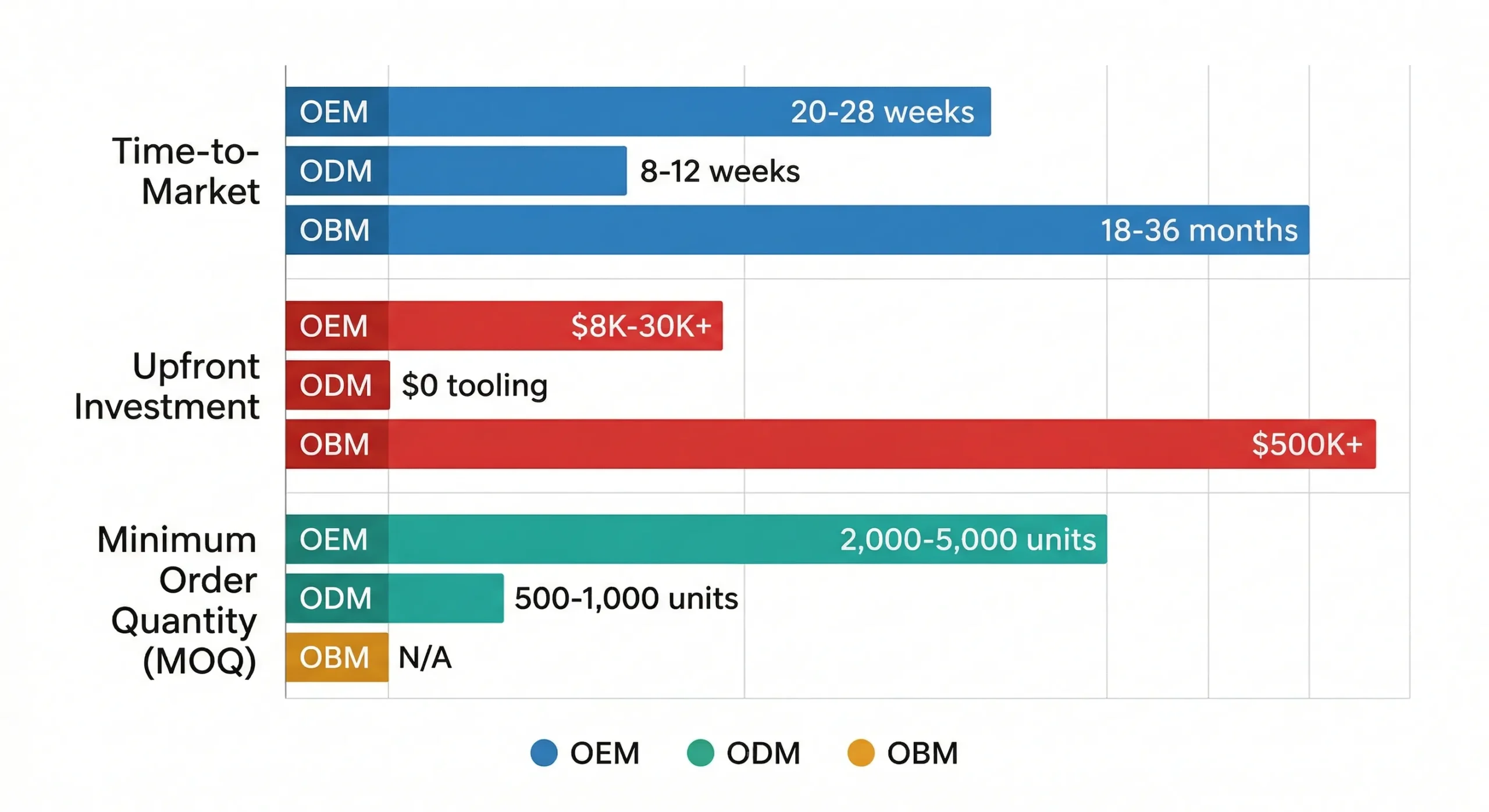
- OEM (Original Equipment Manufacturing): Best for established oral care brands needing 100% design IP ownership. Requires custom mold investments ($8,000–$30,000+), higher MOQs (2,000–5,000 units), and 20–28 weeks time-to-market.
- ODM (Original Design Manufacturing): Ideal strategy for startups and fast market entry. Utilizes pre-engineered, pre-certified factory platforms (e.g., CE, FCC, FDA). Features $0 tooling costs, low MOQs (500–1,000 units), and rapid delivery in 8–12 weeks.
- OBM (Original Brand Manufacturing): Occurs when the manufacturer produces and sells consumer oral care products under its own proprietary brand.
- Strategic Growth Path: Most successful B2B buyers launch their private label with an ODM model to minimize capital risk and validate the market, later transitioning to custom OEM manufacturing with Relish Technology once volume scales.
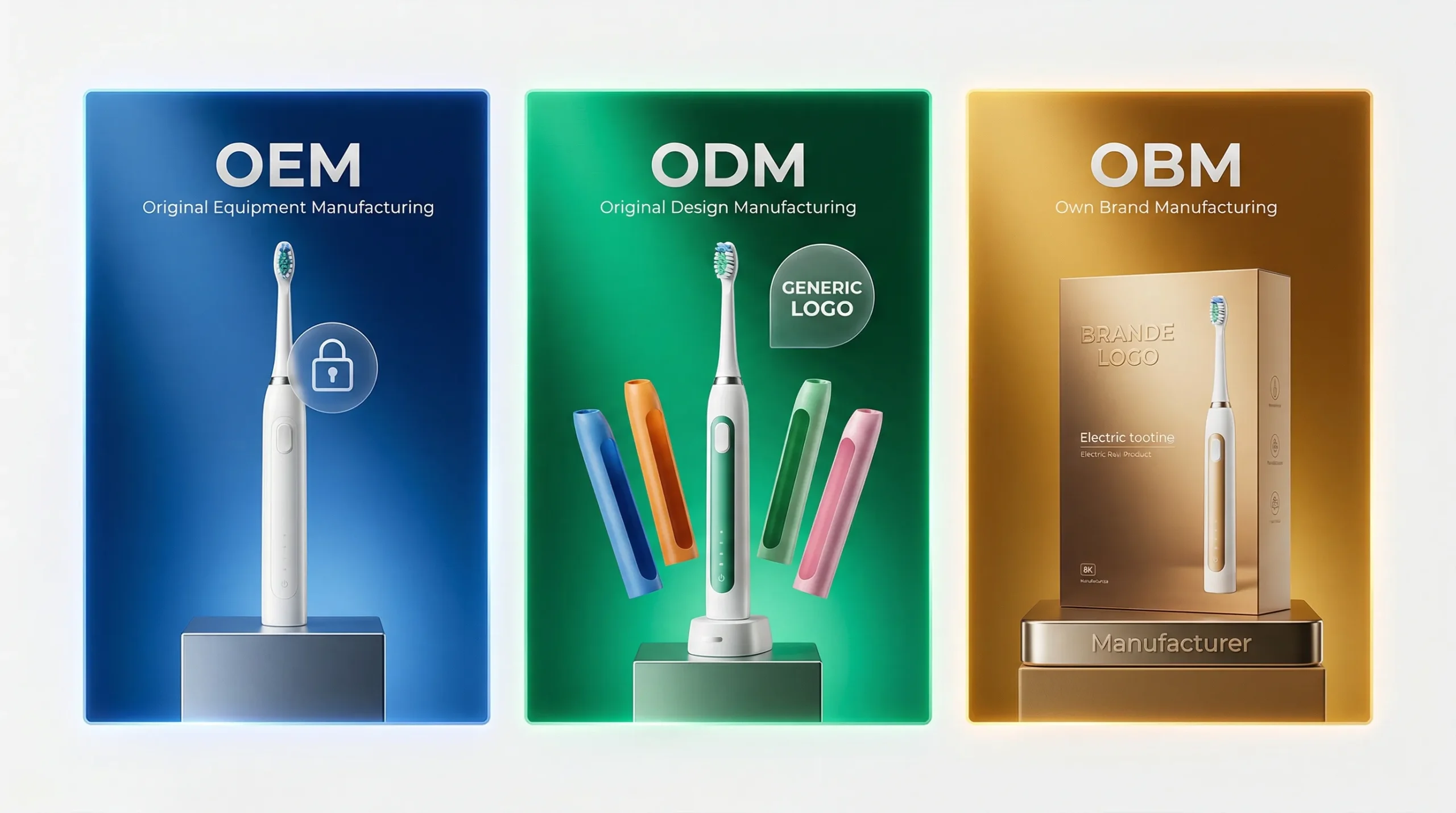
Table of Contents
- What Are OEM, ODM, and OBM?
- Side-by-Side Comparison
- OEM Deep Dive: Pros, Cons & When to Use It
- ODM Deep Dive: Pros, Cons & When to Use It
- OBM Deep Dive: The Manufacturer's Brand Path
- Which Model Is Right for You? Decision Framework
- The Typical Brand Journey: ODM → OEM → OBM
- Why This Matters Specifically for Oral Care
- 常见问题
1. What Are OEM, ODM, and OBM?
These three acronyms describe three fundamentally different relationships between a brand and a manufacturer. Understanding them isn't just an academic exercise — your choice determines your upfront investment, how fast you can launch, and how much control you have over your product.
Original Equipment Manufacturing
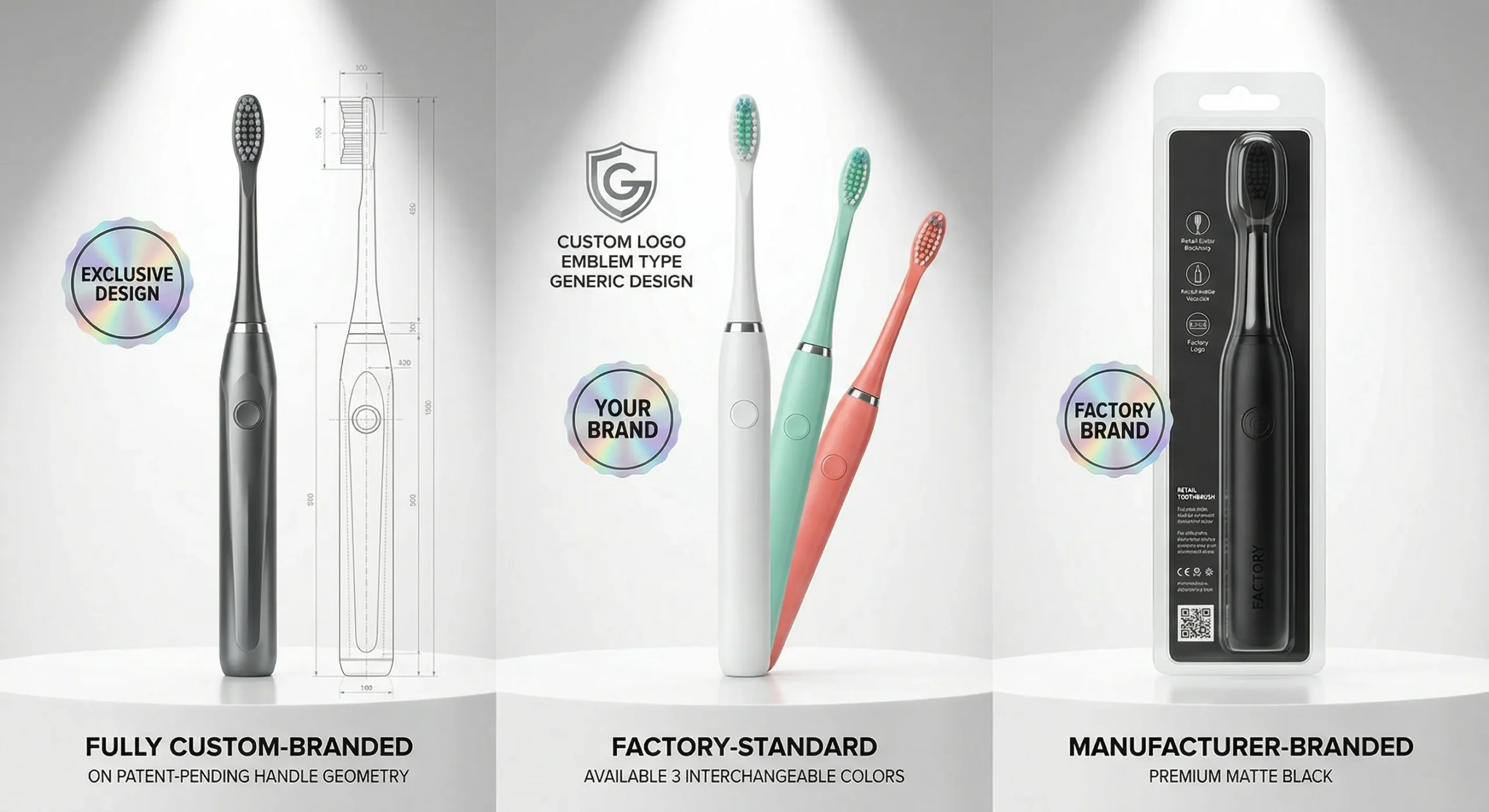
You own the design. The factory manufactures exactly to your specifications — your molds, your electronics, your formulations. You bring the IP; they bring the factory.
Original Design Manufacturing
The factory owns the design. They've already engineered a product — you choose a model, customize the color, logo, and packaging, and sell it as your brand. Faster, cheaper, less differentiated.
Original Brand Manufacturing
The manufacturer builds its own brand. They design, produce, and market products under their own name, competing directly with their OEM/ODM clients in some cases.
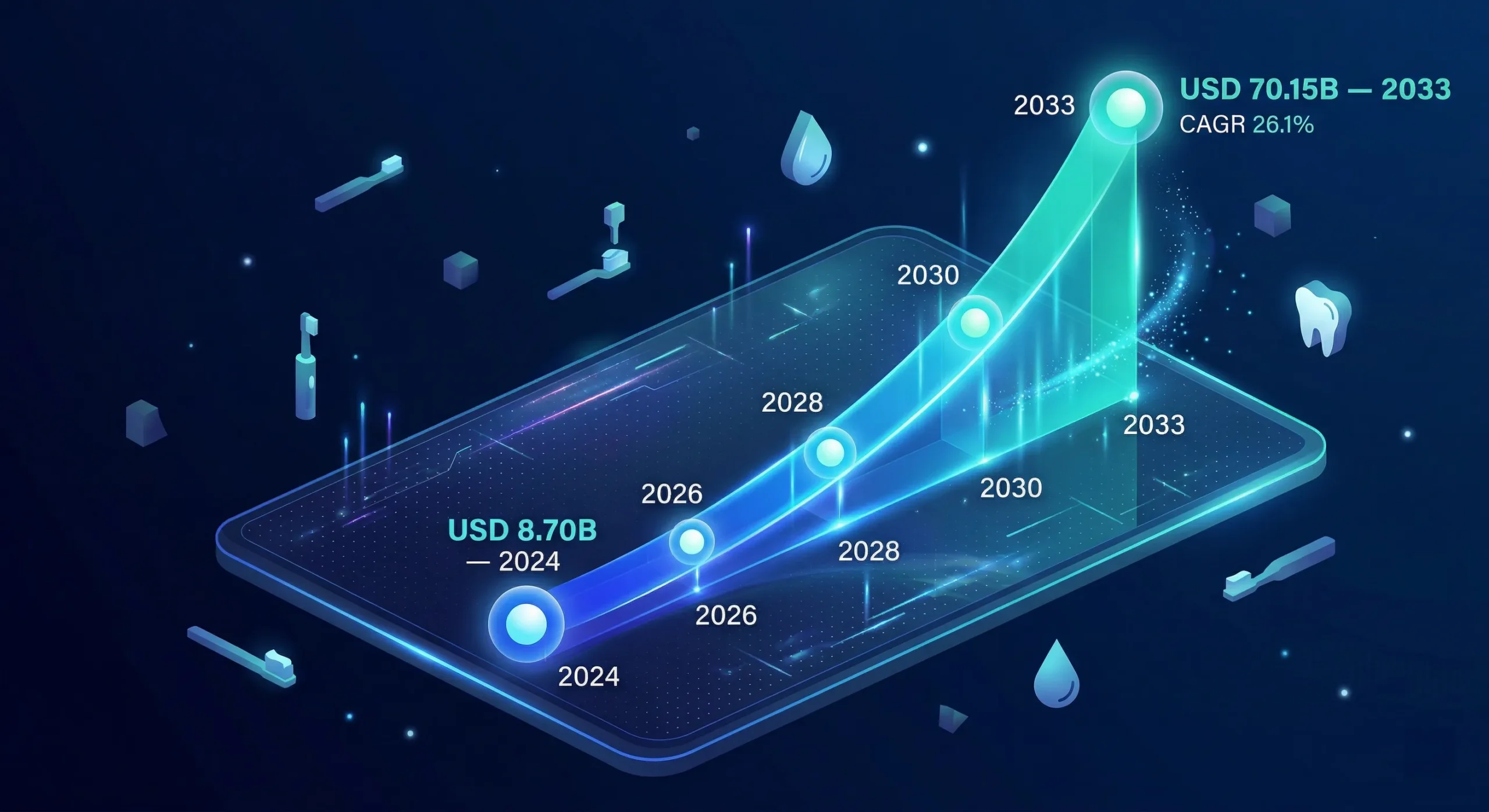
The global electric toothbrush market was valued at USD 8.70 billion in 2024 and is projected to reach USD 70.15 billion by 2033, registering a CAGR of 26.1% during the forecast period (2025–2033) [1]. This growth is driven by increasing awareness of oral hygiene and rising disposable incomes in emerging markets.
According to the American Dental Association (ADA), both manual and powered toothbrushes can be used effectively for oral care [2]. The ADA recommends brushing teeth twice a day for two minutes with a soft-bristled toothbrush — a standard that drives consumer preference for quality electric toothbrushes.
The World Health Organization (WHO) emphasizes that oral health is a critical component of overall health, with oral diseases affecting nearly 3.5 billion people globally [3]. This widespread awareness fuels demand for advanced oral care products, including electric toothbrushes.
📋 About the Manufacturer: Relish Technology
This guide is authored by 深圳市瑞立视科技有限公司., a professional OEM/ODM manufacturer with over 10 years of experience in the oral care industry. Our manufacturing capabilities include:
- Factory footprint: 20,000 m² dust-free workshop in Shenzhen
- Monthly production capacity: 1.2 million+ units
- Workforce: 300+ skilled workers across 12 automated production lines
- R&D capability: 30+ dedicated engineers with full product development capabilities
- Global reach: Products exported to 120+ countries worldwide
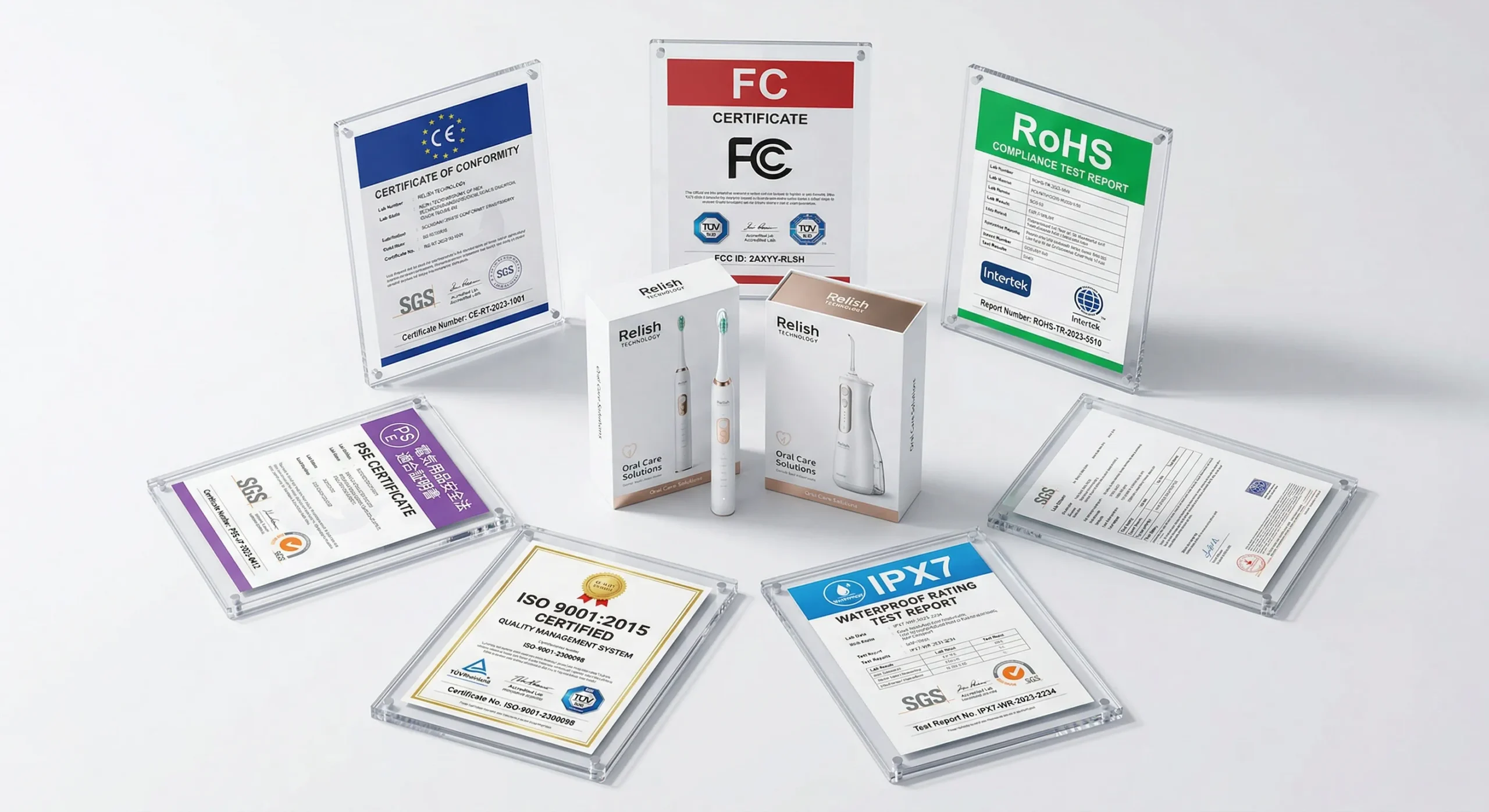
- Certifications: CE, FCC, FDA, ISO 9001, RoHS, REACH — complete testing reports available
- Client base: Trusted by globally recognized oral care brands for OEM/ODM partnerships
Learn more about Relish Tech → | View our certifications → | Client success stories →
2. Side-by-Side Comparison
The table below compares the three models across every dimension that affects your business decision.
| Dimension | OEM | ODM | OBM |
|---|---|---|---|
| Who owns the design | Brand (you) | Manufacturer | Manufacturer's brand team |
| Product uniqueness | 高 — exclusive design | 中型 — color/logo customization | 高 — proprietary brand |
| Time-to-market | 20–28 weeks (tooling + sampling) | 8–12 weeks (branding only) | 18–36+ months (brand building) |
| Typical MOQ | 2,000–5,000 units/SKU | 500–1,000 units/SKU | N/A (manufacturer's own) |
| Upfront investment | 高 — tooling $8k–$30k+ | Low — branding & packaging only | Very High — brand infra + distribution |
| IP protection | Strong — you own the molds | Limited — factory owns base design | Strong — factory owns everything |
| Quality control | Full specification control | Factory standards apply | Factory sets the standard |
| 认证 | Your responsibility (often supported by factory) | Factory usually pre-certified | Factory holds certifications |
| Margin potential | 高 — unique product commands premium | 中型 — commodity competition risk | Depends on brand equity |
| Best for | Established brands, unique features | Startups, fast market testing | Manufacturers pivoting to brand |
3. OEM Deep Dive: Pros, Cons & When to Use It
OEM is the gold standard for brands that have validated their market and are ready to invest in differentiation. You own the molds, the firmware specification, and the product design files — the factory can only produce for you. Learn more about our OEM services →
What "true OEM" looks like in oral care
For an OEM electric toothbrush project, you would typically provide: industrial design (CAD files), motor and battery specifications, brushhead design, PCB firmware requirements, and packaging specs. The factory quotes based on your BOM and manufactures to your tolerances. Certification (CE, FCC, etc.) is filed under your brand name. View our certification capabilities →
✅ OEM Advantages
- 100% exclusive product design — competitors can't replicate your exact product
- Full IP ownership — molds, tooling, and designs are yours
- Higher retail price justification (unique features, premium positioning)
- Certifications filed under your brand strengthen market presence
- Deep factory partnership — factory invested in your success
❌ OEM Disadvantages
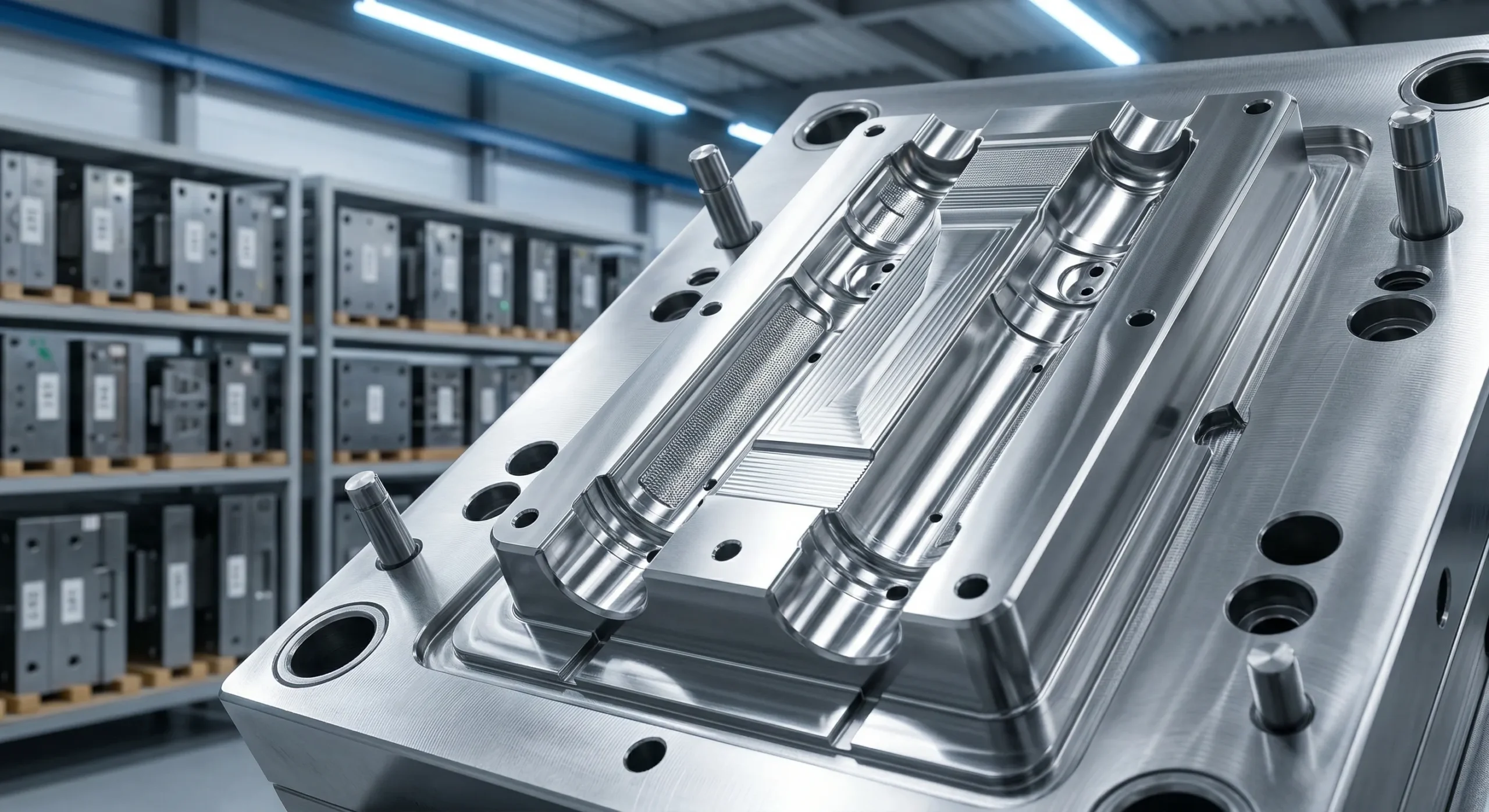
- High upfront tooling cost: $8,000–$30,000+ for injection molds alone
- Long development lead time: 20–28 weeks from design to first shipment
- High MOQ: typically 2,000–5,000 units minimum per SKU
- R&D risk — if design flops, tooling cost is sunk
- Requires experienced product team or industrial design agency
When to choose OEM
- Your brand already sells and you need a product competitors cannot copy
- You have a genuine technical innovation (new motor technology, unique brushhead geometry)
- Your target retail price is $30+ (margin supports tooling amortization)
- You're entering a high-bar market (EU/Japan) that rewards premium positioning
- You have 6+ months of runway before needing revenue from this product
4. ODM Deep Dive: Pros, Cons & When to Use It
ODM is the most underrated entry strategy for new oral care brands. The factory has already spent $50,000–$200,000 engineering and certifying a platform. You tap into that investment for a fraction of the cost, slap your brand on it, and launch in 8–12 weeks. View our private label options →
What ODM customization typically includes
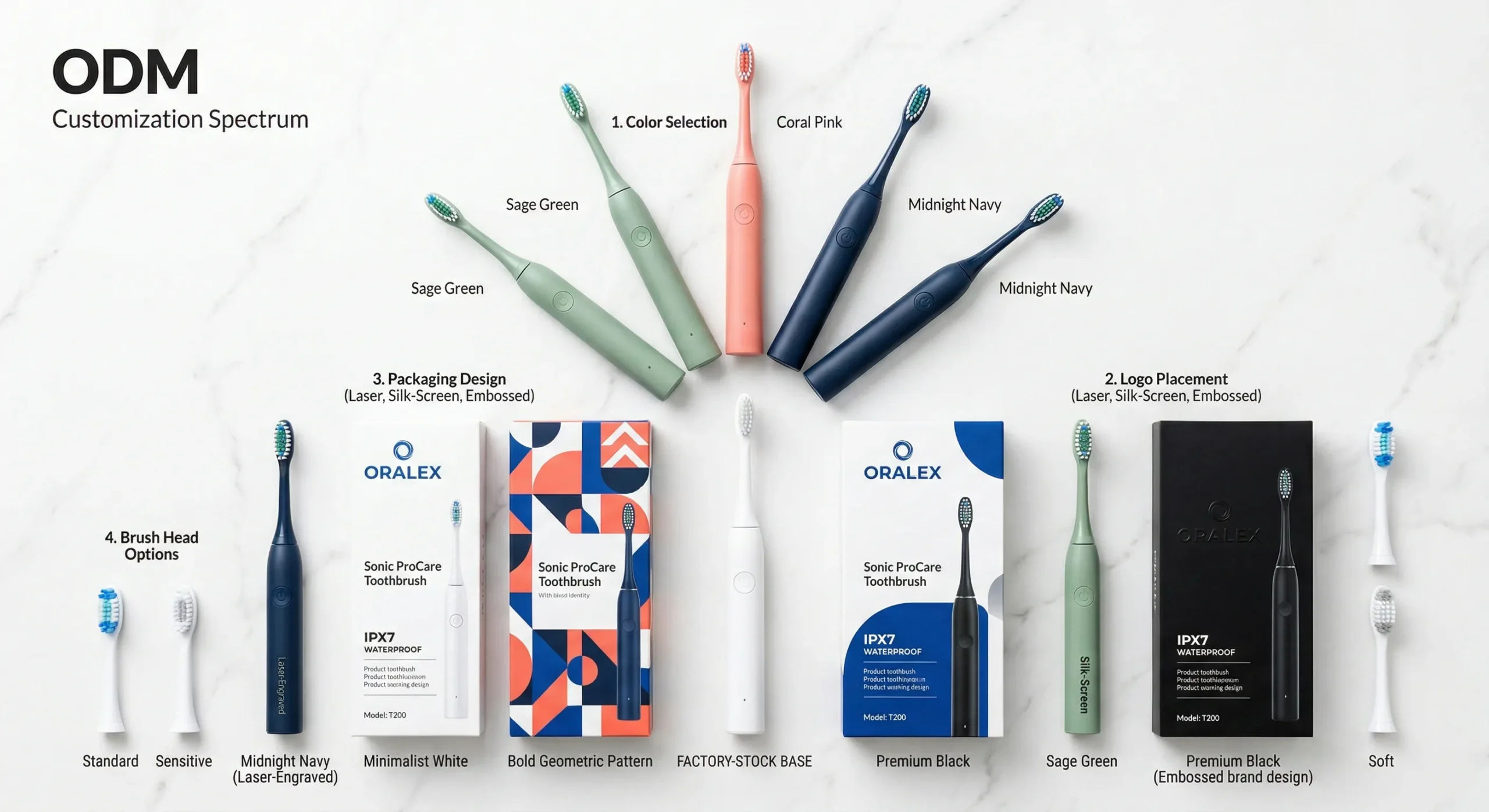
In a typical ODM arrangement, a brand can customize: exterior color and finish, logo silk-printing or laser engraving, packaging box design (full custom or sleeve), brushhead type and bristle color, and instruction manual (translated and localized). What you cannot change: the motor, internal electronics, core housing mold, and fundamental functionality.
✅ ODM Advantages
- No tooling cost — factory absorbs mold amortization
- Certifications (CE, FCC, RoHS) often already obtained by factory
- Low MOQ: 500–1,000 units makes market testing viable
- Fast time-to-market: 8–12 weeks for branding + production
- Lower working capital requirement — ideal for bootstrapped brands
- Factory QC systems already in place for the platform
❌ ODM Disadvantages
- Multiple brands may sell the same underlying product — race-to-bottom pricing risk
- No IP protection on the core product — factory can (and does) sell to competitors
- Limited differentiation — hard to command premium pricing long-term
- Dependent on factory's design roadmap for new features
- Quality floor set by factory — you can't demand higher tolerance on base design
When to choose ODM
- You're launching a new brand and need to validate demand before committing to tooling
- Your go-to-market budget is under $50,000
- You need to be in market within 3 months
- Your differentiation strategy is marketing and branding, not product engineering
- You're targeting Amazon/DTC first and need fast iteration cycles
5. OBM Deep Dive: The Manufacturer's Brand Path
OBM is less about choosing a sourcing model and more about a strategic pivot: a manufacturer decides to go direct-to-consumer under its own brand name. This is increasingly common among Chinese oral care factories as production margins get squeezed.
OBM in the oral care industry
Examples include manufacturers that built production capability for Western brands and then launched their own consumer lines — often initially in Southeast Asia or on Chinese platforms like Tmall/JD.com before expanding globally. The risk is significant: manufacturing excellence does not automatically translate to brand-building ability, and a factory's OBM launch can alienate existing OEM/ODM clients who fear the factory will now compete against them.
⚡ Note for Brands Working with OBM Manufacturers
If your factory is also an OBM — meaning they sell consumer products under their own brand — ask explicitly about IP separation, non-compete policies, and whether your custom designs are truly isolated from their brand development team. A factory without clear internal firewalls may inadvertently (or intentionally) borrow your innovations for their own brand line.
6. Which Model Is Right for You? Decision Framework
Use this decision matrix to quickly identify the right starting point based on your current situation:
Decision Matrix
7. The Typical Brand Journey: ODM → OEM → Hybrid
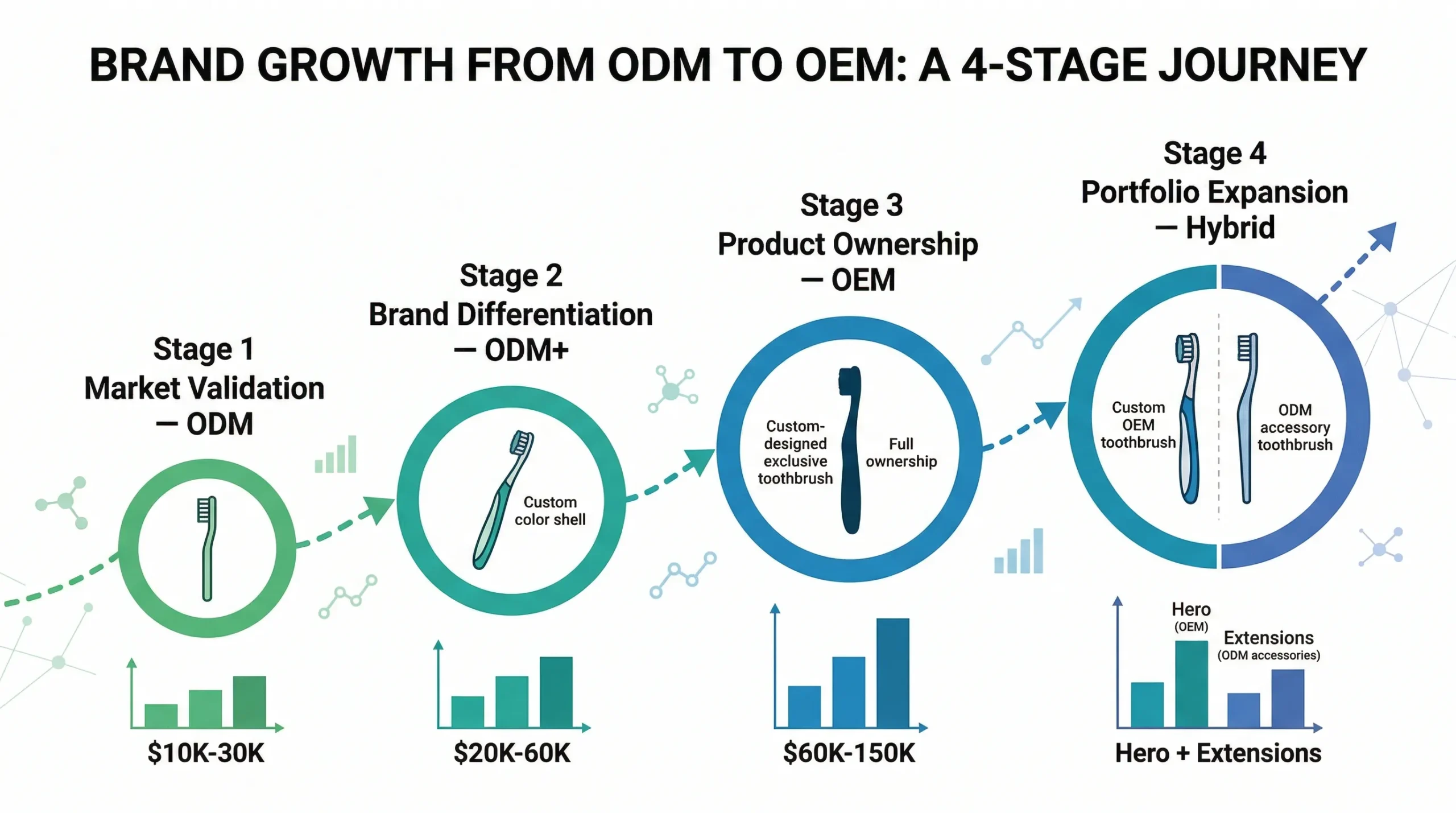
Most successful oral care brands don't pick one model and stick with it forever. The smartest strategy is to use each model at the right stage of brand maturity:
Stage 1 — Market Validation (ODM)
Launch with an ODM product. Low MOQ, fast timeline. Goal: prove the market exists, build customer feedback, reach $30K–$50K monthly revenue. Budget: $10K–$30K total.
Stage 2 — Brand Differentiation (ODM+ / Semi-OEM)
Ask your factory for exclusive colorways, custom packaging, or minor component changes that your competitors can't easily copy. Start building brand recognition. Budget: $20K–$60K.
Stage 3 — Product Ownership (OEM)
Once monthly revenue exceeds $80K–$100K, justify custom tooling for your hero SKU. Commission exclusive molds, own the design IP, build the product moat. Budget: $60K–$150K including tooling.
Stage 4 — Portfolio Expansion
Run OEM for hero products (electric toothbrush flagship), ODM for category extensions (accessories, adjacent SKUs), keeping CAPEX efficient while protecting core differentiation.
8. Why This Matters Specifically for Oral Care
The oral care manufacturing industry has a structural dynamic that makes the OEM/ODM decision particularly consequential:
High certification barrier creates ODM moat
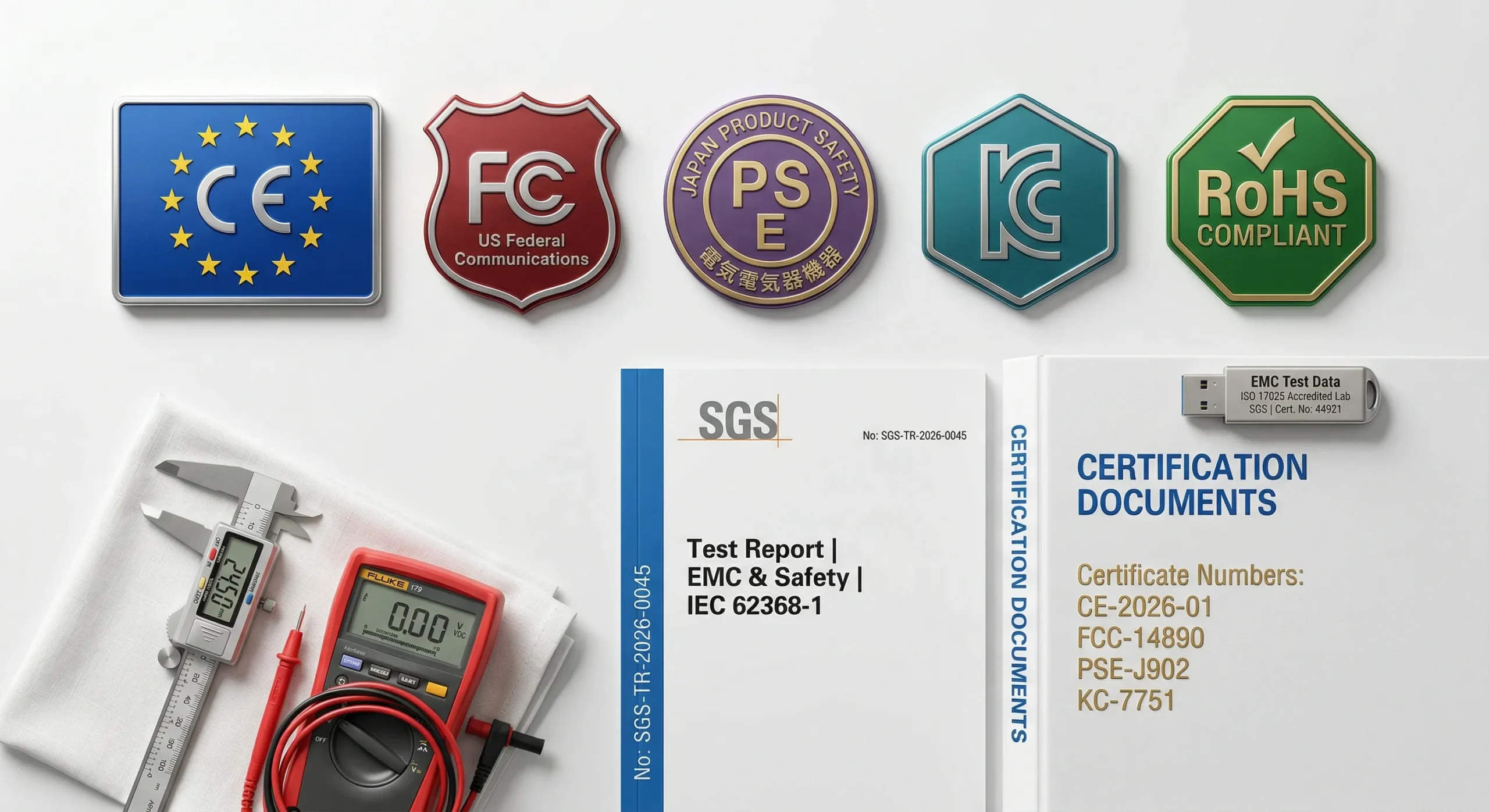
Electric toothbrushes require CE (EU), FCC (USA), PSE (Japan), KC (South Korea), EAC (Russia), and RoHS compliance. A single full certification stack costs $8,000–$25,000 and takes 3–6 months. A quality ODM factory has already paid this cost for its platform products. For a startup, this is a massive advantage of ODM over OEM — you inherit pre-certified hardware.
The "me-too" problem with ODM
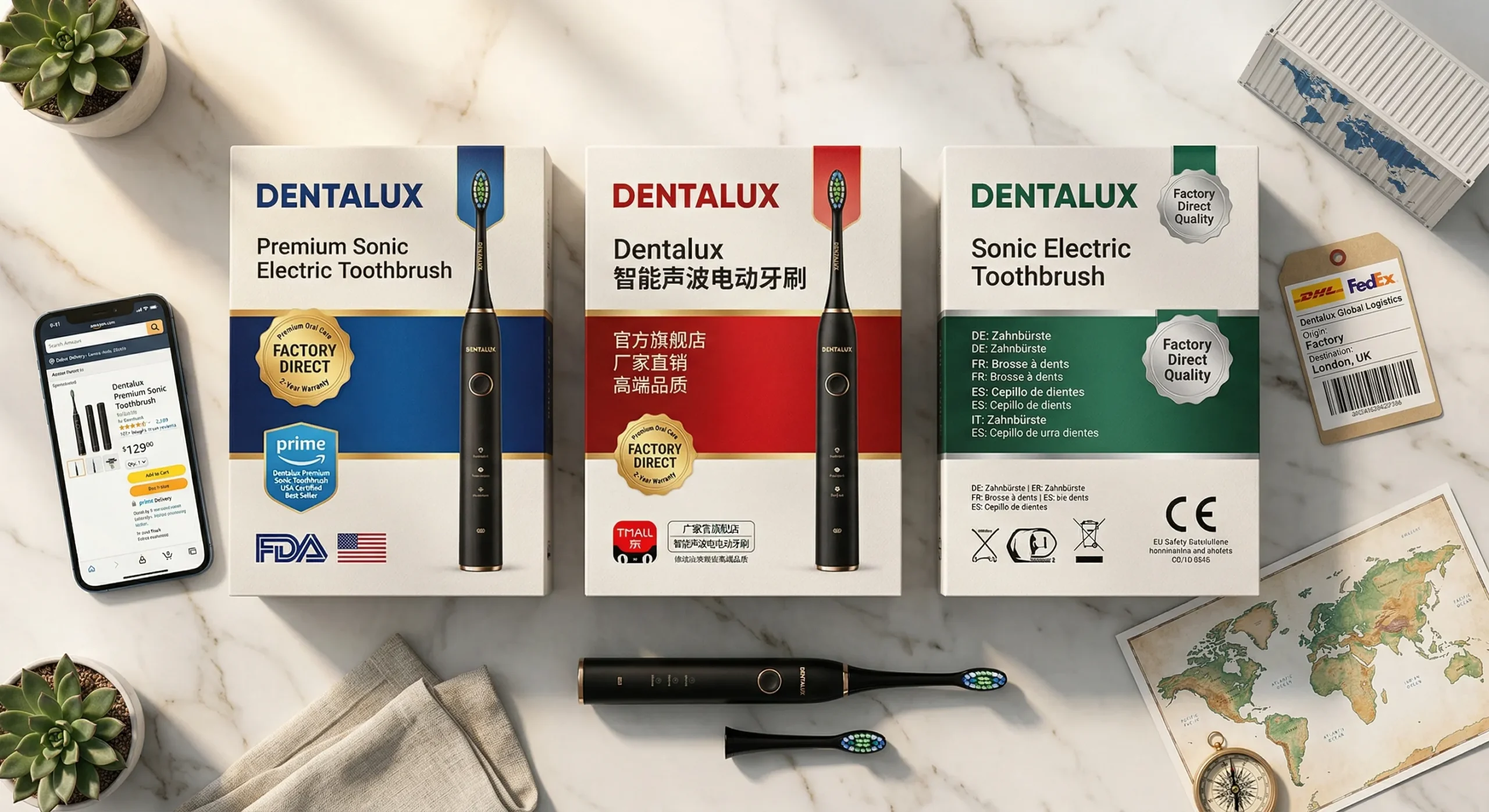
The downside: Shenzhen alone has 200+ factories offering essentially the same 3–4 sonic toothbrush platforms. If you go ODM without strong branding differentiation, you'll end up in a price war with dozens of other brands selling the same product. This is why the ODM-to-OEM journey is critical for long-term brand building.
Shenzhen's ODM ecosystem advantage
The Longhua and Longgang districts in Shenzhen have the world's most complete oral care ODM ecosystem — motor suppliers, PCB fabs, injection molders, and brush head manufacturers all within 30 minutes of each other. This means ODM products are genuinely high quality, not just "cheap alternatives" — the same supply chain feeds both ODM and OEM products at many factories.
| Oral Care Category | Recommended Starting Model | Reason |
|---|---|---|
| Sonic Electric Toothbrush | ODM first, then OEM | High certification cost — inherit from factory platform |
| Water Flosser / Irrigator | ODM (strong platform availability) | Growing category, fewer ODM competitors than toothbrush |
| Kids Electric Toothbrush | OEM (differentiation critical) | App integration, character IP, safety features require custom design |
| UV Sterilizer / Travel Set | ODM | Accessory products, low differentiation need |
| Smart AI Toothbrush | OEM mandatory | App, sensors, and AI algorithms require full custom development |
9. Frequently Asked Questions
Ready to Launch Your Oral Care Brand?
Whether you're starting with ODM or ready for a full OEM project, Relish Technology supports both models — from 500-unit private label to 50,000-unit custom OEM runs.
Get a Free Quote Read the Full OEM Guide参考资料
- [1] Straits Research. (2025). Electric Toothbrush Market Size, Share & Trends Analysis Report, 2025-2033. Retrieved from https://straitsresearch.com/report/electric-toothbrush-market. Market valuation: USD 8.70 billion (2024); Projected: USD 70.15 billion (2033); CAGR: 26.1%.
- [2] American Dental Association. (2024). Toothbrushes: Oral Health Topics. Retrieved from https://www.ada.org/resources/research/science-and-research-institute/oral-health-topics/toothbrushes. ADA recommends powered toothbrushes can be used effectively.
- [3] World Health Organization. (2024). Oral Health. Retrieved from https://www.who.int/health-topics/oral-health. WHO emphasizes oral health as critical component of overall health.