










Round Head Electric Toothbrush: What to Know Before You Buy
A round head electric toothbrush is the signature look of a rotating or oscillating brush. Unlike the elongated, rectangular head of a sonic model, a round head spins and oscillates in a small circle so it can wrap around one tooth at a time. This guide explains how a round head elektryczna szczoteczka do zębów works, how it compares to a sonic brush, and who should reach for one.
- A round head is the hallmark of a rotating or oscillating elektryczna szczoteczka do zębów, not a sonic one.
- The head spins and rocks in a small arc, so it cups each tooth and reaches into the gum line.
- Cochrane reviews found rotating heads consistently outperform manual brushes, and a later meta-analysis gave them a small extra edge over sonic heads.
- Choose a round head for precision cleaning, tight back teeth, and braces or crowded smiles.
Launching a rotating-head brush line? Explore private label options →
What Is a Round Head Electric Toothbrush?
A round head is exactly what it sounds like: a small, circular brush head instead of a long oval one. The shape is not cosmetic. A circular head is what lets a rotating elektryczna szczoteczka do zębów spin and oscillate in place, sweeping each tooth from multiple directions as the bristles pass over the crown and slip just under the gum line.
Why the Shape Matters
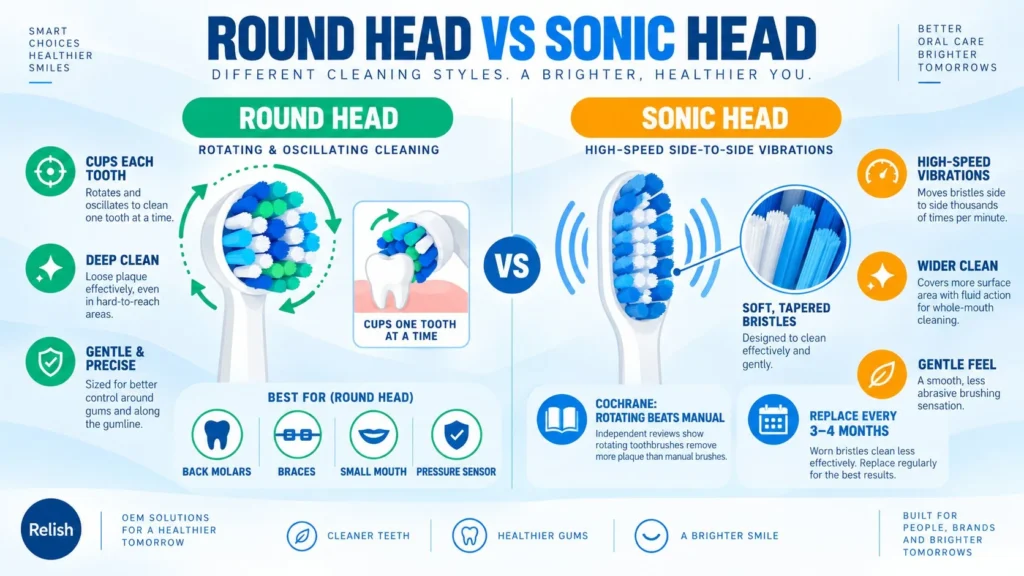
The best-known example is the oscillating rotating design, where the head rotates partway in one direction, then reverses, several thousand times a minute. Some models add a pulsing action on top of the rotation. You will also see this style described as an electric toothbrush with a spinning head, a rotating head toothbrush, or a circular toothbrush. The terms all point to the same core idea: a compact round head driven by rotation rather than a long head driven by vibration.
How a Rotating Head Cleans Differently
A sonic elektryczna szczoteczka do zębów cleans by vibrating a long head side to side at high frequency, using fluid movement to dislodge plaque beyond the tips of the bristles. A rotating head works by direct mechanical contact instead. The round head stays small, so it can sit fully over a single tooth, and its rotation sweeps the bristles across the whole surface in a short, controlled arc.
That precision is the main practical advantage. A round head reaches the back molars and the inside surfaces of the teeth more easily than a long head, which is why many people with a small mouth or tight teeth prefer the rotating style. The American Dental Association (ADA) frames electric brushing as an effective alternative to manual brushing, and the rotating head is one of the most studied designs in that category.
A rotating head is a motor problem before it is a bristle problem, and that is where the engineering sits. In the Relish range the round head is driven by an industrial-grade servo motor, with the platform running to 31,000 VPM, and every unit passes a motor-frequency-consistency check on the line so the arc stays even brushing after brushing.
Round Head vs. Sonic: The Key Differences
Both types of powered brush remove plaque well, but they go about it in different ways. Here is a side by side look at the two common head designs.
For a deeper technical comparison of the two mechanisms, see our guide to sonic versus oscillating rotating electric toothbrushes. If you want to understand the motor and vibration behind each type, our explainer on jak działają elektryczne szczoteczki do zębów covers the internals.
Is a Rotating Toothbrush Better?
This is the question most shoppers actually type, and the honest answer is that the evidence gives the rotating head a small but real edge. The independent Cochrane Collaboration reviewed decades of clinical trials and concluded that only powered brushes with rotation oscillation action consistently removed more plaque and reduced gingivitis than manual brushing. Other powered designs, including early sonic brushes, did not show a consistent advantage over a manual brush in those reviews.
How Rotating Compares With Sonic
A later systematic review and meta-analysis in the Journal of the American Dental Association compared rotating heads directly against other powered heads, including sonic designs. It found a modest advantage for the rotating head in plaque reduction and in the number of bleeding sites, but the difference was statistically significant rather than clearly noticeable in daily use (Clark-Perry & Levin, 2020). The takeaway, as summarized in a narrative review of powered toothbrush design, is that the rotating head has the strongest evidence base, while the real-world difference between a well-used rotating brush and a well-used sonic brush is small.
Who Should Choose a Round Head Electric Toothbrush
A round head is not automatically better for everyone, but it suits several situations especially well:
Where a Round Head Has the Edge
- Small mouths and tight teeth. The compact head reaches back molars and crowded areas that a long head struggles with.
- Braces and orthodontics. The small circular head maneuvers around brackets and wires more easily.
- Precise, tooth by tooth cleaning. The head cups a single tooth at a time, which many users find gives a more thorough feel.
- People who press too hard. Many rotating brushes include pressure sensors, and the focused head encourages a slower, more deliberate technique.
If you have sensitive teeth or gums, either head style can work provided you pick a soft brush head and a brush with a gentle mode. For guidance on that, read our piece on electric toothbrushes for sensitive teeth.
How Long a Round Head Lasts
The replacement schedule is the same as any other brush head: swap it every three to four months, or sooner if the bristles look frayed or faded. A round head tends to show wear at the outer edge of the circle first. Our article on how often to change a toothbrush head walks through the signs, and the guide on how to clean an electric toothbrush head covers keeping it hygienic between changes.
For Brands: Rotating Heads in the OEM Lineup
For OEM and private-label buyers, the round head is a distinct product decision, not a styling detail. A rotating head needs a different motor and transmission than a sonic brush, and it positions your SKU against a clear competitor set. The search demand around terms like “round head electric toothbrush” and “rotating head toothbrush” is a signal that shoppers know what they want and are comparing options.
- Match the motor to the head. A round head only makes sense on a rotating or oscillating drive. Verify the motion and torque during quality control.
- Lead with the precision angle. “Wraps each tooth” and “reaches back molars” are the claims that resonate with round head buyers.
- Offer replacement head variety. Soft, sensitive, and orthodontic head options extend the lifetime value of a single handle.
- Position against sonic. Use the round versus sonic comparison to help retailers and buyers understand where your brush sits.
On commercial terms, the standard MOQ for customized products, including private-label replacement heads, is 1,000 units; smaller orders may be discussed case by case. Prototype samples are ready in 3–7 days and mass production runs 25–35 days after you approve the sample. The factory is ISO 9001 and ISO 13485 certified with FDA establishment registration, and can supply CE, RoHS, and FCC documentation for your destination market.
The motion a round head delivers is verified before any unit leaves the line. Our own reliability laboratory, which has logged more than 450 test items over nine months, runs a motor-frequency and oscillation-consistency check on every handle, a 72-hour full-unit life test, a one-metre drop onto six faces per GB/T 2423.7-2008, 48-hour salt spray per GB/T 2423.17-2008, and a temperature and humidity cycle from -20 °C to 60 °C at 80 % RH. Tuft retention on the matching heads is pulled to at least 1.5 kgf per tuft and at least 50 N on the bristle plate, per GB 39669-2020. Reports are available on request.
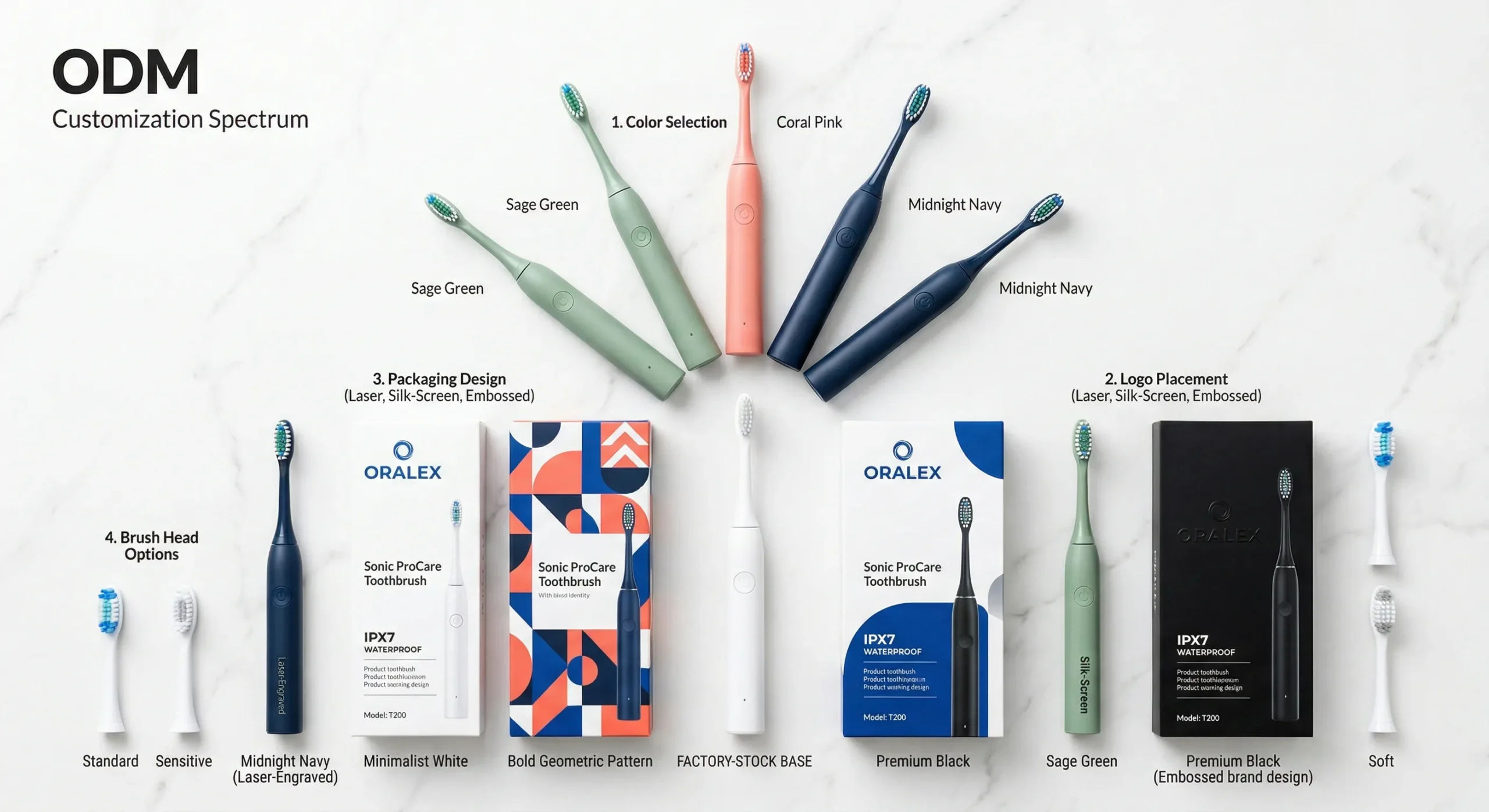
Customization options. The round head is a platform, not a single mould. Head geometry, bristles, motor tuning, and finish can each be re-specified for a buyer’s brand once volume and tooling are agreed, so the table below is a starting point rather than a limit.
Relish Tech manufactures rotating and sonic elektryczne szczoteczki do zębów for OEM/ODM and private-label brands, with matching round replacement heads and full compatibility testing. Browse the electric toothbrush catalog to see current rotating head options.
Need a rotating-head brush for your catalog? Contact Relish Tech →
Często zadawane pytania
What is a round head electric toothbrush?
Is a rotating toothbrush better than a sonic toothbrush?
Are round brush heads better for reaching back teeth?
Who should use a rotating head electric toothbrush?
How often should I change a round brush head?
Can I use a round head on sensitive teeth?
Relish Tech supplies OEM/ODM elektryczne szczoteczki do zębów with round rotating heads and matching replacement heads, fully compatibility tested. Open the cyfrowy katalog produktów, or request a spec sheet and a sample brush to evaluate.
Head design guidance compiled from Cochrane systematic reviews and manufacturer technical references. Not a substitute for professional dental advice.
Referencje
- American Dental Association. (n.d.). Szczoteczki. Retrieved from https://www.ada.org/resources/ada-library/oral-health-topics/toothbrushes
- Heanue, M., Deacon, S. A., Deery, C., Robinson, P. G., Walmsley, A. D., Worthington, H. V., & Shaw, W. C. (2003). Manual versus powered toothbrushing for oral health. Cochrane Database of Systematic Reviews, (1), CD002281.
- Ng, C., Tsoi, J. K. H., Lo, E. C. M., & Matinlinna, J. P. (2020). Safety and design aspects of powered toothbrush—A narrative review. Dentistry Journal, 8(1), Article 15. https://doi.org/10.3390/dj8010015
- Clark-Perry, D., & Levin, L. (2020). Systematic review and meta-analysis of randomized controlled studies comparing oscillating-rotating and other powered toothbrushes. Journal of the American Dental Association, 151(4), 265–275. https://doi.org/10.1016/j.adaj.2019.12.012