









How Often to Change a Toothbrush Head?
How often should you change your toothbrush head? The short answer from dental professionals is simple: every three to four months, or sooner if the bristles look worn. Whether you use a manual brush or an electric toothbrush, the rule stays the same. Changing your toothbrush head on schedule protects your gums and directly affects how well your brush removes plaque.
- Replace your toothbrush head every 3-4 miesiące (American Dental Association guideline).
- Replace it earlier if the bristles are frayed, flattened, or faded.
- After an ordinary cold or flu, a new head is usually optional; replace a worn, shared, or contaminated head, or follow your dental professional’s advice for a specific condition.
- Electric and manual toothbrushes follow the same schedule.
Looking for replacement heads that fit your brand? Explore OEM options →
How Often to Change a Toothbrush Head: The Short Answer
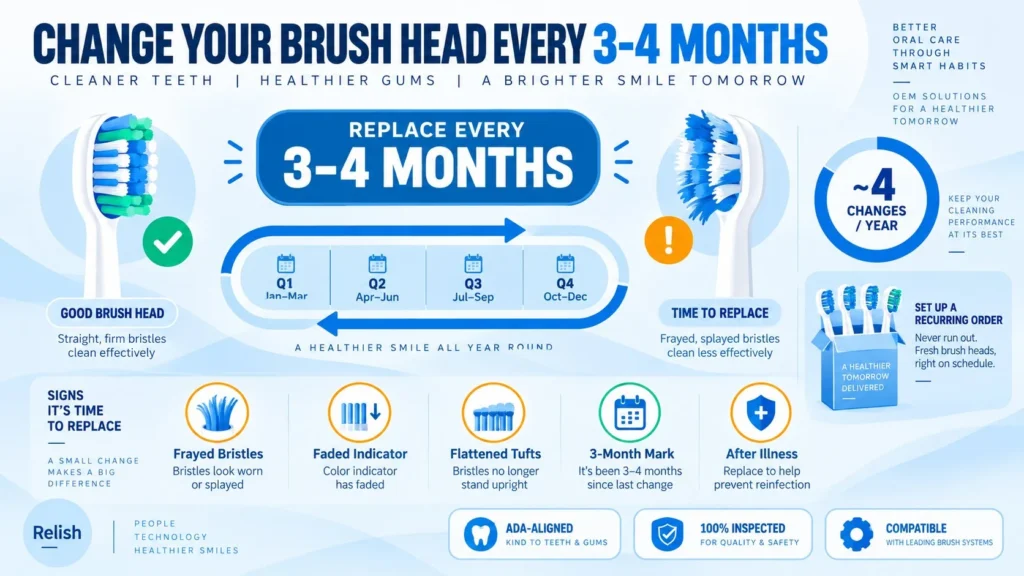
The American Dental Association (ADA) recommends replacing your toothbrush, or your electric toothbrush head, every three to four months, and sooner if the bristles show visible wear. That works out to roughly four replacements a year. An easy way to remember: change your toothbrush head at the start of each new season.
Why three to four months, specifically? It is the point at which most bristles begin to lose their original shape and stiffness. Once that happens, a brush head stops cleaning effectively, even if it still looks “fine” at a glance. Sticking to a simple toothbrush head replacement schedule removes the guesswork.
One limit is worth setting expectations about: even a perfect brush head only cleans the surfaces it touches. The gap under a fixed bridge or around an implant stays out of reach of bristles no matter how new the head is, so it calls for a water flosser instead. Our guide to a water flosser for bridges explains how to clean that space safely.
Why the 3–4 Month Rule Exists
There are three real reasons this schedule matters, and each one affects your oral health.
Worn Bristles Clean Less Effectively
Toothbrush bristles are engineered with specific stiffness and tip design to sweep plaque from the gum line and between teeth. After months of daily use (often twice a day), the bristles bend, fray, and splay outward. The ADA notes that as bristles wear, they become less effective at cleaning teeth, leaving more plaque along the gum line.
Bacteria Accumulate Over Time
Even with thorough rinsing, a toothbrush head retains moisture and microscopic debris. Over weeks and months, bacteria, fungi, and food particles can build up in the bristle bed. Replacing the toothbrush head regularly limits how long these microbes stay close to your gums.
Worn Bristles Can Irritate Gums
Frayed, splayed bristles clean worse and can also poke and irritate gum tissue. For people with sensitive gums or gum recession, a fresh toothbrush head with intact, rounded bristle tips is gentler and safer, which is the same reason we recommend an szczoteczka elektryczna do wrażliwych zębów. If brushing starts to cause twinges, check whether electric toothbrushes can cause tooth sensitivity before you blame the brush.
5 Signs It’s Time to Change Your Toothbrush Head
Do not wait for the calendar alone. Watch for these five signs that tell you when to change your toothbrush head:
- Frayed or splayed bristles: bristles that flare outward instead of standing straight.
- Faded indicator bristles: many electric brush heads have color-fading indicator bristles; when the color fades, it is time to change.
- Flattened or matted bristles: bristles that have lost their spring and lie flat no longer reach into grooves.
- Three to four months have passed: even if the brush looks fine, replace it on schedule.
- A shared or contaminated head: replace a head that was shared or visibly contaminated. An ordinary cold or flu alone does not usually require a new head to prevent reinfection.
The Cleveland Clinic discusses replacement after illness, while the Amerykańskie Stowarzyszenie Stomatologiczne notes that most healthy people are unlikely to reinfect themselves from their own brush after an ordinary cold or flu. Replace a shared or contaminated head, and always replace one with damaged or frayed bristles.
Electric vs. Manual: Does the Rule Change?
No: the 3–4 month rule applies to both, and electric toothbrush heads last about three to four months with normal use. (For a full breakdown, see our electric versus manual toothbrush guide.) However, there are a few electric-specific points worth knowing when deciding how often to change your toothbrush head:
- Vibration can wear bristles faster. Electric brushes move bristles at thousands of strokes per minute, which can accelerate bristle fatigue; learn why in our guide to jak działają elektryczne szczoteczki do zębów. For sonic toothbrush heads, check for wear at the two-month mark and be ready to replace earlier if needed. On a rotating head, wear tends to show first at the outer edge of the circle, as we explain in our guide to the round head electric toothbrush.
- Indicator bristles help. Many electric toothbrush head models use fading indicator bristles that turn pale when the head is due for replacement, a built-in reminder.
- Replacement heads matter. For an electric toothbrush to work as designed, the replacement head must match the model. Using the wrong head can reduce performance and strain the brush handle.
How to Make Your Brush Head Last Longer
You cannot extend the 3–4 month schedule indefinitely, but good care keeps your toothbrush head effective for its full lifespan:
- Rinse thoroughly after every use to remove toothpaste and debris, and follow our guide to how to clean an electric toothbrush head for the weekly deep clean.
- Store upright and allow to air-dry. Do not trap a wet toothbrush head in a sealed case or cover.
- Do not share brush heads, and keep heads from touching each other in storage.
- Avoid pressing too hard, since firm pressure flattens bristles faster.
- Use a ventilated travel cover when on the go, and dry the head before packing.
For Brands: Turn Brush Head Replacement Into a Retention Strategy
If you sell electric toothbrushes or are developing a private-label oral care line, knowing how often to change a toothbrush head is more than a hygiene topic. It is a recurring-revenue and customer-retention opportunity:
- Educate customers with this exact guidance; buyers who understand replacement schedules are more likely to reorder.
- Offer subscription or multi-pack replacement heads to lock in repeat purchases.
- Use indicator bristles as a visible, built-in reminder that drives timely reorders.
- State head compatibility clearly so customers can find the right replacement without friction.
The heads we build use DuPont 5-mil nylon or silicone bristles and offer colour-fading indicator options, so a shopper gets a visual cue before the calendar alone forces the issue. The food-contact materials are covered by an LFGB report, and every head is inspected 100 percent before it is packed.
On commercial terms, the standard MOQ for customized products, including replacement heads, is 1,000 units; smaller orders may be discussed case by case, samples ship in 3–7 days, and mass production runs 25–35 days after approval. The factory is ISO 9001 and ISO 13485 certified with FDA establishment registration, and supplies CE, RoHS, and FCC documentation for your market.
The heads we build are tested to hold up across that 3–4 month window. Our own reliability laboratory has logged more than 450 test items over nine months; for replacement heads the relevant ones are tuft retention (each tuft pulled to at least 1.5 kgf, the bristle plate to at least 50 N, per GB 39669-2020), 72-hour immersion in tap water, toothpaste slurry, and mouthwash, and abrasion testing of both the bristle and the printed markings. Every head is inspected 100 percent before packing, and production follows a documented control plan that fixes tuft layout, bristle height, and the 0.3–0.9 mm head-to-handle fit. Reports are available on request.
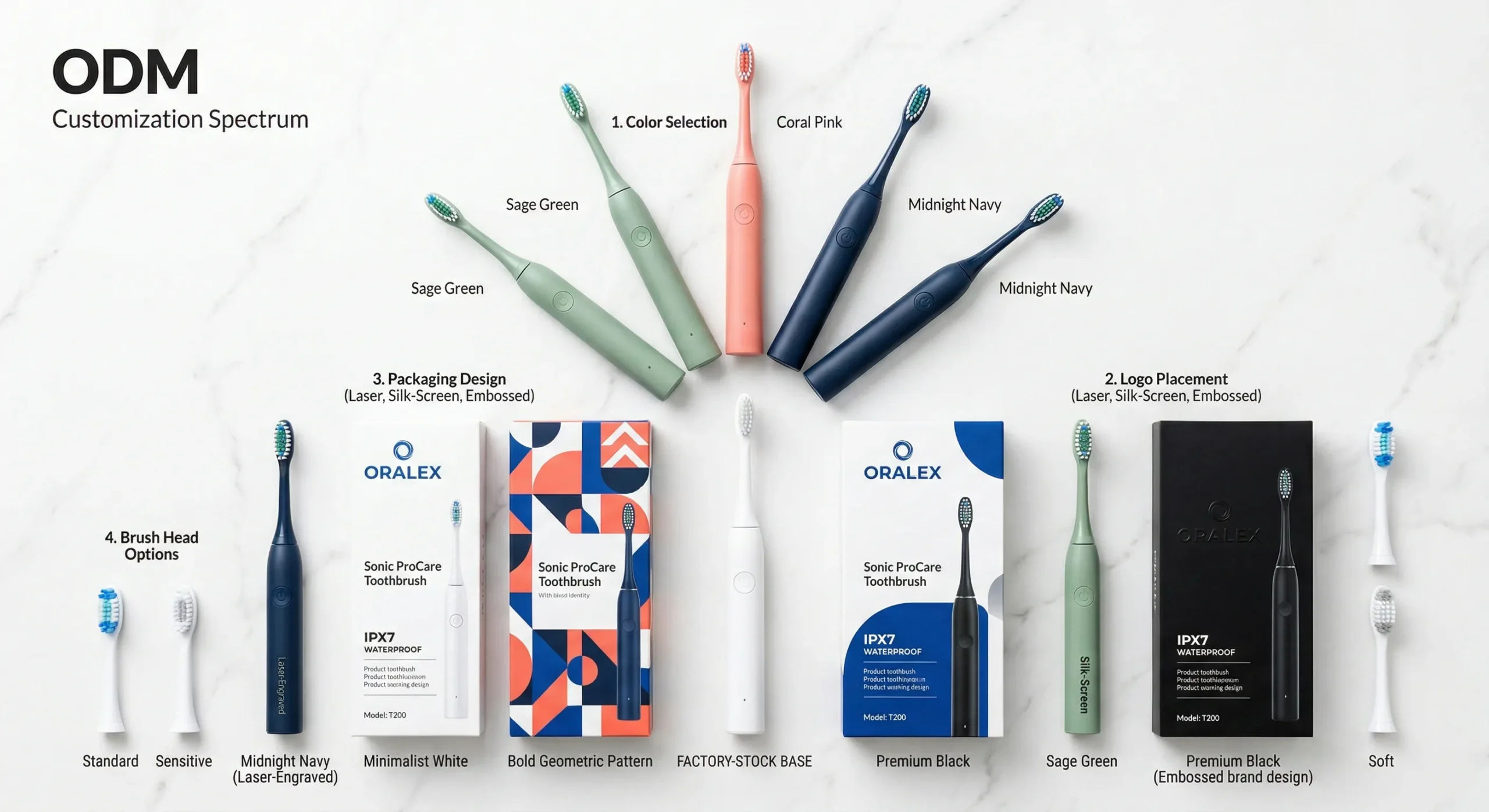
Customization options. A replacement-head program is where a brand earns repeat revenue, and every part of it is configurable. Once volume and tooling are agreed, the indicator, bristles, pack sizes, and packaging can be set to your specification, so the table below is a starting point rather than a limit.
Relish Tech manufactures electric toothbrushes and compatible replacement heads for OEM/ODM and private-label brands, with compatibility-tested heads, customizable indicator bristles, and reliable turnaround on repeat orders.
Need compatible heads for your oral care line? Contact Relish Tech →
Często zadawane pytania
How often should I change my toothbrush head if I’ve been sick?
Do electric toothbrush heads wear out faster than manual brushes?
What happens if I don’t change my toothbrush head?
How do I know when to replace my electric toothbrush head?
Can I reuse a toothbrush head after cleaning it?
How do I dispose of used electric toothbrush heads?
Relish Tech supplies OEM/ODM electric toothbrushes and replacement heads with customizable indicator bristles and full compatibility testing. Open the cyfrowy katalog produktów, or request a spec sheet and a sample head to evaluate.
Oral care guidance compiled from ADA recommendations and dental hygiene best practice. Not a substitute for professional dental advice.
Referencje
- American Dental Association. (n.d.). Szczoteczki. Retrieved from https://www.ada.org/resources/ada-library/oral-health-topics/toothbrushes
- American Dental Association. (n.d.). Cold and flu season. MouthHealthy. Retrieved from https://www.mouthhealthy.org/all-topics-a-z/cold-and-flu-season
- Cleveland Clinic. (2025). How often should you change your toothbrush?. Retrieved from https://health.clevelandclinic.org/how-often-should-you-change-your-toothbrush
- Conforti, N. J., Cordero, R. E., Liebman, J., Bowman, J. P., Putt, M. S., Kuebler, D. S., Davidson, K. R., Cugini, M., & Warren, P. R. (2003). An investigation into the effect of three months’ clinical wear on toothbrush efficacy: Results from two independent studies. Journal of Clinical Dentistry, 14(2), 29–33.